Cardiovascular disease is the main cause of death in patients with end-stage renal disease since childhood.Reference Groothoff, Gruppen and Offringa 1 Left ventricular hypertrophy is an adaptive response to chronic pressure and volume overload, as occurs in end-stage renal disease. Chronic overload in combination with metabolic, electrolytic, and hormonal changes leads to maladaptive left ventricular hypertrophy characterised by structural changes in the myocardium and diastolic dysfunction.Reference Dyadyk, Bagriy and Yarovaya 2
Early detection of cardiovascular disease in children with end-stage renal disease would therefore give an opportunity for targeted intervention in patients at higher risk in order to prevent cardiovascular morbidity and mortality in early adulthood. As a consequence, conventional echocardiography of the heart is currently recommended in children with end-stage renal disease as the method of choice for early detection of cardiac disease.Reference Chavers, Solid and Sinaiko 3 However, reports on the reproducibility and validity of this assessment in children are scarce. In an earlier study of the same cohort, we found conventional echocardiography to be insufficiently sensitive and accurate for a reliable diagnosis of left ventricular hypertrophy.Reference Schoenmaker, van der Lee and Groothoff 4 Tissue Doppler imaging appears to be a promising method for the detection and quantification of subtle abnormalities in diastolic ventricle function in adults.Reference Ommen, Nishimura and Appleton 5 In order to investigate whether this method would also be useful in children with end-stage renal disease, we compared the accuracy of two echocardiographic techniques, that is, conventional echocardiography and tissue Doppler imaging, to detect impairment of left ventricular diastolic function. The aims of this study were to compare the prevalence of diastolic dysfunction in children on renal replacement therapy and healthy children using conventional echocardiography and tissue Doppler imaging; to assess the intra-observer reproducibility of both types of measurement; and to identify potential treatment-related risk factors of diastolic dysfunction in children with end-stage renal disease.
Material and methods
Participants
All children, 0–19 years, who were treated with chronic renal replacement therapy in the Emma Children's Hospital AMC Amsterdam (The Netherlands) or the University Hospital Leuven (Belgium) between 1 October 2007 and 1 January 2012 were included. Children with congenital heart disease were excluded from the study. These two centres are involved in the Renal Insufficiency Therapy in Children: Quality Assessment and Improvement project, in which all Dutch and Belgian centres that provide paediatric renal replacement therapy collaborate to improve the quality of care.Reference Tromp, van der Lee and Offringa 6 We obtained ethical approval from the ethical institutional review boards of all participating hospitals and written informed consent from the parents of all participants and the participants themselves, if possible. The authors of this manuscript have certified that they comply with the Principles of Ethical Publishing in the International Journal of Cardiology.Reference Coats and Shewan 7
In this study, we reviewed 38 echocardiograms of patients included in RICH-Q in the two selected hospitals and 76 echocardiograms of healthy control subjects from one of the centres off-line. Controls were selected from healthy Dutch children without any medical history, evaluated at the cardiology department for a benign murmur, a positive family history for structural cardiac abnormalities or miscellaneous complaints that proved to be non-cardiac. The two groups were matched for body surface area or, if height was not known, as was the case in nine healthy children, for weight.
Echocardiographic measurements
Vivid 7 (GE Medical System, Wauwatosa, WI, United States of America) device equipped with Tissue Doppler imaging technology was used for the standard and pulsed tissue Doppler echocardiograms. The echocardiograms were made by paediatric cardiologists in the two centres between 2008 and 2011. The two-dimensional directed M-mode echocardiograms were performed according to the Guidelines and standards for performance of a paediatric echocardiogram of the American Society of Echocardiography.Reference Lai, Geva and Shirali 8 Digital images were stored and analysed off-line, using EchoPac 108.1.5 (GE Medical System), by one independent paediatric cardiologist with more than 15 years of experience. Conventional parameters included: interventricular septum thickness in diastole (IVSd; mm), left ventricular posterior wall thickness in diastole (LVPWd; mm), left ventricular end-diastolic diameter (LVEDd), early mitral valve ventricular filling velocity (E; ms), late (atrial) ventricular filling velocity (a; ms), and E-wave deceleration time (ms). Tissue Doppler imaging parameter peak early diastolic annular velocity (E′) was obtained at the cardiac base in the apical four-chamber orientation from two locations: the lateral mitral annulus of the left ventricle and the interventricular septum. Each variable was measured three times and the mean was calculated. Diastolic dysfunction is characterised by impaired relaxation of the left ventricle, which results in a decrease of the E/a ratio in conventional echocardiography because of an increased late filling (a) phase of end-diastolic volume relative to early filling (E). Diastolic dysfunction was defined as E/a ratio <1.0.Reference Satpathy, Mishra, Satpathy, Satpathy and Barone 9 In tissue Doppler imaging, an impaired left ventricular relaxation and reduced elastic recoil will lead to a reduced flow propagation to the apex, and a relative reduction of E′.Reference Gaasch and Little 10 Diastolic dysfunction as measured by tissue Doppler imaging (DDTDI) was defined as either septal or mitral E/E′ ratio (i.e. E divided by IVS E′ or by LV E′, respectively) >95th percentile for age.Reference Eidem, McMahon and Cohen 11 Left ventricular mass was calculated using the following equation: LV mass (grams) = 0.8 (1.04 ([LVEDd + IVSd + LVPWd]3 − [LVEDd]3)) + 0.6 g.Reference Devereux, Alonso and Lutas 12 To account for body size, the left ventricle mass index was calculated by dividing left ventricle mass by height raised to the power of 2.7 (g/m2.7). Severe left ventricular hypertrophy was defined as left ventricle mass index >51 g/m2.7.Reference de Simone, Devereux, Daniels, Koren, Meyer and Laragh 13
All statistical analyses were performed using SPSS 18.0 for Windows. Values are presented as mean ± SD unless stated otherwise. An independent samples t-test or Mann–Whitney U test was used to compare the means of continuous variables when appropriate. Categorical values were compared using the χ2-test or Fisher's exact test, where indicated. Parameters related to diastolic function, that is, E/a ratio and E/E′ ratios, were analysed for both end-stage renal disease and control group using multiple linear regression analysis to adjust for confounding. Potential confounders were age, gender, and weight. If the regression coefficient of the central determinant “end-stage renal disease” changed >10% after addition of a particular determinant to the regression model, this determinant was considered to be a confounder and was kept in the final model.
Intra-observer reproducibility
To assess the intra-observer reproducibility of the diastolic function measurements by tissue Doppler imaging and conventional echocardiography, the paediatric cardiologist re-assessed 25 echocardiograms off-line, 10 from end-stage renal disease patients and 15 from healthy controls, in a randomly different order after a period of at least 2 weeks to preclude recollection. To assess intra-observer reproducibility, we calculated the coefficient of variation as the ratio of the standard deviation of the differences of the repeated measurements to the mean of all measurements in all individuals (grand mean). The coefficient of variation gives an indication of the measurement error as a percentage of the mean value in the study population.
Potential determinants of diastolic dysfunction
Data registered in the RICH-Q project were used for the analysis of possible renal replacement therapy-related determinants of diastolic dysfunction. Data were collected from the medical records of the patients by trained local research nurses or by the participating paediatric nephrologists. The following data were used: duration of renal replacement therapy (years); current renal replacement therapy modality; primary cause of end-stage renal disease – acute or chronic onset; cardiovascular indicators, for example, hypertension, calcium-phosphate metabolism, anaemia, and intact parathyroid hormone; and left ventricle mass index and left ventricular hypertrophy. For the plasma concentrations and blood pressure measurements, we used the mean of all available values of one year preceding the date of the echocardiogram. Hypertension was defined as either a systolic or diastolic blood pressure >p95 of the Task Force Report normal values corrected for age, gender, and height. 14 Primary causes of end-stage renal disease were classified into two categories: acute – for example, dense deposit disease, haemolytic uraemic syndrome, tubular necrosis, tumour and nephrotic syndrome; and chronic onset, for example urine tract malformation, chronic renal failure, renal vascular disease, congenital diseases. Logistic regression analysis was performed to investigate the association of these risk factors with DDTDI (mitral E/E′ >95th percentile for age). Predicting factors were entered into a multivariable model one at a time in a preset order to maximise the explained variance.
Results
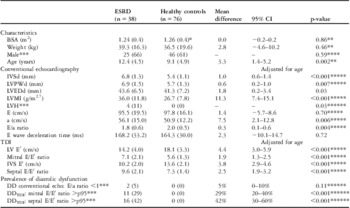
The children's characteristics and results of the echocardiographic measurements are shown in Table 1. At the time of the echocardiogram, 11 children with end-stage renal disease were treated with haemodialysis, eight with peritoneal dialysis, and 19 children underwent transplantation. The children with end-stage renal disease were significantly older than their healthy controls, matched for body surface area or weight, the mean difference [95% confidence interval (CI)] being 3.3 [1.4–5.2] years (p = 0.002).
Characteristics of the study population and results of measurements of conventional echocardiography and TDI.

a = late ventricular filling velocity; BSA = body surface area; CI = confidence interval; DD = diastolic dysfunction; DDTDI = diastolic dysfunction as measured by tissue Doppler imaging; E′ = peak early diastolic annular velocity; E = early mitral valve ventricular filling velocity; ESRD = end-stage renal disease; IVS = interventricular septum; IVSd = diastolic intraventricular septum thickness; LV = left ventricle; LVEDd = left ventricular end-diastolic diameter; LVH = left ventricular hypertrophy; LVMI = left ventricle mass index; LVPWd = diastolic left ventricular posterior wall thickness; TDI = tissue Doppler imaging
Data are presented as mean (SD)
*BSA and therefore LVMI is missing in 9 healthy controls
**Independent samples t-test
***Data are presented as n (%)
****χ2-test
*****Adjusted for age by linear regression analysis
******Fisher's exact test
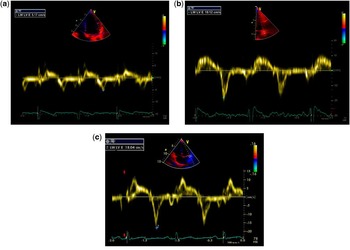
After adjustment for age, children with end-stage renal disease had a larger mean interventricular septum thickness in diastole (mm) and left ventricular posterior wall thickness in diastole (mm). Severe left ventricular hypertrophy was diagnosed in four of the 38 children with end-stage renal disease (11%) and in none of the controls (p = 0.03). Children with end-stage renal disease had a lower E/a ratio compared with control subjects (mean difference [95% CI]); 0.3 [0.1–0.6], p = 0.004). Diastolic dysfunction was diagnosed in two children (5%) with end-stage renal disease according to the E/a ratio (p = 0.11). Children with end-stage renal disease had a lower mean value of E′ of both the mitral annulus of the left ventricle (LV E′) and the interventricular septum (IVS E′), and consequently a higher mitral and septal E/E′ ratio than the controls (both p < 0.001). According to the mitral and septal E/E′ ratio, 11 (29%) and 16 (42%) children with end-stage renal disease, respectively, and none of the controls were diagnosed with diastolic dysfunction measured by Tissue Doppler imaging (DDTDI, both p < 0.001. In 10 children with end-stage renal disease, both septal and mitral E/E′ ratios were >95th percentile for age. In six children, only the septal E/E′ratio was >95th percentile for age, and in one child only the mitral E/E′ ratio was >95th percentile for age. From the 11 children diagnosed with DDTDI according to the mitral E/E′ratio, only two children had severe left ventricular hypertrophy. Figure 1 shows three examples of mitral E′ measurements in (a) children with end-stage renal disease and diastolic dysfunction, (b) children with end-stage renal disease without diastolic dysfunction, and (c) healthy controls.
Examples of E′ = peak early diastolic annular velocity in tissue Doppler images of the mitral annulus from ( a ) a child with ESRD and diastolic dysfunction, ( b ) a child with ESRD without diastolic dysfunction, and ( c ) a healthy control. ESRD = end-stage renal disease.

Intra-observer reproducibility
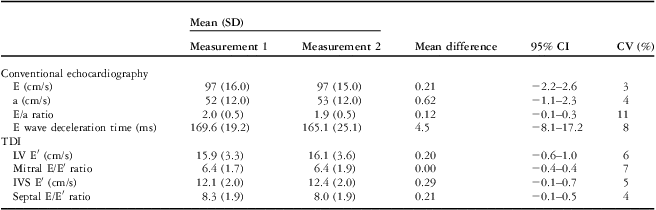
The results of the intra-observer reproducibility are shown in Table 2. There were no significant differences between the repeated measurements for the conventional measurement (E, a, E/a ratio, and E-wave deceleration time) or for the tissue Doppler imaging measurements (IVS E′, LV E′, mitral, and septal E/E′ ratio). The coefficients of variation of the mitral and septal E/E′ ratio, 7% and 4%, respectively, were smaller than the coefficient of variation of the E/a ratio (11%).
Intra-observer reproducibility (n = 25).

a = late ventricular filling velocity; CI = confidence interval; CV = coefficient of variation; E′ = peak early diastolic annular velocity; E = early mitral valve ventricular filling velocity; IVS = interventricular septum; LV = left ventricle; Mitral E/E′ ratio = E divided by LV E′; SD = standard deviation; septal E/E′ ratio = E divided by IVS E′
Risk factors for diastolic dysfunction
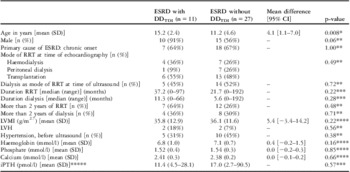
Disease characteristics of end-stage renal disease children with and without diastolic dysfunction, defined as mitral E/E′ ratio >95th percentile for age, are shown in Table 3. The children with DDTDI (n = 11) were on average [95% CI] 4.1 [1.1–7.0] years older than the children without DDTDI (n = 27), p = 0.008. There was a non-significant difference towards more males in the group with DDTDI compared with those with no diastolic dysfunction (91% versus 56%: p = 0.06). The mean (standard deviation) mitral E/E′ ratio for boys was 7.6 (2.3) and for girls 6.4 (1.5), 95% CI: 0.1–3.0; p = 0.036). Boys’ and girls’ ages were comparable. The primary diagnoses and mode of renal replacement therapy did not differ significantly between children with or without DDTDI or between boys and girls.
Association between diastolic dysfunction and possible determinants.

CI = confidence interval; DD = diastolic dysfunction; DDTDI = diastolic dysfunction as measured by tissue Doppler imaging; ESRD = end-stage renal disease; iPTH = intact parathyroid hormone; LVH = left ventricular hypertrophy; LVMI = left ventricular mass index; RRT = chronic renal replacement therapy
DDTDI is defined as mitral E/E ratio >p95 for age
*Independent samples t-test
**Chi square/Fischer's exact test
***Mann–Withney U test
****Adjusted for age by linear regression
*****iPTH blood value is missing for six children without DD (n = 21) and two children with DD (n = 9)
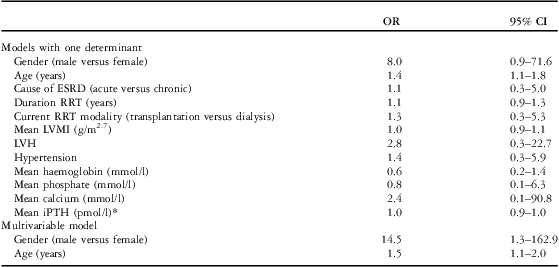
The results of the logistic regression analysis to identify risk factors for DDTDI, defined as mitral E/E′ ratio >95th percentile for age, are shown in Table 4. The odds ratio [95% CI] for boys compared with girls to develop DDTDI was 14.5 (1.3–162.9) corrected for age. The multivariable logistic regression model containing age and gender explained 46% of the variance. None of the other risk factors showed a statistically significant association with DDTDI when analysed as a single determinant.
Results of logistic regression to identify risk factors for DD in 38 children with ESRD.

CI = confidence interval; DD = diastolic dysfunction; ESRD = end-stage renal disease; iPTH = intact parathyroid hormone; LVH = left ventricular hypertrophy; LVMI = left ventricular mass index; OR = odds ratio; RRT = chronic renal replacement therapy
Diastolic dysfunction is defined as mitral E/E′ ratio >p95 for age
*iPTH blood value is missing for eight children
Discussion
Depending on the exact outcome measure, we found between 30% and 40% of the children with end-stage renal disease to have signs ofdiastolic dysfunction as measured by tissue Doppler imaging, depending on the outcome measure. These findings are consistent with those of several other studies.Reference Goren, Glaser and Drukker 15 – Reference Ten Harkel, Cransberg, Van Osch-Gevers and Nauta 17 Early detection of cardiac disease in children with end-stage renal disease is important, given the extremely high cardiac mortality rate in young adolescent patients with paediatric end-stage renal disease. In a follow-up study of patients with end-stage renal disease since childhood, a mortality rate of 25% before the age of 30 was reported. In all, 40% of these patients died of cardiovascular disease.Reference Groothoff, Gruppen and Offringa 1 , Reference Groothoff, Gruppen, de and Offringa 18 Children with end-stage renal disease and diastolic dysfunction are thought to have a particularly increased risk for ventricular systolic dysfunction, leading to congestive heart failure, and early cardiac death.Reference Mitsnefes, Kimball and Border 16 Hypertension, anaemia, increased parathyroid hormone secretion, hyperphosphataemia, hypercalcaemia, and prolonged dialysis have been recognised in adults with end-stage renal disease as potential risk factors for cardiovascular mortality.Reference O'Regan, Matina, Ducharme and Davignon 19 These factors can be influenced by intensifying the treatment. In adult onset end-stage renal disease therapeutic interventions, such as an increase of the dialysis frequency, a stricter control of hypertension, hyperphosphataemia, and anaemia all have shown to be effective in reducing cardiac mortality after left ventricular hypertrophy is established.Reference Mitsnefes 20 It is therefore important to detect cardiovascular disease in children with end-stage renal disease at an early stage so that targeted interventions can be started in time to prevent cardiovascular morbidity and mortality in early adulthood. In contrast with the studies of Mitsnefes et alReference Mitsnefes, Kimball and Border 16 and ten Harkel et al,Reference Ten Harkel, Cransberg, Van Osch-Gevers and Nauta 17 the main objective of the present study was not only to assess the prevalence of diastolic dysfunction in children with end-stage renal disease, but also to assess accuracy and reproducibility of the different echocardiographic techniques. Similar to Mitsnefes et al and Ten Harkel et al, we found lower E/a ratios and higher E/E′ ratios in children with end-stage renal disease than in healthy children. In addition, we found that tissue Doppler imaging is more reproducible than conventional echocardiography.
Although 30–40% of these children were diagnosed with DDTDI, only 5% were diagnosed with severe left ventricular hypertrophy. This suggests that diastolic dysfunction measured by tissue Doppler imaging is detected earlier than left ventricular hypertrophy measured in these children. This finding is supported by those of Borges et al.Reference O'Regan, Matina, Ducharme and Davignon 19 They showed that diastolic dysfunction was already present in hypertensive adults whose left ventricular mass index was still within the clinically defined normal range. This suggests that both the contractile and relaxing myocardial function may already be hampered with normal left ventricle mass values, and supports the potential value of using TDI velocities in the evaluation of cardiac function. However, the definition of left ventricular hypertrophy is a matter of ongoing controversy,Reference Foster, Mackie, Mitsnefes, Ali, Mamber and Colan 21 , Reference Khoury, Mitsnefes, Daniels and Kimball 22 especially in possibly growth-retarded children.Reference Borzych, Bakkaloglu and Zaritsky 23 , Reference Simpson, Savis, Rawlins, Qureshi and Sinha 24 A different definition of left ventricular hypertrophy will probably lead to a different prevalence of left ventricular hypertrophy.
Furthermore, tissue Doppler imaging measurements detected 24–37% more diastolic dysfunction in our study population than conventional echocardiography, by which only 5% of these children were diagnosed. Our findings are consistent with a study in adults with chronic kidney disease, in which tissue Doppler imaging demonstrated impaired diastolic function in patients with left ventricular hypertrophy, which was not detected by conventional echocardiography.Reference Hayashi, Rohani and Lindholm 25
To date, the E/a ratio, measured by conventional echocardiography, has generally been used to evaluate left ventricular diastolic function.Reference Fujimoto, Kagoshima, Nakajima and Dohi 26 , Reference Leung, Boyd, Ng, Chi and Thomas 27 However, this method has several limitations, as it is directly influenced by both the left atrial pressure and the preload. This is especially important for patients on dialysis because of their abnormal hydration status. Tissue Doppler imaging measurements are relatively independent of loading conditions, and thus may be superior to conventional echocardiography to detect diastolic dysfunction in patients with end-stage renal disease.Reference Johnstone, Jones, Grigg, Wilkinson, Walker and Powell 28 Furthermore, in our study, the intra-observer reproducibility of the E/E′ ratio was better than that of the (conventional) E/a ratio. Reproducibility studies for tissue Doppler imaging measurements in children are scant. Eidem et al assessed the intra- and inter-observer reproducibility of tissue Doppler imaging measurements in healthy children.Reference Eidem, McMahon and Cohen 11 The reproducibility was expressed as the mean absolute percentage difference between two observers. Intra- and inter-observer measurement error of E′ measured at the interventricular septum, and left and right ventricle ranged from 1.6% to 2% and from 2.2% to 3.4%, respectively. They concluded that tissue Doppler imaging offers an easily obtained, quantitative, reproducible echocardiographic measure of left ventricular function in children.Reference Eidem, McMahon and Cohen 11
Whether early detection of diastolic dysfunction using tissue Doppler imaging can be used as a specific predictor of cardiovascular morbidity and mortality in children remains to be established. Longitudinal studies in children on renal replacement therapy are necessary to evaluate the role of DDTDI in the risk assessment of developing heart failure later in life. In adults, the prognostic significance of an increased mitral E/E′ ratio has been established in various studies.Reference Bruch, Klem, Breithardt, Wichter and Gradaus 29 – Reference Wang, Wang, Lam, Chan, Zhang and Sanderson 32 In adults with heart failure, the mitral E/E′ ratio was shown to be associated with cardiac mortality and hospitalisation for heart failure (odds ratio 1.92 [1.45–3.88] per unit increment of E/E′ ratio, p = 0.001).Reference Hamdan, Shapira and Bengal 30 Wang et al recommend that mitral E/E′ ratio should be measured during echocardiographic examination for additional prognostication in patients with end-stage renal disease.Reference Wang, Wang, Lam, Chan, Zhang and Sanderson 32 The role of the septal E/E′ ratio is less clear.
Although in this study children with DDTDI were older than children without DDTDI, we found no significant influence of disease and therapy characteristics on outcomes with respect to DDTDI. From other studies, it is known that diastolic dysfunction already develops at the time of mild to moderate chronic renal insufficiency and progresses as renal function deteriorates.Reference Mitsnefes, Kimball and Border 16 , Reference Bullington, Kartel, Khoury and Mitsnefes 33 Unfortunately, we have no echocardiographic information from before the start of renal replacement therapy in these children. The difference that we found between boys and girls may be a real signal, or it may have been due to chance. One explanation could be that these boys had chronic kidney disease for a longer period before developing end-stage renal disease than girls. An earlier study in healthy children found no gender differences in E/E′ ratio.Reference Eidem, McMahon and Cohen 11 Additional studies are needed to either confirm or refute this gender difference in children with end-stage renal disease. Unfortunately, we did not find significant associations between mitral E/E′ ratio and other possible determinants – for example, mean left ventricle mass index, left ventricular hypertrophy, phosphate, haemoglobin, intact parathyroid hormone, blood pressure – in this small study population.
Limitations
The results of this study are limited by the small sample size in the end-stage renal disease group. The study was limited to two hospitals because tissue Doppler imaging measurements in these hospitals were assessed with the same echocardiography machine (Vivid 7), using comparable methods and therefore suitable for off-line analysis. Furthermore, this was a cross-sectional study, including patients on dialysis and transplant patients. We decided not to distinguish between these two modalities because all children had end-stage renal disease and most of the transplant patients had been on dialysis before.
Recommendations
Early detection of cardiovascular disease in children with end-stage renal disease might give an opportunity for targeted intervention in patients at higher risk in order to prevent cardiovascular morbidity and mortality in early adulthood.
Tissue Doppler imaging measurements could be of great value to detect diastolic dysfunction in children with end-stage renal disease at an early stage, and therefore tissue Doppler imaging should be performed in addition to the conventional echocardiography. Longitudinal studies are necessary to evaluate the progression of cardiac dysfunction in these children.
In conclusion, diastolic dysfunction is found in many children with end-stage renal disease. Tissue Doppler imaging is more sensitive in the early detection of diastolic dysfunction than conventional echocardiography in children with end-stage renal disease. Furthermore, tissue Doppler imaging has better intra-observer reproducibility than the conventional echocardiography. Provided that the specificity of this technique in children is confirmed, tissue Doppler imaging could be of great value to detect early onset of diastolic dysfunction in children with end-stage renal disease.
Acknowledgements
This study was performed as part of the RICH-Q project, which is mainly funded by the Dutch Kidney Foundation. Additional funding was provided by Astellas, Ferring Pharmaceuticals, Sanofi, Roche, and Shire. The funders had no role in the design and conduct of the project, data gathering or interpretation, or in the preparation of the manuscript. The authors are grateful to all patients and the participating centres in the RICH-Q study.