An old expression that readers have surely heard countless times is ‘actions speak louder than words’. In a recent article on class relations within the Confederate army, Aaron Sheehan-Dean made much the same point; instead of focusing on the expressions of discontent and disillusionment in the wartime correspondence of southern soldiers, we should focus on how this sentiment actually manifested itself.Footnote 1 One example where scholars have suggested that the rhetoric of discontent did become disloyal behaviour is the desertion of Confederate soldiers. There can be little doubt that unauthorized military absence was a grave problem for the south during the American Civil War. Confederate Secretary of War James Seddon, for instance, concerned by the increasing numbers of soldiers leaving the ranks and returning home during 1863, remarked that ‘some decisive measures are essential to arrest this fearful evil’.Footnote 2 To put some figures on the issue, if we take the flagship army of the Confederacy, General Robert E. Lee's Army of Northern Virginia, Joseph T. Glatthaar's comprehensive study has demonstrated that one in every seven soldiers deserted and fewer than 10 per cent of all deserters returned to the army, whether by their own volition or by arrest.Footnote 3
When historians have grappled with the issue of what motivated these men to leave their comrades and try to return home, many have concluded that these soldiers were fundamentally driven by non-ideological and/or socio-economic factors (examples of such factors include the poverty of soldiers and their families, Union military manoeuvres in their home regions, and the opportunity to leave their post).Footnote 4 It should be noted, though, that a small number of desertion studies have given ideology a more central role as a motivator for men to leave the army.Footnote 5 In some respects, the comparative dearth of scholars who have argued for the importance of ideology as a motivating factor for soldiers who decided to desert is striking when compared to the influential studies that have posited that soldiers enlisted for, and continued to be motivated by, ideological reasoning.Footnote 6 Much of this scholarship on Civil War soldiers, though, has tended to construe ideology in a positive sense, stressing that the principles and politics of these men tended to affirm their respective causes. For works that focus on Union soldiers, the ideological emphasis is often on nationalism and the ideal of the Union (as in the work of James M. McPherson and Gary W. Gallagher) or on the goal of emancipation (as in the work of Chandra Manning).Footnote 7 For works that focus on Confederate soldiers, ideology has positively been construed by an increasing scholarly emphasis on nation over slavery, positing that years of bloody battle and strife saw southern soldiers increasingly identify with the Confederate nation.Footnote 8
Many of these books that focus on soldiers, motivation, and loyalty during the Civil War will deal with, at least at some level, the issue of military absenteeism. However, the matter of methodology soon becomes apparent, and a significant question that must be dealt with is what exactly constitutes a deserter? Some scholars have taken an inclusive approach in their research, including soldiers listed as absent without leave (AWOL) in their calculations. Aaron W. Marrs's study of the unauthorized military absence of soldiers from the Palmetto State, for instance, concludes that ‘desertion’ was often temporary and was, in part, an attempt by soldiers to reassert their rights when they felt that these were being abridged by the powers that be.Footnote 9 However, as Gary Gallagher suggests, surely there is a difference between a soldier going AWOL, temporarily leaving his unit to return home and help on the farm, for instance, and a soldier leaving his unit permanently, with no intention of returning.Footnote 10 To borrow the expression used by two scholars, ‘the motive and not the act determined what constituted desertion’.Footnote 11 Accordingly, the understanding of desertion used in this article is as a clear repudiation of army life and an attempt to leave the military for the foreseeable future, not as a temporary respite from the stresses and strains of war.
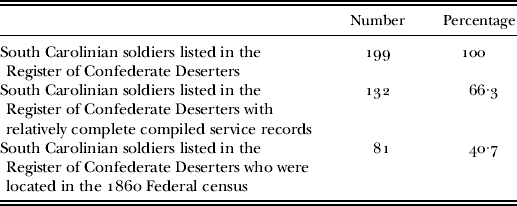
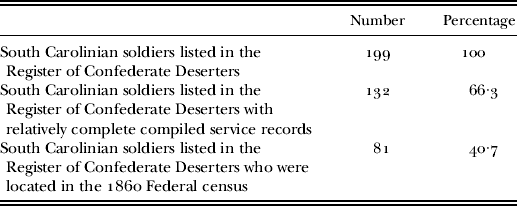
This article will focus on those deserters from South Carolina listed in the Register of Confederate Deserters, a unique group of absentees who crossed Federal lines and took an oath of loyalty to the Union in order to return home during the final two years of the conflict (though this was their intention, a considerable number of the deserters in the Register were never allowed to return home once they had taken the oath).Footnote 12 The names included in the Register, therefore, were men who were undeniably endeavouring to return home with no intention of coming back to the army. One drawback of using the Register is that the 199 South Carolinian deserters who were listed in the document were not only a small sample of the ultimate number of Confederate deserters but were somewhat exceptional. The fact that these men took an oath of loyalty to return to their family suggests that ideological conviction, such as opposition to the Confederacy and/or attachment to the Union, may well have been stronger among this group of military absentees than others. However, we as historians should not be afraid of using an atypical but well-documented group as an inroad to try and understand the behaviour of others who acted similarly but did not do so in such a blatant manner as swearing an oath of allegiance to the enemy. There can be little doubt that the South Carolinians listed in the Register of Confederate Deserters can provide a more rounded picture of Civil War deserters and their respective motivations for leaving their posts precisely because they took the loyalty oath, an act with obvious ideological implications.
Methodological statistical breakdown
In terms of contemplating the ideological or socio-economic motivations of deserters, South Carolina provides a fascinating location in which to explore these issues. First, South Carolina throughout the nineteenth century had a reputation, well deserved it should be added, as having an atypically strong enthusiasm and dedication to slavery and pro-slavery politics. This, in some ways, manifested itself during the Civil War. After all, the Palmetto State was the only state not to raise an active Union military company. Secondly, large portions of South Carolina, with the noticeable exceptions of Charleston and the lowcountry, did not experience Federal invasion until General William T. Sherman turned north from Georgia in early 1865. As one historian has put it, the native soil of South Carolina lived something of ‘a charmed life’ during the conflict.Footnote 13 Much desertion scholarship has focused on how Union incursions in a soldier's home state could push him to return due to fear for the safety of his family and property. South Carolinian deserters in late 1863 and 1864, though, by and large, could hardly claim they were returning home to protect their families, although that does not mean that their loved ones did not require assistance.
This article will utilize those South Carolinians listed in the Register of Confederate Deserters as a case-study in which to evaluate the explanations that historians have proffered when trying to explain Confederate desertion. In order to probe the relative weight of socio-economic reasoning and ideological conviction in the minds of these unique absentees, we must attempt to understand not only who these men were but how they reconciled their behaviour. Whilst many studies of American Civil War soldiers have been preoccupied with why these men fought, we must also grapple with how they thought.Footnote 14 Accordingly, this article will be split into three sections. The first section of this article will trace these men through the 1860 Federal census and will posit that men from certain sections of South Carolinian society prior to the Civil War were more likely to renounce their military duties. Put simply, socio-economic factors are important in understanding why men deserted. The intention here is not to rubbish or discredit the arguments of those who have emphasized material circumstances as the core motivator of men to return home, but instead to enhance our understanding of the relationship between Confederate loyalty, ideology, and the act of desertion. The second section, by analysing the relationship between family and military absenteeism, will show how soldiers, particularly those from poorer economic backgrounds, justified their decision to return home. The third and final section will broaden its scope from the family to the broader community and this is where the role of ideology as a motivating factor for desertion becomes apparent. As these men attempted to justify their behaviour, behaviour that we should not forget would have been overwhelmingly considered the act of a coward at the time, their community became a reference point for vindicating their decision. By looking at how these men fit within their societies, their communities. and their families, we can see how concentric circles of obligation shaped their thoughts about the war and the Confederate nation which they not only fought for, but ultimately abandoned. Whilst, as some scholars have posited, soldiering in the Confederate army may have created stronger bonds between these men and their nascent nation, social conditions at home equally weighed upon them and created a conundrum of which concerns pertained most markedly to them. Ultimately, for certain groups of South Carolinian deserters, particularly those from specific regions or of certain ethnicities that may have imbued them with an ambivalence towards the conflict, ideology was a motivator for them to leave the army, often operating in tandem with concerns about family and worsening poverty at home.
I
Many of the early, foundational historical portrayals of the archetypal deserter tended to depict them as a ‘late-enlisting, poor, cowardly farmer’.Footnote 15 The idea that those who deserted enlisted later than others is oversimplistic. As Aaron Marrs has demonstrated, in the three South Carolinian infantry regiments which he surveyed, late enlistment was not particularly prevalent.Footnote 16 Indeed, the deserters from South Carolina listed in the Register of Confederate Deserters certainly were not late enlisting as a rule. In fact, generally speaking, these men had spent an extended period of time in service. Of the 132 soldiers with complete enough service records to survey accurately, 48, or 36·4 per cent, had joined the service in 1861 and a further 43, or 32·6 per cent, had joined during the first six months of 1862, presumably as a result of the proverbial carrot and stick of enlistment bounties and military conscription enacted by the Confederate government in April 1862. Moreover, 94 of the 132 soldiers, or 71·2 per cent, had served in the Confederate army for over two years. For some, military life was evidently unbearable; 7 soldiers, or 5·3 per cent, had served for less than six months, having presumably decided that a soldier's life was not for them. But, by and large, most South Carolinian soldiers listed in the Register of Confederate Deserters had spent a considerable period of time fighting for the Confederacy.Footnote 17
The idea that most deserters were from poor, agricultural backgrounds has proven to be more resilient though. Bessie Martin's landmark study of military absence among soldiers from Alabama concluded that the ‘chief cause for desertion of Alabama troops, and probably other troops, was poverty in the families of soldiers’.Footnote 18 Even in the children's literature of Thomas Nelson Page, the poverty of Confederate deserters was noted. In Two little Confederates, the rather unpleasantly named Holetown is overrun by deserters whose families resided in the town and are giving the absentees protection. The narrator goes on to note that Holetown was populated by ‘a peculiar but kindly race known to the boys as “poor white folks,” … Some of them owned small places in the pines; but the majority were simply tenants’.Footnote 19 As we shall see, on the basis of the Register of Confederate Deserters, it is apparent that those South Carolinian soldiers from poor, and often agricultural, backgrounds were the most likely to renounce their military duties, providing a level of vindication to the link other scholars, who stress the importance of non-ideological motivators, have previously placed between desertion, poverty, and family.
In terms of trying to configure where those South Carolinians listed in the Register fit within a broader social structure is not a straightforward task. Indeed, a dense body of scholarship has tried to ascertain what exactly were the parameters of class and status at the lower to middling end of white society.Footnote 20 Something which has often been stressed as an important marker of where somebody sat in antebellum southern society is landownership. According to the wave of studies that focused on the southern yeomanry during the 1980s, the fact that yeomen controlled their own land imbued them with a keen sense of independence and a set of republican values. Stephanie McCurry's research on the South Carolina lowcountry, for instance, utilized landownership as a defining tool in conceptualizing social stratification and concluded that operating 150 acres or less of improve agricultural land placed somebody within the yeoman class.Footnote 21 The issue here, though, is taking a quantitative measure and applying it across a broad geographical region. There is, for example, a large difference between farming 150 acres of fertile, lowcountry land suitable for producing a cash crop such as rice, and farming 150 acres of hillier, less fertile land in the upper piedmont sections of the state that bordered the Appalachian mountain chain.
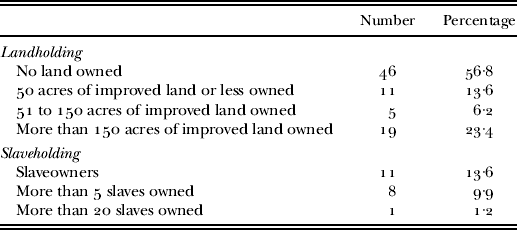
With this in mind, a look at the levels of landholding amongst those South Carolinians listed in the Register is elucidatory. In terms of falling within the bounds of the yeomanry, 11, or 13·6 per cent, owned their own land but farmed 50 acres of improved land or less, whilst a further 5 deserters farmed between 51 acres and 150 acres of improved land, coming within McCurry's perhaps too inclusive definition of a yeoman. Most strikingly, 46 South Carolinians listed in the Register, or 56·8 per cent, were landless in 1860.Footnote 22 Those men who did not own land in the antebellum south have often been placed by historians in a separate category from the yeomanry, generally being labelled as poor whites.Footnote 23 Of these 46 soldiers, 10, or 12·3 per cent of the total, were located in the agricultural schedule, meaning that they were possibly tenant farmers.Footnote 24 Again, placing a straightforward quantitative definition upon poor whites and yeomen does run the risk of oversimplification, and those men who perhaps did not own land but had a skill, such as carpentry or shoemaking, would certainly have been more upwardly mobile than those who relied on manual labour to make a living.Footnote 25 However, in terms of landownership, the overall pattern is clear and those who were more economically marginal were seemingly more likely to desert.
Indicators of social status amongst South Carolinian deserters located in the 1860 Federal census
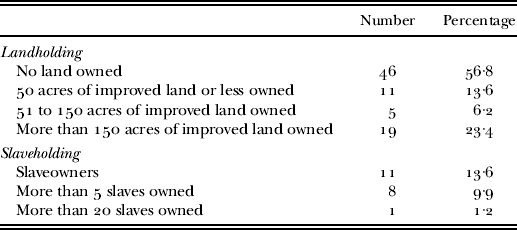
If we look at the slaveownership of the South Carolinian soldiers listed in the Register, further credence is lent to the fact that they were overwhelmingly from poorer backgrounds. Slaveownership, again, is something that has been identified by scholars of antebellum South Carolina as an important marker of social status. Lacy K. Ford's research on the South Carolina upcountry, for instance, emphasized that ownership of five slaves or fewer placed one within the yeomanry.Footnote 26 Out of the 82 soldiers who were located in the 1860 Federal census, only 11, or 13·6 per cent, were located as either being slaveholders or coming from a slaveholding immediate family. This stands in stark contrast to the figures regarding wider South Carolinian slaveownership from the 1860 census as 48·7 per cent of white families in South Carolina held slaves.Footnote 27 Moreover, only one deserter in the Register was noted as owning 20 slaves or more, a threshold that has often been used to identify the planter class.Footnote 28 Again, applying quantitative measures to the issues of class and social structure is challenging and, as one scholar has noted, it is problematic dividing southern society into clear ranks as ‘it seems doubtful that southerners had clear criteria for doing so’.Footnote 29 However, the fundamental point that becomes clear from looking at the statistics contained in Table 2 is that the South Carolinian deserters contained in the Register of Confederate Deserters were disproportionately from the lower echelons, in terms of wealth and ownership of slaves and/or real estate, of society.
The occupations of the deserters listed in the Register are also revealing. Out of the 64 soldiers who had a designated occupation listed in the 1860 census, 28, or 43·8 per cent, were directly involved in agriculture (16 as farmers, 9 as farm labourers, and 3 as overseers). South Carolina in 1860 was overwhelmingly an agricultural state and these figures are a little below average. For instance, in the 1860 census, out of 81,631 listed occupations, 44,186, or 54·1 per cent, were farmers, farm labourers, or overseers.Footnote 30 It should be noted, however, that in addition to these agricultural workers, a further 15 soldiers, or 18·5 per cent of those located in the census, were listed just as labourers, with no mention of whether they worked on farms or elsewhere. Of these 15 labourers, some undoubtedly worked in agricultural roles, although 7 of them were urban labourers from the city of Charleston, a fact that further explains the number of soldiers involved in agricultural employment being slightly below the South Carolinian average in 1860.
Interestingly, 17 deserters in the Register, or 21 per cent of those who were located in the census, did not have a specified occupation. The reason for this is twofold. First, it was the policy of census enumerators in 1860 not to note the occupations of citizens who were under sixteen years of age. Secondly, it would seem that it was the policy of enumerators in some districts not to note the occupations of those who resided in households, were aged sixteen or over, but were not household heads. The lack of a uniform approach by enumerators is but one problem associated with using the census as a historical source.Footnote 31 The logical explanation in these instances seems to be that those who did not have an occupation listed in these households helped the household head with his occupation. With this in mind, it is worthwhile to note that, out of the 17 deserters who did not have a specific occupation attributed to them in the census, 12 resided in a household dedicated to agriculture and were, therefore, presumably farm hands. All in all, this indicates that, out of the 81 deserters that were located in the census, 40, or 49·4 per cent of those found in the 1860 Federal census, were directly involved in agricultural production, whilst there were also a number of labourers who were not listed as agricultural labourers by the enumerator, but were presumably involved at some level.
It is evident, then, that South Carolinian deserters included in the Register of Confederate Deserters were disproportionately likely to be from a poorer, non-slaveholding background. Whilst those involved in agricultural production were slightly underrepresented, they still presented by far the largest employment grouping of those who left their regiments with little or no intention of returning. Evidently, we are able to sketch a broad profile of those most likely to renounce their military duties and, consequently, socio-economic factors did matter. Despite these occurrences, an important caveat is that we should not view desertion as a ‘one rule fits all’ scenario and, as one desertion study has rightly contended, it is too simplistic to suggest that a single individual level characteristic, such as non-slaveownership for instance, can accurately predict the act of desertion.Footnote 32 Certainly, the arithmetic mean number of slaves held by the 11 slaveholders in the database is 11·5, suggesting that those from the upper-middle classes to the upper classes did desert and take the oath of loyalty. One example is William H. Hagood, from Barnwell district, who was the son of a wealthy planter who owned 2,900 acres and 41 slaves.Footnote 33 As so often in life, there is a strong kernel of truth to the ‘poor farmer’ deserter stereotype, but it oversimplifies a complex group.
II
In order to explain how those from the lower to middling echelons of South Carolinian society justified desertion, and indeed why they deserted, one must look at the place to which they were returning. Stories regarding the poverty and privation that occurred on the homefront are legion. Speculators and shortages caused prices to soar, as many families found themselves spiralling into the depths of poverty. Such conditions obviously hit those who were less financially secure prior to the war hardest. The desertion study that has given the most emphasis to the importance of concerns about loved ones on the homefront is Mark A. Weitz's study of desertion among Georgian troops. Weitz's conclusion is that soldiers responded to a call from ‘a higher duty’, that to their families, and that ultimately men ‘chose home over the Confederacy’.Footnote 34 These hardships are best evidenced by the waves of letters to Confederate soldiers complaining of conditions at home during the final years of the war, a state of affairs that suggests that homefront conditions and concerns about loved ones were significant motivations for soldiers to leave their posts. William Martin, for instance, received a letter from his wife Sarah imploring him to come home. Explaining that she was ill, unable to get any male help running the farm due to all the suitable local men in Pickens district being away in service, and uninitiated as to how to sow wheat, Sarah implored, ‘I want you to come home as soone as you can William.’Footnote 35 Although a lot of these letters do not explicitly mention desertion, concerns that one's family and farm were going to ruin would have been deeply troubling for soldiers.
Perhaps even worse for many South Carolinian soldiers was a lack of contact from home. As the war wore on, the internal mail system of the Confederacy began to break down, with letters that did successfully make their way to their destination sometimes taking weeks. Indeed, littered in many soldier letters are expressions of frustration and aggravation at a seeming lack of correspondence from their loved ones. Austin Lister, a non-slaveholding farmer from Greenville district, was in accusatory mood when writing to his wife Mary in late 1863, as she had not replied to his four previous letters, whilst also paying tribute to his wife's displeasure at his service in the Confederate army. Lister complained, ‘I think it hard that I cant hear from home once a month you pretend to be veary mutch apaled at my leaving home but it doesnt prove it.’Footnote 36 For some soldiers, the silence surely resonated louder than any letter ever could, as newspaper reports and camp rumours exacerbated latent fears. Allen Edens, a prosperous farmer from Marlboro district who held nine slaves at the outbreak of the war, wrote to his wife in a state of panic following General Sherman's march through the Palmetto State exclaiming, ‘I hear that you have no horse to work and nothing to feed on. I am anxious to hear from home to know how the Yankees left you – do try to get me a letter soon.’Footnote 37 Concerns about loved ones and the economic circumstances they found themselves in, especially when contact dried up, must have proved a catalyst for soldiers, particularly those from poorer families, to leave the army and return home.
The Register of Confederate Deserters further emphasizes the significance of family and family concerns for those men who chose to leave the army. James Marten has argued persuasively that fatherhood intermeshed with the demands of the war to the point that ‘being a good and loyal soldier’ came with the territory ‘of being a good father’.Footnote 38 For Marten, fatherhood kept men in the army instead of drawing them away. Yet, the figures obtained from the Register partially contradict Marten's conclusions. Out of the 81 deserters who were located in the Federal census of 1860, 38, or 46·9 per cent, were either the household head or the clear leader of the family unit. Out of these 38 deserters, 34 had clearly identifiable dependants (the marker for dependants here was a wife and at least one child under the age of ten) whereas only 4 were identified as either seemingly being single or just living with an adult partner.Footnote 39 Regarding James Marten's work, it would seem that fatherhood had a polarizing effect, seemingly pushing some to renewed military endeavours whilst pulling some home to their children.
On the note of children, it is striking to note that of the 43 deserters who were not household heads or leaders of the family unit, 20 were seemingly the eldest (or only) sons of the family, meaning that they were likely to have a more important role in terms of economic production, as well as presumably feeling a stronger urge to protect their loved ones at home.Footnote 40 This point is especially true when we consider the arguments that have already been made about the economic conditions of the South Carolinian deserters considered in this article; eldest sons, specifically, and elder children, more generally, would have offered vitally important know-how and labour to the family economic unit, potentially proving to be veritable lifelines for their families. This relationship is elucidated in the case of James F. Sloan, a farmer from Spartanburg district who owned $1,000 of real estate in 1860. Seth, who was James's eldest son, was progressively given a more central role on the farm during the late antebellum period and, as he got older, was allowed to visit the country store and to negotiate labour exchanges with neighbours. These seeming male rites of passage would never have been entrusted to Sloan's wife or daughters and it is evident that Seth was being prepared for household head status one day.Footnote 41 During the final period of the Civil War, South Carolinian fathers, husbands, and sons, particularly eldest or only sons, increasingly felt troubled by the calls from home for assistance, both on an economic and emotional level.
Family pervaded the act of desertion in another sense. Just as brothers enlisted together, they also left the army together. Certainly, the Register of Confederate Deserters provides numerous cases of such incidents taking place among South Carolinian soldiers. Take, for example, William, Charles, and Joseph Maples from Chesterfield district. These brothers deserted on the same day in January 1865 and were all enlisted in Company F of the 26th South Carolina Infantry. William, the eldest, had recently moved out of the family home with his newlywed wife, whereas Charles and Joseph still lived at the family farm. All three were listed as labourers in the 1860 census, held no real estate, and had a combined personal estate of $2,640, not dirt poor but certainly rather modest.Footnote 42 Likewise, Robert and John Dover both left the 58th North Carolina Infantry in February 1864 to return to their small family farm in York district, where these eldest sons worked with their parents.Footnote 43 The act of family members deserting together, particularly brothers, demonstrates a collective ability by individuals of the same family unit to redefine the concepts of honour and masculinity that had previously served to keep them in the army to relating more pertinently to their loved ones at home.
The fact that brothers tended to desert together also serves to underline the importance of the family unit to the economics of antebellum southern society. Indeed, many poor and yeomen families would have had a similar reliance on the labour and skills of other family members, like the aforementioned Dover brothers, who worked with their mother prior to the war. Consider the case of the Kelly brothers from Charleston. John and Thomas Kelly, who both served in, and deserted from, Company C of the 23rd South Carolina Infantry, were not only bonded by emotional ties. John, the younger brother, was Thomas's apprentice, learning the art of blacksmithing, and, therefore, these two brothers were also forged together by economic binds.Footnote 44
This emphasis on the importance of family in motivating men to desert stands at odds with some of the existing scholarship on soldiers during the American Civil War. The idea of primary group loyalty, that soldiers developed stronger ties with their fellow soldiers than their families the longer they spent time in service away from their loved ones, was borrowed from studies on twentieth-century armies and applied to the armies of the Civil War.Footnote 45 Perhaps the most noted exponent of the idea of primary group loyalty for Confederate and Union men is Gerald F. Linderman. Linderman has stressed that the actual experience of warfare meant that Civil War soldiers developed a view of combat, based on first-hand evidence, that promoted a strong bond between fellow soldiers whilst alienating them from those they left behind at home, who continued to hold romanticized, mythologized ideas of the violence that took place in the fields of Virginia and elsewhere.Footnote 46 Although most associated with the wave of soldier studies that began in the 1980s, the idea of primary group loyalty and that soldiers could hold just as strong, if not stronger, bonds with their comrades has not faded away. Indeed, as one recent survey of soldiers within the Confederate army has concluded, ‘as a troublesome divide deepened between soldiers and civilians, men in the ANV (Army of Northern Virginia) appear to have shifted their loyalty away from the society they were fighting for and toward the army they were fighting in’.Footnote 47 Yet the evidence contained in the Register of Confederate Deserters contradicts this assertion. Indeed, for the South Carolinian absentees considered in this article family remained both a vital concern and a key component of how these men viewed the world around them.
III
Though concerns about family, particularly for those from the poorer end of the social scale, were evidently an important factor, to understand why men deserted we must broaden our scope to look at the communities and regions to which they were returning. Local communities, and the attitude they held towards desertion, were surely determinants in the decision-making process of soldiers regarding whether to stay or leave.Footnote 48 Indeed, considering that Civil War military units were often based around local communities, many soldiers would have understood that any act of cowardice or dishonour would make its way home. Moreover, the community makeup of Confederate and Union military units surely undermines the strict separation of family and comrades imposed by the exponents of primary group loyalty, as many were fighting with their family and kinfolk.Footnote 49 The fear of being considered unmanly or cowardly within one's regiment or community is best demonstrated in one of the few letters that have been identified in the historical record as being written by a South Carolinian deserter. In 1862, William Henry Harrison Lee from Greenville district wrote to his wife about his temptation to desert. ‘I would like to com home’ wrote Lee ‘but if I were to com tha [they] would say I was a cowared.’Footnote 50 The stigma of cowardice certainly seems to have been a strong deterrent against desertion for some. A poignant example of this is a letter written by Samuel Roper, a deserter from Pickens district, sent to Clerk of Court James Earle Hagood, imploring him ‘not to publish me a deserter’.Footnote 51 Across the state of South Carolina newspapers published lists of deserters, something which, based on Roper, carried a clear sense of shame.
Yet the deserters considered in this study were not simply returning home but were also taking a loyalty oath to the enemy. They were not only being cowardly but treacherous. This would have surely drawn further ire from some in the community. The hatred that one could endure is exemplified in the correspondence of Lalla Pelot. Lalla's brother James wrote to his sister convinced that their brother Joseph had been captured by Union forces near Savannah and taken the oath. James, though, had little sympathy for his brother, remarking that if he had taken the oath he will have ‘lost everything – his property, his friends, his self-respect … and I am ashamed to write it, his honor’.Footnote 52 It is evident that in some communities being a deserter carried a sense of social ignominy, particularly for those who would have been known to have taken the oath. In some communities, though, we can see more complex patterns emerging.
Whilst among the wealthy circles maintained by the Pelot family, and surely many other communities, desertion could assign one to pariah status, the close of the war saw this shift dramatically in some locales. Indeed, unauthorized absence from the army had become socially acceptable in some sections of South Carolina. In parts of Greenville, a district located in the mountainous upcountry, this certainly seems to have been the case. One citizen, who resided in Fairview, not far from the district's border with Spartanburg, noted in disgust in early 1865 that ‘there has been a heap of marrying up here of late some of the girles marry deserters’, advising her sister that she should ‘stay single till the war is over and then you can marry some big general’.Footnote 53 The fact that young women were marrying deserters suggests that some in the community did not necessarily view absenteeism in the military as shameful or unmanly.
Such a shift did not escape the attention of soldiers on the frontlines. Daniel Boyd, a soldier from a non-slaveholding family based in Abbeville district, was positively confused as to what to do in the closing months of the war. Boyd, in a letter to his father, confessed that ‘there is a great meney talking about diserting’, with men leaving on a nightly basis, but that he ‘wold hate to giv it up after fighting four years’.Footnote 54 Boyd's loyalty to the Confederate army was surely not only rooted in his long and dedicated service but also in the fact that three of his brothers and his brother-in-law had all already given their lives for southern independence. For soldiers like Boyd, to leave the army was potentially to besmirch the memory of their deceased loved ones. Yet the attitude of civilians put considerable doubt in Boyd's mind as he confessed that he pondered deserting because ‘it seems like them that stays at home get mor honor than them that stays and fights’.Footnote 55 In the case of Daniel Boyd, the social acceptability of desertion at home was closely linked to his individual thought process on whether to leave the army or not.
How can we explain this shift in the way some communities thought about desertion? In some respects, this again reiterates the importance of socio-economic factors in understanding Confederate desertion. The pattern of young girls in Greenville district marrying deserters, for instance, not only shows that in some communities desertion lost, at least partially, its stigma but it also demonstrates the poverty and desperation that plagued the homefront during the final period of the Civil War. Young and middle-aged men, as shown in section ii regarding the position of deserters within their respective households, were both providers and labourers in yeomen households. With the consistent depletion of the number of military-aged men as a result of the conscription act and its subsequent revisions, deserters, and indeed other shirkers of military duties, were, by the end of the war, part of a very small group of providers left in some communities.
However, by looking at the specific districts in South Carolina where desertion seems to have been a particularly prevalent problem, we can see that ideology may have been a factor in both men leaving the army and their home community's acceptance of such behaviour. The two broad regions that provide the largest proportions of deserters in the Register of Confederate Deserters are the mountainous upcountry and the swampy Pee Dee river basin. The mountainous upper piedmont districts of Anderson, Greenville, Pickens, Spartanburg, and York account for 51 deserters, or 25·6 per cent of the total, whilst the districts of Chesterfield, Darlington, Horry, Marion, and Marlboro, which surround the Pee Dee river, account for 31 deserters, or 15·6 per cent.Footnote 56 The fact that the upper piedmont districts that bordered North Carolina and the Appalachian mountain chain were beset by deserters is hardly novel. Desertion was a problem in these districts to the point that it fostered armed bands of absentees that targeted the citizenry, and the area was consequently identified by Ella Lonn as ‘deserter country’.Footnote 57 Conversely, the existence of a desertion problem in the Pee Dee region is a story that has not yet been sufficiently told. Indeed, it seems that deserters from this area formed similar criminal bands. In late 1864, James Welsh, a resident of Horry district, wrote to Governor Milledge Luke Bonham, explaining that ‘we are at the mercy of deserters’, of which there was ‘eighty of whom, well armed’, and that these men had already killed two local citizens whilst in the act of plundering their property.Footnote 58 Bonham's replacement as governor in December 1864, A. G. Magrath, was likewise plagued by the issue of deserters in the Pee Dee region as he received complaints of unruly bands in both Horry and Marion districts in February 1865.Footnote 59
Ideology as a motivating factor becomes apparent regarding these regions for two clear reasons. First, the existence of armed criminal bands is elucidatory. Though perhaps driven by economic necessity, the formation of such groups displays a clear sense of opposition to and alienation from both the state and government. Moreover, in order for these bands to exist and to avoid capture, they relied on the co-operation of at least some members of the community. The reports of Confederate officials on these armed bands are illustrative of the ideological undertones present. In the autumn of 1863, as noted above, Greenville, Pickens, and Spartanburg districts were overrun by armed groups of deserters. C. D. Melton, the commandant of conscripts, lamented that most of the absentees were ‘poor, ill-informed and but little identified with our struggle’.Footnote 60 For Melton, both socio-economic factors and ideology explained why these armed bands existed in these particular communities. More troubling for Melton was the fact that kinfolk helped these deserters hide via a complex system of communication and the conscription officer noted that few families did not have ‘a husband, a son, a brother, or kinsman, a deserter in the mountains’.Footnote 61 Evidently, in these regions, stigmatization for leaving the army was not prevalent and the community in fact assisted the absentees.
The role of communities in actively encouraging desertion was deeply troubling for Confederate officials. In some kin networks, it seems that desertion was not merely socially acceptable but desirable. The most pre-eminent Confederate military leader, General Robert E. Lee, picked up on this and was in little doubt as to what was causing some of his men to return home. Writing in early 1865, Lee explained that ‘desertions are becoming very frequent and there is good reason to believe that they are occasioned to a considerable extent by the letters written to the soldiers by their friends at home’.Footnote 62 Samuel Wickliffe Melton, a wealthy resident of York district who was working in the Adjutant and Inspector General's Department in Richmond, noticed similar patterns among South Carolinian regiments. Writing to his wife in early 1864, Melton sniped, ‘if the women cannot fight, they can at least refrain from keeping men away from the field’.Footnote 63 The complicity of whole communities in the act of desertion clearly suggests that there is something more in play than mere socio-economic factors, as suggested by the commandant of conscripts C. D. Melton, who remarked, regarding the mountain communities, ‘the tone of the people is lost’.Footnote 64
The ideological roots of the deserter problems in the mountainous upcountry and the Pee Dee river basin becomes clear when we look at the social makeup of these regions. By South Carolinian standards, in 1860, slaveholding was comparatively low in these districts. In Pickens district, for instance, only around 14 per cent of white adult males held slaves, leading to the smallest black demographic in the state as black people made up 27·6 per cent of the district's population.Footnote 65 In nearby Spartanburg district, 30 per cent of farmers held slaves, with fewer than 50 per cent of this group owning more than 6.Footnote 66 These mountainous upcountry districts had been a bastion of Unionist and co-operationist sentiment throughout much of the antebellum period, a stance embodied by the political outlook of Greenville's prominent politician Benjamin F. Perry, often remaining politically distant from the planter elite of the lowcountry.Footnote 67 Unionist sentiment was strong enough in Spartanburg to foster an abortive Union military company in the wake of South Carolina's secession, though they quickly disbanded for ‘fear [of] being hanged’.Footnote 68 Likewise, Horry district had a smaller black demographic and lower rate of slaveholding than most South Carolinian districts.
Put simply, these two regions, the mountainous upcountry and the Pee Dee river basin, were not part of the mainstream, plantation-dominated agricultural system that typified most of the state. For instance, plantation agriculture in Horry was overwhelmingly skewed towards a few small rice plantations to the extreme south-east of the district and a large turpentine plantation to the extreme north-east. Indeed, Horry was considered so cut adrift from mainstream South Carolinian slaveholding society that one newspaper described it as the ‘ultima thule’, that is to say a distant and unknown region, of the state.Footnote 69 These districts were dominated by poor to middling farmers, who, as already established, felt the call from home more acutely than wealthier South Carolinians. Moreover, ideologically, these districts had a tendency to remain hesitant towards the concurrent trends of their state due to their smaller economic investment in slavery. That is not to suggest that they were anti-slavery in any sense but the districts of the mountainous upcountry and the Pee Dee river basin had tended to take a more ambivalent outlook on the issue of secession and this ethos evidently manifested itself again during the final years of the Civil War.
The fact that more deserters from these regions took the oath of loyalty than those from other regions in the state should not be considered insignificant or coincidental either. Indeed, the oath itself had clear ideological overtones. The oath plainly stipulated that the deserter must hold a loyalty to the Union and underlined that they could not return to fighting against Federal forces: ‘I do solemnly swear (or affirm) that I will support, protect and defend the constitution and government of the United States against all enemies, whether domestic or foreign, and that I will bear true faith, allegiance and loyalty to the same.’Footnote 70 Indeed, the oath also stipulated that the pledge must be uttered with sincerity. The end of the oath declared that ‘I do this with a full determination, pledge and purpose, without any mental reservation or evasion or whatsoever: So help me God.’Footnote 71 The scholarship on oath-taking and Americans in the nineteenth century gives a mixed picture as to how seriously they took the process.Footnote 72 However, the implication that the oath was a covenant in the eyes of God would have certainly weighed heavily in the consideration of at least some southern men, considering the prominence and importance of evangelical Christianity within the region. Of course, we should not be naïve about those who took the loyalty oath; some men surely took the oath as a means to an end, uttering its words with an empty heart. But this does not mean that we should therefore discard ideology as a motivator for these men to return home.
Indeed, one prevalent group within the Register who would have perhaps had strong ideological reasoning for taking the oath is the Irish. Of the 81 deserters who were located in the 1860 Federal census, 9, or 11·1 per cent, were listed as being born in Ireland by the census enumerator. Such a high proportion of Irish deserters is striking, considering the ethnic homogeneity of white South Carolinian society at the outbreak of the war, as only 3·4 per cent of free residents in 1860 were foreign born, with 1·6 per cent being born in the Emerald Isle.Footnote 73 As the work of David T. Gleeson has demonstrated, the ideological conviction of the Irish waned markedly as the war progressed, shifting from an enthusiastic response to secession to a ready acceptance of defeat by the time of the war's closing acts.Footnote 74 Interestingly, on another level, the preponderance of Irish deserters further confirms the links between poverty and unauthorized military absence. Of the 9 Irish born deserters, 8 resided in the city of Charleston with 7 of them working either as urban wage labourers or in other manual labour-based occupations. Of the Irishmen, 6 owned no land or property whatsoever.
If we think of the operation of ideology at the individual level, as soldiers who wanted to return home tried to reconcile the act in their minds, it is also possible that some felt they had the ‘right’ to leave the army. The wars prior to the American Civil War, particularly the Mexican War, had certainly left a legacy of volunteer armies. Considering this, it is logical that at least some deserters, particularly those who were volunteers as opposed to conscripts, did not consider their actions as either illegal or wrong, but within their ‘rights’. This idea was strongly articulated by the deserter from Pickens, Samuel Roper, who was evidently vexed at the enforced extension of his terms of service. In his letter to the clerk of court for his home district, he defiantly explained that he had served the three years ‘that I first inlisted for and I think I am at liberty to go when I pleas’.Footnote 75 Indeed, it is interesting to note that of the 53 South Carolinian deserters within the Register that had clearly noted periods of service which they initially signed up for in their compiled service records (typically twelve months or three years), 48 had served for longer than their original terms. Perhaps, at first, enforced extension of their terms of service was something which they could tolerate, but, as they became increasingly concerned about their loved ones and authorized absence became progressively more difficult to obtain, they decided to take a ‘furlough of indulgence’, justified possibly in their minds by the fact that they had already served the original terms that they signed up for. This notion of soldier's deserting due to a republican ideology that stressed their individual rights, in fact, connects rather neatly with the emphasis scholars on the South Carolinian yeomanry have placed on these men as stern guardians of their own independence.Footnote 76
In terms of drawing conclusions from the South Carolinians included in the Register of Confederate Deserters, the first one is that we should not skim over the intricate nature of unauthorized military absenteeism. ‘The desertion calculus was a complex one’ and deserters were capable of being motivated by both non-ideological and ideological notions at the same time.Footnote 77 In fact, there is considerable overlap between the two, as suffering of family at home caused men to question the cause, and those who had questioned the cause from the start were more likely to grow despondent quicker. Still, for the unique deserters contained in the Register of Confederate Deserters, it would seem that ideology as a motivator for desertion was more prevalent than among other groups of unauthorized military absentees. This is best displayed when we consider the regional and ethnic patterns shown in the Register, as well as the oath itself. These groups, such as the people who lived near the Appalachian mountain chain and those born in Ireland, had enlisted, like other South Carolinian men, in large numbers at the outbreak of the war, swept up in excitement and uncertainty. However, during the final two years of the conflict, these groups lacked the ideological motivation that served to sustain their comrades and, exacerbated by the suffering of their loved ones, left the army with the intention of returning home on a long-term basis. Fighting for the Confederate nation had slipped down a list of priorities and obligations. As this article has demonstrated, scholars of Confederate desertion during the American Civil War have not been wrong to emphasize the role of socio-economic factors in motivating men to desert; some have, though, been mistaken in neglecting ideology as, at least, a contributing motivator.