Introduction
Paraquat is a nonselective, contact, photosystem I electron-diverting (PSI-ED) herbicide in the bypyridilium (aka bipyridinium) herbicide family. As a nonselective herbicide, paraquat can be utilized as a POST-directed application, spot treatment, or preplant burndown application in agronomic and horticultural crops (Shaner Reference Shaner2014). In dormant bermudagrass (Cynodon spp.), nonselective herbicides such as paraquat can be utilized for control of winter weeds such as henbit (Lamium amplexicaule L.) and common chickweed [Stellaria media (L.) Vill.] (Johnson Reference Johnson1977). Interestingly, peanut (Arachis hypogaea L.) is tolerant to paraquat before pegging and fruit production (Wilcut and Swann Reference Wilcut and Swann1990). Paraquat is also applied after bed formation but before planting of horticultural crops grown in plasticulture systems (Boyd Reference Boyd2014).
Paraquat diverts electrons from PSI to form reactive oxygen species, primarily superoxide (Dodge et al. Reference Dodge, Harris and Baldwin1970; Funderburk and Lawrence Reference Funderburk and Lawrence1964; Shaner Reference Shaner2014). Superoxide and other reactive oxygen then destructively react with membranes and other cellular constituents (Babbs et al. Reference Babbs, Pham and Coolbaugh1989). Symptomology appears as loss of green color and water-soaked leaves that then desiccate and become necrotic. Paraquat is xylem mobile, which restricts movement out of treated leaves via symplastic movement (Shaner Reference Shaner2014). Because of the contact nature of paraquat, herbicide spray coverage is essential for complete control, which is difficult to achieve with larger annual plants or perennial species.
Despite the introduction of PSI-ED herbicide in the mid-1950s (Hawkes Reference Hawkes2013), relatively few species have evolved resistance to these herbicides compared with other modes of action such as acetolactate synthase (ALS) inhibitors, acetyl CoA carboxylase inhibitors, mitotic inhibitors, photosystem II (PSII) inhibitors, and 5-enolpyruvylshikimate-3-phosphate synthase (EPSPS) inhibitors. According to the International Herbicide-Resistant Weed Database, as of February 2021 only 32 species had evolved resistance to PSI-ED compared with 167 species for ALS inhibitors, 107 for PSII inhibitors, and 53 for EPSPS inhibitors (Heap Reference Heap2021). Herbicide resistance has been attributed to reduced translocation and vacuolar sequestration (Brunharo and Hanson Reference Brunharo and Hanson2017), rapid sequestration and detoxification of reactive oxygen species (Fuerst and Vaughn Reference Fuerst and Vaughn1990; Fuerst et al. Reference Fuerst, Nakatani, Dodge, Penner and Arntzen1985), and an increase in polyamines following paraquat treatment (Luo et al. Reference Luo, Wei, Dong, Shen and Chen2019). No research has attributed paraquat resistance to target-site modification, as it is assumed a target site does not exist (Hawkes Reference Hawkes2013).
Goosegrass [Eleusine indica (L.) Gaertn.] is a common, annual grass species found in agricultural and amenity landscapes around the world. In the United States, previous research has identified an E. indica population in Florida resistant to paraquat (Buker et al. Reference Buker, Steed and Stall2002). Paraquat-resistant E. indica has also been identified in Malaysia (1990, 2009), China (2010), Indonesia (2012), Australia (2015), and Colombia (2016) (Heap Reference Heap2021). Eleusine indica uncontrolled by paraquat in a vegetable crop production field was reported in summer 2019 in St. Clair County, AL. The field location had a multiple-year history of paraquat use for burndown weed control.
Paraquat resistance is still relatively rare compared with other mechanisms of action. As such, limited germplasm and descriptions of resistant biotype response are available compared with other herbicide mechanisms of action for which redundant, complementary data are available to aid in new resistant biotype assessment. Research was conducted to determine whether the population collected from Alabama was resistant to paraquat, describe observed symptomology, and discuss possible hypotheses concerning paraquat-resistance evolution.
Materials and Methods
Research was conducted to evaluate an E. indica population that had survived paraquat treatment during normal field application for paraquat resistance. The suspected paraquat-resistant E. indica population (R) was collected from a tomato (Solanum lycopersicum L.) production field in St. Clair County, AL. Nine plants were transported to greenhouses on the Auburn University campus and propagated for seed. Seeds collected from the original nine plants were combined, dried at 60 C for 24 h, and stored at 4 C.
Three suspected paraquat-susceptible populations were used as comparisons. Susceptible populations were collected from a row-crop field at the E.V. Smith Research and Extension Center–Plant Breeding Unit near Tallassee, AL (S1), a golf course fairway at Clanton Country Club in Clanton, AL (S2), and a golf course fairway at Riverbend Golf Course in New Bern, NC (S3). S1 and S3 have been used in previous research by the authors. S1 is commonly referred to as “PBU” and has no known herbicide resistance (McElroy et al. Reference McElroy, Head, Wehtje and Spak2017). S3 is commonly referred to as “RB” has been previously reported to be resistant to the protoporphyrinogen oxidase (PPO)-inhibiting herbicide oxadiazon (Bi et al. Reference Bi, Wang, Coleman, Porri, Peppers, Patel, Betz, Lerchl and McElroy2020; McElroy et al. Reference McElroy, Head, Wehtje and Spak2017). S2 has no known herbicide resistance.
Research was conducted in a glasshouse environment from May to August 2019. Greenhouse conditions included air temperature maintained at 30 C ± 2 C throughout the experiment, and supplemental light was provided. To establish the experimental populations, approximately 100 seeds were sown in greenhouse flats filled with potting media (Miracle-Gro® Moisture Control Potting Mix, Scotts Miracle-Gro Company, Marysville, OH). Seed germination occurred in 7 to 10 d after sowing. Seedlings developed for an additional 7 to 10 d, after which individual seedlings were transferred to 400-ml pots filled with the same potting media. Plants then grew an additional 14 to 21 d to reach a one- to two-tiller growth stage before herbicide treatments. Plants were automatically irrigated three times daily with overhead irrigation to achieve approximately 5 mm of water. No additional fertilizer was supplied.
Populations were evaluated for response to increasing rates of paraquat using glyphosate and glufosinate as treated checks. Paraquat (Gramoxone® SL 2.0, Syngenta Crop Protection, Greensboro, NC) rates were 0.035, 0.07, 0.14, 0.28, 0.56, 1.12, 2.24, and 4.48 kg ha−1. Glyphosate (Accord® XRT II, Corteva AgriScience, Indianapolis, IN) and glufosinate (Finale®, Bayer Environmental Science, Research Triangle Park, NC) were applied as treated checks at 1.12 and 0.67 kg ha−1, respectively. A non-treated control was included. Treatments were applied at 280 L ha−1, and no additional spray additives were added to the mixture. Plants were watered by hand before application, and leaves were allowed to dry before treatments. Following treatments, plants were not watered for 24 h, after which normal irrigation was resumed.
The experiment was arranged as a completely randomized design with four replications and was repeated in time. Data collected included percent injury on a 0% to 100% scale, where 0% is no visual phytotoxicity and 100% is complete plant death. Percent injury was rated at 3, 7, 14, and 28 d after treatment (DAT). Plant biomass measured as aboveground fresh weight was taken at 28 DAT.
Data were subjected to ANOVA using PROC GLM in SAS v. 9.4 (SAS Institute, Cary, NC). Factors included in the linear model included replications, experimental runs, herbicide treatment, and biotype. Biotype response to paraquat rates was modeled in Prism v. 9.0.0 (Prism, GraphPad, http://www.graphpad.com). Before modeling, nine paraquat rates (including the non-treated) were transformed to log rates, with the non-treated set to −1.75 to maintain equal spacing between treatments, and spacing being −1.75, −1.45, −1.15, −0.85, −0.55, −0.25, 0.05, 0.35, and 0.065. To allow for utilization of models that do not function with negative x values, log-transformed rates were then adjusted to a zero starting point by adding 1.75 to each log-transformed value, which maintained equal spacing among treatments, resulting in paraquat transformed values of 0, 0.30, 0.60, 0.90, 1.2, 1.5, 1.8, 2.1, and 2.4. R control ratings were modeled using an exponential growth equation:
 $${Y={Y_0}*{\rm{exp}} ({\rm{k}}*x)}$$
where Y 0 is the Y value at the non-treated level and k is the rate constant. S1, S2, and S3 control ratings were modeled using an exponential plateau function:
 $$Y = Y_{0}- (Y_{m}- Y_{0}* {\rm{exp}}(-{\rm{k}}*x) $$
where Y 0 is the starting rate, Y m is the response maximum, and k is the rate constant. Biomass at 28 DAT for all biotypes was modeled using an exponential decay curve utilizing log of herbicide rate adjusted to a zero starting point:
 $$Y = (Y_{0}- {\rm{plateau}})* {\rm{exp}}(-{\rm{k}}*x) + {\rm{plateau}} $$
where Y 0 is the starting value of Y, plateau is the lower limit, and k is the rate constant. For all regression models, 95% confidence bands were overlaid on regression figures. Concentration to induce 50% or 90% injury or biomass reduction, I50 and I90, respectively, were calculated for all biotypes at all rating dates based on regression models.
Biomass data for glyphosate, glufosinate, and a field rate of paraquat at 0.56 kg ha−1 were converted to percent biomass relative to the non-treated. Injury and biomass relative to the non-treated at 28 DAT for glyphosate, glufosinate, paraquat field rate, and non-treated were compared using Fisher’s protected LSD (α = 0.05) as a multiple comparison procedure.
Results and Discussion
A significant biotype by treatment interaction was observed (P < 0.05); therefore, the interaction was analyzed in lieu of main effects. Paraquat at 0.56 kg ha−1 controlled R less and reduced R biomass less compared with the S populations at 28 DAT (Table 1). No difference in glyphosate response with respect to control or relative biomass was observed for any population. Glufosinate controlled R more (93%) than S populations (55% to 61%) and reduced R biomass more than S1 biomass. Glufosinate controlled S populations similarly, but reduced S3 biomass more than S1 biomass. Variation in glufosinate response among R and S biotypes was unexpected, and the authors have no explanation for this result. Future research will explore R response to glufosinate in detail. Regardless, comparisons of paraquat with treated and non-treated checks indicate less R control and biomass reduction with paraquat compared with treated checks.
Comparison of biotype response to standard rates of paraquat, glyphosate, and glufosinate as measured by percent control and percent biomass relative to the non-treated at 28 d after treatment.

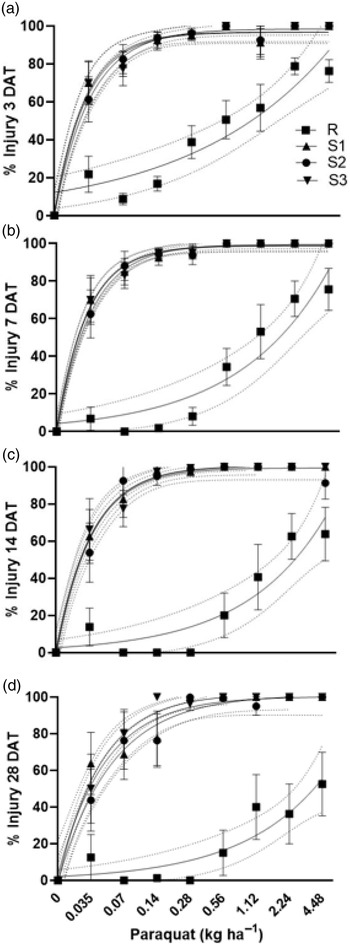
A significant paraquat rate by biotype interaction (P < 0.05) was observed; therefore, the interaction of the two main effects was assessed. Regression models present a clear separation of R and S biotypes in response to paraquat (Figure 1; Table 2). S biotype models tightly clustered and had overlapping confidence intervals at all injury-rating periods. S biotype injury increased exponentially compared with R. S biotypes, fit with an exponential growth equation, were injured approximately 60% and 80% at 3 and 7 DAT, whereas only paraquat greater than 2.24 kg ha−1 injured R greater than 60% at 3 and 7 DAT (Figure 1A and B). Across all rating timings, paraquat at 0.28 kg ha−1 controlled all S biotypes approximately 100%, but controlled R approximately 40% at 3 DAT and <10% at 7, 14, and 28 DAT.
Injury response of resistant (R) and susceptible (S) biotypes to increasing rates of paraquat at (A) 3, (B) 7, (C) 14, and (D) 28 d after treatment (DAT). Injury was rated on a 0% to 100% scale, where 0% is no injury or phytotoxicity induced by herbicide treatment, while 100% is complete absence of green tissue. Models and model components are presented in Table 2. Vertical bars are standard errors of individual means.

Function parameters for four biotypes modeled for percent control response at 3, 7, 14, and 28 d after treatment (DAT), and biomass response at 28 DAT.

a Equation: Y = Y M – (Y M − Y 0)*exp(−k*x), where Y 0 is the starting rate, Y m is the response maximum, and k the rate constant.
b Equation: Y = (Y 0 − plateau)*exp(k*x) + plateau, where Y 0 is the starting value of Y, plateau is the lower limit, and k is the rate constant.
c Equation: ), where Y 0 is control at the non-treated level, and k is the rate constant.
Paraquat rate at which 50% control or biomass reduction (I50) and 90% control or biomass reduction (I90) values for individual biotype response to paraquat based on modeling of control at 3, 7, 14, and 28 d after treatment (DAT) and biomass reduction at 28 DAT.

Paraquat induces rapid necrosis due to the formation of reactive oxygen species that interact with and destroy cell membranes (Hawkes Reference Hawkes2013). Rapid cell membrane disruption likely destroys the routes of translocation, preventing systemic movement of the herbicide. Thus, for the S biotypes, the level of control achieved at 3 DAT was at or near the level of control achieved at 28 DAT (Figure 1A and D). While paraquat at 2.24 and 4.48 kg ha−1 controlled R approximately 70% at 3 DAT (Figure 1A), control was less than or equal to 50% at 28 DAT (Figure 1D).
A similar response to control was observed for biomass response at 28 DAT (Figure 2). All paraquat rates reduced S biotype biomass exponentially compared with the non-treated. Paraquat at 0.07 kg ha−1 and greater reduced biomass of S biotypes to near 0 g, whereas paraquat at 4.48 kg ha−1 reduced R to approximately 1 g.
Biomass reduction of resistant (R) and susceptible (S) biotypes to increasing rates of paraquat at 28 d after treatment (DAT). Models and model components are presented in Table 2. Vertical bars are standard errors of individual means.

Concentrations that controlled or reduced biomass of R and S biotypes 50% (I50) and 90% (I90) were calculated using models (Table 3). I50 values for S biotype control and biomass reduction were 0.2 to 0.4 kg ha−1. By comparison, I50 values for R control increased across rating dates from 0.93, 1.64, 2.38, and 3.74 kg ha−1, resulting in an approximate 100-fold difference at 28 DAT. The I50 value for R biomass reduction was lower at 0.32 kg ha−1, which still represents a 10-fold difference compared with S biotypes. I90 values for S biotypes control and biomass ranged from 0.04 to 0.21 across rating dates.
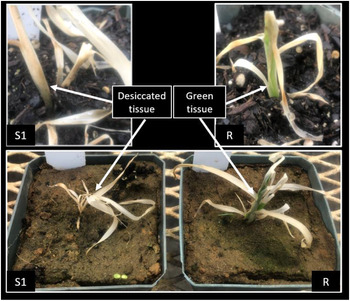
R responded to paraquat in two distinctly different ways compared with S biotypes. First, R was not injured by paraquat to the extent that S biotypes were at 3 DAT and subsequent rating dates (Figure 1). Paraquat at 2.24 kg ha−1 induced complete desiccation of S1 (and other S biotypes) leaf sheath and inner newly forming leaves (Figure 3). While the outer leaf sheath in the R biotype was desiccated, the inner developing leaf remained green and survived to allow the plant to regrow. A similar initial yet contained injury that allows for recovery has been previously reported in horseweed [Conyza canadensis (L.) Cronquist] (Lehoczki et al. Reference Lehoczki, Laskay and Szigeti1992). Considering the speed of paraquat activity and the symptomology of R, we theorize three possible mechanisms of herbicide resistance: (1) paraquat was simply not absorbed and translocated to the site of action in R to the same extent as in S biotypes; (2) paraquat was rapidly detoxified after absorption, or (3) there was modification of the site of action that prevented electron disruption by paraquat. Further discussion of these three theories is provided.
Resistant (R) and susceptible (here S1) biotypes at 3 d after treatment (DAT) with paraquat at 2.24 kg ha−1. S1 biotypes were completely devoid of green tissue, while R had green tissue remaining inside the leaf sheath from which the plant regrew.

First, could paraquat absorption and translocation be reduced in R compared with S? Reduced translocation in paraquat-resistant Italian ryegrass [Lolium perenne L. ssp. multiflorum (Lam.) Husnot] has been reported, yielding credence to this as a possible mechanism (Brunharo and Hanson Reference Brunharo and Hanson2017). Vacuolar sequestration was theorized to restrict movement of paraquat (Brunharo and Hanson Reference Brunharo and Hanson2017). Reduced translocation was also observed in hairy fleabane [Conyza bonariensis (L.) Cronquist] and rigid ryegrass (Lolium rigidum Gaudin) (Fuerst et al. Reference Fuerst, Nakatani, Dodge, Penner and Arntzen1985; Yu et al. Reference Yu, Cairns and Powles2004). Currently, the most convincing empirical evidence suggests that reduced absorption and translocation act as the primary mechanism of paraquat resistance.
Second, could paraquat be rapidly detoxified after absorption? Brunharo and Hanson (Reference Brunharo and Hanson2017) did not observe increased paraquat metabolism in paraquat-resistant L. perenne with decreased absorption and translocation along with vacuolar sequestration. Greater paraquat resistance has been attributed to endogenous polyamine detoxification of paraquat; however, the mechanism is not fully understood (Luo et al. Reference Luo, Wei, Dong, Shen and Chen2019). Production of reactive oxygen species occurs rapidly after paraquat absorption, with free radicals continually generated by paraquat to such a high level (Babbs et al. Reference Babbs, Pham and Coolbaugh1989) that it is difficult to conceive of an innate reactive oxygen detoxification system robust enough to cause herbicide resistance.
Third, could the R biotype have a modified site of action that prevents normal paraquat electron disruption? Hawkes (Reference Hawkes2013) states, “With regard to the possibility of target site resistance (TSR), it is debatable whether paraquat has any specific binding site from which it accepts electrons” (p. 1319). If Hawkes (Reference Hawkes2013) is correct, with no binding site there can be no TSR. If a more definitive target site is identified, perhaps TSR will be discovered in future.
In our opinion, PSI-ED resistance is a somewhat forgotten problem in herbicide-resistance research. With the explosion of glyphosate-resistance cases in the early 2000s and novel resistance to PPO inhibitors and auxin mimic herbicides, paraquat resistance is “old news,” despite paraquat continuing to be a valuable herbicide. However, preventing herbicide resistance to preserve the utility of older herbicides will aid chemical-based herbicide management in the future. Greater understanding of how weeds evolve resistance will aid in preventing future herbicide-resistance cases from occurring. We have provided evidence that paraquat resistance is still occurring. Future research will focus on determining a mechanism of resistance for the R E. indica biotype evaluated. Research will first focus on variation in native gene expression in R and S biotypes and attempts to understand the physiology of R plants both before and after paraquat treatment.
Acknowledgments
This publication was supported by the Alabama Agricultural Experiment Station and the Hatch Program of the National Institute of Food and Agriculture, U.S. Department of Agriculture. The authors declared that the research was conducted without any commercial or financial interactions that could be interpreted as likely conflicts of interest.