Introduction
Cotton is a major economic crop cultivated all over the world, providing renewable textile fibre, seed oil and high protein meals (Chen et al., Reference Chen, Scheffler, Dennis, Triplett, Zhang, Guo, Chen, Stelly, Rabinowicz, Town, Arioli, Brubaker, Cantrell, Lacape, Ulloa, Chee, Gingle, Haigler, Percy, Saha, Wilkins, Wright, Van Deynze, Zhu, Yu, Abdurakhmonov, Katageri, Kumar, Mehboob-Ur-Rahman, Yu, Kohel, Wendel and Paterson2007). China's cotton consumption is the largest in the world. Cotton in China is grown relatively concentrated, mainly distributed in three regions with different ecological environments in Xinjiang, the North China Plain and the Yangtze River Basin. With the development of textile technology and the growth of human living standards, the requirements for fibre quantity and quality are ever-increasing. However, due to the high labour costs and low profits, cotton planting area in China has decreased rapidly according to the data from the National Bureau of Statistics in the past five years.
The application of large mechanical equipment can improve field efficiency by reducing operational time and save labour and financial resources at the same time. Along with this, mechanical harvesting of cotton requires leaf abscission and boll dehiscence before harvesting to ensure fibre cleanliness and maximize harvesting efficiency (Awg-Adeni et al., Reference Awg-Adeni, Abd-Aziz, Bujang and Hassan2010; Singh et al., Reference Singh, Rathore and Gumber2014). Defoliation is a natural physiological process in the growth of cotton; however, it cannot meet the requirements of mechanical harvesting timely and fully (Ashraf et al., Reference Ashraf, Begam and Ragavan2021). Therefore, applying chemicals such as defoliants, desiccants and growth-regulators is an effective auxiliary method, which can make cotton leaves fall off earlier than normal (Siebert and Stewart, Reference Siebert and Stewart2006; Ashraf et al., Reference Ashraf, Ragavan and Begam2020). Several popular types of chemicals have been tested in the world. Thidiazuron, a cytokinin activity analogue, was widely used to promote leaf abscission through a variety of ways, such as affecting the balance among ethylene, auxin and abscisic acid and changing reactive oxygen species metabolism and photosynthetic efficiency (Xu et al., Reference Xu, Chen, Sun, Wusiman, Sun, Li, Gao, Kong, Zhang, Zhang, Xu and Yang2019; Jin et al., Reference Jin, Wang, Xu, Gui, Zhang, Dong, Sikder, Yang and Song2020, Reference Jin, Xu, Gui, Zhang, Dong, Sikder, Wang, Yang and Song2021; Chandrasekaran et al., Reference Chandrasekaran, Ravichandran, Senthil, Mahalingam and Sakthivel2021; Liu et al., Reference Liu, Wei, Yang, Xu and Xue2021). Spraying paraquat had a significant influence on the plant height, leaf-area index, dry-matter production, growth attributes and the per cent of leaf fall (Ashraf et al., Reference Ashraf, Ragavan and Begam2020). However, the application of paraquat was limited to the opening of all mature cotton bolls. The plant growth regulators such as ethephon, mepiquat chloride, cyclanilide and dimethipin were applied to accelerate boll dehiscence and leaf fall to aid harvesting and divert the nutrients towards the immure bolls so as to improve the seed cotton yield and quality (Ashraf et al., Reference Ashraf, Ragavan and Begam2020, Reference Ashraf, Begam and Ragavan2021; Kaur et al., Reference Kaur, Singh, Deol, Malik and Kaur2021; Sravanthi et al., Reference Sravanthi, Rekha, Venkateswarlu, Rao and Jayalalitha2022). The mixture of chemicals such as thidiazuron and diuron (known as drop ultra), thidiazuron and ethephon, endothall and ethephon, tribufos and ethephon, cyclanilide and ethephon, ethephon and triiodbenzoic acidhas also had been proved to accelerate defoliation and boll opening at the same time (Snipes and Baskin, Reference Snipes and Baskin1994; Du et al., Reference Du, Ren, Tian, Duan, Zhang, Tan and Li2013; Mrunalini et al., Reference Mrunalini, Rekha, Murthy and Jayalalitha2019; Ashraf et al., Reference Ashraf, Begam and Ragavan2021; Chandrasekaran et al., Reference Chandrasekaran, Ravichandran, Senthil, Mahalingam and Sakthivel2021; Meng et al., Reference Meng, Zhang, Qi, Du, Zuo, Zhang, Tian and Li2021; Sravanthi et al., Reference Sravanthi, Rekha, Venkateswarlu, Rao and Jayalalitha2022).
On the other hand, the timing of spraying defoliant is an important factor to be taken into consideration (Ashraf et al., Reference Ashraf, Begam and Ragavan2021). Delaying defoliation allows the development of immature bolls, which may potentially increase yield (Snipes and Baskin, Reference Snipes and Baskin1994). However, delaying defoliation also increases the risks of late season rainy weather, light deficiency, lower temperatures or early frost, which will lead to yield loss (Bange and Milroy, Reference Bange and Milroy2000; Mo et al., Reference Mo, McDougall, Beaumont, Munro and Stevens2018; Wang et al., Reference Wang, Han, Lin, Chen, Kong, Ning, Wang, Yu and Liu2019; Raghavendra and Reddy, Reference Raghavendra and Reddy2020). Appropriate defoliation timing may balance the rate of increase in fibre yield and loss in fibre quality (Faircloth et al., Reference Faircloth, Edmisten, Wells and Stewart2004). Therefore, it is recommended to spray defoliants when about 60% of cotton bolls are open (Mrunalini and Rekha, Reference Mrunalini and Rekha2018; Mrunalini et al., Reference Mrunalini, Rekha and Murthy2018; Haliloglu et al., Reference Haliloglu, Cevheri and Beyyavas2020; Jajoria et al., Reference Jajoria, Sharma, Sharma and Narolia2020; Raghavendra and Reddy, Reference Raghavendra and Reddy2020; Chandrasekaran et al., Reference Chandrasekaran, Ravichandran, Senthil, Mahalingam and Sakthivel2021). Studies have shown that early defoliation resulted in losses of yield, quality and profitability, while the use of defoliants in the later period had the opposite effects (Bednarz et al., Reference Bednarz, Shurley and Anthony2002; Faircloth et al., Reference Faircloth, Edmisten, Wells and Stewart2004; Singh and Rathore, Reference Singh and Rathore2015; Ashraf et al., Reference Ashraf, Ragavan and Begam2020; Long et al., Reference Long, Delhom and Bange2021). When the spraying time is delayed to approximately 70–80% of the boll opening, the greatest return was produced (Larson et al., Reference Larson, Gwathmey and Hayes2002; Sravanthi et al., Reference Sravanthi, Rekha, Venkateswarlu, Rao and Jayalalitha2022).
Since fibre yield and quality related traits are controlled by genotype, environment and genotype × environment interaction, cultivar selection is another important factor to be considered (Long et al., Reference Long, Delhom and Bange2021). For example, 75% of the variation in fibre length comes from the variety, while the variation in micronaire is mostly due to weather and management, and only 25% is determined by genetics (Faircloth et al., Reference Faircloth, Edmisten, Wells and Stewart2004). In the current study, four commercial cultivars with different yield and quality traits were selected to study the effects of cultivars sprayed with defoliant on fibre yield and quality. Observations were made after spraying defoliant at three different periods in the early, middle and late stages. In addition, the changes in the bolls from different fruiting branch positions after spraying defoliant were also observed.
Therefore, the overall objectives of the current experiment were to study the impact of cotton genotypes and defoliant spraying times on leaf defoliation, boll opening rate, fibre yield and quality and to screen the optimum defoliant spraying time. These results might provide guidance for determining the appropriate spraying time that was conducive to mechanical harvesting.
Materials and methods
Materials
Four cotton cultivars were used in the current study. The seeds of cotton cultivars LMY21, LMY36, K836 and L7619 were provided by Institute of Industrial Crops, Shandong Academy of Agricultural Sciences. These cultivars were approved by the Shandong Province from 2005 to 2013, suitable for cultivation in the North China Plain cotton area, and have been commercially cultivated. The defoliant used in the experiment was Tuotulong from Bayer Crop Science (Germany), which was a mixed suspension concentrate of 360 g/l thidiazuron and 180 g/l diuron.
Study site and experimental design
The experiment was conducted in Linqing (36°53' N and 115°41' E), Shandong province, China in 2019 and 2020. The soil of the experimental site was sandy loam in texture, with moderately higher soil fertility and good drainage and irrigation conditions. During deep ploughing in both years, 450 kg per hectare of nitrogen, phosphorus and potassium compound fertilizer (25% N, 10% P2O5 and 18% K2O) were used as the basal fertilizer to prepare for cotton planting. Cotton seeds were sown on 26 April 2019 and 27 April 2020, respectively. The experiment was conducted by means of split plot design with three replications. The main plot comprised of four cultivars LMY21 (A1), LMY36 (A2), K836 (A3) and L7619 (A4) and the sub plot consisted of three times of defoliant spraying. Three treatments of spraying defoliant were carried at 26 August (B1, early spraying), 6 September (B2, middle spraying) and 17 September (B3, late spraying) respectively in 2019 and 2020. Each plot was divided into four rows with equal row spacing of 76.0 cm and a total area of 34.2 m2. In each treatment, two rows were sprayed with defoliant and two rows with water as blank control. All the other cultural and field management practices such as irrigation, weeding and pest management followed the normal local managements.
Data scoring
Ten cotton plants were chosen at random and tagged from two rows at the centre of each treatment to evaluate the effect of defoliant on leaf defoliation, boll opening, yield and quality. All leaves on the fruiting nodes in a plant were counted separately at 0 (on the day before treatment), 5, 10, 15, 20, 25 days after defoliant spraying. The total number of opened bolls and unopened bolls of 10 tagged plants were also measured for 6 times. And then the rate of leaf defoliation and the percentage of opened bolls were calculated.
At harvest time, all the fully opened bolls were picked from the 10 tagged plants to investigate fibre yield and quality traits. Besides, all fruiting branches were divided from bottom to top into three parts: 1–4 fruiting branches were the lower part, 5–8 fruiting branches were the middle part, and 9 or more fruiting branches were the upper part. In order to understand the effect of defoliant on different parts of cotton fruiting branches, 20 fully opened bolls were harvested in the upper, middle and the lower parts in each plot. Firstly, the yield-related traits such as the yield, boll weight and lint percentage of the mixed sample and the samples of the upper, middle and lower parts were weighed and calculated by conventional methods. Soon afterwards, these samples were sent to the Supervision, Inspection and Test Center of Cotton Quality, Ministry of Agriculture of China (Anyang, China) to detect quality-related traits through the HVI900 fibre testing system, including fibre length, fibre uniformity, fibre strength, micronaire and fibre elongation.
Statistical analysis
The statistical results of main plot (cultivar, A), subplot (spraying time, B) and their interaction (A × B) effects on leaf defoliation, percentage of opened bolls, fibre yield and quality were performed by SPSS 21.0 and DPS 7.05. The Duncan's new complex polar difference method was used for multiple comparisons and significant differences (P < 0.05) test on the averages of each treatment. Finally, figures and tables were drawn using GraphPad Prism 9 and Excel software, respectively.
Results
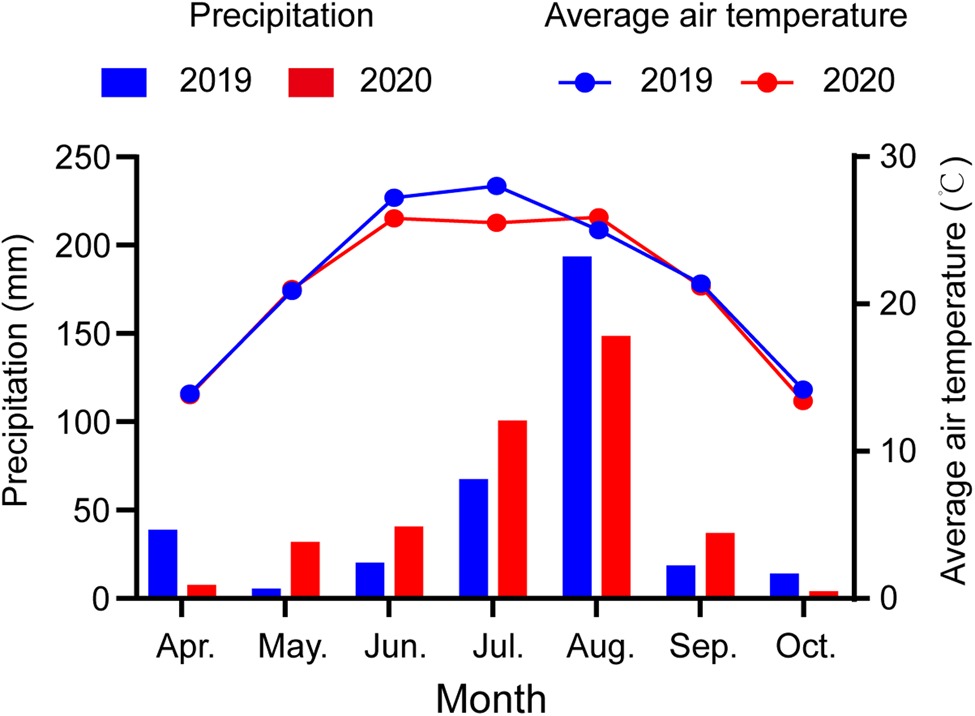
The data of temperature and rainfall were obtained for each year from the Linqing Statistical Yearbook. The average monthly temperatures and rainfall during the cotton growing period (from April to October in 2019 and 2020) are shown in Fig. 1. The average monthly temperatures between the two years were basically the same, however, there were differences in rainfall, with the total rainfall during the cotton growing period in 2020 being higher than that in 2019. Due to the environmental differences between years, the statistical results of all survey indicators were listed separately in the subsequent analysis.
The average monthly temperatures and monthly total rainfall during the cotton growing season in 2019 and 2020.

The interactive effect of cotton cultivars and spraying time on leaf defoliation
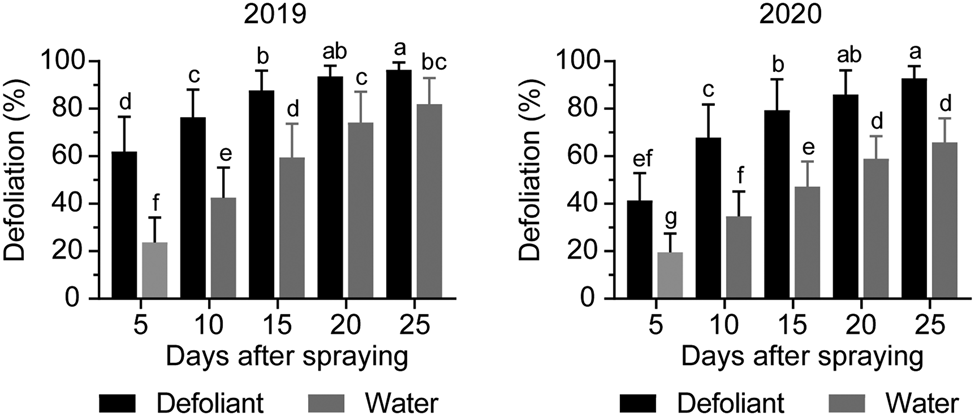
On the day of spraying, there was no obvious difference in the initial number of plant leaves between the defoliant (33.1 leaves per plant) and blank control (33.2 leaves per plant) across two years. The effects on defoliation were the same in 2019 and 2020 (Fig. 2). In 2019 and 2020, five days after spraying, the average defoliation rates of the defoliant treatments were 61.9 and 41.4%, respectively, and the average defoliation rates of the blank control group were 23.7 and 19.6%, respectively. The defoliation rate of the defoliant treatments was more than twice that of the blank control group, and the difference reached a very significant level (P < 0.001). The defoliant effectively promoted the shedding of cotton leaves. Twenty-five days after spraying, the mean number of defoliation rates for all the defoliant treatments in 2019 was 96.4%, while the blank control was 82.0%, and the corresponding results in 2020 were 92.8 and 65.9%, respectively.
The comparison of average defoliation rate between defoliant and water after defoliant treatments for 2019 and 2020. The data are the mean and standard error of all the treatments in each year. The same letter indicates no significant difference at 0.05 level.

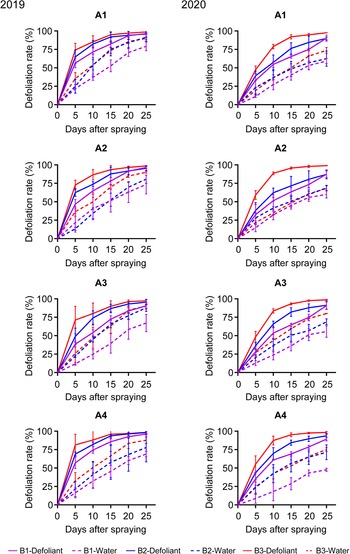
The changing trend of defoliation of each variety after treatment with different spraying time is shown in Fig. 3. All treatments showed the fastest rate of defoliation at 5 days after spraying defoliant, and then the increase in rate of leaf falling slowed down. After spraying defoliant, the defoliation effect of B1 and B2 treatment at 25 days was equivalent to that of B3 treatment at 15 days, and the average defoliation rates were 92.2, 93.3 and 93.8%, respectively. The defoliation rate of four cotton cultivars did not differ much at 15, 20 and 25 days after spraying for the B3 treatment. Among them, the average defoliation rate of the L7619 (A4) variety was the largest, which was 95.5, 97.1 and 98.3%, respectively.
The defoliation rate after defoliant treatments in 2019 and 2020. A1, A2, A3 and A4 represent LMY21, LMY36, K836 and L7619. B1, B2 and B3 stand for the spraying time on 26 August, 6 September and 17 September. The solid line and dotted line with different colours represent the spraying of defoliant and water at different spraying time. The data are the mean and standard error of three replications.

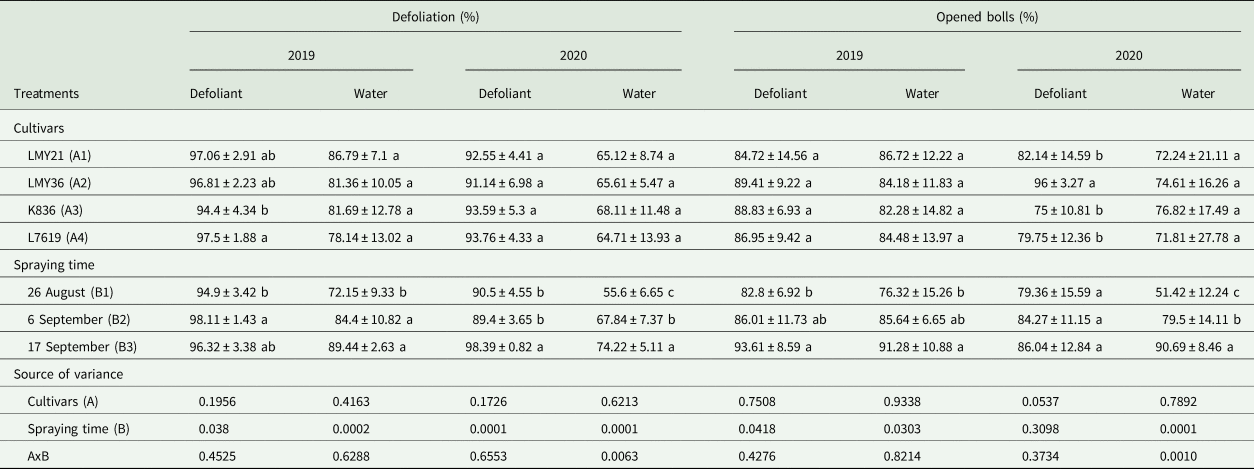
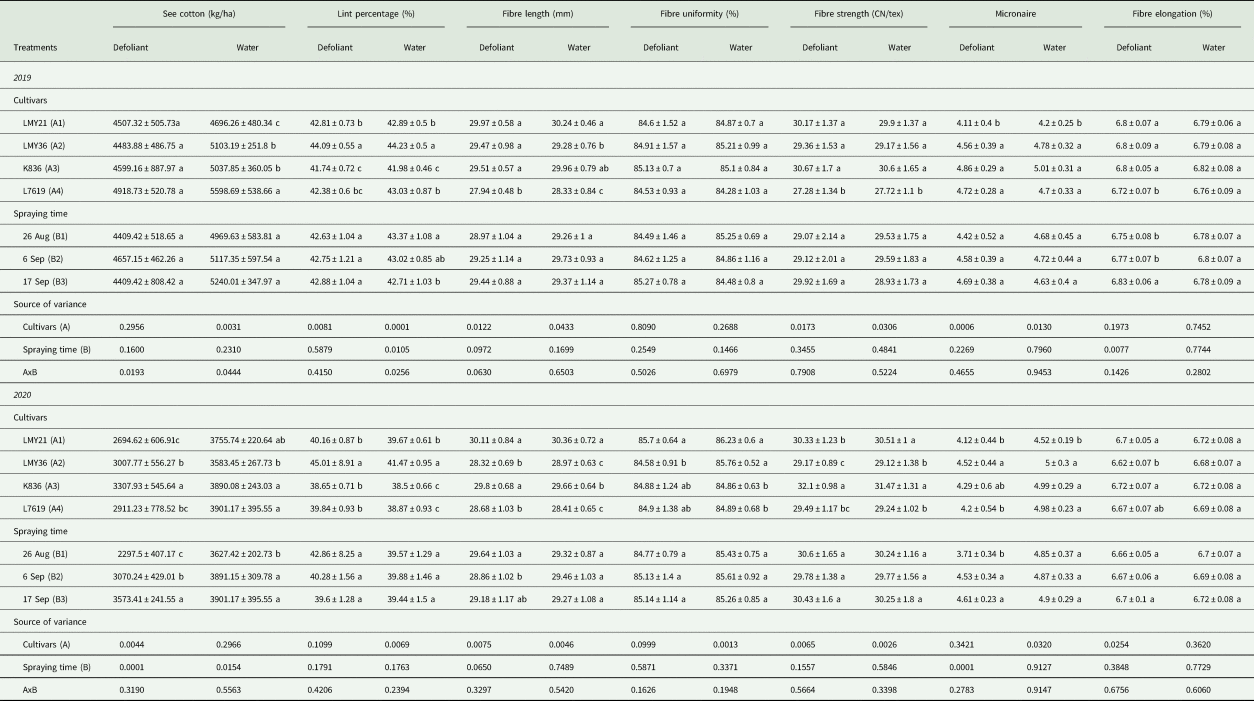
In this study, the defoliation was not significantly affected by cultivar and cultivar × spraying time interaction (Table 1). After spraying defoliant, the defoliation of all cultivars exceeded 90%, which was higher than that of the control. Among them, L7619 (A4) was the most sensitive to defoliant than other cultivars. L7619 had the highest defoliation, with an average of 95.6% across two years, while natural defoliation without defoliant was only 71.4%. The effect of spraying time on defoliation was significant (P < 0.05 in 2019 and ≤0.001 in 2020). With the delay in spraying time, the defoliation rate increased and reached the maximum for the 3 treatments.
Effects of cotton cultivars and spraying time on defoliation and boll opening at harvest time

The data were the mean and standard error of three replications. The same letter indicated no significant difference at 0.05 level.
The interactive effect of cotton cultivars and spraying time on boll opening
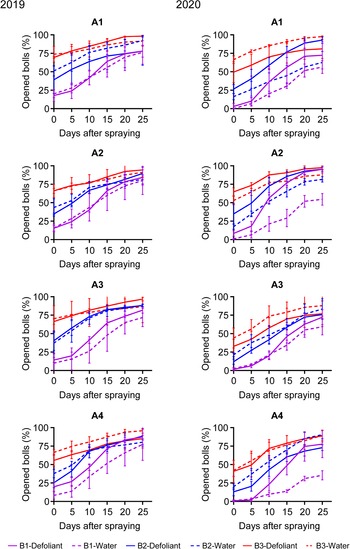
In 2019, the average percentage of opened bolls on the day of B1, B2 and B3 treatments were 16.8, 34.9 and 64.4%. However, the value was lower in 2020 than the same period in 2019, with the average values being 3.52, 21.6 and 46.9%. The reason might be that the rainfall in the middle of cotton growing period (June and July) in 2020 was higher than that in 2019, and the plant's vegetative growth was vigorous, and the overall boll opening rate was delayed. The comparison between the boll opening rate of each treatment is shown in Fig. 4. Compared with the blank control, spraying defoliant for the B1 treatment increased the boll opening rate of all cultivars.
The percentage of opened bolls after defoliant treatments in 2019 (top) and 2020 (bottom). The meanings represent by A1-4 and B1-3 are as shown above. The data are the mean and standard error of three repetitions.

The cultivar and its interaction with spraying time had no significant effect on the boll opening rate (Table 1). There was no significant difference among all cultivars in the control group (water) across two years (P = 0.934 in 2019 and 0.789 in 2020). After spraying defoliant, the average boll opening rate was higher than that of the blank control. Among them, the boll opening rate of LMY36 (A2) increased after spraying defoliant in two years. The spraying time had a significant effect on the boll opening rate in 2019 (P = 0.042). As the spraying time was delayed, the boll opening rate increased gradually. The average value of the boll opening rate investigated for the B3 treatment (89.81%) was higher than the other treatments.
The interactive effect of cotton cultivars and spraying time on fibre yield and quality in mixed samples
The seed cotton yield, lint percentage and fibre elongation decreased in 2020, and the difference between the two years was extremely significant (P < 0.001) as shown in Table 2. Meanwhile, the fibre strength and uniformity increased significantly in 2020 (P = 0.004 and 0.024, respectively). These traits were greatly affected by the environment. The fibre length and micronaire did not differ significantly between two years (P = 0.770 and 0.624, respectively).
Effects of cotton cultivars and spraying time on yield and quality in mixed samples

The data were the mean and standard error of three replications. The same letter indicated no significant difference at 0.05 level.
As evident from data presented in Table 2, the difference in the fibre yield and quality mainly came from cultivars, except for the fibre uniformity in 2019. Compared with the blank control, the seed cotton yield was reduced after spraying defoliant. Among the four cultivars, L7619 (A4) had the highest seed cotton yield, but suffered the most adverse effect after spraying defoliant, with a reduction of 679.9 and 989.9 kg/ha in two years. After spraying defoliant, the average seed cotton yield was the lowest for the B1 treatment (3353 kg/ha) and the highest for the B3 treatment (3991 kg/ha). The early spraying of defoliant (B1) had the greatest adverse effect on the yield of seed cotton, with an average reduction of 945.1 kg/ha. The lint percentage was stably higher after spraying defoliant for the B3 treatment than that of the water in two years. For the treatments of B1 and B2, spraying defoliant in 2019 reduced the lint percentage, but the result in 2020 was the opposite. Therefore, the effect of defoliant on the lint may be related to the environment, which should be investigated further.
The effect of spraying time on fibre quality was not significant. However, as the spraying time was delayed, the performance of each trait was improved. For the B3 treatment, after spraying defoliant, the fibre strength was steadily higher than control for two years, increasing by 0.99 and 0.18 cN/tex, respectively.
The interactive effect of cotton cultivars and spraying time on fibre yield of different parts of cotton fruiting branches
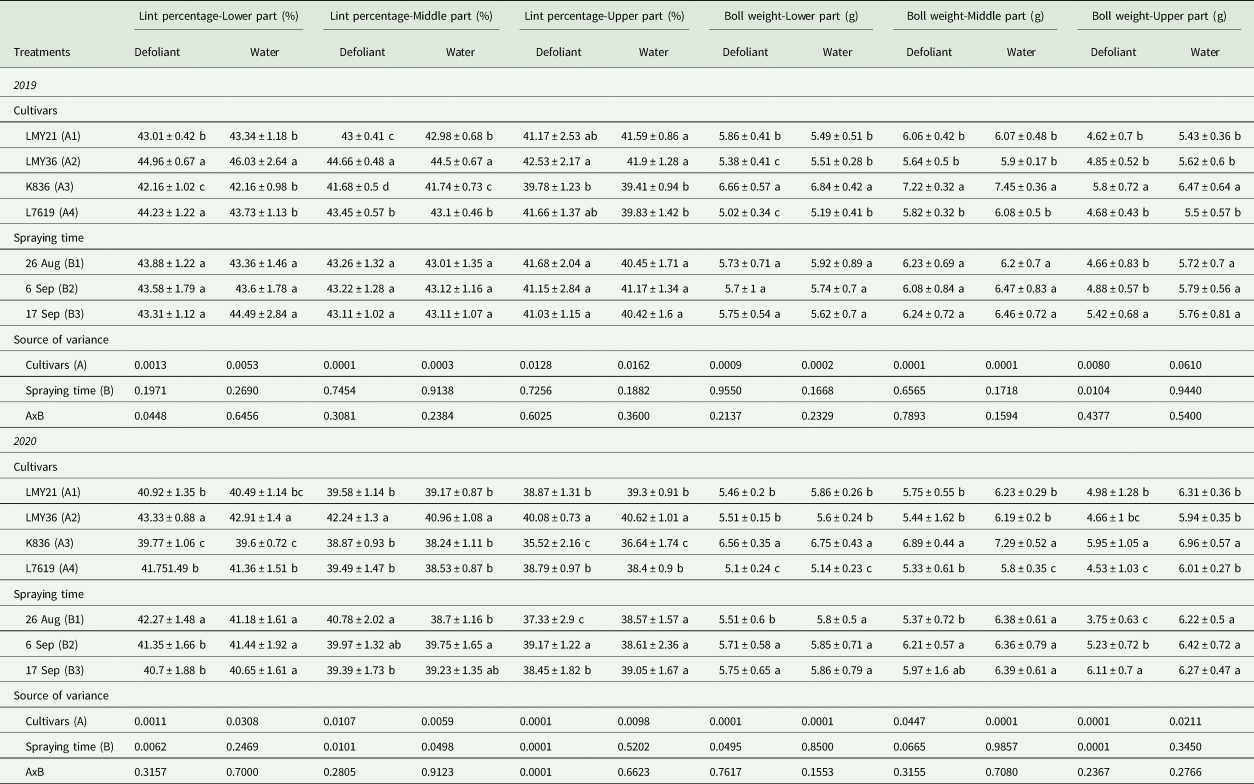
The statistical results show that due to environmental influences, the lint percentage of all cultivars in 2020 was lower than that of the same part in 2019 (Table 3). Regardless of spraying defoliant or water, the lower fruiting branches of all cultivars had the highest lint percentage, the middle part had the highest boll weight, and the upper fruiting branches had the lowest lint percentage and boll weight. In 2019 and 2020, spraying defoliant had a positive effect on the lint percentage of the middle part, which was 0.12 and 0.82 higher than that of water, respectively. In contrast, compared with water, spraying defoliant showed a negative effect and reduced the boll weight of all fruiting branches. Among them, the boll weight of upper part in two years decreased by 0.77 and 1.27 g, respectively, and the difference reached a significant level (P < 0.001).
Effects of cotton cultivars and spraying time on yield components in three parts of fruiting branches

The data were the mean and standard error of three replications. The same letter indicated no significant difference at 0.05 level.
There was a significant difference among cultivars for lint percentage and boll weight of all fruiting branches, while the spraying time had no significant effect on them. The effect of defoliant on different cultivars varied from year to year. However, after spraying defoliant, the lint percentage of the upper, middle and lower parts of L7619 (A4) increased in two years. Compared with the water, spraying defoliant in all periods steadily increased the lint percentage of the middle part within two years. For the B1 treatment, the lint percentage of lower part increased by 0.52 and 1.09 respectively in two years after spraying defoliant. Among the four varieties, the boll weight of the upper, middle and lower parts of K836 (A3) was the highest, which was stable in two years. The boll weight of all three parts was highest for the B3 treatment. In general, spraying defoliant for the B1 treatment increased the lint percentage of the middle and lower parts, and reduced the boll weight of the upper and middle parts. The negative effect for B1 treatment on lint percentage and boll weight was greater than for the B2 and B3 treatments.
The interactive effect of cotton cultivars and spraying time on fibre quality of different parts of cotton fruiting branches
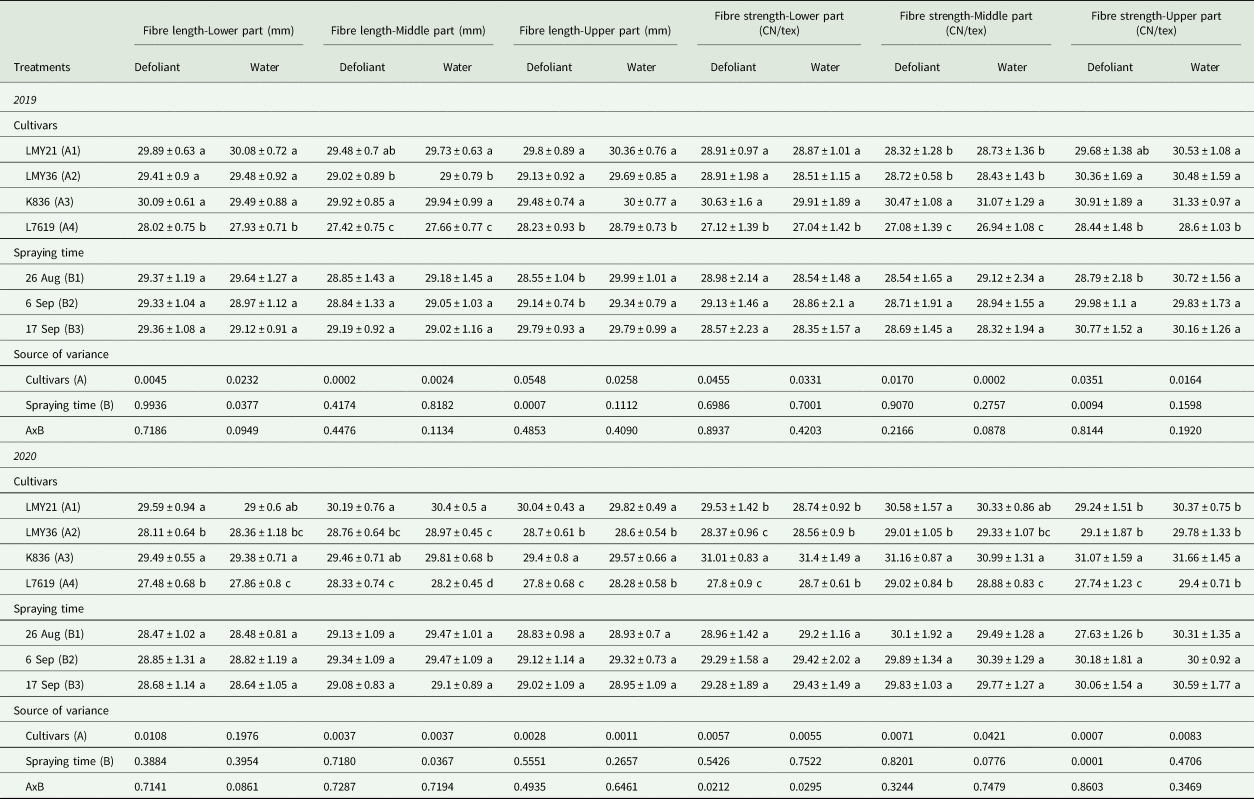
The results of the multiple comparison analysis for all treatments on fibre quality of different parts of cotton fruiting branches are shown in Table 4, S1 and S2.<TE: Please check Supplementary material with xml.> Comparing the results of the two years, it was found that the fibre length and elongation of the upper, middle and lower parts decreased in 2020, and the fibre uniformity and strength increased. The fibre micronaire did not differ significantly between the two years (P = 0.187, 0.019 and 0.624 for fibre micronaire of the upper, middle and lower parts, respectively). The change trend of each treatment was consistent in two years. The cultivar was the main source of variation for the fibre length and strength of the upper, middle and lower parts. Among the four cultivars, the fibre length and strength of L7619 (A4) was the lowest, and the value of K836 (A3) was the highest. The fibre length and strength of the upper part were most negatively affected by spraying defoliant for the B1 treatment. Although there were no significant differences in fibre length and strength, the fibre length of all cultivars was reduced by the effect of defoliant, while the fibre strength was slightly increased after spraying defoliant for the B3 treatment.
Effects of cotton cultivars and spraying time on fibre quality in three parts of fruiting branches

The data were the mean and standard error of three replications. The same letter indicated no significant difference at 0.05 level.
The fibre uniformity of the upper, middle and lower parts had little difference among cultivars. In all treatments, the earlier the spraying time, the greater the impact on the fibre uniformity. Spraying defoliant for the B1 treatment had the greatest negative impact on the fibre uniformity. The micronaire of the upper, middle and lower parts was reduced after spraying defoliant for the B1 and B2 treatments, and the influence on the upper part was the greatest. Among all the observed traits in the current study, the variation of fibre elongation was the smallest. Spraying defoliant for the B1 treatment reduced the fibre elongation of the upper part, while spraying defoliant for the B2 and B3 treatments had little effect on the fibre elongation of all the observed parts.
Discussion
The results of the current study showed that defoliation, boll opening, seed cotton yield, fibre strength and uniformity differed greatly across two years. The main reason might be that the amount of rain in the middle of cotton growth in 2020 was higher than that in 2019, and the plant grew vigorously. The dense crop canopy caused by the excessive vegetative growth of cotton hindered the opening of mature bolls, delayed crop maturity, and affected a series of subsequent related traits (Bange and Milroy, Reference Bange and Milroy2000; Mo et al., Reference Mo, McDougall, Beaumont, Munro and Stevens2018; Mrunalini et al., Reference Mrunalini, Rekha, Murthy and Jayalalitha2019; Raghavendra and Reddy, Reference Raghavendra and Reddy2020). Some traits had the same change trend in the two years after spraying the defoliant, while some traits had opposite, which indicated that the effect of defoliant spraying on these traits might be also affected by environmental changes.
Previous studies have found that applying defoliants at the time of 20–40% boll opening would reduce the cotton lint yield (Snipes and Baskin, Reference Snipes and Baskin1994; Gwathmey et al., Reference Gwathmey, Bednarz, Fromme, Holman and Miller2004; Bange et al., Reference Bange, Long, Constable and Gordon2010; Çopur et al., Reference Çopur, Demirel, Polat and Gür2010; Chen et al., Reference Chen, Han, Zhang, Wang, Yu and Lin2017; Gormus et al., Reference Gormus, Kurt and Sabagh2017), while the application of defoliants at 60% boll opening could increase the cotton lint yield (Bynum and Cothren, Reference Bynum and Cothren2008; Gormus et al., Reference Gormus, Kurt and Sabagh2017; Chandrasekaran et al., Reference Chandrasekaran, Ravichandran, Senthil, Mahalingam and Sakthivel2020, Reference Chandrasekaran, Ravichandran, Senthil, Mahalingam and Sakthivel2021; Haliloglu et al., Reference Haliloglu, Cevheri and Beyyavas2020; Jajoria et al., Reference Jajoria, Sharma, Sharma and Narolia2020; Raghavendra and Reddy, Reference Raghavendra and Reddy2020). In the current study, the opened bolls accounted for about 20% when spraying defoliant on 26 August (B1), about 40% on 6 September (B2) and 60% on 17 September (B3). The current results showed that defoliant caused significant yield loss at the time of 20–60% boll opening across two years, and the loss was the largest under 20% boll opening. In terms of field performance, early spraying of defoliant resulted in smaller bolls and poor boll formation, which in turn affected yield. Nevertheless, spraying defoliant at 20–40% boll opening had little effect on the lint percentage, and spraying defoliant at 60% boll opening even slightly increased the lint percentage. For quality traits, most studies suggest that spraying defoliants at proper time might shed immature cotton bolls without affecting cotton fibre quality (Malik and Makhdum, Reference Malik and Makhdum2002; Faircloth et al., Reference Faircloth, Edmisten, Wells and Stewart2004; Bange et al., Reference Bange, Long, Constable and Gordon2010; Çopur et al., Reference Çopur, Demirel, Polat and Gür2010; Singh and Rathore, Reference Singh and Rathore2015; Ashraf et al., Reference Ashraf, Ragavan and Begam2020; Meng et al., Reference Meng, Zhang, Qi, Du, Zuo, Zhang, Tian and Li2021). Other studies have shown that spraying defoliants at later stage may promote the fibre micronaire and maturity ratio (Long et al., Reference Long, Delhom and Bange2021). As shown in Table 2, spraying defoliant at 20–60% boll opening only affected the fibre length in 2020 and the fibre micronaire in 2019. And compared with the blank control (water), the application of defoliant at 60% boll opening had the least impact on fibre quality traits.
Besides, the growth period of cotton generally extends 4 months. In the North China Plain, cotton is usually harvested in mid-October. The current study showed that 25 days after defoliant spraying in all treatments, the leaf abscission rate exceeded 90%. However, if the time between the defoliant spraying and the harvest was too long, it might increase the possibility of a decline in fibre yield and quality due to the adverse weather (Bange and Milroy, Reference Bange and Milroy2000; Wright et al., Reference Wright, Hutmacher, Shrestha, Banuelos, Rios, Hutmacher, Munk and Keeley2015; Mo et al., Reference Mo, McDougall, Beaumont, Munro and Stevens2018; Raghavendra and Reddy, Reference Raghavendra and Reddy2020). On the other side, after spraying defoliant at an early stage, cotton was prone to secondary growth before harvest, resulting in redundant vegetative shoots and thus increased the trash content at harvest. In 2019, the defoliation exceeded 90% at 20 days after spraying for the B1 treatment, 15 days after defoliant spraying for the B2 and B3 treatments, respectively. While in 2020, 25 days after defoliant spraying for the B1 and B2 treatments, and 15 days after defoliant spraying for the B3 treatment, the defoliation exceeded 90%. Therefore, despite the large difference in weather between the two years, the effect of spraying defoliant at a late stage was the most stable, and it could promote leaf defoliation in a short time and achieved the effect of assisting harvest.
In addition to environmental factors, cotton deciduous leaves were also affected by genetic factors (Singh and Rathore, Reference Singh and Rathore2015; Raghavendra and Reddy, Reference Raghavendra and Reddy2020; Long et al., Reference Long, Delhom and Bange2021). In the current experiment, four different cotton cultivars that had been approved by the Shandong Province were selected. The four cultivars had relatively large variations in the yield, lint percentage, fibre length and strength. Comparing the four cultivars, it was found that the quality (fibre length and strength) of LMY21 (A1) and K836 (A3) was better, and the yield and lint percentage were medium. LMY36 (A2) had the highest lint percentage, but the yield and quality were lower than medium. L7619 (A4) grew vigorously and had the highest yield, while the lint percentage, fibre length and strength were the worst. The comprehensive results showed that the degree of adverse effects of defoliant on fibre quality-related traits was less than that of fibre yield-related traits. Among them, L7619 (A4) had the strongest boll opening, and the cotton squares were easy to fall off after spraying defoliant, resulting in the largest loss in yield.
Spraying defoliant at an early stage affected the bolls in the middle and upper fruiting branches of cotton, and had the greatest impact on all traits. Spraying in the middle stage affected the boll in the upper fruiting branches, while spraying defoliant at late stage had little or even no effect on traits. Taken together, the spraying time of defoliant should be best determined according to the field conditions, cultivar characteristics, upcoming weather as well as the target harvest time.
Conclusion
In the current study, the effects of different spraying time of defoliant and cotton cultivars treatments were investigated, and the main factors affecting fibre yield and quality related traits were discussed. In terms of defoliant spraying time, compared with the blank control (water), the application of defoliant at 60% boll opening (B3, 17 September) resulted in the highest defoliation rate and boll opening rate, the minimal loss of seed cotton yield and had the least negative impact on fibre quality traits. The current results showed that the differences in fibre yield and quality were mainly due to cultivars. In addition, the cultivar and spraying time did not interact for almost all of the investigated traits.
Supplementary material
The supplementary material for this article can be found at https://doi.org/10.1017/S0021859623000151.
Author contributions
ZW and XS conceived and designed the study. BD, MX and XW conducted data gathering. LG, GS, JW and ZH collected and cultivated all the plant materials. LW, YD and FK performed statistical analyses. LW, MS and XS wrote and revised the article.
Financial support
The study was funded by Demonstration and Promotion Project of Lumianyan No. 30 and No. 36 (08214224444014), Agricultural Seed Projects of Shandong Province (2020LZGC002) and Modern Agro-industry Technology Research System of Shandong Province (SDAIT-03-02/03/05).
Conflict of interest
None.
Ethical standards
Not applicable.