Introduction
Alzheimer's disease (AD) accounts for approximately three-quarters of dementia cases (Ott et al. Reference Ott, Breteler, van, Claus, van der Cammen, Grobbee and Hofman1995). With an estimated 24.3 million people worldwide suffering from dementia (Ferri et al. Reference Ferri, Prince, Brayne, Brodaty, Fratiglioni, Ganguli, Hall, Hasegawa, Hendrie, Huang, Jorm, Mathers, Menezes, Rimmer and Scazufca2005), and a rapidly ageing population, the personal and economic implications of AD are clearly huge.
The incidence of late-onset AD increases exponentially with age, with the rate of those affected doubling approximately every 5 years after age 65 (Jorm et al. Reference Jorm, Korten and Henderson1987). Understanding more about factors associated with age of onset might provide clues as to the development of crucial disease-delaying strategies, in addition to increasing our general understanding of disease mechanisms. Some factors have been found to be associated with earlier age of AD onset, including possession of an apolipoprotein E (APOE) ε4 allele, head injury, major depressive disorder and family history of dementia (Tsai et al. Reference Tsai, Tangalos, Petersen, Smith, Schaid, Kokmen, Ivnik and Thibodeau1994; Duara et al. Reference Duara, Barker, Lopez-Alberola, Loewenstein, Grau, Gilchrist, Sevush and St George-Hyslop1996; Nemetz et al. Reference Nemetz, Leibson, Naessens, Beard, Kokmen, Annegers and Kurland1999; Aerssens et al. Reference Aerssens, Raeymaekers, Lilienfeld, Geerts, Konings and Parys2001; Cannon-Spoor et al. Reference Cannon-Spoor, Levy, Zubenko, Zubenko, Cohen, Mirza, Putnam and Sunderland2005). Other factors, such as possession of an APOE ε2 allele, have been found to be associated with later age of AD onset (Aerssens et al. Reference Aerssens, Raeymaekers, Lilienfeld, Geerts, Konings and Parys2001).
Pre-morbid Neuroticism (commonly defined as a ‘tendency to experience negative emotion’) is an interesting candidate for association with age of onset, for several reasons. These include association of this personality domain with pre-existing variation in brain structure and function (Stelmack et al. Reference Stelmack, Houlihan and McGarry-Roberts1993; Socan & Bucik, Reference Socan and Bucik1998; Knutson et al. Reference Knutson, Momenan, Rawlings, Fong and Hommer2001; Deckersbach et al. Reference Deckersbach, Miller, Klibanski, Fischman, Dougherty, Blais, Herzog and Rauch2006), links to a range of other physical and mental health conditions (Andrews, Reference Andrews1996; Goodwin et al. Reference Goodwin, Cox and Clara2006), and possible association with risk of AD or cognitive impairment in old age (Meins & Dammast, Reference Meins and Dammast2000; Wilson et al. Reference Wilson, Evans, Bienias, de Leon, Schneider and Bennett2003; Crowe et al. Reference Crowe, Andel, Pedersen, Fratiglioni and Gatz2006). However, the relationship between pre-morbid Neuroticism and age of AD onset has not yet been investigated. Based upon the possible adverse effects of Neuroticism on the brain, we predicted that higher midlife Neuroticism would be associated with earlier age of onset of AD.
Method
Research participants
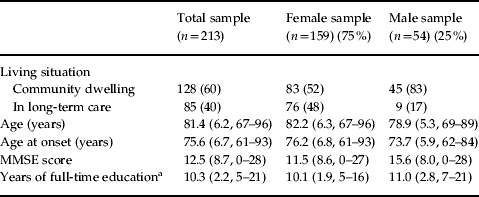
This was a case–comparison study of 213 patients with late-onset probable AD. All patients were white British and aged 65 years or over, with an age of dementia onset of at least 60 years. Patients had suitable informants available to report on both midlife personality and age of dementia onset. Patient demographics are displayed in Table 1. Age of dementia onset ranged from 61 to 93 years. Patients were participating concurrently in a research study investigating AD genetics and biomarkers; and were recruited largely through old age psychiatry services in London and South-East England, although some patients were recruited directly from nursing homes. Old age psychiatry services see the vast majority of patients referred for routine dementia assessment in the UK. Services used for recruitment in the current study included both dedicated memory services and community mental health teams. Both types of service use standardized screening instruments, and neuropsychological testing where appropriate.
Patient demographics

MMSE, Mini-Mental State Examination (Folstein et al. Reference Folstein, Folstein and McHugh1975).
Values are given as n (%) or mean (s.d., range).
a n=211 because of missing data.
Diagnosis of probable AD was made according to National Institute of Neurological and Communicative Disorders and Stroke – Alzheimer's Disease and Related Disorders Association research criteria (McKhann et al. Reference McKhann, Drachman, Folstein, Katzman, Price and Stadlan1984), with a minor modification to enable inclusion of those with an age of onset >90 years. Each diagnosis was made using information obtained from a uniform semi-structured and structured clinical evaluation with the patient and carer(s). The interview and diagnostic procedures have been described previously in detail, and have demonstrated a high degree of diagnostic accuracy of AD when measured against post-mortem assessment (Foy et al. Reference Foy, Nicholas, Hollingworth, Boothby, Williams, Brown, Al-Sarraj and Lovestone2007).
Informants
Age of dementia onset was established by interview with a family member in regular contact with the patient over the period of dementia onset. For the midlife personality report, 109 patients had two informants and 104 patients had a single informant. Informants providing retrospective personality report were required to be either: (1) a spouse, child or sibling who was in regular contact with the patient in the patient's forties (i.e. saw him or her at least every 6 months during this time); or (2) another person who lived with the patient for at least 1 year during the patient's forties and was in regular contact with him or her for the rest of that decade. Many informants were the same family members who had provided data on dementia age of onset. Where possible, these informants also reported on pre-morbid history of affective disorder.
Following full explanation of the study to patients and families, informed consent and assent were obtained. The study was approved by the relevant research ethics committees.
Measures
As part of each patient's dementia assessment, family members were questioned using a structured approach to ascertain the age of onset of the first symptoms of dementia. Phrasing was used such as: ‘I'd like you to tell me about his/her problems. What was the first thing you noticed? When did this happen?’ Informants were then asked to consider whether in retrospect there were any signs of dementia prior to the time of first symptoms originally given, using questions such as: ‘Before this happened, was there any sign, looking back on it now, that there was something wrong before this?’ Age of onset was taken as the time of the earliest symptom report, judged by the researcher to represent a likely early indicator of dementia.
Informants also reported on the patient's personality at midlife. The midlife time period had been selected to avoid the pre-clinical phase of dementia, which can last for a decade or more, during which behavioural and psychological symptoms may precede the development of significant cognitive change potentially influencing expression of personality at that time (Archer et al. Reference Archer, Brown, Boothby, Foy, Nicholas and Lovestone2006). Informant report involved completion of a retrospective version of the 60-item Neuroticism, Extraversion, Openness Five-Factor Inventory (NEO-FFI) questionnaire sent by post (Costa & McCrae, Reference Costa and McCrae1992). This widely used scale is based on the well-established FFI model of personality, comprising the domains of Neuroticism, Extraversion, Openness, Agreeableness and Conscientiousness. We have shown the NEO-FFI to be a reliable retrospective measure of midlife personality when used in this manner in a similar sample of patients with probable AD (Archer et al. Reference Archer, Brown, Boothby, Foy, Nicholas and Lovestone2006). Where two informants were available, mean domain scores were calculated for use in analyses. For the remainder with a sole informant, single domain scores were used.
Supplementary data were obtained from a subgroup of these informants (n=178) with regard to pre-morbid treatment history of affective disorder. Informants were asked whether the patient had ‘received treatment for anxiety before the age of 50’ or ‘received treatment for depression before the age of 50’. A positive treatment history of affective disorder was indicated if an informant responded in the affirmative to either of the above questions. The timing of this measurement was again designed to avoid the influence of any prodromal mood changes on ‘pre-morbid’ ratings.
Statistical methodology
In view of potential differential AD risk factors according to gender (Kivipelto et al. Reference Kivipelto, Helkala, Nissinen, Soininen and Tuomilehto2002), analyses were carried out separately for males and females and also for the sample as a whole.
Correlational analyses
Partial correlation was selected to test the association of midlife Neuroticism with age of onset, as it was considered important to avoid the potential confounding effect of current age. Age at assessment was likely to be closely related to age of onset for methodological reasons; and might also be associated with personality due to generational cohort effects, and survival factors.
Regression analyses
Backward linear regression analyses were carried out to assess the relationship of midlife Neuroticism with age of onset, while adjusting for a wider range of potential confounders. Backward linear regression uses a stepwise selection method, suitable for exploratory analysis (Field, Reference Field2005). The backwards selection process begins with all potential predictors included in the model; and then predictors are removed sequentially based upon the extent of their contribution to the model, until all remaining variables contribute significantly to the model.
Gender-stratified analyses were performed with age of onset as the dependent variable. The regression model included the following independent variables to adjust for key potential demographic confounders: all five personality domains, age at assessment and education. Potential clinical predictors of age of onset were considered for possible inclusion on the basis of their association with age of onset in previous studies: possession of an APOE ε4 allele, possession of an APOE ε2 allele, family history of dementia and pre-morbid head injury with lack of consciousness. The t statistic was used to evaluate association between each variable and age of onset. Where there was a significant association, the variable was included in the subsequent regression model for further testing. For completeness, this procedure was then repeated for the sample as a whole, including gender as an independent variable.
Supplementary regression analysis was planned to explore the impact of a treatment history of affective disorder. Gender-specific analysis forced the affective disorder variable into the final regression model in a second block. The aim was to establish whether any association between midlife Neuroticism and age of onset was independent of pre-morbid affective disorder, a potential confounder in view of its associations with both age of dementia onset and general Neuroticism (Andrews, Reference Andrews1996; Cannon-Spoor et al. Reference Cannon-Spoor, Levy, Zubenko, Zubenko, Cohen, Mirza, Putnam and Sunderland2005).
Prior to the regression analyses, inter-informant reliability for treatment history of affective disorder was calculated using Cohen's κ (Cohen, Reference Cohen1960) in those patients where this information was available from two informants (patient n=66).
Results
Correlational analyses
In the sample as a whole, following adjustment for age at time of assessment, midlife Neuroticism was found to be significantly correlated with younger age of symptom onset (r=−0.12, p<0.05 one-tailed). In gender-stratified analyses, this association held in the female sample (r=−0.15, p<0.05 one-tailed) but not in the male sample (r=0.12, not significant).
Regression analyses
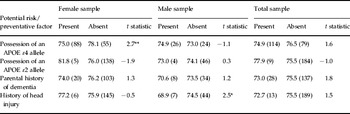
Backward linear regression analyses were performed with age of onset as the dependent variable. Independent key demographic variables entered into all models were age, years of education and the five midlife personality domains. Further independent clinical variables entered into models were possession of an APOE ε4 allele for females, and pre-morbid head injury for males. These were selected on the basis of significant association with age of onset in these samples (see Table 2). Only the additional demographic variable of gender was entered into the total sample regression model.
Comparison of mean ages of dementia onset in accordance with clinical variables

Mean age of dementia onset given in years. Numbers of individuals in each category are given in parentheses.
* p<0.05, ** p<0.01 (both two-tailed).
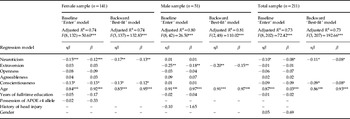
Regression models are presented in Table 3. The strongest predictor of age of onset was age at assessment, which accounted for the majority of variance in all three samples considered. This can be consider a ‘nuisance’ variable in the analysis, but one that is necessary to include. More important are those variables that made an independent contribution to the regression model along with age. Significant additional variance was explained by personality factors; in the female sample both higher Neuroticism and higher Conscientiousness significantly predicted younger age of onset, whereas in the male sample higher Extraversion significantly predicted younger age of onset. Findings in the female sample were replicated (although less strongly) in the sample as a whole.
Proportion of variance in dementia age of onset accounted for by midlife NEO-FFI personality domains and key clinical and demographic variables

NEO-FFI, Neuroticism, Extraversion, Openness Five-Factor Inventory; sβ, standardized beta; β, unstandardized beta; –, not entered into model.
n for the total sample does not equal the sum of n for the gender-specific samples because of missing data on possession of an APOE ε4 allele and history of head injury. β coefficients are presented for all variables in the baseline (‘enter’) models and for all variables that contributed significantly to the final (‘best-fit’) backwards regression models (criteria for removal p>0.05).
* p<0.05; ** p<0.01; *** p<0.001.
The unstandardized β coefficients have been provided to assist the reader in the interpretation of the regression analyses. For the female sample, the unstandardized β coefficient of −0.13 indicates that one point on the Neuroticism scale is associated with a 0.13-year difference in age of dementia onset. In other words, because the interquartile range of NEO-FFI Neuroticism scores in our female sample is 14, this is equivalent to Neuroticism bringing forward dementia onset by 1.8 years in females at the 75th percentile for Neuroticism in comparison to females at the 25th percentile.
Supplementary analysis involved forcing the pre-morbid affective disorder variable into the final backward regression model for the female subsample with this information available (not presented). The pre-morbid affective disorder variable, which demonstrated a ‘fair’ level of inter-informant reliability (κ=0.45) according to commonly used criteria (Cicchetti, Reference Cicchetti1994), made no significant contribution to the model. Furthermore, it did not alter the emergence of midlife Neuroticism as a significant predictor of a younger age of onset in females or reduce the magnitude of its prediction in this sample.
Discussion
Increasing our understanding of factors that influence dementia age of onset is of considerable public health importance in an ageing population, as such factors may provide clues as to the development of interventions to delay disease onset. According to one estimate, an intervention to delay onset by merely 2 years could mean two million fewer cases of AD in the USA over the course of 50 years (Brookmeyer et al. Reference Brookmeyer, Gray and Kawas1998). Knowledge of factors associated with age of onset could also lead to a greater general understanding of disease mechanisms.
Although previous studies have examined the association of the pre-morbid personality domain of Neuroticism with other aspects of AD clinical profile (Archer et al. Reference Archer, Brown, Reeves, Boothby, Nicholas, Foy, Williams and Lovestone2007), to our knowledge this is the first study to consider pre-morbid Neuroticism in relation to dementia age of onset. We hypothesized that higher midlife Neuroticism would be associated with a younger age of dementia onset. Gender-specific analyses were considered on the basis that factors for AD risk have been shown to differ between genders.
Initial correlational analyses adjusting for current age demonstrated a significant association between midlife Neuroticism and younger age of dementia onset in females but not in males. When a range of key demographic and clinical variables were then entered into a regression model, higher midlife Neuroticism significantly predicted a lower age of onset in females. This finding reached a high level of statistical significance (standardized β=0.17, p=0.001); and was equivalent to a difference of almost 2 years in age of onset across the interquartile range for Neuroticism. However, midlife Neuroticism did not predict age of onset in men. Although the finding was replicated more weakly in the sample as a whole (standardized β=0.11, p<0.05), this is probably because the sample was composed of a majority of females (75%) and was therefore underpowered to reliably explore effects in males. Supplementary regression analysis in a large subsample suggested that the association found in females was independent of history of affective disorder.
Why might Neuroticism be associated with earlier age of onset? One explanation might be that Neuroticism could moderate the physiological impact of psychosocial stressors, an explanation that has been proposed in relation to other associations with health outcomes. Neuroticism, by definition, predisposes to negative emotion, and negative emotion and chronic stress have been shown to have a range of negative physiological consequences (Kiecolt-Glaser et al. Reference Kiecolt-Glaser, McGuire, Robles and Glaser2002; Rozanski et al. Reference Rozanski, Blumenthal, Davidson, Saab and Kubzansky2005). Stress-related overactivation of the hypothalamic–pituitary–adrenal (HPA) axis and the sympathetic nervous system is found to have diverse effects, including overproduction of cortisol, inflammation, insulin resistance, ovarian dysfunction, endocrine abnormalities, increased heart rate and hypertension. It is possible that some of these effects might impact upon age of dementia onset, either by exacerbation of AD pathology or other neuronal damage. If Neuroticism were to act as a cardiovascular risk factor, for example, this might increase risk of concomitant cerebrovascular pathology, which has been shown to be associated with earlier presentation of the AD syndrome relative to the degree of AD pathology (Esiri et al. Reference Esiri, Nagy, Smith, Barnetson and Smith1999). Alternatively, evidence suggests that elevated cortisol release may have negative effects on memory (Kiecolt-Glaser et al. Reference Kiecolt-Glaser, McGuire, Robles and Glaser2002), as well as potential neurotoxic effects on the hippocampus (Pruessner et al. Reference Pruessner, Baldwin, Dedovic, Renwick, Mahani, Lord, Meaney and Lupien2005), and may thus ultimately contribute towards cognitive decline later in life. Perhaps consistent with this, higher levels of blood cortisol have been associated with faster cognitive decline in the context of dementia (Csernansky et al. Reference Csernansky, Dong, Fagan, Wang, Xiong, Holtzman and Morris2006). The notion of Neuroticism impacting upon the expression of dementia symptoms via a separate pathway to that of traditional AD pathology is supported by a recent neuropathological study showing high levels of Neuroticism to be associated with greater cognitive impairment in the elderly, despite statistical adjustment for plaque and tangle pathology (Wilson et al. Reference Wilson, Arnold, Schneider, Kelly, Tang and Bennett2006).
On the contrary, general differences in pre-existing brain structure and function associated with greater Neuroticism might lead to earlier presentation of the AD syndrome in response to pathology. Findings of smaller brain volume associated with Neuroticism in the general population (Knutson et al. Reference Knutson, Momenan, Rawlings, Fong and Hommer2001) might mean reduced cerebral reserve to buffer against the effects of AD pathology. The decreased cognitive performance, including increased cognitive response time associated with Neuroticism (Socan & Bucik, Reference Socan and Bucik1998), might mean that change in cognitive ability associated with the development of AD pathology would become clinically relevant sooner. Causality of relationship between personality and brain structure/function is not clear.
The finding of an association between Neuroticism and age of onset is in line with previous research implicating pre-morbid Neuroticism as a general risk factor for AD and cognitive impairment in the elderly (Meins & Dammast, Reference Meins and Dammast2000; Wilson et al. Reference Wilson, Evans, Bienias, de Leon, Schneider and Bennett2003; Crowe et al. Reference Crowe, Andel, Pedersen, Fratiglioni and Gatz2006), although studies have tended not to consider gender-stratified samples. Such findings in relation to lifetime personality might be regarded similarly to the association of lifetime cognitive characteristics with dementia risk. For example, one prospective study showed lower idea density in autobiographical writings of young nuns to be associated with the development of dementia many decades later (Snowdon et al. Reference Snowdon, Kemper, Mortimer, Greiner, Wekstein and Markesbery1996).
Nevertheless, the current finding raises the question as to why an association between Neuroticism and age of onset might be gender specific. The larger female sample size certainly conferred a greater power to detect an association. However, this would appear to be an unlikely explanation for differential findings, as correlational analyses showed the non-significant association between Neuroticism and age of onset in males to be in the opposite direction to that predicted. It may be that the gender-specific nature of our finding implies a role for hormones in the association between Neuroticism and earlier age of onset.
Of note, gender differences in immunological response to stress have been reported in previous literature, with women being more likely than men to show increased cortisol release and immunological response to conflict (Kiecolt-Glaser, Reference Kiecolt-Glaser1999); and ageing increasing the cortisol response to stress almost three times more in women than men (Otte et al. Reference Otte, Hart, Neylan, Marmar, Yaffe and Mohr2005).
It is also conceivable that the association between high levels of Neuroticism and younger age of onset may be restricted to women because the negative impact of stress on the brain is no longer being as well buffered by neuroprotective oestrogen following the menopause (Kajantie & Phillips, Reference Kajantie and Phillips2006). This is consistent with limited evidence suggesting that age of dementia onset might be delayed in women who have received oestrogen therapy (Tang et al. Reference Tang, Jacobs, Stern, Marder, Schofield, Gurland, Andrews and Mayeux1996).
We note, however, that association does not imply causality. It may be that there is an underlying vulnerability factor influencing both midlife Neuroticism and age of dementia onset. Equally, it is possible, if unlikely, that Neuroticism may simply influence age at which symptoms become apparent to family members, for example through potentially increasing risk of psychological symptoms such as depression in the pre-clinical phase. However, age of dementia onset in this study was considered in terms of the emergence of symptoms that represented indicators of dementia over and above potential behavioural and psychological symptoms common in the pre-clinical phase.
Two further personality findings emerged from the regression analyses, although as these were not hypothesis driven they should be treated with caution. Younger age of onset was predicted by higher midlife Extraversion in males, and by higher midlife Conscientiousness in females. In both instances it is plausible, although again unlikely, that this might be due to increased likelihood of symptoms being observed by the family.
Limitations
There are several limitations to this study. Patient age and age of onset were unavoidably very closely associated. This may have reduced the potential of the statistical analyses to detect significant associations with age of onset after adjustment. Nevertheless, Neuroticism emerged as a significant predictor of age of onset in females despite this methodological constraint. The power of the study is also limited in the male samples.
Obtaining a clear estimate of age of symptom onset in AD is methodologically challenging because of the insidious onset of the disorder and the varying levels of pre-morbid cognitive ability among patients. All age of onset studies are subject to this difficulty but we are confident that the structured and detailed questioning used here provides the best possible estimate.
In terms of midlife personality measurement, we used a personality instrument possessing generally good inter-informant reliability, as well as good to excellent intra-informant reliability and generally good internal consistency when used retrospectively in this manner and population (Archer et al. Reference Archer, Brown, Boothby, Foy, Nicholas and Lovestone2006). We also used strict informant criteria and obtained the mean of two informant reports for the majority of patients. Moreover, we considered personality over a ‘midlife’ time-phase to avoid the influence of any dementia prodrome on personality expression. We thus sought to maximize accuracy of pre-morbid personality report. Nevertheless, it must be acknowledged that this approach is reliant upon informant memory of many years previously and, as such, may be subject to error.
A further limitation is that informant-reported history of treatment for anxiety and depression may represent an undercount, as a substantial proportion of informants were adult children, some of whom may not have been privy to this information about their participating parent.
Conclusions
In summary, this study is the first to test the hypothesis that midlife Neuroticism is associated with a younger age of onset of AD. This was confirmed in females but not males, and was found to be independent of pre-morbid affective disorder. Potential explanations include the physiological impact on the brain of chronic negative emotion moderated by Neuroticism; the superimposition of AD pathology on differential brain structure and function associated with Neuroticism; the existence of an underlying developmental vulnerability in some females to both earlier onset of dementia and greater Neuroticism; and simply that Neuroticism might influence the timing of when the first dementia symptoms were noted. Clearly, these explanations may not be mutually exclusive.
Future research should seek to replicate this association and, if substantiated, investigate the underlying mechanism. Studies of neuroimaging and neuropathology may be instrumental in this, particularly in terms of investigating the potential mediating role of cognitive reserve.
Acknowledgements
We are grateful to the patients and families who kindly participated in this study. This study was part of cohort studies funded by the Medical Research Council and the Alzheimer's Research Trust. Additional funding support was received from the Institute of Social Psychiatry.
Declaration of Interest
None.