

1. Introduction
The pension system is an important constituent part of a country's social security system, which aims to provide stable and sustainable payments for pensioners after retirement. With the growth of the aging population, the contradiction between the capacity of the payment of pension funds and the needs of members’ pensions has become apparent, and pay-as-you-go pensions are in the dilemma of not being able to make ends meet. Thus, the fund accumulation pensions become popular. The fund accumulation systems can be divided into two types: the defined benefit (DB) pension plan and the defined contribution (DC) pension plan. The pension sponsor bears most of the investment management risk in a DB plan in the sense that the member receives a predetermined benefit after retirement, while the contribution to the personal pension account is dynamically adjusted according to the investment income. In contrast to DB plans, the contribution for a DC plan is usually a fixed proportion of the member's salary, while the benefit is subject to the contribution and the investment return during the accumulation phase. The payment pressure of a DC plan is mainly borne by the member, which makes DC plans more favored by most countries in the world. In such a context, the optimal asset allocation of the DC plan is a core concern of pension management and has attracted many researchers.
Considering that the investment management of pensions involves a 30–40-year-long period, the background risks such as the risks of interest rate and inflation, can not be negligible. On the one hand, the interest rate is changing in the long run. In the literature on the optimal asset allocation of DC plans, the Vasicek model (see [Reference Vasicek31]), the CIR model (see [Reference Cox, Ingersoll and Ross6]) and the affine interest rate model (see [Reference Duffie and Kan11]) are widely used to describe the dynamics of interest rate (see, e.g. [Reference Battocchio and Menoncin2,Reference Boulier, Huang and Taillard3,Reference Gao16,Reference Han and Hung19]). In this paper, we suppose that the evolution of the nominal interest rate follows the CIR process, which guarantees a nonnegative interest rate. On the other hand, inflation might affect the real value of wealth. The optimal investment problem for DC plans incorporating the inflation risk has been investigated by some scholars. For example, assuming that the plan member can invest in the inflation-indexed bond to hedge the inflation risk, Zhang and Ewald [Reference Zhang and Ewald33] use the martingale approach to obtain the optimal investment strategy in the sense of maximizing the expected exponential utility of the terminal wealth. Wang et al. [Reference Wang, Li and Sun32] study the optimal asset allocation problem with stochastic income and inflation risk under the power utility for an ambiguity-averse member.
Meanwhile, since the benefit of traditional DC pension plan is linked to the investment return and is highly uncertain, it might not even meet the elementary needs of the plan member. Therefore, a minimum guarantee constraint is necessary for the pension fund. There exist many papers studying various minimum guarantee constraints. Boulier et al. [Reference Boulier, Huang and Taillard3] derive the optimal investment strategy for a DC plan with the assumption that the minimum guarantee depends on the level of interest rate at retirement. Deelstra et al. [Reference Deelstra, Grasselli and Koehl7] assume that the guarantee is directly related to the contribution of the plan member. Han and Hung [Reference Han and Hung19] suppose that the minimum guarantee constraint is contingent on the terminal realizations of the interest rate and the inflation index. Guan and Liang [Reference Guan and Liang17] add the stochastic mortality to the constraint adopted by Boulier et al. [Reference Boulier, Huang and Taillard3]. With the purpose of minimizing the expected S-shaped utility, Chen et al. [Reference Chen, Li, Zeng and Sun5] introduce the concept of “(instantaneous) minimum living security” associated with the inflation and stock price, and then define the minimum guarantee as the basic living needs of a DC plan member after retirement. The minimum guarantee considered in this paper is similar to that of Chen et al. [Reference Chen, Li, Zeng and Sun5], except that the minimum living security is assumed to be related to not only the fluctuation of inflation and stock price but also the fluctuation of interest rate.
None of the above-mentioned literature on portfolio optimization problems involves regime-switching. In fact, since Hamilton [Reference Hamilton18] pioneered the econometric application of the regime-switching model, the model has drawn a lot of attention from academic researchers and practitioners because it can capture various states of the market. In most studies, the regime-switching characteristics are described by observable Markov chains. However, in practice, market states are often not directly observable, but only the prices of assets are publicly available. The distribution of the Markov chain must be inferred from the observable price of assets. Such a model is called the hidden Markov model. In recent years, the hidden Markov model is widely applied in formulating investment optimization problems. Rieder and Bäuerle [Reference Rieder and Bäuerle28] solve a portfolio optimization problem in the framework where the expected return of the risky asset is affected by a continuous-time hidden Markov chain and obtain the optimal value function and strategy under both logarithmic utility and power utility. Liang and Song [Reference Liang and Song22] investigate the time-consistent equilibrium investment and reinsurance strategies in the case that the risky asset and the risk aversion are modulated by a hidden Markov chain. Zhu et al. [Reference Zhu, Xie, Ching and Siu34] explore the optimal investment problem with the MVaR constraint under the hidden Markov regime-switching economy. Peng and Hu [Reference Peng and Hu27] obtain the investment and reinsurance strategies with the objective of minimizing risk in a hidden Markov-modulated model using the BSDE approach. However, there is less work on the application of hidden Markov models to the investment management of DC plans. Korn et al. [Reference Korn, Siu and Zhang21] study the problem of maximizing the logarithmic utility of terminal wealth for a DC plan in a hidden Markov economy. Assuming that the drift terms of the price processes of both the inflation-indexed bond and the stock are affected by the hidden Markov chain, Siu [Reference Siu30] uses the BSDE approach to find the optimal investment strategy for a DC plan under the goal of minimizing the convex risk measure of the terminal wealth.
In the DC plan investment management, the conventional utility maximization objective focuses more on the return of investment (see [Reference Boulier, Huang and Taillard3,Reference Guan and Liang17,Reference Han and Hung19,Reference Korn, Siu and Zhang21,Reference Zhang and Ewald33] and references therein). However, the primary objective of pension management ought to be the robustness and safety of the investment. Therefore, more concern should be given to controlling risk than to improving utility. The mean-variance model proposed by Markowitz [Reference Markowitz24] is the groundwork of modern portfolio theory, in which the variance is used as a risk measure. However, the variance treats the positive and negative fluctuations of the return of the portfolio as risk indiscriminately and the dynamic mean-variance criterion is not time-consistent. Therefore, in a real economy, using variance alone to measure risk is to some extent subject to large errors. Later, the research on risk measurement theory has been in full swing, with breakthrough research achievements such as the coherent risk measure and the convex risk measure. The concept of coherent risk measure is introduced by Artzner et al. [Reference Artzner, Delbaen, Heath and Eber1], which requires a rational risk measure to satisfy the monotonicity, translation invariance, subadditivity and positive homogeneity. Besides, the dynamic version of coherent risk measure is time-consistent under certain conditions. The positive homogeneity assumes that there is no liquidity risk in the market, that is, the risk can only change linearly with the size of the trading position. To remedy this defect, Föllmer and Schied [Reference Föllmer and Schied14] and Frittelli and Rosazza Gianin [Reference Frittelli and Rosazza Gianin15] independently construct the framework of convex risk measure. They replace the subadditivity and positive homogeneity in the coherent risk measure with the convexity. For other related literature on the application of convex risk measures to asset allocation problems, see Elliott and Siu [Reference Elliott and Siu13], Siu [Reference Siu30], Meng and Siu [Reference Meng and Siu25], Peng and Hu [Reference Peng and Hu27] and Shen and Siu [Reference Shen and Siu29].
Based on existing researches and taking into consideration the actual situation of pension management, we investigate the optimal portfolio strategy of a DC pension plan under the hidden Markov regime-switching economy and the minimum guarantee constraint. We use a hidden Markov chain to describe the unobservable economic states, and the stock return is modulated by this hidden Markov chain. In addition, other assets available for the investment include a risk-free asset, a zero-coupon bond and an inflation-indexed bond. We adopt the convex risk measure to measure the risk, which captures the characteristic of liquidity risk compared to the coherent risk measure. Combining the filtering technique and the BSDE approach, we derive an explicit optimal investment strategy. Finally, we analyze the impacts of some important parameters on the optimal investment strategy via some numerical examples. This paper is related to Siu [Reference Siu30], which also studies the risk-based portfolio optimization for a DC plan. Compared to Siu [Reference Siu30], this paper has the following contributions. First, the introduction of the minimum guarantee constraint in our model is more suitable for the DC plan member's requirement. It turns out that the contribution significantly impacts the optimal portfolio when considering the guarantee. However, Siu [Reference Siu30] does not consider this constraint, and the strategy he obtains is independent of the contribution. Second, we assume that the interest rate follows the CIR process, which may be unbounded. To hedge the risk of interest rate, the zero-coupon bond is incorporated into our model. In contrast, Siu [Reference Siu30] assumes that the interest rate process is bounded and the interest rate risk can be directly hedged by the stock and the inflation-indexed bond. Finally, a detailed numerical experiment is carried out to explore the properties of the model and the strategy. We also interpret the investment behavior of the plan member from the perspective of economics, which can provide a reference for the DC plan investment in practice.
The remainder of this paper is organized as follows. Section 2 presents basic assumptions of the financial market and formulates the investment optimization problem. In Section 3, we transform the partially observable investment optimization problem into a fully observable optimization problem using the Wonham filtering method and then transform the problem with constraints into an unconstrained auxiliary problem by constructing auxiliary processes. In Section 4, the BSDE method is used to solve the auxiliary problem and the optimal strategy of the original problem can also be derived. Section 5 provides numerical examples to illustrate our results. Section 6 concludes the paper.
2. Problem formulation
Let  $( {\Omega,{\mathcal {F}},{\{ {\mathcal {F}} \} _{t \ge 0}},\mathbb {P}})$ be a complete probability space, where
 ${{\mathcal {F}}_t}$ represents the information available in the financial market up to time
 $\it t$ and
 $\mathbb {P}$ is the real-world probability measure. It is assumed that a DC pension plan member contributes to the pension account continuously until the retirement time
 $T$. Suppose that the assets in the financial market can be traded continuously without constraints on the amount of transactions, and there is no additional cost such as transaction fee or tax.
2.1. Financial market
Assume that the financial market consists of four assets: a risk-free asset, a zero-coupon bond, an inflation-indexed bond and a stock. The first asset in the financial market is the risk-free asset whose price process  $A(t)$ is given by
 \begin{equation} \frac{{{{\rm d}}A(t)}}{{A(t)}} = R(t){{\rm d}}t,{{\rm }}\quad A( 0 ) = {A_0}, \end{equation}
where  $R(t)$ is the nominal interest rate whose evolution satisfies the CIR model:
 \begin{equation} {{\rm d}}R(t) = ( {a - bR(t)} )\,{{\rm d}}t - {\sigma _R}\sqrt {R(t)} \,{{\rm d}}{W_1}(t),\quad R( 0 ) = {R_0}. \end{equation}
Here  $a,b > 0$,
 $b$ denotes the speed of the mean reversion,
 ${\sigma _R}$ is the volatility and
 ${W_1}(t)$ is a standard Brownian motion on
 $( {\Omega,{\mathcal {F}},{\{{\mathcal {F}}\}_{t \ge 0}},\mathbb {P}} )$. If
 $2a \ge \sigma _R^2$, then for all
 $t > 0$ , the nominal interest rate is strictly positive almost surely.
The second asset is the zero-coupon bond closely correlated with the stochastic interest rate. Let  $B( {t,T} )$ denote the price of this zero-coupon bond at time
 $t$ with a payoff of 1 at maturity
 $T$. With the market price of risk corresponding to
 ${W_1}(t)$ being given by
 $\lambda _{R}\sqrt {R(t)}$ and by the no-arbitrage pricing theory,
 $B( {t,T} )$ can be expressed as the following form (see [Reference Guan and Liang17,Reference Han and Hung19]):
 $$B( {t,T} ) = \exp [ {{h_0}( {T-t} ) - {h_1}( {T-t} )R(t)}],$$
where
 \begin{align*} {h_1}( {T - t} ) & = \frac{{2( {{{{\rm e}}^{2d( {T - t} )}} - 1} )}}{{( {c + 2d} )( {{{{\rm e}}^{2d( {T - t} )}} - 1} ) + 4d}},\\ {h_0}( {T-t} ) & ={-} \frac{a}{{\sigma _R^2}}\left[ {2\log \frac{{( {c + 2d} )( {{e^{2d( {T - t} )}} - 1} ) + 4d}}{{4d}} - ( {c + 2d} )( {T - t} )} \right],\\ c & = b - {\lambda _R}{\sigma _R},\\ d& = \frac{1}{2}\sqrt {{{( {b - {\lambda _R}{\sigma _R}} )}^2} + 2\sigma _R^2} . \end{align*}
The dynamics of  $B( {t,T} )$ follows
 \begin{equation} \begin{aligned} \dfrac{{{{\rm d}}B( {t,T} )}}{{B( {t,T} )}} & = ( {R(t) + {\lambda _R}\sqrt {R(t)} {\sigma _B}( {T - t} )} )\,{{\rm d}}t + {\sigma _B}( {T - t} )\,{{\rm d}}{W_1}(t),\\ B( {T,T}) & = 1, \end{aligned} \end{equation}
with  ${\sigma _B}( {T - t} ) = {\sigma _R}{h_1}( {T - t} )\sqrt {R(t)}$ being the volatility.
As argued by Boulier et al. [Reference Boulier, Huang and Taillard3], there are not always zero-coupon bonds corresponding to the specified maturing date in the market. Thus, a rolling bond with a fixed maturity  ${\tau _1}$ will be incorporated in our analysis, which can be used to hedge the interest rate risk. The price dynamics of the rolling bond is as follows:
 \begin{equation} \frac{{{{\rm d}}{B_{{\tau _1}}}(t)}}{{{B_{{\tau _1}}}(t)}} = ( {R(t) + {\lambda _R}\sqrt {R(t)} {\sigma _B}( {{\tau _1}} )} )\,{{\rm d}}t + {\sigma _B}( {{\tau _1}} )\,{{\rm d}}{W_1}(t), \end{equation}
where  ${\sigma _B}( {{\tau _1}} ) = {\sigma _R}{h_1}( {{\tau _1}} )\sqrt {R(t)}$. In addition, the relationship between
 $B( {t,T} )$ and
 ${B_{{\tau _1}}}(t)$ is
 $$\frac{{{{\rm d}}B( {t,T} )}}{{B( {t,T} )}} = \frac{{{h_1}( {T - t} )}}{{{h_1}( {{\tau _1}} )}}\frac{{{{\rm d}}{B_{{\tau _1}}}(t)}}{{{B_{{\tau _1}}}(t)}} + \left( {1 - \frac{{{h_1}( {T - t} )}}{{{h_1}( {{\tau _1}} )}}} \right)\frac{{{{\rm d}}A(t)}}{{A(t)}}.$$
In the sequel, the rolling bond with a fixed maturity  ${\tau _1}$ is referred to as the zero-coupon bond.
Since the investment management of the pension is a decades-long project, the inflation inevitably erodes the purchasing power of plan members’ wealth. Therefore, it is necessary to take into account the inflation in the asset allocation for a DC plan. The consumer price index (CPI) is usually used as an index to represent the level of inflation. We suppose the price index  $P(t)$ satisfies the following stochastic differential equation:
 \begin{equation} \begin{aligned} \frac{{{{\rm d}}P(t)}}{{P(t)}} & = {\mu _P}\,{{\rm d}}t + {\sigma _{P1}}\sqrt {R(t)} \,{{\rm d}}{W_1}(t) + {\sigma _{P2}}\,{{\rm d}}{W_2}(t),\\ P( 0 ) & = {P_0}, \end{aligned} \end{equation}
where  ${\mu _P} > 0$ represents the expected inflation rate,
 ${W_2}(t)$ is a standard Brownian motion independent of
 ${W_1}(t)$ and
 ${\sigma _{P1}}>0$ and
 ${\sigma _{P2}} > 0$ are the volatility parameters. The inflation-indexed bond is issued in the financial market to help plan members manage the inflation risk. Based on the no-arbitrage pricing theory and similar to the procedure for deriving the explicit expression of
 $B(t,T)$, we can know that the price of the inflation-indexed bond at time
 $t$ with the maturity
 $T$ and a payoff of
 $P ( T )$, denoted by
 $I( {t,T} )$, has the explicit form:
 $$I( {t,T} ) = P(t)\exp [ {{q_0}( {T-t} ) - {q_1}( {T-t} )R(t)}],$$
where
 \begin{align*} {q_1}( {T - t} ) & = \frac{{2( {1 + {\sigma _{P1}}{\lambda _R}} )( {{{{\rm e}}^{2f( {T - t} )}} - 1} )}}{{( {g + 2f} )( {{{{\rm e}}^{2f( {T - t} )}} - 1} ) + 4f}},\\ {q_0}( {T-t} ) & ={-} \dfrac{a}{{\sigma _R^2}}\left[ {2\log \frac{{( {g + 2f} )( {{e^{2f( {T - t} )}} - 1} ) + 4f}}{{4f}} - ( {g + 2f} )( {T - t} )} \right]\\ & \quad +{\mu _P}( {T - t} ) - {\sigma _{P2}}{\lambda _P}( {T - t} ),\\ g & = b - {\sigma _R}{\lambda _R} + {\sigma _R}{\sigma _{P1}}, \\ f & = \frac{1}{2}\sqrt {{{( {b - {\sigma _R}{\lambda _R} + {\sigma _R}{\sigma _{P1}}} )}^2} + 2\sigma _R^2( {1 + {\lambda _R}{\sigma _{P1}}} )} , \end{align*}
and  ${\lambda _P} > 0$ denotes the market price of risk with respect to
 ${W_2}(t)$. By the Itô formula, we have
 \begin{equation} \begin{aligned} \dfrac{{{{\rm d}}I( {t,T} )}}{{I( {t,T} )}} & = ( {R(t) + {\lambda _R}\sqrt {R(t)} {\sigma _{I1}}( {T - t} ) + {\lambda _P}{\sigma _{I2}}} )\,{{\rm d}}t\\ & \quad + {\sigma_{I1}}( {T - t} )\,{{\rm d}}{W_1}(t) + {\sigma _{I2}}\,{{\rm d}}{W_2}(t),\\ I( {T,T} ) & = P( T ), \end{aligned} \end{equation}
where  ${\sigma _{I1}}( {T - t} )$ and
 ${\sigma _{I2}}$ are the volatility parameters.
Analogous to the rolling zero-coupon bond, we introduce the rolling inflation-indexed bond with constant maturity  ${\tau _2}$, which can serve as an instrument to hedge the inflation risk. The price process of the rolling inflation-indexed bond evolves as
 \begin{align} \dfrac{{{{\rm d}}{I_{{\tau _2}}}(t)}}{{{I_{{\tau _2}}}(t)}} & = ( {R(t) + {\lambda _R}\sqrt {R(t)} {\sigma _{I1}}( {{\tau _2}} ) + {\lambda _P}{\sigma _{I2}}} )\,{{\rm d}}t\nonumber\\ & \quad+ {\sigma _{I1}}( {{\tau _2}} )\,{{\rm d}}{W_1}(t) + {\sigma _{I2}}\,{{\rm d}}{W_2}(t), \end{align}
where  ${\sigma _{I1}}( {{\tau _2}} ) = ( {{\sigma _{P1}} + {\sigma _R}{q_1}( {{\tau _2}} )} )\sqrt {R(t)}$. The relation between
 $I( {t,T} )$ and
 ${I_{{\tau _2}}}(t)$ is described by
 $$\frac{{{{\rm d}}I( {t,T} )}}{{I( {t,T} )}} = \frac{{{{\rm d}}{I_{{\tau _2}}}(t)}}{{{I_{{\tau _2}}}(t)}} + \frac{{{q_1}( {T - t} ) - {q_1}( {{\tau _2}} )}}{{{h_1}( {{\tau _1}} )}}\left( {\frac{{{{\rm d}}{B_{{\tau _1}}}(t)}}{{{B_{{\tau _1}}}(t)}} - \frac{{{\rm d}M(t)}}{{M(t)}}} \right).$$
The rolling bond with a constant maturity  ${\tau _2}$ is referred to as the inflation-indexed bond in the rest of this article.
The fourth asset in the financial market is the stock whose return rate depends on a Markov chain. Before introducing the stock price process, some notations related to this Markov chain are given. Let  ${\mathbf {X}}: = {\{ {{\mathbf {X}}(t)} \}_{t \ge 0}}$ be a continuous-time Markov chain with
 $N$ states on
 $( {\Omega,{\mathcal {F}},{\{{\mathcal {F}}\}_{t \ge 0}},\mathbb {P}})$. The Markov chain can be applied to describe the uncertainty of the economy. The state space of
 ${\mathbf {X}}$ is represented by a set of standard unit vectors
 ${\mathcal {L}}: = \{ {{{\mathbf {e}}_1},{{\mathbf {e}}_2}, \ldots,{{\mathbf {e}}_N}} \} \subset {\mathbb {R}^N}$. Here
 ${\mathbf {Q}}: = {\{ {{\mathbf {Q}}(t)} \}_{t \ge 0}}$ is the transition rate matrix of
 ${\mathbf {X}}$ and
 ${\mathbf {Q}}(t) = {[ {{q_{ij}}(t)} ]_{i,j = 1,2, \ldots,N}}$ with
 ${q_{ij}}(t)$ representing the instantaneous transition rate of the Markov chain from the
 $i$th state to the
 $j$th state. The natural filtration generated by the Markov chain
 ${\mathbf {X}}$ is denoted as
 ${{\mathbb {F}}^{\mathbf {X}}}: = {\{ {{\mathcal {F}}_t^{\mathbf {X}}} \}_{t \ge 0}}$, where
 ${\mathcal {F}}_t^{\mathbf {X}} = \sigma \{ {{\mathbf {X}}( u ):u \in [ {0,t} ]} \}$. The price process of the stock is specified by
 \begin{equation} \frac{{{{\rm d}}S(t)}}{{S(t)}} = \mu ( {t,{\mathbf{X}}} )\,{{\rm d}}t + {\sigma _S}\,{{\rm d}}{W_3}(t),\quad S( 0 ) = {S_0}, \end{equation}
where  $\mu ( {t,{\mathbf {X}}} ): = \langle {{\mathbf {\mu }},{\mathbf {X}}(t)} \rangle$ (
 $\langle { \cdot, \cdot } \rangle$ represents the inner product) is the expected return rate of the stock at time
 $t$,
 ${\mathbf {\mu }} = ( {{\mu _1},{\mu _2}, \ldots,{\mu _N}} )' \in {\mathbb {R}^N}$,
 ${\sigma _S} > 0$ is the volatility and
 ${W_3}(t)$ is a standard Brownian motion independent of
 ${W_1}(t)$,
 ${W_2}(t)$ and
 ${\mathbf {X}}(t)$. In investment practice, only the stock price process can be observed but not the specific economic states, that is,
 ${\mathbf {X}}(t)$ is not observable, and it is called a hidden Markov chain. From (8), we know that
 ${W_3}(t)$ has the corresponding market price of the risk
 ${\lambda _S}(t): = ({1}/{{{\sigma _S}}})( {\mu ( {t,{\mathbf {X}}} ) - R(t)} )$. The filtration generated by the stock price process is denoted as
 ${{\mathbb {F}}^S}: = {\{ {{\mathcal {F}}_t^S} \}_{t \ge 0}}$, where
 ${\mathcal {F}}_t^S = \sigma \{ {S( u ):u \in [ {0,t} ]} \}$.
2.2. Wealth process and optimization problem
Denote the filtrations generated by  ${W_1}: = {\{ {{W_1}(t)} \}_{t \ge 0}}$,
 ${W_2}: = {\{ {{W_2}(t)} \}_{t \ge 0}}$ and
 ${W_3}: = {\{ {{W_3}(t)} \}_{t \ge 0}}$ by
 ${\mathbb {F}^{{W_1}}}: = {\{ {{\mathcal {F}}_t^{{W_1}}} \}_{t \ge 0}}$,
 ${\mathbb {F}^{{W_2}}}: = {\{ {{\mathcal {F}}_t^{{W_2}}} \}_{t \ge 0}}$ and
 ${\mathbb {F}^{{W_3}}}: = {\{ {{\mathcal {F}}_t^{{W_3}}} \}_{t \ge 0}}$, respectively. The observable information for the member is
 $\mathbb {G}: = {\{ {{{\mathcal {G}}_t}} \}_{t \ge 0}}$, where
 ${{\mathcal {G}}_t}: = {\mathcal {F}}_t^{{W_1}} \vee {\mathcal {F}}_t^{{W_2}} \vee {\mathcal {F}}_t^S$.
In a DC pension plan, the members continuously contribute to their accounts until the retirement date  $T$. The instantaneous contribution rate is denoted as
 $C(t)$, which is usually a preset proportion of the salary of the member. However, the member's salary is usually influenced by many stochastic factors. Therefore, we assume that
 $C(t)$ is a
 $\mathbb {G}$-adapted process.
Suppose  ${V_0}$ is the initial wealth of the member's pension account. Let
 ${x_B}(t)$,
 ${x_I}(t)$ and
 ${x_S}(t)$ represent the proportions of wealth invested in the zero-coupon bond, the inflation-indexed bond and the stock at time
 $t$, respectively. Then the wealth proportion invested in the risk-free asset is
 $1 - {x_B}(t) - {x_I}(t) - {x_S}(t)$. If the investment strategy is denoted as
 $\mathbf {x} := \{ \mathbf {x} ( t ) \} _{t\in [ 0,T ] } = \{ ( x_{B} ( t ) , x_{I} ( t ) , x_{S} ( t ) )^{\mathrm {T} } \}_{t\in [ 0,T ] }$, the nominal wealth process
 ${V^{\mathbf {x}}}$ corresponding to the investment strategy
 ${\mathbf {x}}$ evolves according to
 \begin{equation} \begin{aligned} {{\rm d}}{V^{\mathbf{x}}}(t) & = {V^{\mathbf{x}}}(t)( {R(t) + {{\mathbf{x}}^{{\rm T}}}(t){\bf \Sigma} {\bf \Lambda} (t)})\,{{\rm d}}t + C(t)\,{{\rm d}}t + {V^{\mathbf{x}}}(t){{\mathbf{x}}^{{\rm T}}}(t){\bf \Sigma} \,{{\rm d}}{\mathbf{W}}(t),\\ {V^{\mathbf{x}}}( 0 ) & = {V_0}, \end{aligned} \end{equation}
where
 \begin{align*} {\bf{\Sigma }}& : = \left( {\begin{array}{ccc} {{\sigma _B}({{\tau _1}} )} & 0 & 0\\ {{\sigma _{I1}}( {{\tau _1}} )} & {{\sigma _{I2}}} & 0\\ 0 & 0 & {{\sigma _S}} \end{array}} \right),\\ {\bf \Lambda} (t)& : = {( {{\lambda _R}\sqrt {R(t)} ,{\lambda _P},{\lambda _S}(t)} )^{{\rm T}}},\\ {\mathbf{W}}(t)& : = {( {{W_1}(t),{W_2}(t),{W_3}(t)} )^{{\rm T}}}. \end{align*}
Let  ${\mathcal {A}}$ be the set of all admissible strategies that satisfy the following properties:
(1)
 ${\mathbf {x}}: = {\{ {{\mathbf {x}}(t)} \}_{t \in [ {0,T} ]}}$ is $\mathbb {G}$-progressively measurable;
(2)
$\int _0^T {{{\| {{\mathbf {x}}(t)} \|}^2}\,{{\rm d}}t} < \infty$, $\mathbb {P}$ - a.s.;(3) the stochastic differential equation (9) related to the nominal wealth process
${V^{\mathbf {x}}}$ has a unique strong solution.


In order to protect the benefit of the plan member more effectively, a minimum guarantee constraint should be imposed on the DC pension fund. Assume that the value of the minimum guarantee at retirement time  $T$ is
 $G( T )$, which is
 ${{\mathcal {G}}_T}$-adapted. It is required that the nominal wealth value at time
 $T$ does not fall below
 $G( T )$. The goal of the plan member is to find an optimal investment strategy in
 ${\mathcal {A}}$ that minimizes the risk measure
 $\rho$ of the terminal wealth
 ${V^{\mathbf {x}}}( T )$ over the level of minimum guarantee, that is
 \begin{equation} \begin{aligned} & \inf_{{\mathbf{x}} \in {\mathcal{A}}} \rho ( {{V^{\mathbf{x}}}( T ) - G(T )} ),\\ & {\rm s.t.}\quad {V^{\mathbf{x}}}( T ) \ge G( T ). \end{aligned} \end{equation}
The convex risk measure, which is a generalization of the coherent risk measure, is selected to measure the risk. It can reflect the nonlinear increase of portfolio risk along with the size of assets caused by the liquidity risk. The definition of the convex risk measure is as follows.
Definition 1. Let  ${\mathcal {S}}$ be a set of random variables with lower bounds on
 $( {\Omega,{\mathcal {F}},{\mathbb {P}}} )$, then the convex risk measure
 $\rho$ is a functional
 $\rho :{\mathcal {S}} \to \mathbb {R}$ that satisfies the following properties:
(1) Additivity: For any
$L \in {\mathcal {S}}$ and $K \in \mathbb {R}$, $\rho ( {L + K} ) = \rho ( L ) - K$.(2) Monotonicity: For any
${L_1},{L_2} \in {\mathcal {S}}$, if ${L_1}( \omega ) \le {L_2}( \omega )$ for any $\omega \in \Omega$, then $\rho ( {{L_1}} ) \ge \rho ( {{L_2}} )$.(3) Convexity: For any
${L_1},{L_2} \in {\mathcal {S}}$, $\rho ( {\alpha {L_1} + ( {1 - \alpha }){L_2}}) \le \alpha \rho ( {{L_1}} ) + ( {1 - \alpha } )\rho ( {{L_2}})$, $\alpha \in ( {0,1} )$.


Here, the random variable  $L$ describes the financial position and can be regarded as a loss variable.
The lemma below gives a representation of the convex risk measure.
Lemma 1. Denote by  ${{\mathcal {M}}_a}$ a family of measures absolutely continuous with respect to the probability measure
 $\mathbb {P}$. Define a function
 $\eta :{{\mathcal {M}}_a} \to \mathbb {R}$ such that
 $\eta ( \mathbb {Q} ) < \infty$ for any
 $\mathbb {Q}\in {{\mathcal {M}}_a}$. Then the convex risk measure
 $\rho ( L )$ of
 $L \in {\mathcal {S}}$ is continuous and can be expressed as
 \begin{equation} \rho ( L ) = \sup_{\mathbb{Q} \in {{\mathcal{M}}_a}} \{ {{{\mathbb{E}}^\mathbb{Q}}[ { - L} ] - \eta (\mathbb{Q} )} \}, \end{equation}
where  ${\mathbb {E}}^\mathbb {Q}$ represents the expectation under the measure
 $\mathbb {Q}$.
Proof. See Frittelli and Rosazza Gianin [Reference Frittelli and Rosazza Gianin15] or Föllmer and Schied [Reference Föllmer and Schied14].
From Lemma 1, three components must be determined to define a convex risk measure: the family of probability measures  ${{\mathcal {M}}_a}$, the penalty function
 $\eta$ and the loss variable
 $L$. The family
 ${{\mathcal {M}}_a}$ is interpreted as a set of generalized scenarios representing contingencies of future market or economic situations. The penalty function
 $\eta$ penalizes the improper selection of a probability model. In order to obtain the analytical expression of the optimal strategy, we suppose that the probability measure family
 ${{\mathcal {M}}_a}$ is generated by the Girsanov's transformation and the penalty function
 $\eta$ has a special form. Thus, problem (10) will be converted into a stochastic differential game problem.
3. Problem reduction
Problem (10) is a portfolio optimization problem with partial observation and state constraints. We first transform it into a portfolio optimization problem with complete information by using the filtering method. Then, to deal with the state constraints, we construct the auxiliary processes.
3.1. Filtering estimate
The filtering method has been widely applied to study the stochastic control problem with incomplete information. For the intensive exposition of this theory, see Kallianpur [Reference Kallianpur20], Elliott et al. [Reference Elliott, Moore and Aggoun12] and Liptser and Shiryaev [Reference Liptser and Shiryaev23]. Next, we extract the unobservable information about market states from the observable stock price using the filtering technique.
The Wonham filter of the hidden Markov chain is denoted as
 \begin{equation} {p_k}(t): = \mathbb{P}( {{{\mathbf{X}}(t) = {{\mathbf{e}}_k}} \,|\,{{\mathcal{G}}_t}} ),\quad k = 1,2, \ldots ,N. \end{equation}
Let  ${\mathbf {p}}(t) = {( {{p_1}(t),{p_2}(t), \ldots,{p_N}(t)})^{{\rm T}}}$. Define the innovation process:
 $$\widehat {{W_3}}(t): = {W_3}(t) + \frac{1}{{{\sigma _S}}}\int_0^t {( {\mu ( {u,{\mathbf{X}}} ) - \widehat \mu ( {u,{\mathbf{X}}} )} )}\, {{\rm d}}u,$$
where  $\widehat \mu ( {t,{\mathbf {X}}} ) = \mathbb {E}[ {{\mu ( {t,{\mathbf {X}}} )} \,|\,{{\mathcal {G}}_t}} ] = \langle {{\mathbf {\mu }},{\mathbf {p}}(t)} \rangle$ is the filtered estimate of
 $\mu ( {t,{\mathbf {X}}} )$.
Lemma 2. We have the following results:
(1)
$\widehat {{W_3}}: = {\{ {\widehat {{W_3}}(t)} \}_{t \ge 0}}$ is a $\mathbb {G}$-adapted Brownian motion.(2) The filter processes
${p_k}(t)$ specified by (12) satisfy that for $t \ge 0$,
We can rewrite it in matrix form as follows:\begin{align*} {{\rm d}}{p_k}(t) & = \sum_{j = 1}^N {{q_{jk}}(t)} {p_j}(t)\,{{\rm d}}t + \frac{1}{{{\sigma _S}}}( {{\mu _k} - \widehat \mu ( {t,{\mathbf{X}}} )} ){p_k}(t)\,{{\rm d}}\widehat {{W_3}}(t),\\ {p_k}( 0 ) & = P( {{\mathbf{X}}( 0 ) = {{\mathbf{e}}_k}} ),\quad k = 1, \ldots ,N. \end{align*}
where$${{\rm d}}{\mathbf{p}}(t) = {\mathbf{Q}}'{\mathbf{p}}(t)\,{{\rm d}}t + \frac{1}{{{\sigma _S}}}{\mathbf{N}}(t){\mathbf{p}}(t)\,{{\rm d}}\widehat {{W_3}}(t),$$
${\mathbf {N}}(t){{\rm =\ diag(}}{\mathbf {\mu }} - \widehat \mu ( {t,{\mathbf {X}}} ){{\mathbf {1}}_N}{{\rm )}}$.(3)
$\sigma ( {S( u ):u \in [ {0,t} ]}) = \sigma ( {\widehat {{W_3}}( u ):u \in [ {0,t} ]} ) = \sigma ( {{\mathbf {p}}( u ):u \in [ {0,t} ]} )$.


Proof. See Elliott et al. [Reference Elliott, Moore and Aggoun12] for the detailed proof, which is omitted here.
Let  $\widehat {{\lambda _S}}(t): = ({1}/{{{\sigma _S}}})( {\widehat \mu ( {t,{\mathbf {X}}} ) - R(t)} )$, which is the filtered estimate of the market price of risk
 ${\lambda _S}(t)$. By using the innovation process and the filtered estimate, the dynamics of the nominal wealth process (9) can be rewritten as
 \begin{equation} \begin{aligned} {{\rm d}} {{V^{\mathbf{x}}}}(t) & = {{V^{\mathbf{x}}}}(t)( {R(t) + {{\mathbf{x}}^{{\rm T}}}(t){\bf \Sigma} {\widehat {\bf{\Lambda}}} (t)} )\,{{\rm d}}t + C(t)\,{{\rm d}}t + {{V^{\mathbf{x}}}}(t){{\mathbf{x}}^{{\rm T}}}(t){\bf {\Sigma}} \,{{\rm d}}\widetilde {\mathbf{W}}(t),\\ {{V^{\mathbf{x}}}}( 0 ) & = {V_0}, \end{aligned} \end{equation}
where  ${\widehat {\bf {\Lambda }}} (t) = {( {{\lambda _R}\sqrt {R(t)} ,{\lambda _P},\widehat {{\lambda _S}}(t)} )^{{\rm T}}}$ and
 $\widetilde {\mathbf {W}}(t): = {( {{W_1}(t),{W_2}(t),\widehat {{W_3}}(t)} )^{{\rm T}}}$.
To simplify the notation,  ${V^{\mathbf {x}}}$ will be abbreviated as
 $V$ below.
3.2. Auxiliary problem
In Section 3.1, we have converted problem (10) into an investment optimization problem with complete information, but it is still the one with state constraints which is difficult to solve directly. We will transform it into an unconstrained stochastic control problem by constructing auxiliary processes. This approach has been adopted by Deelstra et al. [Reference Deelstra, Grasselli and Koehl7], Han and Hung [Reference Han and Hung19] and Guan and Liang [Reference Guan and Liang17].
Define the auxiliary processes:
 \begin{align*} F(t)& : = \frac{1}{{H(t)}}\mathbb{E}\left[ {\left. {\int_t^T {H( u )C( u )\,{{\rm d}}u} } \,\right|{{\mathcal{G}}_t}} \right],\\ G(t)& : = \frac{1}{{H(t)}}\mathbb{E}[ {{G( T )H( T )} |{{\mathcal{G}}_t}}], \end{align*}
where
 $$H(t): = \exp \left[ { - \int_0^t ( {R( u ) + \dfrac{1}{2}{{\| {{\mathbf{\Lambda }}( u )} \|}^2} ) \,{{\rm d}}u - \int_0^t {{{\mathbf{\Lambda }}^{{\rm T}}}(t)\,{{\rm d}}\widetilde {\mathbf{W}}( u )} } } \right]$$
is a  $\mathbb {G}$-adapted pricing kernel.
 $F(t)$ represents the present value of the future contribution from
 $t$ to
 $T$, and
 $G(t)$ denotes the present value of the level of minimum guarantee
 $G( T )$ at time
 $t$.
By the property (3) of Lemma 2 and the martingale representation theorem, there exist unique,  $\mathbb {G}$-adapted square integrable processes
 ${\mathbf {u}}(t): = {( {{u_1}(t),{u_2}(t),{u_3}(t)})^{{\rm T}}}$ and
 ${\mathbf {v}}(t): = {( {{v_1}(t),{v_2}(t),{v_3}(t)})^{{\rm T}}}$ such that
 \begin{align} {{\rm d}}( {F(t)H(t)} ) & ={-} H(t)C(t)\,{{\rm d}}t + {{\mathbf{u}}^{{\rm T}}}(t)\,{{\rm d}}\widetilde {\mathbf{W}}(t), \end{align}
 \begin{align} {{\rm d}}( {G(t)H(t)} ) & = {{\mathbf{v}}^{{\rm T}}}(t)\,{{\rm d}}\widetilde {\mathbf{W}}(t). \end{align}
Define a surplus process  $Z(t) = V(t) + F(t) - G(t)$, which equals the value of assets in the pension account plus the present value of the future contribution, and then minus the discounted value of the minimum guarantee level. The following results show that
 $Z(t)$ is self-financing and solving the optimization problem (10) is equivalent to solving an auxiliary problem related to
 $Z(t)$.
Proposition 1. The surplus process  $Z(t)$ is self-financing, and there exists a
 $\mathbb {G}$-progressively measurable process
 ${\bf {\pi }}(t): = {( {{\pi _B}(t),{\pi _I}(t),{\pi _S}(t)} )^{{\rm T}}}$ such that
 \begin{equation} \begin{aligned} \dfrac{{{{\rm d}}Z(t)}}{{Z(t)}} & = (R(t) + {{\bf{\pi }}^{{\rm T}}}(t){\bf{\Sigma }}{\widehat {\bf{\Lambda}}}(t) )\,{{\rm d}}t + {{\bf{\pi }}^{{\rm T}}}(t){\bf{\Sigma}} \,{{\rm d}}\widetilde {\mathbf{W}}(t),\\ Z( 0 ) & > 0. \end{aligned} \end{equation}
The constraint  ${V^{\mathbf {x}}}( T ) \ge G( T )$ in problem (10) is equivalent to
 $Z( 0 ) \ge 0$, and problem (10) is equivalent to the following auxiliary problem:
 \begin{equation} \begin{aligned} \inf_{{\bf{\pi }} \in \widetilde {\mathcal{A}}} \rho ( {{Z^{\bf{\pi }}}( T )} ),\\ {\rm s.t.}\quad Z( 0 ) \ge 0. \end{aligned} \end{equation}
Moreover,  ${\mathbf {x}}(t)$ and
 ${\bf {\pi }}(t)$ have the following one-to-one correspondence:
 \begin{align} x_{B} ( t ) & = \frac{1}{V ( t ) \sigma _{B} ( {\tau_1} ) } \left[ Z(t)\left (\pi _{B} ( t ) \sigma _{B} ( {\tau_1} ) - \left ( \lambda _{R} \sqrt{R ( t ) } - \frac{\lambda _{P} \sigma _{I1} ( \tau_2 ) }{\sigma _{I2} } \right ) \right )\right.\nonumber\\ & \quad \left.-\left ( \frac{u_{1} ( t ) }{H ( t ) } - \frac{v_{1} ( t ) }{H ( t ) } \right ) + \left ( \frac{u_{2} ( t ) \sigma _{I1} ( \tau_2 ) }{H ( t ) \sigma _{I2} } - \frac{v_{2} ( t ) \sigma _{I1} ( \tau_2 ) }{H ( t ) \sigma _{I2} } \right ) \right] , \end{align}
 \begin{align} {x_I}(t)& = \frac{1}{V ( t ) {\sigma _{I2}}} {\left[ {Z(t)( {{\pi _I}(t){\sigma _{I2}} - {\lambda _P}} ) - \frac{{{u_2}(t)}}{{H(t)}} + \frac{{{v_2}(t)}}{{H(t)}}} \right]} , \end{align}
 \begin{align} {x_S}(t) & = \frac{1}{V ( t ) {\sigma _{S}}}{\left[ {Z(t)( {{\pi _S}(t){\sigma _S} - \widehat {{\lambda _S}}(t)} ) - \frac{{{u_3}(t)}}{{H(t)}} + \frac{{{v_3}(t)}}{{H(t)}}} \right]}, \end{align}
where the set of admissible strategies  $\widetilde {\mathcal {A}}$ satisfies:
 ${\mathbf {\pi }} \in \widetilde {\mathcal {A}}$ if and only if the original strategy
 ${\mathbf {x}}$ associated with
 ${\bf {\pi }}$ according to (18)–(20) is admissable, i.e.,
 ${\mathbf {x}} \in {\mathcal {A}}$.
Proof. See Appendix A.
4. Solution to the problem
In this section, we first derive the explicit optimal investment strategy of the auxiliary problem (17). Then, following the relationship between  ${\mathbf {x}}$ and
 ${\bf {\pi }}$ in (18)–(20), we derive the optimal strategy for the original optimization problem (10).
Before solving problem (17), three components of the convex risk measure in Lemma 1 should be specified: the family of probability measures  ${{\mathcal {M}}_a}$, the penalty function
 $\eta$ and the loss variable
 $L$.
The family of probability measures  ${{\mathcal {M}}_a}$ is generated via the Girsanov's transformation. Let
 ${\bf {\theta }} = {\{ {{\bf {\theta }}(t)} \}_{t \ge 0}}: = {\{ {{{( {{\theta _1}(t),{\theta _2}(t),{\theta _3}(t)} )}^{{\rm T}}}} \}_{t \ge 0}} \in {\mathbb {R}^3}$ be a
 $\mathbb {G}$-progressively measurable process. When
 ${\bf {\theta }}$ satisfies
 $${\mathbb{P}}\left( {\int_0^T {{{\| {{\bf\theta }(t)} \|}^2}\,{{\rm d}}t < \infty } } \right) = 1,$$
the  $\mathbb {G}$-adapted process
 ${\Lambda ^{\bf {\theta }}}: = {\{ {{\Lambda ^{\bf {\theta }}}(t)} \}_{t \ge 0}}$ defined by
 $${\Lambda ^{\bf{\theta }}}(t): = 1 + \int_0^t {{\Lambda ^{\bf{\theta }}}( u )} {{\bf{\theta }}^{{\rm T}}}( u )\,{{\rm d}}\widetilde {\mathbf{W}}( u )$$
is a local martingale. Furthermore, if  ${\mathbb {E}}[ {{\Lambda ^{\bf {\theta }}}( T )} ] = 1$, then
 ${\Lambda ^{\bf {\theta }}}$ is a martingale. Denote the set of all
 $\mathbb {G}$-progressively measurable processes
 ${\bf {\theta }}$ satisfying
 ${\mathbb {E}}[ {{\Lambda ^{\mathbf {\theta }}}( T )}] = 1$ by
 ${\mathbf {\Theta }}$. For each
 ${\bf {\theta }} \in {\mathbf {\Theta }}$, define a
 $\mathbb {G}$-adapted probability measure
 ${{\mathbb {P}}^{\bf {\theta }}}$ which is absolutely continuous with respect to
 $\mathbb {P}$:
 $${\left. {\frac{{{{\rm d}}{{\mathbb{P}}^{\bf{\theta }}}}}{{{{\rm d}}{\mathbb{P}}}}} \right|_{{{\mathcal{G}}_T}}}: = {\Lambda ^{\bf{\theta }}}( T ).$$
Then  ${{\mathcal {M}}_a}$ is specified as
 ${{\mathcal {M}}_a} = {{\mathcal {M}}_a}( {\mathbf {\Theta }} ): = {\{ {{{\mathbb {P}}^{\bf {\theta }}}} \}_{{\bf {\theta }} \in {\mathbf {\Theta }}}}$.
For each  $( {{\bf {\pi }},{\bf {\theta }}} ) \in \widetilde {\mathcal {A}} \times {\mathbf {\Theta }}$, let
 ${{\mathbf {Y}}^{{\bf {\pi }},{\bf {\theta }}}}: = {\{ {{{\mathbf {Y}}^{{\bf {\pi }},{\bf {\theta }}}}(t)} \}_{t \ge 0}}$ be the controlled state process, where
 ${{\mathbf {Y}}^{{\bf {\pi }},{\bf {\theta }}}}(t) = {( {Y_1^{\bf {\theta }}(t),Y_2^{\bf {\pi }}(t)} )^{{\rm T}}}: = {( {{\Lambda ^{\bf {\theta }}}(t),{Z^{\bf {\pi }}}(t)} )^{{\rm T}}} \in {{\mathbb {R}}^2}$ satisfying
 \begin{equation} \begin{aligned} {{\rm d}}Y_1^{\bf{\theta }}(t) & = Y_1^{\bf{\theta }}(t){{\bf{\theta }}^{{\rm T}}}(t)\,{{\rm d}}\widetilde {\mathbf{W}}(t),\quad Y_1^{\bf{\theta }}( 0 ) = {y_1} = 1,\\ {{\rm d}}Y_2^{\bf{\pi }}(t) & = Y_2^{\bf{\pi }}(t)( {R(t) + {{\bf{\pi }}^{{\rm T}}}(t){\bf{\Sigma }}{\bf{\widehat \Lambda}} (t)} )\,{{\rm d}}t + {{\bf{\pi }}^{{\rm T}}}(t){\bf{\Sigma}} \,{\rm d}\widetilde {\mathbf{W}}(t),\quad Y_2^{\bf{\pi }}( 0 ) = {y_2} = Z( 0 ). \end{aligned} \end{equation}
To simplify the notation, we use  ${\mathbf {Y}}(t)$,
 ${Y_1}(t)$ and
 ${Y_2}(t)$ to represent
 ${{\mathbf {Y}}^{{\bf {\pi }},{\bf {\theta }}}}(t)$,
 $Y_1^{\bf {\theta }}(t)$ and
 $Y_2^{\bf {\pi }} (t)$, respectively.
Next, we specify the penalty function  $\eta$. As is proved in Delbaen et al. [Reference Delbaen, Peng and Rosazza Gianin8,Reference Delbaen, Peng and Rosazza Gianin9], the penalty term of a time-consistent dynamic convex risk measure has an integral representation. Let
 ${\mathcal {C}}( {[ {0,T} ] ; {{\mathbb {R}}^2}} )$ be the space of
 ${\mathbb {R}}^2$-valued continuous functions on
 $[ {0,T} ]$. Suppose that
 $\lambda ( { \cdot, \cdot, \cdot, \cdot } ):[ {0,T} ] \times {\mathcal {C}}( {[ {0,T} ] ; {{\mathbb {R}}^2}} ) \times {\mathbb {R}^3} \times {\mathbb {R}^3} \to {\mathbb {R}}$ and
 $h( \cdot ):{{\mathbb {R}}^2} \to {\mathbb {R}}$ are two measurable convex functions. From now on, a strategy
 $( {{\bf {\pi }},{\bf {\theta }}} )$ is admissible if
(1)
${\mathbb {E}}[ {\int _0^T {{{| {\lambda ( {t,{\mathbf {Y}}( \cdot ),{\bf {\pi }}(t),{\bf {\theta }}(t)} )} |}\,^2}{{\rm d}}t + {{| {h( {{\mathbf {Y}}( T )} )} |}^2}} } ] < \infty$;(2)
${\mathbb {E}}[ {\int _0^T {Y_1^2(t)Y_2^2(t){{( {R(t) + {{\bf {\pi }}^{{\rm T}}}(t){\bf {\Sigma }}\widehat {\bf {\Lambda }}(t) + {{\bf {\pi }}^{{\rm T}}}(t){\bf {\Sigma \theta }}(t)} )}^2}\,{{\rm d}}t} } ] < \infty$.


Let  $\overline {\mathcal {A}} \times \overline {\mathbf {\Theta }}$ denote the set of all admissible strategies. The penalty function
 $\eta$ is specified as the following form:
 \begin{equation} {\eta} ( {{\bf{\theta }},{\bf{\pi }}} ): = {\mathbb{E}}\left[ {\int_0^T {\lambda ( {t,{\mathbf{Y}}({\cdot} ),{\bf{\pi }}(t),{\bf{\theta }}(t)} )\,{{\rm d}}t + h( {{\mathbf{Y}}( T )} )} } \right],\quad( {{\bf{\pi }},{\bf{\theta }}} ) \in \overline {\mathcal{A}} \times \overline {\mathbf{\Theta }} . \end{equation}
This expression for  ${\eta } ( {{\bf {\theta }},{\bf {\pi }}} )$ is a generalization of that derived in Delbaen et al. [Reference Delbaen, Peng and Rosazza Gianin8,Reference Delbaen, Peng and Rosazza Gianin9] for a time-consistent dynamic convex risk measure. It consists of two parts: one part is an integral related to the paths of the state process
 ${\bf Y}$ and the control processes
 $\bf {\pi }$ and
 $\bf {\theta }$, the other part depends on the terminal value of the state process
 ${\bf Y}$.
Assume that the loss variable  $L$ for a pension plan member under the strategy
 ${\bf {\pi }}$ is
 $- {Z^{\bf {\pi }}}( T )$. Then the convex risk measure in the auxiliary problem (17) is
 $$\rho ( {{Z^{\bf{\pi }}}( T )} ): = \sup_{{\bf{\theta }} \in \overline {\mathbf{\Theta }} } \{ {{{\mathbb{E}}^{{{\mathbb{P}}^{\bf{\theta }}}}}[ { - {Z^{\bf{\pi }}}( T )} ] - \eta ( {{\bf{\theta }},{\bf{\pi }}} )} \}.$$
The optimization goal of the member is to select an investment strategy  ${\bf {\pi }} \in \overline {\mathcal {A}}$ to minimize the risk
 $\rho ( {{Z^{\bf {\pi }}}( T )})$, that is, we need to solve the following optimization problem:
 \begin{equation} \Phi ( {Z( 0 )} ): = \inf_{{\bf{\pi }} \in \overline {\mathcal{A}} } \rho ( {{Z^{\bf{\pi }}}( T )} ) = \inf_{{\bf{\pi }} \in \overline {\mathcal{A}} } \left\{ {\sup_{{\bf{\theta }} \in \overline {\mathbf{\Theta }} } \{ {{{\mathbb{E}}^{{{\mathbb{P}}^{\bf{\theta }}}}}[ { - {Z^{\bf{\pi }}}( T )} ] - \eta ( {{\bf{\theta }},{\bf{\pi }}} )} \}}\right\}. \end{equation}
Substituting (21) and (22) into (23) and by the Bayes’ rule, we have
 \begin{equation} \Phi ( {Z( 0 )} ) = \inf_{{\bf{\pi }} \in \overline {\mathcal{A}} } \sup_{{\bf{\theta }} \in \overline {\mathbf{\Theta }} } {\mathbb{E}}\left[ { - {Y_1}( T ){Y_2}( T ) - \int_0^T {\lambda ( {t,{\mathbf{Y}}({\cdot} ),{\bf{\pi }}(t),{\bf{\theta }}(t)} )\,{{\rm d}}t - h( {{\mathbf{Y}}( T )} )} } \right] = \Phi ( {\mathbf{y}} ), \end{equation}
where  $Y( 0 ) = {\mathbf {y}} = ( {{y_1},{y_2}} ) = ( {1,Z( 0 )})$. For
 $( {{\bf {\pi }},{\bf {\theta }}} ) \in \overline {\mathcal {A}} \times \overline {\mathbf {\Theta }}$, write the value function of problem (17) as
 \begin{equation} {J^{{\bf{\pi }},{\bf{\theta }}}}( {\mathbf{y}} ): = {\mathbb{E}}\left[ { - {Y_1}( T ){Y_2}( T ) - \int_0^T {\lambda ( {t,{\mathbf{Y}}({\cdot} ),{\bf{\pi }}(t),{\bf{\theta }}(t)})\,{{\rm d}}t - h( {{\mathbf{Y}}( T )} )} } \right]. \end{equation}
Then problem (17) is a zero-sum stochastic differential game between the plan member and the market:
 \begin{equation} \Phi ( {Z( 0 )} ) = \inf_{{\bf{\pi }} \in \overline {\mathcal{A}} } \sup_{{\bf{\theta }} \in \overline {\mathbf{\Theta }} } {J^{{\bf{\pi }},{\bf{\theta }}}}( {\mathbf{y}} ) = {J^{{{\bf{\pi }}^*},{{\bf{\theta }}^*}}}( {\mathbf{y}} ). \end{equation}
Here,  $( {{{\bf \pi }^*},{{\bf {\theta }}^*}} )$ is called the saddle point of the game problem. In this two-party game between the plan member and the market, the member chooses a trading strategy
 ${\bf {\pi } }$ to minimize the risk, while the market selects a probability measure indexed by
 ${\bf {\theta }}$ corresponding to the worst-case scenario in which the risk is maximized to counter the member's behavior.
The BSDE approach is applied to solve the game problem (26) with complete information. Before solving the problem, we define the following notations:
(1)
${{\mathcal {L}}^2}( {{{\mathcal {G}}_T}} )$: The space of square integrable and ${{\mathcal {G}}_T}$-measurable random variables;(2)
${\mathcal {S}}_n^2( {[0,T]} )$: the space of $\mathbb {G}$-progressively measurable processes $\phi :\Omega \times [ {0,T} ] \to {{\mathbb {R}}^n}$ such that for each $\omega \in \Omega$, $\phi ( {\omega,t} )$ is continuous in $t$ and ${\mathbb {E}}[ {\sup _{t \in [ {0,T} ]} {{\| {\phi (t)} \|}^2}}] < \infty$;(3)
${\mathcal {H}}_n^2( {[0,T]} )$: the space of $\mathbb {G}$-progressively measurable processes $\phi :\Omega \times [ {0,T} ] \to {{\mathbb {R}}^n}$ satisfying ${\mathbb {E}}[ {\int _0^T {{{\| {\phi (t)} \|}^2}\,{{\rm d}}t} } ] < \infty$.


For the controlled state process  ${\bf Y}$, by the Itô formula,
 \begin{align} {Y_1}( T ){Y_2}( T ) & = {y_1}{y_2} + \int_0^T {{Y_1}(t){Y_2}(t)} ( {R(t) + {{\bf{\pi }}^{{\rm T}}}(t){\bf{\Sigma }}\widehat {\bf{\Lambda }}(t) + {{\bf{\pi }}^{{\rm T}}}(t){\bf{\Sigma \theta }}(t)} )\,{{\rm d}}t\nonumber\\ & \quad + \int_0^T {{Y_1}(t)} {Y_2}(t)( {{{\bf{\pi }}^{{\rm T}}}(t){\bf{\Sigma }} + {{\bf{\theta }}^{{\rm T}}}(t)} )\,{{\rm d}}\widetilde {\mathbf{W}}(t). \end{align}
For each  $( {t,Y( \cdot ),{\bf {\pi }}(t),{\bf {\theta }}(t)} ) \in [ {0,T} ] \times {\mathcal {C}}( {[ {0,T} ];{{\mathbb {R}}^2}} ) \times {{\mathbb {R}}^3} \times {{\mathbb {R}}^3}$, let
 \begin{align} \widetilde \lambda ( {t,{\mathbf{Y}}({\cdot} ),{\bf{\pi }}(t),{\bf{\theta }}(t)} )& : = {Y_1}(t){Y_2}(t)( {R(t) + {{\bf{\pi }}^{{\rm T}}}(t){\bf{\Sigma }}\widehat {\bf{\Lambda }}(t) + {{\bf{\pi }}^{{\rm T}}}(t){\bf{\Sigma \theta }}(t)} )\nonumber\\ & \quad + \lambda ( {t,{\mathbf{Y}}({\cdot} ),{\bf{\pi }}(t),{\bf{\theta }}(t)}). \end{align}
Due to  $( {{\bf {\pi }},{\bf {\theta }}} ) \in \overline {\mathcal {A}} \times \overline {\bf {\Theta }}$, we have
 ${\mathbb {E}}[ {\int _0^T {{{| {\widetilde \lambda ( {t,{\mathbf {Y}}( \cdot ),{\bf {\pi }}(t),{\bf {\theta }}(t)} )}|}^2}\,{{\rm d}}t} } ] < \infty$. Then value function (25) can be rewritten as
 $${J^{{\bf{\pi ,\theta }}}}( {\mathbf{y}} ): ={-} {y_1}{y_2} + {\mathbb{E}}\left[ { - \int_0^T {\widetilde \lambda ( {t,{\mathbf{Y}}({\cdot} ),{\bf{\pi }}(t),{\bf{\theta }}(t)} )\,{{\rm d}}t - h( {{\mathbf{Y}}( T )} )} } \right].$$
Denote
 \begin{equation} {\widetilde J^{{\bf{\pi ,\theta }}}}( {\mathbf{y}} ): = {\mathbb{E}}\left[ { - \int_0^T {\widetilde \lambda ( {t,{\mathbf{Y}}({\cdot} ),{\mathbf{\pi }}(t),{\bf{\theta }}(t)} )\,{{\rm d}}t - h( {{\mathbf{Y}}( T )} )} } \right]. \end{equation}
Then game problem (26) is equivalent to the following problem:
 \begin{equation} \widetilde \Phi ( {\mathbf{y}} ): = {\widetilde J^{{{\bf{\pi }}^{\mathbf{*}}}{\mathbf{,}}{{\bf{\theta }}^*}}}( {\mathbf{y}} ) = \inf_{{\bf{\pi }} \in \overline {\mathcal{A}} } \sup_{{\bf{\theta }} \in \overline {\bf{\Theta }} } {\widetilde J^{{\bf{\pi ,\theta }}}}( {\mathbf{y}} ). \end{equation}
The Hamiltonian  $H:[0,T] \times {\mathcal {C}}([0,T];{{\mathbb {R}}^2}) \times {{\mathbb {R}}^3} \times {\mathbb {R}^3} \times {\mathbb {R}^3} \to {\mathbb {R}}$ of problem (30) is defined as
 \begin{equation} H( {t,{\mathbf{Y}}({\cdot} ),{{\mathbf{U}}_2}(t),{\bf{\pi }}(t),{\bf{\theta }}(t)} ): ={-} \widetilde \lambda ( {t,{\mathbf{Y}}({\cdot} ),{\bf{\pi }}(t),{\bf{\theta }}(t)} ). \end{equation}
To ensure the existence of the value function in the stochastic differential game, we suppose that the Hamiltonian satisfies the Isaacs’ condition, i.e.
 $$\inf_{{\bf{\pi }} \in \overline {\mathcal{A}} } \sup_{{\bf{\theta }} \in \overline {\bf{\Theta }} } H( {t,{\mathbf{Y}}({\cdot} ),{{\mathbf{U}}_2}(t),{\bf{\pi }}(t),{\bf{\theta }}(t)} ) = \sup_{{\bf{\theta }} \in \overline {\mathbf{\Theta }} } \inf_{{\bf{\pi }} \in \overline {\mathcal{A}} } H( {t,{\mathbf{Y}}({\cdot} ),{{\mathbf{U}}_2}(t),{\bf{\pi }}(t),{\bf{\theta }}(t)}).$$
The Isaacs’ condition is satisfied if  $\widetilde \lambda$ is concave in
 ${\bf {\pi }}$ and convex in
 ${\bf {\theta }}$. Define
 $$H( {t,{\mathbf{Y}}({\cdot} ),{{\mathbf{U}}_2}(t),{{\bf{\pi }}^*}(t),{{\bf{\theta }}^*}(t)} ): = \inf_{{\bf{\pi }} \in \overline {\mathcal{A}} } \sup_{{\bf{\theta }} \in \overline {\mathbf{\Theta }} } H( {t,{\mathbf{Y}}({\cdot} ),{{\mathbf{U}}_2}(t),{\bf{\pi }}(t),{\bf{\theta }}(t)}),$$
which will be regarded as the driver of the BSDE corresponding to the value function of game problem (30). The following theorem establishes the relation between the value function of the differential game problem (30) and the solution of this BSDE.
Theorem 1. When the Isaacs’ condition holds, the following BSDE
 \begin{equation} \begin{aligned} - {{\rm d}}{U_1}(t) & = H( {t,{\mathbf{Y}}({\cdot} ),{{\mathbf{U}}_2}(t),{{\bf{\pi }}^*}(t),{{\bf{\theta }}^*}(t)} )\,{{\rm d}}t - {\mathbf{U}}_2^{{\rm T}}(t)\,{{\rm d}}\widetilde {\mathbf{W}}(t),\\ {U_1}( T ) & ={-} h( {{\mathbf{Y}}( T )} ), \end{aligned} \end{equation}
admits a unique solution  ${\{ {( {{U_1}(t),{{\mathbf {U}}_2}(t)} )} \}_{t \in [ {0,T} ]}} \in {\mathcal {S}}_1^2( {[0,T]} ) \otimes {\mathcal {H}}_3^2( {[0,T]} )$. Furthermore,
 ${\{ {( {{{\bf {\pi }}^{\mathbf {*}}}(t),{{\bf {\theta }}^{\mathbf {*}}}(t)} )} \}_{t \in [ {0,T} ]}}$ is the saddle point of game problem (30) and the associated value function is
 $${U_1}( 0 ) = {\widetilde J^{{{\bf{\pi }}^*}{\mathbf{,}}{{\bf{\theta }}^*}}}( {{{\mathbf{Y}}_0}} ) = \inf_{{\bf{\pi }} \in \overline {\mathcal{A}} } \sup_{{\bf{\theta }} \in \overline {\mathbf{\Theta }} } {\widetilde J^{{\bf{\pi ,\theta }}}}( {{{\mathbf{Y}}_0}} ) = \sup_{{\bf{\theta }} \in \overline {\mathbf{\Theta }} } \inf_{{\bf{\pi }} \in \overline {\mathcal{A}} } {\widetilde J^{{\bf{\pi ,\theta }}}}( {{{\mathbf{Y}}_0}} ).$$
Proof. See Appendix B.
Inspired by the entropy penalty function proposed by Delbean et al. [Reference Delbaen, Peng and Rosazza Gianin8], we assume that
 \begin{equation} \lambda ( {t,{\mathbf{Y}}({\cdot} ),{\bf{\pi }}(t),{\bf{\theta }}(t)} ) = \frac{1}{{2( {1 - \gamma } )}}{Y_1}(t){Y_2}(t){\| {{\bf{\theta }}(t)}\|^2}. \end{equation}
Here,  $1 - \gamma$ stands for the relative risk aversion of the member, and
 $\gamma < 1$. The corresponding
 $\eta ( {{\bf {\theta }},{\bf {\pi }}})$ is called the penalty function with quadratic form. From (21), for any
 $t \in [ {0,T} ]$,
 ${Y_1}(t) > 0$,
 ${Y_2}(t) > 0$,
 ${\mathbb {P}}$ - a.s. Then
 $\lambda ( {t,{\mathbf {Y}}( \cdot ),{\bf {\pi }}(t),{\bf {\theta }}(t)})$ is a convex function of
 ${\bf {\theta }}$. Moreover,
 $\widetilde \lambda$ defined by (28) is a concave function about
 $\bf {\pi }$ and a convex function about
 ${\bf {\theta }}$. Therefore, the Hamiltonian defined by (31) satisfies the Isaacs’ condition.
With this particular penalty function given by (33), we can derive the saddle point of game problem (30) and the optimal investment strategy explicitly.
Theorem 2. The saddle point  $( {{{\bf \pi }^*}(t),{{\bf {\theta }}^*}}(t))$ of game problem (30) is given by
 \begin{align} {{\bf{\theta }}^*}(t) & = {( {\theta _1^*(t),\theta _2^*(t),\theta _3^*(t)})^{{\rm T}}}\nonumber\\ & = {( { - {\lambda _R}\sqrt {R(t)} , - {\lambda _P}, - \widehat {{\lambda_S}}(t)} )^{{\rm T}}}\nonumber\\ & ={-} \widehat {\mathbf{\Lambda }}{(t)^{{\rm T}}},\end{align}
 \begin{align}{{\bf{\pi }}^*}(t) & = {( {\pi _B^*(t),\pi _I^*(t),\pi _S^*(t)} )^{{\rm T}}}\nonumber\\ & = \left( \begin{array}{c} \dfrac{1}{{( {1 - \gamma } ){\sigma _R}{h_1}( {{\tau _1}} )}}\left( {{\lambda _R} - \dfrac{{{\lambda _P}( {{\sigma _{P1}} + {\sigma _R}{q_1}( {{\tau _2}} )} )}}{{{\sigma _{I2}}}}} \right)\\ \dfrac{{{\lambda _P}}}{{( {1 - \gamma } ){\sigma _{I2}}}}\\ \dfrac{{\widehat {{\lambda _S}}(t)}}{{( {1 - \gamma } ){\sigma _S}}} \end{array} \right). \end{align}
The optimal investment strategy of the pension member is
 \begin{align} x_B^*(t) & = \frac{1}{{V^* (t){\sigma _R}{h_1}( {{\tau _1}} )}}\left[ {Z(t)\left( {{\lambda _R} - \frac{{{\lambda _P}( {{\sigma _{P1}} + {\sigma _R}{q_1}( {{\tau _2}} )})}}{{{\sigma _{I2}}}}} \right)\frac{\gamma }{{1 - \gamma }}} \right]\nonumber\\ & \quad- \frac{1}{{V^* (t){\sigma _B}( {{\tau _1}} )}}\left[ {\frac{{{u_1}(t)}}{{H(t)}} - \frac{{{v_1}(t)}}{{H(t)}} - \frac{{{u_2}(t){\sigma _{I1}}( {{\tau _2}} )}}{{H(t){\sigma _{I2}}}} + \frac{{{v_2}(t){\sigma _{I1}}( {{\tau _2}} )}}{{H(t){\sigma _{I2}}}}} \right], \end{align}
 \begin{align} x_I^*(t) & = \frac{1}{{V^* (t){\sigma _{I2}}}}\left[ {Z(t){\lambda _P}\frac{\gamma }{{1 - \gamma }} - \frac{{{u_2}(t)}}{{H(t)}} + \frac{{{v_2}(t)}}{{H(t)}}} \right], \end{align}
 \begin{align} x_S^*(t)& = \frac{1}{{V^* (t){\sigma _S}}}\left[ {Z(t)\widehat {{\lambda _S}}(t)\frac{\gamma }{{1 - \gamma }} - \frac{{{u_3}(t)}}{{H(t)}} + \frac{{{v_3}(t)}}{{H(t)}}} \right], \end{align}
where  $V^*(t)$ represents the optimal wealth level at time
 $t$.
Proof. See Appendix C.
Remark 1. The expressions of the optimal portfolio weights (36)–(38) involve  $Z(t)$,
 ${\mathbf {u}}(t)$ and
 ${\mathbf {v}}(t)$, where
 $Z(t)$ is related to the present value of the minimum guarantee
 $G(t)$ and the present value of the future contribution
 $F(t)$, and
 ${\mathbf {u}}(t)$ and
 ${\mathbf {v}}(t)$ are associated with
 $F(t)$ and
 $G(t)$ , respectively. Therefore, it can be concluded that the stochastic contribution and the minimum guarantee are the significant factors affecting the investment strategy of the plan member, which is consistent with reality. Siu [Reference Siu30] also aims to minimize the convex risk measure of the terminal wealth. However, the minimum guarantee constraint is ignored in Siu [Reference Siu30], and the optimal investment strategy is independent of the contribution (see Section 6 in Siu [Reference Siu30]).
In what follows, we specify the explicit forms of  $C (t)$ and
 $G ( T )$ in order to derive concrete expressions for
 ${\bf u} (t)$ and
 ${\bf v} (t)$ in Proposition 1 and Theorem 2.
In practice, the contribution of a plan member is generally a preset proportion of the salary, which may be influenced by the interest rate and inflation to a certain extent. Therefore, it is assumed that the instantaneous contribution rate  $C(t)$ follows the following stochastic differential equation:
 \begin{equation} \begin{aligned} \dfrac{{{{\rm d}}C(t)}}{{C(t)}} & = {\mu _C}\,{{\rm d}}t + {\sigma _{C1}}\sqrt {R(t)} \,{{\rm d}}{W_1}(t) + {\sigma _{C2}}\,{{\rm d}}{W_2}(t),\\ C( 0 ) & = {C_0}, \end{aligned} \end{equation}
where  ${\mu _C} > 0$ is the expected growth rate of the instantaneous contribution rate, and
 ${\sigma _{C1}}$,
 ${\sigma _{C2}}$ are volatility parameters. We construct a fictitious derivative to replicate the continuous contribution. The payoff of the fictitious bond at maturity
 $s$ is
 $C( s )$, and its price at time
 $t$ is denoted as
 $D( {t,s} )$,
 $t \le s$. By the no-arbitrage pricing theory, we have
 \begin{align} D( {t,s} ) & = \frac{1}{{H(t)}}{\mathbb{E}}[ {{C( s )H( s )} |{{\mathcal{G}}_t}}]\nonumber\\ & = C(t)\exp {{f_0}( {t,s} ) - {f_1}( {t,s} )R(t)} ], \end{align}
where
 \begin{align*} {f_1}( {t,s} ) & = \frac{{2( {1 + {\lambda _R}{\sigma _{C1}}} )( {{{{\rm e}}^{2j( {s - t} )}} - 1} )}}{{( {i + 2j} )( {{{{\rm e}}^{2j( {s - t} )}} - 1} ) + 4j}},\\ {f_0}( {t,s} ) & ={-} \frac{a}{{\sigma _R^2}}\left[ {2\log \left( {\frac{{( {i + 2j} )( {{{{\rm e}}^{2j( {s - t} )}} - 1} ) + 4j}}{{4j}}} \right) - ( {i + 2j} )( {s - t} )} \right]\\ & \quad + {\mu _C}( {s - t} ) - {\sigma_{C2}}{\lambda _P}( {s - t} ),\\ i& = b - {\sigma _R}{\lambda _R} + {\sigma _R}{\sigma _{C1}},\\ j & = \frac{1}{2}\sqrt {{{( {b - {\sigma _R}{\lambda _R} + {\sigma _R}{\sigma _{C1}}} )}^2} + 2\sigma _R^2( {1 + {\lambda _R}{\sigma _{C1}}})} . \end{align*}
 $D( {t,s} )$ satisfies the following equation:
 \begin{equation} \begin{aligned} \frac{{{{\rm d}}D( {t,s} )}}{{D( {t,s} )}} & = ( {R(t) + {\lambda _R}\sqrt {R(t)} {\sigma _{D1}}( {t,s} ) + {\lambda _P}{\sigma _{D2}} } )\,{{\rm d}}t\\ & \quad+ {\sigma _{D1}}( {t,s} )\,{{\rm d}}{W_1}(t) + {\sigma _{D2}}\,{{\rm d}}{W_2}(t),\\ D( {s,s} ) & = C( s ), \end{aligned} \end{equation}
with  ${\sigma _{D1}}( {t,s} ) = ( {{\sigma _{C1}} + {f_1}( {t,s} ){\sigma _R}})\sqrt {R(t)}$ and
 ${\sigma _{D2}} = {\sigma _{C2}}$.
The discounted contribution process  $F(t)$ can be expressed as an integral of
 $D( {t,s} )$. In fact, by the conditional Fubini's theorem,
 \begin{align} F(t)& := \frac{1}{{H(t)}}{\mathbb{E}}\left[ {\left. {\int_t^T {C( s )H( s )\,{{\rm ds}}} } \,\right|{{\mathcal{G}}_t}} \right]\nonumber\\ & = \int_t^T {\frac{1}{{H(t)}}{\mathbb{E}} {{C( s )H( s )} \,|\,{{\mathcal{G}}_t}} ]} \,{{\rm d}}s\nonumber\\ & = \int_t^T {D( {t,s} )} \,{{\rm d}}s. \end{align}
Based on (42), we can derive the specific expression of  ${\mathbf {u}}(t)$ in Proposition 1.
Proposition 2. The  $\mathbb {G}$-predictable process
 ${\mathbf {u}}(t) = {( {{u_1}(t),{u_2}(t),{u_3}(t)} )^{{\rm T}}}$ in Proposition 1 is
 \begin{align} {u_1}(t) & = H(t)F(t)\left( {\int_t^T {\frac{{D( {t,s} ){\sigma _{D1}}( {t,s} )}}{{F(t)}}\,{{\rm d}}s - {\lambda _R}\sqrt {R(t)} } } \right), \end{align}
 \begin{align} {u_2}(t) & = H(t)F(t)( {{\sigma _{D2}} - {\lambda _P}} ), \end{align}
 \begin{align} {u_3}(t) & = H(t)F(t)( { - \widehat {{\lambda _S}}(t)} ). \end{align}
Proof. See Appendix D.
Now we turn to specify the explicit form of the minimum guarantee  $G( T )$. Referring to Chen et al. [Reference Chen, Li, Zeng and Sun5], we define a
 $\mathbb {G}$-adapted process
 $L(t)$, which is used to describe the basic standard of living of the member at time
 $t$ and is governed by
 \begin{equation} \begin{aligned} \frac{{{{\rm d}}L(t)}}{{L(t)}} & = {\mu _L}\,{{\rm d}}t + {\sigma _{L1}}\sqrt {R(t)} \,{{\rm d}}{W_1}(t)+ {\sigma _{L2}}\,{{\rm d}}{W_2}(t),\\ L( 0 ) & = {L_0}, \end{aligned} \end{equation}
where  ${\mu _L} > 0$ is the expected growth rate, and
 ${\sigma _{L1}}$ and
 ${\sigma _{L2}}$ are the volatility parameters. The minimum guarantee at time
 $T$ is defined as
 \begin{equation} G( T ):= {\mathbb{E}}\left[ {\left. {\int_T^{T'} {L( u )\frac{{H( u )}}{{H( T )}}\,{{\rm d}}u} } \,\right|{{\mathcal{G}}_T}} \right], \end{equation}
where  $T'$ is the death moment of the plan member, which should be uncertain in real life. However, in our model,
 $T'$ is assumed to be a deterministic constant in order to facilitate the analysis of the impact of the life span of the member on the investment strategy. We only consider the case where the member dies after retirement, i.e.
 $T' > T$. When the member dies before retirement (
 $T \le T'$), the minimum guarantee is no longer needed in the absence of bequest motivation, and the model degenerates to the case without the minimum guarantee constraint.
 $G(t)$ represents the present value of the member's basic requirement of living after retirement. Similar to the method for the replication of the contribution, we construct a fictitious bond with a payoff of
 $L( s )$ at maturing time
 $s$ whose price at time
 $t$ is
 $K( {t,s} )$. Then we have
 \begin{align} K( {t,s} ) & = \frac{1}{{H(t)}}{\mathbb{E}}[ {{L( s )H( s )} \,|\,{{\mathcal{G}}_t}}] \nonumber\\ & = L(t)\exp [ {{m_0}( {t,s} ) - {m_1}( {t,s} )R(t)} ], \end{align}
where
 \begin{align*} {m_1}( {t,s} ) & = \frac{{2( {1 + {\lambda _R}{\sigma _{L1}}} )( {{{{\rm e}}^{2y( {s - t} )}} - 1} )}}{{( {x + 2y} )( {{{{\rm e}}^{2y( {s - t} )}} - 1} ) +4y}},\\ {m_0}( {t,s} ) & ={-} \frac{a}{{\sigma _R^2}}\left[ {2\log \left( {\frac{{( {x + 2y} )( {{{{\rm e}}^{2y( {s - t} )}} - 1} ) + 4y}}{{4y}}} \right) - ( {x + 2y} )( {s - t} )} \right]\\ & \quad +{\mu _L}( {s - t} ) - {\sigma _{L2}}{\lambda _P}( {s - t} ),\\ x & = b - {\sigma _R}{\lambda _R} + {\sigma _R}{\sigma _{L1}},\\ y & = \frac{1}{2}\sqrt {{{( {b - {\sigma _R}{\lambda _R} + {\sigma _R}{\sigma _{L1}}} )}^2} + 2\sigma _R^2( {1 + {\lambda _R}{\sigma _{L1}}} )} . \end{align*}
 $K( {t,s} )$ also satisfies the following stochastic differential equation:
 \begin{equation} \begin{aligned} \frac{{{{\rm d}}K( {t,s} )}}{{K( {t,s} )}} & = ( {R(t) + {\lambda _R}\sqrt {R(t)} {\sigma _{K1}}( {t,s} ) + {\lambda _P}{\sigma _{K2}} } )\,{{\rm d}}t\\ & \quad+ {\sigma _{K1}}( {t,s} )\,{{\rm d}}{W_1}(t) + {\sigma _{K2}}\,{{\rm d}}{W_2}(t),\\ K( {s,s} ) & = L( s ), \end{aligned} \end{equation}
where  ${\sigma _{K1}}( {t,s} ) = ( {{\sigma _{L1}} + {m_1}( {t,s} ){\sigma _R}} )\sqrt {R(t)}$ and
 ${\sigma _{K2}} = {\sigma _{L2}}$.
Similar to (42),  $G(t)$ can be expressed as an integral of
 $K( {t,s} )$. In fact, by the conditional Fubini's theorem and the tower property of the conditional expectation, we have
 \begin{align} G(t)& := \dfrac{1}{{H(t)}}{\mathbb{E}}[ { {G( T )H( T )} \,|\,{{\mathcal{G}}_t}}]\nonumber\\ & = \dfrac{1}{{H(t)}}{\mathbb{E}}\left[ {\left. {{\mathbb{E}}\left[ {\left. {\int_T^{T'} {L( s )\frac{{H( s )}}{{H( T )}}\,{{\rm d}}s} } \,\right|{{\mathcal{G}}_T}} \right]H( T )} \,\right|{{\mathcal{G}}_t}} \right]\nonumber\\ & = {\mathbb{E}}\left[ {\left. {\int_T^{T'} {L( s )\frac{{H( s )}}{{H(t)}}{{\rm d}}s} } \,\right|{{\mathcal{G}}_t}} \right]\nonumber\\ & = \int_T^{T'} {\frac{1}{{H(t)}}{\mathbb{E}}[{{L( s )H( s )} \,|\,{{\mathcal{G}}_t}} ]\,{{\rm d}}s} \nonumber\\ & = \int_T^{T'} {K( {t,s})\,{{\rm d}}s} . \end{align}
By (50), we can obtain the concrete expression of  ${\mathbf {v}}(t)$ in Proposition 1.
Proposition 3. The  $\mathbb {G}$-predictable process
 ${\mathbf {v}}(t) = {( {{v_1}(t),{v_2}(t),{v_3}(t)} )^{{\rm T}}}$ in Proposition 1 is
 \begin{align} {v_1}(t)& = G(t)H(t)\left( {\int_T^{T'} {\frac{{K( {t,s} ){\sigma _{K1}}( {t,s} )}}{{G(t)}}\,{{\rm d}}s - {\lambda _R}\sqrt {R(t)} } } \right), \end{align}
 \begin{align} {v_2}(t)& = G(t)H(t)( {{\sigma _{K2}} - {\lambda _P}}), \end{align}
 \begin{align} {v_3}(t) & = G(t)H(t)( { - \widehat {{\lambda _S}}(t)}). \end{align}
Finally, we give the specific expression of the optimal investment strategy of problem (10).
Theorem 3. When  $C(t)$ and
 $G( T )$ satisfy (39) and (47) respectively, the optimal investment strategy
 ${{\mathbf {x}}^*}(t) = {( {x_B^*(t),x_I^*(t),x_S^*(t)} )^{{\rm T}}}$ of problem (10) is
 \begin{align} x_B^*(t) & = x_{B - {{\rm spec}}}^*(t) + x_{B - F}^*(t) - x_{B - G}^*(t)\nonumber\\ & = \underbrace{\frac{\gamma }{{1 - \gamma }}\left( {{\lambda _R} - \frac{{{\lambda _P}( {{\sigma _{P1}} + {\sigma _R}{q_1}( {{\tau _2}} )} )}}{{{\sigma _{I2}}}}} \right)\frac{1}{{{\sigma _R}{h_1}( {{\tau _1}} )}}}_{x_{B - {{\rm spec}}}^*(t)}\nonumber\\ & \quad+\underbrace {\frac{{F(t)}}{{{V^*}(t)}}\left[ {\frac{1}{{1 - \gamma }}\left( {{\lambda _R}\sqrt {R(t)} - \frac{{{\lambda _P}{\sigma _{I1}}( {{\tau _2}} )}}{{{\sigma _{I2}}}}} \right) - \int_t^T {\frac{{D( {t,s} ){\sigma _{D1}}( {t,s} )}}{{F(t)}}\,{{\rm d}}s} + \frac{{{\sigma _{I1}}( {{\tau _2}} ){\sigma _{D2}}}}{{{\sigma _{I2}}}}} \right]\frac{1}{{{\sigma _B}( {{\tau _1}} )}}}_{x_{B - F}^*(t)}\nonumber\\ & \quad- \underbrace{\frac{{G(t)}}{{{V^*}(t)}}\left[ {\frac{1}{{1 - \gamma }}\left( {{\lambda _R}\sqrt {R(t)} - \frac{{{\lambda _P}{\sigma _{I1}}( {{\tau _2}} )}}{{{\sigma _{I2}}}}} \right) - \int_T^{T'} {\frac{{K( {t,s} ){\sigma _{K1}}( {t,s} )}}{{G(t)}}\,{{\rm d}}s} + \frac{{{\sigma _{I1}}( {{\tau _2}} ){\sigma _{K2}}}}{{{\sigma _{I2}}}}} \right]\frac{1}{{{\sigma _B}( {{\tau _1}} )}}}_{x_{B - G}^*(t)}, \end{align}
 \begin{align} x_I^*(t) & = x_{I - {{\rm spec}}}^*(t) + x_{I - F}^*(t) - x_{I - G}^*(t)\nonumber\\ & = \underbrace{\frac{\gamma }{{1 - \gamma }}{\lambda _P}\frac{1}{{{\sigma _{I2}}}}}_{x_{I - {{\rm spec}}}^*(t)} + \underbrace {\frac{{F(t)}}{{{V^*}(t)}}\left( {\frac{1}{{1 - \gamma }}{\lambda _P} - {\sigma _{D2}}} \right)\frac{1}{{{\sigma _{I2}}}}}_{x_{I - F}^*(t)}\nonumber\\ & \quad- \underbrace{\frac{{G(t)}}{{{V^*}(t)}}\left( {\frac{1}{{1 - \gamma }}{\lambda _P} - {\sigma _{K2}}} \right)\frac{1}{{{\sigma _{I2}}}}}_{x_{I - G}^*(t)}, \end{align}
 \begin{align}x_S^*(t) & = x_{S - {{\rm spec}}}^*(t) + x_{S - F}^*(t) - x_{S - G}^*(t)\nonumber\\ & = \underbrace{\frac{\gamma }{{1 - \gamma }}\widehat {{\lambda _S}}(t)\frac{1}{{{\sigma _S}}}}_{x_{S - {{\rm spec}}}^*(t)} + \underbrace {\frac{{F(t)}}{{{V^*}(t)}}\left( {\frac{1}{{1 - \gamma }}\widehat {{\lambda _S}}(t) } \right)\frac{1}{{{\sigma _S}}}}_{x_{S - F}^*(t)}\nonumber\\ & \quad-\underbrace{\frac{{G(t)}}{{{V^*}(t)}}\left( {\frac{1}{{1 - \gamma }}\widehat {{\lambda _S}}(t) } \right)\frac{1}{{{\sigma _S}}}}_{x_{S - G}^*(t)}. \end{align}
Remark 2. Theorem 3 shows that the optimal investment strategy  ${{\mathbf {x}}^*}(t)$ consists of three parts. The first part is the speculative component, i.e.
 $x_{B - {\rm spec}}^*(t)$,
 $x_{I -{\rm spec}}^*(t)$ and
 $x_{S - {\rm spec}}^*(t)$. They are consistent with the form of the classic Merton portfolio and represent the speculative demand of the plan member, which has nothing to do with the contribution and the minimum guarantee. As
 $\gamma \to 1$, the relative risk aversion of the member approaches 0, and
 $x_{B - {\rm spec}}^*(t)$,
 $x_{I -{\rm spec}}^*(t)$ and
 $x_{S - {\rm spec}}^*(t)$ all tend to infinity.
 $x_{B - F}^*(t)$,
 $x_{I - F}^*(t)$ and
 $x_{S - F}^*(t)$ can hedge the risk caused by the stochastic contribution, while
 $x_{{B - G}}^*(t)$,
 $x_{I - G}^*(t)$ and
 $x_{{S - G}}^*(t)$ are closely related to the minimum guarantee. In addition, the parameters
 ${\mu _C}$,
 ${\mu _L}$,
 $T$ and
 $T'$ have impacts on the optimal strategy via
 $F(t)$,
 $G(t)$ and
 ${V^*}(t)$. The sensitivity analysis of those parameters will be elaborated in the next section.
Remark 3. According to Theorem 3, the hidden Markov chain  ${\mathbf {X}}$ has impacts on all three components of the optimal proportion of wealth invested in the stock, while in the investment strategy of the zero-coupon bond and the inflation-indexed bond, only two hedging components are affected by
 ${\mathbf {X}}$ via
 $F(t)/V^*(t)$ and
 $G(t)/V^*(t)$. It is attributed to the assumption that in all four types of assets only the stock price process is affected by the changes of the market states.
5. Numerical analysis
This section conducts a numerical analysis for the optimal investment strategy derived in Theorem 3, focusing on the impacts of some model parameters on the investment strategy. We mainly adopt the Milstein method to simulate the trajectories of most stochastic processes in our model except for the CIR process and the Wonham filter process. Because the Milstein method has some limitations, the algorithm for stochastic volatility processes proposed by Broadie and Kaya [Reference Broadie and Kaya4] and the Balanced Implicit Method proposed by Milstein et al. [Reference Milstein, Platen and Schurz26] are used to simulate the CIR process and the Wonham filter process, respectively. Without loss of generality, we suppose that  $N = 2$, i.e., the market has two states—“bullish market” and “bearish market” corresponding to Regime 1 and Regime 2. For the transition rate
 $q_{ij}$, we have
 $- {q_{11}} = {q_{12}} = {q_1}$ and
 ${q_{21}} = - {q_{22}} = {q_2}$. The basic values for the parameters of the hidden Markov chain are specified as
 ${p_1}( 0 ) = 0.3$,
 ${p_2}( 0 ) = 0.7$,
 ${q_1} = 0.3$ and
 ${q_2} = 0.6$. In addition, we set
 ${\mu _1} = 0.15$,
 ${\mu _2} = 0.07$, reflecting the fact that the return rate of the stock in the bullish market is usually higher than that in the bearish market. The default values for other parameters are shown in Table 1, which are mainly set on the basis of Han and Hung [Reference Han and Hung19] and Deelstra et al. [Reference Deelstra, Grasselli and Koehl7]. The long-term mean of the interest rate is
 $a/b$, which is about 0.068 and lower than the return rate of the stock. We assume that two rolling bonds have the same maturity date, i.e.
 $\tau _1 = \tau _2 = \tau$.
Default values of model parameters.

Figure 1 depicts the evolution of the optimal investment strategy under the default parameter settings. We find that the optimal wealth proportions invested in the stock and the zero-coupon bond are initially high and decrease over time, while those invested in the inflation-indexed bond and the risk-free asset increase gradually on the whole. In addition, we note that the plan member hedges the inflation risk by short selling the inflation-indexed bond in the beginning years of the investment phase. At the initial time, the proportion of wealth invested in the stock is the largest among all assets, which is about 160%. The proportion of the risk-free asset exceeds that of the stock at about  $t = 12$, and ultimately accounts for the largest proportion of the total wealth which is about 51%. This indicates that the member tends to be defensive in investment when time approaches the retirement date. In the early years of the investment phase, the wealth is not enough to reach the minimum guarantee. Therefore, the plan member invests heavily in risky assets to boost the pension's wealth. As the wealth reaches a high level, the aim of risk minimization forces the member to shift the wealth to safe assets. The movements of the optimal portfolio weights are consistent with the empirical criterion.
The evolution of the optimal investment strategy under default parameters.

Figure 2 shows the effects of the minimum guarantee on the optimal investment strategy  $( {x_B^*, x_I^*, x_S^*} )$ when
 $t=0$. As is shown in Figure 2(a), the initial present value of the minimum guarantee
 $G( 0 )$ increases with the expected growth rate of living standard
 ${\mu _L}$ and the life span
 $T'$. Figure 2(b) shows that when
 $t = 0$,
 $x_B^*$ and
 $x_I^*$ are positively correlated with
 ${\mu _L}$, but
 $x_S^*$ is opposite. The effect of
 $T'$ on the investment proportions of three risky assets
 $( {x_B^*, x_I^*, x_S^*})$ is similar to that of
 ${\mu _L}$, as shown in Figure 2(c). Combined with Figure 2(a), it can be seen that
 $G( 0 )$ increases with
 ${\mu _L}$ and
 $T'$, which subsequently results in the increase in
 $x_B^*$ and
 $x_I^*$ but a decrease in
 $x_S^*$. A high
 $G( 0 )$ means a high level of guarantee, which raises concerns about possible losses on the high-risk investment and prompts the member to adopt conservative investment strategies to reduce risk, especially in an aging society. The stock is the riskiest asset of the three, and hence it bears the brunt of the cuts. This result differs from the conclusion obtained by Chen et al. [Reference Chen, Li, Zeng and Sun5] that “a high level of the guarantee constraint leads to the increase of the investment in stock.” Although the form of the minimum guarantee in this paper is similar to that in Chen et al. [Reference Chen, Li, Zeng and Sun5], the latter chooses the maximization of S-shaped utility as the optimization objective and does not consider the interest rate risk.
The effects of  ${\mu _L}$ and
 $T'$ on
 $G( 0 )$ and the investment strategy when
 $t = 0$.

Figure 3 demonstrates the effects of the future contribution on the optimal investment strategy  $( {x_B^*, x_I^*, x_S^*} )$ when
 $t=0$. As shown in Figure 3(a), the increase in the expected growth rate of contribution rate
 ${\mu _C}$ and the retirement time
 $T$ both lead to the increase in
 $F( 0 )$. Figure 3(b) shows that
 ${\mu _C}$ has negative influences on
 $x_B^*$ and
 $x_I^*$, but has a positive influence on
 $x_S^*$. In Figure 3(c), we find that the effects of
 $T$ on the optimal proportions of risky assets
 $( {x_B^*, x_I^*, x_S^*} )$ is similar to that of
 ${\mu _C}$. Combining Remark 2 and Figure 3(a), it can be inferred that
 $x_B^*$ and
 $x_I^*$ move downwards with
 $F( 0 )$, while the opposite is true for
 $x_S^*$. These results can be explained by the following reason. When the contribution grows, the member becomes more confident in achieving the minimum guarantee at retirement and has stronger tolerance for risk. Therefore, they prefer to put more money in the assets with high-risk premiums in the beginning years of the investment horizon, e.g. the stock. As the result of the substitution effect,
 $x_B^*$ and
 $x_I^*$ decrease. Figures 2 and 3 show that
 $G( 0 )$ and
 $F( 0 )$ have opposite effects on the optimal investment strategy.
The effects of  ${\mu _C}$ and
 $T$ on
 $F( 0 )$ and the investment strategy when
 $t = 0$.

Figure 4 reveals that the impacts of the risk aversion parameter  $\gamma$, the interest rate volatility parameter
 ${\sigma _R}$ and the inflation volatility parameter
 ${\sigma _P}$ on the optimal investment strategy
 $( {x_B^*, x_I^*, x_S^*} )$ when
 $t = 0$. As shown in Figure 4(a),
 $x_I^*$ and
 $x_S^*$ move up when
 $\gamma$ decreases. This is because the higher
 $\gamma$ is, the lower the relative risk aversion level of the member is. Then for the sake of increasing the speed of wealth accumulation, the member tends to increase the investment in risky assets in the initial time. The phenomenon is very evident in the investment of stock. By contrast,
 $x_B^*$ is less sensitive to the change of
 $\gamma$, and just decreases slightly when
 $\gamma$ increases. Figure 4(b) shows that
 $x_S^*$ remains almost flat as
 ${\sigma _R}$ changes, so does
 $x_I^*$. It makes sense that the investment of the zero-coupon bond is most sensitive to the changes in
 ${\sigma _R}$ among the three risky assets. When
 ${\sigma _R}$ increases by 29%,
 $x_B^*$ decreases by about 131%. The larger
 ${\sigma _R}$ is, the greater the fluctuation of the interest rate is, which hints at the higher risk for the investment in the zero-coupon bond. In order to reduce risk, the DC plan member will reduce the proportion of investment in the zero-coupon bond and, due to the substitution effect, invest more in other assets (mainly the risk-free asset in this paper). As is exhibited in Figure 4(c), when
 ${\sigma _{P2}}$ moves up,
 $x_B^*$ moves down but
 ${\sigma _{P2}}$ increases. However,
 $x_S^*$ is almost unaffected by
 ${\sigma _{P2}}$. A higher volatility
 ${\sigma _{P2}}$ means that the price of the inflation-indexed bond is more unstable and the return is of higher risk. Therefore, the short-selling proportion of the inflation-indexed bond diminishes when
 ${\sigma _{P2}}$ grows.
The effects of  ${\gamma }$,
 $\sigma _R$ and
 $\sigma _{P2}$ on the investment strategy when
 $t = 0$.

As stated in Remark 3, the hidden Markov chain  ${\mathbf {X}}$ mainly affects the optimal portfolio weight of the stock. Therefore, we only display how state parameters
 ${q_1}$,
 ${q_2}$,
 ${\mu _1}$ and
 ${\mu _2}$ affect
 $x_S^*(t)$ in Figure 5. Comparing the strategies under
 $( {{q_1},{q_2}} ) = ( {0.3,0.6} )$ and
 $( {{q_1},{q_2}} ) = ( {0.6,0.6} )$ in Figure 5(a), a smaller
 ${q_1}$ corresponds to a larger wealth proportion invested in the stock. When
 ${q_2}$ is fixed, the smaller
 ${q_1}$ means that the average time of the Markov chain staying in Regime 1 (bullish market) is longer, and its stationary distribution has larger probability to stay in Regime 1 (bullish market). Moreover, the expected return rate of the stock is higher in Regime 1 (bullish market). Similarly, we can give an intuitive explanation on what happens to
 $x_S^*(t)$ when
 $( {{q_1},{q_2}} ) = ( {0.3,0.3} )$ and
 $( {{q_1},{q_2}} ) = ( {0.3,0.6} )$. Figure 5(b) shows that the portfolio weight of stock increases with the stock return rate. When the volatility
 ${\sigma _S}$ and the interest rate
 $R(t)$ are fixed, the market price of risk
 $\widehat {{\lambda _S}}(t)$ increases with
 $\mu _1$ or
 $\mu _2$. The above results show that even though the DC pension plan members’ goal is not to maximize the utility of the terminal wealth, when they have good expectations for the stock market, the risky assets still have strong attractions for them.
The effects of  ${q_{1}}$,
 $q_{2}$,
 $\mu _{1}$ and
 $\mu _{2}$ on
 $x^*_S(t)$.

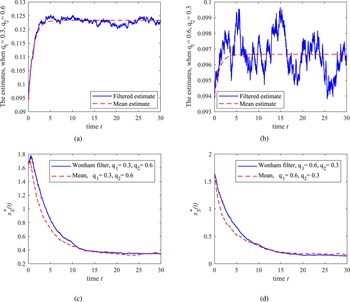
Instead of using the filtering theory based on sample information to estimate the distribution of the hidden Markov chain, we consider the case where the mean value, i.e.  $\overline {\mathbf {p}} (t) = {{\rm E}}[ {{\mathbf {X}}(t)} ]$ is used as an estimate for the distribution. Note that
 $\overline {\mathbf {p}} (t) = {( {{{\overline p }_1}(t),{{\overline p }_2}(t), \ldots,{{\overline p }_N}(t)} )^{{\rm T}}}$ is a deterministic function of
 $t$ and satisfies the following ordinary differential equation:
 \begin{equation} \begin{aligned} {{\rm d}}\overline {\mathbf{p}} (t) & = {\mathbf{Q}}'\overline {\mathbf{p}} (t)\,{{\rm d}}t,\\ {\overline p _k}( 0 ) & = {\mathbb{P}}( {{\mathbf{X}}( 0 ) = {{\mathbf{e}}_k}} ),\quad k = 1, \ldots ,N. \end{aligned} \end{equation}
The solution to (57) is  $\overline {\mathbf {p}}(t)=\overline {\mathbf {p}}(0)\exp [{\mathbf {Q}}'t]$. Then the estimates of the market price of risk and the optimal portfolio weight of stock in Theorem 3 are
 \begin{equation} \begin{aligned} \overline {{\lambda _S}} (t) & = \frac{{\langle {{\mathbf{\mu }},\overline {\mathbf{p}} (t)} \rangle - R(t)}}{{{\sigma _S}}},\\ \overline {x_S^*} (t) & = \frac{\gamma }{{1 - \gamma }}\overline {{\lambda _S}} (t)\frac{1}{{{\sigma _S}}}\\ & \quad+ \frac{{F(t)}}{{{V^*}(t)}}\left( {\frac{1}{{1 - \gamma }}\overline {{\lambda _S}} (t) } \right)\frac{1}{{{\sigma _S}}}\\ & \quad- \frac{{G(t)}}{{{V^*}(t)}}\left( {\frac{1}{{1 - \gamma }}\overline {{\lambda _S}} (t) } \right)\frac{1}{{{\sigma _S}}}. \end{aligned} \end{equation}
Figure 6(a) plots the paths of the filtered estimate and the mean estimate of the stock return rate  $\mu (t)$ when
 $( {{q_1},{q_2}} ) = ( {0.3,0.6} )$, while the case when
 $( {{q_1},{q_2}} ) = ( {0.6,0.3} )$ is illustrated in Figure 6(b). Figure 6(c) and (d) show the optimal proportion of wealth invested in the stock when
 $( {{q_1},{q_2}} ) = ( {0.3,0.6} )$ and
 $( {{q_1},{q_2}} ) = ( {0.6,0.3} )$, respectively. We can see that in the first half of the investment phase, the proportion of wealth invested in the stock obtained by the filtered estimate is larger but, when retirement approaches, there is no significant difference between the optimal investment strategies obtained by the two estimation methods. Compared with the mean estimate, the filtered estimate enables the DC pension plan member to acquire more information about the market states. In this case, the uncertainty of stock return is less, which spurs more investment in stock in the early stage of the investment phase to promote wealth accumulation. As the distribution of the Markov chain tends to be stationary, the information obtained from the stock price process by using two different estimates tends to be identical, hence the investment strategies adopted on the stock also converge.
The paths of the stock return rate and the effects of  $( {q_{1}}, q_{2})$ on
 $x^*_S(t)$ under two estimation methods.

6. Conclusion
In this paper, we investigate the optimal investment problem of a DC pension plan under the hidden Markov economy. Assume that the interest rate is stochastic and follows the CIR model, and the contribution rate is also stochastic. We use the zero-coupon bond and the inflation-indexed bond to hedge the interest rate risk and the inflation risk, respectively. Suppose that the return rate of the stock is governed by a continuous-time, finite-state hidden Markov chain. Besides, with the aim of protecting the wealth of the pension fund at retirement, a minimum guarantee constraint is involved. The guarantee at retirement time stands for the elementary needs of the member from retirement to death. The goal of the DC plan member is to select an optimal portfolio strategy to minimize the risk of the terminal wealth under the constraint that the terminal wealth must exceed the minimum guarantee. We choose a convex risk measure with a specific quadratic penalty term to measure the risk of the portfolio. An explicit expression for the optimal investment strategy is derived using the BSDE approach. Finally, we illustrate the effects of some parameters on the optimal investment strategy through numerical examples and provide explanations from the economic perspective.
To go further in practical use, the present work might be extended. One possible extension is to assume that the contribution rate contains non-hedgeable risk. Another possible extension is to consider the asset allocation problem for a DC pension plan with multiple risk measures, e.g. both the variance and the CVaR constraint.
Acknowledgments
The authors would like to thank editors and anonymous reviewers for their valuable comments and suggestions, which leads to a significant improvement of the paper. This work is supported by the National Natural Science Foundation of China (No. 11701436), the Humanities and Social Science Research Planning Foundation of Ministry of Education of China (No. 22YJAZH087) and the Fundamental Research Funds for the Central Universities (WUT: 3120621545).
Appendix A. Proof of Proposition 1
Note that  $Z(t) = V(t) + F(t) - G(t)$, then
 \begin{equation} {{\rm d}}( {Z(t)H(t)} ) = {{\rm d}}( {V(t)H(t)} ) + {{\rm d}}( {F(t)H(t)} ) - {{\rm d}}( {G(t)H(t)} ). \end{equation}
By the Itô formula,
 \begin{align} {{\rm d}}H(t) = H(t)( { - R(t){{\rm d}}t - {\lambda _R}\sqrt {R(t)}\, {{\rm d}}{W_1}(t) - {\lambda _P}\,{{\rm d}}{W_2}(t) - \widehat {{\lambda _S}}(t)\,{{\rm d}}\widehat {{W_3}}(t)} ),\end{align}
 \begin{align}{{\rm d}}\left( {\frac{1}{{H(t)}}} \right) & = \frac{1}{{H(t)}}( {R(t) + \lambda _R^2R(t) + \lambda _P^2 + {{(\widehat {{\lambda _S}}(t))}^2}} )\,{{\rm d}}t\nonumber\\ & \quad+\frac{1}{{H(t)}}( {{\lambda _R}\sqrt {R(t)}\, {{\rm d}}{W_1}(t) + {\lambda _P}\,{{\rm d}}{W_2}(t) + \widehat {{\lambda _S}}(t)\,{{\rm d}}\widehat {{W_3}}(t)} ),\end{align}
 \begin{align} {{\rm d}}( {V(t)H(t)} ) & = V(t)\,{{\rm d}}H(t) + H(t)\,{{\rm d}}V(t) + {{\rm d}}V(t)\,{{\rm d}}H(t)\nonumber\\ & =H(t)C(t)\,{{\rm d}}t + H(t)V(t)( {{x_B}(t){\sigma _B}( {{\tau _1}} ) + {x_I}(t){\sigma _{I1}}( {{\tau _2}} )} )\,{{\rm d}}{W_1}(t)\nonumber\\ & \quad+ H(t)V(t){x_I}(t){\sigma _{I2}}\,{{\rm d}}{W_2}(t) + H(t)V(t){x_S}(t){\sigma _S}\,{{\rm d}}\widehat {{W_3}}(t). \end{align}
Substituting (A.4), (14) and (15) into (A.1) yields
 \begin{align} {{\rm d}}( {Z(t)H(t)} ) & = [ {H(t)V(t)( {{x_B}(t){\sigma _B}( {{\tau _1}} ) + {x_I}(t){\sigma _{I1}}( {{\tau _2}} )}) + {u_1}(t) - {v_1}(t)} ]\,{{\rm d}}{W_1}(t)\nonumber\\ & \quad+ [ {H(t)V(t){x_I}(t){\sigma _{I2}} + {u_2}(t) - {v_2}(t)} ]\,{{\rm d}}{W_2}(t)\nonumber\\ & \quad+ [ {H(t)V(t){x_S}(t){\sigma _S} + {u_3}(t) - {v_3}(t)} ]\,{{\rm d}}\widehat {{W_3}}(t), \end{align}
which implies that  $Z(t)H(t)$ is a martingale and
 $Z(t)$ is self-financing, that is, there exists a progressively measurable process
 ${\bf {\pi }}(t): = {( {{\pi _B}(t),{\pi _I}(t),{\pi _S}(t)} )^{{\rm T}}}$ satisfying (16). By
 $Z( T ) = V( T ) - G( T )$,
 $V( T ) \ge G( T )$ can be converted to
 $Z( T ) \ge 0$. Moreover, by (16),
 $Z( T ) \ge 0$ is equivalent to
 $Z( 0 ) \ge 0$. Dividing
 $( {Z(t)H(t)} )$ by
 $H (t)$ and using the Itô formula, we can obtain another expression of
 ${{\rm d}}Z(t)$:
 \begin{align} {{\rm d}}Z(t) & = [ \cdots ]\,{{\rm d}}t\nonumber\\ & \quad+ \left[ {V(t)( {{x_B}(t){\sigma _B}( {{\tau _1}} ) + {x_I}(t){\sigma _{I1}}( {{\tau _1}} )} ) + \frac{{{u_1}(t)}}{{H(t)}} - \frac{{{v_1}(t)}}{{H(t)}} + Z(t){\lambda _R}\sqrt {R(t)} } \right]{{\rm d}}{W_1}(t)\nonumber\\ & \quad+\left[ {V(t){x_I}(t){\sigma _{I2}} + \frac{{{u_2}(t)}}{{H(t)}} - \frac{{{v_2}(t)}}{{H(t)}} + Z(t){\lambda _P}} \right]{{\rm d}}{W_2}(t)\nonumber\\ & \quad+ \left[ {V(t){x_S}(t){\sigma _S} + \frac{{{u_3}(t)}}{{H(t)}} - \frac{{{v_3}(t)}}{{H(t)}} + Z(t)\widehat {{\lambda _S}}(t)} \right]{{\rm d}}\widehat {{W_3}}(t). \end{align}
By comparing the Itô integral terms in (16) and (A.6), it is not difficult to obtain (18)–(20).
Appendix B. Proof of Theorem 1
By the definition of the admissible controls, for any  $( {{\bf {\pi }},{\bf {\theta }}} ) \in \overline {\mathcal {A}} \times \overline {\mathbf {\Theta }}$, we have
 \begin{equation} {\mathbb{E}}\left[ {\int_0^T {{{| {H( {t,{\mathbf{Y}}({\cdot} ),{{\mathbf{U}}_2}(t),{\bf{\pi }}(t),{\bf{\theta }}(t)} )} |}^2}\,{{\rm d}}t + {{| {h( {{\mathbf{Y}}( T )} )} |}^2}} } \right] < \infty . \end{equation}
Since  $H( {t,{\mathbf {Y}}( \cdot ),{{\mathbf {U}}_2}(t),{{\bf {\pi }}^*}(t),{{\bf {\theta }}^*}(t)} ) = - \widetilde \lambda ( {t,{\mathbf {Y}}( \cdot ),{{\bf {\pi }}^*}(t),{{\bf {\theta }}^*}(t)} )$ is independent of
 $( {{U_1}(t),{{\mathbf {U}}_2}(t)} )$, the corresponding BSDE has a unique solution
 $( {{U_1}(t),{{\mathbf {U}}_2}(t)} ) \in {\mathcal {S}}_1^2( {[0,T]} ) \times {\mathcal {H}}_3^2( {[0,T]})$.
The proof of the result that  $( {{{\bf {\pi }}^*}(t),{{\bf {\theta }}^*}(t)} )$ is the saddle point of game problem (30) is similar to that in De Scheemaekere [Reference De Scheemaekere10] and Siu [Reference Siu30]. We sketch the main steps. BSDE (32) has a unique solution, and
 \begin{align} {U_1}(t) & = {\mathbb{E}}\left[ {\left. { - {h_1}( {{\mathbf{Y}}( T )} ) - \int_t^T {\widetilde \lambda ( {u,{\mathbf{Y}}({\cdot} ),{{\bf{\pi }}^*}( u ),{{\bf{\theta }}^*}( u )} )\,{{\rm d}}u} } \,\right|{{\mathcal{G}}_t}} \right]\nonumber\\ & := {\widetilde J_t}( {{{\bf{\pi }}^*},{{\bf{\theta }}^*}} ), \quad {\mathbb{P}}- {\rm a.s}. \end{align}
For any  ${\bf {\theta }} \in \overline {\mathbf {\Theta }}$, the BSDE with driver
 $H( {t,{\mathbf {Y}}( \cdot ),{{\mathbf {U}}_2}(t),{{\bf {\pi }}^*}(t),{\bf {\theta }}(t)} )$ and terminal value
 $- h( {{\mathbf {Y}}( T )} )$ has a unique solution
 $( {U_1^{\bf {\theta }},{\mathbf {U}}_2^{\bf {\theta }}} )$, and
 $U_1^{\bf {\theta }}( 0 ) = {\widetilde J_0}( {{{\bf {\pi }}^*},{\bf {\theta }}})$. From the Issacs’ condition, we have
 \begin{align} H( {t,{\mathbf{Y}}({\cdot} ),{{\mathbf{U}}_2}(t),{{\bf{\pi }}^*}(t),{\bf{\theta }}(t)} ) & \le \sup_{{\bf{\theta }} \in \overline {\mathbf{\Theta }} } H( {t,{\mathbf{Y}}({\cdot} ),{{\mathbf{U}}_2}(t),{{\bf{\pi }}^*}(t),{\bf{\theta }}(t)})\nonumber\\ & = \sup_{{\bf{\theta }} \in \overline {\mathbf{\Theta }} } \inf_{\pi \in \overline {\mathcal{A}} } H( {t,{\mathbf{Y}}({\cdot} ),{{\mathbf{U}}_2}(t),{\bf{\pi }}(t),{\bf{\theta }}(t)} )\nonumber\\ & = H( {t,{\mathbf{Y}}({\cdot}),{{\mathbf{U}}_2}(t),{{\bf{\pi }}^*}(t),{{\bf{\theta }}^*}(t)}). \end{align}
According to the comparison theorem for the solution of one-dimensional BSDE,
 \begin{equation} U_1^{\bf{\theta }}( 0 ) = \widetilde {{J_0}}( {{{\bf{\pi }}^*},{\bf{\theta }}} ) \le \widetilde {{J_0}}( {{{\bf{\pi }}^*},{{\bf{\theta }}^*}} ) = {U_1}( 0 ). \end{equation}
Similarly, it can be proved that for any  ${\bf {\pi }} \in \overline {\mathcal {A}}$, we have
 \begin{equation} U_1^{\bf{\pi }}( 0 ) = \widetilde {{J_0}}( {{\bf{\pi }},{{\bf{\theta }}^*}} ) \ge \widetilde {{J_0}}( {{{\bf{\pi }}^*},{{\bf{\theta }}^*}} ) = {U_1}( 0 ). \end{equation}
Therefore,  $( {{{\bf {\pi }}^*}(t),{{\bf {\theta }}^*}(t)})$ is the saddle point of the game problem (30).
Finally, we prove that  ${U_1}( 0 )$ is the value function of game problem (30). On the one hand, by (B.4) and (B.5),
 \begin{equation} \inf_{{\bf{\pi}} \in \overline {\mathcal{A}} } \sup_{{\bf{\theta }} \in \overline {\mathbf{\Theta }} } \widetilde {{J_0}}( {{\bf{\pi }},{\bf{\theta }}} ) \le {U_1}( 0 ) = \widetilde {{J_0}}( {{{\bf{\pi }}^*},{{\bf{\theta }}^*}} ) \le \sup_{{\bf{\theta }} \in \overline {\mathbf{\Theta }} } \inf_{{\bf{\pi}} \in \overline {\mathcal{A}} } \widetilde {{J_0}}( {{\bf{\pi }},{\bf{\theta }}}). \end{equation}
On the other hand, note that
 \begin{equation} \sup_{{\bf{\theta }} \in \overline {\mathbf{\Theta }} } \inf_{{\bf{\pi }} \in \overline {\mathcal{A}} } \widetilde {{J_0}}( {{\bf{\pi }},{\bf{\theta }}} ) \le \inf_{{\bf{\pi }} \in \overline {\mathcal{A}} } \sup_{{\bf{\theta }} \in \overline {\mathbf{\Theta }} } \widetilde {{J_0}}( {{\bf{\pi }},{\bf{\theta }}} ). \end{equation}
Thus,
 \begin{equation} {U_1}( 0 ) = \widetilde {{J_0}}( {{{\bf{\pi }}^*},{{\bf{\theta }}^*}} ) = \sup_{{\bf{\theta }} \in \overline {\mathbf{\Theta }} } \inf_{{\bf{\pi }} \in \overline {\mathcal{A}} } \widetilde {{J_0}}( {{\bf{\pi }},{\bf{\theta }}} ) = \inf_{{\bf{\pi }} \in \overline {\mathcal{A}} } \sup_{{\bf{\theta }} \in \overline {\mathbf{\Theta }} } \widetilde {{J_0}}( {{\bf{\pi }},{\bf{\theta}}} ). \end{equation}
Appendix C. Proof of Theorem 2
According to Theorem 1, seeking  $( {{{\bf {\pi }}^*}(t),{{\bf {\theta }}^*}(t)} )$ is equivalent to solving the extremum of
 $H$. The specific form of the Hamiltonian is
 \begin{align} H( {t,{\mathbf{Y}}({\cdot} ),{{\mathbf{U}}_2}(t),{\bf{\pi }}(t),{\bf{\theta }}(t)} )& :={-} {Y_1}(t){Y_2}(t)( {R(t) + {{\bf{\pi }}^{{\rm T}}}(t){\bf{\Sigma }}{\widehat{\bf {\Lambda}}}(t) + {{\bf{\pi }}^{{\rm T}}}(t){\bf{\Sigma \theta }}(t)} )\nonumber\\ & \quad - \frac{1}{{2( {1 - \gamma } )}}{Y_1}(t){Y_2}(t){\| {{\bf{\theta }}(t)} \|^2}. \end{align}
The first-order condition for maximizing  $H( {t,{\mathbf {Y}}( \cdot ),{{\mathbf {U}}_2}(t),{\bf {\pi }}(t),{\bf {\theta }}(t)} )$ with respect to
 ${\bf {\theta }}$ leads to the following equations:
 \begin{align} \frac{{\partial H}}{{\partial {\theta _1}}} & ={-} {Y_1}(t){Y_2}(t)\left( {{\pi _B}(t){\sigma _B}( {{\tau_1}} ) + {\pi _I}(t){\sigma _{{I_1}}}( {{\tau _2}} ) + \frac{{{\theta _1}(t)}}{{1 - \gamma }}} \right) = 0, \end{align}
 \begin{align} \frac{{\partial H}}{{\partial {\theta _2}}} & ={-} {Y_1}(t){Y_2}(t)\left( {{\pi _I}(t){\sigma _{I2}} + \frac{{{\theta _2}(t)}}{{1 - \gamma }}} \right) = 0, \end{align}
 \begin{align} \frac{{\partial H}}{{\partial {\theta _3}}} & ={-} {Y_1}(t){Y_2}(t)\left( {{\pi _S}(t){\sigma _S} + \frac{{{\theta _3}(t)}}{{1 - \gamma }}} \right) = 0. \end{align}
Similarly, the first-order condition for minimizing  $H( {t,{\mathbf {Y}}( \cdot ),{{\mathbf {U}}_2}(t),{\bf {\pi }}(t),{\bf {\theta }}(t)} )$ with respect to
 ${\bf {\pi }}$ leads to the following equations:
 \begin{align} \frac{{\partial H}}{{\partial {\pi _B}}} & ={-} {Y_1}(t){Y_2}(t)( {{\lambda _R}\sqrt {R(t)} {\sigma _B}( {{\tau _1}} ) + {\sigma _B}( {{\tau _1}} ){\theta _1}(t)} ) = 0, \end{align}
 \begin{align} \frac{{\partial H}}{{\partial {\pi _I}}} & ={-} {Y_1}(t){Y_2}(t)( {{\lambda _R}\sqrt {R(t)} {\sigma _{I1}}( {{\tau _2}} ) + {\sigma _{I2}}{\lambda _P} + {\sigma _{I1}}( {{\tau _2}} ){\theta _1}(t) + {\sigma _{I2}}{\theta _2}(t)} ) = 0, \end{align}
 \begin{align} \frac{{\partial H}}{{\partial {\pi _S}}} & ={-} {Y_1}(t){Y_2}(t)( {{\lambda _S}{\sigma _S} + {\sigma _S}{\theta _3}(t)} ) = 0. \end{align}
Appendix D. Proof of Proposition 2
By property (3) of Lemma 2 and the martingale representation theorem, there exists a unique,  $\mathbb {G}$-predictable process
 ${\mathbf {u}}(t): = {( {{u_1}(t),{u_2}(t),{u_3}(t)} )^{{\rm T}}}$ such that
 \begin{equation} {{\rm d}}( {F(t)H(t)} ) ={-} H(t)C(t)\,{{\rm d}}t + {u_1}(t)\,{{\rm d}}{W_1}(t) + {u_2}(t)\,{{\rm d}}{W_2}(t) + {u_3}(t)\,{{\rm d}}\widehat {{W_3}}(t). \end{equation}
By the Itô formula,
 \begin{equation} {{\rm d}}( {F(t)H(t)} ) = F(t)\,{{\rm d}}H(t) + H(t)\,{{\rm d}}F(t) + {{\rm d}}F(t)\,{{\rm d}}H(t). \end{equation}
According to (41) and (42), we have
 \begin{align} {{\rm d}}F(t) & ={-} C(t)\,{{\rm d}}t + F(t)\left( {R(t) + {\lambda _R}\sqrt {R(t)} \int_t^T {\frac{{D( {t,s} ){\sigma _{D1}}( {t,s} )}}{{F(t)}}\,{{\rm d}}s + {\lambda _P}{\sigma _{D2}} } } \right){{\rm d}}t\nonumber\\ & \quad+ F(t)\left( {\int_t^T {\frac{{D( {t,s} ){\sigma _{D1}}( {t,s} )}}{{F(t)}}\,{{\rm d}}s} } \right){{\rm d}}{W_1}(t) + F(t){\sigma _{D2}}\,{{\rm d}}{W_2}(t) . \end{align}
Substituting (A.2) and (D.3) into (D.2), we have
 \begin{align} {{\rm d}}( {F(t)H(t)} ) & ={-} H(t)C(t)\,{{\rm d}}t + H(t)F(t)\left( {\int_t^T {\frac{{D( {t,s} ){\sigma _{D1}}( {t,s} )}}{{F(t)}}\,{{\rm d}}s - {\lambda _R}\sqrt {R(t)} } } \right){{\rm d}}{W_1}(t)\nonumber\\ & \quad+ H(t)F(t)( {{\sigma _{D2}} - {\lambda _P}} )\,{{\rm d}}{W_2}(t) + H(t)F(t)( { - \widehat {{\lambda _S}}(t)} )\,{{\rm d}}\widehat {{W_3}}(t). \end{align}
By comparing the Itô integral terms of (D.4) and (D.1), we obtain (43), (44) and (45).