Introduction
Active chronic suppurative otitis media (CSOM) is estimated to affect 1.5 per cent of the adult population of the UK.Reference Browning and Gatehouse1 The complications of greatest concern are those that are life-threatening, namely, intracranial complications including meningitis, lateral sinus thrombosis and intracranial abscess. Otogenic lateral sinus thrombosis is rare in the UK, and when it occurs there is often an associated haematological anomaly.Reference Ram, Meiklejohn, Nunez, Murray and Watson2 Leskinen and Jero determined the incidence of adult intracranial or intratemporal complications secondary to otitis media in Finland as 0.32/100 000.Reference Leskinen and Jero3 The most recently published UK data on the risk of otogenic intracranial complications relates only to intracranial abscess.Reference Nunez and Browning4
The current study aimed to determine the adult incidence of otogenic meningitis in the UK.
Materials and methods
Adults hospitalised with meningitis in Bristol between 1 January 1997 and 31 December 2002 were identified by searching the discharge diagnoses databases of the two acute National Health Service hospital trusts serving the city of Bristol, to identify all patients with the International Classification of Diseases version 10 (ICD-10) diagnostic codes G00, G01, G02 and G035 that include all cases of meningitis. The case records thus identified were then accessed, with the approval of the local hospital audit department, if patients were aged 18 years or older at the time of hospitalisation.
A specially designed data collection sheet was used to record each patient's date of admission, age, sex, clinical examination findings, cerebrospinal fluid (CSF) microscopy results, blood and CSF culture results, and computed tomography (CT) and magnetic resonance imaging results. Patients who developed meningitis secondary to a neurosurgical procedure were excluded. We studied cases with CSF evidence of meningitis confirmed either by a CSF white blood cell count of greater than 500 per cm3, or by organism identification via Gram staining, microbiological culture or polymerase chain reaction.
Pathogens were recorded as identified on the microbiology report. Where more than one underlying cause of meningitis existed in a single case, for clarity only one cause was ascribed, using a rank order of otogenic, sinugenic or other. For example, in a patient with lobar pneumonia, sphenoid and mastoid opacification on CT scan, and a cochlear implant, the cause of meningitis was recorded as otogenic. Otogenic meningitis was defined as occurring when there was contemporaneous evidence of a middle-ear infection documented either by physical examination, microbiological ear swab culture or imaging.
The populations covered by the three primary care organisations served by the acute hospitals in Bristol, based on the 29 April 2001 census, were obtained from the Office for National Statistics,6 by searching the data sets for Bristol, North Somerset and South Gloucestershire primary care organisations and extracting age-specific population counts. These populations were then summed to obtain the total population aged 18 years and older.
Ninety-five per cent confidence intervals were calculated for proportions using a Bayesian method, utilising the confidence interval calculator available at the causascientia website.7
Results and analysis
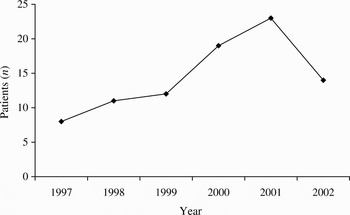
One hundred and ninety-three cases of meningitis were identified by the discharge diagnosis search strategy. Twenty-five case notes could not be traced. Twenty-one had miscoded diagnoses, and 60 cases were excluded by the study criteria. Eighty-seven cases of meningitis met the study criteria. These patients had an age range of 18–94 years on admission, and comprised 44 men and 43 women (Figure 1).
New hospital admissions for meningitis by year.

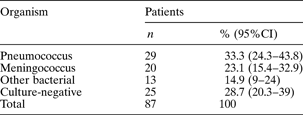
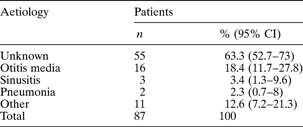
Twenty-nine cases were pneumococcal in origin, 20 meningococcal, 13 due to other bacterial causes and 25 due to unknown causes (Table I). Sixteen (18.4 per cent) patients had documented clinical features of ear infection. Chronic and acute suppurative otitis media were found in three and 13 patients, respectively. One acute otitis media patient with pneumococcal meningitis and bilateral mastoid opacification on CT had a cochlear implant. Three cases were attributed to paranasal sinus disease, four to trauma and two to chest infection. In the majority of patients (55 cases), a primary source could not be identified (Table II). Five patients died, a mortality rate of 5.3 per cent.
Patients' presumed causative organism for meningitis*

* Based on microbiological culture, cerebrospinal fluid Gram stain or polymerase chain reaction. CI = confidence interval
Patients' meningitis aetiology

CI = confidence interval
The adult population (i.e. aged 18 years and older) served by Bristol's acute hospitals, based on the 29 April 2001 census, was 635 976. Within this population, 2.7 cases of otogenic meningitis occurred per year. Therefore, the annual incidence in the sample population was 0.42 per 100 000.
Discussion
This study aimed to identify the proportion of adult cases of bacterial meningitis which occurred secondary to suppurative otitis media. There were two main problems with this aim; firstly, not all cases of otitis media are bacterial in origin, especially if acute in origin; and secondly, the differentiation of bacterial from nonbacterial meningitis is difficult. Acute otitis media is predominantly a disease of childhood. A national, cross-sectional, 1991 survey of the Korean population reported an acute otitis media population prevalence of 8 per 1000 in those younger than 16 years of age, but 0 per 1000 in those aged 16 years and older.Reference Kim, Jung and Yoo8 Viral meningitis is likewise predominantly a childhood disease. The incidence of viral meningitis in Finnish children under one year of age is 219 per 100 000; that in children under 14 years is 27.8 per 100 000.Reference Rantakallio, Leskinen and von Wendt9 However, in the adult Finnish population the incidence is 7.6 per 100 000.Reference Kupila, Vuorinen, Vainionpaa, Hukkanen, Marttila and Kotilainen10
Laboratory examination of CSF is the accepted strategy to distinguish bacterial and nonbacterial meningitis, but there is no consensus on the diagnostic thresholds of different indices. Diagnostic algorithms have been proposed, such as that of Brivet and colleagues,Reference Brivet, Ducuing, Jacobs, Chary, Pompier and Prat11 who found that the presence of at least one sign of disease severity at the time of referral, plus a CSF neutrophil count of more than 1000/µl, acted as predictors of bacterial meningitis. This model has not yet been prospectively validated in an independent population sample. Steele et al. Reference Steele, Marmer, O'Brien, Tyson and Steele12 have advised rapid analysis of CSF because neutrophil counts can decrease by 50 per cent within two hours of collection. The commonly assessed CSF indices do not reliably differentiate bacterial from viral meningitis;Reference Lindquist, Linne, Hansson, Kalin and Axelsson13 however, in the current study the selection of bacterial meningitis was favoured by the combination of (1) an adult study group and (2) meningitis diagnosis inclusion criteria requiring either the identification of a bacterial pathogen on blood or CSF culture, or a CSF white cell count greater than 500/cm3.
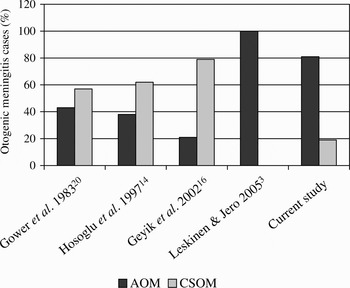
Meningitis developed de novo in the majority of cases studied. However, otitis media was the predominant predisposing cause, accounting for 16 of the 32 cases of secondary meningitis, and 18.4 per cent of all cases. Hosoglu et al. Reference Hosoglu, Ayaz, Geyik, Kokoglu and Ozen14 found chronic otitis media to be the third commonest cause of acute bacterial meningitis, accounting for 6.0 per cent of cases, after pneumonia and head injury. In our series, pneumonia accounted for 2.3 per cent of cases, while trauma and chronic otitis media accounted for 4.6 and 3.4 per cent of cases respectively. The 95 per cent confidence intervals include the ranges described by Hosoglu for chronic otitis media and trauma. However, in this British adult series the predominance of acute otitis media as the underlying cause of meningitis was different to that described by several other authors (Figure 2).
Proportion of adult cases of meningitis secondary to acute and chronic suppurative otitis media, from previous reports and the current study. AOM = acute otitis media; CSOM = chronic suppurative otitis media

Barry et al. Reference Barry, Delattre, Vie, Bedos and Gehanno15 described equal dominance of acute and chronic otitis media as aetiological factors in intracranial infection, in an 18-year French series. However, most twentieth century adult series have demonstrated a predominance of CSOM as a causative factor,Reference Geyik, Kokoglu, Hosoglu and Ayaz16–Reference Gower and McGuirt20 with only a minority reporting the reverse.Reference Leskinen and Jero3, Reference Migirov, Duvdevani and Kronenberg21 Our finding of a predominance of acute suppurative otitis media as a causative factor may be due to improvements in the surgical management of CSOM, or to an increase in adult cases of complicated acute otitis media. An improvement in the surgical management of CSOM is suggested by the absence of any patients with surgically treated CSOM in the meningitis cases identified. This contrasts with the results of Barry and colleagues'Reference Barry, Delattre, Vie, Bedos and Gehanno15 meningitis series, and those of earlier UK series of otogenic intracranial abscesses in which intracranial complications developed in a proportion of patients who had undergone previous mastoid surgery.Reference Nunez and Browning4 Tandon et al. Reference Tandon, Beasley and Swift22 have likewise demonstrated a reduction in intracranial abscesses secondary to CSOM over time, in the Mersey region of the UK. Other possible explanations for an increase in cases of otogenic meningitis (including less frequent antibiotic treatment of acute otitis media by general practitioners, and increased microbial resistance) cannot be confirmed by this study, as primary care records were not accessed and details of the antibiotic sensitivities of cultured microbes were not collected. There was no clear evidence of microbial resistance, as the majority of patients had their meningitis treated with one to two weeks of a cephalosporin.
• Meningitis is the commonest intracranial complication of suppurative otitis media
• Chronic suppurative otitis media (CSOM) has accounted for the majority of adult cases of meningitis reported to date
• Otolaryngological disease (either otitis media or sinusitis) is the predominant known underlying cause of intracranial infections
• In this UK series, acute suppurative otitis media accounted for more cases of adult otogenic meningitis than CSOM
• The annual incidence of adult otogenic meningitis was 0.42 per 100 000
In the current series, no patients with otogenic meningitis died. However, the sample size was not large enough to justify subgroup analysis, and it is safer to assume that the mortality rate in otogenic meningitis cases was similar to that in the overall group, namely 5.3 per cent. This mortality rate is similar to that described by Migirov et al. Reference Migirov, Duvdevani and Kronenberg21 and Barry et al.,Reference Barry, Delattre, Vie, Bedos and Gehanno15 but lower than that described by Leskinen and JeroReference Leskinen and Jero3 and Hosoglu et al. Reference Hosoglu, Ayaz, Geyik, Kokoglu and Ozen14 The reasons for this variation in mortality rates in different series are uncertain.
The current study found an annual incidence of otogenic meningitis of 0.42 per 100 000 in Bristol, UK. This rate exceeds Leskinen's and Jero'sReference Leskinen and Jero3 finding of 0.026 per 100 000 for the population of Helsinki, Finland. Further study will be required to determine if there is a true difference in disease incidence in the two populations, or if differences in study protocols account for the findings.
The spectrum of otitis media and meningitis in children is different to that in adults. As such, the findings of the current study, which excluded patients younger than 16 years, should not be extrapolated to the paediatric population.
Conclusion
This British series demonstrates that acute suppurative otitis media accounted for the majority of cases of adult bacterial meningitis in which an underlying cause could be found. The annual age adjusted incidence of Otogenic meningitis was 0.42 per 100 000.
Acknowledgements
We acknowledge the contribution of the audit departments of the North Bristol NHS Trust and University Hospitals Bristol, NHS Trust and of Mr Graham Porter in facilitating access to case records. Mr Arash Naraghi contributed to study design and data collection.