Asymptomatic bacteriuria (ASB), defined as the presence of significant bacterial count in the urine without the associated symptoms of a urinary tract infection, is common among women, diabetics, and the elderly.Reference Zalmanovici Trestioreanu, Lador, Sauerbrun-Cutler and Leibovici 1 Screening for, and treatment of, ASB with antibiotics has not been shown to prevent symptomatic urinary tract infection (UTI), complications, or death. Treatment is associated with an increased rate of adverse events.Reference Zalmanovici Trestioreanu, Lador, Sauerbrun-Cutler and Leibovici 1 , Reference Nicolle, Bradley and Colgan 2
Treatment for UTI is generally empirical, based on urinary symptoms. In contrast, treatment for ASB occurs in response to a positive urine culture result. Confronted with positive urine-culture results, physicians often treat without considering the symptom history, especially among inpatients, because urine culture may be submitted by nurses without a physician’s order. A novel approach to laboratory reporting would partially withhold positive culture results, unless the physician specifically contacts the laboratory, based on symptoms. In a nonrandomized study using historical controls, this intervention reduced treatment of ASB among noncatheterized inpatients from 48% to 12% (absolute risk reduction, 36%; 95% CI, 15%–57%).Reference Leis, Rebick and Daneman 3
It is established practice for the microbiology laboratory to withhold certain results, unless requested, such as second-line antimicrobial susceptibility, to encourage physicians to use narrow-spectrum antibiotics when appropriate. A related laboratory intervention (ie, delayed ordering of urine culture) has been shown to reduce inappropriate treatment of ASB.Reference Stagg, Lutz and Kirpalaney 4 We hypothesized that modified reporting of positive urine cultures among inpatients would reduce treatment of ASB without increasing untreated UTI, pyelonephritis, bacteremia, or death.
METHODS
Trial Design
The study was a randomized, parallel, superiority trial comparing 2 different methods of reporting positive urine cultures. Eligible urine specimens were inoculated onto blood and MacConkey agars, incubated overnight, and interpreted quantitatively according to laboratory protocol. There were no changes to the trial design during the study.
Participants
Consecutive positive urine cultures were assessed. Specimen eligibility was assessed prospectively using medical records. We used the following exclusion criteria: age <18 years, pregnancy, indwelling catheter, receiving antibiotics at the time of collection, absolute neutrophil count <1×10⁹ per liter, admission to the intensive care unit.
Specimens were collected from inpatients admitted to 1 of the 2 tertiary-care academic hospitals in St John’s, Newfoundland, Canada. The Health Sciences Center (346 acute-care beds) provides medicine, pediatric and surgery inpatient services, critical care, cardiac surgery, neurosurgery, plastic surgery, burn treatment, obstetrics/gynecology, and acute psychiatry. St Clare’s Mercy Hospital (205 acute-care beds) provides medicine and surgical inpatient services, critical care, general surgery, vascular surgery, thoracic surgery, otolaryngology, orthopedics, and ambulatory services. The metropolitan area of St John’s has a population of 219,000 people (2017). One centralized microbiology laboratory performs all testing for the city, reporting ~30 positive urine cultures per day.
Intervention
Enrolled microbiology laboratory reports were randomized equally into standard report (control) or modified report (intervention) arms before being released to physicians via the electronic health record (Meditech). The only laboratory report made available to physicians in the electronic health record on the included specimen was the study report. Specimens randomized to the standard report arm were reported using the usual format, including bacterial count, bacterial identification, and antibiotic susceptibility.
The modified report informed the physician that significant bacterial growth was detected, but bacterial identification and susceptibility information were withheld unless requested. Specimens randomized to the modified report were reported as: “This POSITIVE urine culture may represent asymptomatic bacteriuria or urinary tract infection. If urinary tract infection is suspected clinically, please call the microbiology laboratory at [phone] between 0900 to 2300, or the microbiology technologist on-call at [phone] at night, for identification and susceptibility results.” If a request was received, the complete report was immediately provided in the electronic health record.
After randomization and reporting, included patients were assessed by an investigator on the day of reporting, using medical records, to determine the clinical diagnosis of either UTI or ASB, based on diagnostic criteria for noncatheterized urine specimens. 5 For treatment decisions and adverse events, medical records were again assessed at 72 hours and at 7 days after culture reporting. Investigators did not communicate with attending physicians. If patients were discharged during the follow-up period, primary care physicians were contacted by telephone to collect adverse event data. Calls received by the laboratory requesting complete reports were recorded.
Outcomes
The primary efficacy outcome was the proportion of appropriate antibiotic treatment prescribed based on diagnosis (ASB or UTI) as determined by investigators and treatment prescribed within 24 hours in response to the laboratory result. Appropriate treatment was defined as no antibiotic given for ASB (untreated ASB) or any antibiotic given for UTI (treated UTI), and inappropriate treatment was defined as any antibiotic given for ASB (treated ASB) or no treatment given for UTI (untreated UTI). The primary safety outcome was bacteremia rate.
Secondary efficacy outcomes were rate of requests for complete reports, and cost savings. Secondary safety outcomes were deaths and adverse events, defined as evidence of systemic inflammatory response syndrome (SIRS) at 72 hours (vital signs, glucose, positive fluid balance, and changes in mental status) or any new symptoms during 7 days after urine collection.
The intervention was a single time event; therefore, once randomized and reported, specimens could not discontinue the intervention. If a physician requested standard reporting after receiving a modified report, the patient was analyzed as randomized and included in follow-up.
Sample Size
The expected rate of inappropriate treatment was 45% in the standard reporting arm and 15% in the modified reporting arm.Reference Leis, Rebick and Daneman 3 A power analysis for χ2 test of proportions, with a risk of type 1 error of 5%, and type 2 error of 20%, suggested a sample size of 84 patient results. Allowing for attrition and losses to follow-up of 25%, 110 consecutive inpatient samples were recruited.
Interim Analysis and Stopping Rules
One interim analysis was performed after the recruitment of 47 specimens. There was no predefined stopping rule. The study was stopped after the planned sample size was recruited.
Randomization
Randomization sequence was generated without blocking or stratification using Research Randomizer version 4.0 software.Reference Urbaniuk and Plous 6 Reporting assignments were placed into serially numbered, sealed, opaque envelopes by the investigators.
Blinding
The study was not blinded. Attending physicians were aware of reporting assignment, and investigators were aware of reporting assignment before assessing diagnosis and adverse events. Patients were not aware of the study.
Statistical Methods
All specimens randomized and reported were included in the intention-to-treat (ITT) analysis. Specimens inappropriately included were excluded from the per-protocol (PP) analysis. The proportion of appropriate treatment was compared using 2-sided Pearson χ2 test with SPSS version 23.0 software (IBM, Armonk, NY). An adjusted analysis was not performed. Cost was calculated as the difference in antibiotic cost and length of hospital stay for the episode.
Ethics
The protocol was approved by the Provincial Health Research Ethics Board on June 30, 2016 (reference #2016157). Physician consent requirement was waived because the intervention posed no more than minimal risk to participants. A letter was sent to all inpatient physicians informing them about the study prior to recruitment, and a debrief meeting, offering an opportunity to withdraw physician participation, was provided. The patient consent requirement was waived because physicians were the research subjects.
RESULTS
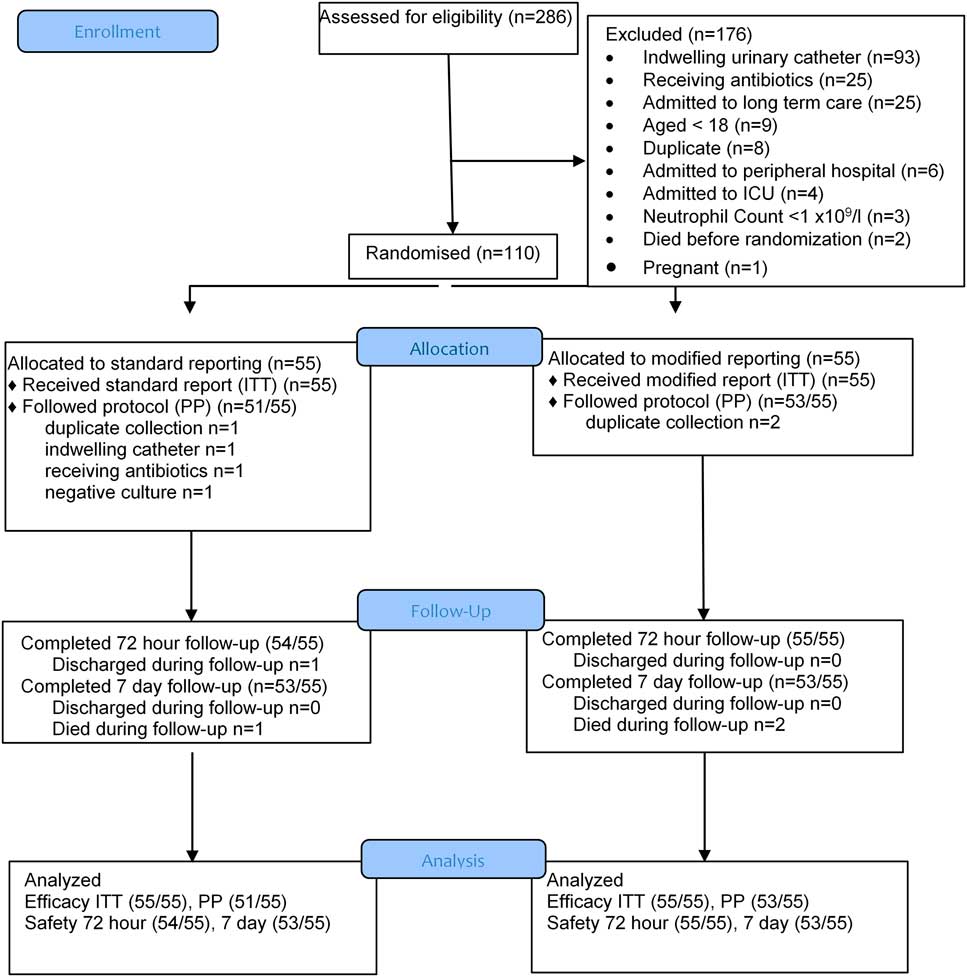
Participant flow is illustrated in Figure 1. We assessed 286 consecutive positive urine cultures between January 3, 2017, and March 27, 2017. Among them, 176 were excluded because they did not meet the inclusion criteria. Baseline data are provided in Table 1. The 2 groups were comparable in mean age and gender. However, the modified reporting arm had more UTIs (20 of 55 [36.3%] vs 14 of 55 [25.4%]; P = .219). Of 110 positive urine cultures, 76 (69.1%) represented ASB rather than UTI.
Patient Demographics

Numbers Analyzed
In total, 110 specimens were randomized and reported and included in the ITT analysis. Overall, 4 specimens were randomized to modified reporting (ie, 1 collected from catheter, 1 duplicate, 1 on treatment, and 1 culture negative). Another 2 specimens randomized to standard reporting (ie, 2 duplicates) did not follow protocol and were excluded from the PP analysis. The final PP analysis included 104 specimens.
Participant Flow.

Outcomes and Estimation
The proportion of appropriate treatment was higher in the modified arm than in the standard arm in the ITT analysis: 44 of 55 (80.0%) versus 29 of 55 (52.7%), respectively (absolute difference = −27.3%; RR, 0.42; P = .002; number needed to report for benefit, 3.7). The PP analysis had a similar result: 42 of 53 (79.2%) in the modified arm versus 26 of 51 (51.0%) in the standard arm (absolute difference, −28.2%; RR, 0.42; P = .002; number needed to report for benefit, 3.5).
The overall difference in proportion of appropriate treatment was based on a change in the proportion of treatment of ASB, not on a change in the proportion of treatment of UTI. The rate of treatment of ASB was reduced from 24 of 41 (58.5%) in the standard arm to 10 of 35 (37.1%) in the modified arm (P = .016) (Table 2).
Treatment Decision ITT Population

Ancillary Analyses
Among specimens in the PP analysis randomized to modified reporting, the physician called the laboratory to request the complete report in 14 of 53 cases (26.4%). The proportion of appropriate treatment in cases when the physician did call the laboratory was 10 of 14 (71.4%), and in cases when the physician did not call the lab, it was 32 of 39 (82.0%; P = .41). These results suggest that a crossover from modified reporting to standard reporting did not reduce the benefit of the modified reporting.
Harms
Untreated UTI was more frequent in the standard reporting arm: 2 of 14 (14.3%) in the standard reporting arm versus 2 of 20 (10.0%) in the modified reporting arm (P = .37) (Table 2).
There were 3 bacteremia cases: 2 in the standard reporting arm (both treated UTI) and 1 in the modified reporting arm (treated UTI). All bacteremias occurred in blood cultures collected at the time of admission to hospital, prior to treatment. None were considered to have been related to the study intervention (Supplementary Table 1).
There were 3 deaths, 1 in the standard reporting arm (untreated ASB) and 2 in the modified reporting arm (1 untreated ASB and 1 treated UTI). None were considered related to the study intervention (Supplementary Table 2).
Complete data were available for 72-hour safety assessment for 109 of 110 patients (1 discharged during follow-up). Complete data were available for 7-day safety assessment for 107 of 110 patients (there were 3 deaths during follow-up). At 72 hours, features of SIRS were uncommon in both arms, with no discernible trend when arms were compared (Supplementary Table 3). At 7 days, new symptoms were observed in both arms. Most new symptoms were unrelated to urinary tract infection (Supplementary Table 4).
Cost
The mean cost of antibiotic treatment given for UTI/ASB was $35.78 ± $109.77 in the standard reporting arm (36 prescriptions given to 53 patients), compared to $19.84 ± 64.88 in the modified reporting arm (27 prescriptions given to 53 patients) (mean cost savings, $14.94 per episode; P = .37). Most inpatients received many courses of antibiotics for various reasons during admission, so this difference reflects a small proportion of total antibiotic cost.
Total length of stay was 45.9 ± 44.6 days in the standard reporting arm, compared to 34.9 ± 46.7 days in the modified reporting arm (mean length of stay reduction = 11.0 days per episode (P = .22). Total length of stay in patients treated appropriately for UTI/ASB was 30.1 ± 41.5 days, compared to 59.6 ± 47.7 days in patients treated inappropriately for UTI/ASB (mean length of stay reduction, 29.5 days per episode; P = .001).
DISCUSSION
We have demonstrated that modified urine-culture reporting is associated with a significant reduction in inappropriate treatment, without an increase in adverse events. An increase in empiric UTI treatment was not observed. Other multifaceted interventions significantly reduced treatment of ASB among inpatientsReference Irfan, Brooks, Mithoowani, Celetti, Main and Mertz 7 and among catheterized patientsReference Trautner, Grigoryan and Petersen 8 ; however, these interventions require considerable ongoing effortReference Leis, Rebick and Daneman 3 compared to changing laboratory policy.
Our study has several limitations. Our randomization appeared successful; however, we found nonsignificantly more UTIs in the modified reporting arm compared to the standard reporting arm (P = .219). Because our primary outcome included both appropriate treatment of UTI and appropriate treatment of ASB, this difference between groups at baseline did not bias our conclusion.
Our diagnosis was based on prospective review of medical records and discussion with nursing staff, not on taking the history from the patient. Thus, where data may have been unavailable, our diagnosis may have been biased toward ASB. Furthermore, investigators were not blinded to reporting assignment, so assessment of appropriate treatment may have been biased toward a favorable effect of the intervention.
Although we actively surveilled harms and observed equal adverse events in both arms, our trial was not powered to adequately assess the safety of modified reporting. Safety should be further assessed in a large effectiveness trial, before implementation.
We observed a very large and statistically significant reduction in length of stay when appropriate antibiotics were prescribed; however, this observation may have been confounded by many alternative explanations.
Most positive urine cultures in our study represented ASB (69.1%), not UTI. This proportion may not be generalizable to other hospitals, depending on local practice in urine culture ordering. This proportion suggests that our laboratory is currently testing many inpatient urine specimens which should not have been collected. We are not aware of other laboratories using restricted reporting.
Other limitations to generalizability include exclusion of urines collected from many patients. Future research could expand the application of our intervention to include catheter-collected urines, long-term care, children, intensive care units, or outpatients. Because treatment for ASB may be appropriate among pregnant women or prior to urologic surgery, these groups should not be included in modified reporting.
Our design is a proof-of-concept study that requires additional verification trials before implementation. It would be impractical for laboratories to manually screen all inpatient urine specimens using our inclusion criteria, although automated eligibility screening may be possible.
Antibiotic stewardship guidelinesReference Barlam, Cosgrove and Abbo 9 suggest that laboratories take a more active role in stewardship. Modified reporting represents a simple, low-cost, sustainable intervention. Future possible laboratory interventions could include physician order entry or rejection of urine collected for inappropriate reasons. Whether physician urine ordering would be more appropriate compared to nurse ordering remains a question for further study.
ACKNOWLEDGMENTS
The authors thank Dr Brendan Barrett and Dr Jerome Leis for critical review of the manuscript.
Financial support: No financial support was provided relevant to this article.
Potential conflicts of interest: All authors report no conflicts of interest relevant to this article.
SUPPLEMENTARY MATERIAL
To view supplementary material for this article, please visit https://doi.org/10.1017/ice.2018.100