Introduction
Living with chronic health conditions is an increasing reality for the majority of older Canadians. Statistics Canada (2006) has reported that 77 per cent of men and 85 per cent of women aged 65 and over have at least one chronic condition, and that the average number of chronic conditions increases with age. Despite the central role that physicians play in chronic illness management, with a few exceptions (Coles et al., 2010; Mutran & Ferraro, 1988; Seale & Charteris-Black, 2008), the research has primarily focused on patient-physician interactions and the experiences of women of varying ages having one chronic condition (Asbring & Narvanen, 2002; Skuladottir & Halldorsdottir, 2008; Werner, Isaksen, & Malterud, 2004; Werner & Malterud, 2003) or with an unspecified health status (Evans & Robertson, 2009; Tannenbaum, Nasmith, & Mayo, 2003; Weitzman, Ballah, & Levkoff, 2008; Weitzman, Chang, & Reynoso, 2004). To date, there has been little investigation of how older individuals with multiple morbidities perceive and interact with their physicians around the management of their chronic health issues. Using qualitative data from in-depth interviews with 35 men and women aged 73 and over who had an average of six chronic conditions, the purpose of the study described in this article was to consider (1) perceived sources of, and explanations for, satisfaction and dissatisfaction with primary care physicians and (2) the strategies that older adults with multiple chronic conditions employ to maximize the care they receive.
Literature Review
Older Adults’ Relationships and Satisfaction with Primary Care Physicians
The extant research concerning older patients’ perceptions of their physicians indicates that most elderly individuals are satisfied with the care they receive (Kong, Camacho, Feldman, Anderson, & Balkrishnan, 2007; Lee & Kasper, 1998), although increasing age and decreasing health status are related to lower levels of satisfaction (Lee & Kasper, 1998). However, Edwards, Staniszweska, and Crichton (2004) cautioned against uncritically accepting patient reports of high levels of satisfaction with their health care providers as they note three psychosocial factors that lead individuals to provide positive evaluations, namely: “the relative dependency of patients within the health care system; their need to maintain constructive working relationships with those providing their care; and their general preference for holding a positive outlook” (p. 159). That said, older adults’ contentment with their general practitioners has been found to be related to positive perceptions of (a) physicians’ expertise and technical competence (Lee & Kasper), (b) the physician demonstrating a caring attitude and friendliness (Kong et al., 2007), and (c) collaborative decision making (Adelman, Greene, & Charon, 1991; Greene, Adelman, Friedmann, & Charon, 1994; Ishikawa, Takayama, Yamazaki, Seki, & Katsumata, 2002; Peck, 2011).
Although some earlier research posited that individuals in later life have been socialized to prefer a traditional approach to care (Beisecker, 1988; Haug, 1979), more-recent studies have examined older adults’ preferences in the context of changing models of health care, and the resultant movement towards patient-directed care and personal involvement in the management of chronic illnesses. These studies have found evidence of a continuum of preferences among older patients, with some favouring a collaborative, patient-centred approach to care and others preferring to defer decision making to their physicians (Bastiaens, Royen, Pavlic, Raposo, & Baker, 2007; Elkin, Kim, Casper, Kissane, & Schrag, 2007; Peck, 2011; Teh et al., 2009). Some research has additionally shown that the definition of egalitarianism and involvement in medical encounters may differ for older adults, who tend to privilege effective, open, patient-centred communication (for instance, the ability to share concerns and receive information from their physicians) and a trusting, supportive, and caring relationship with their doctors over active participation in the decision-making process (Bastiaens et al., 2007; Ekdahl, Andersson, & Friedrichsen, 2010; Rice, Berekmyei, Kuby, Levinson, & Braddock, 2012; Teh et al.). Nevertheless, research with multi-cohort samples indicates that older women tend to have more participatory interaction styles with their physicians around decision making as compared to older men who are more likely to defer, particularly to male physicians (Arora & McHorney, 2000; Kaplan, Gandek, Greenfield, Rogers, & Ware, 1995).
Older Adults’ Dissatisfaction with Primary Care Physicians
Older adults consistently cite lack of time during medical appointments as a source of dissatisfaction, as they perceive that overly short appointments preclude adequate discussion of concerns and receipt of information and explanations about their treatment options (Adelman, Greene, & Ory, 2000; Evans & Robertson, 2009; Lee & Kasper, 1998; Ogden et al., 2004; Rost & Frankel, 1993; Vieder, Krafchick, Kovach, & Galluzzi, 2002; Weitzman et al., 2008). Some studies suggest that rather than time being the underlying problem, it is the tendency of physicians to utilize a closed, one-way communication style that heightens older adults’ displeasure with their experiences during medical consultations (Adelman et al., 2000; Evans & Robertson; Ogden et al.).
Additionally, older adults frequently discuss problems in simply obtaining access to health care professionals (Evans & Robertson, 2009). Some research has suggested that physicians are often reluctant to provide primary care services to the elderly population (Adams et al., 2002; Nussbaum, Pitts, Huber, Raup Krieger, & Ohs, 2005) and may even limit the number of older patients in their practices (Damiano, Momany, Willard, & Jogerst, 1997). Indeed, the complex medical needs of older adults combined with financial disincentives, administrative burdens, time pressures, and inadequate community resources have been cited by physicians as significant barriers to providing adequate care to older patients with multiple morbidities (Adams et al.; Ekdahl, Hellstrom, Andersson, & Friedrichsen, 2012; Pereles & Russell, 1996). Difficulties in accessing physicians’ services may be further exacerbated by the medical prestige hierarchy, which tends to privilege specialties focused on diseases that are easily and quickly treated with intensively technological solutions and more often affecting younger and middle-aged adults, rather than those experienced by older, chronically ill individuals, requiring long-term maintenance with little or no guarantee of successful resolution (Album & Westin, 2008; Campbell & McGauley, 2005; Helton & Pathman, 2008).
Strategies for Optimizing Health Care
In their efforts to ameliorate the treatment they receive from their primary care physicians, older adults report employing a number of strategies. For example, some older adults contend that rather than being passive during medical appointments, they actively assert themselves by asking questions and being direct about their concerns (Seale & Charteris-Black, 2008; Weitzman et al., 2004; 2008). The older men in the study by Seale and Charteris-Black (2008) and the women in the study by Evans and Robertson (2009) utilized lists to avoid forgetting important issues and to give their appointments structure and direction. A number of studies have indicated that older adults often bring a third person to their medical appointments to assist with the questioning of their doctors or to act as an additional advocate (Adelman et al., 2000; Adelman, Greene, & Charon, 1987; Evans & Robertson, 2009; Weitzman et al., 2004; Wolff & Roter, 2008). Finally, despite access difficulties, older adults may change doctors if their current relationships with their physicians become untenable, although such a response to unsatisfactory medical care does not always prove successful (Asbring & Narvenen, 2002; Evans & Robertson, 2009; Weitzman et al., 2004; 2008; Werner & Malterud, 2003).
Theorizing Older Adults’ Interactions with Primary Care Physicians
In order to explicate older adults’ relationships with their physicians, it is helpful to draw on theorizing pertaining to ageism (Butler, 1969; Bytheway, 1995) and age relations (Calasanti, 2003; Calasanti & Slevin, 2006). Butler (1980) defined ageism as “(1) prejudicial attitudes toward the aged, toward old age, and toward the aging process … (2) discriminatory practices against the elderly … and (3) institutional practices and policies which … perpetuate stereotypic beliefs about the elderly, reduce their opportunities … and undermine their personal dignity” (p. 8). The concept of age relations is summarized as “the system of inequality, based on age, that privileges the not-old at the expense of the old” (Calasanti & Slevin, p. 1). Theorizing about ageism and age relations suggests that to be sick and old in today’s society is not only to approximate stereotypical depictions of the elderly as frail, disabled, and dependent (Nelson, 2002) but also to lose power, autonomy, and the “ability to be heard and exert control over personal decisions” (Calasanti, p. 206).
Certainly, societal ageism has been found to negatively influence the relationships between physicians and their elderly patients. For example, health care professionals may avoid addressing important health issues such as those pertaining to sexuality (Gott, Hinchliff, & Galena, 2004) or mental health (Burroughs et al., 2006; Robb, Chen, & Haley, 2002) with elderly patients, because of internalized ageist assumptions. Additionally, physicians may infantilize their older patients and/or engage in less egalitarian styles of communication (Greene, Adelman, Charon, & Hoffman, 1986; Sharpe, 1995). Other research suggests that both doctors and older patients often downplay older adults’ physical symptoms as a natural and inevitable part of aging, with harmful implications for prevention and treatment strategies (Adelman et al., 1991; Butler, 1975; Greenfield, Blanco, Elashoff, & Ganz, 1987; Quadagno, 1999; Tannenbaum et al., 2003).
Although ageism is an insidious problem facing all older adults, Arber and Ginn (1991) asserted that “[a]geist stereotypes about elderly people abound, [and] stereotypes of elderly women are particularly negative and demeaning” (p. 1). Indeed, in her review of the literature, Sharpe (1995) concluded that older women were at greatest risk of discrimination and negative stereotyping during their interactions with physicians because of the combined effects of sexism and ageism. Some studies have found that older women are less likely to receive medical intervention for cancer, heart disease, and kidney disease as compared to their male counterparts (Belgrave, 1994; Keville, 1993; Maly, Leake, & Silliman, 2004; Palmore, 1999). Other research has suggested that elderly women may feel intimidated by their doctors and struggle to fully articulate their health concerns (Ishikawa et al., 2002). Still other studies have found that older women’s illness experiences are often discounted by their physicians as evidence of psychosomatic issues (Asbring & Narvanen, 2002; Henderson, 1997; Werner & Malterud, 2003), which tend to be treated with psychotropic medications (Henderson, 1997; McCandless & Conner, 1999). In particular, older women who experience chronic pain and neurological conditions frequently perceive that their physicians do not consider them to be legitimate patients (Tannenbaum et al., 2003; Werner & Malterud).
Methods
Design
Ethical approval for the study was received from the University of British Columbia’s Behavioural Research Ethics Board. The study was developed to investigate the social and physical experiences of Canadian older adults with multiple chronic conditions, with a particular focus on how individuals managed their illnesses. To that end, we investigated a broad range of topics, including (but not limited to) our participants’ interactions and relationships with their primary care physicians, whom our participants identified as their main source of health care.
The list of topics included these:
-
Histories of health
-
Symptoms of multiple chronic conditions
-
Experiences of pain and disability
-
Experiences of multiple chronic conditions in everyday life
-
Physical consequences of having multiple chronic conditions
-
Social consequences of having multiple chronic conditions
-
Emotional consequences of having multiple chronic conditions
-
Interactions with health care providers
-
Self-care practices
-
Attitudes towards and perceptions of the body
-
Attitudes towards death and dying
-
Strategies of coping with multiple chronic conditions
In-depth interviews were conducted with 35 urban, community-dwelling older individuals (16 men and 19 women), all of whom were interviewed twice either by the first author, the third author, or another graduate student research assistant (with participants being paired with the same interviewer for both sessions). Multiple interviews were conducted to allow for sufficient time to fully reflect on and discuss the various ways that individuals experienced and managed their chronic conditions. The first set of interviews lasted an average of 1.1 hours, and the second set of interviews lasted an average of 1.4 hours. An average of 2.4 hours was spent interviewing each participant, with a total of 97 interview hours having been conducted.
Participants were purposefully sampled with the goal of studying in-depth, “information-rich cases” (Patton, 2002, p. 230). Participants were recruited through advertisements in local newspapers (25 participants) and posters in public facilities (five participants). In addition, we sent invitational letters of recruitment to 20 potential participants using a database of individuals who had participated in a previous large-scale study concerned with chronic conditions in which the first author had been a co-investigator. This generated another five participants. All of the individuals who responded to our call for participants and who met our study criteria were included. We recruited only those individuals who were aged 70 and over and had a minimum of three chronic conditions, at least one of which was arthritis, back problems, cataracts/glaucoma, diabetes, or heart disease. These conditions were utilized as inclusion criteria because they are the most prevalent chronic illnesses reported by older adults in Canada and are frequently linked to increased rates of disability and dependency (Statistics Canada, 2006). No compensation other than reimbursement for travel-related expenses was given to participants, and all interviews took place either in the participant’s home or in an alternative convenient location.
Our interviews were semi-structured, and although participants were encouraged to speak freely, we used a topic guide to ensure that there was consistency across all the interviews. The specific questions that are germane to this article entailed asking participants about the nature of past and ongoing interactions with physicians around their multiple morbidities, how often they saw their family physicians and for what reason, how they would describe their relationships with their physicians, how their health care providers handled the complexities of multiple health issues during appointments and beyond, what they liked and disliked about their doctors, and what qualities they felt were valuable and necessary in a physician.
Sample
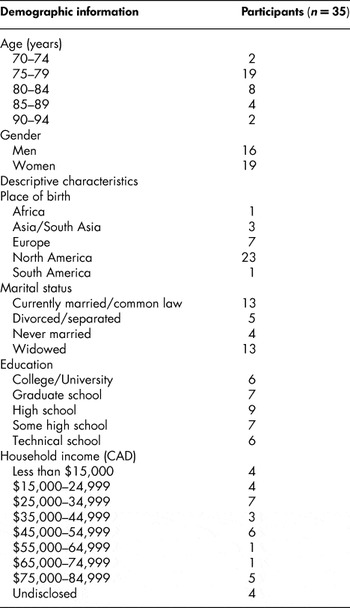
Our participants ranged in age from 73 to 91 years, with the average age of the men being 78.6 years and the average age of the women being 80.3 years. Study members reported having between 3 and 14 chronic conditions, with the average being six health problems. Largely reflecting our recruitment strategy, the most commonly reported chronic conditions included these: arthritis (28), back problems (26), heart disease (24), cataracts/glaucoma (14), and cancer (12). Although all of the participants resided either in their own homes or retirement communities, they were diverse with respect to their place of birth, marital status, educational attainment, and household income (even as the majority of our study members were of European descent) (see Table 1).
Socio-demographic and descriptive characteristics

All 35 participants indicated that they had a primary care physician. While 74 per cent of participants (15 men and 11 women) had a male general practitioner, only 26 per cent (one man and eight women) had a female family doctor. Forty percent of the participants (three men and 11 women) had been with their family physicians for between 1 and 5 years, while 60 per cent (13 men and eight women) had been with their primary care physicians for between 5 and 50 years. Twenty-six percent (three men and six women) saw their family physicians at least once a month, 48 per cent (eight men and nine women) had appointments every two or three months (with four of these specifically noting that their consultation rates increased to once a month when certain health issues flared), and another 26 per cent (four men and six women) visited their doctors between one and three times per year.
Data Analysis
All interviews were digitally recorded and transcribed verbatim by trained research assistants. Each transcript was subsequently reviewed by another research assistant as well as by the original interviewer, to ensure the accuracy of the transcription relative to the digital recording. We conducted a thematic analysis utilizing Marshall and Rossman’s (2006) seven key analytic procedures: (a) organizing the data; (b) immersion in the data; (c) generating categories and themes; (d) data coding; (e) interpretation of the data; (f) searching for alternative meanings; and (g) presentation of the data. Thus, analysis began following transcription, with the uploading of all transcripts into QSR International’s NVivo 8 software. The third author then conducted a line-by-line reading of the transcribed interviews in NVivo 8, identifying all of the text passages that referred to our participants’ perceptions of and interactions with their physicians. These data included responses to our specific questions about the participants’ experiences with their primary care physicians but also extended into other areas of conversation, such as the variety of ways in which the older men and women managed their multiple chronic conditions.
Continual reading and rereading of the amalgamated text allowed us to generate the following six recurring themes across the interviews: (a) thoroughness; (b) gatekeeping; (c) interpersonal skills; (d) constraints of medical appointments; (e) ageism; and (f) strategies for addressing the problems in interactions with physicians. The first and second authors then independently coded the data, coming together to discuss discrepancies in coding until a consensus could be reached. We moved between the coded data, the literature, and our theoretical framework, ultimately developing three analytical categories to explain the recurring themes and patterns in our data. The first category, preferred or necessary qualities in physicians for the management of multiple chronic conditions, included the themes of thoroughness, gatekeeping, interpersonal skills, and decision-making styles. The second category, sources of vulnerability in participants’ interactions with physicians, included constraints of medical appointments, the qualities and practices of physicians, and perceived ageism. Lastly, the third category, problem solving and impression management, comprised participants’ strategies for optimizing the care they received.
Findings
What Older Adults with Multiple Morbidities Want and Need From Primary Care Physicians
When asked to describe their interactions with their primary care physicians and what they felt was important for the effective management of multiple chronic conditions, our participants, irrespective of their age and/or socioeconomic status, focused primarily on specific skills, personal qualities, and styles of interactions that they preferred in a general practitioner. To begin, 57 per cent of our participants (eight men and 12 women) stressed the importance of thoroughness on the part of their general practitioners. Specifically, 23 per cent of the participants (four men and four women) commended their doctors for being thorough as they made comments similar to those of a 75-year-old man who had five chronic conditions:
I’ve got a real good doctor … My old doctor retired and then my wife’s doctor was taking on new patients. And right from the very first time I met him – and he’s just a young fellow – probably 30 maybe – He found out more about me and my history in the hour I spent with him than my old doctor had in 40 years. And then I’ve been in for so many tests … The girl who extracted the blood from me said, “You’ve got a very good doctor.” And I said, “Why is that?” And she said, “Well, the thing is, these instructions here – he wants to know everything. We don’t normally see that.”
Thus, the satisfied participants tended to describe their physicians as exceptional individuals who endeavoured to fully know and understand their patients’ often complex medical histories and current symptoms, who asked a lot of questions, who performed diagnostic and routine physical examinations during medical consultations, who provided information and education, and who, as an 80-year-old man who had three chronic conditions stated, “check[ed] everything more thoroughly.”
At the same time, 51 per cent of our participants (nine men and nine women) contended that effective gate-keeping, specifically making referrals to specialists or for various diagnostic tests and treatments for their often extensive list of health concerns, was another essential quality of a physician who was able to skillfully treat patients with multiple chronic health issues. As one man, aged 79, who had six chronic conditions, stated:
When I have something wrong, [my doctor] doesn’t say, “oh yeah, it’ll be okay.” No, he gets his pad out and sends me to the expert. He’s a family doctor … he’s not supposed to cure anything. He’s just supposed to send you to the people that can possibly cure you.
Moreover, 31 per cent of the participants (seven men and four women) perceived that their physicians were adept at making referrals as they made comments similar to those of a 77-year-old man who had six chronic conditions:
My doctor is very good. I trust him. He’s not the kind that rushes you out of the office. He’ll talk to you … I want to see him before I see anybody else. And then he recommends going to see somebody else if I have to. [For example, to] … a specialist ... I think he handles [my multiple chronic conditions] very well to tell you the truth … He’s an above-average GP (general practitioner) by far. He knows when something should go to the specialist and he sends me to good specialists … He’s on the ball. He doesn’t fool around.
Similarly, many participants stressed that they wanted primary care physicians who had specific personal qualities, including being friendly, open, and trustworthy. Fifty-one per cent of the participants (nine men and nine women) asserted that they felt comfortable with their physicians, with whom they could freely and easily discuss their numerous medical concerns and whom they described with words such as “nice”, “a good and trusted friend”, “supportive”, and “a pleasant sort”. An 82-year-old woman who had six chronic conditions said: “You can say anything to her.” Likewise, a 79-year-old man who had five chronic conditions asserted:
I trust him so much that any problem I had I would tell him. He talks to me very plainly about my health issues and what I can do. He gives me all the options I have … and then we discuss it. In most cases I take his suggestions. I feel he knows what he’s doing.
That said, not all of our participants felt that their physicians were open, supportive, and responsive to all of their health care needs. Indeed, four women reported feeling uncomfortable with their physicians, specifically when trying to discuss sexuality or mental health issues, because they perceived that their doctors were unwilling to address such topics. A 77-year-old woman with 11 chronic conditions reported the following:
I find it difficult to start any kind of a subject that’s to do with sexuality or mental illness with [my doctor]. I don’t know why there’s some kind of barrier there … it seems as if he doesn’t want to hear it. At least that’s how I interpret his body language … I think there is a bias that seems to be ingrained in our society.
In relation to decision-making preferences during physician-patient interactions, there were notable gender differences between our male and female participants. On the one hand, 31 per cent (nine men and two women) stated that they preferred a more traditional style of interaction as they deferred medical decision-making to their physicians. An 80-year-old man with four chronic conditions elaborated:
I always have a list in front of me of one, two, three, four, five things that I want to talk about … I think it’s very legitimate for people to say, “Doctor, I feel a lump”, or “Doctor, I feel nauseated” [but] not be too pushy. Remember that it is after all a consultation and the chief one in the consultation is the physician … He’s spent seven or eight years in medical school so he carries the ball.
In contrast, 37 per cent of the participants (one man and 12 women) expressed a preference for a more patient-centred model of care as they favoured a collaborative approach to medical decision-making and the management of their chronic conditions. A 77-year-old woman with three chronic conditions explained:
A lot of people my age still think doctors are gods and that you don’t have any say in anything … But I have to have a doctor who is going to work with me, not tell me what to do. We need to discuss this and I need to be part of what’s happening to me … That was one of the things I had said in the first place [when I began to see my doctor], that I wanted to work with him, that this was a partnership.
Interestingly, 8 per cent of the participants (two men and one woman) who esteemed their doctors’ personalities downplayed the importance of their physicians’ interpersonal skills and decision-making practices as they contended that what was most important in a primary care physician was his or her medical abilities. An 80-year-old man who had three chronic conditions put it this way: “A good bedside manner is not as important to me as a doctor who knows his stuff. I can do without the bedside manner and the nicey, nicey bit if the doctor knows his stuff.” Similarly, an 83-year-old woman who had 11 chronic conditions expressed appreciation for her physician’s “lovely manner” and reported that she was often told by others that she was “so lucky to have her as a doctor.” Nevertheless, she contended that she would prefer “an alert doctor … not one who is sweet and kind but someone who is wide awake to what could be done … I’ve had doctors like that. They ask the right questions and they immediately act on it. [My doctor] doesn’t do that.”
Experiences of Vulnerability during Medical Consultations among Individuals with Multiple Chronic Conditions
Amidst our participants’ discussions of what they wanted and needed in a family physician were frequent allusions to their underlying sense of vulnerability arising from their perceptions that they were the recipients of inadequate health care. Indeed, 66 per cent of the participants (11 men and 12 women) who were diverse with respect to age and socioeconomic status felt that they were not receiving effective treatment for their multiple chronic health issues. Although they felt that their physicians were adequately addressing their immediate health concerns, 43 per cent (six men and nine women) said that their physicians were insufficiently thorough as they delivered what one 88-year-old woman described as “superficial medicine”, specifically medicine that was only concerned with the filling of prescriptions, the administering of blood work tests, and the writing of specialist referrals. Rather than perfunctory check-ups, the participants expressed a desire for more in-depth and person-centred care as exemplified by this comment:
I want [my general practitioner] to be a little more thorough. Although he does listen when there’s a complaint … he’s very quick to palm me off to a specialist. He’s never given me a proper physical examination. He always does the blood pressure thing and listens to the heart. But that’s superficial as far as I’m concerned … My old doctor was more concerned with my general well-being. He would ask questions … But this one tries to see too many patients in one day. He’s always in a hurry.
Some of the participants attributed their perceived lack of adequate health care to the personal failings of their primary care physicians. Indeed, 37 per cent of the participants (four men and nine women) felt that their family doctors were overly passive. A 76-year-old man who had four chronic conditions had this to say about his family doctor: “He doesn’t do anything on his own initiative at all. I have to ask him to do things … I think he could be more aggressive in his [approach]”. Similarly, a 78-year-old woman who had six chronic conditions said this about her general practitioner: “He’s not a good doctor … He doesn’t work hard to keep you running … He’s not fighting on your behalf”. One man, aged 80, who had three chronic conditions, suggested that his physician’s passivity, specifically his failure to refer to specialists, was the cause of one of his current health issues:
My family doctor never sent me to the cardiologist or specialist. That’s the main reason I had the TIA [transient ischemic attack]. If he had sent me to the cardiologist, he or she could have found the cause of the high blood pressure. But that was never checked. That’s the main reason I had the stroke.
Another 8 per cent of the participants (two men and one woman) were cynical about the underlying financial motives of their doctors who they perceived to be, as a 77-year-old man who had 11 chronic conditions stated, “more interested in making money” or more concerned with, as a 91-year-old woman with six chronic conditions stated, “a good financial reward”, than they were in providing comprehensive and timely medical care. These participants assumed that their physicians were only paid for treating one issue per appointment and, therefore, could not be bothered to, as an 80-year-old woman who had five chronic conditions said, “waste their time”.
In contrast, 43 per cent (six men and nine women) perceived that the complex realities of their chronic conditions were incompatible with the typical structure of medical appointments. For example, an 80-year-old man, who had seven chronic conditions, stated: “They haven’t got the time to go and really detect or investigate the thing thoroughly. You only get 25 per cent – you don’t get a thorough examination.” Consequently, 28 per cent of the participants (three men and seven women) described having to make difficult choices about which acute or chronic health issues to request medical attention for during appointments with primary care physicians, as articulated by a 75-year-old man who had eight chronic conditions:
I usually have multiple complaints so I have to decide what to talk to him about because he’s busy and he can’t accommodate all of my complaints … I think the things that have the greatest priority for me are things which are potentially life-threatening such as coronary artery disease, MSA [multiple system atrophy] or Parkinson’s. The arthritis in my knee and my shoulder – these things are not life threatening, I can live with that. So I sort of put that aside when I’m talking to the GP.
Finally, 26 per cent of the participants (nine women) attributed the inadequacies of the health care they were receiving to the societal devaluation of older adults. Five women (26% of the women) expressed internalized ageism as they perceived themselves and other older adults to be, as a 77-year-old woman with 11 chronic conditions put it, “a drain on the health system” and therefore, unworthy of their physicians’ regard. However, four female participants (21% of the women) rejected this view as they accounted for their physicians’ lack of thoroughness and care with reference to gendered ageism (Arber & Ginn, 1991; Sharpe, 1995). For example, a 77-year-old woman who had four chronic conditions asserted:
Doctors are mostly male and they don’t pay attention to women anyway … and as you get older they treat you with even less regard … The older you get, it’s almost like, “You should be off the face of the earth” … They’ve got big practices, and old people are a pain in their ass.
Two of these women described instances where their health concerns had been dismissed and attributed to psychological or emotional factors. An 81-year-old woman, who had 13 chronic conditions, reported that her family physician had said her post-polio and fibromyalgia symptoms were “all in [her] head” and the result of being “a bit emotional.” Collectively, the four women maintained that their doctors perceived them to be nuisances who were “complaining for nothing” rather than legitimate patients.
Problem Solving and Impression Management: Strategies for Optimizing Care
Regardless of their explanations for the inadequacies of their health care, the general sentiment was that interactions with primary care physicians were often as an 80-year-old man who had four chronic conditions put it, “intimidating and counterproductive.” As a result, 57 per cent of the participants (eight men and 12 women), who were diverse with respect to age and socioeconomic status, indicated that they were employing one or more strategies in order to optimize their medical appointments. Twenty-two percent (two men and six women) described deliberately and assertively asking for referrals to specialists as well as for diagnostic tests. Similarly, 28 per cent of the individuals interviewed (three men and seven women) used lists to help with the prioritization of multiple health concerns during appointments. Of these older adults, 14 per cent (two men and three women) had changed doctors because they wanted someone who was more thorough and amenable to making referrals. One man and three women (11%) brought a companion to their medical appointments, because as one woman, aged 79, who had three chronic conditions, put it: “two heads are better than one.” Additionally, 34 per cent of the participants (five men and seven women) regularly turned to alternative sources of information about their multiple morbidities, including the Internet (three men and two women), library books (one woman), pharmacists (one man and four women), and other health care professionals (one man and two women).
As well as trying to make the best of a difficult situation through active, problem-solving strategies, 60 per cent of the older adults in this study (seven men and 14 women) endeavoured to manage their physicians’ impressions of themselves as compliant and legitimate patients. Twenty-three percent (five men and three women) suggested that it was important to “do as you’re told” by their physicians so as to be considered, as a 75-year-old man who had eight chronic conditions stated, “a cooperative patient.” Forty percent of the participants (five men and nine women) agreed with one woman, aged 81, who had 13 chronic conditions and who stressed that it was important to “not waste the doctor’s time.” For example, an 82-year-old woman who had six chronic conditions had this to say:
I don’t go [to see my physician] often, mind you … If something is bothering me, then I do but otherwise I don’t bother because there’s that prejudice there … and that discrimination. I’ve been in doctors’ offices – have you seen how many older people are there? … It’s full of all these old people with all their problems. I can see the doctors, they go, “Oh god, not another one.” So I go in and I say, “Hey, I just have this and this.” And they say, “Oh okay.” So I don’t have much of a problem because … the doctor knows that I don’t come in just for … any stupid little thing.
Thus, the participants actively distanced themselves from those older adults who they felt consulted their physicians for frivolous reasons or who conformed to negative stereotypes of elderly patients as invariably frail, dependent, and overly difficult. In addition to legitimizing their current need for health care, these participants believed that by appearing not to be too demanding, they ensured that if their multiple chronic conditions worsened or they developed additional health issues, their future health needs would be taken seriously. Thus, a 73-year-old woman who had five chronic conditions contended:
You don’t lay everything on them because it looks like you’re just imagining and compounding things … They don’t know when to take you seriously or not … But if you just talk of things when you are really concerned about something … when you have really got a problem, your doctor listens to you.
In this way, the participants actively tried to be desirable, conscientious, and worthy patients.
Discussion
In this article, we have examined how older adults with multiple chronic conditions perceived and experienced their interactions with their primary care physicians. When asked what qualities they felt were necessary and valuable in a physician for the effective treatment and management of multiple chronic conditions, our participants emphasized the importance of thoroughness during medical consultations, effective gatekeeping, interpersonal skills, and in particular, decision-making approaches. In this way, our findings are consistent with the extant research, which has found that older adults’ satisfaction with their primary care physicians is related to their perceptions of their doctors’ technical competence, trustworthiness, and caring attitude (Kong et al., 2007; Lee & Kasper, 1998) as well as their decision-making styles (Bastiaens et al., 2007; Elkin et al., 2007; Peck, 2011; Teh et al., 2009). In line with previous research (Arora & McHorney, 2000; Kaplan et al., 1995), the women in our sample tended to favour a more collaborative approach to decision making, while the men preferred to defer to their physicians.
However, many of our participants perceived that they were not receiving thorough and comprehensive medical care, including referrals to specialists and full examinations, as a result of the personal failings of their physicians, the constraints of typical medical consultations, and perceived ageism. Our findings build on the existing research which has identified health care system constraints such as lack of time during appointments to be a source of discontent among older patients (Adelman et al., 2000; Evans & Robertson, 2009; Lee & Kasper, 1998; Ogden et al., 2004; Rost & Frankel, 1993; Vieder et al., 2002; Weitzman et al., 2008). Our findings further reveal that the presence of multiple morbidities exacerbates concerns about the amount and usage of time during medical appointments. The participants in our study, especially the women, often reported having to choose between their numerous chronic health issues for which they obtained medical assessments and advice during appointments, leading to the sense that they were receiving inadequate care. The explanations our participants gave for insufficiently thorough medical care complement the findings of previous studies (Adams et al., 2002; Ekdahl et al., 2012; Pereles & Russell, 1996), which examined barriers to caring for older adults from the perspective of physicians who similarly cited time pressures, administrative burdens, and financial disincentives. Moreover, our research highlights the precarious position of older adults who are displeased with their primary care physicians’ skills and decision-making practices. Even as they may perceive and experience a variety of sources of dissatisfaction with their general practitioners, older adults are readily aware of their dependence on the medical care system and the need to maintain positive ties with their health care professionals (Edwards et al., 2004).
Echoing the theorizing and research concerning physicians’ internalization of ageist stereotypes (Adelman et al., 1991; Burroughs et al., 2006; Butler, 1975; Gott et al., 2004; Green et al., 1986; Greenfield et al., 1987; Robb et al., 2002; Sharpe, 1995; Tannenbaum et al., 2003), one third of the participants, all women, were readily aware of their social devaluation and resultant vulnerability. In resonance with previous research (Belgrave, 1994; Keville, 1993; Malyet al., 2004; Sharpe, 1995; Tannenbaum et al., 2003), almost half of the female participants suggested that ageism influenced their interactions with physicians either because they themselves had internalized negative stereotypes of older adults or because they perceived that their physicians engaged in discriminatory practices. Some women also described feeling uncomfortable discussing issues pertaining to mental health or sexuality because of their physicians’ perceived biases. It is likely that the women’s sense of being marginalized and dismissed in medical interactions was further heightened by their preference for a more participatory decision-making style in medical encounters (Arora & McHorney, 2000; Kaplan et al., 1995) as the discrepancy between what they wanted and what they received from their doctors invariably augmented their perceptions of vulnerability. As a result, and as previous studies have found (Adelman et al., 2000; Adelman et al., 1987; Evans & Robertson, 2009; Seale & Charteris-Black, 2008; Weitzman et al., 2004; Wolff & Roter, 2009), many of our participants, especially the women, employed a number of strategies – including the use of lists, prioritizing of health concerns, assertively asking for referrals, as well as attempting to appear cooperative as patients – in their attempts to invalidate negative characterizations of older adults as overly demanding and undesirable patients.
Our study is limited by its small, convenience sample as well as by the fact that only eight of our participants had female physicians, which constrained our ability to interrogate the impact of gender on patients’ experiences and perceptions. Future research should investigate the perspectives of male and female general practitioners regarding the provision of medical care to older patients with multiple morbidities with the goal of better understanding the difficulties they face in providing effective chronic care management. It would also be helpful to conduct research with patient-physician dyads to better understand the influence of multiple chronic conditions on older adults’ experiences and their doctors’ practices. It would also be important to home in more specifically on advanced old age when health issues tend to become more prominent and limiting, and when satisfaction with medical care has been found to decrease, creating even more complexities and difficulties in the physician-older-adult relationship. In addition, future research should investigate the ways in which living in rural versus urban communities and the length of patients’ relationships with their doctors may influence their interactions with health care providers. Finally, it would be useful to examine patient-physician interactions using a quantitative approach, which would allow for the systematic testing of how relationships between the various concepts presented in this article influence older adults’ perceptions of the health care they receive.
Conclusions
Given that aging is associated with the acquisition of increasing numbers of chronic conditions, which in turn is often coupled with a growing need for medical intervention, the relationships that older adults have with their general practitioners are pivotal for their maintenance of health and well-being. Our findings, along with previous research, suggest that elderly patients with multiple morbidities perceive that their health needs are not being adequately met. In particular, our participants asserted that the structure of medical appointments was incompatible with the complexity of their multiple health concerns, specifically the perceived need for more time during appointments and greater thoroughness on the part of health care practitioners. Moreover, the older women in our study conveyed a strong sense of vulnerability and marginalization as they perceived their medical care to be delimited by underlying societal ageism. It is imperative that the Canadian health care system begin to better meet the needs of the growing older-patient population. Affording opportunities for older patients to voice their concerns and complaints, attending to men’s and women’s differing preferences for decision making, providing continuity of care and a comprehensive care plan, and maintaining a caring relationship may do much to address older adults’ dissatisfaction with their medical treatment and promote greater trust within the doctor-patient relationship.