INTRODUCTION
The decision to construct a new Metro line in the capital of Denmark, Copenhagen, initiated a large-scale excavation program around the Copenhagen city center from 2009 and onwards. The archaeological findings and implications of the excavation are published in Dahlström et al. Reference Dahlström, Poulsen and Olsen2018. One of these excavation sites was the Town Hall Square, which revealed settlement layers and two cemeteries. Written sources have often been seen as indicating that it was in the late 12th century that the settlement of Copenhagen developed from a small fishing village into a town, and Bishop Absalon of Roskilde has been given a leading role in this narrative. During the excavation at the Town Hall Square it was clear that this view needed revision. The findings of substantial settlement remains, and not the least, a completely unknown cemetery spoke of a different type of settlement than a fishing village, which is further substantiated by the typological dates of finds indicating an earlier dating than the late 12th century. Radiocarbon (14C) analysis was conducted on all 9 in situ preserved individuals from the cemetery. To compare the dates from the Town Hall Square cemetery with the other known, early medieval cemetery in Copenhagen, St. Clemens, 11 individuals from this cemetery were also chosen for radiocarbon analysis. The radiocarbon analysis place the onset of both cemeteries to the early 11th century AD and therefore, together with archaeological sources, questions the age of Copenhagen and hence the traditional historical perception of the early town (Dahlström et al. Reference Dahlström, Poulsen and Olsen2018). Here a detailed account of the radiocarbon analysis and Bayesian modeling is presented.
The question of an early onset of Copenhagen is debated (see e.g. Dahlström et al. Reference Dahlström, Poulsen and Olsen2018). Moreover, Dahlström et al. Reference Dahlström, Poulsen and Olsen2018 based the early onset of Copenhagen on human remains from two cemeteries. Humans are notoriously difficult to radiocarbon date because of utilization of marine or freshwater resources which may result in significant 14C age offset due to different ages of either marine or freshwater reservoirs (Olsen et al. Reference Olsen, Heinemeier, Lübcke, Lüth and Terberger2010; Wood et al. Reference Wood, Higam, Buzilhova, Suvorov, Heinemeier and Olsen2013; Martindale et al. Reference Martindale, Cook, McKechnie, Edinborough, Hutchinson, Eldridge, Supernant and Ames2018). We therefore provide a detailed account and interpretation of the diet of the individuals used for radiocarbon dating from both the Town Hall Square and St. Clemens cemeteries. Furthermore, we present and discuss the stratigraphical information used to construct the Bayesian models providing the chronologies of the Copenhagen and St. Clemens cemeteries. More importantly, we present new radiocarbon data from settlement remains, which provides independent chronological information for the onset of Copenhagen. Based on the new information we are able to substantiate further our claim that the onset of Copenhagen dates to the early 11th century AD.
METHODS
Charcoal and seed samples are pretreated using the acid-base-acid (ABA) protocol (Brock et al. Reference Brock, Higham, Ditchfield and Ramsey2010). For bone samples collagen is extracted using a modified Longin procedure with ultrafiltration (Longin Reference Longin1971; Brown et al. Reference Brown, Nelson, Vogel and Southon1988; Brock et al. Reference Brock, Geoghegan, Thomas, Jurkschat and Higham2013). The bone minerals were dissolved in HCl, followed by removal of humic acids by NaOH and subsequently the bone sample were gelatinized with HCl. The collagen was then ultra-filtered and the >30 kDa were used for 14C analysis. AAR samples are analysed at the Aarhus AMS Centre, Aarhus University, Denmark and LuS samples are analysed at SSAMS Radiocarbon dating laboratory, University of Lund, Sweden. Radiocarbon ages are reported as conventional 14C dates in 14C yr BP based on the measured 14C/12C ratio corrected for the natural isotopic fractionation by normalizing the result to the standard δ13C value of –25‰ VPDB using the 13C/12C ratios measured during AMS analysis (Stuiver and Polach Reference Stuiver and Polach1977). All δ13C and δ15N values are measured at Aarhus AMS Centre, Aarhus University, Denmark using an Elementar PyroCube elemental analyser coupled to an IsoPrime stable isotope mass spectrometer in continuous flow mode. The δ13C and δ15N are normalized to the VPDB and AIR scale respectively using an internal standard (GelA). International standards (USGS40 and USGS41) are used as secondary standards. The uncertainty is estimated from n=18 measurements on the internal standard to be ±0.2‰ and ±0.4‰ for δ13C and δ15N.
Location
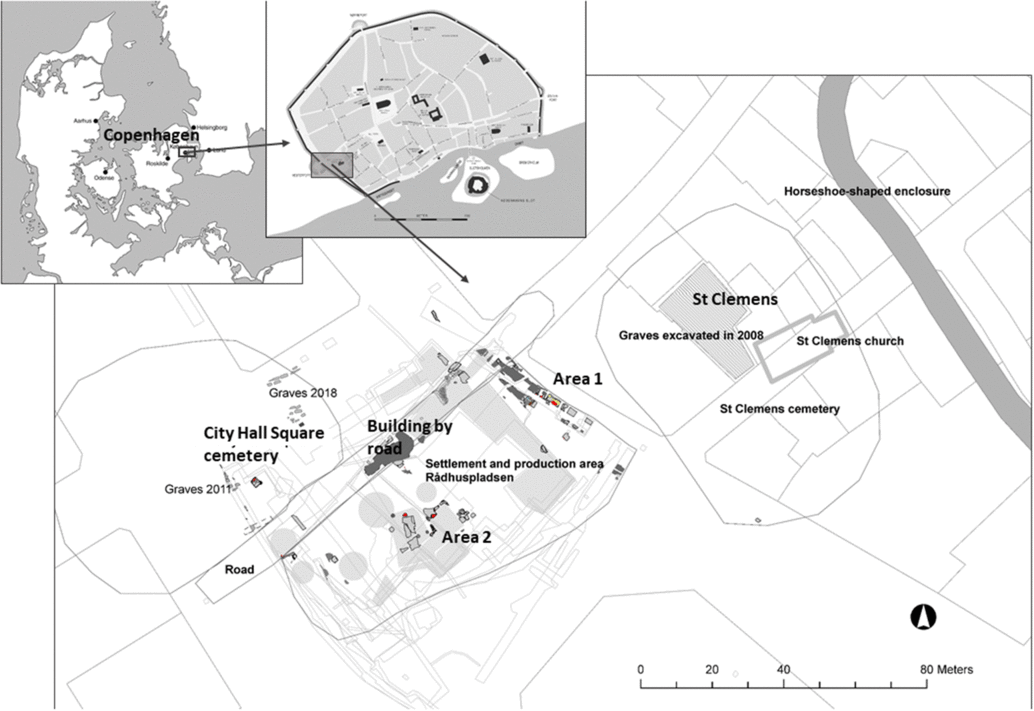
Copenhagen is located on the eastern shore of Zealand, facing the Sound, one of three narrow straits separating the Baltic Sea from Kattegat and further on the North Sea. The excavation site is located in the innermost city center of Copenhagen at the present day City Hall Square. One of the main discoveries at the excavation in 2011–2012 was that the area around City Hall Square, which in the later medieval period was more peripheral, instead should be considered a central part of the earliest settlement. The cemeteries of St Clemens and City Hall Square were situated in the western part (St Clemens), and just outside (City Hall Square), of later medieval Copenhagen, bounded by its 13th century fortification. In between the cemeteries, fragmentary settlement remains were documented, revealing a coherent area of permanent occupation prior to the construction of the medieval fortification (Figure 1).
Location of the City Hall Square St Clemens cemetery along with Area 1 and 2.

Diet and Reservoir Corrections
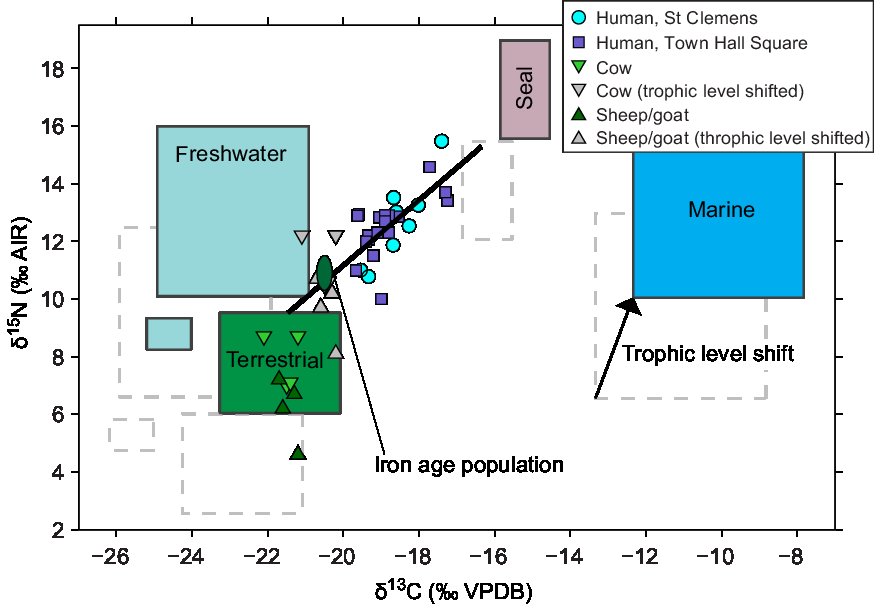
Exploration of aquatic resources being either freshwater or marine may significantly influence the accuracy of 14C age determinations (Olsen et al. Reference Olsen, Heinemeier, Lübcke, Lüth and Terberger2010; Wood et al. Reference Wood, Higam, Buzilhova, Suvorov, Heinemeier and Olsen2013; Martindale et al. Reference Martindale, Cook, McKechnie, Edinborough, Hutchinson, Eldridge, Supernant and Ames2018). Thus, to adequately calibrate 14C ages of human individuals it is necessary to reconstruct their dietary habits using stable isotope analysis, i.e. δ13C and δ15N values (e.g. Olsen et al. Reference Olsen, Heinemeier, Lübcke, Lüth and Terberger2010; Fernandes et al. Reference Fernandes, Grootes, Nadeau and Nehlich2015; King et al. Reference King, Snoddy, Millard, Grocke, Standen, Arriaza and Halcrow2018). The δ13C and δ15N values of the humans from the City Hall Square and St Clemens cemetery are presented in Table S1 and Figure 2. In total 8 δ13C and δ15N values have been obtained on domestic cattle and sheep/goat with an average value of –21.5 ± 0.3‰ and 7.0 ± 1.3‰ for δ13C and δ15N respectively (Figure 2). The range of domestic cattle δ13C values is very narrow in contrast to the δ15N values, which are showing a larger spread probably due to manuring (e.g. Eriksson et al. Reference Eriksson, Linderholm, Fornander, Kanstrup, Schoultz, Olofsson and Liden2008; Kanstrup et al. Reference Kanstrup, Thomsen, Mikkelsen and Christensen2012; Nitsch et al. Reference Nitsch, Andreou, Creuzieux, Gardeisen, Halstead, Isaakidou, Karathanou, Kotsachristou, Nikolaidou, Papanthimou, Petridou, Triantaphyllou, Valamoti, Vasileiadou and Bogaard2017). Adding the trophic level isotope shift (+1‰ for carbon and +3‰ for nitrogen (Schoeninger and DeNiro Reference Schoeninger and DeNiro1984)), the herbivore dataset provides a terrestrial δ13C endpoint value of −20‰. The inferred terrestrial endpoint value agrees well with δ13C and δ15N values from a Danish Iron Age population (Jørkov Reference Jørkov2007). The human δ13C and δ15N values are strongly correlated (ρ = 0.70) and range from –19.7‰ to –17.3‰ for δ13C and from 10.0‰ to 15.5‰ for δ15N (Figure 2). The human minimum δ13C and δ15N values corresponds well with the inferred terrestrial endpoint from the herbivores (Figure 2). However, the generally elevated δ13C and δ15N values together with a strong correlation suggests a variable amount of marine dietary resources being exploited by the humans buried at the City Hall Square cemetery and St Clements cemetery. Using a marine δ13C value of –10‰ the fraction marine diet can be estimated (e.g. Fischer et al. Reference Fischer, Olsen, Richards, Heinemeier, Sveinbjörnsdóttir and Bennike2007). The calculated fraction marine (Fmarine) diet range from 3% to 28% (Table S1). Assuming a ±0.5‰ uncertainty of both the marine and terrestrial δ13C endpoint values translate to an uncertainty of ±4% on the Fmarine diet percentages.
Isotopic δ13C and δ15N values of herbivores (cattle and sheep/goat) and humans from Copenhagen City Square and St Clements cemeteries. Shown is also trophic level corrected food item boxes from Fischer et al (Reference Fischer, Olsen, Richards, Heinemeier, Sveinbjörnsdóttir and Bennike2007). The uncorrected animal δ13C and δ15N values are shown with stippled lines. Iron Age population δ13C and δ15N values inferred to be dominated by a terrestrial diet are also shown (Jørkov Reference Jørkov2007).

Because of the complex hydrology of the Baltic Sea with numerous sources of carbon, the radiocarbon reservoir age of the Baltic Sea is highly variable (Lougheed et al. Reference Lougheed, Filipsson and Snowball2013). Nonetheless, modern radiocarbon reservoir ages from the Øresund strait region reveals local reservoir offset, ΔR, between −65 to 70 14C years (Heier-Nielsen et al. Reference Heier-Nielsen, Heinemeier, Nielsen and Rud1995; Lougheed et al. Reference Lougheed, Filipsson and Snowball2013). The average of all open water ΔR values yield an average reservoir age offset of –23 ± 48 14C years. Therefore, the human individuals are calibrated with the mixed curve method in OxCal 4.3 using the fraction marine diet to determine the mixture between the marine (Marine13) and atmospheric (IntCal13) calibration curves (Bronk Ramsey Reference Bronk Ramsey2009; Reimer et al. Reference Reimer, Bard, Bayliss, Beck, Blackwell, Bronk Ramsey, Buck, Cheng, Edwards, Friedrich, Grootes, Guilderson, Haflidason, Hajdas, Hatté, Heaton, Hoffmann, Hogg, Hughen, Kaiser, Kromer, Manning, Niu, Reimer, Richards, Scott, Southon, Staff, Turney and van der Plicht2013).
Radiocarbon Analysis
The stratigraphic units revealed during the excavations have been translated into Harris matrices (Figure S1). In most cases, it has not been possible to identify phases and the Bayesian model has been constructed to estimate onset and termination of each unit, i.e. City Hall Square cemetery, St Clemens cemetery and Area 2A–B. Whereas the City Hall Square cemetery, Area 1 and Area 2A–B were sampled with the purpose of reflecting the complete activity period, the sampling from the St Clemens cemetery focussed on the onset only. Thus, it is hoped that the Copenhagen City Hall Square cemetery model will provide a tighter estimate of the onset of settlement activity. For Area 1 it has been possible to identify six phases; a top soil phase reflecting the period prior to human activity and five phases (1–5) reflecting the development of the settlement. The five settlement phases consisted of remains of postholes, storage pits, wells and activity layers. Each phase was separated by levelling deposits, marking the change of land use and the start of a new phase. Similar for Area 2B three phases have been identified as a minimum. These have been separated on the basis of stratigraphical relations between intercutting features. No cultural layers were preserved in area 2A and 2B, making the phasing more difficult and tentative for these areas.
The Bayesian models for each unit are constructed using OxCal 4.3 (Bronk Ramsey Reference Bronk Ramsey2009), where each unit is represented by a sequence with onset and termination represented by boundaries. In Area 1 and 2B the transition between phase is also represented by boundaries. Between boundaries, the 14C age samples are inserted as phases assuming an unordered group of events. However, the stratigraphic information shows that within most phases an ordering of the events (i.e. the 14C samples) can be expected (Figure S1). These are added to Bayesian models as constrains, such that for example the ordered events for the samples LuS-11061, LuS-10637 and LuS-10638 from Area 2A are represented as LuS-11061 < LuS-10637 < LuS-10638 in the OxCal code. Outliers are removed based on low agreements indices during initial model runs.
Three samples are originating from postholes belonging to the same building, which suggests these to be of similar age. Hence, for the building, a weighted mean value of the three 14C samples (LuS-11063, LuS-11064, LuS-11065) is used as the best estimate of its age (Table S1). The weighted mean yielded a 14C age of 880 ± 21 14C years BP (reduced χ2: 0.7 ≤ 3.0) resulting in a calibrated 68.2% probability range of 1155–1211 AD (Table S1).
RESULTS AND DISCUSSION
The oceans surrounding Denmark are rich in marine resources, which were also exploited in the Middle Ages as revealed by both written and archaeological sources. For example, a nearby plot of land at Dragør on which a herring market stood from 1320 to 1425 AD has yielded a huge quantity of herring bones, but also the remains of a great deal of cod, as well as pike, eel, haddock, tuna, and flatfish (Stakhaven Reference Stakhaven1979). At the City Hall square remains of fish such as cod and herring have been found (Enghoff Reference Enghoff2015). Thus, the estimated fraction marine diet ranging between ~0% and 30% from the δ13C and δ15N values appears reasonable when compared to the historical available information (Table S1, Figure 2). This interpretation of the stable isotope data is further largely in concord with evidence from Medieval site in Britain concluding that some meat and small amount of fish were eaten regularly (Müldner et al. Reference Müldner, Montgomery, Cook, Ellam, Gledhill and Lowe2015; Bownes et al. Reference Bownes, Clarke and Buckberry2018). Also there are indications that fish consumption was associated with higher social status, however, whether this is also the case for the people buried at the City Hall Square and St Clemens cemeteries cannot be determined (Müldner and Richards Reference Müldner and Richards2005; Bownes et al. Reference Bownes, Clarke and Buckberry2018).
Pigs are omnivores, and in an archaeological context, they are feeding primarily on food refuse found in middens. Thus, their diet are likely to reflect the human diet to some extend (Halley and Rosvold Reference Halley and Rosvold2014; Bownes et al. Reference Bownes, Clarke and Buckberry2018). Although other studies suggest that pigs are imported into the cities from rural areas with a predominantly herbivorous diet (Hammond and O’Connor Reference Hammond and O’Connor2013). It is also possible that pigs were bred and kept in the towns. Nevertheless, it is possible that the five pig-bone samples radiocarbon dated in this study like the humans are prone to marine reservoir corrections due to consumption of marine fish (Table S1, Figure 3). Unfortunately, 13C and 15N isotope analysis was not conducted along with collagen extraction for radiocarbon analysis and therefore no δ13C and δ15N values are available for diet reconstruction. The outlier LuS-11076 sample from Area 1 phase 5 is a pig bone, and it therefore seems possible that this pig could have obtained a significant portion of its protein from refuse fish (Table S1, Figure 3). If we assume that LuS-11076 can be fully explained with fish consumption, then the 14C age difference between LuS-11076 and the average 14C age of AAR-28495 and LuS-10658 can be calculated to ~250 14C years. With a marine reservoir age of 400 14C years this corresponds to a 62% marine diet. Though this is possible, it appears implausible. Furthermore, the pig samples from the more secure stratigraphical building context (LuS-11063, LuS-11064 and LuS-11065) as well as the other pig samples from the St Clemens and Area 1 sequences all appear to agree with other data. Therefore, we assume that the pig radiocarbon ages to a very large degree are correct.
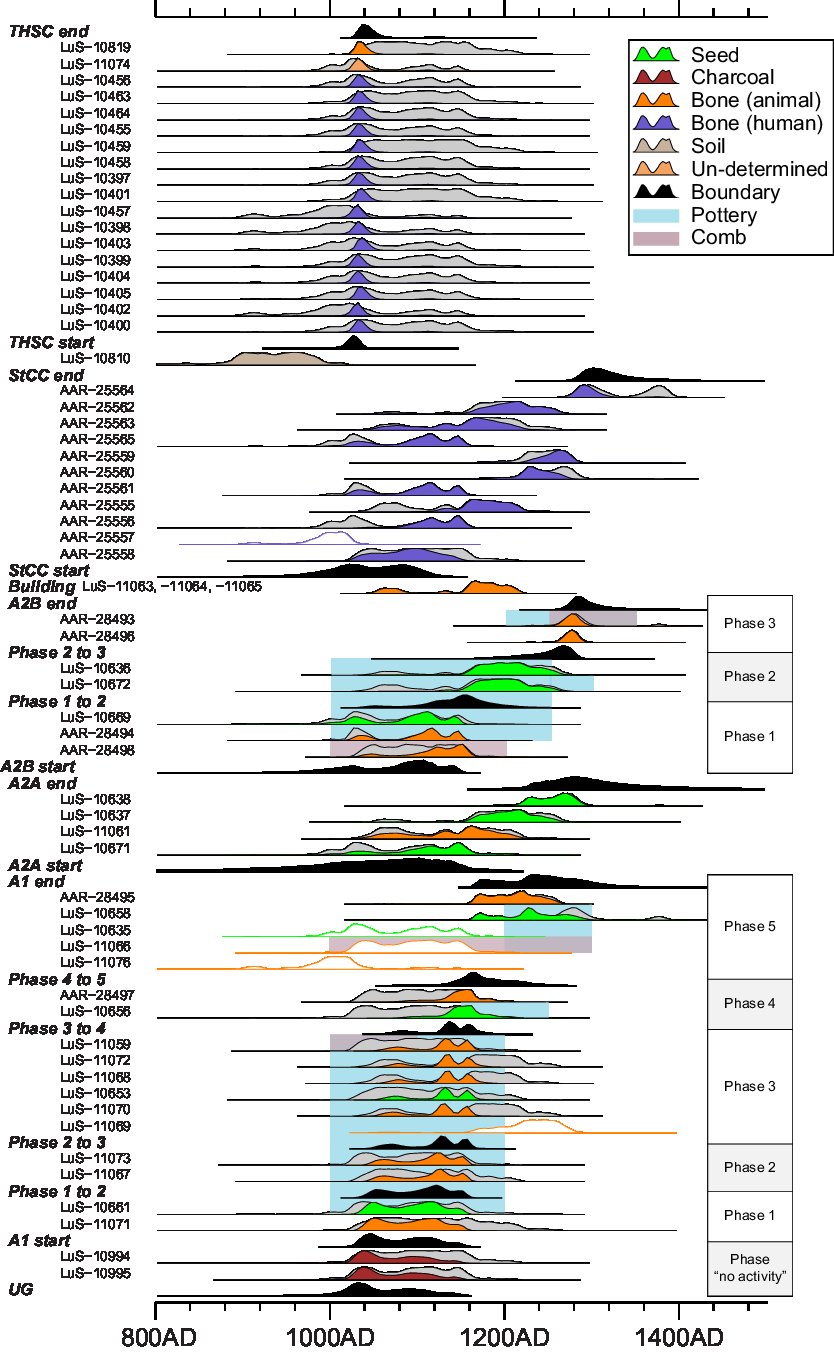
Calibrated probability density distributions of all samples (Table S1) together with the Bayesian modeled units (Copenhagen City Square cemetery, St Clements cemetery, Road, Area 1 and Area 2 A – B). Based on typology (combs and pottery) the expected archaeological ages are shown in boxes for area 1 and 2.

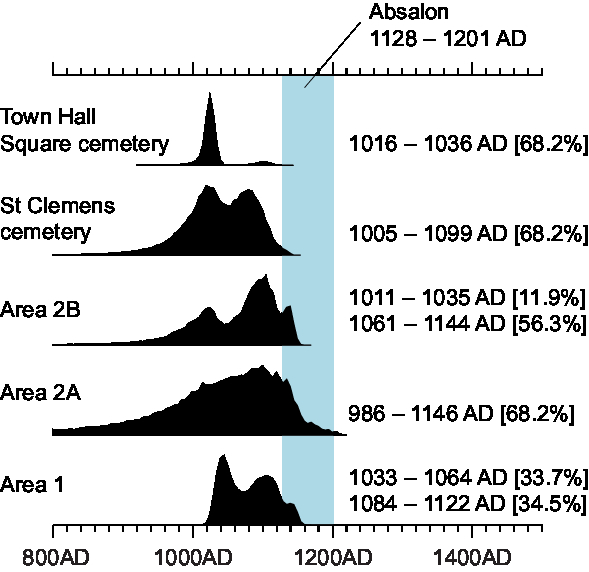
The Bayesian model outcome for all units is presented in Figure 3. All Bayesian models yielded agreement indices, Amodel, between 77% and 206%. Thus indicating a good agreement between the model and the 14C data. For the City Hall Square and St Clemens cemeteries only sample AAR-25557 is identified as an outlier being too old (Figure 3). AAR-25557 is calibrated to 1005–1022 AD (68.2%) which is only slightly older than the modeled onset of the St Clements cemetery dated to 1005–1099 AD (68.2%) (Table S1). This may suggest a simple measurement error or that the fraction marine is slightly underestimated for this sample. Overall, the onset of the two cemeteries appears to be similar. The modeled onset of St Clemens cemetery is dated to 1005–1099 AD (68.2%) and the burials from City Hall Square cemetery are all dated to 1016–1036 AD (68.2%). If this very short period reflects the full usage period of the cemetery is not known. There may well be graves in other parts of the cemetery, which are either younger or older. If anything, the St Clemens cemetery may have been set into service some 40 years later than the City Hall Square cemetery (Figure 4). The Area 1 model has four outliers, one which is too young (LuS-11069) and three too old (LuS-11076, LuS-11066 and LuS-10635). LuS-11069 appears to be redeposited into phase 3. Area 1 phase 5 is a reworked and disturbed unit and hence it may be expected that the material for radiocarbon dating have been redeposited from lower laying stratigraphic units.
Modeled onset of the five units presented plotted with the lifespan of Absalon (1128–1201 AD).

In the settlement layers (Area 1 and 2) in between the two cemeteries remains of pottery and combs were found which could be typologically identified and dated (Figure 3). The pottery was of the types Early Greyware and Baltic Ware (dated to between 1000 and 1200 AD), as well as Early Redware (dated to 1150–1350 AD; Langkilde Reference Langkilde, Lyne and Dahlström2015). The combs were of types 9 (10th–12th century), 14a (11th–13th century) and type 13 (13th–15th century; Dahlström and Ashby Reference Dahlström, Ashby, Lyne and Dahlström2015). The dates were compared to the radiocarbon dates to secure the model. Overall, there appears to be good agreement between the broad typological age ranges and the modeled radiocarbon probability distributions (Figure 3). Only one comb found in Area 1 and belonging to settlement phase 3 is in direct conflict with the modeled age range. The modeled age range is too young when compared to typological age of the comb. This reflects the general problem with redeposited material in urban contexts, and highlights the importance of critically engaging in comparing different types of data and contextually assess its information value in each individual case.
It is probably no surprise that Copenhagen existed as an urban settlement before it was given to Absalon (1128–1201 AD) by the king sometime around 1167 AD (Saxo Reference Friis-Jensen and Zeeberg2005). However, this study contributes significantly to giving an entire new temporal framework to the formation of the town. The modeled onset of both cemeteries and settlement remains range in the period from 986–1146 AD (Figure 4). Hence, the onset of the City Hall Square and St Clemens cemeteries together with the settlement remains of area 1 and 2 strongly suggest that a settlement, which in many ways could be seen as a town, was in place even before Absalon was born. Therefore, the initiatives behind the formation of the town should be seen in another societal context than the classical narrative of the founding of Copenhagen. Copenhagen existed as an established settlement long before Absalon appeared on the stage. The initiatives behind the town’s early development should be more broadly understood as coming from both local aristocrats, the king as well as other layers of the population, all contributing to the shaping of the early town (Dahlström et al. Reference Dahlström, Poulsen and Olsen2018). The radiocarbon dates and the Bayesian modeling have thus contributed to a more nuanced understanding of the urbanization process of Copenhagen.
CONCLUSION
Unravelling the early history of Copenhagen is still an ongoing investigation. However, as this demonstrates, the use of radiocarbon may potentially disclose new and surprising aspects of urban contexts challenging historical records. Furthermore, the age of substantial infrastructure prior to Absalon lordship of Copenhagen from the 1160s suggest a new perception of the history of Copenhagen.
ACKNOWLEDGMENT
This work was supported by the Danish National Research Foundation under the grant DNRF119 - Centre of Excellence for Urban Network Evolutions (UrbNet).
SUPPLEMENTARY MATERIAL
To view supplementary material for this article, please visit https://doi.org/10.1017/RDC.2019.112