





Psychiatric comorbidity in patients admitted to hospital
Psychiatric disorders represent a major global health burden and are among the leading causes of disability worldwide. In 2021, there were an estimated 444 million incident cases of mental disorders globally, with age-standardised rates rising by over 15% since 1990. Reference Fan, Fan, Yang and Fan1 Individuals with mental disorders have a shorter life expectancy by 11–20 years and a 2.22 times higher risk of mortality. Reference Chan, Correll, Wong, Chu, Fung and Wong2,Reference Walker, McGee and Druss3 In in-patient settings, psychiatric comorbidity can complicate acute medical management by impairing treatment adherence, affecting physiological stress responses and increasing overall comorbidity burden, hospital stays and risk of adverse outcomes. Reference Abrams, Vaughan-Sarrazin and Rosenthal4,Reference Jansen, van Schijndel, van Waarde and van Busschbach5 The presence of a psychiatric comorbidity has been associated with a number of worsening outcomes, such as increased 30-day mortality rates, extended lengths of stay in patients admitted to hospital and increased expenditure, compared with those without a psychiatric comorbidity; Reference Chen, Devine, Khan, Khan, Waldron and Barry6 although evidence suggests that integrated mental and physical health interventions can improve outcomes. Reference Zeleke, Tamene, Geremew, Alemayehu, Worku and Wondm7,Reference Leung, Rubenstein, Jaske, Taylor, Post and Nelson8 Patients with psychiatric comorbidity are also associated with greater odds of self-discharge against medical advice compared with those without any underlying psychiatric disorders. This may be because of underlying financial, legal and/or personal obligations, as well as differences in opinion from clinician judgement. Reference Chen, Devine, Khan, Khan, Waldron and Barry6
Prescribing gaps in in-patient care
Psychotropic medications are frequently administered to medical in-patients, sometimes without a documented psychiatric diagnosis, Reference Wiechers, Leslie and Rosenheck9,Reference Marston, Nazareth, Petersen, Walters and Osborn10 and are often used off-label for symptom management, such as insomnia or agitation. This may expose patients to unnecessary adverse effects, including increased risk of falls and metabolic disturbances. Reference Marston, Nazareth, Petersen, Walters and Osborn10,Reference Seifert, Reinhard, Bleich, Erfurth, Greil and Toto11 Despite extensive research in high-income countries, data from low- and middle-income countries (LMICs) remains limited. Reference Knipe, Williams, Hannam-Swain, Upton, Brown and Bandara12 In Pakistan, psychiatric disorders are often underdiagnosed and poorly integrated into healthcare systems. Reference Hussain, Khan, Gul and Asad13 This study aims to examine the relationship between psychiatric diagnoses, psychotropic medication use and short-term hospital stay outcomes among patients admitted with acute medical conditions. Previous studies have examined psychiatric comorbidity or psychotropic medication use independently in correlation with in-hospital outcomes, but the impact of diagnosis–medication concordance on hospital stay outcomes is relatively underresearched, especially in LMICs. Reference Abrams, Vaughan-Sarrazin and Rosenthal4–Reference Marston, Nazareth, Petersen, Walters and Osborn10 Investigating such patterns may help identify opportunities to improve integrated in-patient care.
Method
This retrospective cross-sectional study analysed electronic health records from the Department of Internal Medicine at the Aga Khan University Hospital (AKUH), Karachi, Pakistan, from January 2018 to December 2022. AKUH is a 700-bed Joint Commission Internation-accredited, tertiary care, not-for-profit, academic medical centre that serves patients from across Pakistan. The hospital provides care to a diverse patient population, including self-paying and insured individuals, while also supporting patients through internal and external financial assistance programmes. The authors assert that all procedures contributing to this work comply with the ethical standards of the relevant national and institutional committees on human experimentation and with the Helsinki Declaration of 1975, as revised in 2013. All procedures involving human patients were approved for ethical exemption by the Ethical Review Committee at the Aga Khan University (approval number ERC#2025-12090-38293). The study used de-identified data, and therefore informed consent from individual patients was not required.
We included all adult in-patients (≥18 years of age) under the internal medicine service with at least one of eight prespecified acute medical conditions: acute myocardial infarction, acute heart failure, stroke, pneumonia, sepsis, acute liver failure, gastrointestinal bleeding and acute pancreatitis. We excluded patients with incomplete records or those under 18 years of age.
Psychiatric diagnoses were obtained from the ICD codes documented during each hospital stay. Any ICD-10 code in the F00–F99 range or ICD-9 code in the 290–319 range was considered a documented psychiatric diagnosis. We created a binary flag for these diagnoses (yes/no).
Data on the use of psychiatric medications were obtained through the pharmacy information system. Medication exposure was defined as receipt of any psychiatric medication dispensed during the hospital stay, including both continuation of pre-admission psychiatric medications and medications newly initiated during the in-patient stay. We considered medications specific for psychiatric indications, having at least 20 use cases over the study period. This included lithium, sertraline, escitalopram, citalopram, paroxetine, fluoxetine, amitriptyline, trazodone, mirtazapine, duloxetine, venlafaxine, haloperidol, risperidone, olanzapine, quetiapine, aripiprazole, prochlorperazine, alprazolam, lorazepam, diazepam, clonazepam, clonidine, midazolam, bromazepam, zolpidem and flunitrazepam. A binary flag was created for any psychiatric medication use during the hospital stay (yes/no). Although the present analysis keeps to psychotropic medications with high specificity for psychiatric care, a sensitivity analysis using an alternative, broader classification was also performed.
Covariates included age, gender (male/female), a modified version of the Charlson Comorbidity Index Reference Glasheen, Cordier, Gumpina, Haugh, Davis and Renda14 (continuous score, range 0–29) and medication burden (crude total count of distinct medications administered during admission).
We created a four-category exposure variable considering both psychiatric diagnosis status and psychiatric medication use within each admission: (a) no psychiatric diagnosis, no psychiatric medications (reference group); (b) no psychiatric diagnosis, receiving psychiatric medications; (c) psychiatric diagnosis present, not receiving psychiatric medications; and (d) psychiatric diagnosis present, receiving psychiatric medications.
The primary outcome was discharge disposition, classified into three mutually exclusive categories: general discharge (reference category), expired in hospital and left against medical advice.
Statistical analysis
Data management and handling was performed on Windows 11 using Microsoft Excel (Microsoft Corp., Redmond, WA, USA; available from https://www.microsoft.com/en-us/microsoft-365). Advanced statistics were performed in RStudio version 4.3.3 (R Foundation for Statistical Computing, Vienna, Austria; available from https://cran.r-project.org/). Missing data were handled using listwise deletion.
Descriptive statistics included means and standard deviations for normally distributed continuous variables, medians and interquartile ranges for non-normally distributed continuous variables, and frequencies with percentages for categorical variables. Inter-group tests of difference included Kruskal–Wallis and chi-squared tests.
Two multinomial logistic regression models were developed to assess the relationship between the four-category psychiatric diagnosis–medication variable and discharge disposition. Model 1 was adjusted for age, gender, Charlson Comorbidity Index score and medication burden; and model 2 was adjusted for all of the above, with additional adjustment for all eight acute medical condition indicators.
Model performance assessment was made with the Akaike information criterion, McFadden’s pseudo-R 2 and classification accuracy. Events per variable (EPV) ratios were calculated for both outcomes. Statistical significance was set at α = 0.05.
Results
From 43 515 total admissions with complete data to the department during the study period (2018–2022), we analysed 16 868 patient admissions; 13 044 patients (77.3%) were alive at discharge, 2405 (14.3%) expired in hospital and 1419 (8.4%) left against medical advice. A total of 2527 patients (15.0%) had at least one documented psychiatric diagnosis, and 6279 (37.2%) received at least one psychiatric medication during their admission.
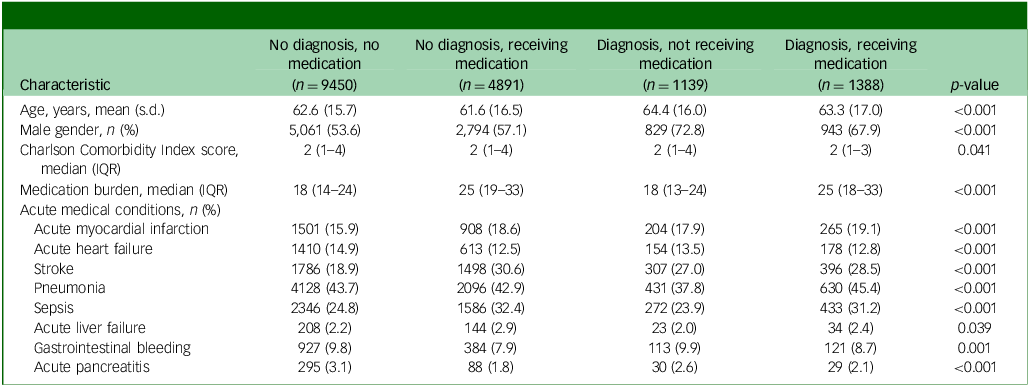
9450 (56.0%) patients had neither a psychiatric diagnosis nor were on any psychiatric medications, 4891 (29.0%) received psychiatric medications without a documented psychiatric diagnosis, 1139 (6.8%) had a documented psychiatric diagnosis but received no psychiatric medications and 1388 patients (8.2%) had both a documented psychiatric diagnosis and received psychiatric medications (Table 1).
Baseline characteristics by psychiatric diagnosis and psychiatric medication status

Table 1 Long description
The table presents baseline characteristics of patients categorized into four groups based on psychiatric diagnosis and medication status. It includes data for 9450 patients with no diagnosis or medication, 4891 patients with no diagnosis but receiving medication, 1139 patients with a diagnosis but not receiving medication, and 1388 patients with both a diagnosis and receiving medication. The table has 13 rows and 5 columns. The columns are labeled as follows: No diagnosis, no medication (n = 9450); No diagnosis, receiving medication (n = 4891); Diagnosis, not receiving medication (n = 1139); Diagnosis, receiving medication (n = 1388); and p-value. The rows include characteristics such as age, gender, Charlson Comorbidity index score, medication burden, and various acute medical conditions. Each cell contains specific values or percentages relevant to the characteristic and group. Notable trends include variations in age, gender distribution, and prevalence of acute medical conditions across the different groups.
IQR, interquartile range.
Patients with documented psychiatric diagnoses (comprising patients with a diagnosis who were and those who were not receiving psychiatric medication) were disproportionately of male gender compared with those without a diagnosis (72.8% and 67.9% v. 53.6% and 57.1%, p < 0.001). Charlson comorbidity scores were similar across groups (median 2), with significant differences in distribution (p = 0.041). Medication burden was much higher among patients receiving psychiatric medications (median 25 v. 18, p < 0.001).
We also observed a varying prevalence of some acute medical conditions across groups. Stroke was more common among patients receiving psychiatric medications (30.6% in those without a diagnosis but receiving medication; 28.5% in those with a diagnosis and receiving medication, versus 18.9% in those with no diagnosis and not receiving medication; 27.0% in those with a diagnosis but not receiving medication). Sepsis prevalence was also higher in psychiatric medication-receiving groups (32.4% and 31.2% v. 24.8% and 23.9%). Acute pancreatitis was less common in the no diagnosis but receiving medication group (1.8%) compared with other groups (2.1–3.1%).
Among patients without psychiatric diagnosis or medications, 80.9% were alive at discharge, 10.4% expired in hospital and 8.7% left against medical advice. Among patients without a psychiatric diagnosis who received psychiatric medication, 70% were alive at discharge, 22.2% expired in hospital and 7.8% left against medical advice. For patients with a diagnosis who did not receive psychiatric medication, 77.8% were alive at discharge, 11.9% expired in hospital and 10.4% left against medical advice. Finally, for patients having both a psychiatric diagnosis and receiving psychiatric medication, 78.5% were alive at discharge, 14.7% expired in hospital and 6.8% left against medical advice (Table 2).
Discharge disposition by psychiatric diagnosis and psychiatric medication status

Table 2 Long description
A table comparing discharge disposition by psychiatric diagnosis and medication status. The table has four rows and four columns. The columns are labeled ‘General discharge’, ‘Expired in hospital’, ‘Left against medical advice’, and ‘Total’. The rows are labeled ‘No diagnosis, no medication’, ‘No diagnosis, receiving medication’, ‘Diagnosis, not receiving medication’, and ‘Diagnosis, receiving medication’. Each cell contains values in the format ‘n (%)’. Row 1: No diagnosis, no medication: General discharge 7645 (80.9 percent), Expired in hospital 982 (10.4 percent), Left against medical advice 823 (8.7 percent), Total 9450 (56.0 percent). Row 2: No diagnosis, receiving medication: General discharge 3424 (70.0 percent), Expired in hospital 1084 (22.2 percent), Left against medical advice 383 (7.8 percent), Total 4891 (29.0 percent). Row 3: Diagnosis, not receiving medication: General discharge 886 (77.8 percent), Expired in hospital 135 (11.9 percent), Left against medical advice 118 (10.4 percent), Total 1139 (6.8 percent). Row 4: Diagnosis, receiving medication: General discharge 1089 (78.5 percent), Expired in hospital 204 (14.7 percent), Left against medical advice 95 (6.8 percent), Total 1388 (8.2 percent).
Percentages in first three columns are row percentages; percentages in the Total column are column percentages.
Multivariable regression
Model 2 returned a better fit compared with model 1 (Table 3). The Akaike information criterion decreased from 22 072.5 to 20 168.8, McFadden’s pseudo-R 2 increased from 0.046 to 0.130 and classification accuracy improved from 77.4 to 78.3%. EPV ratios for model 2 were 75.2 for mortality and 44.3 for leaving against medical advice, whereas the EPV ratio for model 1 was 150.3 for mortality and 88.7 for leaving against medical advice.
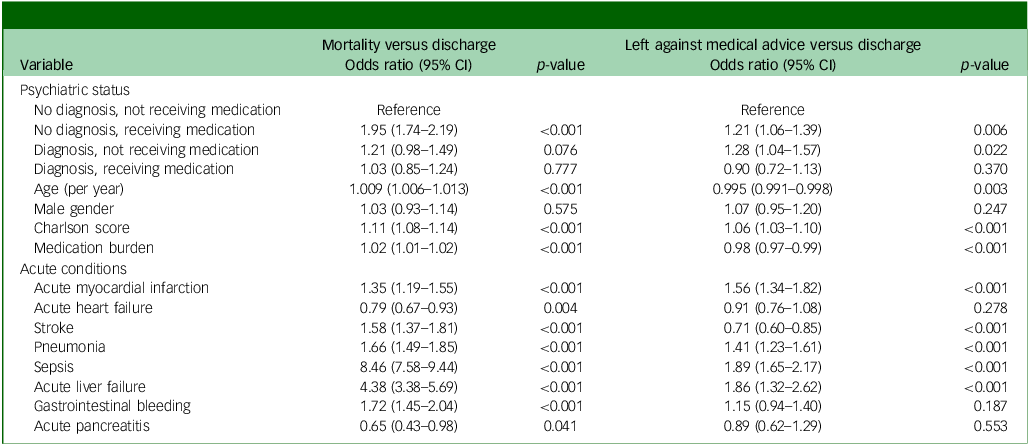
Multinomial logistic regression results (model 2)

Table 3 Long description
A table with 12 rows and 6 columns comparing mortality versus discharge and leaving against medical advice versus discharge. The columns are labeled Variable, Mortality versus discharge Odds ratio (95% CI), p-value, Left against medical advice versus discharge Odds ratio (95% CI), and p-value. The table includes variables such as psychiatric status, age, gender, Charlson score, medication burden, and acute conditions. Each row provides specific odds ratios, confidence intervals, and p-values for the variables. Notable trends include higher odds ratios for acute liver failure and sepsis in both mortality and leaving against medical advice categories.
Table 3 shows the complete results from model 2, and Fig. 1 displays adjusted odds ratios (aORs) for our four-category psychiatric variable.
Adjusted odds ratios for discharge outcomes by psychiatric diagnosis and psychiatric medication status. LAMA, left against medical advice.

Compared with patients with no psychiatric diagnosis or medications, those receiving psychiatric medications without a psychiatric diagnosis had an aOR of 1.95 (95% CI 1.74–2.19, p < 0.001) for in-hospital mortality. Patients with a documented psychiatric diagnosis but no psychiatric medications had an aOR of 1.21 (95% CI 0.98–1.49, p = 0.076). Patients with both a psychiatric diagnosis and psychiatric medications had an aOR of 1.03 (95% CI 0.85–1.24, p = 0.777).
Among covariates, increasing age (aOR = 1.009 per year, p < 0.001), higher Charlson Comorbidity Index score (aOR = 1.11 per point, p < 0.001) and a higher medication burden (aOR = 1.02 per medication, p < 0.001) were all associated with increased mortality. Sepsis had the strongest association from among the acute medical conditions (aOR = 8.46, 95% CI 7.58–9.44, p < 0.001), followed by acute liver failure (aOR = 4.38, 95% CI 3.38–5.69, p < 0.001), gastrointestinal bleeding (aOR = 1.72, 95% CI 1.45–2.04, p < 0.001), pneumonia (aOR = 1.66, 95% CI 1.49–1.85, p < 0.001), stroke (aOR = 1.58, 95% CI 1.37–1.81, p < 0.001) and acute myocardial infarction (aOR = 1.35, 95% CI 1.19–1.55, p < 0.001). Acute heart failure (aOR = 0.79, 95% CI 0.67–0.93, p = 0.004) and acute pancreatitis (aOR = 0.65, 95% CI 0.43–0.98, p = 0.041) were associated with lower mortality.
Patients receiving psychiatric medications without a documented psychiatric diagnosis had an aOR of 1.21 (95% CI 1.06–1.39, p = 0.006) for leaving against medical advice. Patients with a documented psychiatric diagnosis but who were not receiving psychiatric medications had an aOR of 1.28 (95% CI 1.04–1.57, p = 0.022). Patients with both a diagnosis and psychiatric medications had an aOR of 0.90 (95% CI 0.72–1.13, p = 0.370).
Younger age (aOR = 0.995 per year, p = 0.003), higher comorbidity burden (aOR = 1.06 per Charlson Comorbidity Index point, p < 0.001) and lower medication burden (aOR = 0.98 per medication, p < 0.001) were all associated with leaving against medical advice. Among acute conditions, sepsis (aOR = 1.89, 95% CI 1.65–2.17, p < 0.001), acute liver failure (aOR = 1.86, 95% CI 1.32–2.62, p < 0.001), acute myocardial infarction (aOR = 1.56, 95% CI 1.34–1.82, p < 0.001) and pneumonia (aOR = 1.41, 95% CI 1.23–1.61, p < 0.001) were associated with increased odds of leaving against medical advice, whereas stroke was associated with decreased odds of leaving against medical advice (aOR = 0.71, 95% CI 0.60–0.85, p < 0.001).
Our sensitivity analysis with expanded psychiatric medication criteria, available in the Supplementary Materials, showed consistent associations, with slightly attenuated signals across some domains.
Discussion
This study investigated associations between psychiatric diagnosis and/or psychiatric medication use and hospital stay outcomes. We found that patients receiving psychiatric medications without a clinically documented psychiatric diagnosis had the highest adjusted odds of both in-hospital mortality and leaving against medical advice. Further, patients with a clinically diagnosed psychiatric condition but who were not receiving any of the prespecified psychiatric medications showed a significant increase in leaving against medical advice only, without a major change in mortality. We also found no significant increase in either outcome for patients with both a psychiatric diagnosis and medication exposure. Our findings build on prior research on correlates of concurrent psychiatric care within acute care settings, extending the evidence base to an LMIC setting.
An analysis of USA out-patient data found that 60.4% of visits involving a new psychiatric prescription had no associated psychiatric diagnosis recorded. Reference Rhee and Rosenheck15 A similar pattern was observed in our study, where 29.0% of the total population received psychiatric medications without a documented diagnosis. Patients in this group (no diagnosis but receiving psychiatric medication) had the highest odds of adverse outcomes, with an aOR of 1.95 (95% CI 1.74–2.19, p < 0.001) for in-hospital mortality and 1.21 (95% CI 1.06–1.39, p = 0.006) for leaving against medical advice. This discrepancy likely belies a combination of systemic and clinical factors, including underdiagnosis of psychiatric conditions, differential help-seeking patient behaviours and persistent treatment gaps. Specifically, providers may prioritise symptom-based management, such as in cases with acute agitation or aggression, over formal diagnostic evaluations or show reluctance to record psychiatric diagnoses, but this would be concerning for both record-keeping and medico-legal issues. Reference Seifert, Reinhard, Bleich, Erfurth, Greil and Toto11,Reference Brunero, Wand, Lamont and John16 Medication use without a formal diagnosis may also expose patients to unnecessary pharmacological risks. Psychotropic medications, particularly antipsychotics, are associated with significant adverse effects such as sedation, falls, ataxia and urinary retention, as well as increased morbidity and mortality, especially among elderly patients. Reference Maust, Kim, Seyfried, Chiang, Kavanagh and Schneider17,Reference Korkatti-Puoskari, Tiihonen, Caballero-Mora, Topinkova, Szczerbińska and Hartikainen18 In addition, underdiagnosed psychiatric conditions may be associated with poorer prognosis in acute medical illnesses. For instance, patients with chronic conditions such as diabetes or hypertension who also experience undiagnosed depression may have reduced adherence to treatment regimens, which may be contributed to by fatigue, apathy or impaired motivation. Reference Javed, Rana, Siddiqui, Abdalla Afifi and Hafeez19 These factors may worsen hospital stay outcomes.
Patients with a documented psychiatric diagnosis but not receiving psychiatric medications had higher odds of leaving against medical advice (aOR = 1.28, 95% CI 1.04–1.57, p = 0.022). This may reflect undermanagement of psychiatric conditions within acute hospital settings. In busy hospital environments, particularly acute care settings, medical stabilisation is often prioritised over psychiatric care, which may lead to psychiatric needs being insufficiently addressed. Reference Levin and Aburub20 Structural barriers such as limited resources, and fragmented coordination of care, may contribute to this gap. A lack of specialised mental healthcare staff, insufficient training among acute care internists in managing psychiatric conditions and hesitancy among staff in providing care to patients with comorbid mental illnesses may all contribute as well. Reference Searby, Burr, Carolin and Hutchinson21 These issues may be associated with greater unmet treatment needs and higher morbidity and mortality among patients with coexisting mental and medical comorbidity. In underresourced LMIC contexts, this pattern of diagnosis without treatment is an opportunity for quality improvement that can potentially help meaningfully alter the course of acute illness.
Patients with concurrent psychiatric diagnosis and medication usage had both mortality and leaving against medical advice odds statistically indistinguishable from the reference group of patients with neither a psychiatric diagnosis nor psychiatric medications. This is promising because timely recognition and management of psychiatric conditions may lower risk of adverse events and outcomes among patients with psychiatric comorbidities. A meta-analysis evaluating antidepressant therapy in patients following acute coronary syndrome found no significant difference in all-cause mortality between patients receiving antidepressants and controls. Reference Sweda, Siontis, Nikolakopoulou, Windecker and Pilgrim22 Hence, appropriate recognition and pharmacological management of psychiatric conditions may, in effect, restore adverse outcome risk to near-baseline levels.
We also found increasing age to be independently associated with higher in-hospital mortality (aOR = 1.009 per year, p < 0.001), whereas younger age was associated with higher odds of leaving against medical advice (aOR = 0.995 per year, p = 0.003). Increasing short- and long-term mortality with advancing age is an established phenomenon. Reference Walicka, Puzianowska-Kuznicka, Chlebus, Śliwczyński, Brzozowska and Rutkowski23,Reference Jung, Marschall, Hennig, Giemsa, Heramvand and Parco24 The age–leaving against medical advice association is also consistent with prior evidence. Reference Alagappan, Chambers, Brown, Grecian and Lockman25 It may be explained by younger patients having a perception of reduced vulnerability to severe health complications, exhibiting greater impulsivity, a stronger desire for autonomy and perhaps a higher likelihood of non-adherence with medical advice compared with older populations.
In our model, higher overall medication burden was associated with increased mortality (aOR = 1.02 per medication, p < 0.001), and with decreased likelihood of leaving against medical advice (aOR = 0.98 per medication, p < 0.001). Polypharmacy reflects greater clinical complexity, and has been associated with increased mortality risk. Reference Gibson, Li, Jasuja, Keyhani and Byers26 The inverse relationship with leaving against medical advice is interesting and might indicate active engagement in their treatment course, or better perception of care. Similarly, higher Charlson Comorbidity Index scores were associated with both increased mortality (aOR = 1.11 per point, p < 0.001) and increased likelihood of leaving against medical advice (aOR = 1.06 per point, p < 0.001), consistent with evidence showing that higher comorbidity burden elevates all-cause mortality and susceptibility to self-discharge decisions. Reference Wang, Xue, Ma and Liu27,Reference Ni, Lin, Wu, Wu, Chen and Pan28 This association may also reflect confounding by illness severity, where patients requiring a greater number of medications (i.e. polypharmacy) represent a more medically unwell population requiring ongoing in-patient care, who are therefore less inclined to leave the hospital against medical leave.
Among the acute medical conditions, there were many significant mortality associations, with higher-acuity conditions carrying the greatest risk. Sepsis (aOR = 8.46), acute liver failure (aOR = 4.38), gastrointestinal bleeding (aOR = 1.72), pneumonia (aOR = 1.66), stroke (aOR = 1.58) and acute myocardial infarction (aOR = 1.35) were each independently associated with increased in-hospital mortality, with exceptionally high case fatality observed in sepsis, which is also well-established in the literature. Reference Fleischmann, Scherag, Adhikari, Hartog, Tsaganos and Schlattmann29 Notably, acute heart failure (aOR = 0.79) and acute pancreatitis (aOR = 0.65) were associated with lower mortality, possibly because of the availability of well-established management protocols. For leaving against medical advice, associations were found for sepsis (aOR = 1.89), acute liver failure (aOR = 1.86), acute myocardial infarction (aOR = 1.56) and pneumonia (aOR = 1.41). In contrast, stroke was associated with significantly lower odds of leaving against medical advice (aOR = 0.71), a finding consistent with the possible functional dependency and mobility impairment that accompany acute stroke, which may physically limit self-discharge. Reference Lin, Han, Wu, Wei, Ruan and Zhang30
Implications and future directions
Integration of mental health into primary healthcare is recommended by the World Health Organization, 31 and collaborative care models are shown to improve access and provider confidence in LMIC settings. Reference Petersen, Ssebunnya, Bhana and Baillie32–Reference Abdulla, Robertson, Kramer and Goudge34 However, our findings reflect deficiencies that might be emblematic of many settings within Pakistan, driven by limited investment, absence of mental health legislation, workforce shortages, persistent stigma and the lack of a clear pathway for integrating psychiatric care into universal health coverage. Reference Dayani, Zia, Qureshi, Baig and Sabri35 Broadly, within LMICs, 76–85% of individuals with mental illness remain untreated. Reference Mudiyanselage, De Santis, Jörg, Saleem, Stewart and Zeeb36
Our findings carry several clinical and policy implications. Prescribing psychotropic medications without a documented psychiatric indication may pose meaningful pharmacological risk, which calls for safer prescribing practices and improved diagnostic clarity. Reference Rhee and Rosenheck15 Consultation-liaison psychiatry services might be a practical first step to address these issues, which may facilitate proactive identification and management of psychiatric conditions within medical in-patient settings. Reference Gautam, Gautam, Jain and Yadav37 In addition to facilitating appropriate psychotropic prescribing, liaison services may promote non-pharmacological management strategies, including behavioural de-escalation, patient and family counselling, and staff support, potentially reducing unnecessary psychotropic medication use and improving patient engagement. The observed 15% psychiatric diagnosis rate, together with 29% medication use rate in our cohort, suggests concurrent underdiagnosis and empirical prescribing, and it is important to understand underlying causes, whether they relate to stigma, limited psychiatric resources, insufficient non-specialist training or documentation gaps. Reference Kågström, Guerrero, Aliev, Tomášková, Rüsch and Ouali38
Our findings also invite broader questions. To what extent does empirical psychotropic prescribing during medical admissions help, or does it do the opposite? Would formal psychiatric documentation confer measurable clinical benefit beyond the medication itself? Future research should address these through appropriate designs with a more rigorous assessment of psychiatric diagnoses, treatment decisions, prescribing indications, granular medication analyses, timing and dose assessments, consideration of temporality and qualitative exploration of prescriber rationale. These would further clarify the role of our health services in shaping these associations.
Strengths and limitations
Our study has some important strengths. It is considerably powered at a sample size of 16 868, and EPV values for inferential statistics were well above recommended standards. The analysis incorporates multivariable adjustments, at two levels (i.e. with and without adjustment for individual conditions). We also aimed to specify variables (such as medication exposure) to minimise misclassification.
However, several limitations need mention. First, our data were derived from a single tertiary care centre, limiting the generalisability of our findings to other clinical settings. As AKUH serves a substantial proportion of patients seeking tertiary and private sector care, the findings may not fully reflect populations receiving care in community healthcare settings or non-acute care, or generalise to preventative or population health. Second, granular information, including timing, dosage and duration of psychiatric medication use, was unavailable, limiting our ability to assess dose–response relationships or attribute causality with confidence. Additionally, there are valid clinical reasons for prescribing psychotropic medication without an ICD-10 diagnosis, such as utilising hypnotics for sleeplessness because of disruptive intensive care unit environments, or benzodiazepines for seizure management. Although our sensitivity analysis using a broader psychotropic definition lends confidence to the primary findings, better data-sets will help to better contextualise hypothesised causal pathways. We also lacked data on intensive care unit admissions, mechanical ventilation, psychiatric screening and other variables that may be important confounders or mediators. Finally, although exposures preceded discharge outcomes by design, the absence of granular within-admission timing data meant that the precise intervals between exposure and outcomes were unavailable. This precludes assessment of dose–time relationships and latency effects, and residual confounding by indication (whereby clinical deterioration may prompt certain exposures) cannot be fully excluded.
In conclusion, this study examined the association between psychiatric medication use, documented psychiatric diagnoses and short-term hospital stay outcomes among patients admitted with acute medical conditions. Our findings showed that discordance between psychiatric medication use and documented psychiatric diagnosis was associated with higher odds of one or both of in-hospital mortality and leaving against medical advice, whereas patients with both a documented diagnosis and appropriate pharmacologic treatment did not show any difference from the reference group who had neither a diagnosis nor psychotropic medication use. These findings suggest that gaps in psychiatric recognition, documentation or management may be associated with adverse outcomes among medically ill in-patients. Therefore, it is essential to strengthen diagnostic clarity, improve documentation practices and integrate psychiatric care into our services, especially for LMICs such as Pakistan, to optimise patient management and improve outcomes.
Supplementary material
The supplementary material is available online at https://doi.org/10.1192/bjo.2026.12110
Data availability
The data that support the findings of this study are available from the corresponding author, A.U., upon reasonable request.
Acknowledgements
The authors made use of ChatGPT (https://chatgpt.com/) to assist with the drafting of this article. All study design decisions, data analyses, interpretation of results and final content were conducted and verified by the authors, who take full responsibility for the manuscript.
Author contributions
A.U. contributed to study conceptualisation, study design, methods, formal analysis and visualisation, wrote the original draft and reviewed and edited the manuscript. N.H. wrote the original draft of the manuscript. A.A. wrote the original draft of the manuscript. M.A. reviewed and edited the manuscript. A.A. contributed to study supervision and reviewed and edited the manuscript. S.M.S. contributed to study supervision and data curation, and reviewed and edited the manuscript.
Funding
This research received no specific grant from any funding agency in the public, commercial or not-for-profit sectors.
Declaration of interest
None.



 Open access


eLetters
No eLetters have been published for this article.