Introduction
Chronic suppurative otitis media (CSOM), although uncommon in developed countries, is one of the main causes of childhood hearing impairment in developing countries and amongst disadvantaged populations in developed countries.1 Australian Aboriginal communities in remote areas are some of the most disadvantaged populations, with the poorest health outcomes in the world.Reference Couzos and Murray2 It has been well documented for over 30 years that there are alarming rates of hearing loss associated with both otitis media with effusion (OME) and CSOM amongst remote Aboriginal infants and children.Reference Morris, Leach, Silberberg, Mellon, Wilson and Hamilton3 Indeed, prevalence rates found in Australia are often greater than those reported for other First Nation populations in countries such as Canada and New Zealand.Reference Verhoeff, van der Veen, Rovers, Sanders and Schilder4
An investigation of the hearing and ear health status of school age Aboriginal children in remote north-west South Australia between 2003 and 2008 found that the fail rate for a screening test of hearing was 74 per cent and that 32 per cent of ears examined otoscopically were perforated. Fifty-three per cent of the perforated ears showed active ear disease and 47 per cent had dry perforations.Reference Sanchez, Sparrow, Carney and Turner5 In an extension of that study, conducted in the same remote region between 2009 and 2011, 18.8 per cent of children were found to have CSOM in one or both ears.6
The results of national benchmark tests in Australia show low rates of literacy and numeracy amongst Aboriginal children living in remote communities.Reference Hughes and Hughes7 Given that even a mild degree of hearing loss can have a detrimental impact on school performance, it seems likely that CSOM and OME may contribute significantly to poor educational outcomes. Limited educational achievement will lead to reduced employment opportunities and contributes to a perpetuating cycle of poverty.8
Chronic suppurative otitis media treatment
Medical treatment leading to resolution of CSOM has been the focus of much research. A number of studies in various settings have looked at the effectiveness of different combinations of treatment methods, including comparisons of dry mopping alone (also called ear wicking) with dry mopping plus antibiotics. Macfadyen et al. conducted a review of studies investigating CSOM treatment in developing countries.Reference Macfadyen, Acuin and Gamble9 They concluded that cleansing either by dry mopping or wet irrigation was no more successful than no treatment in reducing or resolving discharge and associated CSOM.
The use of dry mopping using tissue paper twisted into spears is advocated in Recommendations for Clinical Care Guidelines on the Management of Otitis Media in Aboriginal and Torres Strait Islander Populations (2010) to facilitate diagnosis and treatment of ear disease; however, direct objective evidence for this intervention is not provided.10 If the tympanic membrane cannot be visualised because of the presence of otorrhoea, clearing the ear canal will facilitate a diagnosis via otoscopy. In addition, removal of otorrhoea has been shown to allow more effective application of antibiotic drops through a perforation.10
Hearing as an outcome measure
The majority of studies assessing resolution of ear disease employ and report outcome measures based on otoscopy and visual diagnosis. Measures of hearing are in some instances included as a secondary outcome measure. A number of studies reviewed by Macfadyen et al. reported the inclusion of audiometric measures, but frequently did not report the results of those measures.Reference Macfadyen, Acuin and Gamble9
One randomised, controlled trial of Kenyan school children with CSOM (n = 524) measured hearing thresholds and reported the results in addition to the primary outcome measure of otorrhoea resolution and tympanic membrane healing.Reference Smith, Hatcher, Mackenzie, Thompson, Bal and Macharia11 Follow-up assessments were conducted at 4, 8, 12 and 16 weeks. It was found that discharge resolved more successfully when treated with dry mopping and topical antibiotics rather than dry mopping alone. After 16 weeks of treatment, there was a (small) statistically significant difference in mean hearing thresholds between children with no otorrhoea (with a perforation) and those who still had discharge at that time. This finding suggests that removal of otorrhoea alone may result in improved hearing. There is, however, currently no literature that reports on the immediate effect of tissue spear use on the hearing of the treated ear. The current study aimed to determine if dry mopping with tissue spears alone improves hearing thresholds.
Materials and methods
Study design
School-age children with candidate ears, where tympanic membrane visualisation was not possible because of obscuring otorrhoea, were identified by otoscopy prior to audiometric testing or video-otoscopy. An audiologist tested each child's hearing following the hearing protocol of screening at 20 dB HL at four frequencies (0.5, 1, 2 and 4 kHz). The pure tone hearing threshold was determined if the screening was failed at any frequency. An audiologist or ENT specialist subsequently used tissue spears to remove discharge from one or both ears. Video-otoscopy imaging and ENT diagnosis were then recorded. A second audiologist (blinded to the audiometric results from the first audiogram) retested the hearing in the treated ear(s) on the same audiometer, in the same location as used for the initial assessment.
Audiometry was carried out on school campuses in the remote communities. Soundproof or sound-treated rooms were not available. The accuracy of threshold audiometry will be influenced by high levels of ambient noise. The schools assisted by identifying locations for audiometry in which ambient and episodic noise would be minimised. Ambient noise levels were determined in these locations and were in the range 22–36 dBA.6 The headphones employed (‘auraldomes’) are rated for use in ambient noise so that a hearing threshold of 20 dB HL can be measured accurately in the presence of ambient noise of 50 dBA.Reference Roeser and Glorig12 No thresholds below 20 dB HL were sought.
Participants and sample size
Sixty-one Aboriginal children (aged 5–18 years; mean of 9.4 years) were recruited for this study. There were 37 females and 24 males. The participants were an unselected subset of children with otorrhoea who were part of a wider study.6
Intervention
Tissue spears were made by twisting paper tissues into a spear shape. These were inserted into the affected ear canal in order to absorb discharge (Figure 1). A maximum of three spears were inserted for a period of 1 minute per spear for each treated ear. Otoscopy was undertaken after each tissue spear use. If the tympanic membrane could be well visualised, no further tissue spears were used. Any discharge remaining after this protocol was not removed by any other method prior to the second audiogram. The time between repeated audiometry did not exceed 30 minutes.
A tissue spear following removal from a discharge-filled ear canal.

Outcomes
There were two patient outcome measures of hearing. The first was a quantitative change in the four-frequency pure tone average (PTA) calculated for each ear from pre- and post-intervention audiograms. A PTA change was determined for each pair of results. The second outcome measure was an assessment of functional change. Three audiologists not involved in the data collection considered each set of de-identified hearing thresholds to answer the question, ‘In your opinion do these changes, if any, constitute a functional change to the child's ability to hear in that ear?’ Response options were ‘better hearing’, ‘worse hearing’ or ‘no change in hearing’.
Blinding
At the time of the second audiometric assessment, audiologists carrying out the post-intervention test were aware that tissue spearing had been performed. In each case, the second testing audiologist was blinded to the audiometric results from the first (pre-intervention) assessment.
Ethical standards
All procedures contributing to this work complied with the ethical standards of the relevant national and institutional guidelines on human experimentation (National Health and Medical Research Council Australia), and with the Helsinki Declaration of 1975 (as revised in 2008). Ethics approval was received from the Aboriginal Health Research Ethics Committee of the Aboriginal Health Council of South Australia and from the Flinders Clinical Research Ethics Committee.
Results
Forty-two children underwent unilateral tissue spearing before and after audiometric testing, and 19 underwent bilateral tissue spearing before and after audiometric testing. Children with unilateral otorrhoea were the source of the 13 control ears, which were not subjected to tissue spearing. Hearing in each child's untreated (control) ear was assessed twice, by both the first and second audiologists.
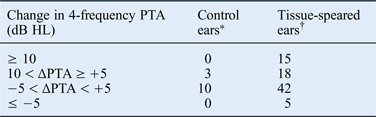
The four-frequency PTAs were calculated from the results for each treated ear of the pre- and post-intervention audiograms. Changes in four-frequency PTA and median changes in four-frequency PTA were calculated. Table I shows the distribution of grouped ‘ΔPTA’ values, defined as pre-intervention four-frequency PTA minus post-intervention four-frequency PTA, for the intervention and the control ears. Thirty-three tissue-speared ears (41.3 per cent) showed an improvement in the four-frequency PTA of 5 dB HL or more. Three of 13 control ears showed an improvement between 5 and 10 dB HL and none showed an improvement greater than or equal to 10 dB HL.
Audiometric measures of tissue spearing effect
Data represent numbers of ears. *n = 13; †n = 80. PTA = pure tone average. ΔPTA = pre-intervention minus post-intervention pure tone average of four frequencies: 0.5, 1.0, 2.0 and 4.0 kHz
Given the smaller number of control ears, a box-and-whisker plot of the median change in four-frequency PTA was used to compare the control with the intervention group (Figure 2). The box-and-whisker plots show that the medians for the changes in the four-frequency PTA for the control and tissue-speared ears are similar. The top quartile for the tissue-speared ears shows much greater change than for the control ears, and there are outliers which indicate even greater change. In a small number of cases, hearing was assessed as measurably worse after the use of tissue spears. Whether this is due to mechanical consolidation of otorrhoea further down the canal or test-retest reliability (some children were observed to become bored or fatigued during the second audiometric test) is unclear.
A box and whisker plot of the difference in pre- and post-intervention four-frequency pure tone averages. (Refer to the Results section for a more detailed description.) ΔPTA = pre-intervention minus post-intervention pure tone average of four frequencies: 0.5, 1.0, 2.0 and 4.0 kHz
Functional analysis
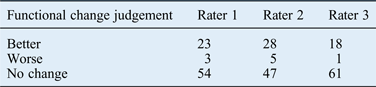
The three audiologists invited to review de-identified pre- and post-intervention audiograms (80 test and 13 control) judged that hearing had functionally improved after tissue spear use in 28.4 per cent of ears.
Fleiss' kappa, a specific statistical test of inter-rater reliability, was used for the qualitative evaluation of functional change. The results indicated good agreement between the three audiologists on the functional effects of tissue spearing (K = 0.64, n = 80) (Table II).
Functional analysis of tissue spearing effect by three audiologists
Data represent numbers of ears.
Discussion
Synopsis of findings
This study demonstrated that tissue spearing to remove otorrhoea can result in an immediate improvement in hearing thresholds. In addition, in approximately one third of ears with otorrhoea, the improvement was judged as being a functional improvement by the three audiologists. The duration of the effect, however, remains unknown.
Study strengths and limitations
Tissue spearing alone as a means of reducing conductive hearing loss in the presence of otorrhoea has not to the authors' knowledge been reported previously. The current study included a large number of cases from a well-characterised sample. The research protocol of audiometric test-retest included a number of control ears. Participating staff were blinded to the pre-intervention audiometric results. Both a quantitative measure of PTA change and a qualitative assessment of functional hearing improvement were employed. A limitation of the study was the lack of opportunity to reassess the participating children's ear(s) both audiometrically and otoscopically to investigate the duration of any change.
Comparisons with other studies
Prior studies have investigated various treatment regimens for CSOM, including the use of dry mopping with or without antibiotic or antiseptic application. In some studies, hearing has been included as a secondary outcome measure of resolution of the pathology.Reference Macfadyen, Acuin and Gamble9, Reference Macfadyen, Acuin and Gamble13 Such studies, however, have only investigated the longer-term effects of regular tissue spearing in disease treatment. The present study focused exclusively on the immediate effect of physical removal of otorrhoea on hearing thresholds.
Clinical implications and recommendations
The very high levels of middle-ear disease in remote Aboriginal communities are thought to exist primarily as a consequence of poverty.Reference Coates, Morris, Leach and Couzos14 Poverty leads to poor nutrition, overcrowded housing, poor sanitation, poor general health and low educational achievement. All of these factors contribute to high rates of middle-ear infection and re-infection in early infancy, which persist through childhood.6 The key to achieving improvements in chronic middle ear disease must be to address living standards and general health.Reference Couzos and Murray2 However, while resources need to be directed at prevention, it is clear that early intervention and treatments to effectively resolve CSOM and associated hearing loss should be a high priority.
Treatment of CSOM in remote communities is often neglected because of limited medical services and competing demands such as the need to focus on medical conditions with life-shortening consequences (e.g. diabetes, and renal and heart disease).Reference Couzos and Murray2 As a result, many children with CSOM may not receive consistent treatment, and suffer not only from ongoing otorrhoea but also from significant levels of persisting conductive hearing loss. Most affected children are likely to experience reduced capacity to hear and learn. The findings of the present study suggest that the dry mopping of ears with otorrhoea can objectively reduce conductive hearing loss in the absence of available medical treatment or as an adjunct to active medical treatment.
• Rates of hearing loss associated with chronic suppurative otitis media (CSOM) and otitis media with effusion are high amongst Australian Aboriginal children
• Dry mopping using tissue spears has been recommended to facilitate ear disease diagnosis and treatment, but there is no direct objective evidence
• There are no previous reports of the immediate effect of tissue spearing for otorrhoea on hearing thresholds in the treated ear
• Tissue spears used to clear otorrhoea resulted in measureable improvements in averaged hearing thresholds
• Qualitative analysis suggested functional hearing improvement in one third of cases
• The duration of these hearing improvements is unknown
A World Health Organization report on CSOM suggested that parents, carers, other schoolchildren, teachers or affected children themselves can perform dry mopping several times per day ‘with cotton wool wisps on orange sticks'.15 We recommend dry mopping using correctly prepared twisted paper tissue as an alternative procedure that can be taught to children and their family members or caregivers.10
Correct preparation of tissue spears could be incorporated as part of current school hygiene promotion programmes (which usually include washing hands, and blowing and wiping noses with tissues) and their use encouraged a number of times daily when otorrhoea is known to be present. Even in the absence of information about the duration of any hearing improvement from tissue spearing, the results of this study suggest that a significant proportion of school-age children with otorrhoea are likely to obtain hearing benefit from tissue spear use. Some children will obtain marked improvement in hearing, as shown in Figure 2.
Conclusion
If implemented appropriately, the use of tissue spears to clear an ear canal of otorrhoea can result in measureable improvement in hearing thresholds. The procedure is simple and quick, and the skills can be rapidly learned. The qualitative results of this investigation suggest a functional improvement in hearing results in approximately one third of cases. Given the uncertainty regarding the duration of any improvement, daily use of tissue spears is indicated for Aboriginal children with discharging ears living in remote communities.
Acknowledgement
This study was performed as part of a larger research project, funded by the Commonwealth of Australia (Department of Health and Ageing), investigating ear health and the use of salt-water chlorinated swimming pools by Aboriginal children (grant number: REI 244/0708).