Clergy are often regarded by citizens and political leaders as trustworthy and reliable sources of guidance (Djupe and Calfano Reference Djupe and Calfano2009). As such, some clergy may hesitate to enter the political fray and all clergy undertake some risk when they do so. They risk alienating their congregants or losing their legitimacy if they are seen as inappropriately political (Olson Reference Olson, Smidt, Kellstedt and Guth2009, p. 372) and they may even see a drop in offerings if their political messages are not well received (Calfano Reference Calfano2010; Calfano, Oldmixon, and Gray Reference Calfano, Oldmixon and Gray2014). For many clergy, their congregants come first, with politics coming second, if at all (Olson Reference Olson, Smidt, Kellstedt and Guth2009; Smidt Reference Smidt2016). Yet, clergy do get involved politically. Clergy from denominations across the United States are active participants in politics (Djupe and Gilbert Reference Djupe and Gilbert2003; Putnam and Campbell Reference Putnam and Campbell2012), but there is a great deal of variance in both the type and the amount of political activity clergy undertake. Whereas some clergy engage in private political activities like voting (Smidt Reference Smidt2003), others openly endorse candidates (Mayer Reference Mayer2009), distribute voter guides (Wilcox and Sigelman Reference Wilcox and Sigelman2001), or mobilize their congregants to vote early after Sunday worship services (sometimes called “Souls to the Polls”) (Herron and Smith Reference Herron and Smith2012; Garrett Reference Garrett2015). Are these different political activities driven by different motivations?
Although voting, delivering political sermons, and endorsing candidates from the pulpit are all examples of clergy members engaging in politics, there are important qualitative differences among them. Clergy likely see very different costs and benefits to private political activities, compared with political activities they might undertake as leaders of a religious congregation. While the literature on clergy political activity does recognize important differences in the types of political activities clergy engage in (Olson Reference Olson, Smidt, Kellstedt and Guth2009), few studies explicitly compare clergy motives and the conditions that lead them to participate in one kind of political activity over another. But if different political activities are driven by different considerations, disaggregation may reveal previously hidden insights. I argue that different political activities have different meanings, risks, and consequences for clergy and so are likely influenced by different variables. Using national data from the Cooperative Clergy Study (CSS) and local data from the Little Rock Congregations Study (LRCS), I disaggregate clergy political activity to look closely and comparatively at the factors driving different types of clergy political engagement.
The results suggest that clergy do see important differences among the types of political activities. Personal political activities, like donating to a campaign, are more likely when a clergy member has been with her or his congregation longer; general congregation-level political activities, like giving political sermons, are more likely in larger and more homogenous congregations; election-related political activities in the congregation, like distributing voter guides at worship services, are more likely to be done by conservative clergy and by Black Protestant clergy. Each of these findings is hidden when clergy political activity is considered in the aggregate, making a compelling case for distinguishing among categories of clergy political activity.
CLERGY POLITICAL ACTIVITY
The current literature on clergy political activities includes valuable typologies for understanding different political behaviors, but few explicit quantitative comparisons across categories (Olson Reference Olson, Smidt, Kellstedt and Guth2009), especially when it comes to clergy motives. While there are a number of factors that may influence a clergy member's decision to engage politically, they can be categorized into two main explanations: theology and context.
Theology influences political participation through the broader religious tradition in which a clergy member ministers, but also through the personal religious beliefs that a clergy member holds. For instance, Guth et al. (Reference Guth, Green, Smidt and Kellstedt1997) point to the importance of social theology, which connects religious beliefs to public affairs (p. 8). Similarly, some religions have a historic tradition of political activism that might lead clergy to be more engaged (Harris Reference Harris1999), others may have a truth-speaking worldview that lends itself to political pronouncements (Jelen Reference Jelen, Crawford and Olson2001), and still others may have a more “otherworldly” focus (Stark et al. Reference Stark, Foster, Glock and Quinley1971; Calhoun-Brown Reference Calhoun-Brown1998; McAdam Reference McAdam2010) that pulls away from politics, or may require such a large commitment (Campbell Reference Campbell2004) as to leave limited resources for political participation. Some may see specific theological reasons to engage in political activity on particular issues. For instance, the Catholic Church's activism on abortion, religious freedom, and nuclear war has been directly tied to theological imperatives (Goldzwig and Cheney Reference Goldzwig and Cheney1984; Tamney, Johnson, and Burton Reference Tamney, Johnson and Burton1992; Meyer and Staggenborg Reference Meyer and Staggenborg1996; Holman and Shockley Reference Holman and Shockley2017).
In addition to the theology of a clergy member's religious tradition, personal religious beliefs can also influence political activity. Survey research on religious belief in the general public indicates that belief is a highly predictive measure (Bader and Froese Reference Bader and Froese2005; Guth et al. Reference Guth, Kellstedt, Smidt and Green2006; Finke and Adamczyk Reference Finke and Adamczyk2008; Friesen and Wagner Reference Friesen and Wagner2012). One could reasonably expect it to be even more predictive among clergy. Providential religious belief—the belief in a divine plan that one can help bring about (Glazier Reference Glazier2017)—may be particularly influential among clergy members, many of whom come to their role in the clergy through what they view as a divine calling and who then dedicate their entire lives to serving God's will (Christopherson Reference Christopherson1994; Grey Reference Grey2012).
The theological explanation for clergy political activity both stands alone and influences the second major explanation: that a clergy member may be motivated to engage in politics at church by the broader context in which she or he works and ministers (Djupe and Gilbert Reference Djupe and Gilbert2002). In this explanation, the clergy-congregant relationship can be seen almost as a representative–constituent relationship (Djupe and Gilbert Reference Djupe and Gilbert2003), with the clergy member addressing social and neighborhood problems that matter to the congregants. Thus, low-income neighborhoods tend to have more politically active clergy as they address pressing poverty in the community (Olson Reference Olson2000; Crawford and Olson Reference Crawford and Olson2001). Clergy may also feel pressure from congregants or from denominational leaders to deliver political sermons (Calfano Reference Calfano2009), perhaps for theological reasons. Clergy often carefully consider the dynamics of their congregations before engaging in any potentially controversial activities—political or otherwise (Calfano and Neiheisel Reference Calfano and Neiheisel2009). Some clergy may shy away from political activity because they hold political views that are significantly different from their congregation (Guth et al. Reference Guth, Green, Smidt and Kellstedt1997). Simple propriety may also come into play: does the clergy member think talking about a particular political topic is appropriate for her or his congregation (Guth et al. Reference Guth, Green, Smidt and Kellstedt1997; Djupe, Olson, and Gilbert Reference Djupe, Olson and Gilbert2005)?
Thus, the current literature can tell us a lot about what drives clergy political activity. What we do not know is whether the influence of religious tradition, personal religious belief, or congregational unity (among many other factors) is the same across all types of clergy political activity. Is there a difference between those factors that motivate clergy to engage in personal political activities, like donating to a campaign or writing a letter to the editor, compared with political activities undertaken in the role of a religious leader, like giving a sermon on a political topic or distributing voter guides at worship services? Why do some religious leaders get involved, for instance, in electoral politics while others stick to more general political activities?
There are some studies that lead us to expect that different clergy political activities may be driven by different motivations. For instance, Djupe and Gilbert (Reference Djupe and Gilbert2002) find that clergy speech on moral issues like abortion is more common (compared with clergy speech on social justice issues like the environment) when clergy feel that their religious community is isolated from the surrounding community. McDaniel (Reference McDaniel2003) distinguishes between “pulpit activism” and direct political activism among Black clergy, with education significantly predicting participation in the latter. Looking at American rabbis in particular, Djupe and Sokhey (Reference Djupe and Sokhey2003) compare direct participation in electoral politics (like voting or attending a rally) and indirect participation in electoral politics (like displaying a campaign sticker or encouraging the congregation to vote) and find that direct participation by rabbis is predicted by newspaper reading, where indirect participation is not.
The current literature has a lot to say about what influences clergy political activity, but it is likely that these influences come into play to different extents depending on the type of political activity clergy engage in. In the following section, I argue that different clergy political activities are likely driven by different factors, depending on the visibility, and therefore risk, associated with the activity.
DIFFERENT ACTIVITIES, DIFFERENT MOTIVATIONS
Clergy are politically active in a variety of ways. Even when clergy stay away from political activities as congregation leaders, they are still often politically active in their personal lives—donating to campaigns, voting, and advocating for issues they care about (Smidt Reference Smidt2003). These activities are not performed in front of a congregation and are thus generally low-visibility and low-risk activities for clergy. On the other hand, communicating a political message directly to congregants is riskier. We know clergy are attuned to how their political messages are received (Calfano Reference Calfano2010); similar considerations are likely brought to bear when clergy are deciding whether and how to act politically. Congregations are rarely completely homogenous and any political statement or action by a clergy member may alienate some congregants (Wald, Owen, and Hill Reference Wald, Owen and Hill1990; Dougherty et al. Reference Dougherty, Bader, Froese, Poison and Smith2009). But some political activities are less risky than others. Clergy members may not be willing to risk alienating large sections of their congregation by bringing in one candidate over another in tight race for elected office, but hosting a non-partisan discussion group—where homogeneity is also more likely (Djupe and Gilbert Reference Djupe and Gilbert2006)—could be seen as a safer option.
Currently, scholars often pool all clergy political activity into a single measure. The index that Guth et al. (Reference Guth, Beail, Crow, Gaddy, Nelsen, Penning and Walz2003) use contains 28 different political acts and the one that Smidt et al. (Reference Smidt, Crawford, Deckman, Gray, Hofrenning, Olson, Steiner and Weston2003) use has 26. Even the more narrow measure of clergy political speech that Djupe and Gilbert (Reference Djupe and Gilbert2002) use includes both publicly taking a stand on a political issue and taking a stand while preaching. The former type of political speech is one that members of a congregation may not hear, potentially changing the calculus for the clergy member.
Here, I argue that because the types of political activities available to clergy members have different levels of risk, we should disaggregate political activity and analyze similar activities together. Disaggregating clergy political activity can reveal important differences that were previously hidden. Comparable work has been successfully done for other political measures. For instance, research on the gender gap in political interest that disaggregates political interest measures finds that women are not less interested in politics in general, but are actually more interested in local politics, but less interested in national and international politics, compared with men (Coffé Reference Coffé2013). Similarly, research that distinguishes between private and collective activism (among other forms of political participation) demonstrates that women are actually more likely than men to engage in private political acts like boycotts (Coffé and Bolzendahl Reference Coffé and Bolzendahl2010). In another example, DiGrazia (Reference DiGrazia2014) finds that different factors predict low- and high-risk political protest behaviors and recommends examining them separately.
An equivalent process may elucidate clergy political activity. By disaggregating activity measures, we can test whether different factors influence clergy participation in different ways across political activities. I propose three basic categories of clergy political activity, which can be aggregated into broader categories, as illustrated in Figure 1.
Types of clergy political activities

In the first category are personal political activities. These include activities like contributing to a candidate or signing a petition. These activities tend to happen in private and are thus not visible to a clergy member's congregation. In this category of political activities, clergy members are not acting in an official capacity as religious leaders and so their behaviors are less relevant to their professional positions.
Next are general congregation-level political activities, which are engaged in by a clergy member in his or her role as the congregation leader. These political activities are visible to congregants but are not related to an election. They include activities like taking a stand on a political issue in a sermon or organizing a political discussion group. These activities are political, but do not necessarily reveal partisan preferences, and are therefore less risky for clergy (Smidt Reference Smidt2016). Because these types of activities are done directly in the leadership of a congregation, clergy are likely to carefully consider their religious context when deciding whether or not to engage in them, including the extent to which they see their own political views as similar to their congregations or the extent to which there is a tradition of political engagement in their congregation or denomination (Guth et al. Reference Guth, Green, Smidt and Kellstedt1997; Djupe and Gilbert Reference Djupe and Gilbert2002; McDaniel Reference McDaniel2003).
Third are election-specific congregation-level political activities. These are activities like inviting candidates to attend or speak at worship services, distributing voter guides, or holding voter-registration drives. Similar to the way personal political activities might be less risky for clergy than those undertaken as a religious leader, election-related political activities are a special category of political activities that entail greater risk for clergy because the stakes are so high. Whereas some clergy may embrace electoral politics, other clergy may be uncomfortable with such activities, or may believe that their congregations would be uncomfortable with the direct connection of religion to an election. Electoral activity may also put a religious organization's tax-except status at risk. Activities in this category may be more likely when congregation political views are homogenous and clergy members are more partisan. Under such circumstances, clergy electoral activity as religious leaders might be better received and even supported by congregants, and therefore less risky for clergy.
The two congregation-level categories of political activities—general and election specific—can be considered together and all three can be pooled into an aggregate category of all clergy political activity. Although much of the literature utilizes the latter approach, I expect that significant differences will be revealed through disaggregating clergy political activities and analyzing them separately. Clergy political activities are varied enough that distinguishing among them is important. Utilizing these three categories of clergy political activity will help answer the question of whether different influences lead to clergy engaging in different kinds of political activities.
DATA AND METHODS
The question of whether different clergy political activities are influenced by different variables is best answered with clergy-level data. The best source for clergy-level data is the CCS, which contains survey data collected from 22 different denominations and 8,933 clergy members in 2000–2001. The CCS was conducted through a cooperative effort led by the Henry Institute at Calvin College. In some cases, all clergy members from a particular tradition were contacted and in others a random sample was used. Response rates range from 11% to 59%. For more information about the CCS, see the 2003 special issue of the Journal for the Scientific Study of Religion (Volume 42, Issue 4). The size and diversity of the CCS plus the breadth of questions included in the study make it extremely valuable for analysis.
However, the CCS data do have some drawbacks. The study was conducted in 2000–2001 and may not capture more recent developments in clergy political behavior. Additionally, the dataset does not contain any geographic markers and has a limited number of questions on personal religious belief. Thus, the CCS data are supplemented with clergy survey data from the LRCS.
The data from the LRCS were collected from clergy serving within the city limits of Little Rock in two iterations: 2012 and 2016.Footnote 1 In 2012, the mail survey response rate was 15.9% and in 2016 it was 21.4%. Data from both years are merged in the analysis below for a total sample of 149 clergy surveys.Footnote 2 The two datasets complement one another in the analysis that follows. The CCS provides a big-picture view of the political activity of clergy from a broad national sample, while the LRCS provides a close-up view of clergy political activity in a single, Southern city with a particular religious–political history. The LRCS also contains some questions that the CCS does not and thus is able to point to some potentially important variables whose influence we would otherwise miss.
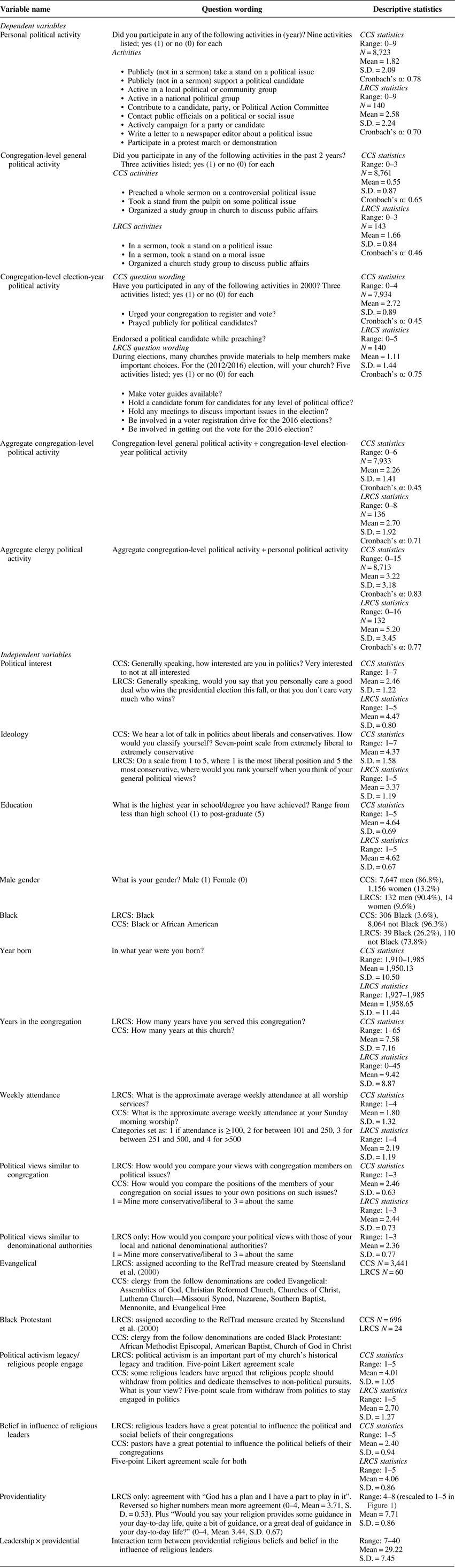
There are five key dependent variables of interest in the analyses that follow. The first three are derived from the theoretical categories of clergy political activity described above: personal political activity, general congregation-level political activity, and election-specific congregation-level political activity. The fourth dependent variable combines general and election-specific congregation-level political activities in a single variable, and the fifth pools all three of the described theoretical categories into one aggregate variable measuring all clergy political activity. The dependent variables used in the models for each sample are described in Table 1 and more detailed statistics, including Cronbach's α scores, are provided in Appendix 1.
Question wording of dependent variables for the Cooperative Clergy Study and the Little Rock Congregations Study

Clergy personal political activity is measured using a nine-item political participation battery of questions. The questions include activities like participating in a protest march or demonstration and being active in a national political group. This summary measure is intended to capture the clergy member's political activity as a private citizen, not as a religious leader. General congregation-level political activities are measured by a battery of three questions, which capture preaching on political issues and organizing a church study group to discuss public affairs. This is the activity that congregation members will see and hear if they attend worship services, but it is not explicitly connected to an election.
Election-specific congregation-level political activities are measured through a battery of three or five election-related activities places of worship might engage in. For the CCS sample, there are three questions, including endorsing a political candidate while preaching and publicly praying for a candidate. For the LRCS sample, there are five questions, including holding meetings to discuss important issues in the election and participating in voter registration drives. This is the most partisan, consequential, and risky of the three categories of political activity.
Again, the two types of congregation-level political activities are combined in a measure of clergy political activity as religious leaders and all three political activity categories are combined to provide a measure of all clergy political activity. Comparisons across all five models will reveal the extent to which disaggregating clergy political activity reveals otherwise hidden insights into the influences driving different activities.
Each of the models in each sample includes variables for gender (male = 1), education, the year the respondent was born, and ideology (higher numbers more conservative). There is also a binary variable for the clergy of Evangelical churches and a binary variable for the clergy of Black Protestant churches, as some research indicates that certain denominations may “specialize” in specific types of political activity (Beyerlein and Chaves Reference Beyerlein and Chaves2003). The last 40 years of scholarship on religion and politics in the United States has focused a great deal of attention on the Evangelical religious tradition (e.g., Green et al. Reference Green, Guth, Smidt and Kellstedt1996; Wilcox Reference Wilcox1996; Smith and Emerson Reference Smith and Emerson1998). Additionally, the specific historical–political experience and worship practices of Black Protestant churches may lead to different political activities (Lincoln and Mamiya Reference Lincoln and Mamiya1990; Calhoun-Brown Reference Calhoun-Brown1996; Pattillo-McCoy Reference Pattillo-McCoy1998; Harris Reference Harris1999; Barnes Reference Barnes2005). The models also include a dummy variable for Black ethnic identity (Black = 1), as race may also influence Black clergy who may serve diverse congregations not categorized within the Black Protestant religious tradition (Dougherty and Huyser Reference Dougherty and Huyser2008). Race is thus accounted for at two levels of analysis: the broad culture and practice of the Black Protestant religious tradition and the personal experience of Black clergy members. Black Protestant denomination and Black ethnic identity are distinct in the data—they are correlated at only 0.35 in the CCS and 0.69 in the LRCS, a finding which supports including both variables in the models.
The models also include a measure of connection to religious engagement in politics (“Some religious leaders have argued that religious people should withdraw from politics and dedicate themselves to non-political pursuits. What is your view? Withdraw from politics or Stay engaged with politics” for the CCS and agreement with the statement “political activism is part of my church's legacy and tradition” in the LRCS). Agreement with the statement “religious leaders have a great potential to influence the political and social beliefs of their congregations” is included as a measure of professional political efficacy (Guth et al. Reference Guth, Beail, Crow, Gaddy, Nelsen, Penning and Walz2003).
Each model also contains variables to account for the context in which clergy members do their work as congregation leaders. Both surveys asked clergy how similar their own political views are to their congregations (higher numbers indicate more similarity). A categorical measure of weekly attendance to indicate the size of the congregation and one of political interest (general interest for the CCS and interest in who wins the election for the LRCS) are also included. For the two congregation-level political activities models, the personal political activities battery is included as an independent variable.
The LRCS provides a few important variables that are not available in the CCS. First, the LRCS survey included two questions to measure providential religious beliefs—or the belief that God has a plan that people can help bring about (Glazier Reference Glazier2013; Reference Glazier2017). Providential religious believers are more likely to engage in political activity, under certain circumstances (Glazier Reference Glazier2015) and providential clergy may be more likely to undertake some political actions. Second, because clergy who believe that God's plan includes their own efforts to influence the political and social views of their congregants may be more active in congregation-level political activities than those who do not hold those views, an interaction term between providential beliefs and belief in religious leadership is also included in the LRCS models.
Finally, Little Rock was actually the location of some early and important work on the topic of the political influence of clergy, which found that clergy who were active in the civil rights movement needed personal commitment to the cause, support from their congregations, and support from their denominational authorities (Campbell and Pettigrew Reference Campbell and Pettigrew1959). Thus, the LRCS included a question about how similar clergy's political views are to denominational authorities.
RESULTS
The five dependent variables first presented in Figure 1 are related, but they do not measure the same thing. The correlations among them are presented in Table 2. Correlations with aggregate measures are of course higher, due to measurement overlap. Most important are the correlations among the three disaggregated political activity measures (in bold), which range from 0.27 to 0.57, indicating that the disaggregated variables are measuring different aspects of clergy political activity.
Correlations among political activity measures, CCS/LRCS

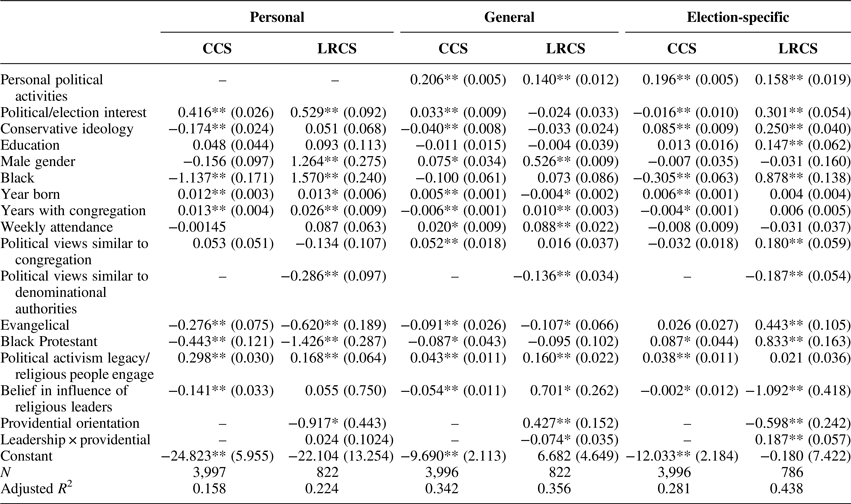
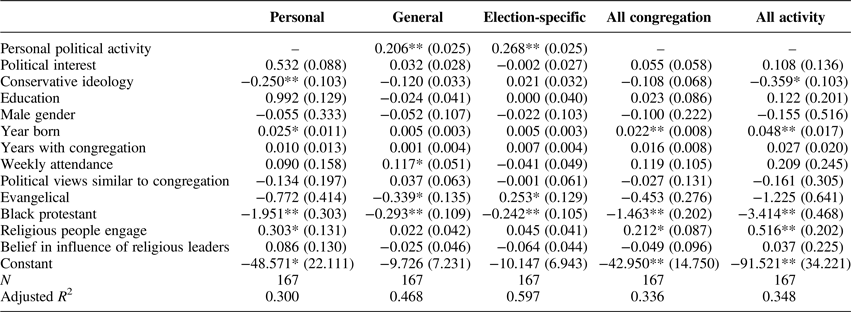
The results of regression models that take these three disaggregated measures of clergy political activity as their dependent variables are presented in Table 3. Personal political activities are presented first, with results from the CCS followed by the LRCS. The next two columns similarly present the results for general congregation-level political activities. The final set of models present the results for political activities explicitly linked to the election (2000 for the CCS and either 2012 or 2016 for the LRCS).
OLS regression models of personal, general congregation-level, and election-specific congregation-level clergy political activity

*p < 0.05, **p < 0.01.
While the significant variables in each model could be individually discussed, the results here instead focus on the discrepancies across models: those variables that significantly influence different categories of clergy political activity in different directions. These variables demonstrate specific instances where disaggregating political activity significantly improves interpretation—revealing the same factor influencing different clergy political activities in different ways.
The first discrepancy is found in the first variable—interest in politics—which predicts greater personal and general congregation-level political activity, but lower election activity. Perhaps political interest leads to less election-related activity because electoral activities are otherwise motivated. The next variable measures conservative ideology and is split in the opposite way from political interest; conservative ideology leads to less personal political activity and less general congregation-level political activity, while also leading to more electoral activity. The differential impact of political interest and ideology indicate that the clergy electoral activity in their congregations is driven less by personal interest and more by ideological goals. Those who have been with their congregation longer are more likely to be personally politically active, but less likely to engage in either type of congregation-level political activity. Evangelical clergy are significantly less likely to engage in personal or general congregation-level political activity, although Evangelical religious tradition has no effect on electoral activity.
Additional discrepancies are found in the variables that predict general congregation-level political activities, like holding political discussion groups. Male clergy are significantly more likely to engage in this category of activity, although gender is not a significant predictor for either of the other dependent variables. Likewise, having political views that are similar to one's congregation and leading a larger congregation both significantly predict general congregation-level political activities, but not political activity in either of the other two categories. The significance of these three variables for only general congregation-level political activities indicates that clergy considerations are different for this type of political activity, compared with the other two categories.
One of the more complex stories to emerge from the models is about the influence of race on clergy political activity. Black ethnic identity is not a significant predictor of general congregation-level activity, but it negatively predicts the other two categories of activity, at least for the CCS sample. The models also show that Black Protestants are significantly less likely to be personally active in politics or to engage in general congregation-level political activity. However, Black Protestants are more likely to engage in election-specific congregation-level political activity, perhaps because of the lasting legacy of the Black church in the civil rights movement in general and in securing voting rights particularly. Indeed, research indicates that Black Protestant churches do more voter registration drives than White churches both because of historical Black voter suppression and because the resource demands of voter registration drives are low (Brown Reference Brown2006). Data from the Pew Research Center similarly shows much higher levels of vote encouragement in Black Protestant churches (reported by 59% of recent church attenders at Black Protestant services, compared with 40% for the entire sample, in the 2016 presidential election), but similar levels of political sermons (28%, compared with 29% for the entire sample) (Pew Research Center 2016). The disaggregated models clearly demonstrate that Black Protestant clergy view personal and election-related activities very differently.
Also note that the Black ethnic identity is negatively associated with election-specific congregation-level political activity, while the Black Protestant religious tradition is positively associated with it. The differential impact of race through different mechanisms here demonstrates the value of including variables to account for both individual Black ethnic identity and the broader Black Protestant religious tradition.
The story of race and clergy political activity becomes even more complex when we compare the impact of racial variables in the CCS models to the LRCS models.Footnote 3 In Little Rock, a Southern city with a long history of racial divisions, Black clergy are more likely to be personally politically active and more likely to be engaged in election-related activities in their congregations. These relationships are significant and negative in the CCS sample, indicating that the Black ethnic identity variable is functioning differently for a sample of clergy drawn from a single city in the South, compared with a national sample. When it comes to electoral activity in congregations, however, both the CCS and the LRCS samples indicate that Black Protestant clergy are more likely to be active. Both samples also indicate that Black Protestant clergy are less likely to be personally politically active. These findings are somewhat surprising, given the centrality of the Black church to Black social life and the fact that the literature strongly associates Black Protestant clergy with political activity. It may be that the sample of Black Protestant clergy in the CCS data is too small (making up about 0.7% of the total sample) or too widely distributed geographically. It may also be that perceptions of high levels of political activity of Black Protestant clergy are based on political activity that is actually quite focused on elections.
Without geographic data from the CCS sample, we can only speculate on where the Black and Black Protestant clergy in the sample were drawn from. The clear differences in the effect of Black ethnic identity may indicate that not many of the Black clergy in the CCS sample are from cities like Little Rock. Although these data do not allow generalization, it may be that Black ethnic identity has a different impact in the South, compared with the rest of the country. The similarities in the effects of the Black Protestant religious tradition across both samples may indicate a strong, shared religious–political connection that transcends some geographic differences in the United States.
In addition to adding some context to our understanding of the different ways religion and politics interact for Black clergy in different geographic locations, the LRCS also adds three variables that are not available in the CCS. First is similar views to one's denominational leaders. In each of the three models of disaggregated political activity, political views that are similar to one's denominational leaders depresses activity. When clergy see themselves as politically different from authorities, they are more likely to be politically active (a very different finding from what drove political activity in the 1957 integration crisis in Little Rock; see Campbell and Pettigrew, Reference Campbell and Pettigrew1959). In line with the research by Djupe and Gilbert (Reference Djupe and Gilbert2006), feeling as though one is in the political minority may inspire greater political activity.
Second is a providential religious orientation, or believing that God has a plan that people can help bring about. Clergy who hold providential beliefs are less likely to be personally politically active or to engage in electoral politics at the congregation level. In line with the research by Glazier (Reference Glazier2015), providential believers tend to default to less political activity, leaving things in God's hands without a clear impetus to do otherwise. The model of general congregation-level political activity, however, indicates that a providential orientation increases this category of political activity, perhaps indicating that providential clergy see the general guiding activities that make up this dependent variable more in line with what they believe to be God's plan than the overt electioneering in the following model or the personal activities of the previous model.
Third is the interaction term between providentiality and belief in clergy influence. Somewhat counter-intuitively, those who believe that religious leaders can influence their congregants’ social and political views are less likely to be personally politically active or active in election-specific politics, perhaps indicating that clergy are hesitant to use that influence in the pursuit of electoral victories. However, when providentiality meets a belief in the power of religious leaders to influence their congregations, there is significantly more election-related political activity in the congregation. This interaction is plotted in Figure 2. This finding indicates that while belief in the influence of religious leadership generally decreases electoral activity, when this belief is paired with providentiality—that is, when clergy likely connect their potential influence with God's will—they become significantly more likely to engage in election-related political activities in their congregations.
Clergy election-specific congregation-level political activities, leadership × providential interaction term

Thus, the inclusion of the providential belief measure in the LRCS sample reveals some potentially meaningful information about how religious beliefs motivate political activity. Providential beliefs alone do not motivate the election-related activities, but those who hold providential beliefs and also believe they can influence their congregation's political views may find the fulfillment of those two beliefs in political efforts related to a presidential election. When they see influencing as part of God's plan, providential clergy are more likely to engage in election-related political activities. Importantly, not only is the providential variable significant in all three models, but the adjusted R 2 is also higher in all of the LRCS models, compared with the CCS models, indicating that accounting for providential religious beliefs may improve the explanatory power of the models.Footnote 4
In total, 10 of the 14 variables in the CCS models and 15 of the 17 variables in the LRCS models had a significant and differential impact across the three categories of clergy political activity. Only the personal political activity measure (significant and positive), education (insignificant), support for religious people engaging in politics (significant and positive), and belief in the influence of religious leaders (significant and negative) have a consistent influence across all three CCS models of clergy political activity.
Comparing Aggregated and Disaggregated Models
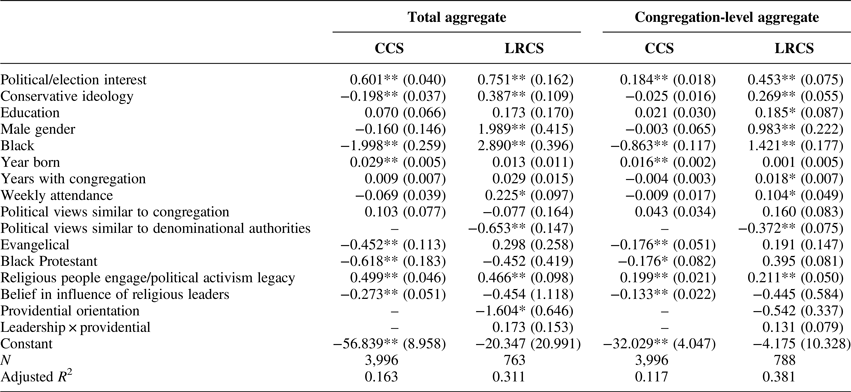
We can compare the results of the disaggregated political activity categories presented in Table 3 to the results of the two aggregate categories presented in Table 4. The first set of columns in Table 4 present the results of regression models that take all clergy political activity as their dependent variable. The second set of columns in Table 4 aggregates only congregation-level political activity. These two aggregate measures reflect how clergy political activity is often treated in the literature.
OLS regression models of total clergy aggregate political activity and congregation-level aggregate political activity

*p < 0.05, **p < 0.01.
The results of the aggregate models illustrate how important trends are obscured when clergy political activity are pooled. For instance, in all of the aggregate models, political/election interest is a significant predictor of political activity. But the disaggregated models in Table 3 demonstrate that this positive relationship only holds for personal and general congregation-level political activities. Political interest is actually negatively associated with election-specific congregation-level political activities. Thus, something else is driving these specific election-related behaviors, which we only see when they are disaggregated from other political activities. Conservative political ideology is negatively associated with political activity in the aggregate model, but positively associated with electoral activity, indicating an important role for ideology in clergy electoral engagement.
Weekly attendance is not significant in the aggregate models, but the model of general congregation-level political activities indicates that clergy who undertake these activities tend to shepherd larger flocks, perhaps an indication of the resources necessary for holding additional meetings like those required for political discussion groups (Beyerlein and Chaves Reference Beyerlein and Chaves2003). Another insignificant variable in the aggregate models is holding political views that are similar to one's congregation. But, again, the disaggregated models reveal that similar political views are positively associated with general congregation-level political activities like giving political sermons. Clergy engage in these activities more often when they see themselves as politically in line with their congregants. The number of years a clergy member has spent with their congregation is also insignificant in the aggregate models, but it is positively associated with personal political activity and negatively associated with both general and electoral political activities at the congregation level in the disaggregated models. These are all examples of findings that would have remained hidden by aggregating clergy political activities.
Importantly, the influence of religious tradition is also obscured by the aggregate models, where Black Protestants are significantly less likely to be politically active. The model of election-specific congregation-level political activity, however, demonstrates that Black Protestants are actually significantly more likely to engage in this category of political activity.
Turning to the belief variables unique to the LRCS, we see that the pooled models of clergy political activity also obscure the role of personal religious beliefs, specifically providentiality. Providential beliefs actually pull clergy members in two different directions: toward general congregation-level political activities and away from election-specific and personal political activities. These differences deserve further investigation, but would have never been revealed without differentiating among types of clergy political activities.
Conclusion
Distinguishing between personal political activity and political activity undertaken as a religious leader reveals the different motivations driving each. Although the basic distinction between personal and congregation-level political activities is an important one, grouping all congregation-level political activities together also obscures some important differences. The findings presented here demonstrate that clergy do view different categories of political activity differently. Personal political activities are more likely when the clergy member is interested in politics and has been with the congregation longer. General political activities—like delivering sermons on political topics and organizing political discussion groups—are more likely to be seen in larger congregations with a history of engagement. Election-specific political activities—like passing out voter guides or inviting a candidate to speak at worship services—are more likely to be done by conservative clergy and by those who lead Black Protestant churches.
Analyzing all three categories in the aggregate obscures the different ways that some variables influence these different categories of activity. For instance, the aggregate models show a negative relationship between political participation and conservative ideology and between political participation and the Black Protestant religious tradition. But both of these relationships are actually positive for election-related activities at the congregation level.
Analyzing disaggregated clergy political activity data also reveals avenues for future research. Understanding how a motivation to carry out God's will may affect clergy political participation is one such avenue. The consistent significance of providential beliefs, in sometimes different directions across three models, indicates that clergy—people who are often explicitly seeking do what they see as God's will—may see God's will as sometimes connected to, and sometimes distant from, their political actions. Additionally, as clergy political activity increasingly becomes a topic of public debate, clergy activity may change over time (Smidt Reference Smidt2016). Understanding more about the factors that influence different clergy political behaviors can shed additional light on these important political actors.
Clergy political participation is not monolithic. Different motivations drive different types of behaviors, a finding that was obscured until clergy political activities were disaggregated. The models presented here are strong evidence that disaggregating clergy political activity better reflects the reality of clergy political participation both as individuals and as leaders of congregations. Clergy make up a small but potentially important group of political actors. Knowing more about how the risk and visibility of political activities influences their behaviors may provide insights that can transfer to other political actors and activities. At the very least, these findings should nudge scholars in the field of religion and politics, and beyond, to think carefully about how they conceptualize political activity.
APPENDIX 1
Question wording and descriptive statistics

APPENDIX 2 ROBUSTNESS CHECKS
Model Replication with LRCS Repeats Dropped
All four models were run without the 12 repeat clergy members who completed surveys in both 2012 and 2016. The substantive results of the models were almost exactly similar with all variables retaining their direction of influence and significance or near significance, with the exception of age in the general congregation-level activities model; it is no longer significant when the repeats are dropped.
Providential Beliefs Likelihood Ratio Tests
The three models for which providential beliefs were significant were run with and without the providential beliefs measure, to assess whether including them significantly improved the fit of the models. Including providential beliefs improved the fit of the model of personal political activities from 0.153 to 0.222 (p = 0.000), improved the fit of the general congregation-level political activities model from 0.344 to 0.356 (p = 0.000), and improved the fit of the election-specific political activities model from 0.424 to 0.438 (p = 0.000). The pooled model of congregation-level political activities, for which providential beliefs were not a significant predictor (driving the two component measures of political activity in the pooled sample in opposite directions), improved from 0.500 to 0.508 (p = 0.000).
Model Replication with Only Black Protestant Clergy
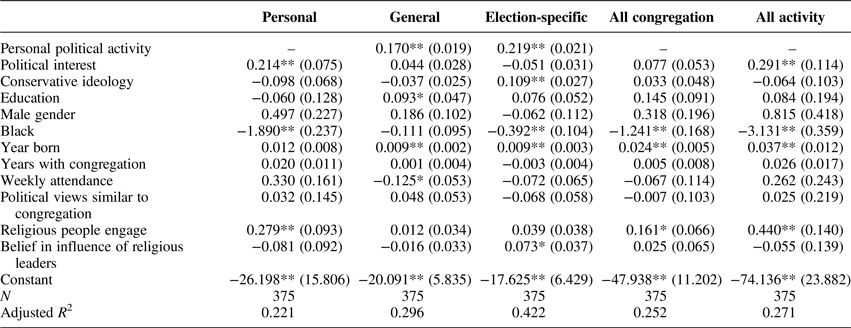
Models including only clergy from the Black Protestant religious tradition were run on the CCS data for all five dependent variables (the LRCS Black Protestant n is too small to support independent analysis). The results are available in Table A2. They reveal generally similar findings. As the sample size is much smaller (Black Protestant clergy make up about 7% of the CCS sample), it is not surprising that fewer variables are significant. The most interesting results are those variables that are significant in the Black Protestant but not the general models, or which switch their direction of influence between the two. Only the general congregation-level and election-specific congregation-level models contain variables that meet this standard. For general congregation-level political activities, education is a significant predictor of political activity in the Black Protestant, but not the full, model. Also, the sign on congregation size changes direction—in the full model larger congregations lead to more general political activities, but for Black Protestant clergy, smaller congregations do. For electoral activities, the sign flips for the influence of religious leaders—in the full model, belief in the influence of leaders reduces electoral activity, but for Black Protestant clergy, it increases it.
Model Replication with Only Black Clergy
Models including only clergy who self-identify as Black or African-American were run on the CCS data for all five dependent variables (the LRCS Black n is too small to support independent analysis). The results are available in Table A3. They reveal generally similar findings. As the sample size is much smaller (Black clergy make up <2% of the CCS sample), it is not surprising that fewer variables are significant. The most interesting results are those variables that are significant in the models for Black clergy, but not the general models, or which switch their direction of influence between the two. That is only true for one variable in one model. In the model of election-related political activities at the congregation level, the sign of the Black Protestant dummy variable reverses, indicating that, among Black clergy, those who minister in the Black Protestant religious tradition are less likely to engage in election-related political activities at the church than those in other religious traditions.
OLS regression models of total clergy aggregate political activity, Black Protestant clergy only

OLS regression models of total clergy aggregate political activity, self-identified Black or African-American clergy only