I. INTRODUCTION
Concentric ring array has received considerable interest over other types of planar arrays because it is symmetric and provides a nearly invariant beam pattern for 360° azimuthal coverage. A concentric ring array, also known as a concentric circular array (CCA) consisting of elements lies on several concentric circles of different radii. The array configuration in which all the elements are uniformly excited and are kept by almost half of the wavelength is regarded as the uniform concentric circular array (UCCA). One of the most important properties of the beam pattern of an UCCA is its cylindrical symmetry; however, it often suffers from a high sidelobe problem. Sidelobe reduction techniques in concentric ring array appear in the literatures [Reference Stearns and Stewart1–Reference Ghosh and Das13].
The beam pattern function of a concentric ring array has been expressed by Stearns and Stewart [Reference Stearns and Stewart1] as a truncated Fourier–Bessel series and the non-uniform distribution of the rings has been approximated to a smaller number of equally spaced ones. Goto and Cheng [Reference Goto and Cheng2] showed that for a Taylor weighted ring array the maximum allowable inter-element spacing should be about four-tenths of a wavelength, if high sidelobes are to be avoided. Biller and Friedman [Reference Biller and Friedman3] used steepest descent iterative process to find out element weights and ring spacing to get lower sidelobe levels and control over beamwidth. Huebner [Reference Huebner4] reduced the sidelobe levels for small concentric ring array by adjusting the ring radii using optimization technique. Kumar and Branner [Reference Kumar and Branner5] also proposed optimum ring radii for getting lower sidelobes. Thinning of a planar concentric ring array for fulfilling the requirements of beamwidth in the broadside direction and peak sidelobe level in a specified sub-domain of the visible region is proposed by Hebib et al. [Reference Hebib, Raveu and Aubert6]. Dessouky, Sharshar and Albagory [Reference Dessouky, Sharshar and Albagory7] showed that the existence of central element in case of concentric circular array of smaller innermost ring reduced the sidelobe levels significantly while minor increase in the beamwidth. Sidelobe level can also be reduced by thinning the array [Reference Haupt8–Reference Ghosh and Das13], spacing the concentric rings non-uniformly or by varying the number of elements in each ring of the array [Reference Haupt8].
In this paper, sidelobe levels are reduced by thinning the outermost rings of a uniformly excited concentric ring array with a specified number of rings and elements. Two different cases have been considered. In the first case (case I), peak sidelobe level (peak SLL) is reduced by thinning only the outermost ring. In the second case (case II), peak SLL is reduced by thinning the two outermost rings of the proposed array. In [Reference Chatterjee, Mahanti and Pathak12], authors already shown that Gravitational Search Algorithm (GSA) [Reference Rashedi, Nezamabadi-pour and Saryazdi14] is a better alternative than particle swarm optimization (PSO) for the synthesis of a thinned scanned concentric ring array. Considering the outcomes, GSA [Reference Rashedi, Nezamabadi-pour and Saryazdi14] is applied as a global optimization algorithm to find out the optimum elements states for the selectively thinned arrays of both the cases. Ghosh and Das [Reference Ghosh and Das13] show the thinning of a planar concentric ring array by differential evolutionary approach. The presented work is different from [Reference Ghosh and Das13] because instead of thinning all the rings only the outmost rings of the array are considered, which relatively improves the directivity of the array. The angular positions as well as the states of the elements in each ring of the optimized arrays for both the cases are also presented graphically to get better idea about the presented method.
Thinning the outermost rings instead of thinning all the rings of the initial concentric ring array by GSA requires dealing with fewer numbers of variables for determining optimum elements state. Moreover, from the computational point of view, only the field contributions due to the elements in outermost rings (which has to be thinned) need to be compute, as the field contributions due to the uniformly excited elements in inner rings are already known, and the final beam pattern in obtained by combining both the fields for outermost rings as well as inner rings. In this manner the computational time for the above two cases improves than thinning all the rings of the initial array for getting desired array characteristics by the same algorithm.
The directivity of the array decreases as the array becomes thinner. The thinning percentage of the optimized array for the above two cases remains comparatively less than that of an optimized array by thinning all the rings. So, the directivity of the optimized array of the above two cases remains higher than the directivity of the optimized array by thinning all the rings of the initial fully populated array. The outermost rings of the initial array are chosen for thinning, because for an array with fixed inter-element spacing the number of elements in each ring increases with its radius. So, choosing the outermost rings for thinning the array using any evolutionary algorithm gives sufficient amounts of variable for getting a satisfactory result.
In both the cases, peak SLL is reduced for fixed and variable first null beamwidth (FNBW) constrains. The fixed FNBW is considered to be less than or equal that of a fully populated, uniformly excited and 0.5 λ spaced concentric ring array of same number of elements and rings. For variable FNBW consideration, peak SLL is reduces without maintaining any predefined value of the FNBW. The peak SLL and the FNBW of the optimized array for the above two cases are compared with the optimized array by thinning all the rings using the same algorithm.
II. SYNTHESIS OF THINNED CONCENTRIC RING ARRAY
Thinning an array means turning off some of the elements from a uniformly spaced or periodic array to generate a pattern with low sidelobe levels. Typical applications for thinned array include satellite-receiving antennas that operate against a jamming environment [Reference Mailloux15], ground-based high-frequency radars [Reference Mailloux15] and design of interferometer array for radio astronomy [Reference Mailloux15]. It is assumed that the positions of the elements are fixed and all the elements have two states either “on” or “off”, depending on whether the element is connected to the feed network or not [Reference Chatterjee, Mahanti and Pathak12]. In the “off” state, either the element is passively terminated to a matched load or an open circuited [Reference Chatterjee, Mahanti and Pathak12]. If there is no coupling between the elements, it is equivalent to removing them from the array.
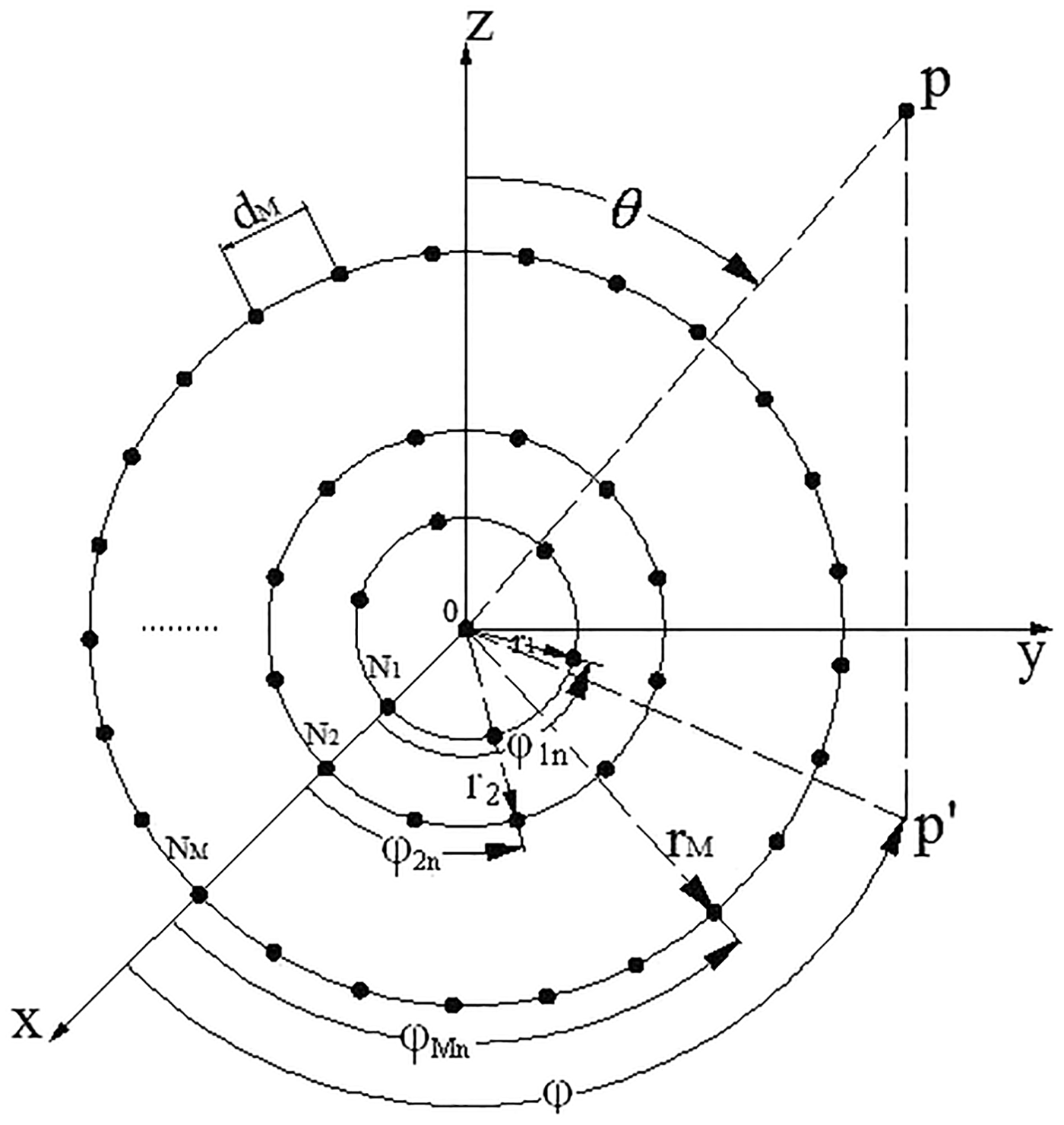
The array factor of a concentric ring array [Reference Dessouky, Sharshar and Albagory7, Reference Haupt8] shown in Fig. 1 on the x–y plane with central element feeding can be defined as:
 $$AF{\rm \lpar }\theta {\rm \comma \; }\varphi {\rm \rpar }={\rm 1 + }\sum\limits_{m = 1}^M {\sum\limits_{n = 1}^{{N_m}} {{I _{mn}}} } {e^{j\lsqb k\,{\rm }{r_m}\sin \theta \cos \lpar \varphi - {\varphi _{mn}}\rpar + {\alpha _{mn}}\rsqb }}\comma \;$$
where, M = number of concentric rings, N m = number of isotropic elements in mth ring, I mn = excitation amplitude of the mnth element, d m = inter-element arc spacing of mth circle, r m = N md m/2π, radius of the mth ring, φmn = 2nπ/N m, angular position of mnth element with 1 ≤ n ≤ N m, θ,φ = polar and azimuth angle, λ = wave length, k = wave number = 2π/λ; j = complex number, αmn = excitation phase of elements on mnth ring.
Concentric ring array of isotropic antennas in XY plane.

All the elements have same excitation phase of 0°.
Directivity of the planar concentric ring array is calculated as [Reference Mailloux15, Reference Lee, Song, Yoon and Park16]:
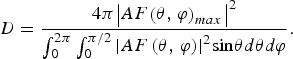 $$D = \displaystyle{{4\pi {{\left\vert {AF{{\left({\theta {\rm \comma \; }\varphi } \right)}_{max }}} \right\vert }^2}} \over {\vint_0^{2\pi } {\vint_0^{\pi {\rm /}2} {{{\left\vert {AF\left({\theta {\rm \comma \; }\varphi } \right)} \right\vert }^2}{\rm sin}\theta d\theta d\varphi } } }}.$$
In the presented problem, I mn is 1 if the mnth element is turned “on” and 0 if it is “off”. To make the initial array thinned with desired array characteristics, optimum set of I mn is necessary. In this paper, for the first case, optimum set of I mn for the outermost ring is determined using GSA and for the second case optimum set of I mn for the two outermost rings are determined using the same algorithm. All the other elements in other rings are assumed to be excited uniformly. For the optimized array by thinning all the rings, optimum set of I mn for all the rings are computed using the same algorithm to get lower peak SLL with desired array characteristics. The fitness function for this problem can be defined as:
 $$Fitness\, 1 = {k_1}\, max\, SLL + {k_2}\left({FNB{W_o} - FNB{W_d}} \right)H\lpar T{\rm \rpar \comma \; }$$
 $$Fitness\, 2 = max \, SLL.$$
Equations (3) and (4) are reduced using GSA for optimal synthesis of the array, where max SLL is the value of peak SLL, FNBW o, FNBW d are obtained and desired value of first null beamwidth respectively, k 1, k 2 are weighting coefficients to control the relative importance given to each term of equation (3). Equation (4) is for variable FNBW.
H(T) is Heaviside step functions defined as follows:
 $$T = \left({FNB{W_o} - FNB{W_d}} \right)\comma \;$$
 $$H\lpar T\rpar = \left\{{\matrix{0 & {{\rm if}} & {T < 0\comma \; } \cr {1\comma \; } & {{\rm if}} & {T \ge 0} \cr } }. \right.$$
III. GRAVITATIONAL SEARCH ALGORITHM
GSA proposed by Rashedi et al. [Reference Rashedi, Nezamabadi-pour and Saryazdi14] is a population-based search algorithm based on the law of gravity and mass interaction. The search agents are considered to have different masses and they moves due to the gravitational attraction force acting between them. Each agent in GSA is specified by four parameters [Reference Rashedi, Nezamabadi-pour and Saryazdi14]: position of the mass in the dth dimension which is regarded as the solution of an optimization problem, inertia mass, active gravitational mass and passive gravitational mass. The inertia mass of an agent reflect its resistance to make its movement slow. The computation of gravitational mass requires computation of best and worst solutions at current iteration. The velocity of the search agents is dependent on their gravitational mass and the inertial mass. The velocity of an agent towards every other agent is determined by computing the force acting in-between them and thereafter computing acceleration which in turn requires fitness evaluation. Based on the computed velocities, the positions of the agents in specified dimensions are updated. The termination condition of the algorithm is defined by a fixed amount of iterations, reaching which the algorithm automatically terminates. The recorded best fitness at final iteration gives the global fitness and the position of the agent reflects the global solution. The flowchart of the algorithm is shown in Fig. 2.
Flowchart of GSA.
In this problem the algorithms is run up to 400 iterations and number of agents is taken 50. The lower and upper bound of the search interval are taken as 0 and 1, and the computed real global fitness value is rounded off to get the state of the array elements (on–off) required for fitness evolution.
IV. SIMULATION RESULTS
For a fully populated nine-ring concentric ring array of isotropic antennas [Reference Haupt8] the radii of the rings are r m = mλ/2 (mth ring) and the inter-element spacing of each ring are kept at λ/2. For this arrangement, the number of elements in the mth ring is found out by rounding off the values of N m expressed as N m = 2πr m/d m, and the total numbers of isotropic elements including the central element becomes 279. The array with uniform excitation to all the elements gives the maximum sidelobe of −17.4 dB [Reference Haupt8], FNBW of 14.8° and directivity 29.35 dB [Reference Haupt8]. The beam-pattern of the fully populated and uniformly excited array is shown in Fig. 3.
Far-field pattern of the fully populated and uniformly excited nine-ring concentric ring array of isotropic elements [8].
In case I of the presented problem, the maximum sidelobe level is reduced by thinning only the outermost ring. In the second case, the maximum sidelobe level is reduced by thinning the two outermost rings. For the first case, the outermost ring of the initial array is thinned by finding out optimum set of elements state (on–off) using GSA by minimizing fitness functions of Equations (3) and (4). In the second case, the two outermost rings of the initial array are thinned by finding out optimum set of elements state (on–off) using GSA by minimizing Equations (3) and (4). Finally, the results from the above two cases are compared with the results from optimized array by thinning all the rings using the same algorithm for getting lower sidelobe levels, both for fixed and variable FNBW requirements.
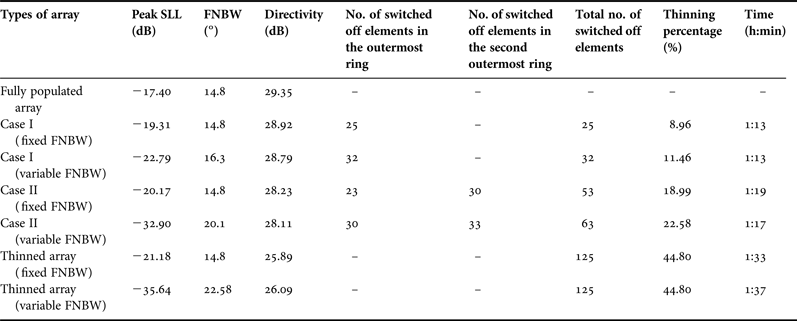
Table 1 shows the inter-element spacing and number of elements in each ring of the presented uniformly excited concentric ring array of nine concentric rings. Table 2 shows the sidelobe levels, FNBW, directivity, number of switched off elements and thinning percentages of the array for all the previously mentioned cases.
Ring spacing, inter-element distance and number of elements in each ring of the presented uniform array [Reference Haupt8].
Peak SLL, FNBW, number of switched off elements and thinning percentage of uniform array and optimized array with fixed and variable FNBW constrains.
From Table 2 it can be observed that computational time for the optimized array of cases I and II are lesser compare to the optimized array by thinning all the rings using GSA for both for fixed and variable FNBW requirements. The optimized array by thinning all the rings gives better maximum sidelobe level than the optimized array by thinning only the outermost ring whereas the optimized array by thinning the two outermost rings gives maximum sidelobe level which is comparable to optimized array by thinning all the rings using the same algorithm for both fixed and variable FNBW requirements. From Table 2 it can be concluded, that the directivity of the array decreases as the array becomes thinner. The directivities of the optimized array by thinning all the rings of the initial fully populated nine-ring concentric ring array for both fixed and variable FNBW are 25.89 and 26.09 dB, respectively, whereas the directivities of the optimized array under cases I and II for both fixed and variable FNBW considerations are 28.92, 28.79, 28.23, and 28.11 dB, respectively.
Figure 4 shows the optimized array under case I for both fixed and variable FNBW requirements and Fig. 5 shows the optimized array under case II for both fixed and variable FNBW. The far field patterns of the optimized arrays under cases I and II of the presented problem are shown in Fig. 6. It can be easily seen from Figs 3 and 6, that the optimized array has lower sidelobes than the initial fully populated array with uniform excitations among the elements.
Optimized array geometry under “case I”: (a) with fixed FNBW constrain and (b) without FNBW constrain.
Optimized array geometry under “case II”: (a) with fixed FNBW constrain and (b) without FNBW constrain.
Far-field patterns of the optimized array of “case I”, “case II”, and thinned structure: (a) with fixed FNBW constrain and (b) without FNBW constrain.
From Fig. 6, it can be noticed that lower peak SLL is achieved under case II of the presented problem for both fixed and variable FNBW requirements.
The thinned arrays computed using GSA for fixed and variable FNBW requirements are shown in Fig. 7. The beam patterns of the thinned array for fixed and variable FNBW constrains are shown in Fig. 6. From Fig. 6, it can be easily observed that the peak SLL achieved by thinning all the rings of the array and by thinning the outermost rings of the array are comparable. Moreover thinning the outermost rings reduces the hardware complexity in the feed network. The time required to compute the array factor of the partially thinned array is also less, because the field contributions due to the uniformly excited elements in the inner rings are already known. The optimized array under cases I and II of the presented problem also shows better directivity than the optimized array by thinning all the rings.
Optimized array geometry under thinned array: (a) with fixed FNBW constrain and (b) without FNBW constrain.
V. CONCLUSIONS
The authors proposed method of thinning the outermost rings instead of thinning all the rings of a large concentric ring array of isotropic elements to reduce peak SLL while retaining the desired array characteristics. The proposed method also reduced the computational time to find out the optimum set of elements state and increased the directivity of the array compared to the optimized array by thinning all the rings. The presented method requires to control the states of the elements which only resides in the outermost rings of the array and hence capable of reducing the hardware complexity of the feed network. This establishes the effectiveness of the proposed method. Here GSA has been effectively used as a global optimization algorithm to find out optimal set of elements states.
Anirban Chatterjee received his M. Tech and PhD from National Institute of Technology, Durgapur, India in 2009 and 2013 respectively. His research interest includes Array Antenna synthesis, Soft Computing, and Electromagnetics. He has published 12 research papers in international journals and 6 papers in international conferences.
G.K. Mahanti was born in the year 1967 in West Bengal, India. He obtained his B. E. in Electronics & Communication Engg. in 1988 from NIT,Durgapur, India, M.E. in Electronics System and Communication in 1994 from NIT, Rourkela, India and Ph.D (Engg.) from IIT, Kharagpur, India. He has more than 20 years of teaching and research experience. Presently he is working as Professor, department of Electronics and Communication Engineering, National Institute of Technology, Durgapur, India. He is a senior member of IEEE, USA.
He has published approximately 70 papers in journals and in national and international conferences. He was the reviewer of many international journals like Electronics Letter, IEEE Antennas and Wireless Propagation Letter, Progress in Electromagnetics Research, International Journal of Adaptive control & Signal processing and many conferences. He was also the program committee member of many national and international conferences. His biography is listed in Marqui s Who is Who in the world.
His research area is Array antenna synthesis, Evolutionary Algorithms, Microwave Engineering & Electromagnetics.
Narendra Nath Pathak was born in Bankura, West Bengal, India in 1970. He received B.E degree from Gulbarga University, Karnataka, India in 1994, and the M.Tech degree from Jadavpur University, Kolkata, India in 2008, both in Electronics and Communication Engineering. He received the PhD degree in Electronics and Communication Engineering from National Institute of Technology, Durgapur, India in 2011. Currently he is Associate Professor in the department of Electronics and Communication Engineering at Dr. B.C.Roy Engineering College, Durgapur, India. His teaching and research areas include Microwave, Antenna Array & Soft computing. He has published several papers in International Journals and International Conference proceedings. He has delivered many invited talks and tutorials in several Engineering colleges.