INTRODUCTION
The brown mussel Perna perna (Linnaeus, 1785) is a subtropical/tropical species that is widely distributed along Madagascar, the east African coast (from central Mozambique to False Bay), the west coast of Africa (from Luderiz Bay north into the Mediterranean) and from the Strait of Gibraltar (African side) to the Gulf of Tunis (Berry, Reference Berry1978). It is also present in Sri Lanka, southern India and on the Atlantic coast of South America where it was reported in Venezuela, Uruguay, and Brazil as well as in the West Indies (Berry, Reference Berry1978; Vakily, Reference Vakily1989; Wood et al., Reference Wood, Apte, MacAvoy and Gardner2007). In Brazil, P. perna has been reclassified as an old introduction, most likely dating from the 16th Century (Silva & Barros, Reference Silva and Barros2011).
In the United States, P. perna invaded Texas (Gulf of Mexico) shores in 1990 (Hicks & Tunnell, Reference Hicks and Tunnell1993). This mussel species is thought to have been introduced to this area via ballast water release (Hicks & Tunnel, Reference Hicks and Tunnell1993), and its invasion has attracted much attention because of its potential threat to shipping safety and to cooling water systems of coastal power stations (Hicks & McMahon, Reference Hicks and MacMahon2002; Rajagopal et al., Reference Rajagopal, Venugopalan, Van der Velde and Jenner2003). Perna perna has recently been detected on an oil rig in New Zealand waters but vigorous efforts by the Biosecurity New Zealand system strongly reduced the likelihood of a successful population establishment (Manawatu Standard, 2008).
Perna perna has never been observed along the European Atlantic coast, despite several extensive surveys of intertidal communities having been conducted since the mid-1950s (e.g. Fischer-Piétte, Reference Fischer-Piétte1958, Reference Fischer-Piétte1963; Santos, Reference Santos2000; Boaventura et al., Reference Boaventura, Ré, Fonseca and Hawkins2002; Fa et al., Reference Fa, Sánchez-Moyano, García-Asencio, García-Gómez, Finlayson and Sheader2003; Arauújo et al., Reference Araújo, Bárbara, Sousa-Pinto and Quintino2005; Guerra-García et al., Reference Guerra-García, Maestre, González and García-Gómez2006; Lima et al., Reference Lima, Queiroz, Ribeiro, Hawkins and Santos2006, Reference Lima, Ribeiro, Queiroz, Hawkins and Santos2007; Pereira et al., Reference Pereira, Lima, Queiroz, Ribeiro and Santos2006).
MATERIALS AND METHODS
Study area and sampling
Extensive field surveys were carried out during low spring tides between April and November 2011 on rocky intertidal shores along the southern Portuguese coast, from Vilamoura (37°04′19.70″N 8°07′19.71″W) to Tavira (37°06′58.48″N 7°37′43.86″W). All locations were visited at least twice (covering winter and summer months) and each location included two sites from 500 m to 1 km apart. At each site, two observers performed approximately 60 minutes searches across all microhabitats present.
Identification
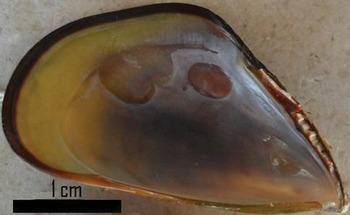
Key morphological and behavioural characters were used to identify Perna perna specimens (Siddal, Reference Siddal1980; Vakily, Reference Vakily1989; Nicastro et al., Reference Nicastro, Zardi, McQuaid, Stephens, Radloff and Blatch2010). A main diagnostic feature is the pattern of the scars left at the area of muscle attachment on shells. In Mytilus spp., the scar left by the posterior adductor and retractor muscles is united forming a continuous band along the dorsal margin of the pallial line (Siddal, Reference Siddal1980). In contrast, these two muscles attach separately on the shell in Perna spp., resulting in a discontinuous scar (Figure 1). Another key character is the anterior adductor muscle which is present although small, in Mytilus spp. but absent in all Perna spp. (Siddal, Reference Siddal1980). Moreover, the shell of P. perna adults presents a brown to red-maroon colour with some irregular light brown and green areas (Siddal, Reference Siddal1980). Despite mussel shell plasticity, the width (the maximum distance along the lateral axis between the two valves of the closed shell) and the height (the maximum distance along the dorso-ventral axis across the mid-axis of the shell) can also be used to identify P. perna specimens (shells are typically higher than wider: Marques et al., Reference Marques, Pereira and Correa1998).
Left valve of a Perna perna specimen: the characteristic posterior double scar is shown.

Finally, gaping (periodic valve movement during emersion) is an ideal diagnostic behavioural trait to distinguish between Mytilus galloprovincialis and P. perna individuals. During emergence, intertidal mussels either keep the valves closed, minimizing water loss and utilizing anaerobic metabolism (non-gaping species), or periodically open the valves allowing more efficient aerobic metabolism but increasing the risk of desiccation (gaping species: Widdows et al., Reference Widdows, Bayne, Livingstone, Newell and Donkin1979; Famme & Kofoed, Reference Famme and Kofoed1980). In contrast to the non-gaping M. galloprovincialis, P. perna is a gaping species (Nicastro et al., Reference Nicastro, Zardi, McQuaid, Stephens, Radloff and Blatch2010).
RESULTS AND DISCUSSION
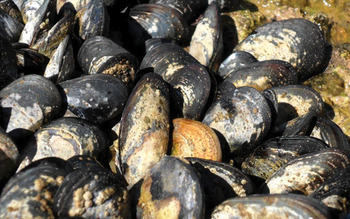
Several individuals of Perna perna were first observed in Vilamoura (37°04′19.70″N 8°07′19.71″W) and Ilha do Farol (36°58′29.38″N 7°51′42.51″W), south coast of Portugal on 1 and 3 July 2011, and their presence was followed during the consecutive months. Perna perna was interspersed within beds of the dominant mussel species Mytilus galloprovincialis in the lower eulittoral zone (hereafter referred to as the mussel zone; Figure 2).
Isolated brown mussel (Perna perna) in the centre of a blue mussel bed (Mytilus galloprovincialis) from Vilamoura on 1 July 2011.

All key features such as the light-brown colour, the double posterior muscle scar, the absence of an anterior adductor muscle and the gaping behaviour confirmed that all individuals belong to P. perna species. Furthermore, P. perna specimens were higher than wider as previously described by Marques et al. (Reference Marques, Pereira and Correa1998), on average 2.4 and 1.7 mm for height and width respectively.
Perna perna and M. galloprovincialis overlap in their distributions on the Atlantic coast of North Africa and the Mediterranean coast of Algeria (Abada-Boudjema & Dauvin, Reference Abada-Boudjema and Davin1995). In these regions, the two species co-occur in high abundance and have reached a distributional equilibrium through partial habitat segregation (Bownes & McQuaid, Reference Bownes and McQuaid2006). The upper and the lower areas of the mussel zone are dominated by M. galloprovincialis and P. perna respectively, while the two species overlap in the mid-mussel zone. Moreover, M. galloprovincialis shows similar patterns of zone segregation with Perna viridis in Hong Kong (Lee & Morton, Reference Lee and Morton1985) and Perna canaliculus in New Zealand (McDonald et al., Reference McDonald, Seed and Koehn1991). Previous studies showed that partial habitat segregation of these two species results from a combination of biotic and physical conditions along a gradient of multiple stresses (e.g. Zardi et al., Reference Zardi, Nicastro, McQuaid, Rius and Porri2006; Rius & McQuaid, Reference Rius and McQuaid2009; Nicastro et al., Reference Nicastro, Zardi, McQuaid, Stephens, Radloff and Blatch2010). In contrast, the mussel zone in southern Portugal is characterized by a lack of vertical segregation with few P. perna individuals sparingly distributed within the dominating M. galloprovincialis. Low population density and lower habitat occupancy is typical of marginal populations, which exist at the ecological edges of a species range living under unfavourable ecological conditions (Sagarin et al., Reference Sagarin, Gaines and Gaylord2006). A continuous monitoring of the structure and dynamics of mixed populations of the two mussel species will be important to define the impact of P. perna and to understand if the distribution of these coexisting species is stable or if it will evolve to the same vertical patterns observed in other regions.
The presence of P. perna on the Portuguese southern coast is a striking shift of the previous northern distributional boundary along the Moroccan coastline (Siddal, Reference Siddal1980; Vakily, Reference Vakily1989; Wood et al., Reference Wood, Apte, MacAvoy and Gardner2007). Perna perna has larvae with a long pelagic stage that, under favourable conditions, can disperse over large distances (100s km) before settling (McQuaid & Phillips, Reference McQuaid and Phillips2000). Such a large dispersal potential could have allowed dispersal from North African populations and colonization of European shores. Over the last 50 years, sea surface temperatures along the Portuguese coast have consistently increased (Lima et al., Reference Lima, Ribeiro, Queiroz, Hawkins and Santos2007). The range expansion of the subtropical/tropical species P. perna is consistent with general predictions of species distributional shifts under warming climate scenarios, which anticipate northwards expansions of warm-water taxa (Parmesan & Yohe, Reference Parmesan and Yohe2003; Helmuth et al., Reference Helmuth, Mieszkowska, Moore and Hawkins2006; Mieszkowska et al., Reference Mieszkowska, Hawkins, Burrows and Kendall2007; Hawkins et al., Reference Hawkins, Sugden, Mieszkowska, Moore, Poloczanska, Leaper, Herbert, Genner, Moschella, Thompson, Jenkins, Southward and Burrows2009). Genetic characterization is needed to determine the exact origin of P. perna Portuguese populations and also to understand if multiple introductions have occurred over time.
Intertidal mussels are fascinating models for studies of climate-induced range shifts over small (intertidal) and large (latitudinal) spatial scales (Harley, Reference Harley2011). Perna perna, together with other key species, whose distributional ranges are changing along the Portuguese coastline (e.g. Fucus spp.: Viejo et al., Reference Viejo, Martínez, Arrontes, Astudillo and Hernández2011) is an ideal model organism to study climatic-driven biogeographical changes.
ACKNOWLEDGEMENTS
We are grateful to Rúben Silva for field assistance. This research was supported by post-doctoral fellowships from FCT, Portugal (to G.I.Z. and K.R.N.) and funded by project PTDC/BIA-BEC/103916/2008 from FCT (to G.I.Z.).