Introduction
The worldwide population ageing has brought increasing care demands among older adults with disabilities. While extensive literature has investigated the role of care demands and care provision (Lou et al. Reference Lou, Yan and Lu2024; Choy et al. Reference Choy, Lum, Yu and Wong2025), the role of quality of care is understudied. Quality of care is a critical determinant of older adults’ wellbeing and has been identified as a key predictor for long-term outcomes like institutionalization and even mortality (Higashi et al. Reference Higashi, Shekelle, Adams, Kamberg, Roth, Solomon, Reuben, Chiang, MacLean, Chang, Young, Saliba and Wenger2005; Seibert et al. Reference Seibert, Stiefler, Domhoff, Wolf-Ostermann and Peschke2022). The majority of studies into quality of care for older adults are institution-based, focusing on evaluating and examining influencing factors of quality of care for older adults provided by formal care-givers in institutions like nursing homes and hospitals (Shaheen et al. Reference Shaheen, El-Hneiti, Albqoor and Ahmad2019; Cohen-Mansfield and Golander Reference Cohen-Mansfield and Golander2022). However, it was estimated that more than 60 per cent of older adults exclusively relied on care provided by their family care-givers (Riffin et al. Reference Riffin, Van Ness, Wolff and Fried2017), and this figure is even higher (i.e. around 90 per cent) in China where familism and filial piety are highly valued (Li et al. Reference Li, Sun, Zheng and Zhou2022). Given that family constitutes a key context for ageing and care-giving, it is essential to investigate the quality of care provided by family care-givers, which would play an important role in enhancing older adults’ wellbeing and the sustainability of society’s long-term care systems.
Furthermore, existing studies on family care-giving predominantly focused on primary care-givers; however, care-giving responsibility is commonly shared among family members (Lou et al. Reference Lou, Kwan, Chong and Chi2015; Hu et al. Reference Hu, Freedman, Patterson, Lewis and Meeks2023). While shared care-giving could potentially alleviate the burden of the primary care-giver and meet the demands of older adults in an efficient manner, it could also be linked to conflicts and discordance, which might relate to the quality of care provided for older adults (Ngangana et al. Reference Ngangana, Davis, Burns, McGee and Montgomery2016; Xu et al. Reference Xu, Liu and Beach2021; Hu et al. Reference Hu, Freedman, Patterson, Lewis and Meeks2023). Therefore, it is essential to explore the role of shared care-giving in the care-giving process of family care-givers, especially regarding how it relates to the process associated with quality of care. Therefore, guided by Lawton’s two-factor model and the conservation of resources theory (Lawton et al. Reference Lawton, Moss, Kleban, Glicksman and Rovine1991; Hobfoll Reference Hobfoll and Folkman2012), this study has two aims: (a) examine factors and pathways related to quality of care – more specifically, the mediating roles of care-giving appraisals in the association between stressors and quality of care; and (b) examine the moderating role of shared care-giving in the above associations.
Literature review
Theoretical framework
According to the two-factor model (Lawton et al. Reference Lawton, Moss, Kleban, Glicksman and Rovine1991), family care-giving is a sequential process linking stressors (i.e. functional impairment of care recipients), appraisals and outcomes. In this present study, stressors include three types of functional impairment of care recipients, namely, impairment in activities of daily living (ADL), in instrumental activities of daily living (IADL) and in cognitive function (Pearlin et al. Reference Pearlin, Mullan, Semple and Skaff1990; Lawton et al. Reference Lawton, Moss, Kleban, Glicksman and Rovine1991). Care-giving appraisals refer to care-givers’ subjective appraisals of care-giving activities, including both care-giving burden (i.e. negative appraisal) and positive aspects of care-giving (i.e. positive appraisal; hereafter PAC; Lawton et al. Reference Lawton, Moss, Kleban, Glicksman and Rovine1991). In terms of outcomes, theories have primarily examined care-givers’ outcomes like psychological wellbeing (Pearlin et al. Reference Pearlin, Mullan, Semple and Skaff1990; Lawton et al. Reference Lawton, Moss, Kleban, Glicksman and Rovine1991). However, recent studies have verified the spillover effect of family care-giving, suggesting that the care-giving appraisals can also affect care recipients’ wellbeing (Lu et al. Reference Lu, Liu and Lou2016). Given that quality of care is highly related to care recipients’ wellbeing, this study proposes quality of care as another essential outcome in the care-giving process, which is associated with stressors and care-giving appraisals.
Resource is another key concept in the two-factor model (Lawton et al. Reference Lawton, Moss, Kleban, Glicksman and Rovine1991). Resources not only significantly affect care-giving appraisals and outcomes but also modify the associations among stressors, appraisals and outcomes (Lawton et al. Reference Lawton, Moss, Kleban, Glicksman and Rovine1991). Furthermore, according to the conservation of resources theory (Hobfoll Reference Hobfoll and Folkman2012), resources are not static – instead, they involve a dynamic process of resource investment in order to gain resources. Shared care-giving, which involves collaborating with other family members to complete care-giving tasks, can be viewed as a process of resource investment. During this process, family care-givers need to invest resources (e.g. time spent in negotiating with other care-givers, effort in coordinating care-giving arrangements) to gain the resource derived from supportive behaviours of other secondary care-givers (Ngangana et al. Reference Ngangana, Davis, Burns, McGee and Montgomery2016; Kokorelias et al. Reference Kokorelias, Rittenberg, Law, Wan, Machon, Arfeen and Cameron2022). In other words, shared care-giving is a process of balancing resource loss and resource gain. When family care-givers successfully handle challenges that occur in the shared care-giving process, shared care-giving can lead to resource gain, which not only directly contributes to better quality of care but also compensates for adverse outcomes caused by stressors and negative appraisals and magnifies the positive effects of positive appraisals through mechanisms like providing more available time for respite and self-care (Choy et al. Reference Choy, Lum, Yu and Wong2025; Lim-Soh et al. Reference Lim-Soh, Sung, Quach, Malhotra and Schafer2025). On the contrary, if family care-givers fail to collaborate with other family members and have to make a significant amount of resource investment (e.g. handling conflicts among care-givers) in the shared care-giving process, resource loss may overshadow resources gained from the support of secondary care-givers. Under such circumstances, shared care-giving, instead of playing a protective and promoting role, may have negative associations with quality of care (Ngangana et al. Reference Ngangana, Davis, Burns, McGee and Montgomery2016; Xu et al. Reference Xu, Liu and Beach2021).
Stressors, appraisals and quality of care
Previous studies focusing on care-givers’ physical and mental wellbeing have generated supportive evidence regarding the associations among stressors, appraisals and outcomes (Chiao et al. Reference Chiao, Wu and Hsiao2015; Quinn and Toms Reference Quinn and Toms2019; Jiang et al. Reference Jiang, Lu, Sun and Lou2020; Lou et al. Reference Lou, Yan and Lu2024), suggesting that care-givers’ positive and negative appraisals play significant mediating roles in the association between stressors and outcomes. As previously stated, quality of care is a crucial outcome of the family care-giving process; nevertheless, limited studies have examined how stressors and appraisals relate to the quality of care provided by family care-givers of older adults with disabilities.
Preliminary studies on antecedents of quality of care have partially confirmed the associations of stressors (i.e. older adults’ functional impairment) with quality of care (Bass et al. Reference Bass, Noelker and McCarthy1999; Chodosh et al. Reference Chodosh, Mittman, Connor, Vassar, Lee, DeMonte, Ganiats, Heikoff, Rubenstein, Della Penna and Vickrey2007; Ma et al. Reference Ma, He, Wang, Huang and Zhou2021; Zhao et al. Reference Zhao, He, Tang, Wang, Zhang, Zhou and Wang2022); however, the current evidence is inconclusive. Some studies focusing on the quality of care provided by family care-givers have found that severe impairment was associated with lower quality of care (Ma et al. Reference Ma, He, Wang, Huang and Zhou2021; Zhao et al. Reference Zhao, He, Tang, Wang, Zhang, Zhou and Wang2022). Others, however, revealed a non-significant association between functional impairment and quality of care (Bass et al. Reference Bass, Noelker and McCarthy1999). Studies examining the relations between stressors and quality of care provided by formal or professional care-givers in medical and health-care settings have even found that severe impairment was, to some extent, related to better quality of care (Min et al. Reference Min, Reuben, MacLean, Shekelle, Solomon, Higashi, Chang, Roth, Kamberg, Adams, Young and Wenger2005; Chodosh et al. Reference Chodosh, Mittman, Connor, Vassar, Lee, DeMonte, Ganiats, Heikoff, Rubenstein, Della Penna and Vickrey2007). These inconsistencies are partially due to different target groups and measurements of quality of care. Moreover, this result indicates that there might be understudied mechanisms linking stressors to quality of care.
As aforementioned, care-giving appraisals are potential mediators in the above association. Previous studies have investigated the associations between stressors and care-giving appraisals (Chiao et al. Reference Chiao, Wu and Hsiao2015; Jiang et al. Reference Jiang, Lu, Sun and Lou2020; Lou et al. Reference Lou, Yan and Lu2024); however, few studies have investigated the relationship between appraisals and quality of care. Specifically, regarding the association between stressors and appraisals, previous studies have found that older adults’ functional impairment could contribute to higher levels of care-giving burden and lower levels of PAC (Chiao et al. Reference Chiao, Wu and Hsiao2015; Lu et al. Reference Lu, Lou, Mao and Jiang2023; Lou et al. Reference Lou, Yan and Lu2024). Despite this, some studies have found that PAC were more related to internal factors and supportive external resources, and thus were less likely to be associated with stressors as compared to care-giving burden (Jiang et al. Reference Jiang, Lu, Sun and Lou2020; Johansson et al. Reference Johansson, McKee, Dahlberg, Summer Meranius, Williams and Marmstal Hammar2022). In terms of the associations between care-giving appraisals and quality of care, only two studies have investigated this association among family care-givers (Harris et al. Reference Harris, Durkin, Allen, DeCoster and Burgio2011; Luth and Pristavec Reference Luth and Pristavec2020). Specifically, Harris et al. (Reference Harris, Durkin, Allen, DeCoster and Burgio2011) found that care-giving burden was associated with lower quality of care. Luth and Pristavec (Reference Luth and Pristavec2020) found that care-giving burden and benefits (i.e. similar to PAC) were related to end-of-life quality of care for older adults, suggesting that lower levels of burden and higher levels of benefits could relate to better end-of-life care provided by family care-givers. Other studies focusing on formal care-givers (e.g. domestic helpers or professional care-givers) have found that their appraisals of work, including perception of work and work strains, were negatively related to quality of care provided for their older clients (Shaheen et al. Reference Shaheen, El-Hneiti, Albqoor and Ahmad2019; Cohen-Mansfield and Golander Reference Cohen-Mansfield and Golander2022). This preliminary evidence all suggests that care-giving burden is a potential risk factor for quality of care provided for older adults (Harris et al. Reference Harris, Durkin, Allen, DeCoster and Burgio2011; Shaheen et al. Reference Shaheen, El-Hneiti, Albqoor and Ahmad2019; Luth and Pristavec Reference Luth and Pristavec2020; Cohen-Mansfield and Golander Reference Cohen-Mansfield and Golander2022). However, target populations varied across these studies, and studies on family care-givers of older adults living with disabilities were particularly scarce. Furthermore, PAC are also an important aspect of care-giving appraisals (Lawton et al. Reference Lawton, Moss, Kleban, Glicksman and Rovine1991). They are increasingly valued among research into family care-giving, and have been found to have substantial protective effects on care-givers’ wellbeing (Quinn and Toms Reference Quinn and Toms2019). Nevertheless, even fewer studies have examined the role of PAC in relation to the quality of care provided by family care-givers of older adults with disabilities. Hence, the current study aims to simultaneously examine the mediating roles of family care-givers’ care-giving burden and PAC in the associations between stressors and quality of care for older adults with disabilities.
The moderating role of shared care-giving
Care-giving is not only the responsibility of the primary care-giver; it is commonly shared among family members, especially in the Confucius cultural contexts (Lou et al. Reference Lou, Kwan, Chong and Chi2015; Hu et al. Reference Hu, Freedman, Patterson, Lewis and Meeks2023). Empirical studies found that compared to those who share care-giving responsibilities with others, sole care-givers had significantly higher levels of care-giving burden and mental health problems (Viñas-Diez et al. Reference Viñas-Diez, Turró-Garriga, Portellano-Ortiz, Gascón‐Bayarri, Reñé‐Ramírez, Garre‐Olmo and Conde‐Sala2017; Lim-Soh et al. Reference Lim-Soh, Sung, Quach, Malhotra and Schafer2025). Despite this, some studies have generated opposite results, suggesting that those who had multiple care-givers had more severe depressive and anxiety symptoms (Wittenberg-Lyles et al. Reference Wittenberg-Lyles, Kruse, Oliver, Demiris and Petroski2014).
However, limited studies have investigated the role of shared care-giving in the quality of care provided by family care-givers. Regarding the direct associations of shared care-giving, preliminary studies have generated contradictory results. For instance, using data from the National Health and Aging Trends Study, Hu et al. (Reference Hu, Freedman, Patterson, Lewis and Meeks2023) found that older adults with a small, low-intensity shared care-giving network had fewer unmet needs as compared to their counterparts with clear primary care-givers. However, Jordan et al. (Reference Jordan, Latham-Mintus and Patterson2024) found that older adults with multiple care-givers had the highest risks of mortality. Some qualitative studies also found that adult-child care-givers of older adults who shared care-giving responsibilities with their siblings experienced both positive and negative experiences in meeting their parents’ needs (Ngangana et al. Reference Ngangana, Davis, Burns, McGee and Montgomery2016; Kokorelias et al. Reference Kokorelias, Rittenberg, Law, Wan, Machon, Arfeen and Cameron2022). Although these studies did not directly measure the quality of care provided by family care-givers, they provided initial evidence, indicating that shared care-giving may have inconsistent associations with quality of care for older adults. Nevertheless, these studies were all conducted in Western countries with individualism as the dominant cultural norm (Ngangana et al. Reference Ngangana, Davis, Burns, McGee and Montgomery2016; Kokorelias et al. Reference Kokorelias, Rittenberg, Law, Wan, Machon, Arfeen and Cameron2022; Hu et al. Reference Hu, Freedman, Patterson, Lewis and Meeks2023; Jordan et al. Reference Jordan, Latham-Mintus and Patterson2024). In Chinese contexts that highly value familism and collectivism, support from other family members might have different meanings and effects on family care-givers (Silverstein et al. Reference Silverstein, Cong and Li2006). Therefore, evidence from these contexts is warranted to gain deeper insights into the role of shared care-giving in relation to the quality of care provided to older adults living with disabilities.
Furthermore, in line with theoretical arguments, shared care-giving could exert moderating effects in the care-giving process, and thus indirectly relate to quality of care by altering the associations of stressors and care-giving appraisals (Hobfoll Reference Hobfoll and Folkman2012). However, to our best knowledge, no existing study has investigated the moderating role of shared care-giving in the associations of stressors and appraisals with quality of care. Limited studies focusing on care-givers’ psychological wellbeing and care-giving burden have found that, instead of protective effects, sharing care-giving responsibilities with a secondary care-giver could exacerbate the negative associations of care recipients’ neuropsychiatric symptoms and co-morbidities (Lou et al. Reference Lou, Kwan, Chong and Chi2015; Liu et al. Reference Liu, Fang, Chan and Chen2019). However, given that quality of care and psychological wellbeing are distinct concepts and could be differently associated with shared care-giving, more efforts should be invested to examine the moderating role of shared care-giving in the associations of stressors and appraisals with quality of care.
The present study
Studies on the quality of care provided by family care-givers, which is a salient predictor for older adults’ wellbeing and the sustainability of family care-giving, are at a preliminary stage, particularly in countries with a Confucius culture. Moreover, care-giving for older adults living with disabilities is frequently shared among multiple care-givers, whereas few studies have explored the role of shared care-giving on quality of care and its underlying mechanisms. To address these gaps, this study derived data from north-eastern China to gain theoretical and empirical insights into the underlying mechanisms of quality of care for older adults living with disabilities. Based on the two-factor model and the conservation of resources theory, this study hypothesizes that care-giving stressors (i.e. ADL impairment, IADL impairment and cognitive impairment) are negatively associated with quality of care, and care-giving appraisals (i.e. care-giving burden and PAC) play significant mediating roles in the above associations. Furthermore, shared care-giving moderates the associations of stressors and appraisals with quality of care.
Materials and methods
Sample
We drew data from a cross-sectional survey on family care-givers of older adults living with disabilities in Changchun, Jilin Province, China. Located in north-eastern China, Changchun is the capital city of Jilin Province, and is faced with severe population ageing. Data were collected during August and September 2024. Using a stratified sampling method, this survey was conducted in five main districts in Changchun based on the lists of older adults living with disabilities provided by those districts’ governments. For each district, we randomly selected one-quarter of older adults living with disabilities and contacted their family care-givers by telephone for eligibility screening. Specifically, the inclusion criteria for this study were: (a) family care-givers were unpaid primary care-givers of older adults (i.e. ≥ 60 years old); (b) family care-givers had provided care for at least six hours per week over the past half year; (c) care recipients had difficulties in at least one ADL; and (d) over the past year, care recipients had resided in the local community for a minimum of six months.
A total of 492 family care-givers of older adults living with disabilities remained after excluding those who were ineligible or could not be contacted after three attempts. Trained research assistants who had received at least 12 hours of training were responsible for conducting face-to-face interviews with these care-givers at the older adults’ home. Signed consent forms were obtained before data collection. Finally, 431 family care-givers agreed to participate in this survey (response rate: 87.60 per cent). Furthermore, this study focused on shared care-giving in the family context; therefore, those who were assisted by paid care-givers (e.g. domestic helpers; N = 15) were excluded. The final analytical sample in this study included 416 family care-givers.
Measurements
Dependent variable
The Exemplary Care Scale was used to measure quality of care (Dooley et al. Reference Dooley, Shaffer, Lance and Williamson2007). This 11-item care-giver-report scale measured to what extent family care-givers thought that they had respected the care recipients’ opinions and feelings, provided a pleasant living environment and activities, and showed affection towards the care recipients. A four-point Likert scale was adopted (1 = never to 4 = always). We calculated the average score of this scale, with higher scores indicating higher quality of care. This scale has been validated among Chinese family care-givers (Lau et al. Reference Lau, Lou and Cheung2018), and its Cronbach’s α in this current study was 0.80. Given that a multiple group analysis was conducted, Cronbach’s α for family care-givers with different shared care-giving status was calculated, with the α being 0.76 for multiple care-givers and 0.83 for sole care-givers.
Independent variables
Based on previous studies, three stressors – care recipients’ ADL difficulties, IADL difficulties and cognitive impairment – were selected as independent variables in this study. Specifically, ADL difficulties were measured by Katz et al.’s (Reference Katz, Ford, Moskowitz, Jackson and Jaffe1963) ADL scale. This scale consisted of six ADL (i.e. dressing, feeding, bathing, transferring, continence and toileting). A four-point Likert scale (1 = no difficulty to 4 = cannot do at all) was used to evaluate the severity of care recipients’ ADL difficulties. The total score was generated, with higher scores indicating more difficulties.
Similarly, we used a four-point Likert scale (1 = no difficulty to 4 = cannot do at all) to assess care recipients’ IADL in seven domains, namely food preparation, using the telephone, shopping, housekeeping, transportation, handling finances and taking medicines (Lawton Reference Lawton1971). We calculated the summed score; higher scores represented more difficulties.
Cognitive impairment was measured using the Global Deterioration Scale (Reisberg et al. Reference Reisberg, Ferris, MJd and Crook1982). Family care-givers were interviewed regarding the cognitive function of the older adults (e.g. may have got lost, had decreased knowledge of current and recent events) and levels of cognitive impairment were rated by trained research assistants based on scoring criteria (1 = no cognitive decline to 7 = very severe cognitive decline).
Mediators
Care-giving burden and PAC are mediators in this study. We measured care-giving burden using the Chinese version of the Zarit Burden interview (Bédard et al. Reference Bédard, Molloy, Squire, Dubois, Lever and O’Donnell2001; Wang et al. Reference Wang, Yang, Hou, Feng and Marui2006). Measured by a five-point Likert scale (1 = never to 5 = always), this tool consists of 12 items, covering both personal and role strains. We generated the average score of this scale, with higher scores indicating higher levels of care-giving burden (Cronbach’s α = 0.86). The Cronbach’s α stratified by shared care-giving status was also adequate (multiple care-givers: 0.87, sole care-givers: 0.84).
We assessed PAC using the Chinese version of the Positive Aspects of Caregiving Scale (Lou et al. Reference Lou, Lau and Cheung2015). This 11-item scale captures care-givers’ gains and rewards derived from care-giving (e.g. ‘feel more useful’, ‘feel needed’ and ‘give more meaning to my life’). A five-point Likert scale ranging from 1 (strongly disagree) to 5 (strongly agree) was used, and we calculated its mean score. A higher score refers to more PAC. The internal consistency of this scale in both whole sample (Cronbach’s α = 0.93) and subgroups (multiple care-givers: 0.92, sole care-givers: 0.94) was satisfactory.
Moderator
Shared care-giving was the moderator in this current study. Care-givers were asked whether they cared for the care recipients by themselves or had other family care-givers to assist. The moderator was coded as a binary variable (1 = multiple care-givers, 0 = sole care-giver). In addition, care-givers’ perceived care-giving coordination was assessed among those with multiple care-givers (Xu et al. Reference Xu, Liu and Beach2021). Supplementary subgroup analysis was conducted to evaluate whether the role of shared care-giving persists across care-givers with different levels of perceived coordination (Supp_1).
Covariates
Covariates in this study included family care-givers’ age, gender (1 = male, 0 = female), educational attainment (1 = senior high or above, 0 = lower than senior high), household registration (1 = non-agricultural, 0 = agricultural) and monthly income (log transformed). Moreover, care-givers’ relationship with care recipients (1 = spouse, 0 = other), care-giving length (years), care-giving time per week (hours) were adjusted. Care-givers’ depressive symptoms, a core indicator of care-givers’ mental health, were controlled. Specifically, we used the ten-item Center for Epidemiologic Studies Depression Scale (Cronbach’s α = 0.87; Andresen et al. Reference Andresen, Malmgren, Carter and Patrick1994) to measure depressive symptoms. Scores of this scale range from 0 to 30, with higher scores indicating more severe depressive symptoms. In addition, we adjusted for demographic characteristics of care recipients, including their age and gender (1 = male, 0 = female).
Statistical analysis
Descriptive analysis was conducted using STATA 16SE. We performed the T-test and chi-square test to compare sample characteristics of care-givers with different statuses of shared care-giving. Furthermore, structural equation modelling was constructed to examine our proposed hypotheses using Mplus 8.8. First, a mediation model was built to examine the mediating roles of care-giving burden and PAC. We conducted a regression analysis to examine the total effect of stressors on quality of care. Subsequently, care-giving burden and PAC were included in the model as mediators. Bootstrapping with 5,000 replications was performed, and a 95 per cent confidence interval not containing zero represented significant mediating effects (Preacher and Hayes Reference Preacher and Hayes2008).
To examine the moderating role of shared care-giving, multiple-group analysis was conducted (Muthén and Muthén Reference Muthén and Muthén2017). After dividing care-givers into two groups (multiple care-givers vs single care-giver), we first built an unconstrained model by freely estimating all path coefficients across groups. In the next step, we sequentially constrained the coefficient of each path to be equal across groups while allowing all other paths to vary across groups. Chi-square differences between the unconstrained model and each constrained model were calculated, and a significant difference referred to the potential moderating role of shared care-giving. Finally, we freely estimated the coefficients of paths identified to have significant chi-square difference in the previous step, and the constrained coefficients of other paths to be equal. A Wald test was conducted to examine the significance of differences across groups, and a simple slope test was performed to calculate and visualize the differences of coefficients across groups. A directed acyclic graph is presented in Supp_2 to visualize the statistical model and justify the adjustment set.
During the analytical process, maximum likelihood estimation with robust standard errors was employed for the multiple-group analysis and maximum likelihood estimation combined with bootstrapping was used for the mediation analysis, both of which could adjust for non-normality in the data (Muthén and Muthén Reference Muthén and Muthén2017). A full information maximum likelihood estimator was used to treat missingness. All variables measured by Likert scales included in this study were treated as observed continuous composite scores, because these scales have been well-established in previous studies (Bédard et al. Reference Bédard, Molloy, Squire, Dubois, Lever and O’Donnell2001; Wang et al. Reference Wang, Yang, Hou, Feng and Marui2006; Dooley et al. Reference Dooley, Shaffer, Lance and Williamson2007; Lou et al. Reference Lou, Lau and Cheung2015; Lau et al. Reference Lau, Lou and Cheung2018) and showed satisfactory reliability in this present study. Moreover, in both the mediation and the multiple-group model, model fit indices were assessed. Specifically, a non-significant chi-square value, values above 0.90 for Tucker-Lewis index (TLI) and comparative fit index (CFI), and values below 0.08 for root mean square error of approximation (RMSEA) and standardized root mean square residual (SRMR), indicate satisfactory model fit (Bentler and Bonett Reference Bentler and Bonett1980; Browne and Cudeck Reference Browne and Cudeck1992).
Sensitivity analysis
We conducted a sensitivity analysis to examine the robustness of the results of this study. Given that shared care-giving status may be affected by socio-demographic factors like age, relationship with care recipients and gender, this study further used propensity score methods (i.e. overlap weighting) to adjust for the confounding. Weights were calculated based on a logistic regression model. Socio-demographic variables (e.g. care-givers’ age, educational attainment, monthly income and care recipients’ age) and care-giving-related variables (e.g. relationship with care recipients, care recipients’ ADL, care-giving time and care-givers’ depressive symptoms) were used for estimation. The results of the multiple-group analysis after adjusting for the overlap weights turned out to be robust. The detailed results for this sensitivity analysis were shown in Supp_3.
Results
Sample characteristics
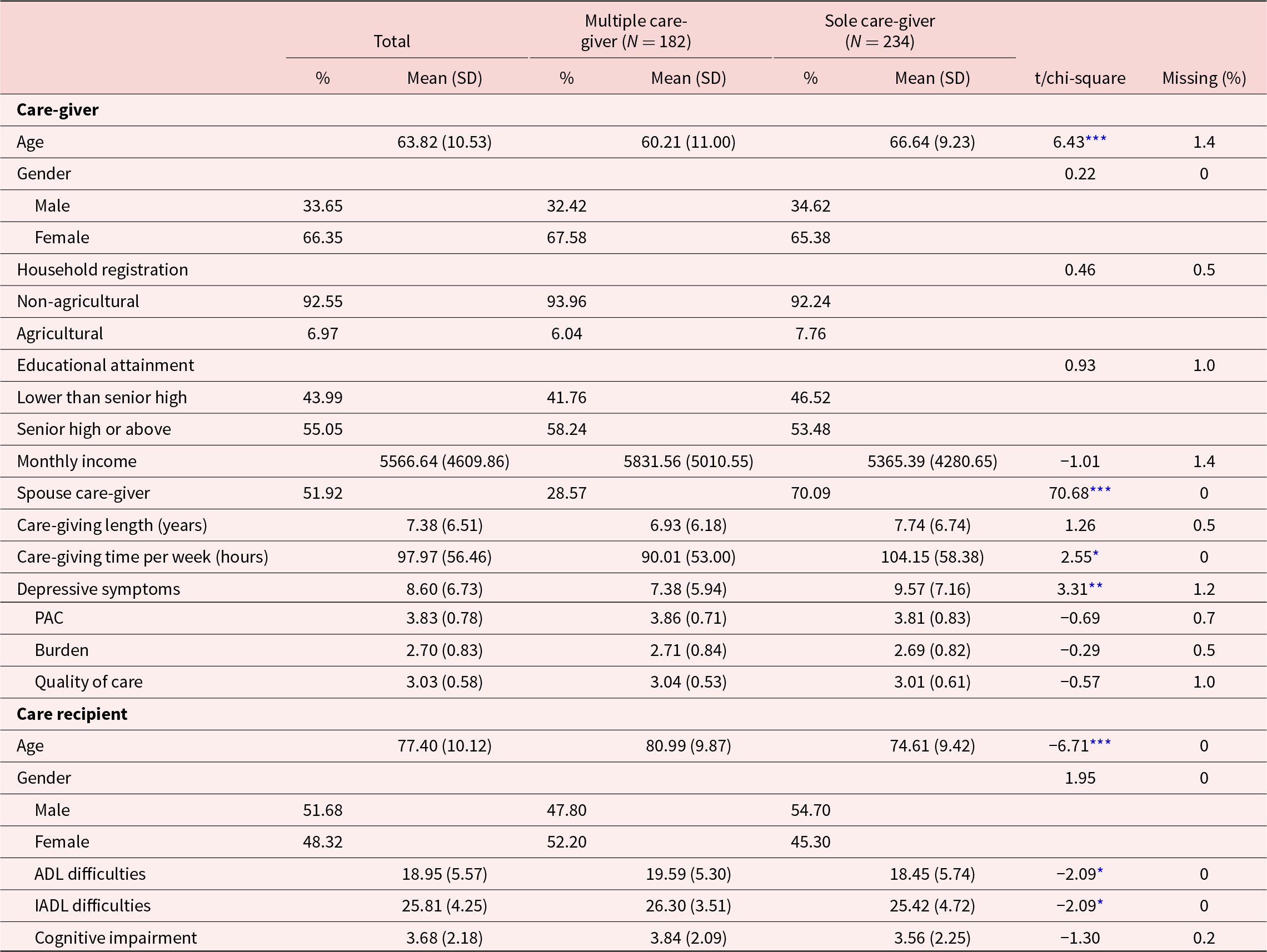
Table 1 shows the descriptive statistics of all variables included in this study by status of shared care-giving. On average, family care-givers were 63.82 years old. Approximately half of them were spousal care-givers, and the majority of them were female (66.35 per cent), received relatively high levels of education (55.05 per cent) and held non-agricultural household registration (92.55 per cent). Their monthly income was around 5,500 yuan. These care-givers had provided care for the care recipients for an average of 7.38 years, and they provided 97.97 hours’ care per week over the past six months. The mental health of these care-givers was relatively good, with the mean score of depressive symptoms 8.60 out of 30. Among these care-givers, PAC was at a relatively high level (3.83) whereas burden was low to moderate (2.70). The quality of care provided was at a moderate level, with the average score 3.03. Regarding the characteristics of care recipients, their mean age was 77.40 years old and 48.32 per cent of them were female. Their ADL and IADL difficulties were relatively severe, while cognitive impairment was at a mild level. Specifically, 61.78 per cent of older adults had impairments in all ADLs and 81.49 per cent of them had impairments in all IADLs. Missing values of all included variables were less than 2 per cent.
Sample characteristics by status of shared care-giving (N = 416)

Notes: PAC = positive aspects of care-giving, ADL = activities of daily living, IADL = instrumental activities of daily living.
* p < 0.05, **p < 0.01, ***p < 0.001.
In terms of shared care-giving, 182 family care-givers (43.75 per cent) were assisted by other family members. Descriptive statistics showed that care-givers who had received assistance from others were significantly younger, and spouse care-givers in this group were significantly fewer (30.46 per cent) compared to those in the other group. While those who provided care alone had younger care recipients with less severe ADL and IADL impairment, they also had significantly more severe depressive symptoms, and provided more intense care-giving (i.e. 104.15 hours per week) in comparison to their counterparts. Quality of care was not significantly different across the two groups.
Mediating roles of care-giving burden and PAC
A regression analysis was initially conducted to examine the total effect of independent variables on quality of care. Results showed that older adults’ ADL impairment was significantly related to worse quality of care (b = − 0.012, SE = 0.006, p < 0.05), whereas care recipients’ IADL impairment (b = − 0.010, SE = 0.007, p = 0.195) and cognitive impairment (b = − 0.026, SE = 0.014, p = 0.068) were not significantly associated with quality of care.
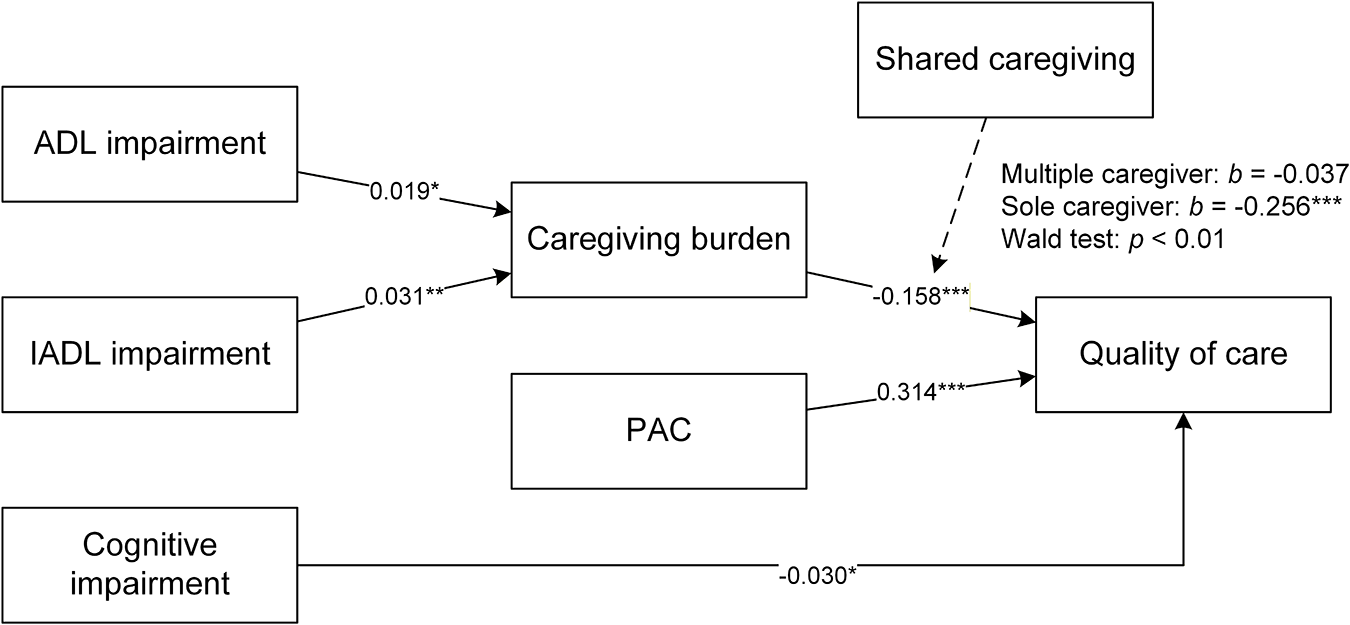
Subsequently, PAC and care-giving burden were introduced to the model as mediators (Figure 1). The model fit of the mediation model was: χ2(8) = 4.581, p = 0.801, RMSEA = 0.000, CFI = 1.000, TLI = 1.000, SRMR = 0.010. The R2 of quality of care was 0.453, suggesting that 45.3 per cent of variances in quality of care were explained by the variables included in this model. Regarding the coefficients of each path, more severe ADL and IADL impairment were significantly related to higher care-giving burden (ADL: b = 0.019, SE = 0.009, p < 0.05; IADL: b = 0.031, SE = 0.011, p < 0.01), whereas the relation between cognitive impairment and care-giving burden was non-significant (b = −0.012, SE = 0.019, p = 0.539). However, all three stressors were not significantly associated with PAC (ADL: b = 0.004, SE = 0.009, p = 0.677; IADL: b = 0.019, SE = 0.010, p = 0.071; cognitive impairment: b = 0.008, SE = 0.019, p = 0.661). In terms of the associations of PAC and burden with quality of care, results showed that both PAC and burden were significantly related to quality of care (PAC: b = 0.314, SE = 0.044, p < 0.001; burden: b = −0.158, SE = 0.041, p < 0.001). Specifically, according to the standardized coefficients (Table 2), one standard deviation increase in PAC was related to an increase of 0.427 standard deviations in quality of care, whereas one standard deviation increase in burden was related to a decrease of 0.228 standard deviations in quality of care. Additionally, after controlling for the roles of PAC and care-giving burden, the direct effect of care recipients’ cognitive impairment became significant, with more severe impairment relating to poorer quality of care (b = −0.030, SE = 0.013, p < 0.05). However, the direct associations of both ADL and IADL impairment with quality of care were statistically non-significant (ADL: b = −0.011, SE = 0.006, p = 0.060; IADL: b = −0.010, SE = 0.007, p = 0.125).
Results of the mediation and moderation model.

Standardized estimate and 95 per cent confidence intervals of all paths

Notes: CI = confidence interval, PAC = positive aspects of care-giving, ADL = activities of daily living, IADL = instrumental activities of daily living.
Regarding the indirect effects, care-giving burden significantly mediated the association between older adults’ ADL impairment and quality of care (b = −0.003, 95% CI [−0.007, −0.000]), and that between IADL impairment and quality of care (b = −0.005, 95% CI [−0.010, −0.001]). However, the indirect association linking older adults’ cognitive impairment, care-giving burden and quality of care was non-significant (b = 0.002, 95% CI [−0.004, 0.008]). Indirect effects through PAC were all non-significant (ADL impairment: b = 0.001, 95% CI [−0.004, 0.007]; IADL impairment: b = 0.006, 95% CI [−0.001, 0.013]; cognitive impairment: b = 0.003, 95% CI [−0.009, 0.014]).
Moderating role of shared care-giving
As previously stated, we first built an unconstrained model by freely estimating all paths of the mediation model across different groups. Results showed adequate model fit: χ2(16) = 17.254, p = 0.369, RMSEA = 0.020, CFI = 0.998, TLI = 0.987, SRMR = 0.021. Subsequently, we sequentially constrained each path to be equally estimated across groups while freely estimating other paths. Model fit did not significantly worsen by constraining all paths except for that between care-giving burden and quality of care (Δχ2 = 9.788, df = 1, p < 0.01) and that between older adults’ cognitive function and care-giving burden (Δχ2 = 5.135, df = 1, p < 0.05). Therefore, we built a model by freely estimating the aforementioned two paths while holding the coefficients of other paths to be equal across the groups. Results showed that the relationship between care-giving burden and quality of care was significantly moderated by shared care-giving (Wald χ2(1) = 8.605, p < 0.01), whereas the moderation effect on the association of cognitive impairment with care-giving burden became non-significant (Wald χ2(1) = 2.271, p = 0.132), indicating that the moderating effect diminished in a more strictly defined model.
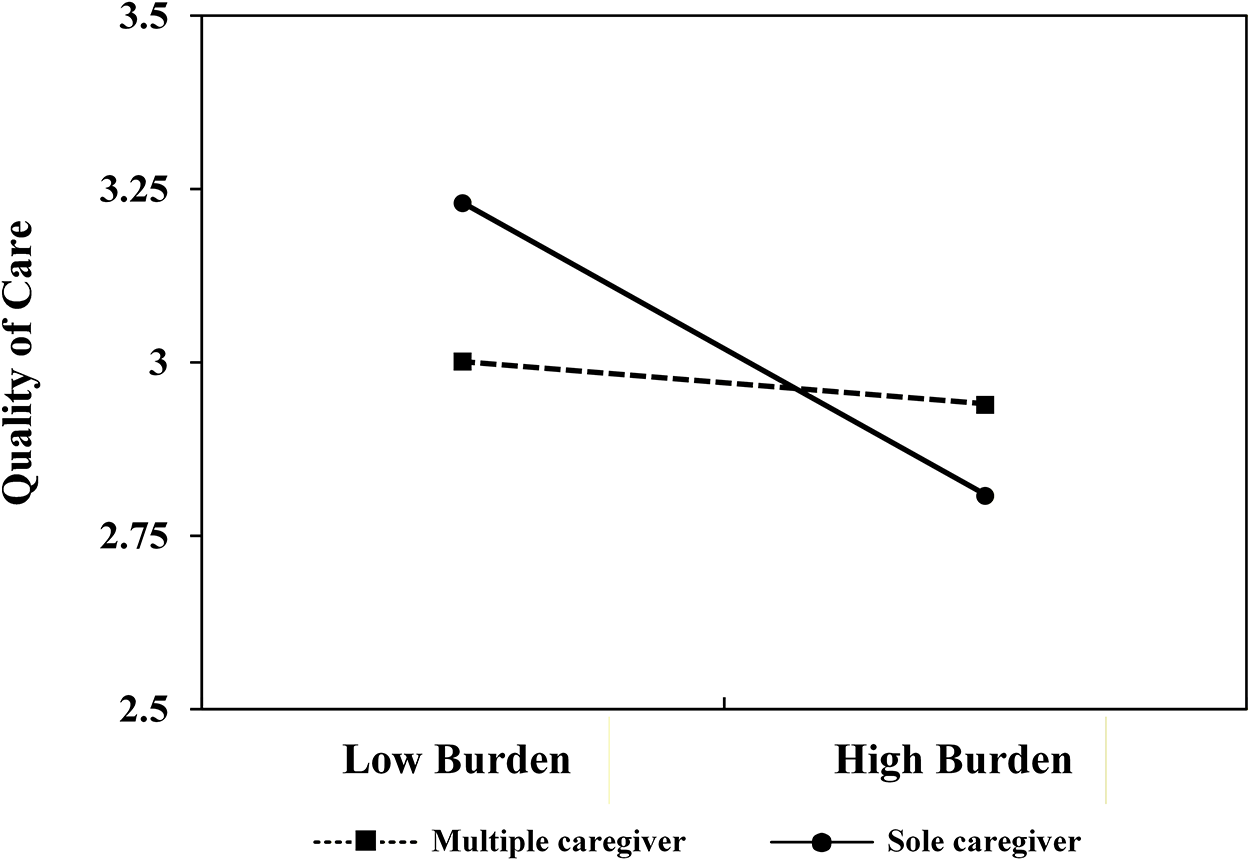
Consequently, a final model was built by freely estimating the path from care-giving burden to quality of care only (χ2(41) = 38.324, p = 0.590, RMSEA = 0.000, CFI = 1.000, TLI = 1.011, SRMR = 0.040; Figure 1). In this model, care-giving burden had significantly negative association with quality of care only among care-givers who did not receive help from others (b = −0.256, SE = 0.053, p < 0.001), whereas that among care-givers who had helpers was non-significant (b = −0.037, SE = 0.054, p = 0.497). The moderation effect in this final model remained significant (Wald χ2(1) = 8.605, p < 0.01). The simple slope test also showed significant differences across the two groups (Δb = −0.219, 95% CI [−0.365, −0.073], p < 0.01). Standardized coefficients and 95 per cent CIs of all direct and indirect pathways, as well as the association between burden and quality of care stratified by shared care-giving status, are also presented in Table 2. The visualization of the simple slope test is shown in Figure 2.
Simple slope test for the moderating role of shared care-giving.

Discussion
While previous studies on the family care-giving process primarily focused on care-givers’ psychological wellbeing, this study represents the first attempt to investigate the quality of care provided by family care-givers of older adults living with disabilities in China. This study further extended current understanding of the care-giving process to the entire family care-giving system by examining the moderating role of shared care-giving. The results of this study indicated that stressors, care-giving burden and PAC were all significantly related to quality of care. Care recipients’ cognitive impairment (i.e. one of the stressors) and care-giving burden had direct negative associations with quality of care, whereas PAC had a positive association, which is the strongest among all the pathways. The other two care-giving stressors, namely, older adults’ ADL and IADL impairment, had significant indirect association with quality of care through increasing care-giving burden. Our results also suggested that, although quality of care did not significantly differ across the status of shared care-giving, shared care-giving significantly moderated the relationship between care-giving burden and quality of care. Specifically, the negative association between care-giving burden and quality of care was significant only among those who did not share care-giving responsibilities with others. The findings of this study provide insights into factors related to quality of care in home-care settings, which could further guide the development of tailored interventions, thus sustaining the family-based long-term care system.
Regarding the factors related to quality of care, this study revealed that care-giving stressors and appraisals were all significantly associated with quality of care. In line with previous studies focusing on other care-giving outcomes (Quinn and Toms Reference Quinn and Toms2019; Chiao et al. Reference Chiao, Wu and Hsiao2015; Jiang et al. Reference Jiang, Lu, Sun and Lou2020; Lou et al. Reference Lou, Yan and Lu2024), this study confirmed that the two-factor model can also be applied to studies into quality of care – stressors and care-giving burden were all negatively related to quality of care, whereas PAC had significantly positive relations. In terms of the specific mechanisms, care-giving burden played a significant mediating role in the associations of older adults’ ADL and IADL impairment with quality of care. Meanwhile, care recipients’ cognitive impairment only had significant direct association with quality of care. This may be because that cognitive impairment impairs older adults’ ability to express their needs and thoughts, leading them to be perceived as lacking autonomy and awareness, which in turn poses direct barriers to the provision of high-quality care (Cummings Reference Cummings2003). Furthermore, partially consistent with previous studies (Jiang et al. Reference Jiang, Lu, Sun and Lou2020; Johansson et al. Reference Johansson, McKee, Dahlberg, Summer Meranius, Williams and Marmstal Hammar2022), the current study found that PAC were not significantly related to all three types of stressor. One plausible explanation is that PAC refer to benefits gained through the care-giving experiences, and such benefits could remain even under severe stressors (de Labra et al. Reference de Labra, Millan-Calenti, Bujan, Nunez-Naveira, Jensen, Peersen, Mojs, Samborski and Maseda2015). Therefore, this finding implies the presence of other potential uninvestigated factors of PAC, which require further exploration. Nevertheless, PAC had stronger association with quality of care than care-giving burden, underscoring the potential of PAC-related interventions in increasing the quality of care provided by family care-givers.
In terms of the role of shared care-giving, we found that, although quality of care did not significantly differ by shared care-giving status, shared care-giving modified the association between care-giving burden and quality of care. However, our findings were to some extent different from previous studies focusing on other care-giving outcomes (Lou et al. Reference Lou, Kwan, Chong and Chi2015; Liu et al. Reference Liu, Fang, Chan and Chen2019). While these studies found that shared care-giving could exacerbate the negative effects of stressors and care-giving burden on care-givers’ psychological wellbeing, shared care-giving buffered the negative association between care-giving burden and quality of care in the current study. In other words, this study suggested that shared care-giving should be viewed as a process of resource gain rather than resource loss. There are several plausible reasons for this result. First, compared to psychological wellbeing, quality of care is a distinct construct and might be more likely to benefit from additional human resources gained through the shared care-giving process (Hu et al. Reference Hu, Freedman, Patterson, Lewis and Meeks2023). Consequently, even if shared care-giving exacerbated the care-giving burden’s negative association with psychological wellbeing, its association with quality of care may still be mitigated. Second, among those who shared care-giving responsibilities with others, most of them reported effective collaboration with other care-givers (Supp_1). Further subgroup analysis found that the negative association between burden and quality of care was non-significant among care-givers who received help from secondary care-givers, regardless of their satisfaction with the collaboration (Supp_1). One possible explanation for this is the Confucius culture, which emphasizes familism and collectivism that encourages family members to handle challenges collectively (Silverstein et al. Reference Silverstein, Cong and Li2006). As a result, the shared care-giving process may be more efficient than in other cultural contexts (Xu et al. Reference Xu, Liu and Beach2021), leading to resource gains rather than resource losses. However, given that this study did not directly examine the impact of cultural value on the care-giving process, future studies should incorporate cultural factors into their studies, as well as explore the impacts of other macro factors like urbanization, migration and regional variations, to provide a contextual and culturally sensitive insight. Moreover, the majority of older adults in the current study were severely disabled, whereas previous studies reporting negative effects of shared care-giving primarily involved older adults with only mild disabilities (Lou et al. Reference Lou, Kwan, Chong and Chi2015; Liu et al. Reference Liu, Fang, Chan and Chen2019). For instance, in Lou et al.’s (Reference Lou, Kwan, Chong and Chi2015) study conducted in Hong Kong SAR, China, approximately 97 per cent of older adults were cognitively intact or only had mild cognitive impairment. Therefore, the results of this study might indicate that when care-giving demands are intensive and overwhelming, the benefits of shared care-giving may outweigh its potential drawbacks. This is also in line with the conservation of resources theory, which suggests that resource gains become more salient in the context of severe resource losses (Hobfoll Reference Hobfoll and Folkman2012). Consequently, this study highlights the importance of shared care-giving in improving quality of care, especially when caring for older adults with severe disabilities.
Implications
This study has several implications for social work interventions and policies. First, as older adults experience functional decline, their demands for high-quality care increase. However, the results of this study reveal a dilemma – older adults’ functional impairment has significant negative associations with quality of care, directly or indirectly. This underscores the need to screen and provide targeted services for older adults with severe disabilities and their family care-givers. Long-term care policies should prioritize professional support for family care-givers of older adults living with severe disabilities to enhance their capabilities to provide high quality of care. Second, care-giving appraisals, including both care-giving burden and PAC, could be the focus of interventions aimed at improving quality of care. Existing interventions, including psychoeducation and psychological therapies, have exhibited great potential in alleviating care-giving burden and promoting PAC (Cheng et al. Reference Cheng, Li, Losada, Zhang, Au, Thompson and Gallagher-Thompson2020). These interventions, as a result, could be further refined to enhance their applicability and effectiveness in improving quality of care by modifying care-giving appraisals. Furthermore, as existing research and interventions tended to overlook PAC, this study further highlights the need for more intervention studies on PAC of family care-givers to promote better care. Third, given that the negative association between care-giving burden and quality of care was significant only among those who did not share care-giving responsibilities with others, this study highlights the importance of supporting sole care-givers. In addition, family-based interventions should be implemented to strengthen intra-family supportive networks and promote shared care-giving.
Limitations
This study has several limitations. First, this was a cross-sectional study, which impaired our ability to conduct causal inference and capture the trajectory and fluctuations of the care-giving stressors, appraisals and quality of care. Despite this, this study is grounded in theory and provides preliminary evidence on the mechanisms influencing the quality of care delivered by family care-givers. Second, the quality of care in this study was assessed through care-giver self-reports due to the functional limitations of the older adults. While this method is well-established and captures an important dimension of quality of care, it is necessary to incorporate older adult self-reports and objective measures in future research to construct a more comprehensive understanding of quality of care. Third, shared care-giving was measured using a binary variable in this study. Although we did additional analysis using care-givers’ perceived coordination, the relatively small sample size limited our ability to further examine its moderating role. Future studies with a larger sample size could use a comprehensive measurement of shared care-giving to provide subtle insights into the care-giving experience among family care-givers receiving assistance from secondary care-givers. Moreover, although we did sensitivity analysis using propensity score methods and the results were robust, selection bias and unmeasured confounders exist, which need to be treated with caution. Fourth, social desirability bias may exist during the interviewing process, which may contribute to the measurement error of this study. Finally, the older adults in this study were primarily severely disabled, reflecting the local context in which those with mild disabilities tend to live independently and thus do not require family care-givers. While this finding illustrates a specific situation in north-eastern China – where outmigration of the younger population is prevalent – a nationally representative survey with a larger sample size is needed to further validate the pathways proposed in this study.
Supplementary material
The supplementary material for this article can be found at https://doi.org/10.1017/S0144686X26100774
Acknowledgements
The authors would like to acknowledge the staff members for their contributions and the respondents for their active participation in this survey.
Author contributions
Yuqi Yan contributed to the study design, statistical analysis, original draft preparation and writing, and revision. Nan Lu contributed to the study design, supervision, data analysis, and paper writing and revision.
Financial support
This work was supported by the Planning Fund Project of the Humanities and Social Science Research, Ministry of Education, China (Project No. 25YJA840010).
Competing interests
The authors have no competing interests to declare that are relevant to the content of this article.
Ethical standards
Ethical approval was obtained from the Ethics Committee of Renmin University of China.