Introduction
An ecological disturbance is a discrete event in time that impacts ecosystems by altering or disrupting community structure and composition, population dynamics and structure, edaphic factors, or available resources. Disturbances are driven by abiotic (e.g., fire, wind, flooding) or biotic (e.g., grazing) forces, with ecosystems experiencing varying intensities and frequencies of disturbance events across different spatial and temporal scales. Disturbances promote spatial heterogeneity within ecosystems, shaping the composition and structure of abiotic and/or biotic ecosystem features. However, alteration, suppression, and degradation of disturbance regimes by human activities have altered disturbance dynamics, potentially increasing the magnitude and severity of subsequent disturbance events. Therefore, it is critical that we understand ecosystem responses to disturbances, especially in at-risk systems.
Cyclonic storms, such as hurricanes, are a common natural disturbance capable of altering the structural and edaphic factors of landscapes, such as islands, through strong winds, storm surge, and heavy rainfall (Gunzburger et al. Reference Gunzburger, Hughes, Barichivich and Staiger2010, Schriever et al. Reference Schriever, Ramspott, Crother and Fontenot2009, Walls et al. Reference Walls, Barichivich and Brown2013). These destructive storms are known to have both negative and positive direct and indirect effects on island flora and fauna (Wiley & Wunderle Reference Wiley and Wunderle1993). Mortality, resource depletion, shifts in behaviour and population dynamics, and increased competition are common responses to these disturbances (Wiley & Wunderle Reference Wiley and Wunderle1993, Barnés Reference Barnés1946, Wunderle et al. Reference Wunderle, Mercado, Parresol and Terranova2004). Hurricanes can also alter landscape heterogeneity at multiple spatial scales and have a wide range of effects on insular biodiversity and community composition (Dornelas Reference Dornelas2010, Schaefer et al. Reference Schaefer, McDowell, Scatena and Asbury2000, Sousa Reference Sousa1984, Wiley & Wunderle Reference Wiley and Wunderle1993). With hurricanes predicted to increase in frequency and severity as a result of a changing climate (Emanuel Reference Emanuel2005, Webster et al. Reference Webster, Holland, Curry and Chang2005, Dornelas Reference Dornelas2010, Walls et al. Reference Walls, Barichivich and Brown2013), it is critical that we document and study how these disturbances influence communities and ecosystems.
Hurricanes shift community dynamics in very complex ways including shifts in dominant species, predator–prey relationships, and niche loss (e.g., Schriever et al. Reference Schriever, Ramspott, Crother and Fontenot2009). Pre- and post-hurricane (Ivan and Katrina) surveys in Louisiana, USA, indicated an increase in species evenness after the storms (Schriever et al. Reference Schriever, Ramspott, Crother and Fontenot2009). This increase was attributed to shifts in habitat heterogeneity creating more available niche space for previously rare, less abundant species. Schriever et al. (Reference Schriever, Ramspott, Crother and Fontenot2009) also documented saltwater inundation of freshwater ponds after these hurricane events. This resulted in a decline in native saltwater-intolerant amphibian populations that rely on these freshwater ponds as breeding areas (Schriever et al. Reference Schriever, Ramspott, Crother and Fontenot2009). Schriever et al. (Reference Schriever, Ramspott, Crother and Fontenot2009) documented differential responses across taxonomic groups (amphibians and reptiles), with some groups (i.e., reptiles) faring better than others (i.e., amphibians) after these events. Examining and documenting these different responses is critical, especially for island ecosystems, which are becoming increasingly imperilled. Understanding community, taxa, and species’ specific responses to hurricanes can better inform conservation and management strategies.
Hurricanes are known to alter the structure and composition of island floral and faunal communities (e.g., Schriever et al. Reference Schriever, Ramspott, Crother and Fontenot2009). Major disturbances can have a substantial influence on resident island populations where communities can be sensitive to fluctuating conditions (Platenberg & Boulon Reference Platenberg and Boulon2006, Barnés Reference Barnés1946, Courchamp et al. Reference Courchamp, Hoffmann, Russell, Leclerc and Bellard2014). This is especially important in areas of high endemic biodiversity, such as islands. Studying the extended effects of hurricanes on island ecosystems is critical for conservation due to high levels of biodiversity found on islands and the varying potential positive and negative consequences to those ecosystems (Schriever et al. Reference Schriever, Ramspott, Crother and Fontenot2009, Fitch Reference Fitch2006).
The US Virgin Islands (USVI) are home to 30 extant reptiles and amphibians; 24 of these species are native with 9 being species of conservation concern (Platenberg & Boulon Reference Platenberg and Boulon2006). Nineteen of the 30 extant species are found on the island of St. John. Significant natural disturbances (i.e., hurricanes) paired with human activity may negatively impact endemic herpetofauna of USVI, making monitoring of the herpetofaunal communities necessary for preserving biodiversity (Platenberg & Boulon Reference Platenberg and Boulon2006). The objective of our study was to evaluate the response of herpetofaunal communities to two major hurricane events (hurricanes Irma and Maria, in September of 2017). Due to the extreme severity of these two storms, we hypothesised that these hurricanes had a negative effect on the herpetofaunal communities of Virgin Islands National Park (VINP), on St. John, that would be observable 9 months after the hurricanes hit. We expected herpetofaunal communities to exhibit lower species diversity across landscape cover types and shifts in species’ associations with each landscape cover type.
Study site
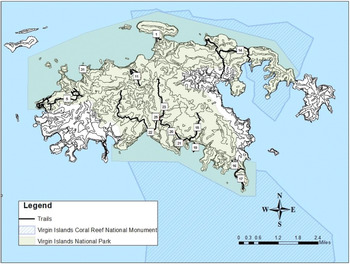
The US Virgin Islands lie within the Lesser Antillean island chain in the Caribbean Sea, roughly 40 miles east of Puerto Rico. The territory has been heavily visited for tourism, industry, and military activity for hundreds of years, creating a very dynamic environment for native reptile and amphibian species (Platenberg & Boulon Reference Platenberg and Boulon2006). St. John, the smallest of the three major islands, is home to Virgin Islands National Park, which comprises about 60% of the island’s landmass (Figure 1). The island’s population is 4170 people (US Census Bureau 2010) and attracted around a half million visitors per year before hurricanes Irma and Maria (National Park Service 2020). The area is prone to periodic disturbances of hurricanes (Platenberg and Boulon Reference Platenberg and Boulon2006). Schaefer et al. (Reference Schaefer, McDowell, Scatena and Asbury2000) suggested that hurricanes with a magnitude of 3 or greater were predicted to pass over northeast Puerto Rico with a 50- to 60-year period. However, during September of 2017, St. John took a near-direct hit from major hurricanes Irma (category 5) and Maria (category 5) within a period of 14 days (Bureau of Labor Statistics 2017). Because the island is relatively small and isolated, the recovery of species could be long and challenging. The area sustained heavy damage including denudation of the foliage and canopy damage.
Trail labels. Francis Bay:1, Caneel Hill: 5, Cinnamon Bay: 11, Brown Bay: 14, Bordeaux Mountain: 15, Saltpond Bay: 16, Ram’s Head: 17, Yawzi Point: 19, Lameshur Bay: 20, Europa Bay: 21, Reef Bay Ruins: 22, Reef Bay: 23, Petroglyphs: 25, and Peace Hill/ Hawksnest: 31.

VINP incorporates the terrestrial and immediate marine environments across St. John. The terrestrial acreage of the park encompasses 29.38 km2 between sea level and around 400m (National Park Service 2021), and contains five major landscape cover types. These landscape cover types, from lowest to highest elevation, are as follows: estuarine, comprised mostly of black mangrove (Avicennia germinans Linnaeus) and red mangrove (Rhizophora mangle Linnaeus); scrub, comprised of pipe organ cactus (Pilocereus royenii Byles and Rowley), century plant (Agave missionum Trel), and heiti (Thespesia populnea Linnaeus and Solander), as well as grasses and forbs; dry forest, comprised of trees such as turpentine (Bursera simaruba Sargent), water mampoo (Pisonia subcordata Swartz), wild frangipani (Plumeria alba Linnaeus), and others; and moist forest, comprised of large trees such as kapok (Ceiba pentandra Gaertner), sandbox (Hura crepitans Linnaeus), locust (Hymenaea courbaril Linnaeus) and others. The final landscape cover type is gut. Gut can occur at various levels of elevation and is characterised as seasonally flooded stream beds lined with boulders. These fill during rainstorms and can occur across the island within any of the other four habitat types (Rice et al. Reference Rice, Waddle, Crockett, Carthy and Percival2005). Gut habitat often remains moist and in rare cases, can hold water year-round. There are approximately 19 species of herpetofauna present on the island, including 8 amphibian and 11 reptile species (Rice et al. Reference Rice, Waddle, Crockett, Carthy and Percival2005). Several of these species have not been observed in recent decades, while six of these species have been recently introduced by humans.
Methods
Surveys
We used visual encounter surveys (VES) and vocalisation surveys to sample VINP, following the methods of Heyer et al. (Reference Heyer, Donnelly, McDiarmid, Hayek and Foster1994) and Rice et al. (Reference Rice, Waddle, Crockett, Carthy and Percival2005). We selected transects to sample major and minor trails in the park within as many different landscape cover types as possible. We chose transects at random along trails within VINP to maximise access to more remote areas of the island. Each transect was characterised by one of the five landscape cover types found in VINP. Surveyors walked for 20 minutes along a transect, actively seeking and observing reptile and amphibian species by rolling logs, looking under rocks, and other similar activities. Each surveyor was allotted time to be a primary observer and secondary observer. Roles switched 10 minutes after the start of a survey. Data recorded at each transect included species, GPS coordinates of individuals, and the landscape cover type of the transect.
We completed 30 transects in 2016 and 42 transects in 2018, varying in distance from 50 to 100 m. The same transects that were completed in 2016 were also completed in 2018. The distance of each transect varied to accommodate the surveyors’ ability to move through each landscape cover type and thoroughly search the vegetation, rocks, and woody debris. We conducted vocalisation surveys for a period of 5 minutes prior to a nocturnal VES, in order to survey frog species that would otherwise not be found on a visual encounter survey. Surveyors recorded the number of different calls and species for 5 minutes. Surveyors assigned a code to the predicted number of calling individuals of a frog species: 1 = 1 individual, 2 = 2–5 individuals, 3 = 6–10 individuals, and 4 = greater than 10 individuals. Opportunistic encounters were documented as often as possible. Surveys took place between 28 February–4 March 2016 and 9–17 June 2018. Weather conditions were not considered influential during our surveys and varied little during our study periods in 2016 and 2018. The average temperature during our surveys in 2016 was 27oC, and 28.4oC during our 2018 surveys. The average precipitation during our surveys in 2016 and 2018 was minimal (0.03 and 0.08 cm, respectively; National Centers for Environmental Information). The authors assert that all procedures contributing to this work comply with applicable national and institutional ethical guidelines on the care and use of laboratory or otherwise regulated animals.
Statistical analysis
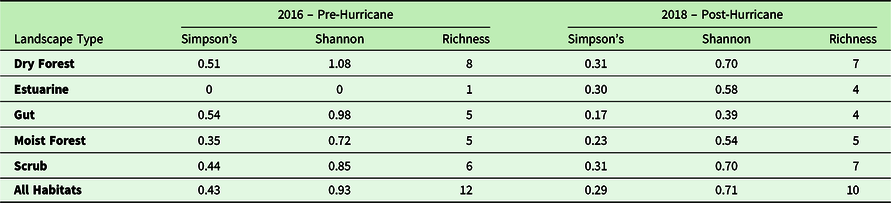
Simpson’s and Shannon diversity indices (Simpson Reference Simpson1949; Shannon Reference Shannon1949), as well as species’ richness were calculated for each landscape cover type using VES data. We compared pre- and post-hurricane diversity using both Simpson’s and Shannon’s diversity indices to include the ability to separately interpret the results of both metrics. Both metrics use an evaluation of both richness and evenness, although Shannon’s is more sensitive to richness, and Simpson’s is more sensitive to evenness (Haines-Young & Chopping Reference Haines-Young and Chopping1996). Shannon’s higher sensitivity to richness allows for us to more easily see changes in the rarest species across landscape cover types and over time (Peet Reference Peet1974). Simpson’s higher sensitivity to evenness will more readily show changes in the most abundant species across landscape cover types and over time (Peet Reference Peet1974). We used linear regression to assess differences in these metrics across landscape cover types and years in program R Version 3.5.1. (RStudio Team, 2016) using package “multcomp” (Hothorn et al. Reference Hothorn, Bretz and Westfall2008). We used a multiple comparisons test (Tukey) to make comparisons across landscape cover types and years (2016 and 2018). We evaluated the dissimilarity of herpetofauna communities across landscape cover types in VINP using non-metric multidimensional scaling (NMDS) in the “vegan” package in program R version 3.5.1. (RStudio Team 2016) (package = “vegan”) (Oksanen et al. Reference Oksanen, Guillaume Blanchet, Friendly, Kindt, Legendre, McGlinn, Minchin, O’Hara, Simpson, Solymos, Stevens, Szoecs and Wagner2019). We used the Bray–Curtis distance measure, as this is a common measure used in ecological studies. We built a species matrix consisting of the total number of detections of every species across all landscape cover types and years (2016 and 2018). We built a site matrix consisting of the landscape cover type and year as environmental variables. An unconstrained ordination was run to determine if the first two axes explained the majority of the variation in the data. We used the function “envfit” within the “vegan” package to test the significance of the environmental variables using permutation tests. We considered all tests significant at α = 0.05.
Results
Diversity and richness metrics
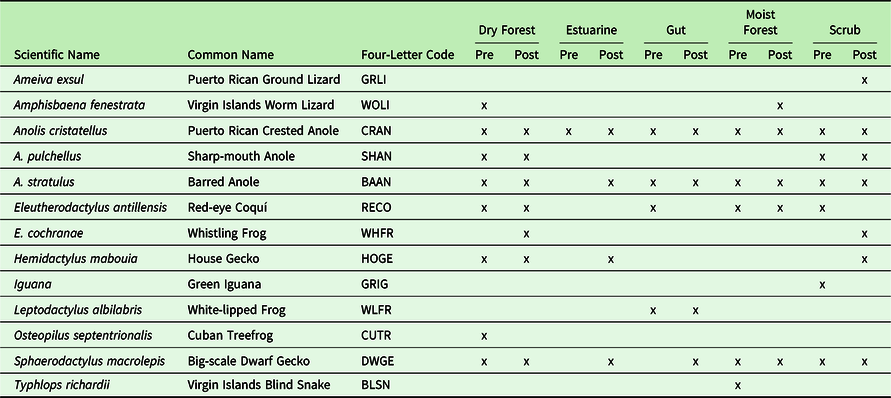
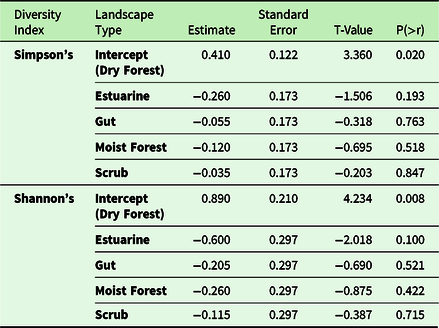
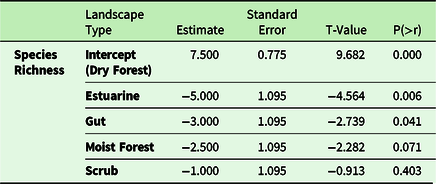
We detected a total of 1168 individuals encompassing 13 species across the 2016 and 2018 sampling periods (Tables 1 and 2). Across landscape cover types, both Simpson’s and Shannon’s diversity indices did not differ significantly (Est = 0.410, SE = 0.122, F = 0.705, P(>r) = 0.621, Est = 0.890, SE = 0.210, F = 1.156, P(>r) = 0.428, respectively) (Table 3). Only species richness differed significantly among landscape cover types (Est = 7.500, SE = 0.775, F = 6.167, P(>r) = 0.036) (Table 4). We ran a Tukey multiple comparisons test to reveal where the difference in landscape cover type was found. The only significant difference found was between estuarine and dry forest landscape cover types (Est = −5.00, SE = .095, T = −4.56, P(>r) = 0.030) (Supplementary Table 1). This is likely due to the fact that only one species, the Puerto Rican crested anole (Anolis cristatellus Duméril and Bibron) was found in the estuarine habitat in 2016. However, two more species of Anolis were found in this landcover type in 2018. This is likely the result varying detectability of each species in each landcover type. Both Simpson’s and Shannon’s diversity metrics did not differ significantly differ from 2016 to 2018, pre- and post-hurricanes (Est = 0.368, SE = 0.072, F = 1.049, P(>r) = 0.336, Est = 0.726, SE = 0.141, F = 0.519, P(>r) = 0.492, respectively). Species richness across years also did not differ significantly (Est = 5.000, SE = 0.938, F = 0.091, P(>r) = 0.771) (Supplementary Table 2, Table 5).
Species name, species four-letter code, and habitat that the species was found in pre- and post-hurricane visual encounter surveys of Virgin Islands National Park in 2016 and 2018. Table does not include opportunistic encounters

Species name, species four-letter code, and habitat that the species was found in pre- and post-hurricane vocalisation surveys of Virgin Islands National Park in 2016 and 2018. Numerical code corresponds to the number of individuals calling: 1 = 1 individual, 2 = 2–5 individuals, 3 = 6–10 individuals, and 4 = greater than 10 individuals

Linear Regression Model Output for Simpson’s and Shannon’s diversity indices across landscape cover types. Simpson’s: F = 0.705, P(>r) = 0.621. Shannon’s: F = 1.156, P(>r) = 0.428. Data collected from Virgin Islands National Park in 2016 and 2018, before and after hurricanes Irma and Maria

Linear Regression Model Output for species richness across landscape cover types. Species richness did vary significantly among landscape cover types. (F = 6.167, df = 4,5, P(>r) = 0.036). Data collected from Virgin Islands National Park in 2016 and 2018, before and after hurricanes Irma and Maria

Simpson’s and Shannon diversity indices and species richness across habitat types for 2016 and 2018. Data collected from Virgin Islands National Park in 2016 and 2018, before and after hurricanes Irma and Maria

NMDS results
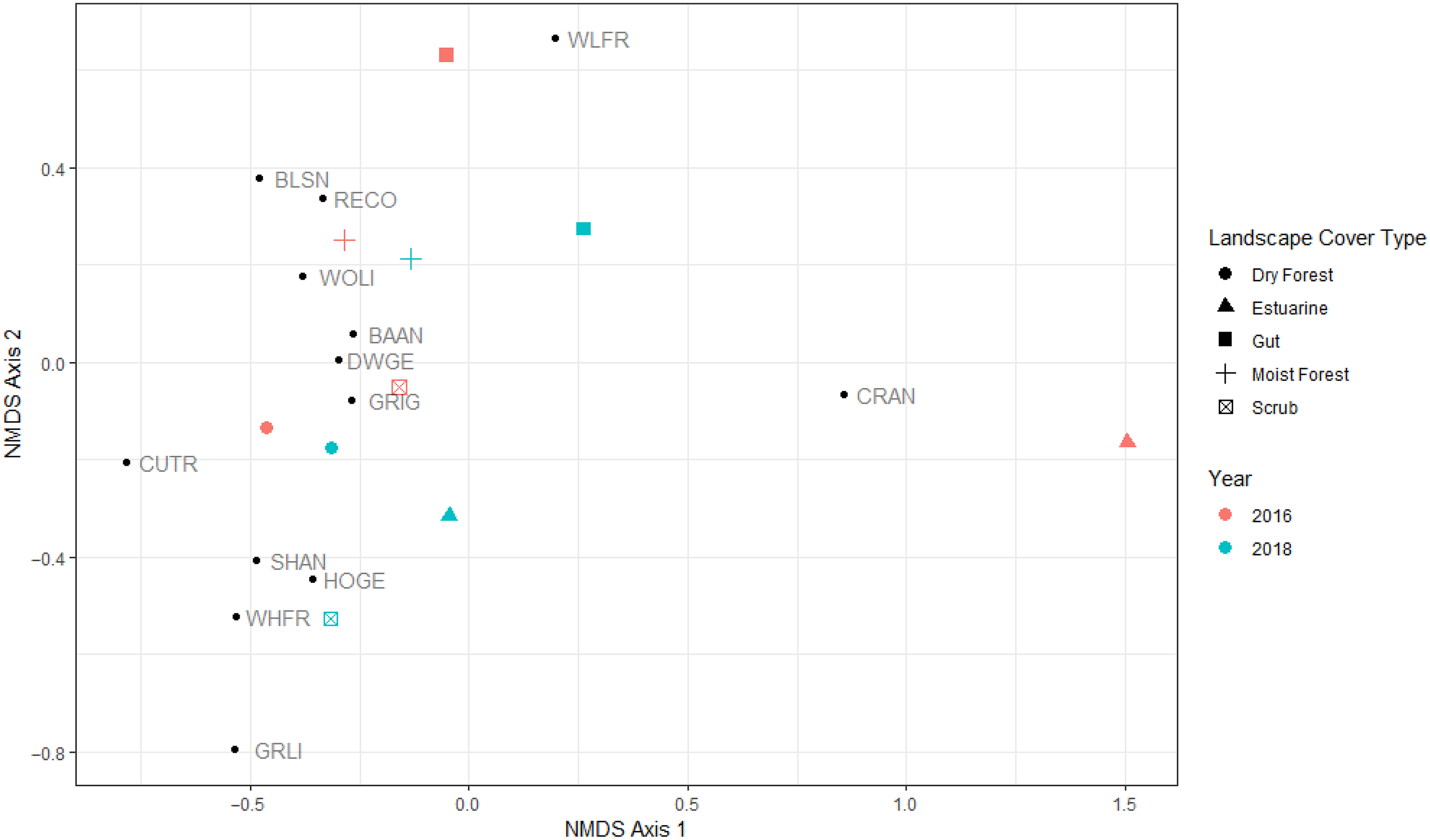
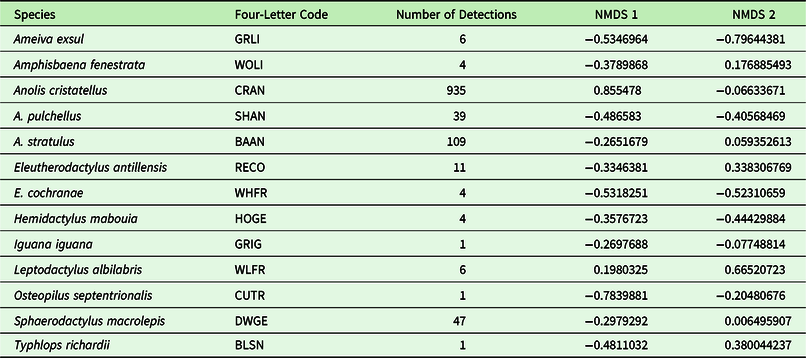
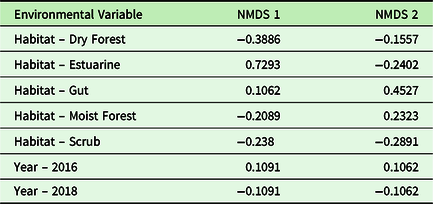
The ordination obtained a stress value of 0.07 with k = 2 confirming that the ordination was an adequate representation of the underlying data. The environmental variables of year and landscape cover type were not significant (P(>r) = 0.06, r2 = 0.63, and P(>r) = 0.79, r2 = 0.06, respectively), suggesting no difference in herpetofaunal community composition and abundance across space and time (Figure 2 and Tables 6 and 7).
NMDS plot showing species occupation association with habitat type and year. There are no associations between year and habitat type and species occupation.

Detections and non-metric multidimensional scaling centroids for each species. Data collected from Virgin Islands National Park in 2016 and 2018, before and after hurricanes Irma and Maria

Non-metric multidimensional scaling centroids for the environmental variables. Data collected from Virgin Islands National Park in 2016 and 2018, before and after hurricanes Irma and Maria

Discussion
In this study, we sought to determine how major disturbances influenced herpetofaunal communities within VINP by comparing survey data from 2016 (18-month pre-hurricane) and 2018 (9-month post-hurricane). We found no evidence of observable changes in herpetofaunal community composition across years or landcover types as a result of the hurricanes. This suggests that herpetofaunal communities are well adapted and resistant to hurricanes. Hurricanes are common in the Caribbean, with an average of 4.6 hurricanes per season (Alaka, Reference Alaka1976), and hitting the US Virgin Islands an average of once every 8 years. Even with this high frequency of storms, it is rare to have two major hurricanes strike an island within 2 weeks. Despite the damage caused to the island, and with 2017 having been the most active hurricane season on record at the time (Blake Reference Blake2018), island herpetofaunal communities resembled that of the pre-hurricane communities 8 months after two direct hits from Irma and Maria. Across all species, there was a lack of evidence of changes in species composition across landscape cover types. Also, herpetofauna community associations between our 2016 and 2018 surveys did not differ. This evidence suggests that the herpetofauna communities of VINP may be resistant to high-intensity, low-frequency disturbances, being able to recover given enough time after the disturbances. These results are inconsistent with our hypotheses but are consistent with previous evidence indicating the ability of island herpetofauna to respond to hurricanes without long-lasting negative effects (Reagan Reference Reagan1991).
While large disturbances undoubtedly affect vegetation cover, water chemistry, and initial mortality (Schriever et al. Reference Schriever, Ramspott, Crother and Fontenot2009), island herpetofaunal communities have evolved alongside hurricanes, and are well adapted to them. Reagan (Reference Reagan1991) demonstrated that communities of Anolis species of Puerto Rico modified their behaviour post-Hurricane Hugo and were able to adjust to habitat changes and began to recover 6 months after the storm. We saw similar community composition and landscape cover associations in communities 9 months after hurricanes Irma and Maria hit VINP, despite changes in vegetation structure after the storms, demonstrating the resistance of the communities and adaptability of the species. The response to the combined influence of the two hurricanes may well be related to the spacing of the hurricanes. It seems likely that the two storms were perceived as a single ecological event with a single recovery process. Given the climate change-related storm predictions in the region, it may be relevant to investigate how changes in the spacing of hurricanes affect ecosystems since recovery trajectories may be interrupted by subsequent storms.
Variations in survey results may have been due to time constraints and temporal variation of the surveys, as well as low detectability of several species. Detectability and seasonal variation in behaviour may have influenced the perceived abundance and subsequent recovery of herpetofaunal communities. For example, the seasonality of certain species’ behaviours may lead to variations in detection. Townsend and Stewart (Reference Townsend and Stewart1994) reported Eleutherodactylus coqui (Thomas) calling was reduced during the dry season (January–February) and was at its highest during the wet season (May–July). Our 2016 surveys occurred during a time when E. coqui were not actively calling, while our 2018 surveys fell during their active season, leading to their detection on our vocalisation surveys. In addition, the red-eyed coquí (E. antillensis Reinhardt & Lutken) calls primarily during the fall (MacLean Reference MacLean1982). Others, such as the blind snake (Antillotypholps richardii Duméril and Bibron) and worm lizard (Amphisbaena fenestrata Cope) are highly fossorial and finding these species can be difficult. Not detecting these species on VES does not indicate a lack of presence in the survey area. Differences in species abundances across landscape cover types and years may therefore be a result of seasonal variation in detectability and not a result of hurricanes altering species numbers. Other factors that may influence species detectability and overall community responses to disturbances include changes in microhabitat conditions, which we did not measure, but has been shown to alter species’ behaviour, and shift food webs (Wunderle et al. Reference Wunderle, Mercado, Parresol and Terranova2004). Landscape composition, such as the distance to human development, may also cause differences in the detectability and perceived abundance of certain species. Habitat generalists, such as Anolis cristatellus, thrive in human-altered habitats (Fitch et al. Reference Fitch, Henderson and Guarisco1989) and may use these habitats until suitable habitat conditions recover in adjacent habitats. Differences in detectability, seasonal behaviours, microhabitat conditions, and landscape composition certainly play a role in community recovery. While we did not observe any differences in herpetofaunal communities 9 months after the hurricanes, further research is necessary to determine how these factors influence recovery, and how they influence on our ability to quantify community recovery.
In addition to differences in detectability, species show variation in their reproductive cycles that can lead to differences in their recovery abilities. Anolis cristatellus, a habitat generalist, has a relatively short generation time. Females of this species can be reproductively mature as small as 39 mm snout-to-vent length (Fitch et al. Reference Fitch, Henderson and Guarisco1989), which can take less than a year to reach. Eggs can be laid throughout the year, meaning A. cristatellus, and likely other Anolis species, which have similar reproductive cycles, may have reproduced several times in the interval between the hurricanes and our surveys. In contrast, Ameiva exsul (Cope), does not reproduce throughout the year (Rodriguez-Ramirez & Lewis Reference Rodriguez-Ramirez and Lewis1991), and may require more time to recover from large disturbances. Information on the more fossorial species of snakes and lizards of the US Virgin Islands is lacking and research should be conducted to determine seasonal patterns of reproduction, and how those patterns influence recovery from disturbance.
Prolonged community recovery from large-scale disturbances is also likely affected by invasive species, a common threat across the globe and specifically on islands, such as St. John (Platenberg & Boulon Reference Platenberg and Boulon2006, Gibbons et al. Reference Gibbons, Scott, Ryan, Buhlmann, Tuberville, Metts, Greene, Mills, Leiden, Poppy and Winne2000). St. John is home to many invasive predator species, including domestic cats (Felis catus Linnaeus), small Indian mongoose (Herpestes auropunctatus Hodgeson), and black rats (Rattus rattus Linnaeus). All are known predators of reptiles and amphibians and have contributed to species’ declines on islands across the globe (Seaman & Randall Reference Seaman and Randall1962, Platenberg & Boulon Reference Platenberg and Boulon2006, Gibbons et al. Reference Gibbons, Scott, Ryan, Buhlmann, Tuberville, Metts, Greene, Mills, Leiden, Poppy and Winne2000). These invasive predators are habitat generalists and thrive in and around the presence of humans (Oppel et al. Reference Oppel, Beaven, Bolton, Vickery and Bodey2011). Disturbances can also produce suitable habitat conditions for invasive predators (Lehtonen et al. Reference Lehtonen, Mustonen, Ramiarinjanahary, Niemelä and Rita2001), facilitating their movement further into protected natural areas. In addition to invasive predator species, St. John has been subject to the introduction of non-native species of herpetofauna, including Cuban treefrogs (Osteopilus septentrionalis) and common coquís (Eleutherodactylus coqui). The introduction and spread of a non-native species can significantly influence native herpetofauna, including increased mortality and altered behaviors. The introduced Cuban treefrog predates on a wide variety of both invertebrate and vertebrate prey, including frog species native to the locations that it has been introduced (Glorioso et al. Reference Glorioso, Waddle, Crockett, Rice and Percival2010, Gibbons et al. Reference Gibbons, Scott, Ryan, Buhlmann, Tuberville, Metts, Greene, Mills, Leiden, Poppy and Winne2000, Oppel et al. Reference Oppel, Beaven, Bolton, Vickery and Bodey2011, Lehtonen et al. Reference Lehtonen, Mustonen, Ramiarinjanahary, Niemelä and Rita2001). The introduction of species that do not directly predate on native species, such as common coquís, can also have effects on behavior, habitat selection, and prey availability through resource competition (Losos et al. Reference Losos, Marks and Schoener1993, Platenberg & Boulon Reference Platenberg and Boulon2006). Differences in the recovery abilities of native and non-native species likely play a significant role in post-disturbance community structure. We were not able to monitor St. John’s introduced mammalian predators before and after hurricanes Irma and Maria. We were also not able to specifically compare the abundance and recovery of non-native reptiles and amphibians, though we did not see any obvious patterns of changes in distribution in both native and non-native herpetofauna species. However, as these factors play a significant role in the loss of island biodiversity (Gibbons et al. Reference Gibbons, Scott, Ryan, Buhlmann, Tuberville, Metts, Greene, Mills, Leiden, Poppy and Winne2000), it would be of interest to monitor the abundance and location of invasive species across St. John to determine their population changes and effects on the herpetofauna communities of the island.
Although studying the immediate effects of disturbance is important for quantifying damage to habitat and population levels, extending evaluations through time can provide greater insight into island community recovery. Short-term examinations of abundance and diversity provide information on disturbance severity (Moring, Reference Moring1996); however, long-term studies allow for observations of changes in biodiversity and abundance, species recovery, and behavioural changes in response to disturbances (Schriever et al. Reference Schriever, Ramspott, Crother and Fontenot2009, Reagan et al. Reference Reagan1991, Wunderle et al. Reference Wunderle, Mercado, Parresol and Terranova2004), better informing conservation actions for post-disturbance protections and restorations. Our study did occur 9 months after the hurricanes initially struck St. John, however, return visits over multiple years and seasons could allow us to see changes that were undetectable during our initial visit. Continued examination of the herpetofaunal communities of VINP will provide insight into taxa, community, and species disturbance recovery, and allow managers and researchers to make informed predictions for post-hurricane wildlife and habitat management.
As threats to island communities increase, studies are needed to determine how the unique communities found on islands will respond. Knowing how issues such as invasive species and loss of habitat will affect a community’s ability to recover after disturbance will be necessary to protect biodiversity. While most ecosystems are affected by some type of disturbance (e.g., hurricanes, fires, floods), the interaction of natural disturbance with additional stressors such as invasive species and urbanisation is not as well understood. In addition to an increased presence of invasive species on St. John, tourism in the US Virgin Islands continues to increase (Jeffrey et al. Reference Jeffrey, Anlauf, Beets, Caseau, Coles, Friedlander, Herzlieb, Hillis-Starr, Kendall, Mayor, Miller, Nemeth, Rogers, Toller and Waddell2005), bringing increased land use and visitation to natural areas of the islands, like VINP. In VINP, we saw no significant changes in community association before and after hurricanes Irma and Maria. However, it is unknown how the interaction of disturbance events with introduced/invasive species and urbanisation affects reptile and amphibian populations. Studies focusing on how the interaction of these factors may provide useful information that can aid in the conservation and management of island herpetofauna.
Supplementary material
To view supplementary material for this article, please visit https://doi.org/10.1017/S0266467421000262
Acknowledgements
Special thanks to Thomas Kelley of the National Park Service for park information, Northern Michigan University for continued support, guidance, and the GIS lab, and the University of Georgia for collaboration. There are no known conflicts of interest in this work.
Financial support
This research was funded by the National Geographic Society’s Early Careers Grant Program (Grant EC-200R-18) and the Northern Michigan University Biology Department.