




No CrossRef data available.
S marks the spot? Regional variation and early African American correspondence
Published online by Cambridge University Press: 03 May 2005
Abstract
The different population ecologies of slavery-era America necessitate an investigation into the issue of regional variation in Early African American English (AAE). This article addresses this issue through the Ottawa Repository of Early African American Correspondence, a corpus of letters written by semiliterate African American settlers in Liberia between 1834 and 1866. We investigate nonstandard verbal -s and its conditioning by linguistic and social factors, including each writer's regional origin in the United States. Results show that, despite differences in overall rates across regions, the linguistic conditioning largely remains constant. These results suggest that subtle regional distinctions in Early AAE existed when specific settlement and population ecologies encouraged them, but that the shared history and circumstances of language contact and development led to an overall identity of forms and conditioning factors across regional varieties.The data on which this study is based are taken from the Ottawa Repository of Early African American Correspondence (OREAAC; Van Herk & Poplack, 2003), housed in the Sociolinguistics Laboratory at the University of Ottawa. Financial support was provided by the Social Sciences and Humanities Research Council of Canada in the form of a postdoctoral fellowship to the first author. Earlier versions of the analyses reported here were presented at meetings of the American Dialect Society (Chicago, January 2000) and the Canadian Linguistics Association (University of Toronto, June 2002). We thank the audiences at these presentations for their comments and suggestions, and we thank Shana Poplack and two anonymous reviewers for comments on earlier drafts of this paper. Any remaining errors are our own responsibility.
Information
- Type
- Research Article
- Information
- Copyright
- © 2005 Cambridge University Press
The variability in regional distribution and population ecology of both Europeans and Africans in slavery-era America has long necessitated an investigation into the issue of regional distinctions in Early African American English (AAE). Much recent work has speculated on the likely linguistic outcomes of sociohistoric factors, such as the period of settlement, African–European population ratios, and type of agriculture (Mufwene, 1996, 2000; Rickford, 1997; Singler, 1998; Winford, 1997; Wolfram, 1999; Wolfram & Thomas, 2002). In particular, distinctions have been drawn between the Deep South states of Louisiana, Mississippi, Alabama, Georgia, and South Carolina, with their larger plantations and larger African-origin populations, and the remaining southern states. However, as we have pointed out elsewhere (Van Herk, 2002:14; Walker, 2000:23–24), although sociohistorical evidence can serve to inform linguistic reconstruction, it can never give us definitive answers about the linguistic consequences of a particular situation. To address these issues, we must supplement sociohistorical information with linguistic evidence.
Unfortunately, such evidence is in short supply. Some work on Early AAE is based on data too sparse to permit detailed regional distinctions (e.g., Bailey, Maynor, & Cukor-Avila, 1991; Montgomery, 1999), some is based on data drawn from African American diaspora communities, in which the multiple or incompletely documented input populations complicate regional analysis (e.g., Poplack & Sankoff, 1987 and Poplack & Tagliamonte, 2001 for Samaná, Dominican Republic; Poplack & Tagliamonte, 1991, 2001 for Nova Scotia, Canada; and Singler, 1989 for Liberia, West Africa); and some is based on data produced by transcribers or reporters who were unlikely or unable to note the distinctions relevant for our purposes (e.g., Dillard, 1972; Schneider, 1989; Viereck, 1989).
This article tests the possibility of regional variation in Early AAE in a corpus that is both historical (produced during the period of slavery) and primary (produced by African Americans), as well as sufficiently large, diverse, and well-documented to allow analysis of its contents along both linguistic and social (especially regional) axes. The Ottawa Repository of Early African American Correspondence (OREAAC) consists of over 400 letters written by ante-bellum African American settlers in Liberia (Van Herk & Poplack, 2003). The limited literacy of the letter writers leads to the retention of linguistic variability, paralleling in some cases that described for spoken AAE (Poplack & Tagliamonte, 2001; Van Herk & Poplack, 2003).
The linguistic variable we examine here, the nonstandard use of verbal -s in the present tense, is ideally suited to an investigation of regional diversity in AAE. It has been attributed to a range of origins associated with specific linguistic conditioning that can be empirically tested, and it exhibits variability in both historical and recent written AAE (Funkhouser, 1973; Montgomery, 1999; Montgomery, Fuller, & DeMarse, 1993). Unlike modern Standard English, in which only third-person singular verbs are marked, AAE shows variable marking across the grammatical paradigm, as illustrated in (1).

Examples taken from the OREAAC are identified by the writer's name and the American Colonization Society microfilm reel, volume, and letter number.
We begin by providing a brief overview of the treatment of regional variation in Early AAE, before describing the OREAAC and discussing our analytic methods and the results of our multivariate analyses. The particular emphasis of this article is on the linguistic conditioning of verbal -s, comparing writers who originated in the Deep South with those from other areas.
REGIONAL VARIATION IN EARLY AFRICAN AMERICAN ENGLISH
Most work on regional variation in Early AAE is based on sociohistorical reconstruction, largely aimed at determining the demographic and social conditions that may or may not have been conducive to the formation and maintenance of a plantation creole (e.g., Mufwene, 1996, 2000; Rickford, 1997; Winford, 1997, 1998; Wolfram & Thomas, 2002). Schneider and his associates (e.g., Kautzsch & Schneider, 2000; Schneider, 1989) provided a linguistic focus in their work on the Ex-Slave Narratives (Rawick, 1972, 1979), which are transcribed interviews with elderly former slaves conducted in the 1930s and 1940s. Based on the presence or overall rate of use of various forms, this work proposed regional distinctions delimiting the likely Gullah-speaking area (Kautzsch & Schneider, 2000) and also differentiating Tennessee from its southern neighbors (Schneider, 1989:251–255). Aside from the general dangers inherent in the use of secondary data, there are specific problems for regional differentiation resulting from certain attributes of the Ex-Slave Narratives. The reliability tests established by Schneider (1989) for the inclusion of transcriptions eliminates the crucial states of Virginia and Louisiana from consideration, and the transcriptions are incapable of capturing the relevant phonological conditioning on verb marking (Schneider, 1989:65–70, 84). In addition, the focus of these studies on the simple presence or absence of nonstandard forms, or their overall rates of use, limits their utility in employing regionally diagnostic constraints on the choice of forms.
Primary data are examined in Singler's (1999) work on verbal -s in diaspora communities in Liberia, West Africa. His analysis of modern Liberian Settler English (LSE) showed constraints on -s similar to those of other diaspora communities (Poplack & Tagliamonte, 2001), except in Sinoe County, an isolated community in southern Liberia. Here he found that his fifteen informants had very low rates of -s-marking, and five had none at all. This led him to conclude that there were differences in the input varieties to Sinoe and to the other diaspora communities, including the rest of Liberia. Because the original Sinoe settlers were largely from the Deep South states of Mississippi and Louisiana, he argued, the language of Sinoe represents a distinct variety found only on the plantations of the Deep South. The language of the Liberian settlers outside of Sinoe, as well as that of other diaspora communities, would thus be descended from European-influenced varieties that existed only in marginal agricultural areas of the early United States that featured a lower ratio of African American plantation slaves to Europeans. Such an interpretation is consistent with the “creolist” viewpoint of some contributors to the debate over the origins of contemporary AAE, who argued that its salient features derive from a prior plantation language which was very un-English-like and probably creolized (e.g., Bailey, 1965; Baugh, 1980; Dillard, 1972; Holm, 1984; Rickford, 1977; Stewart, 1967, 1968, 1973).
An alternative interpretation is that changes have occurred since the diaspora, perhaps as a result of contact with other language varieties. This interpretation, consistent with the principles of the comparative method (Meillet, 1967; Poplack, 2000; Tagliamonte, 2002), would lead us to conclude that it is Sinoe that has changed, not that every other variety has changed in parallel ways. Singler dismissed the possibility of contact-induced change (beyond a few discourse markers and calques) because of hostility between the Sinoe settlers and their neighbors, which even led to a war in 1857. However, this argument can equally be made for just about every other diaspora community, all of which have been socially distant from and often in conflict with their neighbors (cf., J.S.G. Walker, 1992). Ideally, resolving this issue would involve the use of data from an earlier time period, so that conflicting hypotheses over the direction and degree of post-diaspora change could be tested.
DATA: THE OTTAWA REPOSITORY OF EARLY AFRICAN AMERICAN CORRESPONDENCE
The Ottawa Repository of Early African American Correspondence (OREAAC) is a collection of 427 letters written by 235 semiliterate African American settlers in Liberia between 1834 and 1866, and is housed in the Sociolinguistics Laboratory at the University of Ottawa. As described in detail in Van Herk and Poplack (2003), these letters were selected from among 191,000 documents in the microfilmed archives of the American Colonization Society, held by the Library of Congress. A rigorous protocol permitted the selection and verbatim transcription of letters only from those informants who were the least literate and wrote the least frequently. These letters feature a range of nonstandard forms that are closely associated with AAE, including zero copula, r-lessness, consonant-cluster reduction, vowel lowering, the pin/pen merger, preverbal bin, was/were leveling, negative concord, and the absence of overt marking for plurals and possessives. Perhaps more remarkable is the finding that not only the forms, but also the linguistic conditioning of their use, match the results from studies of the spoken language. Although some AAE features seem to be affected by either the acquisition of partial literacy or the writing process (notably, negation and most contractions; cf., Kautzsch, 2002; Montgomery, 1999; Van Herk, 1999), others seem to retain their frequency and conditioning.
Three aspects of the OREAAC make it a particularly suitable corpus for dealing with these issues.
First, the OREAAC represents a direct (albeit written) view of the input to the Liberian communities, in that the writers are not just the descendants of the Liberian settlers, they actually are the settlers. Most OREAAC correspondents left America between the ages of 18 and 49, writing soon after their arrival in Liberia. As such, the language of their letters can be taken to represent their vernacular, acquired in the United States. This corpus thus provides an unparalleled opportunity to compare the linguistic input to a diaspora community with the language spoken there today.
Second, the record keeping associated with the Liberian settlement gives us detailed demographic information about the majority of the OREAAC correspondents, gleaned from 19th-century ships' logs and the 1843 Liberian census. As Table 1 illustrates, most OREAAC correspondents, like most African Americans, were described as illiterate. Most had been slaves before emigrating to Liberia. Over 60% of the informants for whom we have information were slaves who had been freed by their masters, or who had purchased their own freedom. Almost all (90%) were from the slave states of the South, including large numbers from the Deep South states, which are sometimes claimed to have produced the most divergent African American English (i.e., Louisiana, Mississippi, Alabama, Georgia, and South Carolina). Finally, as far as we can determine by extrapolating from the slave status of OREAAC writers and the occupations of slave and free Liberians, most had been agricultural laborers in the United States. On all these axes, the majority of the OREAAC correspondents match the demographic characteristics of the majority of African Americans of the time. Van Herk and Poplack (2003) discussed in detail the status of the OREAAC correspondents as representative of ante-bellum African American society, addressing, in particular, issues of literacy and regional origin.2
It is obviously crucial to our arguments that the attributions of state of origin of these informants be reliable, given that slaves were often sold from one area into another. Textual evidence in the letters themselves supports the evidence derived from ships' logs and the census, in some cases confirming multiple generations of residence in one state. An exception is the case of informants from free states such as Illinois, who sometimes mention their (southern) slave status, but these informants are very few.
Reported demographic characteristics (in percentages) of OREAAC correspondents, the overall Liberian population, and the African American population in the United States ca. 1850

Finally, and of greatest importance, the Liberian demographic information can be applied to a different purpose. Our knowledge of the state of origin of most OREAAC correspondents allows us to test claims directly with respect to the language of 19th-century AAE and its regional diversity. By comparing the linguistic conditioning on variability in letters written by settlers from the Deep South with those from elsewhere, we can determine the degree to which their underlying linguistic systems may differ.
METHOD
From the OREAAC, we extracted those tokens implicated in -s-marking and coded each token for a series of factors hypothesized in the literature to condition the variation. The statistical significance of each factor group and its direction and magnitude of effect were determined by the multiple regression procedures incorporated in goldvarb 2.1 (Rand & Sankoff, 1990). By comparing the ranking of factors between writers of different regional origins, we can determine whether or not they partake of the same linguistic system.
Defining the variable context
Following recent work (Poplack & Tagliamonte, 2001; Walker, 2000), we defined the variable context of verbal -s as all verbs with reference to present time. We excluded any verbs that either clearly had past reference, and might therefore be subject to competing variable processes of zero-marking in the past (Van Herk, 2002), as in (2a), as well as temporally ambiguous forms (2b).

In addition to regular simple present verbs (1a–c), we retained for analysis irregular verbs (have, be, do) with simple present tense morphology, including copular (3a), progressive (3b), and perfect constructions (3c).

This protocol resulted in a total data set of 2,873 simple present verb tokens, each of which was coded for whether or not it was marked with -s (or, in the case of irregular verbs, by whether it occurred in the equivalent form: has, is, does). In addition, for each token we coded a number of factor groups hypothesized to affect the variable use of verbal -s in previous studies.
Linguistic factor groups
Phonological context
Studies of Early AAE have reported phonological conditioning of -s, though the effects are inconsistent across varieties and grammatical persons (Poplack & Tagliamonte, 1989:64–65, 1991:329, 2001:188–190; Schneider, 1989:70–71; Singler, 1997; Walker, 2000:142). We coded each of our tokens as to whether the preceding segment was a vowel (4a), a sibilant (4b), or other consonant (4c), and whether the following segment was a vowel (4d) or consonant (4e).3
We also coded the phonological environment for following pause, as indicated by a full stop (.). However, because it is unclear whether such “pauses” correspond to spoken pauses, we have excluded such tokens from consideration.

Type of subject and adjacency
The type of subject is an important consideration in verbal -s, in terms of both the grammatical status of the subject and its adjacency to the verb. Full noun phrase (NP) subjects favor -s over pronominal subjects in most varieties of Early AAE (Bailey et al., 1989:330; Montgomery & Fuller, 1996:217–218; Montgomery et al. 1993; Poplack & Tagliamonte, 1989:66, 1991; Walker, 2000:346–347), but not in Liberian Settler English (Singler, 1997).4
Van Herk (2004) argued that over time, cumulative phonological tendencies have eroded the NSR effect in AAE; a study of a contemporary (albeit isolated) variety of AAE by Wolfram and Thomas (2002) found little evidence of a subject-type effect among their elderly informants.

If Early AAE from the Deep South differs from that of other areas by being less English-like, we would expect the NSR effect to be absent.
Grammatical person
Studies of Early AAE have generally shown that -s is found most in third-singular, less in third-plural and least in other grammatical persons (Montgomery et al., 1993:345; Poplack & Tagliamonte, 1989:62–63, 1991:328; Schneider, 1983:103, 1989:70; Singler, 1997). The subject-type effects discussed previously are sensitive to grammatical person, being most evident in third-person plural contexts. We coded each token for whether the grammatical person was third-singular, third-plural or nonthird.
Verbal aspect
The linguistic effect that has received the most attention in the discussion of verbal -s in AAE is verbal aspect, undoubtedly because of its relevance to the English-based creoles to which AAE has often been linked (e.g., Holm, 1988:148–168; Winford, 1993). Several early studies (Bickerton, 1975; Brewer, 1986; Pitts, 1981, 1986) argued that verbal -s represents the relexification of an earlier preverbal marker of nonpunctual (habitual or durative) aspect. The habitual effect has been reported for most varieties of Early AAE (Poplack & Tagliamonte, 1989:68, 1991:329–330, 2001; Singler, 1997; Walker, 2000, 2001). Following recent studies (Poplack & Tagliamonte 2001; Walker 2000), tokens were coded as habitual (6a) or nonhabitual (6b) on the basis of the aspectual reading of the sentence rather than on the nature of the lexical verb.

Verb type
One consideration that has not received much attention in the literature is the morphological status of verbal -s. If it represents a relexified earlier aspectual marker, we might expect regular verbs (which mark person/number agreement solely via suffixation) to exhibit linguistic conditioning differing from that of irregular verbs (which additionally mark agreement through vowel change and suppletion). If -s is simply the phonological instantiation of a more general process of agreement, constraints between the two types of verb should be the same.5
One caveat is that, unlike the situation with respect to past tense marking (cf., Van Herk & Poplack, 2003), very few verbs in English have irregular present tense paradigms.

Social factor groups
Reported literacy tests the degree of potential interference from informants' knowledge of the agreement rules of the standard written variety. The reported literacy of the informant is reduced here to low (informants whose literacy was described in source documents as “unknown,” and who have been presumed in the literature to be illiterate) or medium (informants whose literacy was described using such terms as “reads,” “writes,” “reads and writes,” “spells,” or “good.”).6
As Van Herk and Poplack (2003) discussed, the existence of so many letters written by people assumed by earlier authors to be illiterate supports recent historical research (Anderson, 1988; Cornelius, 1991) that questions long-held assumptions that ante-bellum African American literacy was extremely rare, and that most African Americans learned to read from whites.
Slave status tests whether rates of -s are higher among free blacks, who may have had greater access to standardizing linguistic forces, than among slaves. Here we distinguish only between freeborn and nonfreeborn writers, the latter including both those who had purchased their freedom and those who had been manumitted.
The state of origin tests for regional differences, not only in the overall rate of -s, but also in terms of the hierarchy of language-internal constraints on -s variation in each region. For this analysis, we divided informants according to whether their state of origin is Deep South (Louisiana, Mississippi, Alabama, Georgia, and South Carolina) or non-Deep South (Kentucky, North Carolina, Oklahoma, Pennsylvania, Tennessee, Virginia, Washington DC, and New York).7
We initially coded for the area of Liberia from which the letter was written, divided between Sinoe County and elsewhere, to test Singler's (1999) hypothesis of regional differences in Liberia. However, because there was a large degree of overlap between this factor and that of the state of origin (as we would expect, given Sinoe's history of settlement), this factor group was not retained in the analyses.
ANALYSIS AND RESULTS
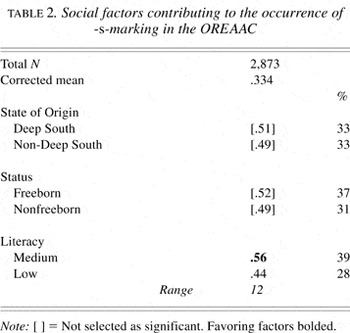
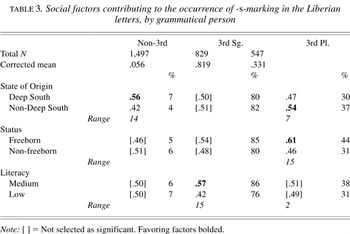
All of the above factors were considered both individually and together using goldvarb 2.1 (Rand & Sankoff, 1990). Table 2 displays the results of a multivariate analysis of all 2,873 tokens, across all persons, and their distribution across social factors, including both regular and irregular verbs. The only factor selected as significant is the degree of literacy, with more literate correspondents favoring -s. Separating the analysis according to grammatical person, as shown in Table 3, reveals that the literacy effect is significant only in third-person singular contexts, where -s is required in the standard language.8
The greater use of -s in both standard and nonstandard contexts by the more literate informants parallels Poplack and Tagliamonte's (1989) finding for Samaná English, in which informants with greater exposure to school and/or church used more -s across all contexts.
Social factors contributing to the occurrence of -s-marking in the OREAAC

Social factors contributing to the occurrence of -s-marking in the Liberian letters, by grammatical person

At first glance, the distinction between Deep South and non-Deep South writers lends credence to Singler's (1999) claim that differences in modern-day LSE may reflect different linguistic systems associated with the different origins of his Liberian Settler informants. However, the important consideration in comparative analysis is not the overall rate of occurrence across social groups, which can fluctuate for a number of (extralinguistic) reasons, but rather whether different groups (here, regions) share linguistic conditioning, as evidenced by the ordering and significance of linguistic factors contributing to the occurrence of -s.
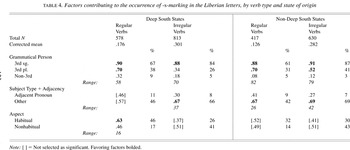
Therefore, the next step in the analysis is to consider whether the linguistic conditioning is parallel across the two groups of writers. In addition, the inclusion of both regular and irregular verbs may confound a purely phonological process (insertion and/or deletion of -s) with morphological or lexical considerations (suffixation, stem alteration, suppletion). Therefore, we performed separate multivariate analyses of -s-marking according to the type of verb, as well as the writer's state of origin. Table 4 shows the results of these analyses.
Factors contributing to the occurrence of -s-marking in the Liberian letters, by verb type and state of origin

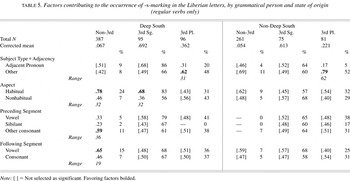
First, as noted previously, the OREAAC correspondents always adhere to the person-number hierarchy observed elsewhere, whereby rates of -s are highest in third-person singular, lower in third-plural, and lowest of all in other persons. In Table 4, this factor is not only selected as significant, but its strength (instantiated by the range) is considerably greater than the effect of other linguistic factor groups. This effect holds for both regular and irregular verbs, and for writers from the Deep South or elsewhere. Although the effects of subject type/adjacency and aspect are similar across categories in the percentages, these factor groups have not been selected as significant for all combinations of verb type and state of origin. However, recall that the effect of subject type/adjacency is claimed to hold only in third-person plural. Therefore, it is necessary to examine the conditioning of -s in each person-number context separately. Table 5 shows the results of a multivariate analysis for regular verbs, considering grammatical persons separately.
Factors contributing to the occurrence of -s-marking in the Liberian letters, by grammatical person and state of origin (regular verbs only)

The subject type-adjacency factor group (which tests the Northern Subject Rule) exerts a significant effect only with third-person plural subjects, the very context in which it has been found to occur in previous studies of Early AAE (and other varieties of nonstandard English). Writers from both Deep South and non-Deep South states avoid -s-marking in third-plural contexts when the subject is a pronoun adjacent to the verb, and prefer -s with all other subjects. In fact, the NSR effect is so strong in both groups that no other linguistic factor group is selected as significant in third-plural contexts.
In other grammatical persons, the absence of the NSR effect (and, arguably, the context which permits its application) allows other conditioning to achieve significance. In particular, preceding (nonsibilant) consonants exert a strong favoring effect on -s in nonthird-person contexts. This is the strongest overall effect (with a range of 36) in the Deep South, and it is categorical in the non-Deep South. This effect may be accidental or epiphenomenal, because phonological effects have been inconsistent or insignificant in earlier studies of -s-marking. Another possible explanation for this effect is hypercorrection, which we might expect to play a role in written documents. The preceding segment effect is significant only in nonthird-person contexts, where -s is infrequent (and forbidden in the standard) and occurs largely in phonological contexts where speakers wishing to avoid consonant clusters might be most expected to reinsert, paralleling an early finding for contemporary AAE (Labov, 1972:221).
The other strong effect in nonthird-person contexts is the favoring effect of habituals, described elsewhere for other Early AAE varieties. That this effect achieves significance only in the Deep South might result from the slightly larger amount of data for that region (especially given the overall infrequency of habituals in nonthird-person to begin with). However, note that the aspectual effect also holds in the Deep South for third-singular contexts, which suggests that this effect is valid.
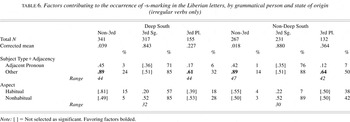
The linguistic conditioning of irregular verbs has received less scholarly attention than that of regular verbs, and studies usually consider the two categories together. Table 6 illustrates the results of a separate variable rule analysis of 1,443 irregular-verb tokens (largely have, be, and do) in the OREAAC.9
Since phonological factors are irrelevant in this context, they were not considered in the analysis.
Factors contributing to the occurrence of -s-marking in the Liberian letters, by grammatical person and state of origin (irregular verbs only)

First, note that the results are identical for the Deep South and non-Deep South writers. The NSR exerts a strong effect in third-person plural contexts, across region of origin. As we would expect, the NSR effect does not operate in third-singular, but it does appear to surface in nonthird-person contexts. Thus, the influence of the NSR effect with irregular as well as regular verbs suggests that verbal -s is a form of agreement, rather than a simple operation of suffixation.
The aspectual findings are also identical across regions. Only in third-singular is aspect significant, but in a direction opposite to that described elsewhere, with habituals disfavoring. However, we argue that this apparent effect results from the lexical composition of the irregular category. Unlike the situation with past marking, which features an array of irregular verbs (Van Herk, 2002; Van Herk & Poplack, 2003), the irregular category for present tense consists entirely of the verbs have, be, and do. The most frequent verbs, have and be, which occur largely in nonhabitual contexts, tend to show standard agreement patterns (cf., Patrick, 1991; Walker, 2000), leading to a contrary habitual effect only in third-singular, the only grammatical person requiring -s in Standard English. Such lexical effects, especially in irregular verbs, have been shown to underlie a range of apparent aspectual tendencies, especially given that lexical identity is often inextricable from aspect (Poplack & Tagliamonte, 2001; Tagliamonte, 1991; Van Herk & Poplack, 2003; Walker, 2000).
DISCUSSION
Our findings strongly suggest a number of conclusions. First, the Northern Subject Rule was clearly operative in the language of African Americans during the era of slavery, regardless of where in the United States they came from. Thus, if there were regional distinctions in Early AAE, they did not include differential application of the NSR, which has been found in other studies to contribute to Early AAE -s-marking. Because the OREAAC represents (a written version of) the input language varieties to the Liberian diaspora communities, we suggest that contemporary Liberian Settler English should show traces of the NSR effect, unless later developments have eroded either the conditioning of -s-marking or its overall rates of use. In the case of Sinoe, the decrease in -s-marking may be due to a number of reasons, such as contact with speakers of Liberian Pidgin English or a second-language variety of recaptured slaves who were integrated into the settler community. The strong tendency towards consonant-vowel (CV) syllable structure in the Liberian Settler English of Sinoe (Singler, 1991) may have led to word-final consonant-cluster deletion, which would have had the effect of eliminating verbal -s.
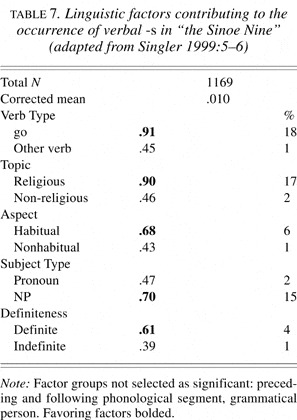
In fact, a close examination of the data provided in Singler (1999) shows that the Sinoe speakers who do use verbal -s show linguistic conditioning remarkably similar to what we have described for the Deep South correspondents. Although Singler did not investigate adjacency, he did test for the type of subject. As Table 7 shows, the “Sinoe Nine” show a strong subject-type effect, as well as an aspectual effect, parallel to our findings. Such parallels show that, despite the differing rates of use, the linguistic conditioning remains constant. Thus, the system generating this variability is revealed by the linguistic factors conditioning the use of the form, not simply by its overall rate of occurrence.
Linguistic factors contributing to the occurrence of verbal -s in “the Sinoe Nine” (adapted from Singler 1999:5–6)

These findings remind us of an operative assumption of the comparative method, as applied to variable linguistic evidence: namely, that similarities across varieties tell us more than differences (Poplack, 2000; Poplack & Tagliamonte, 2001; Tagliamonte, 2002). Specifically, shared retention of variable conditioning that cannot be attributed to universal considerations constitutes evidence of a shared origin. In this case, similar linguistic conditioning across widely-separated diaspora corpora is matched in the letters of writers from across the American South. As in traditional historical linguistics, we cannot interpret the absence of shared conditioning in widely separated or differently constituted varieties as proof that the varieties were never the same, although we rarely have access to the kind of diachronic confirmation the OREAAC offers.
Other similarities that we note here include the cross-regional tendency to use -s in nonthird-person contexts after consonants, which may be evidence of hypercorrection, and to disfavor -s with habitual irregular verbs, which appears to be an epiphenomenon of lexical considerations. Deep South and non-Deep South writers also behave identically in their application of the NSR effect in irregular verbs, which may provide theoretical insight into issues of how agreement rules operate in nonstandard varieties of English (cf., Börjars & Chapman, 1998; Henry, 1995).
The one robust regional distinction is the tendency of habituals to favor -s outside of third-plural contexts, statistically significant in the Deep South and potentially derived from one or more aspect-prominent donor varieties. It may be that the habitual effect achieves maximum strength only in those areas where (almost) all potential donor varieties contribute such a habitual distinction. That this tendency is also found across African American diaspora communities testifies to the speech-like nature of the OREAAC, and further suggests that this Deep South component is present in all the diaspora communities studied, apparently even those for which precise demographic information is unavailable.
The findings described here reinforce many of the earlier findings with respect to Early AAE -s-marking derived from work on diaspora communities. However, in this particular case, the application of variationist methodology to the analysis of a frequent and highly variable form in a regionally widespread, authentic 19th-century corpus of written Early AAE has allowed us to investigate regional diversity to a degree not previously possible. These results suggest that Early AAE, like any geographically widespread linguistic variety, displays the results of two opposing but complementary forces. There are subtle regional distinctions when specific settlement and population ecologies encourage them, but more important—and impressive—is the overall identity of forms and conditioning factors determined by shared history and circumstances of language contact and development.
References
REFERENCES
Anderson, James D.
(1988).
The education of Blacks in the South, 1860–1935.
Chapel Hill, NC:
University of North Carolina Press.CrossRef
Bailey, Beryl.
(1965).
Toward a new perspective in Negro English dialectology.
American Speech
40:171–177.Google Scholar
Bailey, Guy,
Maynor, Natalie, &
Cukor-Avila, Patricia.
(1989).
Variation in subject–verb concord in Early Modern
English.
Language Variation and Change
1:285–300.Google Scholar
Bailey, Guy,
Maynor, Natalie, &
Cukor-Avila, Patricia. (eds.).
(1991).
The emergence of Black English: Texts and commentary.
Amsterdam:
Benjamins.CrossRef
Baugh, John.
(1980).
A reexamination of the Black English copula. In
William Labov (ed.),
Locating language in time and space.
New York:
Academic Press.
83–106.
Bickerton, Derek.
(1975).
Dynamics of a creole system.
Cambridge:
Cambridge University Press.
Börjars, Kersti, &
Chapman, Carol.
(1998).
Agreement and pro-drop in some dialects of English.
Linguistics
36:71–98.Google Scholar
Brewer, Jeutonne.
(1986).
Durative marker or hypercorrection? The case of -s in the
WPA Ex-slave Narratives. In
Michael Montgomery &
Guy Bailey (eds.),
Language variety in the South. Perspectives in Black and
White. Tuscaloosa:
University of Alabama Press.
131–148.
Cornelius, Janet D.
(1991).
When I can read my title clear: Literacy, slavery, and religion in
the antebellum South.
Columbia:
University of South Carolina Press.
Dillard, J. L.
(1972).
Black English: Its history and usage in the United States.
New York:
Random House.
Fraenkel, Merran.
(1964).
Tribe and class in Monrovia.
Oxford:
Oxford University Press.
Henry, Alison.
(1995).
Belfast English and Standard English: Dialect variation and
parameter setting.
Oxford:
Oxford University Press.
Holm, John.
(1984).
Variability of the copula in Black English and its creole
kin.
American Speech
59:291–309.Google Scholar
Holm, John.
(1988).
Pidgins and creoles, volume 1: Theory and structure.
New York:
Cambridge University Press.
Ihalainen, Ossi.
(1992).
The dialects of England since 1776. In
Robert Burchfield (ed.),
The Cambridge history of the English language, volume V. English in
Britain and overseas: Origins and development.
Cambridge:
Cambridge University Press.
197–274.
Kautzsch, Alexander.
(2002).
The historical evolution of Earlier African American English: An
empirical comparison of early sources.
Berlin:
Mouton de Gruyter.CrossRef
Kautzsch, Alexander, &
Schneider, Edgar W.
(2000).
Differential creolization: Some evidence from Earlier African
American Vernacular English in South Carolina.
In
Ingrid Neumann-Holzschuh &
Edgar W. Schneider (eds.),
Degrees of restructuring in creole languages.
Amsterdam:
Benjamins.
247–274.
Labov, William.
(1972).
Sociolinguistic patterns.
Philadelphia:
University of Pennsylvania Press.
Liebenow, J. Gus.
(1987).
Liberia: The quest for democracy.
Bloomington, IN:
Indiana University Press.
McDaniel, Antonio.
(1995).
Swing low, sweet chariot: The mortality cost of colonizing Liberia
in the nineteenth century.
Chicago:
University of Chicago Press.
Meillet, Antoine.
(1967).
The comparative method in historical linguistics.
Paris:
Librairie Honoré Champion.
Montgomery, Michael.
(1999).
Eighteenth-century Sierra Leone English: Another exported variety of
African American English.
English World-Wide
20:1–34.Google Scholar
Montgomery, Michael, &
Fuller, Janet M.
(1996).
What was verbal -s in 19th-century African American
English? In
Edgar W. Schneider (ed.),
Focus on the USA.
Amsterdam:
Benjamins.
211–230.
Montgomery, Michael,
Fuller, Janet M., &
DeMarse, Sharon.
(1993).
The Black Man Has Wives and Sweet Harts [and third person
plural -s] Jest Like the White Men: Evidence from verbal
-s from written documents on 19th-century African American
speech.
Language Variation and Change
5:335–357.Google Scholar
Mufwene, Salikoko S.
(1996).
The Founder Principle in creole genesis.
Diachronica
13:83–134.Google Scholar
Mufwene, Salikoko S.
(2000).
Some sociohistorical inferences about the development of African
American English.
In
Shana Poplack (ed.),
The English history of African American English.
Oxford:
Blackwell.
233–263.
Patrick, Peter.
(1991).
Creoles at the intersection of variable processes: -t/d-deletion
and past-marking in the Jamaican mesolect.
Language Variation and Change
3:171–189.Google Scholar
Pitts, Walter.
(1981).
Beyond hypercorrection: The use of emphatic -z in
BEV.
Chicago Linguistic Society
17:303–310.Google Scholar
Pitts, Walter.
(1986).
Contrastive use of verbal -z in Slave Narratives.
In
David Sankoff (ed.),
Diversity and diachrony.
Amsterdam:
Benjamins.
73–82.
Poplack, Shana.
(2000).
Introduction. In
Shana Poplack (ed.),
The English history of African American English.
Oxford:
Blackwell.
1–32.
Poplack, Shana, &
Sankoff, David.
(1987).
The Philadelphia story in the Spanish Caribbean.
American Speech
64:291–314.Google Scholar
Poplack, Shana, &
Tagliamonte, Sali.
(1989).
There's no tense like the present: Verbal -s
inflection in early Black English.
Language Variation and Change
1:47–84.Google Scholar
Poplack, Shana, &
Tagliamonte, Sali.
(1991).
African American English in the diaspora: The case of old-line Nova
Scotians.
Language Variation and Change
3:301–339.Google Scholar
Poplack, Shana, &
Tagliamonte, Sali.
(2001).
African American English in the diaspora: Tense and aspect.
Oxford:
Blackwell.
Rand, David, &
Sankoff, David.
(1990).
GoldVarb: A variable rule application for the Macintosh. Version
2.1.
Centre de Recherches Mathématiques, Université de
Montréal.
Ransom, Roger L., &
Sutch, Richard.
(1977/2000).
One kind of freedom: The economic impact of Emancipation.
New York:
Cambridge University Press.
Rawick, George P. (ed.).
(1972, 1979).
The American slave: A composite autobiography.
Westport, CT:
Greenwood Press.
Rickford, John R.
(1977).
The question of prior creolization in Black English. In
Albert Valdman (ed.),
Pidgin and creole linguistics.
Bloomington, IN:
Indiana University Press.
190–221.
Rickford, John R.
(1997).
Prior creolization of African-American Vernacular English?
Sociohistorical and textual evidence from the 17th and 18th
centuries.
Journal of Sociolinguistics
1:315–336.Google Scholar
Schneider, Edgar W.
(1983).
The origin of the verbal -s in Black English.
American Speech
58:99–113.Google Scholar
Schneider, Edgar W.
(1989).
American earlier Black English.
Tuscaloosa:
University of Alabama Press.
Singler, John V.
(1989).
Plural marking in Liberian Settler English, 1820–1980.
American Speech
64:40–64.Google Scholar
Singler, John V.
(1991).
Liberian Settler English and the ex-slave recordings: A comparative
study.
In
Guy Bailey,
Natalie Maynor, &
Patricia Cukor-Avila (eds.),
The emergence of Black English: Texts and commentary.
Amsterdam:
Benjamins.
249–274.
Singler, John V.
(1997).
On the genesis, evolution, and diversity of African American
English: Evidence from verbal -s in the Liberian Settler English
of Sinoe.
Paper presented at the Society for Pidgin and Creole Linguistics,
London, UK.
Singler, John V.
(1998).
The African-American Diaspora: Who were the dispersed?
Paper presented at New Ways of Analyzing Variation 27, Athens,
GA.
Singler, John V.
(1999).
Passing verbal -s from Northern British Vernacular to the
Liberian Settler English of Sinoe: Transfer interrupted!
Paper presented at the special session on Accountability in
Reconstructing Verbal -s, Methods in Dialectology X,
Memorial University of Newfoundland,
St. John's, NF.
Stewart, William A.
(1967).
Sociolinguistic factors in the history of American Negro
dialects.
Florida FL Reporter
5:11.Google Scholar
Stewart, William A.
(1968).
Continuity and change in American Negro dialects.
Florida FL Reporter
6:3–4,
14–16, 18.Google Scholar
Stewart, William A.
(1973).
Continuity and change in American Negro dialects. In
Robert H. Bentley &
Samuel D. Crawford (eds.),
Black language reader.
Glenview, IL:
Scott, Foresman, & Co.
45–55.
Tagliamonte, Sali.
(1991).
A matter of time: Past temporal reference verbal structures in
Samaná English and the Ex-Slave Recordings.
Doctoral dissertation,
University of Ottawa.
Tagliamonte, Sali.
(2002).
Comparative sociolinguistics. In
J. K. Chambers,
Peter Trudgill, &
Natalie Schilling-Estes (eds.),
The handbook of language variation and change.
Oxford:
Blackwell.
729–763.
Tagliamonte, Sali, &
Poplack, Shana.
(in press).
Back to the present: Verbal -s in the (African American)
English diaspora. In
Raymond Hickey (ed.),
The legacy of colonial English: The study of transported
dialects.
Cambridge:
Cambridge University Press.
Van Herk, Gerard.
(1999).
“Ain't-shaped holes” and Standard English that
isn't: Negation and literacy in Early African American English
letters.
Paper presented at Methods X,
St. John's, Newfoundland.
Van Herk, Gerard.
(2002).
A message from the past: Past temporal reference in early African
American letters.
Doctoral dissertation,
University of Ottawa.
Van Herk, Gerard.
(2004).
Regional variation in 19th-century African American English.
Paper presented at Language Variety in the South 3.
Tuscaloosa, AL.
Van Herk, Gerard, &
Poplack, Shana.
(2003).
Rewriting the past: Bare verbs in the Ottawa Repository of Early
African American Correspondence.
Journal of Pidgin and Creole Languages
18:231–266.Google Scholar
Viereck, Wolfgang.
(1989).
A linguistic analysis of recordings of ‘early’ American
Black English.
In
Udo Fries &
Martin Heusser (eds.),
Meaning and beyond.
Tübingen:
Gunter Narr Verlag.
179–196.
Walker, James A.
(2000).
Present accounted for: Prosody and aspect in Early African American
English.
Doctoral dissertation,
University of Ottawa.
Walker, James A.
(2001).
Using the past to explain the present: Tense and temporal reference
in Early African American English.
Language Variation and Change
13:1–35.Google Scholar
Walker, James S. G.
(1992).
The Black Loyalists: The search for a promised land in Nova Scotia
and Sierra Leone, 1783–1870.
Toronto:
University of Toronto Press.
Winford, Donald.
(1997).
On the origins of African American Vernacular English—A
creolist perspective, Part I: The sociohistorical background.
Diachronica
14:305–344.Google Scholar
Winford, Donald.
(1998).
On the origins of African American Vernacular English—A
creolist perspective, Part II: Linguistic features.
Diachronica
15:99–154.Google Scholar
Wolfram, Walt.
(1999).
Principles of donor dialect attribution.
Paper presented at Methods in Dialectology X,
Memorial University of Newfoundland,
St. John's, NF.
Wolfram, Walt, &
Thomas, Erik.
(2002).
The development of African American English.
Oxford:
Blackwell.CrossRef

Reported demographic characteristics (in percentages) of OREAAC correspondents, the overall Liberian population, and the African American population in the United States ca. 1850
Social factors contributing to the occurrence of -s-marking in the OREAAC
Social factors contributing to the occurrence of -s-marking in the Liberian letters, by grammatical person
Factors contributing to the occurrence of -s-marking in the Liberian letters, by verb type and state of origin
Factors contributing to the occurrence of -s-marking in the Liberian letters, by grammatical person and state of origin (regular verbs only)
Factors contributing to the occurrence of -s-marking in the Liberian letters, by grammatical person and state of origin (irregular verbs only)
Linguistic factors contributing to the occurrence of verbal -s in “the Sinoe Nine” (adapted from Singler 1999:5–6)
 You have
Access
- 11
- Cited by