

INTRODUCTION
Muslim Americans constitute one of the United States’ most vulnerable minorities, facing prejudice and discrimination from both the public and the government (Howell and Jamal Reference Howell, Jamal, Baker, Howell, Lin, Shryock, Stockton and Tessler2009; Mogahed and Pervez Reference Mogahed and Pervez2016). Negative attitudes toward the community have remained high for decades (Kalkan, Layman and Uslaner Reference Kalkan, Layman and Uslaner2009; Panagopoulos Reference Panagopoulos2006), but this vulnerability has worsened in the context of the War on Terror, and more recently following the 2016 election (Calfano, Lajevardi and Michelson Reference Calfano, Lajevardi and Michelson2017; Haddad and Harb Reference Haddad and Harb2014). While scholars have developed a substantial body of research on the causes of prejudice against Muslim Americans, relatively few studies in the prejudice reduction field consider interventions to mitigate prejudice against this minority group. Footnote 1 Building on insights from these literatures, this paper reports results from an experiment designed to improve attitudes toward Muslim Americans.
Prejudice is a complex phenomenon with many contributing factors, but scholars have long recognized its connection to ignorance about the other (Fiske Reference Fiske, Gilbert, Fiske and Lindzey1998). Unfamiliarity with an out-group can encourage a focus on perceived dissimilarities and negative stereotypes, which then activates prejudice by exacerbating feelings of threat and fear (Stephan and Stephan Reference Stephan, Stephan and Oskamp2000). This dynamic appears relevant to prejudice against Muslim Americans. Unfamiliarity with Muslims is relatively common in the United States (Pew 2017a, 2010), and research shows that prejudiced views are related to inaccurate beliefs that the Muslim community is “different” in ways that pose both cultural and security threats to the country. For instance, Muslims in the United States are seen by many as a foreign minority that resists assimilation and falls outside of the country’s cultural mainstream (Kalkan, Layman and Uslaner Reference Kalkan, Layman and Uslaner2009; Panagopoulos Reference Panagopoulos2006; Pew 2017a). However, the vast majority of Muslim Americans are well integrated and proud of their American identity (Lajevardi and Oskooii Reference Lajevardi and Oskooii2018; Mogahed and Pervez Reference Mogahed and Pervez2016; Pew 2017b). Attitudes toward Muslim Americans are also tied to fears of terrorism: Muslims are stereotyped as violent and threatening (Hellwig and Sinno Reference Hellwig and Sinno2016; Morey and Yaqin Reference Morey and Yaqin2011; Piazza Reference Piazza2015; Sides and Gross Reference Sides and Gross2013), and their loyalty to the United States is often questioned (Braman and Sinno Reference Braman and Sinno2009; Haddad and Harb Reference Haddad and Harb2014). Yet, Muslim Americans are just as likely as other Americans to reject political violence (Mogahed and Pervez Reference Mogahed and Pervez2016), and they have often played a crucial role in assisting US law enforcement, even while experiencing discrimination from these institutions (Aziz Reference Aziz2016). In other words, prejudice is linked to inaccurate views of Muslims as “enemy Others” (Jamal Reference Jamal, Jamal and Naber2008) — a community that is foreign, threatening, and disloyal to the United States. Footnote 2
Can information countering these misperceptions help to reduce prejudice? Changing attitudes is difficult, because people are frequently motivated to resist information that counters their existing beliefs (Taber and Lodge Reference Taber and Lodge2006). This difficulty extends to prejudice reduction, since prejudiced attitudes tend to be deeply held (Paluck Reference Paluck2009; Tesler Reference Tesler2015), including toward Muslim Americans (Lajevardi and Oskooii Reference Lajevardi and Oskooii2018). As a result, even successful interventions often produce only modest effects (Stangor Reference Stangor and Nelson2009). However, negative attitudes can and do shift, as demonstrated by several recent studies that attempt to reduce prejudice against vulnerable groups (e.g. Bonilla and Mo Reference Bonilla and Mo2018; Broockman and Kalla Reference Broockman and Kalla2016; Facchini, Margalit and Nakata Reference Facchini, Margalit and Nakata2016). To the extent that ignorance contributes to prejudice by fostering perceptions of threatening differences with the other, interventions that seek to downplay or disprove these differences provide a potential method for reducing prejudice, and research suggests that this approach can be successful (Fiske Reference Fiske, Gilbert, Fiske and Lindzey1998; Paluck and Green Reference Paluck and Green2009; Stangor Reference Stangor and Nelson2009). Since prejudice against Muslim Americans appears to be rooted partially in misperceptions about how the community differs from the American mainstream, I test whether this prejudice can be lessened by information demonstrating that Muslim Americans’ identities, hobbies, and attitudes toward political violence are similar to those of other Americans.
The experiment generated modest improvements in respondents’ attitudes, particularly among some groups predisposed to prejudice against Muslim Americans. However, the results also demonstrated potential vulnerabilities to competitive information environments and social desirability bias. The findings contribute to the literature on prejudice reduction by addressing a particularly vulnerable but understudied minority group, by suggesting certain contexts in which attitude improvement is more or less likely to occur, and by providing additional survey-experimental evidence in a field that has relied primarily on non-experimental or lab-based research (Paluck Reference Paluck2016). The paper also has practical implications for attempts to reduce prejudice, since the intervention builds on common efforts to mitigate prejudice against Muslim Americans and other groups.
RESEARCH DESIGN
Sample
The experiment was conducted simultaneously on three nationally representative omnibus surveys implemented online in Qualtrics via Survey Sampling International (SSI) in March 2017. Each survey included different questions on various political and social topics in the United States, but the experimental intervention was identical, and the surveys were split only because of the funding arrangement for the project. Footnote 3 The total sample included 3,267 respondents after 458 speeders were dropped. Footnote 4 More details on the sample composition can be found in Supplementary Online Appendix Section 2.
Experimental Design
Two-thirds of respondents were randomly assigned to the treatment group. These respondents were exposed to a prompt with information addressing misperceptions about Muslim Americans. The remaining one-third of respondents in the control group received no prompt. The treatment is shown here:
Most Americans say they do not know any Muslims. To help address this unfamiliarity, two research centers (ISPU and the Pew Research Center) have compiled information comparing Muslim Americans to other Americans. Some of this information is shown below. Does any of the information here surprise you? Please check the boxes that you find surprising. Footnote 5
Muslim Americans have the same hobbies as other Americans: 48 percent of Muslim Americans watch pro or college sports regularly, compared to 47 percent of the general American public.
Muslim Americans oppose violence against civilians as much as other Americans: 81 percent of Muslim Americans say violence against civilians is never justified, compared to 84 percent of Protestant-Americans.
Muslim Americans value their American identity as much as other Americans: 85 percent of Muslim Americans say that being an American is very or somewhat important to their identity, compared to 84 percent of Protestant-Americans.
The first statement is from a poll conducted by Pew (2010) on the Muslim American community, and the other two statements are taken from a 2016 poll of American faith communities conducted by the Institute for Social Policy and Understanding (ISPU), a research and advocacy group focused on Muslim Americans. Footnote 6 These comparisons have been used by ISPU in publications and messaging campaigns aimed at reducing prejudice against Muslim Americans (e.g. Mogahed and Pervez Reference Mogahed and Pervez2016), providing the information with a degree of practical relevance.
Respondents were asked to mark any of the statements they found surprising to encourage them to read the information more closely and to provide a check about misperceptions. For those who received the treatment, 42 percent were willing to admit that at least one of the statements surprised them. The experiment combined the statements to ensure a relatively strong treatment – given the difficulty of shifting prejudiced attitudes – and because real-world efforts at prejudice reduction typically combine multiple messages in this way. However, one limitation of this design is the inability to determine whether the information contained in some of these statements matters more than others for attitude change.
The experiment included two additional manipulations intended as robustness checks. First, prejudice reduction strategies must compete with environmental cues and deliberate messaging that promote prejudice. This contestation can make it more difficult to shift attitudes (Chong and Druckman Reference Chong and Druckman2007; Garrett, Nisbet and Lynch Reference Garrett, Nisbet and Lynch2013), so it is important to test the robustness of interventions to competitive information environments (Lazarev and Sharma Reference Lazarev and Sharma2017). Regarding Muslim Americans, media and political actors often promote misperceptions, particularly about Muslims and terrorism (Akram Reference Akram2002; Powell Reference Powell2011). As a result, I evaluated the treatment’s robustness to an environment in which fear of terrorism was present by randomly assigning half of the respondents to a question priming terrorism threats. For those assigned to the prime, it was the first component of the survey module they viewed. These respondents were reminded of recent ISIS attacks in the West and asked to rate the threat terrorism posed to the United States.
Second, to evaluate the effects of social desirability bias, half of the respondents were randomly assigned to a statement licensing them to voice non-politically correct views. This sentence was embedded in the instructions for the first outcome question, following the terrorism prime and information treatment but preceding any responses to the outcomes. It stated that “People have different opinions about Muslim Americans, so you should not feel like you need to be politically correct.”
To summarize the survey procedure, respondents were first exposed to the terrorism prime or not, they were then provided with the information treatment or not, and finally they were assigned to the non-PC license or not in the outcome instructions, at which point they responded to the questions. The full survey module can be found in Supplementary Online Appendix Section 3, and additional details about the randomization can be found in Supplementary Online Appendix Section 5. Balance on a range of covariates was attained across all manipulations. See Supplementary Online Appendix Section 6 for balance tables.
Outcomes
Respondents answered five outcome questions meant to capture both perceptions of Muslim Americans and views of how the government should treat Muslim Americans (Lajevardi and Abrajano Reference Lajevardi and Abrajano2018). Regarding perceptions, respondents rated Muslim Americans on a feeling thermometer, and they were also asked if Muslim Americans were just as patriotic as other Americans. Regarding policies, respondents were asked about their support for increasing surveillance of Muslim Americans, banning refugees from Muslim countries, and requiring Muslim Americans to register with the government. All three policies would be harmful to the Muslim American community, all three were mentioned by presidential contenders during the 2016 campaign (Hobbs and Lajevardi Reference Hobbs and Lajevardi2019), and all three have sometimes found meaningful support among the American public (Jamal Reference Jamal, Jamal and Naber2008; Panagopoulos Reference Panagopoulos2006).
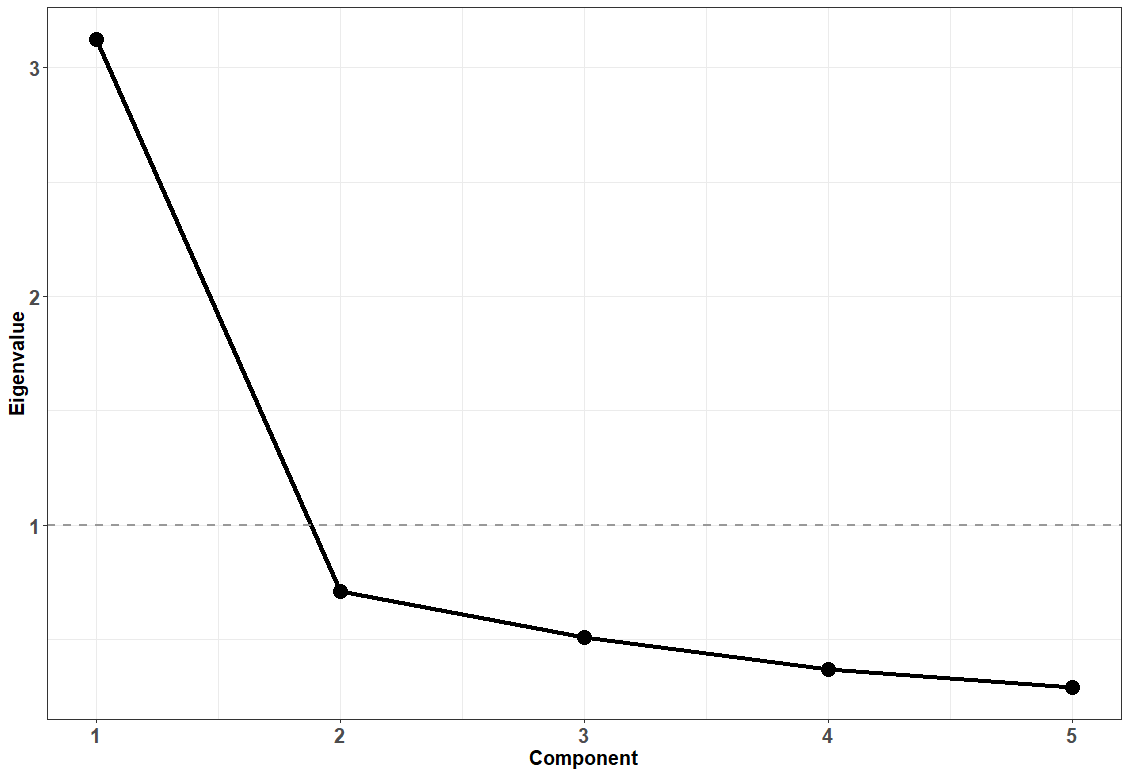
The questions have a high degree of internal consistency, with a Cronbach’s alpha of 0.85. I also aggregate the questions with principal components analysis (PCA) and use the first component as an additional outcome. See Supplementary Online Appendix Section 4 for details about the PCA results and summary statistics for all outcome measures.
Hypotheses
The primary hypothesis of the study is that respondents exposed to the information treatment would, on average, demonstrate more favorable attitudes toward Muslim Americans. I also explore heterogeneous effects among subgroups predisposed to hold prejudiced views. Practically speaking, interventions to reduce prejudice aim to change attitudes of the prejudiced, so it is important to understand the reactions of subgroups with more negative attitudes toward Muslim Americans. Because people resist information that conflicts with their beliefs (Taber and Lodge Reference Taber and Lodge2006), attempts to reduce prejudice may “preach to the converted” (Fiske Reference Fiske, Gilbert, Fiske and Lindzey1998), with the treatment influencing those who already hold relatively favorable attitudes (Adida, Lo and Platas Reference Adida, Lo and Platas2018), or perhaps backfiring among those it was designed to persuade (Nyhan and Reifler Reference Nyhan and Reifler2010). As a result, it is possible that treatment effects will be weaker or even negative among subgroups that tend to view Muslim Americans poorly. On the other hand, the treatment is intended to improve attitudes by providing new information that reduces misperceptions about differences with Muslim Americans. These misperceptions should be more common among groups with more prejudiced attitudes (Fiske Reference Fiske, Gilbert, Fiske and Lindzey1998), suggesting they also have more to learn from the treatment. It is, therefore, possible that they react to the treatment more strongly. Previous research indicates that negative attitudes toward Muslim Americans are especially pronounced among Republican, older, and white Americans who do not know any Muslims (Chalabi Reference Chalabi2015; Pew 2017a), so I look at heterogeneous effects for these groups.
RESULTS
Exposure to the information treatment appears to have generated modest improvement in attitudes toward Muslim Americans. Main effects are analyzed using two-sample t-tests: these results are shown in Figure 1, with higher outcomes indicative of less prejudiced views. Footnote 7 The average value of the PCA component increased by 0.13 standard deviations (p = 0.000). Favorability on the feeling thermometer increased from 59.2 to 64.4 (p = 0.000), equivalent to a one-fifth standard deviation increase. Likewise, respondents who described Muslim Americans as equally or more patriotic increased from 63.2 percent to 67.9 percent (p = 0.008), equivalent to a one-tenth standard deviation increase. While the effect sizes are relatively small, they are substantively important. For instance, if a shift of 5 percentage points on the feeling thermometer occurred among the public, the gap between attitudes toward Muslim and Protestant Americans would decrease by 30 percent (Pew 2017a).
Main Effects for Information Treatment.
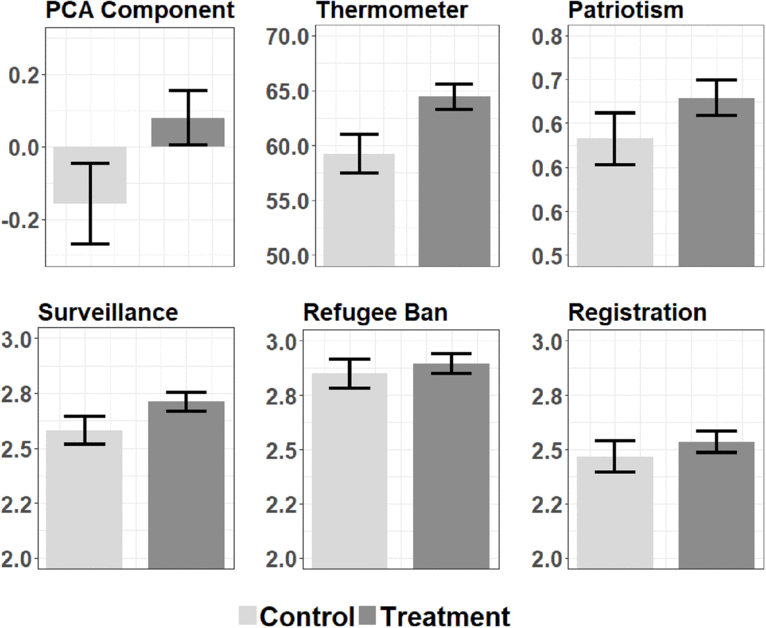
However, effects for the policy outcomes were inconsistent, indicating less success at increasing opposition to policies that would harm Muslim Americans. For surveillance, the average increased from 2.58 to 2.71 (p = 0.000), equivalent to 0.13 standard deviations. Yet, responses for the refugee ban moved only from 2.85 to 2.89 (p = 0.255), an increase of 0.04 standard deviations. Similarly, responses for registration rose from 2.47 to 2.53 (p = 0.109), an increase of 0.05 standard deviations.
Furthermore, the main effects demonstrate some vulnerability to the competitive information environment, as well as social desirability bias. These results are displayed in Figure 2. Footnote 8 For the competitive information environment, the left panel shows the treatment effect among respondents not exposed to the terrorism prime, the treatment effect among respondents who were exposed to the prime, and the interaction between the treatment and the prime. Because the interaction terms were insignificant, it cannot be concluded that the treatment became less effective when respondents were first primed to think about terrorism (Gerber and Green Reference Gerber and Green2012). However, in general, the treatment appeared to weaken: the coefficients for all interaction terms were negative, and the treatment effect was only significant at 0.05 for the thermometer and surveillance outcomes among respondents exposed to the prime.
Robustness Checks for Main Effects.
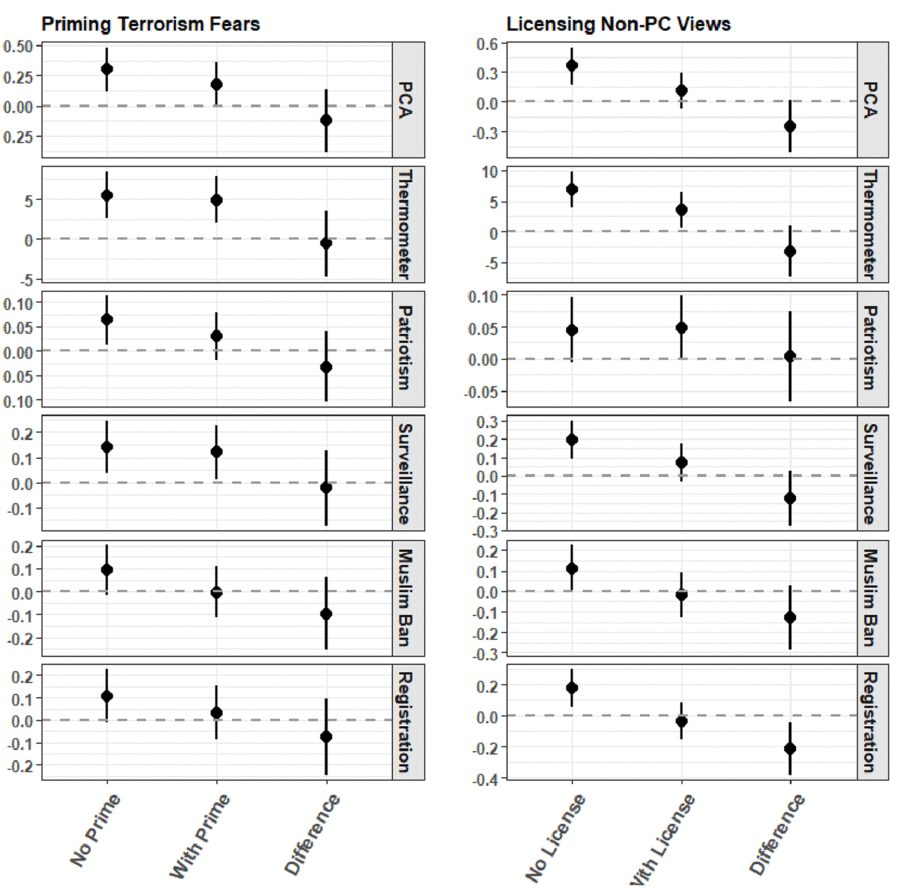
To evaluate robustness to social desirability bias, the right panel of Figure 2 shows the treatment effect without the non-PC license, the effect with the license, and the interaction between the treatment and the license. The results suggest that social desirability bias contributed to some – but not all – of the observed effects. Five of the six interaction terms were negative. Only the interaction for the registration outcome was significant at 0.05, but the other four negative interactions indicated a substantively meaningful decrease in the magnitude of the treatment effect when respondents were told they did not need to be politically correct. In addition, the treatment effects were only significant for the thermometer and patriotism outcomes in the presence of the non-PC license, and not for the policy outcomes. This pattern sheds light on the results for the main effects, where the treatment improved perceptions of Muslim Americans but struggled to reduce support for harmful policies.
Analysis of heterogeneous effects for subgroups predisposed to prejudice against Muslim Americans suggests that some of these groups actually responded more strongly to the treatment, in contrast to expectations that they should be more resistant to updating their beliefs favorably. These results are reported in Figure 3, using ordinary least squares (OLS) regressions with robust standard errors to evaluate the significance of the interaction terms. Because the subgroup characteristics are not randomly assigned, the regression models control for age, race, gender, education, news interest, conservative ideology, Republican party ID, and whether the respondent reported knowing any Muslims in the United States, as well as respondents’ exposure to the terrorism prime and non-PC license. Each plot shows coefficients for the treatment, the relevant demographic characteristic, and the interaction term.
Heterogeneous Effects.
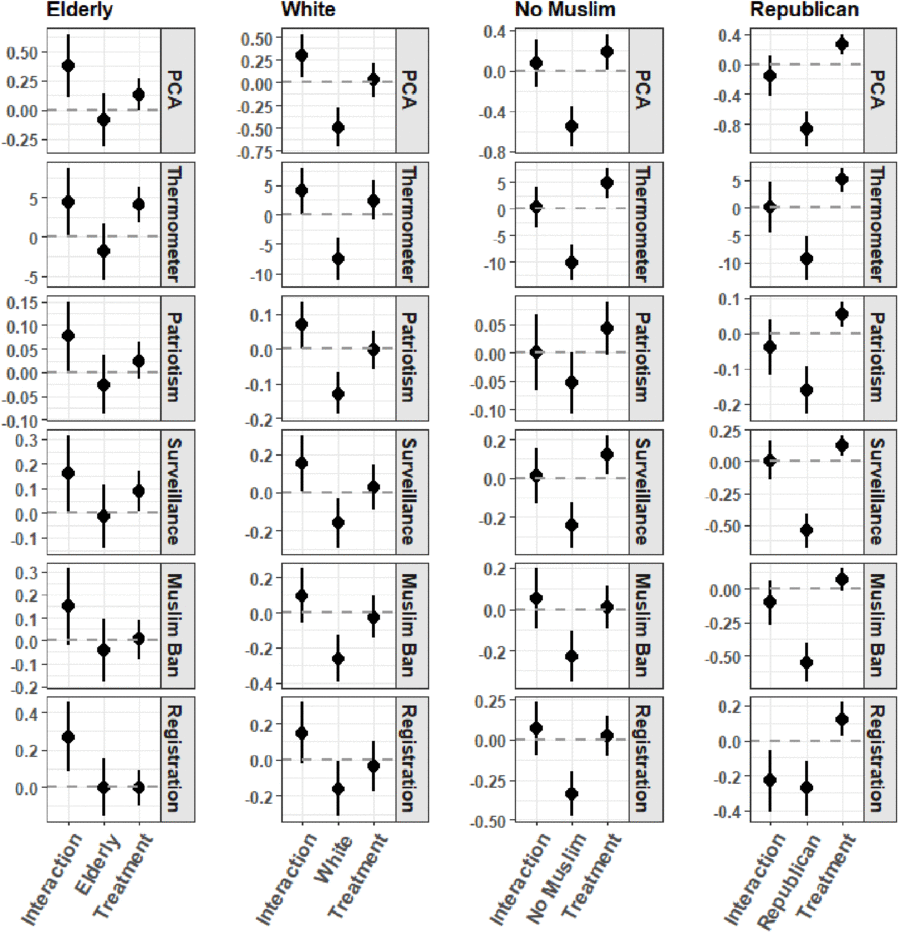
The interaction between the treatment and elderly respondents was positive and significant at 0.05 for five of the six outcomes, and the interaction with white respondents was positive and significant for three of the outcomes, with two others borderline. Footnote 9 Thus, elderly and white respondents seem to have been affected more strongly by the treatment. On the other hand, the interactions with not knowing Muslims were positive but insignificant, and the Republican interactions were primarily negative, though only the interaction for the registration outcome was significant. While not conclusive, these results suggest that Republicans were slightly more resistant to updating their beliefs following exposure to the information.
CONCLUSION
This paper finds that information countering misperceptions about how Muslim Americans differ from other Americans can somewhat decrease the expression of negative attitudes toward the community, at least in the short term. While the modest effects make it clear that this approach is no panacea for prejudice reduction, the results do suggest that advocates can acquire incremental benefits from pursuing informational campaigns carefully constructed to counter common but inaccurate beliefs about differences between the majority and a vulnerable minority.
A potential strength of the treatment was its relative success among white and elderly Americans, given their predisposition to negativity toward Muslim Americans. On the other hand, the fact that Republicans were somewhat less likely to respond to the treatment is more in line with the expectations that prejudice toward Muslim Americans will be deeply held and difficult to change (Lajevardi and Oskooii Reference Lajevardi and Oskooii2018). A possible explanation for the difference between these subgroups could be that hostility toward Muslims is associated with one’s Republican identity because of positions adopted by the party. Prejudiced Republicans might be particularly motivated to maintain their attitudes after exposure to information countering their misperceptions, since accepting such information would threaten their identity (Nyhan and Reifler Reference Nyhan and Reifler2019). In other words, some prejudiced people will be more motivated to hold onto their attitudes than others, but attempts to reduce prejudice need not always result in preaching to the converted.
One limitation of the treatment was its difficulty in shifting respondents’ policy attitudes, a finding that is consistent with experimental studies demonstrating that information often struggles to move policy preferences, even if it can change other attitudes (e.g. Grigorieff, Roth and Ubfal Reference Grigorieff, Roth and Ubfal2016; Lawrence and Sides Reference Lawrence and Sides2014). This divergence highlights the fact that improving attitudes toward a minority group does not necessarily translate into reduced support for policies that would harm the group. In part, this pattern may occur because views of salient policies are more closely tied to partisan identities that undermine respondents’ willingness to change their attitudes (Flynn, Nyhan and Reifler Reference Flynn, Nyhan and Reifler2017). Particularly since the treatment weakened slightly when confronted by even a modestly competitive information environment, the partisan and policy dynamics in the study suggest that attempts to reduce prejudice will face an uphill battle as long as the political and media actors seek to promote and benefit from misperceptions that Muslim Americans are different in ways that pose both cultural and security threats to the United States.
Supplementary Material
To view supplementary material for this article, please visit https://doi.org/10.1017/XPS.2019.22.