INTRODUCTION
Since the passage of the 1965 Immigration and Nationality Act, the United States has experienced a sustained inflow of foreign migrants. These immigration flows have increased the proportion of the U.S. resident population that is foreign-born and have contributed disproportionately to U.S. population growth. In 1970, the foreign-born accounted for 4.7% of the U.S. population. By 2000, the percentage of foreign-born increased to 10.4%. During these three decades, the foreign-born population increased by 18.8 million, accounting for roughly one-quarter of overall population growth (U.S. Bureau of the Census 2001).
Moreover, the source countries and relative skill profiles of this most recent wave of immigrants differ markedly from those of previous immigrants. While most pre-1965 immigrants originated in southern and central Europe and had similar levels of educational attainment to native-born Americans, the most recent immigrants come largely from Latin America and Southeast Asia and are on average relatively less educated (Borjas Reference Borjas1995, Reference Borjas1999).
Recent immigration trends coupled with the low average-skill levels of recent immigrants have raised concerns that immigration to the United States has adversely affected the earnings and employment of the least skilled native workers. Moreover, there have been several well-documented changes in native employment and earnings corresponding in time with this most recent immigrant wave. For example, the last three decades have witnessed pronounced increases in earnings inequality, with the premium associated with a college degree and work experience rising sharply beginning in the 1980s. Moreover, there have been marked declines in labor force participation and employment rates among relatively unskilled African American men.
Despite the coincidence of these immigration and labor market trends, the economic research pertaining to the impact of immigrants on native labor market outcomes is far from conclusive, with reputable scholars in considerable disagreement as to the magnitude of these impacts. Complicating matters, a number of factors that determine employment and earnings have changed coincidentally with the most recent immigrant wave, making it difficult to disentangle the impact of immigrant competition from the effects of other forces in the economy. For example, the proportion of the U.S. work force represented by unions has declined in recent decades, a fact likely to contribute to downward pressure on wages. The value of the federal minimum wage has declined after accounting for the effects of price inflation. As one further example, the proportion of low-skilled men who have served time in prison has increased at an alarming rate: the Bureau of Justice Statistics estimates that one in every five African American men is doing or has done prison time, a new factor that greatly compromises the labor market prospects of the lowest-earning native-born Americans. Isolating the impact of immigration on native outcomes requires a research design that holds constant these other factors, a considerably challenging methodological problem.
In this paper, we provide an overview of the current debate among economists pertaining to the effects of recent immigration on the earnings and employment of native-born workers. Since much of this debate revolves around methodological differences in research design, we devote much of our effort to discussing the various strategies that researchers have used to isolate immigrant competition effects, and the costs and benefits of each. Our overall assessment is that the central tendency of the research evidence suggests that recent immigration has had only a modest effect on the labor market prospects of native-born Americans. In the concluding section, we offer several potential hypotheses that may explain this lack of a large impact.
BASIC ECONOMIC MODELS OF IMMIGRATION AND LABOR MARKET COMPETITION
Plainly stated, a large increase in immigration will suppress the wages of those native-born workers who are in direct labor market competition with immigrants. The economic forces behind this proposition are best illustrated with a simple model of the overall economy. Suppose for the moment that all workers in the economy are exactly the same, such that employers can perfectly substitute one employee for another. Assume further that this “perfect substitutability” extends to the ability of employers to substitute an immigrant worker for a native worker. We will also assume that the stock of productive capital (machinery, plants, and equipment used in the production of goods and services) is fixed. Under these conditions, an increase in immigration will increase national output, lower the wages and employment of native workers, and increase total income accruing to the owners of capital.
Figure 1 illustrates these points in a simple supply-demand framework. The downward-sloping curve depicts the economy-wide demand for labor, with the height of the curve giving the maximum amount that employers would be willing to pay for one more worker at the corresponding level of employment. Incidentally, this amount equals the value of the output added by the last worker hired, a value that declines as the level of employment increases.Footnote 1 Thus, to induce employers to hire more workers relative to some given employment level, wages must decline. Since the height of the demand curve at any employment level provides the value added by the last worker, it follows that the area under the demand curve up until the actual employment level corresponds to the value of national output or gross domestic product (GDP).
The Effect of Immigration on Labor Supply and Native Wages and Employment

The upward sloping line, S 0, provides the supply of native workers to the labor market, or the number of workers willing to work at a given wage. The upward slope indicates that, as wages increase, more people will want to work. In the absence of foreign migration, the market will settle where supply equals demand, at the wage W o and the employment level E 0. Total wage and salary income is simply wages multiplied by employment (the area in the rectangle below the line at the wage level W o and to the left of the employment level E 0).
In this simple framework, international immigration impacts the economy by augmenting the number of people wishing to work at any given level of wages. For example, at the equilibrium wage, w o, the quantity of natives who wish to work is E 0, and absent international immigration this is where the economy will settle. Immigration, however, increases the number of people willing to work at this wage, effectively shifting the entire labor supply curve outward to S 1. At the old wage level, there are now more workers seeking employment than employers are willing to hire. Competition for jobs will drive down wages, inducing employers to expand employment and some job seekers to leave the labor market. This continues until wages decline to W 1 in Figure 1, where labor demand and supply are once again equal to one another.
Note the impact of this “labor supply shock” on the labor market outcomes of native workers and on the economy as a whole. To begin, wages have declined for all workers, immigrant as well as native, and thus natives who are still working are clearly worse off, relative to the outcome preimmigration. Moreover, despite the fact that total employment has increased, native employment has declined, since the decrease in wages causes some natives to withdraw from the labor market. This can be seen by looking at the number of native job seekers along the original natives-only supply curve, S 0, at the new lower wage, W 1. At the lower post-immigrant-wave wage, only E 2 natives will seek work, a decline in employment equal to the distance between E 0 and E 2. Thus, in this simple model, it must be the case that native-born workers are harmed by the influx of foreign-born labor.
In contrast, employers (or, more specifically, the owners of capital) clearly benefit from the influx of immigrants. Since overall employment has increased and the value of national output is given by the area under the demand curve up through the actual employment level, the nation's GDP must have also increased. Moreover, employers are now paying lower wages than they were previously. With higher national output and a lower wage level, the total income accruing to capital has clearly increased.
This is a relatively straightforward story. Immigration increases national output, harms native labor, but enriches the owners of capital. Stated in an alternative manner, using terminology that we will more clearly define below, immigration harms the “factors of production” with which it directly competes while benefiting the factors that it tends to complement. Given the large increases in immigration in recent decades and the clear predictions of these simple theoretical arguments, one may wonder what there is to debate.
Of course, the actual economy and the likely impacts of immigration operate within a far more complex model. Accounting for some of these complexities will help us to interpret the research findings that we discuss below. Perhaps the best way to proceed is to relax some of the simplifying assumptions that permitted us to reduce the entire economy to Figure 1, and discuss how this affects the story.
Most conspicuously, we assumed that employers can perfectly substitute the average immigrant worker for the average native worker (and vice versa). This is clearly unrealistic. Immigrants and natives differ along a number of dimensions that are likely to be of value to employers. Immigrants tend to have less formal education on average, with levels of educational attainment particularly low among Hispanic immigrants and many Southeast Asian immigrants. Immigrant and native-born workers are likely to differ in their ability to converse in English. Immigrants also tend to be younger than natives, which suggests that the average immigrant worker may have less labor market experience than the average native-born worker.Footnote 2
Given such differences in skills, it is more likely that immigrants and natives are what economists refer to as “imperfect substitutes” in production (i.e., substituting immigrant for native workers is possible, but limited by differences in skills). Moreover, the substitution possibilities are likely to vary across jobs according to the skill content of various occupations. In some instances, certain subgroups of natives are likely to complement immigrant labor in production. That is to say, certain native workers are likely to be hired in conjunction with the hiring of immigrant workers. For example, Spanish-speaking laborers on a construction site may increase the demand for native-born bilingual Hispanics with enough education to serve in supervisory positions. As another example, an increase in the supply of low-skilled construction labor may increase the demand for architects, structural and civil engineers, skilled craftsmen, and workers in other occupations important to the construction industry.
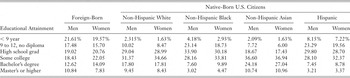
The imperfect substitutability between immigrant and native workers in the United States is most readily demonstrated by comparing their distributions of educational attainment. Table 1 presents the distributions of immigrants and native men and women of eighteen to sixty-four years of age across formal educational-attainment levels for the year 2000. We tabulated these figures from the 1% Public Use Microdata Sample (PUMS) of the 2000 U.S. Census of Population and Housing. The share of immigrant workers with extremely low levels of educational attainment is quite high relative to all native groups. For example, roughly 22% of immigrant men left school before the ninth grade, as compared with 2% of native-born White men, 4% of native-born Black men, 2% of native-born Asian men, and 8% of native-born Hispanic men. Similar patterns are observed when comparing immigrant and native-born women. Immigrants are also more likely to hold advanced degrees, relative to most of the native-born groups.
Distribution of Educational Attainment by Immigration States and by Race/Ethnicity for Adults, 18 to 64 Years of Age, 2000

Interestingly, the immigrant distribution across educational-attainment categories is lightest in the intermediate educational-attainment levels, among high school graduates and those who have some college. Roughly 38% of immigrant men and 43% of immigrant women fall within these two educational-attainment levels. By contrast, over 60% of non-Hispanic native-born White and Black workers are in these two educational-attainment categories, as are nearly 60% of native-born Hispanic men and women. Native-born Asian men and women are even more highly concentrated at higher levels of educational attainment.
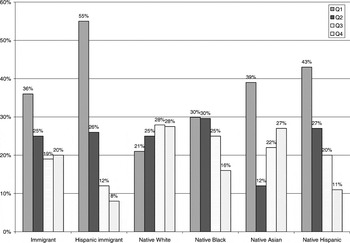
One can also characterize the degree of overlap between the skill distributions of immigrants and natives by incorporating the effects of age and education on skills and earnings. We did so by first defining fifty-four groups based on age and educational attainment.Footnote 3 We then used the 2000 PUMS data from the census to rank these groups from lowest to highest in average earnings among the employed within each group. This ranking serves as an indication of skill endowments as they are valued by the market.Footnote 4 Next, we identified those age-education groups that account for the bottom 25% (the first quartile) of the skill distribution for natives, the next 25% of natives (the second quartile), the middle-upper 25% of natives (the third quartile), and the top 25% of the native-skill distribution (quartile four). With this breakdown, we then calculated the percentage of each immigrant and native group that falls within each skill quartile. To the extent that the percentage for a given group and quartile exceeds 25%, the group is overrepresented in this portion of the skill distribution. Conversely, to the extent that the percentage falls below 25%, the group is underrepresented.
Figure 2 presents these skill distributions for immigrant and native men, and for Hispanic immigrant men. As can be seen, immigrants are heavily overrepresented in the least-skilled quartile and underrepresented in the remainder of the skill distribution. Fully 42% of all immigrant men and 62% of Hispanic immigrant men lie in the bottom quartile of the overall native-skill distribution. For the native-born, in contrast, 23% of White men, 35% of Black men, 41% of Asian men, and 48% of Hispanic men are in this low-skilled group. Furthermore, immigrants are underrepresented in the middle of the skill distribution, with 37% of all immigrants and 31% of Hispanic immigrants in the second and third quartiles. For the native-born, the comparable figures are 50% for White men, 53% for Black men, 34% for Asian men, and 43% for Hispanic men. Figure 3 presents the comparable distribution for women. The figure also reveals fairly large differences between the skill distributions of immigrants and natives.
Distribution of Immigrant and Native-Born Men across Earnings Groups, Based on Native Population Quartiles

Distribution of Immigrant and Native-Born Women across Earnings Groups, Based on Native Population Quartiles

These figures suggest that immigrants and natives differ considerably in their skills, a fact that complicates our analysis. Allowing for imperfect substitution between immigrant and native labor driven by differences in skills alters our theoretical predictions regarding the economic effects of immigrants on native labor market outcomes. Native workers whose skills are most like those of immigrants are most likely to be harmed, while native workers with sufficiently different skill sets are likely to be the least harmed or may even benefit in their wages and employment by an increase in immigrant labor. The educational-attainment figures presented in Table 1 and the skill distributions depicted in Figures 2 and 3 indicate that there are substantial differences in skills between immigrants and natives. Perhaps the greatest degree of similarity occurs between immigrants and native-born Hispanics. Nonetheless, one cannot predict a priori how immigration will affect each of these groups on average, as immigrant skill distributions clearly differ in each case. The ultimate effect of immigrants on natives (both the direction of the effect, as well as its magnitude) is an empirical rather than a theoretical question.
In the simple model in Figure 1, we assumed that the stock of productive capital used in the production of goods and services was fixed, an unrealistic assumption that figures prominently in understanding some of the differing empirical results we discuss below. To understand the importance of this assumption, we should briefly discuss the process by which capital accumulates in modern market economies. Changes in the capital stock from year to year reflect the difference between capital investment (which increases the capital stock) and capital depreciation (which diminishes the capital stock). Investment involves the deliberate allocation of resources toward activity that augments the future productive capacity of the economy (e.g., the production of a machine or factory). Capital depreciation occurs through the wear and tear of the existing capital stock. For the capital stock to increase, capital investments must exceed capital depreciation.
Whether the economy makes sufficient investments, on net, to increase the stock of productive capital will depend on the return to capital, with increasing returns to capital spurring net capital accumulation. If, for whatever reason, one can earn more with a lathe today than yesterday, the demand for investment capital for the purpose of producing lathes will increase. This will increase interest rates (the price of capital), which will induce people to save more domestically (supply their purchasing power to the capital market) and perhaps induce inflow of investment capital from abroad.
Immigration may increase the returns to capital by altering the composition of a nation's factors of production. To appreciate this point, it is helpful to think about how the mix of a country's endowment of productive inputs (referred to as factor proportions) affects the marginal productivity of each input. The higher the amount of capital per worker, the more capital each employed person has to work with, which translates into higher labor productivity. Conversely, with a higher ratio of labor to capital, each unit of capital has more labor to work with, increasing the average productivity of capital. By increasing the ratio of labor to capital (or, equivalently, reducing the capital-labor ratio), immigration makes the existing capital stock more productive on a per-unit basis. This in turn increases the returns to capital in the receiving nation and should spur net capital formation.
To see how allowing capital to respond to an immigrant inflow alters our conclusion from the model in Figure 1, Figure 4 charts the effect of a net augmentation of capital in response to an increase in immigration. As before, we begin with our original labor-demand curve, D 0, our native labor-supply curve, S 0, and the labor-supply curve incorporating a new wave of immigrants, S 1. As before, immigration leads to a decrease in wages, an increase in overall employment, and a reduction in native employment. An increase in capital stock in response to the immigrant wave will add one additional adjustment to our original story. An increase in capital now makes labor more productive, increasing the value of the output of the marginal worker at each point. Since the height of the demand curve is indicative of this value, the increase in the capital stock shifts the labor-demand curve upward to D 1. This increase in labor demand will result in an excess demand for labor at the wage W 1 (in other words, there will be more employers seeking workers than workers seeking jobs at that wage level). Wages will increase, and, as they do, more workers—native as well as immigrant—will be coaxed into the labor market. Thus, capital accumulation will partially offset the negative effects of immigration on native wages and employment. The degree of this offset will depend on the responsiveness of capital supply to changes in return, as well as underlying technological relationships governing production in the economy.
Allowing Capital to Accumulate in Response to Immigration Inflow

We began with a simple story according to which immigration unambiguously lowers the wages and reduces the employment level of native workers, and then finished with a more nuanced description, where the theoretical predictions are more ambiguous and varied. As the theoretical prediction regarding the effect of immigrants on natives is ambiguous, the question is ultimately empirical in nature. Thus, we now turn to a discussion of existing empirical research on the labor market effects of immigration.
A REVIEW OF THE EMPIRICAL FINDINGS
Over the past three decades, a large number of studies have characterized the degree of competition between immigrants and natives, and estimated the overall effect of immigration to the United States on the nation's wage structure. Research on this question has, broadly speaking, pursued one of two methodological strategies. First, many studies compare cities or metropolitan areas in the United States with small immigrant populations to those with large immigrant populations and estimate immigrant competition effects from corresponding differences in native labor market outcomes. Studies that pursue this strategy consistently find very modest effects of immigrants on native employment rates and wages.
An alternative strand in this literature estimates the effects of immigration on natives by analyzing at the level of the nation how immigration has altered the relative supply of labor at various skill levels. Given information pertaining to the degree of substitutability between labor-skill groups, estimates of relative supply shifts can be used to simulate what relative wages would have been, had we not experienced the recent historic levels of immigration, with the difference between the “counterfactual” and the actual wage structure providing estimates of overall effects. While not every study in this vein has found large impacts of immigration on native wages, the estimates from this national-level research tend to be larger than the comparable estimates from the cross-regional analyses.
In this section, we provide a selective review of empirical research on the labor market effects of immigration. We summarize the results of key publications that employ either the national-level or the cross-regional approach. Since much of the disagreement among economists pertains to the methodological particulars of this research, we attempt to clarify the strengths and weaknesses of particular studies.
Research that Exploits Interregional Variation in Immigrant Concentration
Our theoretical discussion indicated that increases in immigration should negatively impact the employment and earnings of those who are most similar to immigrants in terms of the skills that they bring to the labor market. To empirically determine such an impact, one needs to compare labor markets where immigrant competition with natives is relatively fierce, with otherwise similar labor markets where competitive pressures from immigrants are less severe. In other words, we need variation.
Within the United States, regional differences in the relative size of the immigrant population provide a natural starting point for such an inquiry. Coastal states such as New York and California have been traditional entry points for immigrants, as have important industrial states in the Midwest, such as Illinois and Michigan. While recent immigrants have fanned out across states, with notable recent increases in immigration to the South, it is still the case that the immigrant population is distributed unevenly across states and metropolitan areas in the United States, relative to the comparable distributions of the native-born.
A number of studies have exploited this interregional variation in immigrant concentration to estimate the effect of immigration on local labor markets. The typical methodological approach in this research is to estimate a linear regression, where the dependent variable is either the average wage of native-born workers or the change in average wages measured at the city level, and the key explanatory variable is either the level or the change in the fraction of the local working-age population that is immigrant. Theory suggests that wages should be lower (or should be more likely to decline) in areas with larger immigrant proportions (or larger increases in the proportion of resident immigrants).
While such comparisons are intuitively appealing, a number of methodological issues must be addressed if the results from such interregional strategies are to be interpreted as providing causal estimates.Footnote 5 First, where immigrants choose to locate within the United States is likely to depend on regional employment prospects. To the extent that immigrants choose areas with strong labor markets or strong growth prospects, inter-area differences in other determinants of labor market outcomes may mask any adverse effect of immigrants on natives. In other words, simple regressions of native labor market outcomes on the proportion of residents who are immigrant are likely to be biased toward zero by unobserved differences in the strength of the regional economy.
Second, the residential location choices of native-born U.S. residents are quite sensitive to labor market conditions. Natives tend to move from high-unemployment and low-wage areas to low-unemployment and high-wage areas, a fact that greatly facilitates the economy's adjustment to regional economic shocks. To the extent that immigrants suppress a region's wages, natives may simply pick up and leave. Such a mobility response by natives would dull the effect of an immigrant influx into a specific region and transmit part of the shock to other regions of the nation, those on the receiving end of out-migrating natives.
Finally, interregional trade in goods and services may further diffuse any immigrant-induced shock to labor supply through an adjustment of the industrial structure of the regional economy. One can conceive of regional economies as small, open economies that operate within a larger collection of small economies. The local economy will produce some goods and services for local consumption (which economists refer to as nontradable goods) and produce other goods and services for trade with other regional economies (which we will call tradable commodities). Naturally, the local economy will specialize in producing those goods for which its resources are best suited and import those goods for which its resources are least well suited. Thus, if a region's labor force is disproportionately high skilled, the region will produce and export tradable goods that use high-skilled labor intensively and import from other cities primarily tradable goods that are produced through the use of low-skilled labor. In such a world, an influx of immigrant labor that differs in composition from the incumbent native work force may eventually alter the mix of what is produced locally and what is imported from other regions. For example, an influx of low-skilled immigrants into a relatively high-skilled labor market may induce an expanded production of goods that use low-skilled workers intensively, and a curtailing of the importation of such goods. Such an expansion would again dull the local labor market effects of immigrant competition, while transmitting the shock to other regions in the form of lower import demand for their output.
Note that all three of these factors would tend to bias interregional correlations between immigrant penetration and native labor market outcomes toward the finding of no or small effects. In our discussion to follow, we assess how each study addresses these critiques.
One of the earliest examples of a cross-regional analysis is provided by Grossman (Reference Grossman1982), who uses data from the 1970 U.S. Census for a small number of Standard Metropolitan Statistical Areas (SMSAs) to estimate the degree to which native-born workers, second-generation native-born workers, and immigrant workers compete with one another in the labor market. While the actual estimation details of this study are complex, the basic strategy is to estimate the cross-sectional correlation between the relative supply of each group of workers and the fraction of regionally produced output paid to each group in the form of wage and salary income. Grossman finds relatively small effects of immigrants on natives and second-generation natives, with a 10% increase in the immigrant population predicted to have no more than a 1% negative effect on wages in the long run. This early study by Grossman does not account for the nonrandom residential choices of immigrants, the potential effect of the out-migration of natives, or the potential adjustment of the regional economy through trade with cities.
Altonji and Card (Reference Altonji, Card, Abowd and Freeman1991) provide one of the earliest examples in the cross-regional research literature to directly address some of these methodological challenges. Similar to Grossman (Reference Grossman1982), the authors analyze the cross-sectional relationship between the wages and employment of low-skilled native-born workers and the fraction of the local adult population that is immigrant. The authors go further, however, in that they use a much larger number of SMSAs in their analysis (over 150), present results for 1970 and 1980, and estimate models that regress the change over the decade of the 1970s in average native wages and employment on the change in immigrant penetration. The principal benefit of modeling the change in native labor market outcomes rather than conducting a cross-sectional comparison is that a within-city change analysis effectively controls for any intercity differences that are constant through time. Thus, if Los Angeles and New York happen to be high-wage cities throughout U.S. history, this will not bias a change analysis, as the study is effectively comparing how the change in immigrant concentration in Los Angeles and New York correlates with a change in native wages and employment.
An additional innovation in this study is that Altonji and Card (Reference Altonji, Card, Abowd and Freeman1991) isolate the variation in growth in the immigrant population likely to be independent of regional economic factors that may be unobservable to the researcher but that influence the residential choices of immigrants. In particular, the authors isolate variation in the growth of the regional immigrant population associated with historical immigration patterns in 1970. The authors show that cities with larger immigrant populations in 1970 had greater proportional growth in immigrant populations between 1970 and 1980.
Using cross-city variation in the growth of the immigrant population caused by differences in the historical location choices of immigrants, Altonji and Card (Reference Altonji, Card, Abowd and Freeman1991) find little consistent evidence of a negative impact of immigration on native employment rates. The authors do, however, find modest negative effects of immigrant competition on wages. Interestingly, their correction for the nonrandom location choice of immigrants increases the size of these estimates, suggesting that cross-sectional comparisons that make no such adjustment are indeed biased toward zero.
Pischke and Velling (Reference Pischke and Velling1997) present a comparable analysis, using data from 1985 and 1989 for Germany. One of the benefits of applying this methodological framework to Germany is that Germans are considerably less mobile interregionally within the nation than are Americans, thus native mobility is likely to pose less of a confounding variable. The authors divide Germany into 167 local labor markets, using geographic boundaries that minimize the degree of cross-area commuting. The authors test for effects of regional increases in the overall immigration share on overall employment and unemployment rates using change regressions and adjustment for nonrandom immigrant location comparable to those presented in Altonji and Card (Reference Altonji, Card, Abowd and Freeman1991). The study finds little evidence of a displacement effect and little evidence that native-born Germans migrate out of areas in response to increases in the immigrant population.
Card (Reference Card2001) uses cross-metropolitan area data from the 1990 U.S. Census to estimate the effects of (1) regional differences in immigration flows on the occupational supply structure of cities across the country and of (2) immigration-induced supply shocks to specific occupations on local wages. This study also presents an analysis of the migration responses of natives to net increases in immigration, and tests for the effects of recent growth in immigration on wages, with an eye toward isolating a response period that is too short for the economy to adjust its industrial structure in the manner discussed above. This is the only regional study that addresses all three of the critiques of the interregional research in one form or another.
Card finds little evidence that native migration responds to the influx of immigrants. The study shows that a one-person increase in the supply of immigrant labor of a given skill level generally results in a one-person increase in the city's supply of labor at that skill level, suggesting very little offsetting effect due to native out-migration. The study also finds that immigration-induced increases in the relative supply of specific occupational groups within cities do indeed reduce overall employment rates, as well as wages. These effects, however, are modest. In terms of wage effects, an immigrant inflow that increases the supply of labor to one occupation by 10% is estimated to lower wages in this occupation by 1.5%. Moreover, since the study looks at the effects of recent immigrants, this estimate is unlikely to be dulled by shifts in the industrial composition of the local economy.
A number of studies have explored the three critiques of the regional research using alternative data sources and estimation strategies. Card and DiNardo (Reference Card and DiNardo2000) analyze in greater detail the migratory responses of natives to the influx of immigrants and find little evidence of a substantial response. Lewis (Reference Lewis2003) explores how the industrial composition of regional economies responds to an influx of immigrants, and finds little evidence of an expansion in employment in industries whose labor needs match those of the immigrant inflow (i.e., much of the regional adjustment to immigration occurs within industries). Finally, Card (Reference Card2005) updates the analysis in his 2001 study on native migratory responses and immigrant wage and employment effects using data from the 2000 U.S. Census. The results remain quite similar.
Natural Experiments
In addition to the research based on cross-regional comparisons, a small number of studies exploit concentrated, and arguably accidental, immigration flows into specific regional labor markets. Given that one of the main critiques of the regional research concerns the likelihood that migrants were choosing locations within the United States with strong regional market conditions, several researchers have looked for examples where politics, war, or some other factor has led to massive immigration shocks to a small region.
The earliest study to pursue such a strategy is Card's (Reference Card1990) analysis of the effect of the Mariel boat lift on the Miami labor market. Between May and September of 1980, approximately 125,000 Cuban immigrants migrated to the United States, with many of them settling in the Miami metropolitan area. This concentrated immigration influx increased the supply of workers to the Miami labor market by roughly 7% in a very short time period. The migration flow and ultimate location of these immigrants had very little to do with differences in economic conditions between Cuba and the United States. The boat lift followed an abrupt decision on the part of Fidel Castro on April 20, 1980, to allow anyone who wanted to leave Cuba to go. Moreover, the location choices of immigrants were driven largely by the facts that Miami was the closest U.S. port, and Miami already had a large Cuban population.
Card analyzes the path of wages and unemployment for native-born workers as well as for previous Cuban immigrants in the Miami labor market relative to a chosen group of other southern cities that did not experience a Mariel-induced population increase during the period from 1979 to 1985. The study tests for effects on natives of various skill levels and from various racial and ethnic groups. There is no evidence of an impact of this large influx on wages or unemployment rates. Most interestingly, Card finds little evidence of an effect on the wages of previous Cuban immigrants.
Hunt (Reference Hunt1992) presents a similar analysis using the 1962 independence of Algeria from France as an exogenous shock to the French population. Upon independence, nearly all French nationals residing in Algeria returned to France, a migratory flow that amounted to over 900,000 immigrants (roughly 1.6% of the total French labor force in 1962). Moreover, these immigrants tended to settle in the south of France where the climate was most similar to the Algerian climate, thus providing variation in the location of these immigrants. While Hunt finds relatively high unemployment rates among repatriates, she does not find large effects of these inflows on the unemployment rates of nonrepatriates. Her estimates suggest that the flow of repatriates increased the 1968 unemployment rate of nonrepatriates by, at most, 0.3%. The study finds similarly modest effects on annual salaries, with an upper-bound estimate of the effect of the influx nationwide of −1.3%.Footnote 6
As a final example, Friedberg (Reference Friedberg2001) analyzes the effect of Russian immigrants on the Israeli labor market during the 1990s. Again, the immigration flow in this instance was driven largely by the lifting of travel restrictions in the former Soviet Union, while the destination choice was driven largely by the fact that Israel imposed neither a waiting period nor numerical limitations on Jewish migrants from abroad. Friedberg analyzes how the massive increase in Russian immigrants affected the relative supply of workers in various occupational groups in Israel, under the assumption that the occupation of immigrants before migrating to Israel provides a good prediction of their occupation in their new home country. Friedberg finds no evidence of an adverse effect of Russian immigrants on the wages and unemployment of Israeli natives.
National-level Studies on the Effect of Immigration
Results from the regional-level estimates consistently find modest effects of immigration on the employment and earnings of native workers. In fact, the finding of no or little effect is so pervasive in this research that two prominent literature reviews on this topic written during the mid-1990s concluded that there is little evidence of an adverse effect of immigration on native labor market outcomes in the United States (Friedberg and Hunt, Reference Friedberg and Hunt1995; Smith and Edmonston, Reference Smith and Edmonston1997). Nonetheless, there are scholars who contend that it is impossible to simultaneously address the three critiques of interregional comparisons (the problems of nonrandom immigrant choice, native mobility responses, and adjustments through interregional trade) within this methodological framework. While many of the studies reviewed here have identified clear exogenous immigration shocks, it is difficult to argue that any of these studies has ruled out the possibility that portions of the labor market impacts are being diffused to other regions of the nation through the various adjustment valves discussed above.
Based on these contentions, several scholars argue for an analysis of immigration on native labor market outcomes using data at the national level. Borjas et al. (Reference Borjas, Freeman and Katz1997) provide such an analysis of the contribution of immigration and international trade to growth in U.S. wage inequality between 1980 and 1996. This study first presents a lengthy and detailed critique of the large body of cross-regional research, whose substantive outline is similar to the three critiques discussed above. The authors then go on to characterize how international immigration to the United States has altered the relative supply of low- and high-skilled labor (in the language of economists, the impact of immigration on relative factor proportions).
The authors present simulation estimates of these changes on the wage structure based on existing estimates of the degree of substitutability between low- and high-skilled workers. One of the key conclusions in this analysis is that immigration increased the supply of low-skilled labor in the United States to such an extent that, given existing estimates of the responsiveness of wages to shifts in supply, immigration explains a substantial portion of the increase in wage inequality occurring during the 1980s and the early 1990s. In particular, the authors conclude that immigration to the United States between 1980 and 1996 explains roughly half of the relative decline in the earnings of high school dropouts over this period.
Notably, Borjas et al. (Reference Borjas, Freeman and Katz1997) do not directly estimate the effect of the immigrant-induced supply shifts on national-level wages, but instead carry out their simulation using existing estimates of substitutability among workers of differing skills. Borjas (Reference Borjas2003), however, does use national-level data to directly estimate the overall correlation between immigrant penetration and native wages and employment, as well as the structural parameters that are needed to perform the factor proportions simulations comparable to those in his earlier work with Freeman and Katz.
In this later study, Borjas first divides the national-level labor market into a set of groups defined by four alternative levels of educational attainment (high school dropouts, high school graduates, some college, and college graduates) and eight work-experience groups (1 to 5 years, 6 to 10 years, 11 to 15 years, 16 to 20 years, 21 to 25 years, 26 to 30 years, 31 to 35 years, and 36 to 40 years).Footnote 7 When interacted with one another, these two dimensions split the labor force into thirty-two separate skills groups. Borjas then estimates the average annual earnings, weekly earnings, and fraction of year employed for natives in each of these groups, and the fraction of the total population in these groups that is immigrant for each of the years 1960, 1970, 1980, 1990, and 2000. Adjusting for time trends and group-specific factors that do not vary over time, Borjas finds strong negative associations between the labor market outcomes of natives and the proportion of one's skill group that is immigrant. To summarize the magnitude of these relationships, Borjas estimates that a 10% increase in labor supply caused by immigration results in a 4% decrease in average native weekly wages. With regard to annual earnings, a 10% immigrant-induced supply shock is estimated to decrease annual earnings by 6.4%. These estimates are considerably larger than those from the interregional literature, which predicts at most a 1.5% decline in wages associated with a 10% immigration-induced supply shock.
Borjas (Reference Borjas2003) then goes on to estimate a structural model of the national labor market, the parameters of which can be used to estimate how the impact of immigrant competition differs for workers of different skill levels. Specifically, using the education-skill groups described above, Borjas estimates the degree to which employers are able to substitute workers of different experience levels within groups defined by educational attainment, as well as the degree to which employers can substitute employees of different levels of educational attainment for one another. The analysis assumes that immigrants and natives in the same education/experience group are perfect substitutes for one another. Using these “elasticity of substitution” parameter estimates, Borjas is able to simulate the effect of the net change in the immigrant population between 1980 and 2000 on the wages of native workers from different skill groups. This structural analysis yields the conclusion that net migration to the United States between 1980 and 2000 induced an average reduction of approximately 3% in the real wages of natives, with a much larger reduction for natives who hadn't graduated from high school (a predicted real decline of 9%).
The results of this study represent a sharp departure from the previous literature. Moreover, unlike the early national-level study summarized above, this latter provides actual estimates of the competition effects of immigration, and thus is much more than a complex back-of-the-envelope calculation. However, the research design in Borjas (Reference Borjas2003) fails to account for many other factors that have changed over time and differentially within these skill groups that may also affect the wages and employment of natives. For example, in Raphael and Ronconi (Reference Raphael and Ronconi2005), we have shown that changes in the measure of immigrant competition employed by Borjas correlate quite strongly with changes in the fraction of natives within each skill group who are involved with the criminal justice system.
Clearly the increasingly common experience of serving or having served time in prison represents a barrier to stable employment that is more prevalent today among low-skilled men than in past years (Raphael Reference Raphael, Auerbach, Card and Quigley2005). Having served time is likely to negatively impact one's earnings through a host of channels. To begin, former inmates are likely to have fewer years of noninstitutionalized work experience relative to those who have not been incarcerated. Furthermore, serving time may negatively affect one's stock of human capital through the depreciation of skills while idle or the erosion of “soft skills” in the case of those who develop antisocial attitudes while incarcerated. Finally, employers consistently voice strong aversion to hiring workers with criminal history records, a factor that is likely to impact average employment and wages for certain native skill groups.
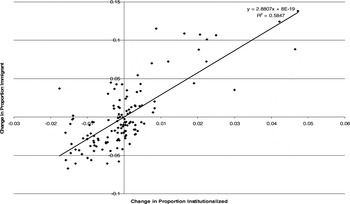
Figure 5 presents a scatterplot of adjusted interdecade changes in the proportion that is immigrant against the changes in the proportion of natives who are currently institutionalized, by skill group.Footnote 8 As can be seen, the change in the proportion of immigrants is strongly positively correlated with the change in the proportion of native men who are currently in prison or jail. To the extent that these correctional trends negatively affect wages and employment of men in these groups, omitting this factor from the regression analysis will lead to an overestimate of the effect of immigrants on native labor market outcomes.
Scatterplot of Adjusted Changes in Proportion Immigrant against Adjusted Changes in the Proportion Institutionalized for Education-Experience Year Cells

Indeed, we find that adding this single factor to the regression models in Borjas (Reference Borjas2003) substantially reduces the estimated impacts of immigrant competition. To be precise, in our preferred model specifications, we find that omitting correctional trends leads one to infer that a 10% increase in labor supply caused by immigration will result in a 5.3% decline in annual earnings and a 3.1% decline in weekly earnings. When correctional trends are accounted for, the comparable immigration competition effect estimates declines of −1.4% for annual earnings and 0% for weekly earnings. Thus, accounting for one additional factor using national-level variation provides estimated effects that are comparable to the results from the cross-regional research.
Moreover, the structural model in Borjas (Reference Borjas2003) used to simulate the effect of net migration between 1980 and 2000 on native wages of different skill levels has been shown to be quite sensitive to small changes in model specification. For example, Ottaviano and Peri (Reference Ottaviano and Peri2005) recalibrate the model in Borjas (Reference Borjas2003) with two key extensions. First, they build into their model the possibility that immigrants and natives within the skill groups defined in Borjas are not perfect substitutes for one another. This seems to be a reasonable assumption, given that immigrants and natives often differ in English fluency and other sorts of factors that may be of value to U.S. employers. Moreover, the data appear to support this more flexible specification of substitution possibilities over a model that assumes immigrants and natives to be equals as far as production is concerned within these skill groups.
Second, Ottaviano and Peri (Reference Ottaviano and Peri2005) incorporate capital accumulation in their model, while the simulations in Borjas (Reference Borjas2003) assume that stock of capital is fixed.Footnote 9 As we discussed above, an increase in immigration is likely to increase the returns to capital, and thus creates an incentive for natives to save more and for foreign capital to flow into the United States. Such capital flows will dampen the adverse effects of immigration on native wages.
Ottaviano and Peri (Reference Ottaviano and Peri2005) find, first, that immigrants and natives are not perfect substitutes within these groups, a fact that is likely to limit the effect of immigrant competition on native wages and employment while augmenting the effects of competition from newly arriving immigrants on the employment and wages of immigrants who arrived in previous years. The authors also find that resimulating the effect of immigration on wages, allowing capital to accumulate in response to the immigrant labor flows, yields much smaller estimated effects on natives. On net, these additions to Borjas's original analysis yield estimates of the effect of immigration on native labor market outcomes that are not far from the modest results derived from the cross-regional research.
CONCLUSION
Our review of the literature on the economic effects of immigrant competition on native-born Americans suggests that interregional studies as well as those of concentrated immigrant shocks find modest effects of immigrants on native wages and employment, with the greatest impact on those workers who are most like immigrants in skill. The body of cross-regional studies is fairly uniform in these findings and led many to conclude during the mid-1990s that immigration was not a major cause of increasing earnings inequality in the United States.
Results based on national-level analyses, however, are far from uniform. The early theoretical simulations, as well as the more recent work by Borjas (Reference Borjas2003), suggest potentially large impacts of immigration on the nation's wage structure. The findings from this research appear to be sensitive to the inclusion of omitted factors and small changes in the specification of the underlying model used to simulate the impact of immigration. Thus, while some of the national-level research indicates substantial adverse effects of immigrant competition, the evidence here is far from uniform, and there is reason to believe that the largest estimates from this line of research are perhaps too large.
To those unfamiliar with this scholarly debate, the summary of this research presented here may come as a surprise. Given that male immigrants account for roughly 15% of prime-age males in the United States in 2000, and a much larger percentage of low-skilled males, one may wonder why economists have not been able to find more consistent evidence of severe adverse effects. These findings raise the question of why immigration does not have a larger effect on native wages and employment.
One potential explanation is provided by capital accumulation. Certainly, international capital mobility is sufficient to respond to international differences in returns. To the extent that immigration induces greater capital accumulation, the impact on native wages and employment will be moderated. Similarly, international migration is likely to partially displace international trade between sending and receiving countries. In other words, rather than import goods and services from the origin nations of immigrants, we may produce a greater portion of these goods at home (effectively shifting our consumption demand from foreign producers to domestic producers). This trade diversionary effect of immigration will also partially offset the negative effects of immigration on wages relative to what one might observe in an economy closed to international trade.
A further possible explanation, offered by Ottaviano and Peri (Reference Ottaviano and Peri2005), concerns the imperfect substitutability between otherwise similar natives and immigrants. To the extent that the elasticity of substitution between observationally similar (in education and experience) immigrants and natives is less than infinite, the negative effects of immigration on U.S. wages will be concentrated on the wages of prior immigrants. Indeed, the authors find a degree of substitutability between immigrants and natives on the order of previous estimates of the degree of substitution between workers with different levels of education.
A final potential explanation may be found by relaxing the implicit assumption in most structural analyses, that national income is generated by constant returns to scale production function. To the extent that there are agglomeration economies in the United States, perhaps in part augmented by the diversity of experiences and aptitudes associated with having a large and internationally diverse immigrant population, immigration may, on net, increase output per worker.