Introduction
Out-of-hospital cardiac arrest (OHCA) affects nearly 300,000 individuals per year in the United States. Despite widespread efforts, survival to hospital discharge remains at only 9.6%.Reference McNally, Robb and Mehta1 While much attention is focused on optimizing high-quality chest compressions, less attention has been focused on ventilation. Hyperventilation is defined as ventilation of a patient above the recommended rate, which the American Heart Association (AHA; Dallas, Texas USA) advises as 10 breaths per minute or one breath every six seconds at a tidal volume of 500–600ml.Reference Kleinman, Brennan and Goldberger2 Hyperventilation occurs frequently during OHCA and may negatively impact patient outcomes by increasing intrathoracic pressure, thereby reducing cardiac output.Reference Aufderheide, Sigurdsson and Pirrallo3–Reference Ryu, Han, Jeung and Heo10 This may be compounded during cardiopulmonary resuscitation (CPR) with an advanced airway (eg, endotracheal tube or supraglottic airway) when compressions and ventilations are provided synchronously.
Hyperventilation occurs frequently (>10 breaths per minute up to 90% of the time, >20 breaths per minute up to 61% of the time, and reports of ventilation rates >70 breaths per minute).Reference Aufderheide, Sigurdsson and Pirrallo3, Reference Aufderheide and Lurie4, Reference Abella, Alvarado and Myklebust7–Reference Ryu, Han, Jeung and Heo10 Given the potentially devastating effects of hyperventilation in OHCA patients, several methods have been proposed to help mitigate hyperventilation, including compression-adjusted ventilations (CAVs).Reference Nikolla, Lewandowski and Carlson11 The CAV method is a method of timing ventilations based off of the number of compressions that have been delivered since the last breath. For instance, a breath is delivered; the provider counts 12 compressions and then delivers another breath. Previous studies have found that the CAV method delivers more accurate ventilation rates than the conventional one breath every six seconds method taught by the AHA, which may prevent hyperventilation. However, as CAV is dependent upon an accurate compression rate, the variability in compression rates may have limited the impact of CAV in those studies. In addition, the generalizability is limited given the low prevalence of hyperventilation in the conventional ventilation (CV) comparison groups, which is inconsistent with the literature.Reference Yun, Ryu and Cho12–Reference Cho, Ryu and Cho14 Therefore, this study sought to examine ventilation rates between CV and CAV in a simulated OHCA model with local Basic Life Support (BLS)-trained providers performing metronome-guided chest compressions.
Methods
Study Subjects
The study protocol was approved by the Saint Vincent Hospital (Erie, Pennsylvania USA) Institutional Review Board as exempt from Human Research 45 CFR 46.101. A convenience sample of Emergency Medical Services (EMS) providers and firefighters with BLS training were enrolled from June through September 2017.
Study Protocol
Volunteers had to prove that they had an up-to-date BLS certification following the 2015 AHA Guidelines and were actively employed or volunteering for an EMS or fire service. Volunteers were told that they would be providing bag-valve-mask (BVM) ventilations for two intervals of four minutes in length. No further training or preparation was provided prior to the study period. Prior to the first interval, volunteers were given the scenario of a middle-aged male who was found unresponsive and CPR is in progress by their EMS colleagues upon their arrival. The patient has been intubated, and they have been given the task of delivering BVM ventilations. Prior to the start of the scenario, a CPR manikin (Resusci Anne; Laerdal; Stavanger, Norway) was intubated with an endotracheal tube and a BVM attached to simulate CPR with an advanced airway. The start of the first 4-minute interval began at the delivery of the first breath. Chest compressions guided by an audible metronome at 100 compressions per minute were performed by a different provider. Volunteers were stopped at the 4-minute mark. They were then briefly instructed on how to perform CAV. They were told to deliver a breath, count 12 compressions, and deliver the next breath. There were no additional instructions, didactics, or educational materials used. Metronome-guided chest compressions were resumed, and the start of the second 4-minute interval began at the delivery of the first breath. Volunteers were stopped at the 4-minute mark. Ventilations were manually counted and recorded by a single investigator (DN).
Number of breaths per minute were recorded for each minute during the two study intervals. Eight to 10 breaths per minute was considered an adequate ventilation rate, <eight breaths per minute was considered hypoventilation, and >10 breaths per minute was considered hyperventilation.
The pre-determined primary outcome was the difference in ventilation rates between CV and CAV. The secondary outcome was the difference in rates of hyperventilation between the two groups. Median ventilation rates were calculated and percent time of hyperventilation was calculated based on number of 1-minute segments in which >10 breaths per minute occurred.
Data Analysis
It was estimated that a sample size of 22 providers per group will allow 80% power to detect a six breath/minute difference between the two groups with an alpha of 0.05. Therefore, the goal was to enroll 24 volunteers to account for possible missing data or recording errors. Median (interquartile range [IQR]) ventilation rates were compared using Wilcoxon sign rank test as the data are paired and nonparametric. Number of 1-minute segments with hyperventilation were compared using McNemar’s test for paired data. A two-tailed alpha of 0.05 was used for all tests to calculate statistical significance. Analyses were performed using Stata version 12 (Stata Corp; College Station, Texas USA).
Results
A total of 23 volunteers were recruited with a median (IQR) age of 36 (28.5–46.5) and 21 (91.3%) were male. The median (IQR) years of experience was 14 (8.25–29.5) and the median (IQR) time since their last BLS training was six (three to seven) months.
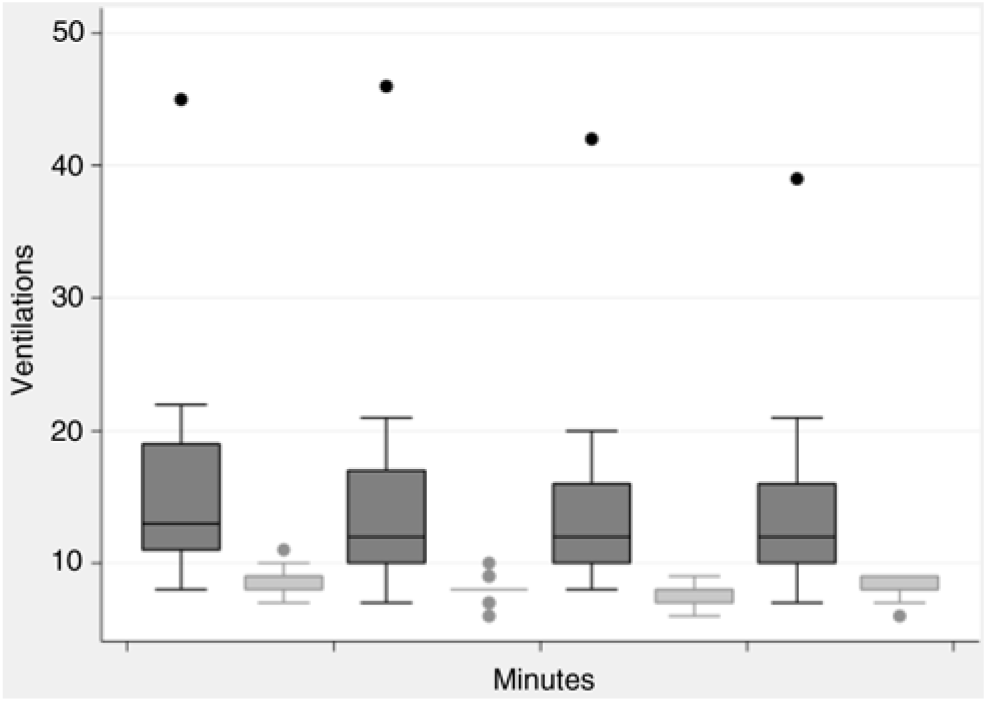
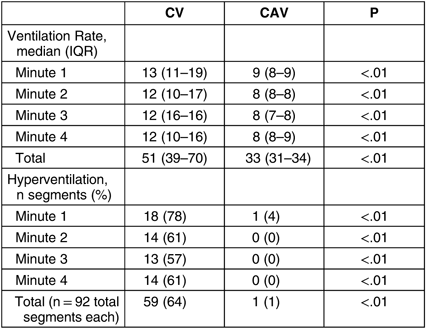
Median ventilation rates were consistently higher in the CV group versus the CAV group across all 1-minute segments: 13 vs 9, 12 vs 8, 12 vs 8, and 12 vs 8 for minutes one through four, respectively (P <.01, all; Table 1). The proportion of time which hyperventilation occurred was also consistently higher in the CV group versus the CAV group across all 1-minute segments: 78% vs 4%, 61% vs 0%, 57% vs 0%, and 61% vs 0% for minutes one through four, respectively (P <.01, all). There was also less variability in the ventilation rates with CAV than with CV (Figure 1).
Box and Whisker Plots for Number of Breaths per Minute for Conventional Ventilations (Dark Grey) and Compression-Adjusted Ventilations (Light Grey) for Each Minute.

Ventilation by Minute

Abbreviations: CAV, Compression-Adjusted Ventilations; CV, Conventional Ventilations; IQR, Interquartile Range.
Discussion
The optimal ventilation rate during adult CPR is unknown, and there are few studies to support the current recommendation of 10 breaths per minute.Reference Kleinman, Brennan and Goldberger2, Reference Vissers, Soar and Monsieurs15 Nevertheless, hyperventilation has been shown to negatively impact physiologic variables associated with cardiac arrest outcomes (eg, cardiac output) and has been shown to negatively impact neurologic outcomes in other disease states such as traumatic brain injury.Reference Aufderheide, Sigurdsson and Pirrallo3–Reference Theres, Binkau and Laule6, Reference Steiner, Balestreri and Johnston16–Reference Muizelaar, Marmarou and Ward18 Unfortunately, CV with BVM breaths regularly deliver inconsistent tidal volumes and ventilation rates with recorded intra-individual variability of up to 86% and 66%, respectively, between ventilation cycles.Reference Khoudry, Sall and DeLuca19 This inconsistency results in hyperventilation.Reference Aufderheide, Sigurdsson and Pirrallo3, Reference Aufderheide and Lurie4, Reference Abella, Alvarado and Myklebust7–Reference Ryu, Han, Jeung and Heo10 Since re-training is often ineffective, several methods have been studied to mitigate hyperventilation, with regard to rate, including metronome guidance and feedback devices. However, the simplest method to utilize, without an adjunctive device, is likely CAV.Reference Nikolla, Lewandowski and Carlson11
The results were consistent with previous studies which showed that CAV provided ventilations at a more consistent and desired rate than CV. Although previous studies found differences in the median ventilation rates, the prevalence of hyperventilation in the CV groups was low; therefore, it is difficult to assess for efficacy in preventing hyperventilation.Reference Yun, Ryu and Cho12–Reference Cho, Ryu and Cho14 This study revealed that CAV reduced hyperventilation and resulted in a respiratory rate more consistent with AHA recommendations compared to CV in this cohort, a group of experienced providers with recent BLS training. This difference was consistent over all four 1-minute segments of the study period. The use of metronome-guided chest compressions ensured that hyperventilation was not the result of an elevated compression rate. The highest observed ventilation rate over a 1-minute segment was 46 breaths per minute, which is concerning given the impact on mortality seen by single episodes of secondary insult in other conditions such as traumatic brain injury.Reference Manley, Knudson and Morabito20 Though, hypoventilation (<eight breaths per minute) did occur three percent of the time in the CV group and 21% in the CAV group.
Limitations
The study had several limitations. First, it was a manikin study which may not have adequately simulated real life CPR. The CAV method, like CV, requires attention; providers may be distracted during the chaos of a real resuscitation. Second, ventilations were only delivered for eight minutes total, which may not have been long enough to induce fatigue or in-attention in the volunteers causing a lack of compliance with the CAV method. Third, the order of CAV and CV was not randomized. Though, having providers perform CV first mitigated the possibility that performing CAV first would alter their CV technique. Fourth, tidal volumes were unable to be measured during the study; therefore, the effect CAV may have had on tidal volumes or minute ventilation cannot be assessed. Lastly, theoretically, the ventilation rates in the CV group may have been higher as the subjects, trained in the 2015 AHA Guidelines, are taught to target a ventilation rate of 10 breaths per minute as opposed to eight to 10, which the authors defined as an adequate ventilation rate.Reference Kleinman, Brennan and Goldberger2 This range was chosen as it was consistent with previous studies and still included the target rate of 10 breaths per minute recommended by the latest guidelines.Reference Kleinman, Brennan and Goldberger2, Reference Yun, Ryu and Cho12–Reference Cho, Ryu and Cho14 Nevertheless, the significance of this effect is limited. If hyperventilation is redefined as >12 breaths per minute, hyperventilation still occurred 48% of the time in the CV group and zero percent in the CAV group. The difference in frequency of hyperventilation is more likely an indicator that it is easier to count compressions and/or metronome beeps between breaths than it is to count seconds.
Conclusion
In this simulated model, CAV with metronome-guided compressions resulted in more accurate ventilation rates and fewer episodes of hyperventilation than CV when performed by experienced providers with recent BLS training.
Author Contributions
All three authors have made substantial contributions to the concept and design of the manuscript, have partaken in the drafting and revising of the manuscript, and have approved the final version. This is their original work. It does not overlap with previous work. It has not been published previously, nor is it under consideration elsewhere.