


Introduction
Advance care planning (ACP), which involves nuanced conversations to elicit an individual’s beliefs, values, and preferences regarding future care, is recognised as ‘a feature of good clinical care in Ireland’ (Royal College of Physicians of Ireland 2014, p. 3). However, representative population surveys indicate low uptake of ACP and appointment of attorney under Enduring Power of Attorney (Safeguarding Ireland 2023, 2024), which are comparable with international statistics (Kox et al. Reference Kox, Pasman, van der Plas, Huisman, Hoogendijk and Onwuteaka-Philipsen2023; Safeguarding Ireland 2022). In the context of mental health, ACP, and psychiatric advance directives enable the expression and documentation for preferences for future treatment should mental health crisis occur. Users of mental health services regard psychiatric advance directives as tools that enhance their involvement and autonomy in care (Braun et al. Reference Braun, Gaillard, Vollmann, Gather and Scholten2023); however, evidence also indicates low completion rates (Gaillard et al. Reference Gaillard, Braun, Vollmann, Gather and Scholten2022).
As the population of older persons in Ireland continues to grow (Central Statistics Office 2023), there is a corresponding increase in the numbers experiencing mental health challenges (Finnerty Reference Finnerty2020). Complex medical issues, including cognitive impairment can interact with and exacerbate mental health challenges in later life, which can make decision-making more complex (Hantke and O’Hara Reference Hantke, O’Hara, Hantke, Etkin and O’Hara2022). ACP centres on the principal of autonomy (Jox Reference Jox, Schweda, Pfaller, Brauer, Adloff and Schicktanz2016), so a tailored, iterative, person-centred approach is conceptualised as key (Tilburgs et al. Reference Tilburgs, Vernooij-Dassen, Koopmans, Weidema, Perry and Engels2018). Advance Healthcare Directives (AHDs), recently legislated for under Ireland’s Assisted Decision-Making (Capacity) Act 2015, also support people to exercise agency during periods of incapacitating mental illness, as their expressed choices for care ensure that they are treated according to their will and preference (Redahan et al. Reference Redahan, Kelly and Gergel2024). For the purposes of this research a broad holistic conceptualisation of ACP, which can encompass AHDs is utilised.
A scoping review of the literature, systematically undertaken as part of the first author’s PhD study (Allen Reference Allen2024), revealed facilitator and barrier mechanisms to ACP in the later life cohort in the contexts of mental health and dementia. The importance of timing (Monnet et al. Reference Monnet, Diaz, Gove, Dupont, Pivodic and Van den Block2024), the responsiveness of healthcare professionals (HCPs) (Ryan and McKeown Reference Ryan and McKeown2020), the importance of establishing a relationship of trust between the individual and HCPs (Tetrault et al. Reference Tetrault, Nyback, Fagerström and Vaartio-Rajalin2023) and embedding triggers in clinical practice that would prompt ACP were emphasised as important facilitating mechanisms. Barrier mechanisms included the time required to engage in ACP (Lombard and Davidson Reference Lombard and Davidson2022), and HCP’s lack of knowledge (Tetrault et al. Reference Tetrault, Nyback, Fagerström and Vaartio-Rajalin2023) and inadequate training (Manthorpe and Goodwin Reference Manthorpe and Goodwin2019). Community mental health teams are identified as well placed to initiate ACP, provided they have the appropriate training and resources (Juliá-Sanchis et al. Reference Juliá-Sanchis, Cabañero-Martínez, Zaragoza-Martí and García-Sanjuán2020; Poppe et al. Reference Poppe, Burleigh and Banerjee2013).
The current study is the first study to the best of our knowledge to explore ACP within Mental Health Services for Older Persons in the Irish context. Such services are required to adapt to the legislative changes arising from the Assisted Decision-Making (Capacity) Act (2015) (ADM Act), commenced on 26th April 2023 to reform Irish law relating to persons who require, or may require assistance in exercising their decision-making capacity, and has considerable implications for practice. The ADM Act legislates for AHDs for the first time in Irish law and places an onus upon HCPs to support individuals to make decisions by providing ‘the tools they need to make the decision for themselves or to participate in the decision-making process to the fullest extent possible’ (Decision Support Service 2023, p. 4). A review recently published by Redahan et al. (Reference Redahan, Kelly and Gergel2024) identifies that changes in legislation must be coupled with additional initiatives to heighten awareness and knowledge, and improve the uptake of AHDs in practice, in order to generate positive change. The current overall study sought to collaboratively explore ACP from the multi-stakeholder perspectives of older persons, family carers and interdisciplinary mental HCPs, and to augment and improve practice. Amplifying the lived experience of older persons and family carers and embracing the principle of co-production in mental health were important considerations in the participatory action research methodology chosen (Advancing Recovery Ireland 2018).
This article presents the themes from the first Action Research Stage of a three-stage PhD study, making the case for a pro-active approach to ACP in mental health and answering two key research questions:
1. What are the perceptions, levels of knowledge and confidence levels in ACP practice of mental HCPs based in Mental Health Services for Older Persons?
2. What factors facilitate or pose barriers to ACP engagement with older persons who have mental health issues and /or dementia?
Methods
Setting
The study was conducted within a Mental Health Service for Older Persons, located in Dublin South-East, under the auspices of the Health Service Executive. These services provide mental health care to individuals aged sixty-five years and over, under two broad client groups: persons who develop a functional mental health complaint such as depression or anxiety, and those with a diagnosis of dementia, who develop non-cognitive psychological and/or behavioural symptoms (Dyer et al. Reference Dyer, Harrison, Laver, Whitehead and Crotty2018; NCPOP 2019). The aims of treatment are multi-faceted, including the alleviation of distress, increasing functioning and independence, and improving quality of life (NCPOP 2019). Mental HCPs from the disciplines of nursing, occupational therapy, psychiatry, psychology and social work engaged in the research. The national survey engaged HCPs from Mental Health Services for Older Persons across the nine community healthcare areas in Ireland.
Participatory action research
The current study utilises a multi-stage participatory action research framework. The research is underpinned by the participatory paradigm, which provides a foundational theory for action research, and is conceptually underpinned by an integrated theoretical approach, combining critical gerontology (Donnelly and Torres Reference Donnelly, Torres, Torres and Donnelly2022) and critical realist ontology (Sayer Reference Sayer2000). The study utilised a mixed-method approach, combining data from quantitative, qualitative, and participative methods (in stages two and three), to add richness to the understanding of the research questions and to enhance validity and triangulation (Creswell Reference Creswell2014). Action research was chosen as this approach to research is rooted in participation and conducted with rather than on participants who often become co-researchers (Bradbury and Reason Reference Bradbury and Reason2003). Furthermore, action research is concerned with the process of the research as well as final outcomes and is also concerned with creating change and planning an intervention (Boutilier et al. Reference Boutilier, Mason and Rootman1997). An action arising immediately from this first action research stage was the need for training, which was arranged through the Public Engagement Officer of the Irish Hospice Foundation (n.d.), who carries responsibility for the ‘Think Ahead’ ACP programme.
The status of the lead PhD researcher, who is a social worker by profession, was as an insider-researcher within the research setting where the research took place. A strength of this positionality included insight into the cultures and norms within the Mental Health Service for Older Persons (Tichen Reference Tichen2015). However, the researcher was also mindful of the need to critically reflect upon the organisational practices (Coghlan and Brannick Reference Coghlan and Brannick2010).
Action research stages
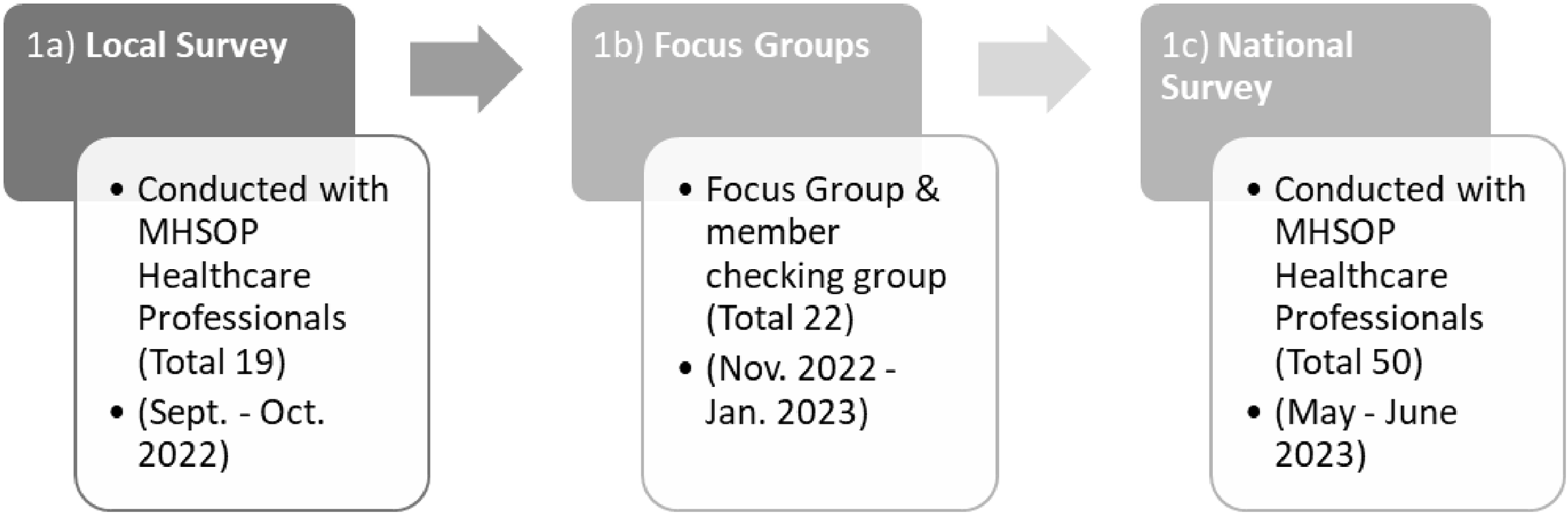
There were three action research stages, with the findings of each stage iteratively informing the development of the next. Aspects of the second and third stages are published elsewhere (Allen et al. Reference Allen, Donnelly and Morton2026). The three sub-stages of the first action research stage are illustrated in Figure 1.
Overview of action research stage 1 sub-stages and participant information.

Stage one, which sought to establish the evidence base, utilised:
-
a. A local survey informed by the scoping review of the literature with 19 inter-disciplinary mental HCP respondents;
-
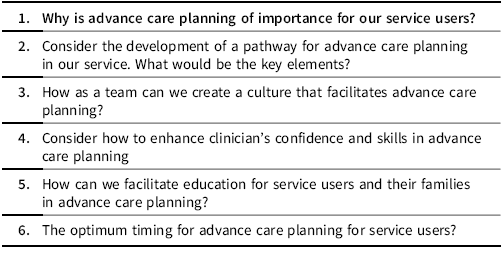
b. Mini-focus groups with five-to-six interdisciplinary mental HCP participants and a member-checking group to extend and validate the focus group findings with 22 inter-disciplinary mental HCP participants. The schedule of questions posed to guide the focus group discussion were derived from the findings of the recently completed local survey (illustrated in Table 1); and,
-
c. A national survey with 50 inter-disciplinary mental HCP respondents.
Principal focus group questions considered

Table 1. Long description
A table listing principal focus group questions. The table has six rows and one column. Row 1: Why is advance care planning of importance for our service users? Row 2: Consider the development of a pathway for advance care planning in our service. What would be the key elements? Row 3: How as a team can we create a culture that facilitates advance care planning? Row 4: Consider how to enhance clinician’s confidence and skills in advance care planning. Row 5: How can we facilitate education for service users and their families in advance care planning? Row 6: The optimum timing for advance care planning for service users?
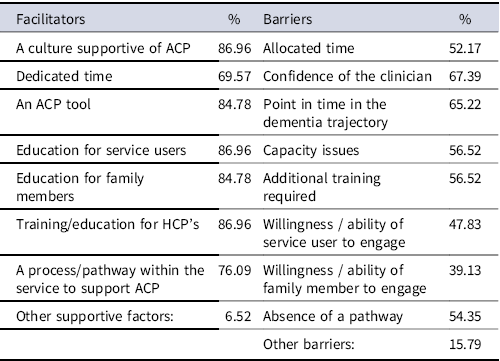
Pilot testing was conducted with both surveys and changes incorporated to reflect the feedback given. The national survey was further refined by the findings of the local survey and focus groups. Questions in the surveys were structured under four sections: Assisted Decision-Making; ACP; Experience of the Mental Health Services for Older Persons in ACP; and Demographics, with qualitative statements also sought. All answers were must answer, with a mix of open, closed and scaling questions used. Confidence levels were measured using multiple choice scaling answers from ‘not confident’ to ‘very confident’. Survey respondents were also presented with a choice of facilitators and barriers to facilitating ACP (Detailed in Table 4).
Participants and recruitment
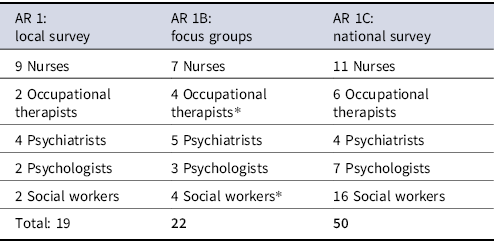
All current HCP staff members in the local Mental Health Service for Older Persons were invited to participate in the local survey and focus groups in Action Research Stage 1. Participants in the national survey were recruited through an invite issued by their national discipline specific special interest groups. The exact response rate therefore is unclear. Furthermore, the exact number of HCPs within each MHSOP is unknown as services are not operating with full staffing levels, with the most recent figure available identifying an average staffing rate of 54% nationwide (Finnerty Reference Finnerty2020). The study sample and characteristics are presented in Table 2.
Study sample & characteristics of action research stage 1

Table 2. Long description
The table presents the number of healthcare professionals (HCPs) participating in three different survey methods: local survey, focus groups, and national survey. It has three columns labeled AR 1 A: local survey, AR 1 B: focus groups, and AR 1 C: national survey, and six rows labeled with different professions. Row 1: Nurses, 9, 7, 11. Row 2: Occupational therapists, 2, 4, 6. Row 3: Psychiatrists, 4, 5, 4. Row 4: Psychologists, 2, 3, 7. Row 5: Social workers, 2, 4, 16. Row 6: Total, 19, 22, 50. The table shows the distribution of participants across different professions and survey methods.
Note. *Including 1 OT & 1 SW trainee. In the National Survey 6 skipped the demographics Q.
Data analysis
Data was analysed following each stage and sub-stage of the research, with the findings of each stage informing the development of the next. The qualitative data from transcriptions of the focus group recordings was analysed using reflexive thematic analysis (Braun and Clarke Reference Braun and Clarke2006), adopting a realist frame to report the reality of participant’s experiences, insights, and perceptions (Terry et al. Reference Terry, Hayfield, Clarke, Braun, Willig and Rogers2017). The approach to data analysis was iterative, with integration of data at the methods level occurring through building upon the results from each data collection phase to identify constructs (Fetters et al. Reference Fetters, Curry and Creswell2013). Transcripts were coded by the PhD researcher using NVivo software, and the data were discussed with the other researchers, who reviewed the process of thematic development. Non-statistical sampling was used in the selection of survey participants and given the small sample size and exploratory nature of the study, descriptive statistical analysis was employed, with graphs and charts used to provide a visual summary of the data.
Ethical approval
Ethical approval for this study was granted by St Vincent’s Healthcare Group Research Ethics Committee for stage one on 25th April 2022 (RS1-043) with ethical exemption granted by University College Dublin Human Research Ethics Committee. Data were collected between November 2022 and June 2023. Data were anonymised, encrypted, and stored securely under encrypted password protection on the St Vincent’s University Hospital server. Participant Information and Consent Forms were stored in accordance with GDPR and ethical approval requirements.
Consent procedure
The Health Service Executive National Consent Policy (2024) provided important guidance for obtaining consent in this study. Informed consent was sought electronically from respondents at the beginning of the local and national surveys, while written consent was sought from all participants prior to participation in the focus groups.
Results
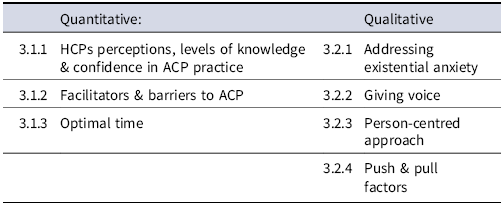
The findings of Action Research Stage One are presented in two sections in response to the two research questions indicated, with an overview provided in Table 3. Firstly, the quantitative findings on HCPs perceptions, levels of knowledge, and confidence in ACP practice and the facilitators and barriers to ACP practice from local and national surveys, and secondly the integrated themes from the qualitative findings are presented. Lingard’s (Reference Lingard2019) principles of authenticity and argument guided the selection of quotations to evidence the findings. Legend: Local Survey Respondent = LSR; Focus Group Participant = FGP; National Survey Respondent = NSR.
Overview of the findings and themes

Table 3. Long description
A table summarizing findings and themes from research on healthcare professionalsʼ perceptions and practices in advance care planning. The table is divided into two main sections: Quantitative and Qualitative. The Quantitative section has three rows labeled 3.1.1, 3.1.2, and 3.1.3, with corresponding descriptions: HCPs perceptions, levels of knowledge and confidence in ACP practice, Facilitators and barriers to ACP, and Optimal time. The Qualitative section has four rows labeled 3.2.1, 3.2.2, 3.2.3, and 3.2.4, with corresponding descriptions: Addressing existential anxiety, Giving voice, Person-centred approach, and Push and pull factors.
Facilitators and barriers to advance care planning (National survey findings n = 50)

Table 4. Long description
A table comparing facilitators and barriers to advance care planning. The table has two main columns: Facilitators and Barriers, each with their respective percentages. The Facilitators column includes: A culture supportive of ACP (86.96 percent), Dedicated time (69.57 percent), An ACP tool (84.78 percent), Education for service users (86.96 percent), Education for family members (84.78 percent), Training/education for HCPʼs (86.96 percent), A process/pathway within the service to support ACP (76.09 percent), and Other supportive factors (6.52 percent). The Barriers column includes: Allocated time (52.17 percent), Confidence of the clinician (67.39 percent), Point in time in the dementia trajectory (65.22 percent), Capacity issues (56.52 percent), Additional training required (56.52 percent), Willingness/ability of service user to engage (47.83 percent), Willingness/ability of family member to engage (39.13 percent), Absence of a pathway (54.35 percent), and Other barriers (15.79 percent).
Quantitative findings
HCPs perceptions, levels of knowledge, and confidence in ACP practice
The results of the current study revealed insights into inter-disciplinary HCPs perceptions, levels of knowledge, and confidence in relation to ACP practice within the context of older person’s mental health. Overall ACP was regarded as having a positive impact, notwithstanding challenges in practice which will be discussed. ‘It allows for a comprehensive and coherent plan for a treating team which can lead to better care and outcomes’ (LSR3). The positive impact upon family members was also identified. ‘It allows the family to feel confident that they are guiding the interventions according to a loved one’s will and preference, which can provide a sense of comfort and support that in turn impacts on the service user’ (LSR3). However, HCPs indicated that 36.16% (n = 7) of family members were ‘not informed’ or ‘somewhat informed’ 63.16% (n = 12). These findings were echoed in the national survey. Similarly, HCPs indicated that service users were either ‘not informed’ 63.16% (n = 12) or only ‘somewhat informed’ 36.85% (n = 7) in the local survey, which may impact engagement.
HCPs largely acknowledged all disciplines as having responsibility for facilitating ACP, with 68.42% (n = 13) in the local study and 80.43% (n = 37) in the national study indicating their agreement. Social work, however, was recognised as a discipline with experience in ACP and as potentially taking a leadership role. ‘All disciplines have a responsibility but typically people are referred to social work for these types of interventions. There is a sense that social workers have better skills and training in these areas’ (NSR10).
The research provided insights into HCPs confidence levels with regards to knowledge of AHDs, with only 38.84% (n = 7) feeling ‘quite confident’ of their knowledge, and 0% feeling ‘very confident’ in the local survey, compared with 24% (n = 12) and 2% (n = 1) in the national survey respectively. 26.32% (n = 5) of HCPs indicated having ‘no experience’ of facilitating ACP discussions with service users, while 67.43% (n = 13) indicated ‘limited or some experience’ in the local survey. The sole respondent who indicated having extensive experience, was the only respondent who indicated they had undertaken formal training, and demographics indicated was a social worker with 21+ years practice experience and 16–20 years in their current role. These findings were replicated in the national survey whereby 23.91% (n = 11) indicated ‘no experience’ and 67.39% (n = 34) indicating ‘limited or some experience’ engaging in ACP discussions with both service users and family members as decision-making supporters.
Facilitators and barriers to ACP
Survey respondents were presented with a choice of facilitators and barriers to ACP engagement informed by the findings of the scoping review. The choices given and responses from respondents of both surveys are detailed in Table 4. A culture supportive of ACP was indicated as a facilitator by 100% of respondents in the local survey compared with 86.96% (n = 40) in the national survey. Culture was further identified as a facilitating mechanism in the focus groups. Education for all stakeholders; service users, family members, and HCPs, was strongly identified as a facilitating mechanism in both surveys respectively. The need for additional guidelines or skills training was indicated unanimously in the local survey and by 95.65% (n = 44) in the national survey. The need for training to support AHDs was highlighted. ‘I think mandatory training needs to be introduced to educate and support all team members to engage in the process of AHDs’ (NSR48). Other barriers to ACP engagement cited in the National Survey were: ‘a culture of resistance within the team’ (NSR3); and ‘sometimes there is a perception amongst staff that ‘capacity’ prevents conversation and supported decision-making’(NSR41).
As ‘a process or pathway to support ACP’ was a strong feature of the focus group discussions, therefore, the presence/absence of a pathway was added as a potential facilitator or barrier mechanism to the national survey. 76.09% (n = 35) considered a pathway as a facilitating mechanism, while 54.35% (n = 25) considered the absence as a barrier. Additional barriers cited included, ‘Availability of social supports such as family members, friends, voluntary organisations, to assist service users in the process’ (NSR7), and ‘Not prioritised. Not clear who should initiate or when’ (NSR37). Decision-making capacity was also recognised as a potential barrier mechanism. ‘I think there is goodwill around this issue and that staff do the best they can in time-pressured environments, but sometimes there is a perception amongst staff that capacity prevents conversation and support decision-making’ (NSR10). While family members were recognised as being very well placed to support ACP, collaboration with service users and informed consent to engage ‘identified trusted family members’ was recognised as important. The need for trust within the relationship was also underscored. ‘I think trusted family members and friends that have been identified by the service user are key in supporting the implementation of ACP and AHDs’ (LSR3).
Optimal time
Survey respondents were presented with a choice of options suggesting the optimal time to initiate ACP discussions with service users. These included as part of: the initial assessment, a Wellness Recovery Action Plan, discharge planning following an inpatient admission, the recovery process, as well as in the early stages of cognitive impairment, and depending upon the person.
The findings amplified the need for a person-centred approach, throughout the study. ‘All of the above would be appropriate but must be person-centred’ (NSR16). Allowing time to process a dementia diagnosis was also underscored. ‘When a service user has had time to process their diagnosis’ (LSR3). Additional comments provided some valuable insights on the impact of service user’s health and the therapeutic relationship with professionals. ‘Optimum time could be any of the above times depending on the healthcare professional’s therapeutic relationship with the service user and the service users state of physical and psychological health’ (NSR7). However, HCPs recognised engagement in ACP as a time intensive process, in the context of limited resources. ‘Time constraints in a busy environment… prevent space and time to discuss the issues and liaise with families’ (NSR10).
Qualitative themes
This section presents the integrated qualitative findings from the focus groups, and member checking group; addressing existential anxiety; giving voice; a person-centred approach; and push and pull factors.
Addressing existential anxiety
The anxieties that can naturally arise in later life where people are often faced with the challenges of ageing, frailty, comorbidities, potential cognitive impairment, loss of loved ones, and an increased awareness of their own mortality were discussed in the focus groups and further explored in the member checking group. ‘Clients of our service are beginning to think about possibly end-of-life and advance care planning as it is sort of part of the natural life stage’ (FGP4). ACP was identified as a mechanism for potentially grounding some of these existential anxieties that naturally arise at this life stage. ‘It gives structure to what would be seen as philosophically the existential anxiety that really arises at this life stage. And so, it grounds you know I suppose the worry and the concerns… reducing stress’ (FGP7). The importance for service users having a sense of security and control over their future decision-making was recognised. One participant provided an example of a service user who she has supported and spoke of the reduction in fear that involvement in the process of ACP gave him. ‘He has resolved a lot of that anxiety as he knows a little bit more about the finances, a bit more about what’s in store so it’s lessened the fear’ (FGP4).
Giving voice
ACP was recognised as a mechanism that gives service users a voice and protects their autonomy in the context of anticipated loss of decision-making capacity, as well as in the context of potentially difficult family dynamics. ‘It protects a person’s right to choose so that they can articulate their own end-of-life care preferences…participating in advance care planning gives them a voice’ (FGP16). Focus group participants recognised the complexities in family systems and understood that family members do not always fully appreciate a person’s will and preference or agree with one another. Supporting someone to engage in ACP was seen as mitigating the potential for family conflict. ‘That is has the potential to reduce family stress or possibly prevent conflict later where maybe family members have different positions on what they…perceive a person’s will and preference to be, but if they have actually articulated themselves’ (FGP16).
One of the concerns raised related to the fact that a capacity assessment is not required to make an AHD, which may lead to potential challenges to the AHD at a later point. The need for potential amendments to the ADM Act as legal challenges arise was foreseen. Collaboration with and more specialised advice from legal professionals was suggested as being potentially helpful in mitigating some challenges ‘I think it needs to be some kind of collaboration, with either family solicitors or more specialised legal counsel in this particular area’ (FGP8).
Person-centred approach
Participants recognised throughout the focus group discussions that ACP is very much a person-centred process, therefore support needs to be tailored in a person-centred way. Establishing the right time to approach ACP with service users was discussed. Mental health challenges were identified as posing a possible barrier to insight into the need for ACP, and as adding an extra layer of complexity to the discussions for HCPs. The need to establish emotional and psychological readiness to engage was highlighted, which echoed the survey findings. ‘Sometimes the client isn’t ready psychologically to face some questions about the future too’ (NSR10). Furthermore, in the context of the later stage of life, the presence of comorbidities and impact of physical health complaints, focus groups participants identified the necessity of actively collaborating with other service providers to inform decision-making.
Time sensitivities relating to cognitive impairment where HCPs may miss opportunities to engage with service users were underscored as crucial in the focus groups. ‘You miss opportunities…for real conversations that capture the person’s own views in the moment’ (FGP13). In the context of cognitive impairment and dementia, the timeframe where someone may possibly lose the capacity to make some ACP decisions, such as appointing an Enduring Power of Attorney, or making an AHD was recognised as a pertinent window of opportunity. ‘So, there is also a need for discussion around prioritising people maybe we come across who have a mild cognitive impairment…anticipating future loss of decision-making capabilities’ (FGP1). Participants also recognised the challenge in supporting people referred for functional mental health difficulties, where it becomes apparent that there is a cognitive issue.
Push and pull factors
‘Push and Pull’ factors for supporting ACP were identified as a strong theme in the first stage of the study. HCPs recognised the need to support ACP, whilst also appreciating that not everyone may be able or willing to participate for varying psychological and emotional reasons. Taking an active stance yet balancing voluntary engagement were important facets of this.
Active stance
Taking an ‘active stance’ (FGP1) in initiating conversations with service users and providing them with information around ACP was identified as an important push factor. HCPs recognised that there can be critical points in time for people to make decisions that clinicians have a responsibility to support them to understand. However, also recognised the need to appreciate perhaps why they are avoiding or procrastinating, and how this can be linked to anxiety for some service users and an impediment to decision-making.
“It’s in fact balancing the responsibility of helping someone understand that, that there are critical points in time for making decisions. You know and giving information that they can take. But perhaps looking at appreciating that they’re wanting to avoid something that is actually quite worrying” (FGP7).
The need to be respectful of their premorbid way of decision-making was also recognised as an important part of this. ‘It’s very important to be respectful of their history of decision making as well. How they always made decisions’ (FGP13).
Voluntary engagement
The study found the need to strike a balance between making ACP part of routine practice, but also not a mandatory step for everyone, respecting the right to self-determination, autonomy and the right not to plan ahead. There was an acknowledgement that the newly commenced ADM Act may cause anxiety for some clinicians and teams, however pressure should not be placed upon individuals who do not wish to engage in ACP. The findings of the study underscored the importance of clinician’s assessing their own comfort and tolerance levels in this regard. ‘So it’s striking a balance between you know, making it part of the practice, but also maybe not a mandatory step for everyone perhaps where it’s not appropriate for some’ (FGP13).
Potential triggers to proactively raise the topic with service users were discussed. Receiving a health diagnosis or a prognosis was identified by participants as a time when ACP might be prompted, with the challenge being to incorporate ACP into routine practice outside of potential crises. ‘I suppose it’s how do you incorporate this into routine practice? That isn’t just prompted by a sudden diagnosis or something’ (FGP8). Prompts were also considered on a more collective scale, with life stages such as having children, buying homes, or dealing with legal affairs, such as will making, recognised as possible prompts to harness, and a whole of population approach to normalise ACP suggested.
Discussion
This section will synthesise and discuss the integrated findings from the first action research stage, making the case for a pro-active approach to ACP in mental health. Embedding ACP practice in Mental Health Services for Older Persons is very much underscored as potentially addressing existential anxiety and giving a voice to service users.
Time
The numerous aspects of time were identified as impactful to ACP engagement in this study. The importance of time sensitivities was highlighted by focus group participants, which is consistent with prior research which emphasised the essential role of HCPs in initiating timely and informed ACP discussions (Dening et al. Reference Dening, Jones and Sampson2011). HCPs need to be attuned to the right time and to be vigilant for prompts and triggers to ACP engagement such as when someone receives a health diagnosis, prognosis, or hospitalisation (Howard et al. Reference Howard, Elston, Vries, Kaassalainen, Gutman, Swinton, Carter, Sussman, Barwich, Urquhart, Jayaraman, Munene and You2021; Tetrault et al. Reference Tetrault, Nyback, Fagerström and Vaartio-Rajalin2023). Balancing responsibilities as HCPs to encourage and educate about ACP (Lombard and Davidson Reference Lombard and Davidson2022), with respect for the person’s emotional and psychological readiness, which included respecting the person’s right not to engage was recognised. This concept of readiness is very much related to existential anxieties, and the identification of engagement in ACP processes as having the potential to address some of the anxieties that naturally arise during this life stage.
ACP was identified as a time-intensive process, with structural barriers including time and limited resources for implementation identified (Spacey et al. Reference Spacey, Scammell, Board and Porter2021), which reinforce the need to engage in ACP earlier in the life course prior to the onset of serious illness and for HCPs to have dedicated time to build ACP into routine practice. Receiving timely information is in line with previous research by Harrison Dening et al. (Reference Harrison Dening, King, Jones, Vickerstaff and Sampson2016) which similarly emphasised the benefits of early and ongoing support for family carers to aid decision-making.
Trusted person
The study shed light on the importance for the older person of engaging family members/trusted persons of their choosing in ACP, based on the foundational element of trust (Monnet et al. Reference Monnet, Diaz, Gove, Dupont, Pivodic and Van den Block2024). Collaboration with service users and informed consent to engage with the identified trusted person was highlighted, which is very much in keeping with the Health Service Executive National Consent Policy (2024) and indicated in prior research (Donnelly and O’Brien Reference Donnelly and O’Brien2019). The findings also recognised the positive impact for family members, and the sense of comfort provided when they are guiding interventions according to the person’s will and preference. However, survey respondents indicated that service users and family members are largely uniformed of ACP processes, which is indicative of the need for HCPs and wider services to target this cohort specifically and to ensure that the necessary supports and structures are in situ to support their engagement in ACP. The role for social work in supporting the identification of a decision-making supporter has also been indicated in the literature (Otis-Green et al. Reference Otis-Green, Thomas, Duncan, Walling, Lieto, Kung, Pietras and Wenger2019).
Fostering therapeutic and trusting relationships
The importance of fostering a therapeutic and trusting relationship with HCPs was validated throughout this study. The delicate nature of ACP discussions depending on the person’s emotional readiness and health status were highlighted, however it was recognised that with a skilled professional who has a pre-existing positive relationship with the person these discussions could take place. These findings are consistent with prior research which underscores the importance of relational connections in ACP (Sussman and Tétrault Reference Sussman and Tétrault2022; Tilburgs et al. Reference Tilburgs, Vernooij-Dassen, Koopmans, Weidema, Perry and Engels2018), amplifying the need for HCPs to be attuned to triggers to initiate ACP within care pathways (Howard et al. Reference Howard, Elston, Vries, Kaassalainen, Gutman, Swinton, Carter, Sussman, Barwich, Urquhart, Jayaraman, Munene and You2021). The impact of the physical environment where ACP discussions take place was also highlighted as important, with the person’s home recognised as facilitating a more relaxed environment and emotionally secure environment for therapeutic alliances to be developed (Donnelly et al. Reference Donnelly, Cahill and O’Neill2018) and sensitive topics to be discussed (Tilburg’s et al. Reference Tilburgs, Vernooij-Dassen, Koopmans, Weidema, Perry and Engels2018). Home visits are previously found to facilitate a positive effect on older person’s mental health (Klug et al. Reference Klug, Gallunder, Herm, Singer and Schulter2019). This amplifies the need to prioritise the home environment for ACP discussions, which community mental health teams who are recognised as having the capacity for more prolonged interventions are well placed to do (Manthorpe and Goodwin Reference Manthorpe and Goodwin2019; Poppe et al. Reference Poppe, Burleigh and Banerjee2013).
Embedding ACP practice in mental health services for older persons
The study identified critical components for practice including, confidence and knowledge of HCPs in ADM and ACP practice and the need to address the unique needs of mental health service users, including specific documentation tools including Wellness Recovery Actions Plans to capture the preferences for mental health treatment. One of the challenges underscored was how to embed ACP into routine practice outside of potential crises. The results provide a helpful baseline for confidence in knowledge in Mental Health Services for Older Persons given the infancy of the ADM Act so that training can be tailored accordingly. The majority of survey respondents indicated that ACP is the responsibility of every discipline, with social work highlighted by some as potentially having a more specific role. Additional guidelines or skills training to enhance competencies were overwhelmingly indicated by local and national survey respondents (Sussman and Tétrault Reference Sussman and Tétrault2022), which has implications for inter-professional training, and continuous professional development (Davies et al. Reference Davies, Fattori, O’Donnell, Donnelly, Ní Shé, O’Shea, Prihodova, Gleeson, Flynn, Rock, Grogan, O’Brien, O’Hanlon, Cooney, Tighe and Kroll2019). Training programmes for HCPs in ACP, particularly with a focus on values, communication, and encompassing an interactive approach, have been shown to enhance knowledge and skills and pose considerations for training initiatives in Mental Health Services for Older Persons (Chan et al. Reference Chan, Ng, Chan, Wong and Chow2019).
Limitations
In terms of limitations of the study, some of the data from Action Research Stage 1a and 1b were collected pre-implementation of the ADM Act so this will have impacted on results and findings. This first stage of the research was conducted from the perspectives of mental HCPs in the Irish context; therefore, the results must be interpreted in consideration of the cultural nuances, and the practice and policy contexts of general adult and other services, and jurisdictions.
In terms of quantitative limitations, the response rate to the national survey was lower than anticipated. Several reminder emails were sent, and respondents were also asked to circulate the survey to their inter-disciplinary colleagues, which boosted the response rate. In terms of the qualitative data, the research was a small-scale study that provides insights as a point in time, which limits generalisability. A larger-scale longitudinal study could build upon this.
Conclusion
This paper presented and discussed the integrated findings from the first action research stage of a PhD study, which is both timely and pioneering given the recent commencement of the ADM Act. The study provides insights from the perspectives of HCPs within the context of older person’s mental health on ACP in Ireland and argues the case for a pro-active approach by HCPs to ACP in Mental Health Services for Older Persons. Whilst ACP is largely viewed as positive by HCPs, confidence and experience levels vary in practice, with a strong desire for additional specific training and tools to support ACP engagement indicated. The importance of fostering a therapeutic and trusting relationship with HCPs was validated throughout this study. The identification of time sensitivities, particularly ‘a window of opportunity’ and emotional readiness to engage, was underscored across the first action research stage. The study highlighted the importance for the older person of engaging family members / trusted persons in ACP of their choosing, based on the foundational element of trust. Collaboration with other healthcare and legal providers in the context of comorbidities and decision-making challenges in later life were amplified. Time pressures within the context of limited resources reinforce the need to engage in ACP earlier in the life course prior to the onset of serious illness and for HCPs to have dedicated time to build ACP into routine practice. This study highlights some important implications for person-centred practice, centring on the need for community mental health teams to balance an active stance to ACP whilst also respecting the right not to engage for varying psychological and emotional reasons.
Acknowledgements
The authors acknowledge and greatly appreciate the collaborative involvement of the older persons, family carers, and interdisciplinary healthcare professionals involved in this study.

 Open access

