Introduction
The synthetic gold chalcogenides of the Au–Te–Se–S system are the long-standing subject of numerous studies in experimental mineralogy (see, e.g. Cranton and Heyding, Reference Cranton and Heyding1968; Ettema et al., Reference Ettema, Stegink and Haas1994; Ishikawa et al., Reference Ishikawa, Isonaga, Wakita and Suzuki1995; Wang, Reference Wang2000; Concepción Gimeno and Laguna, Reference Concepción and Laguna2008; Ciesielski et al., Reference Ciesielski, Skowronski, Trzcinski, Górecka, Pacuski and Szoplik2019; Palyanova et al., Reference Palyanova, Tolstykh, Zinina, Kokh, Seryotkin and Bortnikov2019, Reference Palyanova, Mikhlin, Zinina, Kokh, Seryotkin and Zhuravkova2020 etc.). However, naturally occurring phases of this system remained unknown until recent times when two new minerals, maletoyvayamite, Au3Se4Te6 (Tolstykh et al., Reference Tolstykh, Tuhý, Vymazalová, Plášil, Laufek, Kasatkin, Nestola and Bobrova2020), and gachingite, Au(Te1–xSex), 0.2 ≈ x ≤ 0.5 (Tolstykh et al., Reference Tolstykh, Tuhý, Vymazalová, Laufek, Plášil and Košek2022), were discovered at the Gaching ore occurrence of the Maletoyvayam deposit, Kamchatka peninsula, the Far East of the Russian Federation. Their formation was possible due to the very special conditions requiring an abundant source of Au, S, Se and Te and a strongly oxidising environment (Tolstykh et al., Reference Tolstykh, Vymazalová, Tuhý and Shapovalova2018).
Herein, we provide the description for the third mineral of the above system from the same occurrence that we named tolstykhite (pronounced: tol sty khait; cyrilic – толстыхит) in honour of Russian mineralogist Dr. Nadezhda Dmitrievna Tolstykh (Надежда Дмитриевна Толстых), born October 7th, 1954, for her contributions to the mineralogy of gold and platinum-group elements (PGE) and the study of ore deposits. Dr. Tolstykh is the leading researcher at the Sobolev Institute of Geology and Mineralogy, Novosibirsk, Russia and the author of numerous publications focused on the mineralogy, geology and geochemistry of noble minerals (see, e.g. Tolstykh et al., Reference Tolstykh, Orsoev, Krivenko and Izokh2008, Reference Tolstykh, Sidorov and Kozlov2009, Reference Tolstykh, Vymazalová, Tuhý and Shapovalova2018, Reference Tolstykh, Palyanova, Bobrova and Sidorov2019, Reference Tolstykh, Tuhý, Vymazalová, Plášil, Laufek, Kasatkin, Nestola and Bobrova2020, Reference Tolstykh, Bukhanova, Shapovalova, Borovikov and Podlipsky2021). In addition, she is the discoverer and author of several noble minerals, including maletoyvayamite and gachingite mentioned above.
The new mineral and its name (symbol Tls) have been approved by the Commission on New Minerals, Nomenclature and Classification of the International Mineralogical Association (IMA2022-007; Kasatkin et al., Reference Kasatkin, Nestola, Plášil, Sejkora, Vymazalová and Škoda2022). The holotype specimen is deposited in the collections of the Fersman Mineralogical Museum of the Russian Academy of Sciences, Moscow, Russia, with the registration number 5795/1.
Occurrence and mineral association
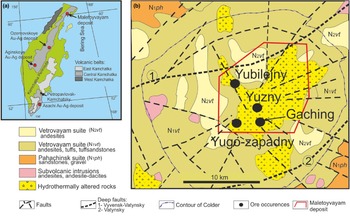
The Maletoyvayam deposit is located in the southwestern part of the Koryak Highland of the Central Kamchatka volcanic belt, in the Far East of the Russian Federation (60°19’51.87”N, 164°46’25.65”E). The Eocene–Oligocene Central Kamchatka volcanic belt is ~1800 km long. It is controlled by the Main Kamchatka deep fault, displaying many gold–silver epithermal deposits, including Maletoyvayam (Fig. 1a). The latter is particularly confined to a volcano-tectonic structure (up to 30 km) within the Vetrovayam volcanic zone located in the northeastern region of the Central Kamchatka volcanic belt and limited by the Koryak Highland in the southwestern part (Fig. 1b). This whole structure is controlled by the Vyvenskiy northeast-striking deep fault and the northwest-striking faults zone. Stratified subvolcanic and intrusive formations, as well as Quaternary sediments, are the main elements of the ore field (Sidorov et al., Reference Sidorov, Borovikov, Tolstykh, Bukhanova, Palyanova and Chubarov2020).
Geographic and geological position of the Maletoyvayam deposit: (a) volcanic belts and epithermal deposits of Kamchatka peninsula including Maletoyvayam; (b) geological map of the Maletoyavaym deposit (modified after Sidorov et al., Reference Sidorov, Borovikov, Tolstykh, Bukhanova, Palyanova and Chubarov2020 and Tolstykh et al., Reference Tolstykh, Tuhý, Vymazalová, Plášil, Laufek, Kasatkin, Nestola and Bobrova2020).

Unlike other epithermal deposits of the Central Kamchatka volcanic belt, which belong to the low-sulfidation type, the Maletoyvayam deposit is assigned to the high-sulfide one (Sidorov et al., Reference Sidorov, Borovikov, Tolstykh, Bukhanova, Palyanova and Chubarov2020; Tolstykh et al., Reference Tolstykh, Vymazalová, Tuhý and Shapovalova2018, Reference Tolstykh, Palyanova, Bobrova and Sidorov2020, Reference Tolstykh, Bukhanova, Shapovalova, Borovikov and Podlipsky2022). The Maletoyvayam deposit is composed of andesites, tuffs and tuffaceous sandstones. The main gangue minerals are quartz, alunite, native sulphur and kaolinite. The main ore minerals include pyrite and gold. A detailed description of the Maletoyvayam deposit, its geology, geochemical features and mineralisation can be found elsewhere (Kalinin et al., Reference Kalinin, Andreeva and Yablokova2012; Shapovalova et al., Reference Shapovalova, Tolstykh and Bobrova2019; Sidorov et al., Reference Sidorov, Borovikov, Tolstykh, Bukhanova, Palyanova and Chubarov2020; Tolstykh et al., Reference Tolstykh, Vymazalová, Tuhý and Shapovalova2018, Reference Tolstykh, Palyanova, Bobrova and Sidorov2020, Reference Tolstykh, Bukhanova, Shapovalova, Borovikov and Podlipsky2022).
The Maletoyvayam deposit comprises four ore occurrences: Yubileyniy, Yugo-Zapadniy, Tyulul and Gaching. The latter is located at the head of the Gachingalhovayam River and differs from the others by having a significant mineral variety. Tolstykhite described in this paper is associated with calaverite, fischesserite, Cu–Te-rich ‘fahlores’ [stibiogoldfieldite, ‘arsenogoldfieldite', tennantite-(Cu) and tetrahedrite-(Zn)], galena, gold, maletoyvayamite, famatinite–luzonite series minerals, native Se, native Te, pyrite, baryte, ilmenite, magnetite, quartz, V-bearing rutile and tripuhyite.
General appearance and physical properties
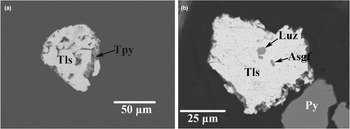
Tolstykhite was found in polished sections containing a heavy-mineral concentrate from the Gaching occurrence prepared following Tolstykh et al. (Reference Tolstykh, Tuhý, Vymazalová, Laufek, Plášil and Košek2022). It occurs as individual anhedral grains up to 0.05 mm. Some grains of tolstykhite form intergrowths with native Se, native Te and tripuhyite, or contain tiny (<0.01 mm) inclusions of the minerals of famatinite–luzonite series and different fahlores (Figs 2a,b).
Anhedral grains of tolstykhite (Tls): (a) intergrown with tripuhyite (Tpy); (b) with small inclusions of luzonite (Luz) and ‘arsenogoldfieldite’ (Asgf) in association with pyrite (Py). Polished section. Back-scattered electron image, sample no. 880T.

Tolstykhite is bluish-grey, opaque, with metallic lustre and a grey streak. Its tenacity is brittle and its fracture is uneven. Cleavage is good on {010} and {001}. No parting is observed. The density calculated using the empirical formula and unit-cell volume obtained from powder XRD data is 7.347 g/cm3. In reflected light, tolstykhite is grey with a bluish shade. No bireflectance, pleochroism and internal reflections are observed. In crossed polars, it is weakly anisotropic with bluish to brownish rotation tints. The reflectance values were measured in the air relative to a WTiC standard using a Zeiss 370 spectrophotometer MSP400 TIDAS mounted to Leica microscope with a 100× objective (National Museum in Prague, Czech Republic). Data are given in Table 1 and plotted in Fig. 3 in comparison with the published data for maletoyvayamite (Tolstykh et al., Reference Tolstykh, Tuhý, Vymazalová, Plášil, Laufek, Kasatkin, Nestola and Bobrova2020).
Reflectivity curves for tolstykhite compared with published data for maletoyvayamite (Tolstykh et al., Reference Tolstykh, Tuhý, Vymazalová, Plášil, Laufek, Kasatkin, Nestola and Bobrova2020).

Reflectance data of tolstykhite.*

* The values required by the Commission on Ore Mineralogy are given in bold.
Raman spectroscopy
The Raman spectrum of tolstykhite (Fig. 4) was collected in the range 80–4000 cm–1 using a DXR dispersive Raman Spectrometer (Thermo Scientific) mounted on a confocal Olympus microscope (National Museum in Prague, Czech Republic). The Raman signal was excited by an unpolarised 633 nm He–Ne gas laser and detected by a CCD detector (size 1650 × 200 pixels, Peltier-cooled to –60°C, quantum efficiency 50% and dynamic range 360–1100 nm). The experimental parameters were: 100× objective, 10 s exposure time, accumulation of 100 exposures, 50 μm pinhole spectrograph aperture and 0.5 mW laser power level. The spectra were repeatedly acquired from different grains in order to obtain a representative spectrum with the best signal-to-noise ratio. The possible thermal damage of the measured point was excluded and assessed by visual inspection of the exposed surface after measurement, observation of possible decay of spectral features at the start of excitation, and checking for thermal downshift of Raman lines. The instrument was set up by a software-controlled calibration procedure using multiple neon emission lines (wavelength calibration), multiple polystyrene Raman bands (laser-frequency calibration) and standardised white-light sources (intensity calibration). Spectral manipulations were performed using Omnic 9 software (Thermo Scientific).
Raman spectrum of tolstykhite in comparison with maletoyvayamite (taken from Tolstykh et al., Reference Tolstykh, Tuhý, Vymazalová, Plášil, Laufek, Kasatkin, Nestola and Bobrova2020).

The main bands observed in the spectrum are (in wavenumbers): 297, 203, 181, 151 and 127 cm–1 that are close to Raman spectra provided for natural ‘S-maletoyvayamite’ with the composition Au3Te6(S3.4Se0.6)Σ4.0 and synthetic Au2.92Te6.13(S2.15Se1.80)Σ3.95 (Palyanova et al., Reference Palyanova, Beliaeva, Kokh, Seriotkin, Moroz and Tolstykh2022) as well as for maletoyvayamite Au3Se4Te6 (the Se-analogue of tolstykhite) and its synthetic analogue (Tolstykh et al., Reference Tolstykh, Tuhý, Vymazalová, Plášil, Laufek, Kasatkin, Nestola and Bobrova2020; Palyanova et al., Reference Palyanova, Beliaeva, Kokh, Seriotkin, Moroz and Tolstykh2022). The strong bands at 127 and 151 cm–1 in tolstykhite could be tentatively assigned to Au–Te bonds whereas the ones at 181, 297 and the shoulder at 203 cm–1 – to Au–S bonds. According to Palyanova et al. (Reference Palyanova, Beliaeva, Kokh, Seriotkin, Moroz and Tolstykh2022), the band in the 280–290 cm–1 range appears when chemical analyses show the presence of S substituting for Se, and the more S is present in the sample, the stronger the corresponding band is. This is in line with the sharp peak of 297 cm–1 in tolstykhite, which is absent in maletoyvayamite and synthetic Au3Se4Te6. Also, in comparison with published peaks for maletoyvayamite (178, 158, 137 and 101 cm–1 – Tolstykh et al., Reference Tolstykh, Tuhý, Vymazalová, Plášil, Laufek, Kasatkin, Nestola and Bobrova2020), some observed bands of tolstykhite are shifted to higher wavenumbers (Fig. 4). These shifts are probably also connected with the S–Se substitution, as Hooke's Law predicts (Nakamoto, Reference Nakamoto1986). Analogous shifts have been reported as a consequence of S–Se substitution in permingeatite–famatinite/luzonite (Škácha et al., Reference Škácha, Buixaderas, Plášil, Sejkora, Goliáš and Vlček2014), tetrahedrite/hakite (Škácha et al., Reference Škácha, Sejkora and Plášil2017) or chalcostibite/příbramite (Sejkora et al., Reference Sejkora, Buixaderas, Škácha and Plášil2018).
Chemical composition
Seven electron-microprobe analyses were carried out with a Cameca SX-100 electron microprobe (wavelength dispersive spectroscopy mode with an accelerating voltage of 25 kV, a beam current on the specimen of 10 nA and a beam diameter of 1 μm) at the Department of Geological Sciences, Faculty of Science, Masaryk University, Brno, Czech Republic. Peak counting times (CT) were 20 s for all elements; CT for each background was one-half of the peak time. Matrix correction by PAP software (Pouchou and Pichoir, Reference Pouchou and Pichoir1985) was applied to the data.
Analytical data and used standards are given in Table 2. Contents of other elements with atomic numbers higher than that of beryllium are below detection limits. The empirical formula based on 13 atoms per formula unit is (Au2.98Ag0.01)Σ2.99(S3.59Se0.41)Σ4.00Te6.01. The ideal chemical formula is Au3S4Te6 which requires Au 39.79, S 8.64, Te 51.57, a total of 100 wt.%.
Chemical composition of tolstykhite (wt.%).

S.D. – standard deviation
X-ray diffraction data
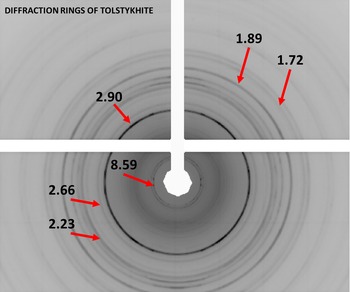
Single-crystal XRD studies could not be carried out because of the absence of single crystals: grains of tolstykhite are cryptocrystalline and inhomogeneous (see Fig. 5 showing diffraction rings typical of polycrystalline materials). Thus, an irregular aggregate not larger than 50 μm was collected in powder diffraction mode using a Supernova single-crystal X-ray Rigaku-Oxford Diffraction diffractometer equipped with a Pilatus 200 K Dectris detector and an X-ray micro-source (MoKα radiation) with a spot size of ~0.12 mm (University of Padova, Italy). The detector-to-sample distance was 68 mm. A standard phi scan mode as implemented in the powder power tool of CrysAlisPro was used for the powder data collection. We collected 360 frames, 1° and 120 seconds of exposure per frame for a total of ~12 hours of data collection. The observed d spacings are reported in Table 3. From these data, the unit-cell parameters of tolstykhite were obtained and gave the following values: triclinic, P $\bar{1}$ , a = 8.976(5), b = 9.030(2), c = 9.343(5) Å, α = 93.97(3), β = 110.02(3), γ = 104.38(4)°, V = 679.2(3) Å3 and Z = 2.
Diffraction rings of tolstykhite.

Comparison of powder XRD patterns (d in Å) of tolstykhite and maletoyvayamite (Tolstykh et al., Reference Tolstykh, Tuhý, Vymazalová, Plášil, Laufek, Kasatkin, Nestola and Bobrova2020)

Crystal structure and relation to other minerals
We assume that tolstykhite is isotypic with maletoyvayamite, with sulfur in the former substituting for selenium in the latter. A comparison of powder XRD for tolstykhite and maletoyvayamite (Table 3) demonstrates the structural identity between these two minerals. For their further comparison, see Table 4.
Comparative data for tolstykhite and maletoyvayamite.

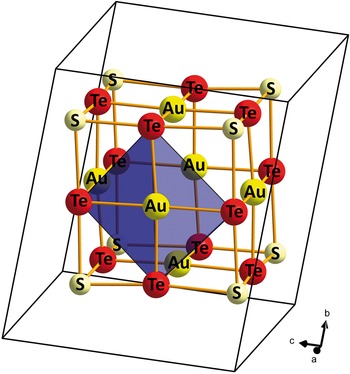
The structure of maletoyvayamite has been solved for its synthetic analogue and reported by Tolstykh et al. (Reference Tolstykh, Tuhý, Vymazalová, Plášil, Laufek, Kasatkin, Nestola and Bobrova2020). The crystal structure of the synthetic analogue of maletoyvayamite contains three Au, six Te and four Se atoms in the asymmetric unit; Se atoms are replaced by the S atoms in tolstykhite (Fig. 6). The SSe–1 substitution is connected with the decrease in unit-cell volume, resulting from the smaller ionic radius of S compared to Se (Shannon, Reference Shannon1976). This decrease is noted in tolstykhite as compared with maletoyvayamite [679.2(3) vs. 685.9(4) Å3 —see Table 4] and is even more apparent— in contrast with the synthetic Au3Se4Te6 [679.2(3) vs. 698.81(6) Å3 —see Tolstykh et al., Reference Tolstykh, Tuhý, Vymazalová, Plášil, Laufek, Kasatkin, Nestola and Bobrova2020].
Crystal structure of tolstykhite, based on the analogy with synthetic Au3Se4Te6, showing the [Au6S8Te12] cluster. The [AuTe4] square is emphasised.

Our analyses show a large degree of isomorphic substitution of S for Se in the tolstykhite–maletoyvayamite pair leading to a solid-solution series from S-richest and Se-poorest tolstykhite with S3.65Se0.35 through many intermediate members, including those corresponding to the middle of the series, to S-poorest and Se-richest maletoyvayamite with S0.38Se3.62 (Fig. 7). Even if the structures of both minerals are not solved by direct methods, the possible ordering of S and Se in them seems highly improbable. The similarity in the radii of Se2– and S2– anions lead to their substitution in solid solutions of many related minerals and synthetic compounds. No cases of their ordering are known to date. Aguilarite, the only mineral whose official IMA formula, Ag4SeS, indicates possible S–Se ordering, was, in fact, redescribed as the Se-analogue of acanthite and its structure determination revealed no ordering at room temperature (Bindi and Pingitore, Reference Bindi and Pingitore2013).
S vs. Se in tolstykhite–maletoyvayamite series. 1 – tolstykhite; 2 – maletoyvayamite; 3 – tolstykhite holotype; 4 – maletoyvayamite holotype (1–3: our data, 4:Tolstykh, Reference Tolstykh, Tuhý, Vymazalová, Plášil, Laufek, Kasatkin, Nestola and Bobrova2020).

Acknowledgements
We thank Associate Editor Owen Missen, Structure Editor Oleg Siidra, two anonymous reviewers and Principal Editor Stuart Mills for valuable comments. This research was supported by the Ministry of Culture of the Czech Republic (long-term project DKRVO 2019-2023/1.II.d; National Museum, 00023272 for J.S.) and the Grant Agency of the Czech Republic (project No. 22-26485S to A.V.).
Competing interests
The authors declare none.