Implications
The behaviour of stabled draught foals of both sexes was observed to evaluate possible negative effects due to the reduction of protein content in diet during the fattening phase. Results showed that maintaining well-being in fattening draught foals farming under a regimen of dietary protein reduction is possible, but the significant differences found in some behaviours influenced by diet, such as movement and rest, suggest a careful evaluation of diet changes. The use of diets with low protein (LP) content has often been suggested as a strategy to reduce nitrogen emissions in farms as required by the European Union Nitrate Directive.
Introduction
Behaviour is the most immediate indicator of animal welfare, and it has been used widely to understand the conditions of livestock under housing systems (Dawkins, Reference Dawkins2003). Current farming systems are aimed at ensuring animals have an adequate level of welfare, but management decisions typically have to balance the animals’ needs with farm profit and environmental requirements concerning animal well-being. The recent European Directive on nitrates (ec.europa.eu/environment/water/water-nitrates/index_en.html), aimed at regulating the level of nitrogen in the soil due to farming activity, has imposed serious restrictions on farmers, pushing researchers and operators to find strategies to reduce nitrate emissions at farm level. One of the most popular solutions applied is the reduction of protein levels in diets, combined, in general, with an increased supply of essential amino acids, but in a measure that does not involve negative consequences for animal performances and welfare (Oenema et al., Reference Oenema, Witzke, Klimont, Lesschen and Velthof2009). A number of studies have investigated the effects of a protein dietary reduction under the Nitrate Directive, and they have been mainly focussed on beef cattle and pigs, livestock species typically reared under intensive management conditions (e.g. Schiavon et al., Reference Schiavon, Tagliapietra, Dal Maso, Bailoni and Bittante2010). On the other hand, little attention has been paid until now to horses. Management systems for horses are varied, because they depend on the purpose for which the animals are used (e.g. sporting purposes such as show jumping, dressage, trotting or galloping competitions, or other aims as recreation, work, or meat production), and on the environmental choices and conditions under which animals are reared (Waran, Reference Walz, Stertz, Fijtman, dos Santos and de Almeida2001). Horses managed for meat production have been typically less studied than horses for sport, either because there are different feelings in different countries with respect to the consumption of horse meat, or because this product is only consumed locally, even in countries where horse meat is in common use. In Italy, a specialised breed, the Italian Heavy Draught Horse breed (IHDH) is mainly reared for meat production, although this animal is receiving increasing attention from many breeders for activities on holiday farms or for non-professional draught. The history, spread and rearing system for the IHDH have been described elsewhere (Mantovani et al., Reference Mantovani, Sartori and Pigozzi2013), as well as the quality of meat obtained at different ages (Tateo et al., Reference Tateo, De Palo, Ceci and Centoducati2008). Usually, meat-horses are reared in open pasture or stabled in intensive or semi-intensive stud-farm systems, and their nutritional requirements are typically greater than for sport horses (Pearson and Dijkman, Reference Pearson and Dijkman1994). A reduction of protein level in the diet may be, therefore, necessary in many intensive horse stud-farms, but the study of this matter has only recently been taken up and there is a lack of suitable case studies in the literature.
In addition, the role assumed by protein variations in horse diet is often controversial: in treadmill horses, an improvement in exercise performances has been observed both with high CP intakes, helping muscle recovery under intense exercise (Essén-Gustavsson et al., Reference Essén‐Gustavsson, Connysson and Jansson2010), and under a protein restriction, able to decrease the acidogenic effects of repeated sprints (Graham-Thiers et al., Reference Graham-Thiers, Kronfeld, Kline and Sklan2001). Furthermore, dietary deficiencies such as in protein typically drive the onset of oral stereotypies in horses and other ungulates, but also high CP rations may contribute to increase abnormal behaviours such as wood-chewing (McGreevy, Reference McGreevy2012). Some effects of a change in horse dietary regimen have been reported by Nicol et al. (Reference Nicol, Badnell-Waters, Bice, Kelland, Wilson and Harris2005), showing that young animals fed a diet with increased fat and non-structural carbohydrates are less distressed, quieter and more curious towards environmental stimuli. Horses may adapt their feeding behaviour to achieve a high-quality, balanced diet (Edouard et al., Reference Edouard, Duncan, Dumont, Baumont and Fleurance2010). Therefore, the introduction of different amino acid qualities in diet may imply different behavioural responses in horses (Grimmett and Sillence, Reference Grimmett and Sillence2005).
A first investigation on the effects of protein level reduction in diet was carried out on IHDH weanlings reared under intensive management systems (Mantovani et al., Reference Mantovani, Guzzo, Sartori and Bailoni2014). Productive performance and growth patterns were recorded in foals fed two different dietary protein levels, and first evidence of a non-significant reduction in both productive and growth performance was provided (Mantovani et al., Reference Mantovani, Guzzo, Sartori and Bailoni2014). In order to understand if the reduction in dietary protein could also have some consequences for animal daily habits, behavioural information was recorded in the study of Mantovani et al. (Reference Mantovani, Guzzo, Sartori and Bailoni2014). As a further research step, the present study is therefore aimed at investigating the possible differences in time budget and behaviour expressed in IHDH foals fed two different dietary protein levels.
Material and methods
All procedures were performed according to Italian legislation on animal care (Legislative Decree No. 116 of 27 January 1992) and approved by the ‘Ethical Committee for the care and use of experimental animals’ at the University of Padova, which operates within the European Directive 86/609/CEE regarding the protection of animals used for experimental and other scientific purposes.
Housing system and experimental design
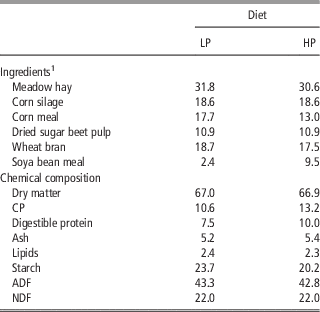
The work is part of a study carried out at the experimental farm of the University of Padova (Legnaro, Italy) aimed at evaluating the differences in growth patterns, in vivo performances, and meat quality and composition in IHDH foals fed a normal diet v. a diet with protein restriction (Mantovani et al., Reference Mantovani, Guzzo, Sartori and Bailoni2014). The experiment was carried out in two consecutive phases of fattening, each ending at about the traditional ages of slaughtering for the IHDH (about 12 and 18 months of age). Data of the present study were obtained during the first experimental phase and concerned a total of 20 weaned foals of both sexes, 10 males distributed in two pens and 10 females in two other pens. The animals in each pen (n=5) were randomly distributed but balanced for age and BW, and behaviour was monitored at the beginning of the trial to avoid relevant aggressive events within pens. The four pens were each assigned to one of the two isoenergetic diets differing in the level of CP, in order to obtain a 2 (diet)×2 (sex) factorial design. Therefore, the foals that entered this study were divided as follows: five females fed LP diet (LPF), five females fed high-protein diet (HPF), five males also fed LP (LPM), and five males HP (HPM). The feed was provided once a day, in quantities exceeding the requirements of foals, that is, ad libitum. Feed requirements, estimated for foals ageing 6 to 12 months and weighting 500 kg, were 8.5 kg/day of dry matter (DM), 1.217 kg/day of CP, 28 Mcal/day of digestible energy and 6.9 horse feed units/day of net energy (Martin-Rosset et al., Reference Martin-Rosset, Andrieu, Vermorel and Jestin2006; National Research Council (NRC), 2007). The LPF and LPM were fed a diet containing 10.6% of CP on DM; the HPF and HPM received a diet containing a normal CP content, that is, 13.2% CP on DM (Mantovani et al., Reference Mantovani, Guzzo, Sartori and Bailoni2014). Differences in CP level in diets were obtained by including different quantities of soya bean meals.
Additional details on chemical composition and ingredients of diets have been provided elsewhere (Mantovani et al., Reference Mantovani, Guzzo, Sartori and Bailoni2014) and summarised in Table 1. Subjects were housed in a barn consisting of pens with straw-bedded cubicles sized 5×7×5 m. The manger was situated in front of the pens and refilled at around 0900 h each day. A drinking cup providing ad libitum fresh water was placed within each pen, in one of the corners opposite the manger. Access to a paddock located at the back of the pens and sized 60×9 m was scheduled twice a week, in the morning. All the foals from one pen at a time were allowed to spend 45 min in the paddock. The behaviour that foals exhibited in the pen in a sample of days was used to detect behavioural differences due to the two diets. At the time of the video recordings, that is one week before the end of the first phase of the feeding trial (Mantovani et al., Reference Mantovani, Guzzo, Sartori and Bailoni2014), the foals were 437±60 kg of BW and 379±37 days of age.
Ingredients and chemical composition, expressed as percentage on dry matter (DM) basis, of the experimental diets

LP=low protein; HP=high protein.
1 Vitamin and mineral content (per kg, in international units, IU): 10,00,000 IU of vitamin A, 70 000 IU of vitamin D3, 1200 mg of vitamin E, 5000 mg of niacin, 1980 mg of betaine, 800 mg of Fe, 500 mg of Cu, 2950 mg of Zn, 28 mg of I, 8 mg of Se, and 30 mg of Mo.
Behavioural observations
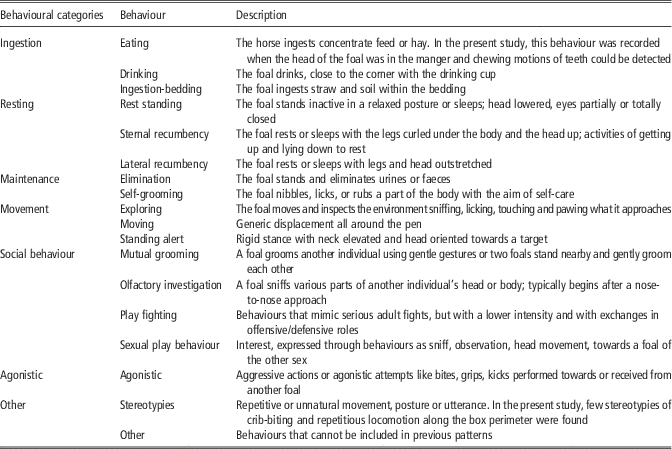
The behaviour of the foals was video recorded using a video-surveillance kit with four channels, each related to an IR camera (4 Channel H.264 Standalone Digital Video Recorder (DVR); AtlantisTM, Atlantis-land, MI, Italy) positioned within each pen. Each camera of the kit was fixed to the ceiling in front of the pen, to cover the whole available area. The DVR for video recording was placed in a room close to the pens, and a continuous recording of alternate hours was scheduled covering a number of consecutive days in which foals were not brought into the paddock. Low neon lightning was provided during the days of observation to allow the video recording. Two consecutive days of video recording, the same for all the groups of foals observed, were retained as a data set for analysis, and a subsample of a few hours was used for preliminary analysis, consisting of an inter-observer reliability test and the assessment of the foals’ ethogram. The reliability test was performed as three observers were used to analyse video recorded data. The Cohen’s κ, the Fleiss κ, and the AC1 Statistics were considered to check reliability between observers (Inter_Agree Macro and Magree Macro, developed by SAS Institute, 2009). The ethogram was built by considering the behaviours found in a subset of videos retained for preliminary analyses and in literature (e.g. McDonnell, Reference McDonnell2003; Nicol et al., Reference Nicol, Badnell-Waters, Bice, Kelland, Wilson and Harris2005; Ransom and Cade, Reference Ransom and Cade2009). Behaviours included in the ethogram are reported in Table 2.
Ethogram of foal behaviour within behavioural category and main descriptors of each behaviour

The data set was partitioned in 1-hour intervals that were randomly assigned to observers to avoid observer effects. Foals were tracked using a focal sampling and continuous monitoring approach, that is each foal was individually followed by observers and the whole video recording was tracked. The interval (s) between the beginning of a given behaviour and of the following one was considered as a single observation of that behaviour. The video recordings were performed at the beginning of May, when there were about 14 h and half of daylight (sunrise and sunset were at around 1750 h and 2025 h, respectively; www.timeanddate.com), that horses mostly spend in grazing (McGreevy, Reference McGreevy2012). All the single observations of a target behaviour that were recorded for an individual were divided by the total time of recording and multiplied by 100. This way, each behaviour was expressed as percentage of the total activity of each individual (i.e. its time budget). The behaviours recorded in two days by different observers were added and considered together, and therefore possible dissimilarities in data due to different observers were prevented. Concerning behavioural categories (BC), the amount of time spent by each individual in activities of a specific BC was quantified as sum of all behaviours of that BC.
During the whole experiment, the amount of total mixed ration given daily was recorded, and residuals were collected and weighed weekly. The DM and CP intakes were computed for each week of trial as the difference between the weekly total mixed ration distributed in the manger and the residual, then divided by the number of days in the week and by the foals within each pen, to obtain an estimate of the mean individual daily intake of DM and CP (kg/h). The same approach was considered in the previous study of Mantovani et al. (Reference Mantovani, Guzzo, Sartori and Bailoni2014). The ingestion from the straw of the bedding (ingestion-bedding behaviour) was not considered for intake estimation because no measures from the bedding were available. The least square means (LS means; GLM procedure, SAS Institute, 2009) of the eating behaviour within diet and sex (expressed as percentage of behaviour within a day, and obtained from the statistical analysis described below) were used to calculate the average amount of time that foals daily spent in ingesting feed. A rate of DM intake (kg/h) was calculated by dividing the daily DM intake by 24 h/day. The rate of CP intake was obtained with the same approach.
Statistical analysis
Behavioural differences due to diet and to other possible sources of variations were investigated using an ANOVA approach, and the following single traits linear model (GLM procedure; SAS Institute, 2009) was considered for analysis:
 $$Y_{{ijk}} \,{\equals}\,{\rm }\mu {\rm }{\plus}{\rm }D_{i} {\plus}{\rm }S_{j} {\plus}\left( {D{\times}S} \right)_{{ij}} {\plus}{\rm }e_{{ijk}} $$
The model included the target behaviour Y ijk as trait, the overall mean µ, the fixed effects of the ith diet D (HP or LP, 2 levels), and of the jth sex S (2 levels), the interaction among D and, S, and the random residual error term e ijk ~N(0, σ 2 e ). Other effects preliminarily investigated, such as the body condition score, morphology and rank of individuals, were not included in the final model because they did not account for a significant amount of variation (P>0.05). Also the age and BW of foals were preliminarily considered, but not used because of their small effect on the variance of many behaviours. The LS means (GLM procedure, SAS Institute, 2009) were calculated for each effect included, and comparisons between LS means were carried out by applying the Bonferroni correction method (SAS Institute, 2009).
Results
An agreement of ~60% was found for the three observers when compared in pairs, that is Observer 1 v. Observer 2 (63.2%; Cohen’s κ=0.60), Observer 1 v. Observer 3 (64.1%; Cohen’s κ=0.61), and Observer 2 and Observer 3 (56.3%; Cohen’s κ=0.52). When the three observers were considered at the same time an agreements of 0.57 and 0.59 were calculated using the Fleiss κ and the AC1 Statistics, respectively. A degree of agreement from moderate (0.4 to 0.6) to substantial (0.6 to 0.8) was found (Magree Macro; SAS Institute, 2009). Possible inconsistencies between observers were then eliminated by randomly assigning the video recordings of different hours to different observers and then summing up their measures.
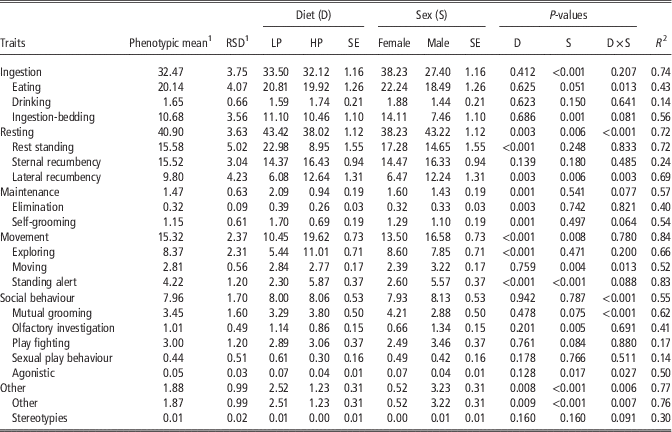
The ANOVA performed on behaviours and behavioural categories on a daily basis well explained in many cases the variability of data (Table 3). Movement was the BC with the greatest coefficient of determination (R 2=0.84), followed by ingestion (R 2=0.74) and resting (R 2=0.72). Social behaviour was the BC with the lowest R 2 (0.55), close to maintenance (R 2=0.57). The ANOVA performed on the other BC, counting all the non-included behaviours, was not furtherly considered because the behaviours within this BC had different biological meaning. The only exception were the ANOVA results on the stereotypies behaviour, clearly defined.
Phenotypic mean with RSD for all the behavioural categories and individual behaviours considered in the ANOVA, least square means for the main effects diet and sex, significance of the effects and their interaction D×S, and coefficient of determination (R 2) for the model

LP=low protein; HP=high protein.
1 Percentage of daily activity.
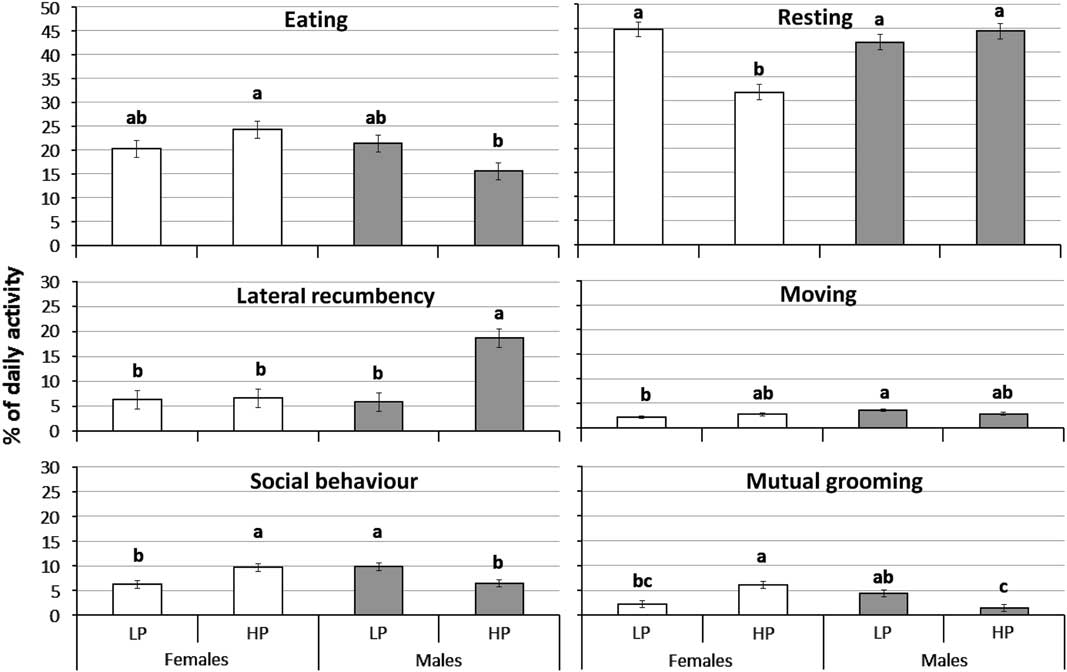
Foals spent 32.47±3.75% of their daily time (Table 3) in ingestion activities such as feeding from the manger (eating; 20.14±4.07%), drinking (1.65±0.66%) and feeding from the bedding (i.e. ingestion-bedding; 10.68±3.56%). The expression of ingestion and of the behaviours included in this BC apart drinking mainly depended on the sex of the foals (P⩽0.001 for ingestion and ingestion-bedding) and on the interaction diet×sex (for eating; Figure 1), with females spending a greater amount of time in ingestion (38.23±1.16%) than males (27.40±1.16%; Table 3). HP females spent more time in eating than HP males (24.25±1.78% v. 15.59±1.78%; P⩽0.05; Figure 1), but we did not find differences between sexes in LP group (20.23±1.78% and 21.39±1.78%, respectively). No significant differences due to diet were found in ingestion BC and in related behaviours. Focussing on the eating behaviour (see Table 3), an average amount of 4.83±0.98 h was daily spent by foals for feeding from the manger (data not shown in table). The male foals fed HP spent 3.74±1.36 h of the day in feeding from the manger, and they had daily DM and CP intakes of 12.15±0.68 and 1.55±0.06 kg/day. The rate of intake was 2.16±0.18 kg/h and 0.27±0.03 kg/h for DM and CP intakes, calculated by dividing the respective intake for the number of hours dedicated to eating. The males fed LP spent 5.13±1.16 h of the day in feeding from the manger, and considering intakes of 9.27±1.34 (DM) and 1.05±0.14 (CP) kg/day, the rates of intake were 1.81±0.26 (DM) and 0.20±0.07 (CP) kg/h. Concerning the females, a total of 5.82±0.47 and 4.85±0.43 h were dedicated to the activity of feeding from the manger by HPF and LPF, respectively. The intakes were 10.78±1.00 kg/day (HPF) and 9.75 kg/day±1.10 (LPF) for DM and 1.38±0.10 kg/day (HPF) and 1.10±0.09 kg/day (LPF) for CP. The rate of intake was similar in the females, and reported values of 1.85±0.17 kg/h (HPF) and 2.01±0.18 kg/h (LPF) for DM, and of 0.24±0.05 kg/h (HPF) and 0.23±0.04 kg/h (LPF) for CP. On the whole, CP intake was significantly higher in HP foals than in LP foals (1.47±0.10 v. 1.07±0.10 kg/day; P⩽0.05; data not shown), whereas DM intake was not different between HP foals (11.48±0.73 kg/day) and LP foals (9.53±0.73 kg/day).
Least square means for the significant interactions (see Table 3) between diet and sex in the ANOVA. Both behavioural categories and individual behaviours have been reported. a,b,cLeast square means with diverse superscript differ at P⩽0.05. LP=low protein; HP=high protein.

The resting BC occupied 40.90±3.63% of the day for the foals (Table 3): the animals rested either standing in a relaxed posture (15.58±5.02%), lying down with their head up (sternal recumbency; 15.52±3.04%), or with head and legs stretched (lateral recumbency; 9.80±4.23%). Females fed HP diet significantly (P⩽0.05; Figure 1) spent less time in resting than the other foals (31.67±1.59% v. 43.74±1.59% as average of the other foals). Concerning behaviour included in resting BC, LP foals spent a considerably greater amount of time standing at rest than HP foals (22.98±1.55% v. 8.95±1.55%; P⩽0.001). No differences due to diet or sex were found for sternal recumbency (Table 3), whereas males fed HP spent more time in lying in lateral recumbency than other foals (18.66±1.73% v. 6.25±1.89%; P⩽0.001; Figure 1).
Only 1.47±0.63% of the day was dedicated to body care (e.g. self-grooming; 1.15±0.61% of the time), and both maintenance BC and related behaviours showed differences due to diet, overall more performed by LP foals than by HP foals (2.09±0.19% of the day v. 0.94±0.19%, P⩽0.001; Table 3).
Movement was the third activity in the daily activity of foals (15.32±2.37% of their time budget), meaning exploration of the environment in which they were (exploring; 8.37±2.31%), simple displacement within the pen (moving; 2.81±0.56%) or taking up a rigid posture of alert (standing alert; 4.22±1.20%). Relevant differences due to the diet were found in the activities related to displacement (movement BC: 19.62% of the day in HP foals v. 10.45% in LP foals, P⩽0.001; Table 3). Looking at the single behaviours included within movement BC, analyses showed that animals fed HP spent more time than LP foals in exploring the environment (11.01±0.71% v. 5.44±0.71%; P⩽0.001), and staring in a posture of alarm (standing alert; 5.87±0.37% v. 2.30±0.37%; P⩽0.001), whereas no differences due to diet were found in moving behaviour. Male foals significantly spent more time than females staring in an alert position (5.57±0.37% v. 2.60±0.37%; P⩽0.001), and – but only within LP diet regimen – to move within the pen (3.60±0.25% v. 2.09±0.25%; P⩽0.05). On the whole, males dedicated more time than females in movement BC (16.58±0.72% v. 13.50±0.75%; P⩽0.01).
Social interactions with neighbours involved <8% of the foals’ time, and they were mainly affiliative (e.g. mutual grooming; 3.45±1.60%) or dedicated to a friendly play fighting (3.00±1.20%). The interactions oriented towards members of other sex and agonistic interactions such as bites or kicks rarely occurred (0.44±0.51% and 0.05±0.03%, respectively). The social behaviour BC was affected by the interaction of diet and sex (P⩽0.001; Table 3) showing females HP and males LP spending more time than the others in social interactions (9.73±0.76% v. 6.33±0.73%; Figure 1). Social behaviours were to some extent different in the two sexes: males were significantly more inclined than females to gently approach pen mates through olfactory investigation (1.34±0.15% v. 0.66±0.15%; P⩽0.01; Table 3), whereas females have exerted mutual grooming for more time than males. However, a significant difference between sexes was found only within HP diet (5.29±0.67% v. 1.05±0.61%; P<0.01; Figure 1). Males showed a trend in spending more time than females in play fighting (3.46±0.37% v. 2.49±0.37%; P=0.084; Table 3). Agonistic expressions resulted a bit greater in females (0.07±0.01 v. 0.04±0.01; P⩽0.05) since they were almost absent in LP males (0.01±0.01, P⩽0.05 for D×S effect; data not shown). However, agonistic behaviours were quite rare during the day in all foals.
Few occasional stereotypies were observed (about the 0.01% of the day; Table 3), and not statistical significance due to diet or sex was found. The stereotypies observed were a couple of events of crib-biting (the grab of a solid object such as the fence rail), and few moments of repetitious movements along the box perimeter.
Discussion
The effects of diet variations on behaviour have been sometimes considered in livestock species, and they have mostly regarded feed restriction regimens (e.g. in gilts, Appleby and Lawrence, Reference Appleby and Lawrence1987) and fibre supplementations (e.g. in heifers, Redbo and Nordblad, Reference Redbo and Nordblad1997; and in sows, Meunier-Salaün et al., Reference Meunier-Salaün, Edwards and Robert2001). The effects of protein supplementation, e.g. under a restricted regimen, have been also seldom studied (e.g. in lambs, Yurtman et al., Reference Young, Creighton, Smith and Hosie2002). The consequences of a reduction in dietary protein content, that have become relevant after the Nitrate Directive and its restrictions on nitrogen emissions, have mainly focussed on productive aspects such as meat quality or growth (e.g. in pigs, Schiavon et al., Reference Schiavon, Tagliapietra, Dal Maso, Bailoni and Bittante2010).
About behaviour, an increase in dietary protein has been generally associated with an increase in dominance or territorial aggressions towards other individuals, as found in other species such as dogs (deNapoli et al., Reference DeNapoli, Dodman, Shuster, Rand and Gross2000), mice (Walz et al., Reference Waran2013), laying hens (Van Krimpen et al., Reference Van Krimpen, Kwakkel, Reuvekamp, Van Der Peet-Schwering, Den Hartog and Verstegen2005). An explanation for the increase in activity may be obtained in the greater large neutral amino acids/tryptophan (LNAA/Trp) ratio generally found in diets with a CP enrichment; these diets tend to increase the protein percentage by introducing amino acids such as leucine, isoleucine, methionine, phenylalanine, tyrosine and valine, that compete with free plasma tryptophan for the binding sites of carrier proteins in the blood-brain barrier (Grimmett and Sillence, Reference Grimmett and Sillence2005). Tryptophan is precursor of serotonin, the ‘good mood protein’ which is an inhibitor of anxiety, aggressiveness, excitability and causes an increase in sleepiness or sedation (Grimmett and Sillence, Reference Grimmett and Sillence2005). An increase in competition for binding sites leads to a reduction in the quantity of tryptophan to be converted to serotonin in brain, with a consequent lessening in the sedative effects of serotonin. Conversely, a diet rich in free fatty acids increases the quantities of free plasma tryptophan because fats compete with tryptophan for binding to albumin, and therefore a greater quantity of free tryptophan can be carried within brain (Grimmett and Sillence, Reference Grimmett and Sillence2005). A number of studies have been carried out on diverse species such as horses and focussed on behavioural differences due to different tryptophan levels in diet, but experimental evidences have been not always found. Concerning horses, tryptophan has been commercialised as a calmative for horses, but literature studies have not considered adequate doses of this amino acid to reach statistically significant behavioural variations linked to aggressiveness (Malmkvist and Christensen, Reference Malmkvist and Christensen2007; Noble et al., Reference Noble, Brockwell, Munn, Harris, Davidson, Li, Zhang and Sillence2008). Some significant variations in horse behaviour due to different dietary protein levels have been found for exercise, as also mentioned in the Introduction. A study on Quarter horses has found an increased level of blood lactate : pyruvate ratio in animals fed a higher level of CP, probably due to more exercise carried out in a short-time period (Miller-Graber et al., Reference Miller-Graber, Lawrence, Foreman, Bump, Fisher and Kurcz1991). Concerning the present study, HP diet contained a quantity of LNAA with respect to the amount of tryptophan that was higher than the one of LP diet (LNAA/Trp was 18.6 in HP and 15.5 in LP, calculated following National Research Council (NRC) data about amino acid content in feeds; NRC, 2007), and foals fed HP were found to spend significantly more time in behaviours related to excitability such as exploring and standing alert, and significantly lower time in the ‘calm behaviour’ of rest standing with respect to foals fed LP. As well as in literature, no statistical evidences of increased aggressive behaviours in foals fed HP diet were obtained (Table 3). A significant behavioural difference in the study concerned the lateral recumbency, greater in HP males than in the other foals, but clear explanations from literature were not found.
Differences in diet did not cause variations in foals feeding: no differences in drinking activities were observed in foals fed the two diets (Table 3) although in previous studies HP horses showed greater absorption of liquids due to an increased intracellular concentration (Connysson et al., Reference Connysson, Muhonen, Lindberg, Essén‐Gustavsson, Nyman, Nostell and Jansson2006). Again, since a clear trend of individual intake rates was not found in the study (i.e. foals did not show a different intake as respect to the diet; see the Results) this fact suggested that feeding different diets did not cause relevant metabolic differences in foals. Intake and rates of intake for DM found in the present study are within the range of literature examples reviewed by Ellis et al. (Reference Ellis, Longland, Coenen and Miraglia2010) and considered more in detail in the companion work of Mantovani et al. (Reference Mantovani, Guzzo, Sartori and Bailoni2014).
The analysis of individual time budgets may provide useful indications for animal welfare, because they allow evaluating whether behaviours observed are consistent with the normal behaviour of the species, in terms of stereotypies, amount of ‘positive’ and ‘negative’ behaviours (e.g. play or standing alert, respectively) and number of different behaviours acted by individuals (Dawkins, Reference Dawkins2003; Young et al., Reference Yurtman, Savas, Karaagac and Coskuntuna2012). Weaned foals in the present study have shown a negligible amount of stereotypies and a very low number of negative behaviours such as aggressive acts. An amount of time spent in the negative behaviour of standing alert was found in all foals of the study, and proved to be significantly higher in HP foals. Nevertheless, some moments in standing alert are consistent with normal activity of the species, and both under LP and HP diet behaviours may be considered at level 2 of the 10-point stress scale of Young et al. (Reference Yurtman, Savas, Karaagac and Coskuntuna2012), indicating a basic absence of stress. Again, foals of different sexes showed differences in social activities consistent with the species behaviour (Waran, Reference Walz, Stertz, Fijtman, dos Santos and de Almeida2001; McGreevy, Reference McGreevy2012): males were a bit more likely to play than females, and females groomed each other more than males.
A time budget including as many behavioural patterns typical of the species as possible is desirable in livestock management and provides indications of animal well-being (Dawkins, Reference Dawkins2003). Group-living animals show a greater amount of behavioural patterns than individual stabled animals, due to the possibility of interactions (Waran, Reference Walz, Stertz, Fijtman, dos Santos and de Almeida2001). The foals in this study had an amount of social contacts and locomotion activities greater than the group of housed animals studied by Heleski et al. (Reference Heleski, Shelle, Nielsen and Zanella2002) in comparison with single housed foals, suggesting the preservation of welfare regardless of the diet fed. The time budget of foals showed behavioural occurrences similar to the ones observed for a daytime period in adult horses of mixed breed when housed in groups (Yarnell et al., Reference Yarnell, Hall, Royle and Walker2015). Compared with the individual stabling, group housing allows more natural behaviours and contacts with conspecifics, diminishing the stress level of individuals, and improving well-being conditions (Yarnell et al., Reference Yarnell, Hall, Royle and Walker2015). Furthermore, the possibility of moving twice a week into a paddock (Mantovani et al., Reference Mantovani, Guzzo, Sartori and Bailoni2014), in addition to group housing, has surely provided advantages for animal welfare (Heleski et al., Reference Heleski, Shelle, Nielsen and Zanella2002).
Data provided in literature and the findings of the present work suggest that the welfare of IHDH foals was maintained both under LP and HP diets, and therefore a small reduction in CP in stabled draught horses is feasible without welfare detriment. This finding is consistent with a companion study (Mantovani et al., Reference Mantovani, Guzzo, Sartori and Bailoni2014) that found non-significant variations in growth and in vivo performances in IHDH foals fed the same LP or HP diets considered here. Management systems providing slightly lower percentages of dietary protein than those in current use seem, therefore, to be a good solution to fulfil the requests of the Nitrate Directive. Nevertheless, the significant behavioural differences found in the present study that were due to diet related to movement and rest, also suggest that great attention needs to be paid when varying the protein content. Also little differences in diet may cause behavioural variations, and proper management strategies such as avoiding increasing or reducing too much dietary protein content, group housing, or providing adequate spaces for movement activities, should be taken into account.
Acknowledgements
The authors would like to acknowledge the Italian Heavy Draught Horse Association for the help in finding the study subjects; the students Maria Laura Babetto, Annalisa Boscolo, Giulia Canevarolo, Giulia Faccioli, Federica Franchin, Massimiliano Pisapia, Pietro Scarpa, Elisa Stoppini, for the analysis of video recorded data; Neil Herbertson of the Blenheim School of English (Castelfranco, TV) for the linguistic revision; the Veneto Region for funding. The project is a part of the project ‘Characterization and valorisation of foal meat in Italian Heavy Draught Horse (IHDH) stabled in Veneto – LABELCAI’ (Veneto Region, PSR, Misura 124, DGR 877 del 07/04/2009; period: November 2010 to November 2011).