Not long after the Deepwater Horizon blowout of 20 April 2010, the Miami Herald published an article that considered the disaster's place in oil history. Moving toward an argument against a federal moratorium on offshore drilling, the story offered a brief historical sketch of the US oil industry that emphasized the dependence of Gulf state economies on deep-ocean extraction. While setting the disaster within the specific history of offshore drilling, the Herald story invoked another “context” for the affair, noting that “Oil and humanity have been linked since the dawn of civilization. In ancient times, oil … was collected and used to make ointments, medicines, building materials, adhesives and lamp fuel.”Footnote 1 Locating the roots of the oil industry in the originary moments of “civilization,” the Herald article introduced a maximally expansive perspective for the evaluation of the Deepwater Horizon disaster, a perspective that implicitly refigured the blowout as one moment in an eternal sequence of human interactions with oil.
In its efforts to archaize oil, the Herald story drew on a cultural discourse long employed to assess and recode the crises of the modern petroleum industry, a set of narratives and representational tropes that first appeared in corporate oil promotions of the early twentieth century. In the midst of a 1901 dedicatory speech in the Pennsylvania oil region, Congressman John Dalzell offered an early articulation of the central themes of this discourse:
So long as men have known anything they have known of the existence of petroleum … It has been known in all places and by all races; by Egyptian, Persian, Greek, and Roman; by European and Asiatic and by dwellers in the islands of the sea … It served in the construction of the ark in which Noah and the progenitors of our race successfully rode the waters of the deluge. It burned in the sacred lamps of the Temple of Jupiter, and made part of the wrappings in which the Egyptians sought to preserve the bodies of their dead …Footnote 2
Imagining petroleum production as a timeless practice transcending the vicissitudes of sociopolitical history, Dalzell's speech drew inspiration from its ceremonial object: the Drake Memorial in Titusville, Pennsylvania (Figure 1). Commissioned by Standard Oil, the Drake Memorial shaped a complex allegory of oil extraction that rehabilitated the public image of the corporation and the broader oil industry in a moment of intensifying crisis. Conceived as a symbolic response to the period's intensifying concerns about the sustainability and social effects of oil capitalism, the monument worked to reinvest the turbulent petroleum industry with deep historicity. The Drake Memorial, I will argue, organized an image of the petroleum business that encouraged visitors and national audiences (reached through an extensive publicity campaign) to take the long view on oil: to adopt a sweeping historical perspective that reconceived the fugitive resource as a timelessly abundant element and the boom-and-bust oil industry as one phase in an age-old and steadfast venture. In so doing, the memorial set the terms for a cultural discourse that would inform promotional imaginings of the oil industry throughout the twentieth century, and (as suggested by the Miami Herald article) that continues to find voice in contemporary assessments of oil.
Charles Brigham and Charles Henry Niehaus, Drake Memorial (1899–1901), Titusville, Pennsylvania. Photo by the author.

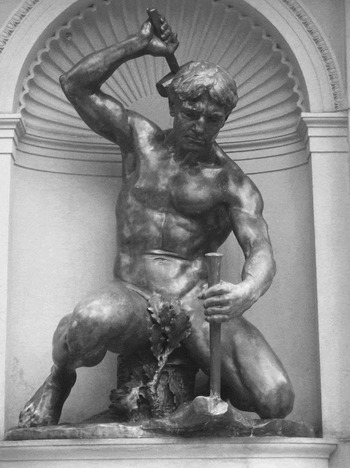
This essay reconstructs the Drake Memorial project, examining its plastic forms and press notices as components of the monument's promotional meaning. I focus on the looming bronze figure at the center of the memorial – Charles Henry Niehaus's bronze The Driller (Figure 2) – as the symbolic core of the monument's reimagining of the oil industry. Nude, heavily muscled, and crouching over a barren rock shelf, The Driller articulates a primitivist vision of petroleum extraction that addressed and reframed the material conditions of oil capitalism that deeply unsettled turn-of-the century Americans. This archaizing vision pursued several symbolic objectives. By realigning oil with deep historicity, The Driller answered period concerns about the industry's sustainability. In conjuring a primordial past for oil production, moreover, the sculpture recoded the atavistic associations that circled around the industry in the moment. Returning extractive industry to its imagined roots, The Driller refigured the violent and unpredictable process of oil production as an elemental contest between body and nature. This fantastic vision resonated with contemporaneous antimodernist arguments that decried the strictures of bourgeois society and urged Americans (and especially white men) to rediscover primal energies and corporeal capacities smothered by “civilization.” Tapping into these popular primitivist fantasies, The Driller recast the modern oil industry as a field of savage exertion that held the promise of personal and national renewal.
Charles Henry Niehaus, The Driller, 1899–1901, bronze. Photo by the author.

Though keyed to the specific concerns facing the turn-of-the century oil industry, the Drake Memorial established the foundations for a cultural discourse – I will call it “petro-primitivism” – that would reappear in later promotional displays and gradually filter into the rhetoric of advertising and publicity. To suggest the enduring power of petro-primitivist themes, I will briefly consider two displays mounted by US oil companies: the Sinclair Oil exhibit at the Chicago World's Fair of 1933–34 and Sun Oil's Oil Serves America exhibit at the Franklin Institute in Philadelphia (1953–54). Undertaken in moments of conflict and crisis, these projects employed the image of oil's primordial past to reframe the chaotic cycles of oil capitalism, to counter conservationism, and to reassert the viability of domestic oil in the face of industrial globalization. By examining the primitivist arguments advanced by these exhibits and the earlier Drake Memorial, I aim to offer a new account of the promotional initiatives of the early petroleum industry that explores the intersections between the traditional arts and corporate publicity and that reestablishes the important role that representations of petroleum's deep past played in accommodating twentieth-century Americans to modern oil capitalism.Footnote 3
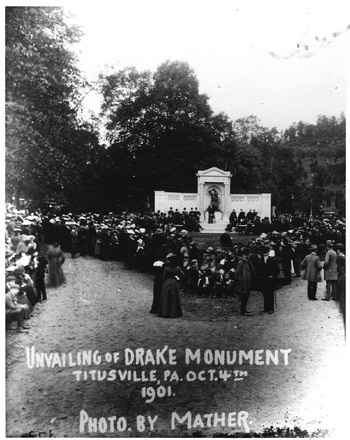
John Mather, “Unveiling of the Drake Monument,” silver print from glass negative (1902), Drake Well Museum, Titusville, PA.

BLEAK VISIONS: POPULAR ACCOUNTS OF PETROLIA AND THE EARLY OIL INDUSTRY
Efforts to raise a monument to Edwin Drake (1819–80) began not long after the operator struck a large petroleum pool on the banks of Oil Creek, a tributary of the Alleghany River in northwest Pennsylvania, on 27 August 1859.Footnote 4 Though Drake would subsequently recede from the industry that grew up around his well, the oilman enjoyed iconic status among the small producers of the Pennsylvania oil region. Embracing Drake as a founding father of “Petrolia” (as the region was quickly dubbed) and an icon of independence in an era of corporatization, Pennsylvania oilmen began calling for a monument to his memory in the late 1860s. The most ambitious attempt to realize this goal unfolded in 1881–82, when the businessmen of Titusville (the nerve center of the oil region) began soliciting subscriptions for a sculptural monument within the city's new oil exchange. After making preliminary arrangements with Washington, DC sculptor Vinnie Ream for a monumental figure, however, the commission failed to raise enough money to complete the project.Footnote 5
After several subsequent efforts went unrealized, the memorial project was taken up in 1899 by Standard Oil executive Henry H. Rogers, who pledged $50,000 and named Calvin Payne, general manager of the Standard Oil Trust's pipeline subsidiary, as the director of the undertaking.Footnote 6 Payne hired Boston architect Charles Brigham to design a granite memorial for a triangular lot in Woodville Cemetery, a picturesque burying ground on the western edge of Titusville that catered to the city's elite.Footnote 7 Brigham settled on a design that balanced a curving granite exedra organized around a central sculptural niche and capped by two shallow-relief panels, and selected models submitted by New York sculptor Charles Henry Niehaus (1855–1935) to fill the monument's sculptural spaces. Niehaus was a popular choice among municipal and corporate patrons of the moment. The artist worked in a classicized sculptural language that was accessible to popular audiences and readily adapted his creative ambitions to suit the demands of his clients. This flexibility served Niehaus well over the years, allowing the artist to win commissions for sculptures of a range of subjects from Abraham Lincoln to Nathaniel Forrest Bedford.Footnote 8
After Niehaus completed a plaster model of The Driller, the sculpture was cast in bronze by the John Williams Foundry in New York and set on its base in August 1900; the artist finished maquettes for the allegorical figures of Memory (at the exedra's left edge) and Grief (at the right) soon after, which the New England Granite Company executed in 1901.Footnote 9 The completed Drake Memorial was dedicated on 5 October 1901 with an elaborate ceremony (Figure 3) that included several speeches, a brass-band performance, and a procession of schoolchildren.Footnote 10 Widely reported in the press in the oil region and nationally, the ceremony culminated an extensive publicity campaign that carefully tracked the memorial's development. This campaign ensured that the Drake Memorial spoke to two audiences: even as it intervened in the civic landscape of the oil region, the heavily promoted monument organized a cultural spectacle that reached a national viewership.
Though it would later fall into obscurity, the Drake Memorial was the centerpiece of a sweeping promotional initiative undertaken by Standard Oil at the turn of the century. Breaking from its previous policy of public taciturnity, the Trust sponsored exposition displays, published books and periodicals that advanced its views, and hired an advertising agency to place company-friendly articles in the national press.Footnote 11 This campaign had acquired increasing urgency by the last decade of the nineteenth century. Brian Black has demonstrated that the rapid expansion of oil production in Pennsylvania generated a wave of popular representations of the region that emphasized the danger, social chaos, and environmental ruin of the early industry.Footnote 12 As Standard Oil attained control over production and refining in the oil region, these dystopian visions of Petrolia were increasingly employed to attack the Trust. Representing the first major cultural attempts to make sense of the oil business, these journalistic, artistic, and reformist accounts called into question the sustainability of oil and the compatibility of the petroleum industry with period notions of technological modernity.
The petroleum industry was associated with disorder and ruin almost from its inception. The only regulatory framework guiding early oil production was the common-law doctrine of the rule of capture, which granted drillers the right to exhaust underground deposits regardless of surface property demarcations.Footnote 13 By disconnecting subterranean oil pools from property boundaries, the rule of capture removed any incentive for traditional land stewardship and instead ensured a flush-field model of production in which drillers sought to drain pools as quickly as possible. East Coast reporters covering the oil boom marveled at the despoliation produced by this system. An 1864 article in Harper's Magazine, for example, imagined Petrolia as a dystopian inversion of the pastoral ideal, noting, “The whole aspect is as unattractive as anyone with a prejudice for cleanliness, a nose for sweet smells, and a taste for the green of country landscapes can well imagine. Everything you see is black … [and] saturated with waste petroleum.”Footnote 14 Echoing other period accounts, the Harper's article figured Petrolia as a “black” landscape of industrial dreck, an abject space that offended refined aesthetic tastes and short-circuited normative sensory experiences of the natural landscape.
Other observers noted and decried the radically unstable character of oil-region development. The boomtown Pithole frequently served as a metonym for the region's disposable mode of settlement in these accounts. Just eight months after oil was discovered on sparsely populated farmland near Pithole Creek in January 1865, Pithole boasted 15,000 residents; by 1868, local oil pools had been exhausted and the instant city was abandoned. Noting the absence of traditional communal hubs (schools, churches, and so on) and the prevalence of illicit entertainments within Pithole, visitors construed the boomtown as a flimsily built and morally debased encampment headed for ruin. An 1866 Beadle's article thus predicted that in the near future “Pithole will have run its race. It may never become a Pompeii or Herculaneum, buried in the body of the earth, but it will expire when oil ceases to flow in its midst.”Footnote 15 The eastern press regularly revisited the fallen boomtown in the following decades, appropriating Pithole's “forlorn and shattered” ruins as an illustration of the oil region's alarmingly evanescent forms of settlement.Footnote 16
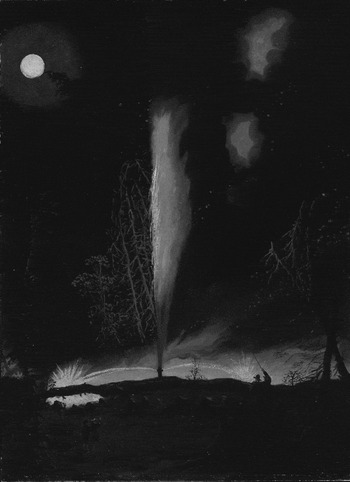
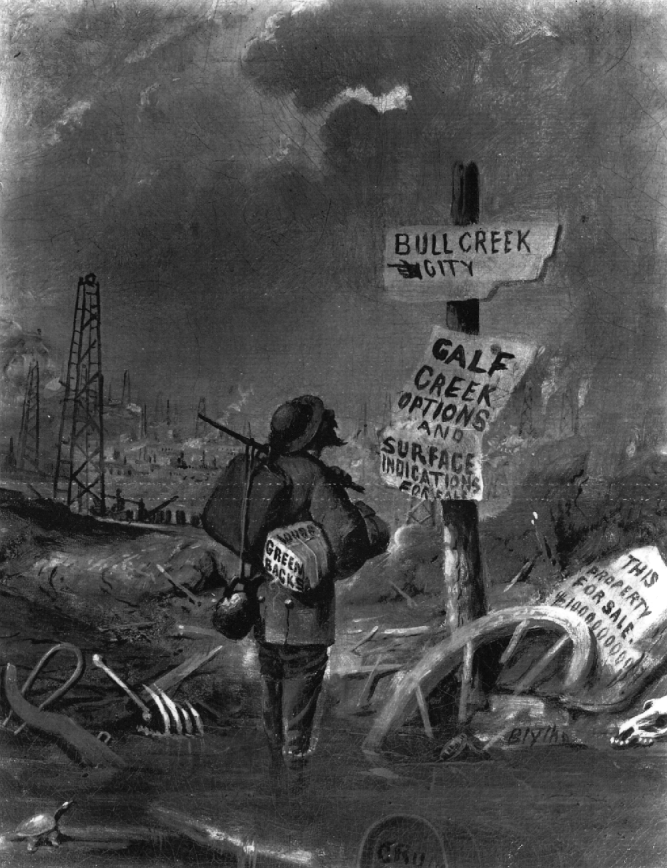
The chaos of the early oil industry also inspired several painters to produce dystopian scenes of Petrolia. In 1861 the Philadelphia artist James Hamilton composed an otherworldly scene of that year's Rouse Well Fire (Figure 4), which killed nineteen men and raged out of control for three days.Footnote 17Burning Oil Well at Night rendered oil as a horrific force that eradicated the picturesque landscape: verdant trees are remade as fiery skeletons, the night sky is replaced by clouds of red energy, and a central plume of flame refuses the sort of deep prospect viewers associated with optimism and progress.Footnote 18 Pittsburgh artist David Gilmour Blythe (1815–65) shaped a similarly dark vision of the industry. As Sarah Burns, Rina Youngner, and Bryan Wolf have shown, Prospecting (Figure 5) satirizes the speculative turmoil and environmental devastation unleashed by the oil boom.Footnote 19 Blythe's scene, I would suggest, also offers a bleak account of oil's social impact in the region. The composition of Prospecting invokes the transitions remaking Petrolia: scattered debris from the region's agricultural past (wagon wheel, yoke, and so forth) in the foreground creek gives way to modern derricks and refineries in the distance. And yet the filthy waterway also seems to complicate any notion of progress in the oil fields. Littered with bones and inhabited by antediluvian creatures (the turtle at left), the oil-fouled creek appears as a primordial marl pit that ensnares the petroleum operator. This murky morass locates a regressive impulse within the oil boom, suggesting that the processes that remade Petrolia as a field of ultramodern financial and industrial endeavor also entailed a return to base primitivity.
James Hamilton, Burning Oil Well at Night, Near Rouseville, Pennsylvania, c.1861, oil on canvas, Smithsonian American Art Museum, Museum Purchase.

David Gilmour Blythe, Prospecting, 1861–63, oil on canvas, private collection. Photo courtesy of Berry-Hill Galleries.
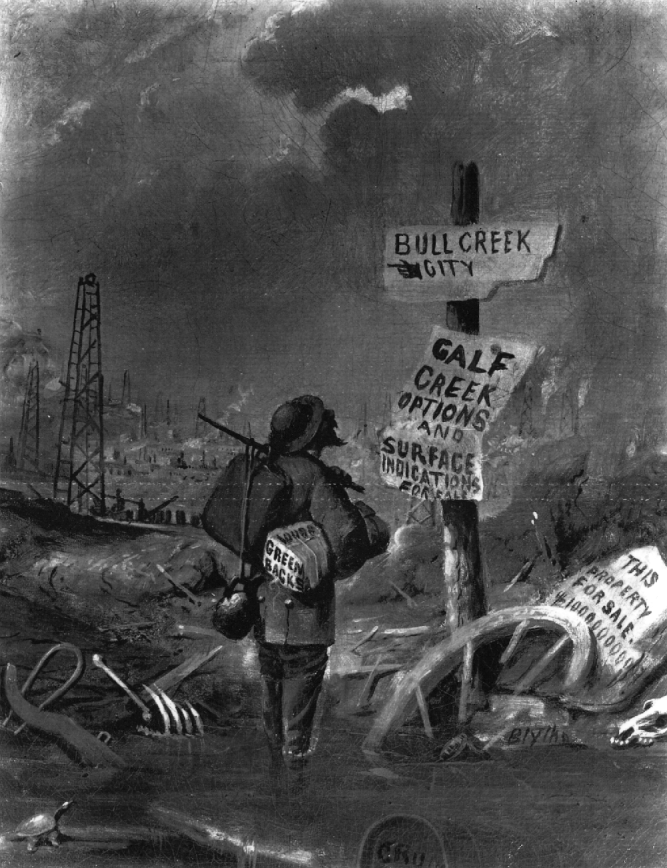
Imagining the oil region as a space of commercial disorder, environmental despoliation, and social devolution, Prospecting and Burning Oil Well at Night amplified claims that were made in other popular accounts of the early industry. By aligning oil technology with catastrophe and oil-region industrialization with debasement, Blythe and Hamilton's paintings stressed the incompatibility of oil capitalism with the dominant narratives of modern industrial society. On the one hand, Burning Oil Well at Night depicts a subject (oil's violent debilitation of extractive technology) that clashed dramatically with the body of feeling that Thomas Hughes has called “technological enthusiasm”: late nineteenth-century Americans’ burgeoning confidence in the capacity of industrial technology to remake the natural world.Footnote 20 On the other hand, Blythe's dark scene transgressed deeply rooted doctrines of material progress, which framed US historical development as a linear process of improvement fueled by technological innovation and unrestrained market exchange.Footnote 21 Elaborating on contemporary media responses to the oil boom, Hamilton and Blythe framed the oil industry as an alarming deviation from, and even an obstacle to, technological modernity and national progress.
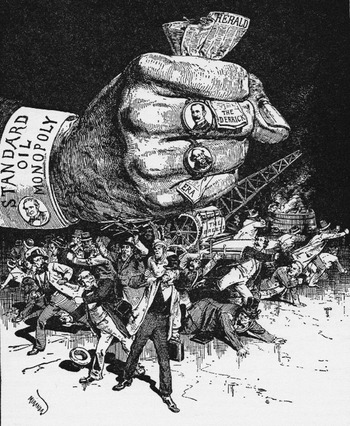
This bleak image in turn informed the arguments of later scientists and reformers who questioned the sustainability and social effects of the monopolized oil industry. Having secured control over the Pennsylvania fields in the 1870s, the Standard Oil Trust achieved dominance over domestic petroleum refining, transportation, and marketing the following decade.Footnote 22 The ruthless business practices that created this dominant position, however, sparked resistance from local producers and antimonopoly reformers who increasingly aligned Standard Oil with a phenomenon that Michael Watts has called “evacuative despoliation.” Working to theorize the material conditions of advanced oil capitalism, Watts has proposed that the contemporary petroleum industry is structured by “a peculiar sort of double movement,” wherein “wealth literally flows out” of oil-producing regions even as their terrain is socially, politically, and ecologically devastated.Footnote 23 Critics of Standard Oil detected similar processes of distant enrichment and local ruination taking shape around the Trust. As early as 1879, an antimonopoly New York Daily Graphic cartoon (Figure 6) imagined Standard as a remote entity whose local applications of power (in the form of a crushing fist) produced socioeconomic disorder and dangerous calamity (the smoking oil tank at right) within the oil region. Later critics extended this line of critique. Henry Demarest Lloyd's Wealth against Commonwealth (1894), for example, forcefully tied the monopoly's enrichment to oil-region impoverishment. To dramatize the effects of the Trust's dominance, the text thus juxtaposed “the spectacle of a few men at the centre of things in offices rich with plate glass and velvet plush” with the “strange spectacle … of widespread ruin” throughout Petrolia.Footnote 24 Spokesmen for independent oil-region companies emphasized similar themes in their own attacks on Standard Oil. A 1901 article in the antimonopoly Petroleum Gazette thus noted that the oil region “has contributed to other great fortunes, but somehow or other comparatively little of the wealth has found its way back.”Footnote 25 An 1899 article in the same journal made a more pointed argument, noting, “If the Standard … desired to erect a monument … a fitting course for it would be to make one heap of the remnants of the millions of dollars worth of oil refineries it has put out of business here.”Footnote 26
“The Iron Hand,” New York Daily Graphic, 12 March 1879, wood engraving. Photo by the author.

Unsettled by the expansion and centralization of the oil industry, late nineteenth-century artists, journalists, and reformers worked out a grim cultural image for the petroleum business. Linking oil extraction to disorder and decline, observers of the first oil boom questioned the compatibility of petro-capitalism with the fundamental ideologies of industrial modernity. Drawing on these dark accounts, reformers and rivals framed the ascendant Standard Oil Trust as an engine of upheaval and desolation. Both cultural discourses undermined confidence in the long-term prospects of the industry; these doubts were further stoked by new scientific arguments stressing the productive limitations of the Pennsylvania oil fields. As Roger and Diana Olien have shown, geologists Pete Lesley and John F. Carll began to warn of the imminence of petroleum depletion in the 1880s and 1890s.Footnote 27 In 1888, for example, Carll noted that “we have no reasonable ground for expecting … that these oil fields will continue to supply the world with cheap light.”Footnote 28 An 1889 American Geologist article dramatically affirmed this prognostication, noting that in the oil region,
Exhaustion stares the visitor in the face everywhere … The quiet old towns that sprang into sudden energy during the oil-craze have sunk back to their former quietness and lethargy … Corner lots are at a discount, and often the ruins of derrick and engine house alone mark the spots where once a “city” stood.Footnote 29
Drawing on the familiar trope of ruination, this passage reimagines the Pennsylvania oil fields as a desolate wasteland that made the unsustainable nature of oil production palpably visible.
OIL HISTORY IN BRONZE AND STONE: SCULPTING THE “PRIMITIVE IDEA OF MAN”
Undertaken even as these critiques proliferated, the Drake Memorial attempted to rehabilitate the public image of Standard Oil and rebuild popular confidence in the oil industry. To do so, the monument organized a spectacle that reconnected oil with traditional forms of civic community, realigned the dynamic industry with stability and permanence, and reimagined oil as a vehicle for social and national reinvigoration. The classicized architectural forms and heavy stone masses of the Drake Memorial initiate this symbolic project: balancing a vertical sculptural niche with the sweeping curve of the granite exedra, the monument gives palpable form to the themes of harmonious order, solidity, and permanence. Arrayed around the swirling bronze, the exedra's classical forms seem to counter and contain the dynamic energies of the central bronze, invoking a suggestive tension between fixity and fluidity that is (as we will see) central to the promotional program of the memorial. By situating a bench at the base of the exedra, moreover, designer Charles Brigham created an amphitheatrical space that tied the memorial to the traditions of civic architecture. Stressing this connection, promoters presented the exedra as a didactic space where visitors might gather for contemplative experiences. In his dedication speech, for example, Calvin Payne declared, “this monument should be an object lesson … It should be an incentive to succeed in what you are called upon to do.”Footnote 30 Echoing other backers, Payne framed the monument as a civic space where visitors might rededicate themselves to the cultivation of traditional virtues (diligence, ambition, duty, and so on) and the reforging of communal bonds.Footnote 31
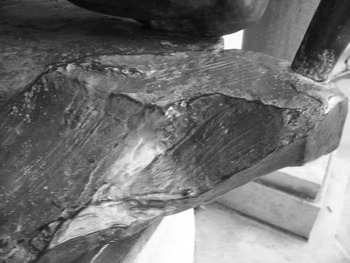
At the heart of this space was the allegorical figure of The Driller (Figure 2), which advanced several “object lesson[s]” about the oil industry. Collapsing the collective processes of modern extraction into the heroic form of single laborer, The Driller realigned the corporate petroleum industry with a traditional mode of work – independent artisanship – increasingly absent from a modern industrial realm defined by mechanization and class conflict. At the same time, the medium, pose, and narrative irresolution of Niehaus's sculpture worked to recode extraction as a process whereby the explosive material of oil was powerfully rechanneled into an endlessly productive flow. Period reviews outlined the mechanisms of this complicated symbolic project for their audiences. In noting the “tremendous energy in suspense shown by the bronze symbolical figure,” for example, a New York Times review encouraged readers to address the sculpture as a construct holding in tension the themes of power and duration, energy and stasis.Footnote 32 Various aspects of Niehaus's figure in turn seem to bear out these tropes, particularly its medium. As a malleable metal carefully manipulated in a molten state and then allowed to solidify in a cast, bronze already carried connotations of fluidity and stasis. Niehaus's handling of surface texture (Figure 7) suggestively emphasized the dual status of the medium: incised marks and lumps of congealed metal appear on the figure and its base, palpably invoking the malleability of the metal and encouraging the visitor to read The Driller as a controlled manipulation of fluid material.
Detail of base, Charles Henry Niehaus, The Driller.

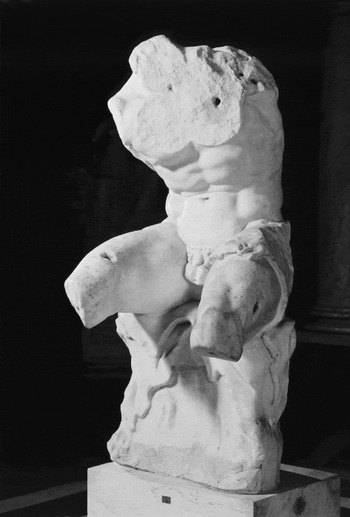
The productive performance of the gleaming sculpture seems to realign oil extraction with these themes, framing oil production as a carefully controlled application of technological power to dynamic natural matter. Squatting over his drill, The Driller models a willful command over the natural landscape that visualizes the complete harnessing of the dynamic material of oil through extractive labor. Drawing on the idealized forms of the ancient Belvedere Torso (Figure 8), the driller's heavily muscled and coiling torso dramatically affirms the theme of corporeal potentiality. These invocations of productive power are counterbalanced with signs of rational control. Read together, the figure's focussed gaze, clenched jaw, and firmly gripping fist signal an inner discipline guiding the extractive process.
Belvedere Torso, copy of original (50 bce), marble, Museo Pio-Clementino, Rome. Photo: Scala/Art Resource.

Even as it visualizes the power and rationality of modern oil extraction, the laborer's productive performance remains open-ended. Holding his hammer aloft at the final point of a backward stroke, The Driller appears poised in a moment of suggestive stasis. Reviews encouraged audiences to understand this pause as replete with potentiality; a writer for the Oil City Derrick noted, for example, that Niehaus had rendered “the exact point wherein the greatest potential of power is secured.”Footnote 33 Considered together, the forms of the monument's niche might be read as a visualization of the eventual realization of that power: rising vertically from a curving stone foundation, the black-and-gold figure visually invokes the inky plume of an oil “gusher” bursting from the earth. And yet this conclusion remains visible only in abstract and transient fashion. Poised on the verge of an explosive “strike,” The Driller remains locked enduringly in a fruitful moment of productive potential, a moment in which an extractive conclusion is both immediately foreseeable and infinitely deferred. The sculpture, that is, visualizes a permanent transitional state of productive capability that both invokes the inexorable completion of industrialized oil extraction and endlessly delays that final moment. In organizing this fantasy of unending capacity, I would suggest, The Driller advanced an effective response to period arguments about the imminent exhaustion of the oil region and the ultimate transience of all oil deposits.
Embodying productive power, rational control, and infinite potentiality, The Driller offered a glittering spectacle of “energy in suspense” – a spectacle of dynamic power rationally contained that was calculated to dispel lingering concerns about the stability and long-term viability of the oil industry. This vision of oil futurity takes shape, however, within an archaizing symbolic frame: rather than picturing the mechanized techniques of the modern petroleum industry, The Driller describes an imagined scenario of primitive oil production. In organizing this primordial spectacle, I will argue, the sculpture attempted to recode the cultural image of the oil industry in two significant ways. By conjuring oil's ancient past, The Driller buttressed the tempestuous petroleum business with the weight of deep history. And, by reconceiving oil extraction as an exercise of primal energies, the sculpture aligned the industry with an emerging set of antimodern arguments that connected visceral struggle with personal and national renewal.
Eschewing the collective and technologically mediated processes employed by period oilmen, The Driller reduced extraction to a spartan struggle between the individual body and the natural landscape. Both terms of this binary appear in their sparest form. Invocations of the landscape are limited to the sculpture's base, which reduces the primitive oil field to three elements – the stump on which the figure rests, a gnarled cluster of oak leaves concealing the driller's genitalia, and a rock shelf that serves as the sculpture's foundation. The heaving body above toils with simple tools and without protective equipment of any kind. While certain elements (including the figure's parted hair and shaven face) maintain a subtle connection to the sculpture's turn-of-the century milieu, the drastically simplified forms of The Driller project the pictured scenario into a remote past. The primitive character of the unfolding struggle is heightened by the figure's “crude” physiognomy (low brow, thick nose, broad cheeks) and awkward earthbound pose. While resting much of his weight on his left knee, the laborer balances on the ball of his right foot; the tension in the right calf and flexed position of the foot suggest that the laborer will use the right leg to propel his hammer downward. Despite the seemingly elegant character of the figure's resting pose, these cues suggest that the impending stroke will take the form of a violent full-body lunge – an ungainly action that reconfirms the crudity of the driller's labor.
Taking note of these cues, period reviews underscored the primordiality of the sculpted scenario. An Oil City Derrick report thus argued that Niehaus's figure embodied “the primitive idea of man, wresting from the earth her secrets and gifts, with … energy, determination, and vigor.”Footnote 34 Extending this interpretation, a New York Times review declared,
The monument will … recall first of all the various laborers in these oily fields – the Indians who collected oil to mix with their paints and used to set fire to the scum of petroleum on lakes and rivers on days of high festival – the settlers who used the oil as liniment and for lighting purposes, and the great army of workmen who have been laboring in the oil fields since 1859.Footnote 35
This sweeping passage figures The Driller as a “monument” to the “various laborers” of an ever-receding past of oil production, a past that encompasses the extractive practices of nineteenth-century “workmen,” Anglo-American colonial “settlers,” and “Indians” before them. Oil extraction appears here as a transhistorical practice rooted in the distant past and linking successive phases of civilization. Echoing other reviews, the Times article found encoded within the primitive nude an alternative perspective on the history of oil that reframed the turn-of-the-century industry as one fleeting phase in an age-old temporal arc.Footnote 36
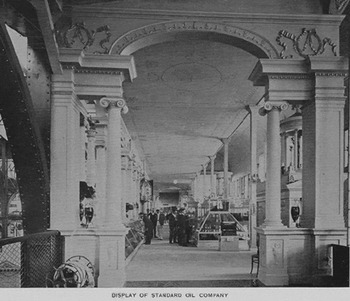
In conjuring oil's primordial past and expansive history, the Drake Memorial extended an impulse that appeared throughout Standard Oil's promotional ventures in the moment. The Trust's exposition displays, for example, took various measures to visualize oil's timeless roots. Standard Oil's classicized display at the Columbian Exposition (1893; see Figure 9), for example, included two lamp-bearing sculptural nudes that tied the company to the ancient past.Footnote 37 Pro-Trust writers explored these archaizing themes in even more strident terms. John McLaurin's oil history Sketches in Crude Oil (1896) accordingly noted that “petroleum … flourished ‘ere Noah's flood had space to dry.’”Footnote 38The Derrick's Hand-Book to Petroleum (1900) likewise informed its readers, “Petroleum … has been known and used by mankind in various parts of the world from time immemorial.”Footnote 39 Like the Trust's exposition displays, these accounts had some historical basis. Though oil was little used in the ancient Western world, archaeological and documentary evidence suggests that ancient Near East civilizations used petroleum to produce lighting fuels, bituminous sealants, and incendiary weapons as early as 3000 bce.Footnote 40 As the above texts suggest, however, pro-Trust boosters used references to ancient petroleum practices alongside biblical passages and creative historical fabrication to construct sweeping narratives that reimagined oil as an eternal object of universal “human” endeavor. Advanced even as reformers questioned oil's future viability, these narratives refigured the turn-of-the-century industry as a modern extension of an “immemorial” field of activity – a field that, having already endured for millennia, would continue to flourish into the distant future.
“Display of Standard Oil Company,” from Hubert Bancroft, The Book of the Fair (1893). Photo by the author.

The primordial struggle described by The Driller condensed these promotional claims into a striking vision of oil's deep historicity and unbounded futurity. In its efforts to conjure oil's primordial past, moreover, the sculpture organized a spectacle of rapacious masculinity that aligned the petroleum industry with new primitivist discourses emerging in the moment. Gail Bederman and T. Jackson Lears have shown that traditional constructs of self-restrained bourgeois masculinity were dramatically undermined at the end of the nineteenth century by the corporate restructuring of the economy, growing working-class political agency, and the new activism of middle-class women.Footnote 41 In an effort to consolidate a new manhood that might shore up gender and class hierarchies, Bederman and Lears argue, reformers urged bourgeois men to cultivate a “strenuous” mode of masculinity characterized by vigorous physicality, imperialist militancy, and aggressive sexuality. Anthony Rotundo and John Pettegrew have shown that the spokesmen of strenuousness frequently espoused primitivist ideals, urging men to rediscover primal energies purportedly suppressed by the “femininizing” forces of civilization.Footnote 42 By tapping long-hidden reserves of animalistic vitality, reformers argued, American men could reinvigorate themselves and renew the nation's flagging energies.
Composed even as these arguments proliferated, The Driller gave striking visual form to the precepts of masculinist primitivism. In so doing, the sculpture contributed to a broader primitivist discourse of work that focussed on the industrial laborer's body. Melissa Dabakis and Edward Slavishak have demonstrated that corporate boosters regularly employed artistic and journalistic representations of the working body to refigure industry as a realm of masculine independence and primal vitality.Footnote 43 Paralleling these contemporaneous projects, The Driller reframed the oil-field worker as a dynamic nude engaged in an autonomous performance of strenuous labor. The crouching pose of Niehaus's laborer further imbues this performance with primitivist resonances. Squatting over his drill and poised to thrust forward, the laborer appears ready to direct a sexualized act of aggression toward both the drill and the monument visitor, who confronts the elevated sculpture at the level of the driller's genitalia. Noting the physique, suggestive pose, and crude labor act of The Driller, reviewers framed the sculpture as a vision of masculine potency, describing the primordial worker as a “splendid figure of male physical power,” a “virile” hero, and a predator “quivering with virile power.”Footnote 44 These reviews frequently employed penetrative rhetoric that made the sexualized connotations of the worker's drilling labor explicit. Critics thus described the laborer as tapping nature's “secrets and gifts” or delving into “the magnificent riches … hidden in [Mother Nature's] bosom.”Footnote 45 In characterizing the driller as an explorer of hidden resources, these reviews simultaneously tied the figure to the strenuous man's rediscovery of long-concealed primal energies, a process frequently described in extractive terms by period reformers.
Even as it invoked a distant past for the petroleum industry and dramatically redrew the arc of oil history, then, The Driller reframed oil extraction as a primitive practice of heroic struggle that offered access to reinvigorating vital forces. In pursuing these various impulses, the sculpture countered critical accounts that tied the oil industry to disorder, transience, and social regression. By resituating the modern oil business within a broad and unending history of human interactions with oil, the sculpture answered concerns about the fleetingness of petroleum and the industrial system that developed around it. And, by drawing creatively on the themes of primitivism, the sculpture acknowledged and recoded the atavistic associations that swirled around the oil industry at the turn of the century, converting these devolutionary connotations into signs of oil's regenerative potential for citizenry and nation. Trumpeted in a variety of periodicals across the country, the Drake Memorial encouraged period Americans to reconceive oil as a timeless natural element, a vehicle of social stability and national renewal, and a reliable platform for limitless industrial expansion.
THE CULTURAL AFTERLIFE OF PETRO-PRIMITIVISM
As it contended with the specific concerns of its moment, the Drake Memorial established the key terms for a promotional discourse that would inform corporate oil publicity throughout the twentieth century. Though subsequent promotional projects would largely abandon the masculinist constructs that spoke to anxious turn-of-the-century audiences, corporate oil publicity continued to meet reformist critiques, regulatory initiatives, and economic crises with invocations of oil's immeasurably distant past. Two later public displays offer glimpses of the ways that twentieth-century oil companies adapted the tropes of petro-primitivism.
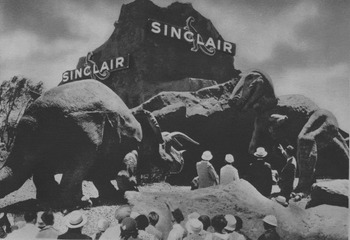
The Sinclair Oil pavilion at the Chicago World's Fair of 1933–34, first, revolved around a dramatic invocation of the primordial past: a spectacular exhibit of seven animatronic dinosaurs (Figure 10) clashing in a rocky Mesozoic landscape.Footnote 46 Guided by informational placards and souvenir newspapers distributed onsite, visitors wound their way around a series of outdoor tableaux featuring groupings of sculpted reptiles. This sequence ended in the “Grotto” (Figure 11), a promotional gallery that celebrated the products and operations of Sinclair Oil. In part, the spectacular displays of the Sinclair pavilion can be understood as a dramatic extension of the corporation's ongoing promotional appropriation of the dinosaur. After the company selected the brontosaurus as an official emblem in 1930, Sinclair launched an advertising campaign that tied the superior quality of the company's oil products to their ancient age and employed the dinosaur as an immediately legible symbol of primordiality.Footnote 47 Elaborating on the company's advertisements, the exposition pavilion presented its mechanized dinosaurs as dramatic emblems of the ancientness, and by extension the superior caliber, of Sinclair reserves.Footnote 48
Photograph of Sinclair Dinosaur Exhibit, from Millions See Weird Sinclair Dinosaurs (New York: Sinclair Refining Company, 1933). Photo by the author.

Photograph of the “Grotto,” Sinclair Dinosaur Exhibit, from Millions See Weird Sinclair Dinosaurs. Photo by the author.

I would suggest, however, that the pavilion's prehistoric spectacle also worked to symbolically bolster the position of Sinclair Oil in a context of intensifying crisis. By the time the Chicago fair opened in summer 1933, Sinclair had become implicated in new conflicts over the sustainability of oil. These struggles were fueled by the chaotic oil boom that unfolded in East Texas in the early 1930s. Heedless overproduction in the Texan fields quickly glutted crude markets, inspiring new conservationist arguments emphasizing the nonrenewable character of petroleum and predicting the imminent exhaustion of domestic oil.Footnote 49 Echoing arguments voiced elsewhere, Interior Secretary Harold Ickes warned that unless overproduction and waste were “checked, this most valuable and necessary natural resource … must inevitably soon reach practical exhaustion.”Footnote 50 Buffeted by a ground swell of conservationist and anticorporate feeling, East Texas oil companies worked to obstruct local and federal regulatory initiatives. Chief among these was Sinclair Oil, which had come to rely on cheap Texan crude as a means of expanding its operations.Footnote 51 The company had long led efforts to discredit conservationist arguments; in a 1921 speech, for example, chief executive Harry Sinclair declared, “There is plenty of petroleum and always will be. Exhaustion of the world's supply is a bugaboo.”Footnote 52 Sinclair Oil again spoke out against conservationist measures debated by state and federal authorities in the 1930s, with the hope of preserving its supply line to the Texan fields.Footnote 53
Read against this backdrop, the dinosaur exhibit can be understood as an effort to address the regulatory initiatives that undermined Sinclair's market position and to bolster the company's tenuous public image. As dramatic embodiments of the deep past, the pavilion's dinosaurs palpably visualized the eternality of oil for fairgoers, answering new concerns about the resource's transience (concerns that threatened Sinclair's market position) with signs of its immeasurable timelessness. The robotic creatures’ periodic performances dramatically elaborated on this theme. Animated by electric motors and equipped with loudspeakers that projected simulated cries, the dinosaurs ceaselessly reinvigorated the prehistoric past for the onlooker, shaping a mechanized spectacle that allegorized the unending viability of ancient oil deposits. The displays of the “grotto” (Figure 11), finally, visualized Sinclair's role as a key catalyst of oil's infinite futurity. Juxtaposing a model of the company's brontosaurus logo with photographic panels describing the operations that made Sinclair “America's fastest-growing oil company,” the hall framed the company as a conduit by which the ultra-archaic material of oil was productively channeled into a golden future of economic growth.Footnote 54
Twenty years after the Sinclair exhibit, the Sun Oil Company unveiled its promotional exhibit Oil Serves America (1953–c.1962) at the Franklin Institute in Philadelphia.Footnote 55 Comprising twelve separate displays arranged in a spiraling sequence, the exhibit explained the sources of oil, described modern extraction technologies, and celebrated Sun Oil's innovations in refining (chiefly its role in developing fluid catalytic cracking). The exhibit's parade of industrial achievements began, however, with a dramatic invocation of oil's past: Morris Berd's mural The History of Oil and Natural Gas (Figure 12, now unlocated).Footnote 56 Painted in a cheery cartoonish style on a semi-circular wall, the mural presented visitors with a panoramic composition that traced oil's development across time and space. Shifting from scenes of the “early uses of petroleum obtained by primitive peoples” (at right) to a vignette of cutting-edge extraction and refining (at left), Berd's painting framed the exhibit's displays with an expansive vision of oil history.Footnote 57
Photograph of Morris Berd, History of Oil and Natural Gas, 1953, from Oil Serves America (Philadelphia: The Company, 1960). Photo by the author.

In so doing, The History of Oil and Natural Gas firmly situated that history within a North American context. Although the mural included a vignette of ancient Mediterranean oil use (the ship-caulking scene at upper right), its various components emphasize developments unfolding within the continent. Set at the center of the mural, Drake's inaugural derrick functions as the organizing hub of the composition. The “modern” vignette at left pictures bits of cutting-edge infrastructure developed by US companies, including a steel derrick, a fractionating tower (at the far left, essential to catalytic cracking), and a Hortonsphere tank (for the storage of liquid petroleum gas). Given emphasis by its large size and visual proximity to the visitor, the “primitive” grouping at right further affirmed the “American” character of the pictured history. Picturing a group of Native Americans engaged in archaic practices of oil extraction and consumption, the vignette firmly situated oil's past within the confines of the continent. Read together, the three main vignettes of The History of Oil and Natural Gas foreground the specific history of American oil, and in so doing imagine that broad history as an inexorable and linear process of technological advancement.Footnote 58
This historical spectacle, I would suggest, perfectly answered the symbolic needs of its corporate patron in the early 1950s. Having built its operations on Texan and Albertan crude, Sun Oil remained a staunch defender of North American oil production long after its major competitors had begun to concentrate their efforts overseas.Footnote 59 This position allowed Sun to escape the legal scrutiny and public hostility directed at the corporate members of Aramco, which the Federal Trade Commission investigated from 1949 to 1952 as a potential violation of antitrust regulations.Footnote 60 Sun's reliance on domestic oil nevertheless weakened its market position in these years: already squeezed by competitors who bought cheap Middle Eastern oil, the company was further undercut by Texas authorities’ 1952 decision to impose multi-year controls on the state's oil production.Footnote 61
Considered in this context, The History of Oil and Natural Gas can be understood as a symbolic attempt to reinvigorate Sun Oil's identity as a domestic producer. By reworking oil history as an American phenomenon, the mural affirmed the company's commitment to domestic oil and its divergence from the unpopular multinationals. In tracing the expansive history of American oil, moreover, Berd's painting advanced a complex response to the regulatory initiatives that constrained Sun Oil in the moment. By conjuring a primitive past for American oil, the mural emphasized the already lengthy life of domestic oil pools. In rendering oil history as a sequential process of technological advancement, moreover, the painting visualized a claim for domestic oil's futurity long made by Sun Oil officials. Called to testify before a Senate Committee investigating wartime oil shortages, chief executive J. Edgar Pew declared in 1945, “this country possesses hydrocarbon resources sufficient to meet this Nation's requirements for oil products for generations to come.”Footnote 62 To support this bold assertion, the executive cited a succession of technological breakthroughs that had consistently extended the productivity of proven fields and enabled drilling in previously inaccessible sites. Noting that “oil has always been discovered and produced when and as needed,” Pew reimagined the history of domestic oil as an enduringly sustainable progression toward ever-greater productivity facilitated by persistent technological innovation and minimal state regulation.Footnote 63 Undertaken in a moment in which this vision appeared increasingly tenuous, The History of Oil and Natural Gas advanced a dramatic restatement of the company's investments in domestic oil. Appearing at the entrance to the Oil Serves America exhibit, the mural situated the displays of Sun Oil's operations that followed in a deeply rooted and infinitely extendable history of domestic oil production – a history that countered the pressures of oil's globalization with a fantasy of timeless American oil.
Taken together, Oil Serves America and the Sinclair pavilion offer a suggestive glimpse at the rich cultural life of petro-primitivism in the century after the dedication of the Drake Memorial. Faced with supply crises, market spasms, and environmental disasters, individual companies and industry groups continually employed images of oil's primitive origins to redraw the public face of oil capitalism. Indeed, a wide variety of promotional endeavors focussed on oil's distant past, including advertisements, children's toy giveaways (such as ARCO's “Noah's Ark” playsets of the 1970s), exposition displays (including Sinclair Oil's Dinoland at the 1964 New York World's Fair), and educational films (such as Oil for Tomorrow, 1944, and As Old as the Hills, 1950). Extending tropes crystallized by the Drake Memorial, these projects countered concerns about the violent instability of oil with visions of primordiality meant to suggest the permanence and infinite futurity of petro-capitalism. Fluid and readily adaptable, the tropes of petro-primitivism have encouraged generations of Americans to embrace oil – a resource long understood to be dirty, dangerous, and fleeting – as an entirely natural and unassailable component of everyday life in the United States. In so doing, these archaizing imaginings of oil contributed to a much broader field of symbolic practices and cultural representations that have worked to forestall efforts to see beyond oil capitalism and conceive alternative energy economies.