Ventilator-associated pneumonia (VAP) is one of the most common healthcare-associated infections in pediatric and adult intensive care units (PICUs and ICUs) and has been associated with substantial increases in length of stay, broad-spectrum antibiotic use, morbidity, mortality, and cost. Reference Aelami, Lotfi and Walter Zingg1–Reference Iosifidis, Pitsava and Roilides4 However, a definite diagnosis of VAP remains controversial.
The Centers for Disease Control and Prevention (CDC) algorithm for clinically defined pneumonia in mechanically ventilated patients has been widely accepted and is used for surveillance purposes in both adult and pediatric patients. Reference Iosifidis, Chochliourou and Violaki5 Nevertheless, there are significant difficulties when applying these criteria for VAP diagnosis, including the requirement of radiographic evidence of pneumonia as well as the reliance on subjective clinical signs and symptoms. For this reason, in January 2013, the CDC introduced a broader and potentially more objective definition for the diagnosis of ventilator-associated events (VAEs), including VAP. 6 Unfortunately, this module has been mostly validated in adults, with very little study in children. Reference Willson, Hall and Beardsley7 Two more VAE algorithms have been proposed for VAE in critically ill children, one by Cocoros et al, 8 which has recently been adopted by the CDC and is the US pediatric VAE criteria (ie, US Ped VAE) Reference Cocoros, Priebe and Logan9 and algorithm proposed by Peña-López et al, Reference Peña-López, Pujol, Campins, Lagunes, Balcells and Rello10 the European pediatric criteria (ie, EU Ped VAE). Reference Peña-López, Pujol, Campins, Lagunes, Balcells and Rello10
All of the aforementioned algorithms include 3 definition tiers: ventilator-associated complication (VAC), infection-related VAC (IVAC), and possible or probable VAP. The VAC definition depends on respiratory deterioration, designated by objective mechanical ventilation parameters: fraction of inspired oxygen (FiO2), positive end-expiratory pressure (PEEP), and mean airway pressure (MAP) parameters of mechanical ventilation. Each algorithm includes different bundles of mechanical ventilation parameters.
We have described the epidemiological and clinical characteristics as well as the outcomes of children on mechanical ventilation in a PICU)who met each of the 3 proposed sets of criteria for VAE.
Methods
Setting and study design
The study was conducted in a multidisciplinary 8-bed PICU in a tertiary-care general hospital in northern Greece. Both medical and surgical patients, including hematology-oncology as well as liver and kidney transplant patients are admitted here. The average number of patients hospitalized yearly is 100–140, and most of them receive mechanical ventilation.
In this retrospective study, we analyzed a cohort of patients hospitalized in the PICU between January 1, 2017 and December 31, 2019 (36 months). Children aged between 35 days and 16 years were included in the study. All mechanical ventilation courses >48 hours were included. Patients with a tracheostomy at admission, as well as patients with permanent tracheostomy, were included. Patients receiving noninvasive mechanical ventilation and patients aged <35 days and >16 years were excluded. In all eligible patients, CDC adult VAE criteria, US Ped VAE criteria, and EU Ped VAE criteria were applied.
The protocol of the study was approved by the Scientific and Bioethics committee of the Hippokration General Hospital of Thessaloniki (Directors’ Board 21st issue no. 31.08.2016). Because it was a retrospective study, no informed consent was needed.
Definitions
The duration of mechanical ventilation was defined as the total duration of mechanical ventilation until successful extubation for >24 hours. Reintubation before 24 hours was considered persistence of the same course, and reintubation after 24 hours was considered a subsequent course of mechanical ventilation.
PICU length of stay was calculated from time of admission until time of discharge from the PICU. A readmission was considered a separate PICU stay.
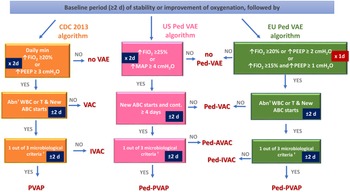
In all 3 definitions, the patient must have a ≥2-day baseline period of stability or improvement followed by the criteria, which are different for each definition. According to the CDC VAE algorithm for adults, VAC is defined as increase in daily minimum FiO2 ≥ 20% or increase in daily minimum PEEP ≥ 3 cmH2O, lasting for ≥2 days. In contrast, the US Ped VAE module defines VAC as increase in daily minimum FiO2 ≥ 25% or increase in daily minimum MAP ≥ 4 cmH2O, lasting for ≥2 days. The EU Ped VAE proposed algorithm defines VAC as increase in FiO2 ≥ 20% or increase in PEEP ≥ 2 cmH2O lasting for 1 day, or increase in FiO2 ≥ 15% and at the same time as an increase in PEEP ≥ 1 cmH2O lasting for 1 day.
In a patient who fulfills the VAC definition according to the CDC adult VAE and EU Ped VAE algorithms, if temperature (T >38oC or <36oC) or WBC (<4,000/mm3 or ≥12,000/mm3) variation is noted and antibiotic therapy is instituted for at least 4 days, then IVAC is present. The US pediatric definition differs concerning this tier. According to Cocoros et al, Reference Cocoros, Priebe and Gray11 because most patients had abnormal white blood cell counts and temperatures, the surveillance should focus on “pediatric VAC with antimicrobial use” (ie, pediatric AVAC). When criteria of IVAC or AVAC are met according to any of the 3 definitions, and the patient has purulent respiratory secretions (≥25 polymorphonuclear cells and ≤10 squamous epithelial cells per low-powdered field), or positive cultures (endotracheal aspirate ≥105 CFU/mL, BAL ≥104 CFU/mL), possible pneumonia (PVAP) is defined. When a patient with IVAC has purulent respiratory secretions and positive culture or alternate confirmatory test (positive pleural fluid culture, histopathology, Legionella testing or viral testing), then probable pneumonia criteria are met. All 3 currently available VAE criteria for critically ill children are described in Figure 1.
Currently available ventilator-associated event (VAE) criteria for critically ill children. †Microbiological criteria: (1) positive culture via endotracheal aspirate, bronchoalveolar lavage, lung tissue or protected specimen brush, with (semi) quantitative thresholds; (2) purulent respiratory secretions and positive culture via specimens in criterion 1, but not meeting those thresholds for growth; (3) one of the following: organism identified via pleural fluid, lung histopathology, Legionella diagnostic test, or respiratory secretion positive for viral organism. Note: PEEP, positive end expiratory pressure; FiO2, fraction of inspired oxygen; Abn, abnormal; MAP, mean airway pressure; WBC, white blood cell count; T, temperature; ABC, antibiotic course; VAC, ventilator-associated complication; IVAC, infection-related VAC; AVAC, pediatric VAC with antimicrobial use; PVAP, possible or probable VAP.

Data collection—study outcomes
The following data for all eligible patients were extracted from medical records: sex, age, presence of comorbidities, severity-of-illness index (PRISM III 24 score validated for the study population Reference Volakli, Sdougka, Tamiolaki, Tsonidis, Reizoglou and Giala12 ), type of patient (surgical or medical), administration of inotropes, duration of mechanical ventilation, length of stay (ICU), and ICU mortality.
The main outcomes evaluated were VAE rates, mechanical ventilation days, length of stay (ICU), and mortality, especially in patients with VAE. VAE prevalence and incidence rates for each of the 3 VAE definitions were calculated as follows: Prevalence was calculated as the percentage of ventilated patients with VAE, and the incidence was calculated as (number of VAE per total number of ventilator days) × 1,000. A monthly record was conducted as VAE per 1,000 ventilator days.
Statistical analysis
Nominal variables are presented with absolute and relative frequencies, and continuous variables are presented with median and interquartile range (IQR). The association of patient characteristics between patients with and without VAE for each VAE criteria was evaluated using the χ2 test of independence and the Mann-Whitney U test. Agreement between the different VAE criteria was evaluated using the κ (kappa) score. Univariate and multiple logistic regression analyses were performed to evaluate the association of CDC adult VAE, US Ped VAE, EU Ped VAE with mortality. Results are presented as odds ratios (ORs) with 95% confidence intervals (CIs). Analyses were conducted using SPSS version 20 software (IBM, Armonk, NY). The level of statistical significance was set to α = 0.05.
Results
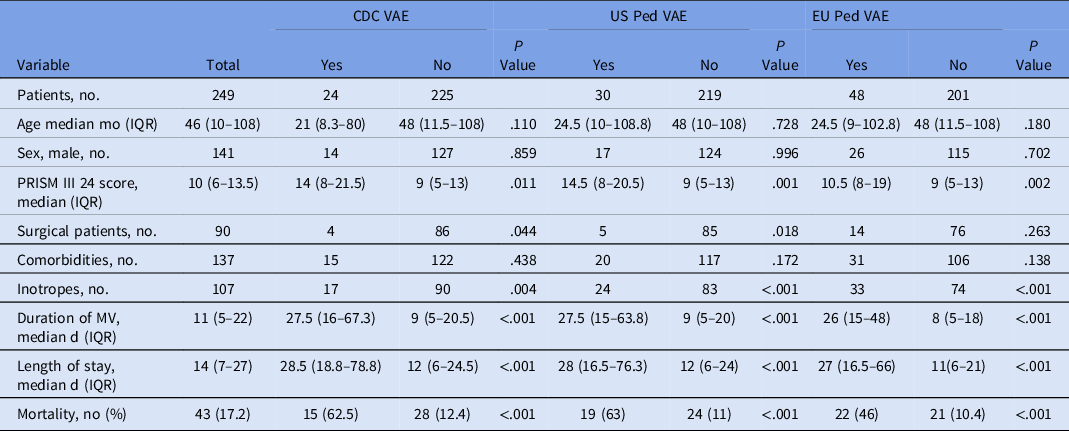
During the study period, among 319 patients admitted to the PICU, 290 (91%) received mechanical ventilation (total days, 4,787) and 249 received mechanical ventilation for ≥3 days (total day, 4,736). Among them, 141 (56.6%) were male and 90 (36%) were surgical patients (most often postoperative, CNS trauma, or polytrauma). Specifically, the main reasons for admission and intubation were respiratory failure (22.9%), followed by postoperative recovery (21.8%), coma (11.1%), CNS trauma or polytrauma (10.9%), status epilepticus (10.4%), sepsis or septic shock (8.6%), post cardiac arrest and/or return of spontaneous circulation (5.9%), metabolic disorder (3.8%), other (2.9%), and cardiovascular disease (2.5%). The median age was 46 months. Moreover, 137 patients (55%) suffered from comorbidities and 107 (43%) required administration of inotropes. The median PRISM III 24 score at admission in PICU was 10 (range, 0–52). The median duration of mechanical ventilation was 11 days, and the median length of stay in the PICU was 14 days. Among patients who received mechanical ventilation for ≥3 days, 43 patients (17%) died (Table 1).
Patient Characteristics

Note. CDC, Centers for Disease Control and Prevention; VAE, ventilator-associated event; Ped, Pediatric, EU, European; PRISM III 24 score, Pediatric RISk of Mortality (PRISM) III 24 score, MV, mechanical ventilation.
Epidemiology of VAE
In total, 50 patients (27 males) fulfilled the criteria of at least 1 of the 3 algorithms (20%) and 199 patients did not have a VAE: 24 patients met the CDC adult VAE criteria, 30 patients met the US Ped VAE criteria, and 48 patients met the EU Ped VAE criteria. Also, 22 patients met the VAE criteria according to all 3 algorithms; 2 patients met only the CDC adult VAE criteria; 3 patients met only the US Ped VAE criteria; and 19 patients met only the EU Ped VAE criteria and neither of the other definitions. The median number of mechanical ventilation days at the time of meeting VAE criteria was 9 days. In 25% of patients, VAE occurred until day 5 of mechanical ventilation and in 75% of patients, VAE occurred until day 17 of mechanical ventilation.
Various VAE definitions
The incidence of CDC VAE was 5 per 1,000 ventilator days; the incidence of US Ped VAE was 6.2 per 1,000 ventilator days; and the incidence of EU Ped VAE was 10 per 1,000 ventilator days. Children with CDC VAE were admitted to the PICU with higher PRISM III 24 scores; they were mostly medical patients and more often required administration of inotropes. Patients with US Ped VAE had been admitted with higher PRISM III 24 scores, were mostly medical patients, and usually required inotropes. These patients also presented with higher PRISM III 24 scores during admission to PICU and more often required inotropes.
Degree of agreement among the 3 definitions
Substantial agreement was found between CDC adult VAE criteria and both US Ped VAE criteria (κ = 0.78) and EU Ped VAE criteria (κ = 0.62). Substantial agreement (κ = 0.66) was noted between the US Ped VAE and EU Ped VAE criteria.
Of the 30 patients defined as having US Ped VAE, 3 children did not meet the criteria of the 2 other algorithms, probably due to the inclusion of MAP in this specific definition.
Mortality among children diagnosed with different VAE definitions
The mortality rate in patients on mechanical ventilation during study period was 17.2% (N = 249) (Table 1). Among the 43 children who died, 22 children presented VAE with at least 1 of the 3 definitions (51%) and 15 patients met the criteria of all 3 VAE algorithms. Also, 4 patients met only EU Ped VAE criteria, and 1 patient met only the US Ped VAE criteria. The mortality rate was higher in pediatric patients who met the CDC adult VAE criteria (n =24, 62.5%) and the US PED criteria (n = 30, 63%) than in patiens who met the EU Ped VAE definition (n = 48, 46%). In a subanalysis of 19 patients who met the criteria only for EU Ped VAE and patients without VAE (using all definitions), mortality rates were not significantly different (P = .24).
In the multivariate analysis of mortality, diagnoses of VAE using the CDC adult VAE criteria, the US Ped criteria, and the EU Ped criteria were significantly associated with higher mortality, considering PRISM III 24 score, comorbidities, and treatment with inotropes (Table 2).
Multiple Logistic Regression of Mortality

Note. CDC, Centers for Disease Control and Prevention; VAE, ventilator-associated event; Ped, pediatric; EU, European; OR, odds ratio; PRISM III 24 score, Pediatric.
RISk of Mortality (PRISM) III 24 score.
Median duration of mechanical ventilation and length of stay
The total median duration of mechanical ventilation was 11 days. In children without VAE, the median duration of mechanical ventilation was 9 days. In children with VAE, these durations were 27.5, 27.5 and 26 days for CDC VAE, US Ped VAE, and EU Ped VAE, respectively.
The total median length of PICU stay was 14 days. In patients without VAE, the median PICU length of stay was 12 days. For patients with CDC VAE, US Ped VAE, and EU Ped VAE, the median PICU lengths of stay were 28.5, 28 and 27 days, respectively. In a subanalysis of 19 patients who fulfilled criteria only for EU Ped VAE, duration of mechanical ventilation and length of PICU stay were significantly higher (P < .001) than in those without any VAE (using all definitions).
Discussion
Our study is the first to compare the 3 currently available VAE algorithms applied to pediatric patients. We confirmed that VAEs are associated with adverse outcomes, including prolonged mechanical ventilation, longer intensive care duration, and higher mortality rates. The results of this study suggest that different cutoff values of FiO2 and PEEP in children result in major differences in the detection of VAE in the pediatric population. They also support the need to develop more objective pediatric VAE criteria for the early detection and treatment of VAP.
Adult studies have shown that the CDC VAE surveillance definition is (1) objective and based on the numerical criteria, (2) less time-consuming, and (3) a robust predictor of outcomes. Reference Hayashi, Morisawa and Klompas13 It also permits the identification of other ventilator-associated complications such as pulmonary oedema, atelectasis, and acute respiratory distress syndrome. Reference Klompas14
Additionally, the definition simplifies the surveillance process and minimizes inconsistency within incidence reporting. Reference Mohd Ali, Jauncey-Cooke and Bogossian15 Results supported by a few previous studies Reference Phongjitsiri, Coss-Bu and Kennedy16,Reference Klompas, Khan and Kleinman17 suggest that the CDC adult VAE algorithm can also predict adverse outcomes of mechanical ventilation in children (longer duration of mechanical ventilation, longer duration of hospitalization, mortality) and its use by PICUs should not only focus on VAP surveillance but should also include a wider range of complications. In the CDC adult VAE definition, mortality prediction is greater in children than in adults, as noted in this and previous studies. Reference Cocoros, Priebe and Logan9,Reference Phongjitsiri, Coss-Bu and Kennedy16,Reference Magill, Li, Gross, Dudeck, Allen-Bridson and Edwards18 This observation, along with the lower rates of VAE found in the pediatric population compared with adults, Reference Magill, Li, Gross, Dudeck, Allen-Bridson and Edwards18,Reference Fan, Gao, Wu, Zhang, Zhu and Xiong19 confirms that the application of CDC adult VAE criteria in children selects only the severe cases. Reference Peña-López, Pujol, Campins, Lagunes, Balcells and Rello10 Thus, it is prudent to further evaluate whether this definition is applicable and beneficial for children. Reference Phongjitsiri, Coss-Bu and Kennedy16
Cocoros et al Reference Cocoros, Kleinman and Priebe20 proposed a new definition for VAC that is unique to pediatrics. Reference Magill, Klompas and Balk21 The first tier of this definition (VAC) has recently been adopted by the CDC. 8 These researchers modified the adult definition and used MAP instead of PEEP as a criterion because MAP more accurately reflects changes in lung compliance (which worsens with VAC, frequently along with worsening oxygenation) than PEEP, which is set by clinicians. In addition, this definition allows high-frequency ventilation to be included in the surveillance definition, given the frequency of its use in neonatal and pediatric populations, although it is excluded in the adult definition. 6 Preliminary data demonstrate that the incidence rate of this newly adopted pediatric VAE ranged between 1 and 4 per 1,000 ventilator days in the United States. The incidence of US Ped VAE on our study was even higher at 6.2 per 1,000 ventilator days.
However, our PICU is relatively small but with high acuity. The US Ped VAE criteria have retrospectively been associated with increased morbidity and mortality, Reference Cocoros, Priebe and Logan22–Reference Beardsley, Nitu and Cox24 which is reflected in our results as well. Although this VAE definition might be useful for neonates undergoing high-frequency oscillatory ventilation, it may be suboptimal in pediatric patients who use higher tidal volumes and PEEP, which is the standard ventilation method in this population. Reference Peña-López, Ramírez-Estrada, Serrano-Megías, Lagunes and Rello25 It seems that the US Ped VAE definition selects the most severe cases, Reference Willson, Hall and Beardsley7 which makes its utility in clinical diagnosis controversial. Therefore, a more sensitive definition should be addressed.
Changes regarding oxygenation seem to be the earliest warning sign of complications associated with intubation, whereas degree of hypoxemia is related to worse outcomes. Reference Farias, Frutos-Vivar and Casado Flores26 Considering hypoxemia as a key prognostic factor, Peña-Lopez et al Reference Peña-López, Pujol, Campins, Lagunes, Balcells and Rello10 have suggested the use of a less restrictive definition of VAE (compared with the CDC definition) in children. Using these different thresholds for changes and duration of changes of FiO2 and PEEP, the EU Ped VAE definition presented increased sensitivity and greater predictive accuracy regarding clinical outcomes in ventilated critically ill children. Reference Peña-López, Pujol, Campins, Lagunes, Balcells and Rello10,Reference Peña-López, Ramírez-Estrada, Serrano-Megías, Lagunes and Rello25 The advantage of the EU Ped VAE definition is that it has been validated prospectively in children, Reference Peña-López, Pujol, Campins, Lagunes, Balcells and Rello10 which highlights the need for more prospective studies of pediatric VAEs. In our study, patients who met only the EU Ped VAE criteria (and not the other VAE definitions) had longer duration of mechanical ventilation and lengths of stay than patients without any VAE (using all definitions). However, further research is needed to clarify whether the less strict EU peds criteria may identify more cases with preventable risk factors.
Our study was designed to identify factors associated with pediatric VAC and was not designed to examine causality. We were not able to distinguish whether children experiencing a VAC had suffered a complication of mechanical ventilation or were just displaying progressive respiratory manifestations of the severe illness that necessitated intubation in the first place. Further research is needed to determine whether the currently reported risk factors (eg, surgical admission, inotrope prescription, red blood cell unit transfusion, spontaneous breath trials, type of sedation-continuous vs intermittent- and type of sedative drugs used, early mobility, positive fluid balance) Reference Peña-López, Ramírez-Estrada, Serrano-Megías, Lagunes and Rello25 are strongly associated with pediatric VAE and their adverse outcomes.
This study had several limitations. First, it was retrospective nature, and we analyzed a small number of events, which limited the power to identify potential risk factors. Due to single-center nature of this study, interpretation of its results might not be applicable to other settings due to large variation of patient populations and the huge differences in treatment strategies. Being an observational study with no randomization, selection bias may have led to important but unmeasured differences between the comparison groups.
All VAE algorithms were associated with adverse outcomes, including higher mortality rates. Different cutoff values of FiO2 and PEEP in children resulted in major differences in pediatric VAE detection. The EU Ped VAE criteria presented the highest incidence rates, and this algorithm may be used as an indicator for implementation of VAE prevention measures.
A unified pediatric VAE definition of ventilator-associated infections and/or events, that is globally accepted is needed and could be used to drive quality improvement efforts and avert outlier antibiotic usage in PICUs.
Prospective validation of the proposed pediatric VAE definitions, along with the identification of risk factors associated with VAE, is needed to improve the definition of VAE and to tailor it to the cardiac, neonatal, and pediatric critically ill patients. Further research is needed to identify optimal strategies for management and prevention of VAEs and/or infections.
Acknowledgments
Financial support
No financial support was provided relevant to this article.
Conflicts of interest
All authors report no conflicts of interest relevant to this article.