1. Introduction
Adaptation, as well as mitigation, is expected to play a significant role in reducing the damage from global warming (Parry et al., Reference Parry, Canziani, Palutikof, Linden and Hanson2007). In particular, it can be highly effective in the short term, because the effects of mitigation will remain indiscernible for the next few decades.Footnote 1
Adaptation, from the perspective of economics, has an important attribute as a private good, in contrast to mitigation. Although both measures function primarily to alleviate damage from climate change, mitigation by a country also benefits other countries through the reduction of total emissions, so it has the attribute of a public good. On the other hand, the benefit of adaptation by a country does not extend beyond the country (Mendelsohn, Reference Mendelsohn2000; Buob and Stephan, Reference Buob and Stephan2011).
Adaptation measures differ from region to region. For example, measures include irrigation water management in Israel (Fleischer et al., Reference Fleischer, Lichtman and Mendelsohn2008), crop choices in South America (Seo and Mendelsohn, Reference Seo and Mendelsohn2008), purchasing sandbags and water-resistant floors to reduce flood insurance cost in the Netherlands (Botzen et al., Reference Botzen, Aerts and Bergh2009). These examples of adaptation, unique to each region, may well explain why adaptation can be regarded as a private good.
This property of adaptation will be important particularly when the technology of adaptation is innovated so that the use of adaptation to climate change in a country is more advantageous than mitigation. In fact, such innovation of adaptation is occurring. In the context of agriculture, for example, Smithers and Blay-Palmer (Reference Smithers and Blay-Palmer2001) introduced climate-related innovation into Ontario soybean cultivation in adaptation to various types of climate stresses such as changes of temperature, humidity and rainfall (see Smithers and Blay-Palmer, Reference Smithers and Blay-Palmer2001, table 1). Another important example of innovation in adaptation is the development of data collection and information technology. If the data and information used by the decision-maker are more relevant, accurate, and up-to-date, adaptive strategies can be more targeted and more effective (Klein et al., Reference Klein, Dougherty, Alam and Rahman2005). Thus, the difference between mitigation and adaptation becomes more important when we take the aspect of innovation in adaptation into consideration.
In the literature, many economists have recently attempted to answer a variety of fundamental questions about the linkage between mitigation and adaptation. In the context of determination of mitigation and adaptation, for example, Kane and Shogren (Reference Kane and Shogren2000) examine the optimal mix of the two measures in a one-country model with endogenous risk recognizing that mitigation reduces the risk of climate change while adaptation decreases the damage caused. They show that the scale of adaptation depends on whether mitigation and adaptation are complements or substitutes. In addition, Lecocq and Shalizi (Reference Lecocq and Shalizi2007) assume two types of adaptation–proactive and reactive–in a dynamic model with different sectors and regions, and derive the optimal level of proactive and reactive adaptation as well as mitigation.Footnote 2 Moreover, Ingham et al. (Reference Ingham, Ma and Ulph2007) incorporate adaptation into the model with uncertainty, learning, and irreversibility developed by Ulph and Ulph (Reference Ulph and Ulph1997). They conclude from the model that adaptation weakens the effect of the irreversibility constraint.
On the other hand, Mendelsohn (Reference Mendelsohn2000) distinguishes private and public adaptation, and shows that private adaptation is efficient, while suggesting that public adaptation may be underprovided.
Although the above literature sheds light on the effects that arise when adaptation is considered in addition to mitigation in the one-country case, most of the literature still does not reveal how adaptation will affect other countries through changes in mitigation. The analysis of this direction is important because adaptation can be more advantageous or effective for a country due to innovation, with the result that the country may give greater weight to adaptation and reduce the level of mitigation. If the change in adaptation affects the level of mitigation of that country in this way, then other countries will also be affected through its effect on total worldwide greenhouse gas (GHG) emissions. Therefore, to show the exact impact of adaptation, an analysis using a model with more than one country is necessary.Footnote 3
As theoretical contributions of importance along these lines, Buob and Stephan (Reference Buob and Stephan2008, Reference Buob and Stephan2011) studied multi-regional models with mitigation and adaptation in a non-cooperative Nash game. In Buob and Stephan (Reference Buob and Stephan2008), when industrialized countries support developing countries in adaptation, it is shown how the funding of adaptation affects the welfare of the countries of both regions through the change in global mitigation. Next, Buob and Stephan (Reference Buob and Stephan2011) examine how investment in the mitigation and adaptation of a region is determined in a multi-regional model, and characterize the determination of mitigation and adaptation in terms of each region's income level. Though the viewpoints of the papers are important, the focus in the former paper is on examining whether funding adaptation is incentive-compatible for the developed region, given the level of adaptation in the developed region, while the focus in the latter paper is on how mitigation and adaptation depend on the level of income and initial environmental quality, assuming that cost functions of mitigation and adaptation are identical across the world. Thus, despite their studies, it is still unknown from their models and results how the welfare and mitigation of each region change if adaptation in a country or region becomes more effective due to innovation.
The aim of this paper is precisely to deal with this problem. We employ a model with a developed country (the North) and a developing country (the South). Both countries determine their levels of mitigation of GHGs while adaptation is available only for the developed country. That is, mitigation is assumed to be the only measure available for the South. This assumption can be justified because the South cannot easily afford adaptation, as pointed out by the Intergovernmental Panel on Climate Change (Parry et al., Reference Parry, Canziani, Palutikof, Linden and Hanson2007; 734), based on the estimates of the World Bank: ‘[t]he implementation of adaptation measures faces a number of financial barriers. At the international level, preliminary estimates from the World Bank indicate that the total costs of “climate proofing” development could be as high as US$10 billion to US$40 billion/year (World Bank, 2006). While the analysis notes that such numbers are only rough estimates, the scale of investment implied constitutes a significant financial barrier.’ Beg et al. (Reference Beg, Morlot, Davidson, Afrane-Okesse, Tyani, Denton, Sokona, Thomas, La Rovere, Parikh, Parikh and Rahman2002) and Stern (Reference Stern2006) also refer to the financial barriers of the developing countries to implementing adaptation.
In this model, we examine the effect of the innovation of adaptation technology on each country's emissions and the total level of emissions and the welfare of the two countries. We can see the impact of innovation of adaptation technology when it becomes more efficient in alleviating damage from climate change. Although such innovation allows the strict improvement of both countries, our analysis shows that this does not always occur.
We demonstrate that there are five cases arising from the innovation of adaptation technology. Only one of these shows strong Pareto improvement with the reduction of total emissions. Two of the other cases include weak Pareto improvements in which one country is improved but the other remains indifferent. Of the remaining two cases, one involves the North being better off but the South being worse off, and one in which the North is worse off and the South is better off.Footnote 4 The case in which the South is damaged is shown to occur when the innovation of adaptation technology is highly effective. Moreover, we analyze the role of an income transfer system from the North to the South, which includes a case where the South receives nothing. We demonstrate that the South is always better off under such a system, including the above case–even though the innovation is highly effective, which would harm the South without the transfer system.
The structure of the paper is as follows. In section 2, we introduce our model. In section 3, we examine how each country's emissions and total emissions would change corresponding to an exogenous technological innovation for adaptation. In section 4, welfare effects are examined. In section 5, the role of a transfer system is discussed. Finally, we make our concluding remarks.
2. The model
Let us suppose that there are two countries in the world, a developed country (the North) and a developing country (the South). Each country produces an identical kind of good. To produce the good, each emits GHGs. We assume that there are no other factors for production to stress the effect of emissions on the welfare of each country. We define their production functions as follows:

where Y i, F i, Z i are the product, production function and GHG emissions, respectively. We assume that F i′ > 0 and F i′′ < 0. We also assume that there is no trade between the two countries.Footnote 5
The North and the South each distribute their products in a different manner: the North consumes and invests in adaptation, while the South only consumes. In our model, investment in adaptation is undertaken only by the North. This is reflected by the fact that the South very often lacks the ability to finance the investment, as we stressed in section 1. Let C i (i = N, S) be consumption and I N the investment or expenditure in adaptation. That is:

Each country gains the benefit of its consumption, which is denoted by B i (C i) (i = N,S). With regard to its benefit functions, we assume that B i′ > 0 and B i′′ < 0. On the other hand, climate changes caused by emitted GHGs damage both countries. The level of damage to each country depends on the total emissions, i.e., Z = Z N + Z S.
The North can decrease its damage by adaptation, which is assumed to be instantaneously achieved by the investment in adaptation as A = αI N. α is a measure of the effectiveness of adaptation, which is a parameter representing the level of technology, such as plant breeding for temperature change and seawalls for the rising sea level, or the level of information technology by which damage can be decreased or effectively avoided. That means such innovation will enable more effective reduction of climate-related damage for a given expenditure, so we identify innovation of adaptation technology with the increase of α in this paper.
Therefore, the damage functions of the North and South are denoted by D(Z,A) and d(Z), respectively, with D Z (=∂D/∂Z) > 0,D ZZ (=∂D Z /∂Z) > 0,D A (=∂D/∂A)< 0,D AA (=∂D A /∂A) > 0,d′ > 0, and d′′ > 0. Note that the damage function of the North, D, depends on two variables.Footnote 6
Throughout the paper, the damage function of the North is supposed to be additive; the damage is represented by a gross damage f(Z) minus e(A), where f represents the damage given the level of GHGs when no adaptation is taken and e expresses the reduction of damage depending on the level of adaptation. That is,

This means that D ZA (=∂D Z /∂A) = D AZ (=∂D A /∂Z) = 0.
The social welfare of the North and South are expressed as the benefit by consumption minus the environmental damage. That is:

Using the model shown above, we explore how the improvement of adaptation technology in the North would affect their emission levels and social welfare. We assume that the improvement is exogenous. The assumption is to see how adaptation impacts both countries, by comparing the levels of GHGs and social welfare of them both with those under a better adaptation technology.
3. Emission changes with an innovation of adaptation
In this section, we analyze the effect that an innovation of adaptation would have on the equilibrium emission level of each country. We suppose that there is no international agreement over emissions and that the equilibrium is characterized as a Nash equilibrium in a simultaneous move game. The North and South strategically determine their emission levels to maximize their own social welfare. It should be noted that the North has two options, i.e., mitigation and adaptation, while only mitigation is available for the South. Thus, the North's objective is to maximize W N with Z N and I N subject to F N (Z N) = C N + I N and the South's objective is to maximize W S with Z S subject to F S (Z S) = C S.
Assuming that there are interior solutions, the first-order conditions of the above maximization problem are represented by

Equilibrium emissions Z i* (i = N,S) and the adaptation investment I N* derived from these equations become Nash equilibrium solutions. By differentiating (5), we obtain

We define matrix M as

From appendix A, it is derived that

Appendix B shows that the effect on the North's GHG emissions from a technological change of adaptation is expressed as follows:

where ϵ is defined as:

ϵ is the adaptation elasticity of marginal environmental damage reduction.Footnote 7
On the other hand, the South's emission is affected such that:

Finally, appendix B demonstrates that the total emission Z = Z N + Z S changes such that:

From these properties, we attain the next theorem.
Theorem 1
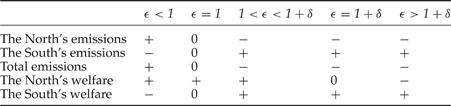
The effects on emissions of the North and the South given by an exogenous technological change of adaptation are determined in accordance with ϵ. With assumptions regarding F(·),B(·) and D(·), we obtain the conclusion below. (1) If ϵ < 1, then dZ N /dα > 0, dZ S /dα < 0 and dZ/dα > 0. (2) If ϵ = 1, then dZ N /dα = dZ S /dα = dZ/dα = 0. (3) If ϵ > 1, then dZ N /dα < 0, dZ S /dα > 0 and dZ/dα < 0.
In this paper, ‘mitigation’ is defined as dZ i < 0. We examine whether mitigation will occur, corresponding to innovation in adaptation. Theorem 1 shows that the result crucially depends on the magnitude of ϵ. Note that sgndI/dα = sgn(1 − ϵ) by (28) in appendix A. When ϵ is inelastic, equilibrium emissions of the North increase with the rise of α, while the South's emissions decrease. In this case, innovation of adaptation technology is so effective that the North increases adaptation investment and reduces mitigation to implement the increase. As a result, the South increases its mitigation effort to alleviate increased damage from the North's additional emissions.
On the other hand, when the innovation is less effective, i.e., ϵ is elastic, the North's emissions decrease and the South's increase. In this case, increasing adaptation by reducing consumption or mitigation does not raise the North's welfare enough. Thus, the North controls the rise of adaptation by reducing adaptation investment, which will enable the North to cut emissions. Consequently, the North decreases adaptation investment and increases the level of mitigation. In response to the North's increase of mitigation, the South will increase its emissions.
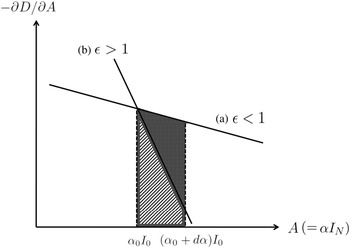
Note that the effect of improvement of adaptation technology to reduce damage at a given (Z N0, Z S0, α0, I 0) is represented as:

Inelastic ϵ, i.e., ϵ < 1 depicts a situation where an adaptation would have a sustainable impact; that is, adaptation can steadily abate damage regardless of its level. Conversely, ϵ > 1 illustrates that its effect would decline more steeply than in an inelastic case. This aspect is illustrated in figure 1, where line (a) represents the inelastic case and line (b) the elastic case. The shaded areas below both lines show the potential benefits from the innovation defined by (13). Figure 1 shows that the benefit in (a) is larger than that in (b).
Additional benefit by innovation of adaptation technology

This aspect may be clearer if we specify the damage function as (3) and e(A) as:

In this specified case, ϵ = β and (13) will be

which is shown to be decreasing with β.Footnote 8
It is interesting that innovation in adaptation will not always lead to mitigation worldwide. The direction of the change of total emissions, Z, is identical to that of the North; as the appendix shows, |dZ N/dα| always exceeds |dZ S/dα| unless ϵ = 1. Therefore, the total emissions will increase because of innovation in adaptation if ϵ < 1.
4. Welfare changes with an innovation of adaptation
In this section, we investigate the effects of an innovation in adaptation technology on the levels of welfare of both the North and the South, the proof of which is given in appendix C. We differentiate W N with α to observe the effect on the North's social welfare.

where

the sign of which is determined by |M| < 0 from (39). On the other hand, the South's welfare changes as follows:

The sign of  is determined by that of (1 − ϵ) by theorem 1. From these equations, we obtain the following theorem.
Theorem 2
The effects on the welfare of the North and the South resulting from an exogenous technological change in adaptation are determined dependent on ϵ: (1) If ϵ < 1, then dW N /dα > 0 and dW S /dα < 0. (2) If ϵ = 1, then dW N /dα > 0 and dW S /dα = 0. (3) If 1 < ϵ< 1 + δ, then dW N /dα > 0 and dW S /dα > 0. (4) If ϵ = 1 + δ, then dW N /dα = 0 and dW S /dα > 0. (5) If ϵ > 1 + δ, then dW N /dα < 0 and dW S /dα > 0.
Theorem 2 shows that the North's welfare gain is non-negative except for the case of ϵ > 1 + δ. In other words, an adaptation option enables the North to benefit even in the situation where the South's emissions grow, which occurs when ϵ ∈ (1,1 + δ). However, highly elastic ϵ ∈ (1,1 + δ, ∞) represents the situation in which the innovation is very ineffective, so the North no longer gains a benefit from the innovation, because of an increase in the South's emissions.
On the other hand, the South's welfare can also be negatively influenced by adaptation innovation through a change in the North's emissions. When the North's emissions increase, the South's welfare is reduced. Because the South is assumed to be unable to implement adaptation, welfare increases only if the innovation in adaptation results in mitigation by the North.
Let us integrate theorem 1 and theorem 2 into table 1. The above summary shows that it is not always true that innovation in adaptation technology reduces total emissions and improves the welfare of the North and South. Such a case occurs if and only if 1 < ϵ< 1 + δ. On the contrary, total emissions will increase in the case of ϵ < 1, the welfare of the North will decline if ϵ > 1 + δ, and that of the South will drop in the case that ϵ < 1.
Summary of effects by innovation in adaptation technology

The signs indicate the changes in GHG emissions and the levels of welfare in the North and the South corresponding to ϵ, namely, the adaptation elasticity of marginal environmental damage.
This shows that an innovation in adaptation technology, which is thought to be beneficial, is not always so, in the sense that it can damage either the North or South if both countries behave in a non-cooperative way. The case of 1 < ϵ< 1 + δ is, from (13), that the innovation in adaptation does not abate the damage as in the case of ϵ < 1 where the total emissions increase and the welfare of the South declines despite the effectiveness of the innovation.
Although technological innovation will allow every player to improve, improvement is not easily achieved in the climate change context where both countries maximize their own benefits, although adaptation is available only for the North. Is there any measure to benefit both countries and reduce total emissions when an innovation in adaptation technology is sufficiently effective, as in ϵ < 1? The next section addresses this issue.
5. The effect of an international transfer system
In this section, we show that an international transfer system can be beneficial to both the North and the South even if there is an effective innovation in adaptation technology. Let the North pay T for an international environmental agency. We suppose that the transfer depends on the level of adaptation as:

where t is the rate of transfer per unit of increment of adaptation. That is, adaptation is ‘taxed,’ for example because the North may be required to share the benefit of the innovation with other countries. The international agency here may transfer all or a part of its revenue to the South, through which the South can be compensated for part of the environmental damage. As a result, the net benefits of the North and the South will be:

where 0 ≤ s ≤ 1. s = 0 means that the South receives nothing and the agency utilizes the revenue from the North elsewhere. As we show, the level of s does not matter; only t > 0 for the North is important.
Under this system, the equilibrium will differ from that without the transfer system that innovation with ϵ < 1 would cause. Note that the amount of damage after adaptation that the North faces will be D(Z,A) + tA, because a part of the benefit from the adaptation is lost due to taxation. Let us denote the damage function after adaptation by D~(Z,A). Under this system, D~A = D A + t,D~AA = D AA, so that the adaptation elasticity of marginal damage reduction ϵ~ will be:

With the transfer system, the optimum conditions for both countries are identical as in (5), except that the damage function here is denoted by  . Let us choose t to satisfy
 . For example, under (14), the following holds:

Thus, if we want to equalize  to 1 + θ (0 < θ< δ), then we can set

With  , the reasoning developed in the previous sections applies so that total emissions will drop and the levels of welfare of the North and South will rise following the introduction of the innovated adaptation technology for any s. That means that, even if s = 0, the welfare of the South will rise to a sufficient degree with the transfer system. This is summarized in the following claim.
Theorem 3
Under the transfer system where T = tA and sT is transferred to the South with 0 ≤ s ≤ 1, the innovation in adaptation technology with ϵ < 1 leads to a reduction of total emissions and an increase in the welfare of both countries if we choose t to satisfy ϵ~∈ (0,1 + δ).
While such a system might be politically infeasible, our result shows the role of the transfer system is that it makes adaptation look less effective for the North because of the transfer system, even if adaptation is in fact effective. Even under the transfer system, the North will be better off as long as rate t satisfies the condition of the above theorem.
6. Conclusions and discussion
Adaptation has the properties of a private good, while mitigation is characterized as a public good. This paper demonstrates, in an economy with the North and South, that such properties of adaptation and mitigation have rather complicated effects on the total emissions of GHGs and welfare of each country. We examine this by supposing an instance of innovation in adaptation technology in the North, while only mitigation is available to the South.
In particular, we show that if the innovation is sufficiently effective, the South is worse off. This is due to the behavior of the North in reducing its own mitigation, because adaptation can reduce the damage so much that the North is led to emit more, which damages the South. We might refer to this phenomenon as a ‘leakage of damage’ from the country where adaptation is available to the one where it is unavailable. We prove rigorously in what case the leakage occurs and how it affects both countries in other cases. The other possibilities involve a case in which both countries will be better off and even one in which the North will be worse off but the South will be better off.
We show that it is possible to avoid leakage and to realize the case in which both the North and the South are better off when a highly effective innovation in adaptation technology occurs, by taxing the North according to the level of adaptation. This instrument makes innovation look less effective for the North, so it does not emit more. That is, with taxation, there may be a situation where a ‘sharing of benefit’ occurs, even if the revenue raised by the taxation does not go to the South.
As our analysis shows, adaptation should be utilized by paying special attention to mitigation so as not to reduce it. In this sense, the implementation of adaptation and mitigation should not be separated but integrated, sometimes with the use of a transfer system between the North and South. In fact, Adger et al. (Reference Adger, Arnell and Tompkins2005) argue for the necessity of a comprehensive framework for adaptation in terms of sustainable development of the South, and Adger (Reference Adger2001) also claims a need for a financial transfer system from the North to the South based on the Climate Adaptation Fund to make adaptation feasible for the South.Footnote 9
In this paper, the analysis considers a simultaneous move game. However, the decision of adaptation may be made depending on how much mitigation is implemented, so the analysis might better reflect reality if it is extended to a two-stage game as in Buob and Stephan (Reference Buob and Stephan2011), so that the level of mitigation is chosen separately by the North and the South in a non-cooperative or cooperative way in the first stage, and the North chooses adaptation in the second stage. Moreover, although we assume that the cost of adaptation is independent of mitigation, it is sometimes true that the cost declines with mitigation, as Ingham et al. (Reference Ingham, Ma and Ulph2005) point out. We also neglect trade between the North and the South, although a model including trade is important to see how leakage affects mitigation and adaptation of both countries. These extensions will make the analysis more complex and may produce variation in the results.
Finally, this paper deals with effects of adaptation in terms of the properties of private goods, but adaptation has various other characteristics that may have interesting effects. These include a distinction between joint and private adaptation (Mendelsohn, Reference Mendelsohn2000) and adaptation technology transfer (Klein et al., Reference Klein, Dougherty, Alam and Rahman2005; Buob and Stephan, Reference Buob and Stephan2008). An analysis focusing on these aspects is left for future interesting studies.
Appendices
Appendix A: The solution of (6)
The definitions of G,H and L are as follows:

The assumptions for B,F,D and d are B i′′ < 0, F i′> 0, F i′′ < 0(i = N,S), α > 0, D ZZ > 0, D AZ = D ZA = 0, D AA > 0, d′ (Z) > 0, d′′ (Z) > 0, I N > 0. Then, we obtain the signs we need as follows:

For later convenience, let us connect the sign of H α with 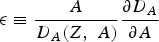 .

Hence we obtain

We expand (6) and obtain

where

Note that L I N = L α = H Z S = G α = 0, so

Finally, we show that |M| < 0.


 and


 , it holds

 and


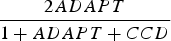
 , where ADAPT is interpreted as adaptation activities as a whole, including capacity building, and Y G is the GDP without climate change. Since RD is regarded as the damage function D in our paper, the expression leads to ϵ in our paper being equivalent to
 , which can be obtained if the values of ADAPT and CCD are available. It is easy to see that ϵ < 1 holds if and only if ADAPT < 1 + CCD. That is, in the model of Agrawala et al., ϵ increases with ADAPT.