It is well documented that individuals who are abused or neglected are at high risk for a variety of negative and enduring biological, emotional, and behavioral outcomes (Cicchetti & Toth, Reference Cicchetti and Toth2005; Cicchetti & Valentino, Reference Cicchetti, Valentino, Cicchetti and Cohen2006). In addition, evidence shows that without intervention, parents with a history of childhood maltreatment are significantly more likely to demonstrate poor parenting practices or to maltreat their own children than are parents who were not maltreated (Cort, Toth, Cerulli, & Rogosch, Reference Cort, Toth, Cerulli and Rogosch2011; Egeland, Jacobvitz, & Sroufe, Reference Egeland, Jacobvitz and Sroufe1988; Lyons-Ruth & Block, Reference Lyons-Ruth and Block1996; Pears & Capaldi, Reference Pears and Capaldi2001), thus sustaining a cycle of abuse and neglect. Because maltreatment has the potential to cause widespread harm to individuals and because the impact of abuse and neglect is often intergenerational, efforts to prevent the negative consequences of child abuse and neglect possess high public health significance.
Maltreated children often have difficulty resolving a progression of essential stage-salient developmental issues, such as affect regulation, secure attachment, and autonomous self-development, because their environments fail to provide adequate support to facilitate healthy biological and psychological growth (Cicchetti, Reference Cicchetti2002; Cicchetti & Lynch, Reference Cicchetti, Lynch, Cicchetti and Cohen1995; Cicchetti & Toth, Reference Cicchetti and Toth1995). According to the organizational perspective on development, as children master developmental tasks, the quality of adaptation they acquire becomes hierarchically integrated and influences adaptation and functioning over time (Cicchetti, Reference Cicchetti1993; Toth & Cicchetti, Reference Toth, Cicchetti, Russ and Ollendick1999). As a result, difficulties in resolving early tasks of development increase the probability of subsequent maladaptation (Cicchetti, Reference Cicchetti1993; Sroufe & Rutter, Reference Sroufe and Rutter1984). However, because maladaptive trajectories can be altered (Toth & Cicchetti, Reference Toth, Cicchetti, Russ and Ollendick1999), interventions aimed at preventing the harmful consequences of maltreatment are critical for promoting healthy development in maltreated individuals. Early intervention is of particular importance in order to provide children with opportunities to resolve and consolidate early developmental tasks, which may assist them in subsequent development. Thus, investigations of the sustained impact of preventive interventions on attachment security for maltreated children are essential.
Caregiver–Child Interactions and Child Attachment
The study of the caregiver–child relationship in abused and neglected infants is important for elucidating a potential process by which maladaptive developmental trajectories are initiated in maltreated children. Bowlby (Reference Bowlby1969, Reference Bowlby1973) theorized that, within the first year of life, infants form a type of psychological connectedness with their caregivers known as attachment. A caregiver's reliable and sensitive responsiveness to children's cues, particularly bids for comfort when distressed, is a critical aspect in the development of secure attachment (Ainsworth, Blehar, Waters, & Wall, Reference Ainsworth, Blehar, Waters and Wall1978; Bowlby, Reference Bowlby1969). As a result of the caregiver's comforting responses, the infant becomes increasingly confident that the caregiver will effectively relieve distress and fulfill needs for both safety and autonomy. Through the security of the attachment relationship, the child gradually grows more autonomous and is able to interact with the environment and turn attention toward developmental tasks such as exploration, learning, and play, confident that the caregiver will respond if needed (Ainsworth et al., Reference Ainsworth, Blehar, Waters and Wall1978). Secure attachment in infants is positively associated with long-term outcomes such as psychosocial adaptation, school success, and the avoidance of psychopathology (Bureau, Easterbrooks, & Lyons-Ruth, Reference Bureau, Easterbrooks and Lyons-Ruth2009; Lyons-Ruth, Easterbrooks, & Cibelli, Reference Lyons-Ruth, Easterbrooks and Cibelli1997; Moss & St.-Laurent, Reference Moss and St.-Laurent2001).
In contrast, when a caregiver fails to respond to infant cues, or responds in a frightening (e.g., harsh, frightened, or dissociated) or inconsistent manner, the infant is likely to form an insecure or disorganized attachment (George, Cummings, & Davies, Reference George, Cummings and Davies2010; Hesse & Main, Reference Hesse and Main2006; Isabella, Reference Isabella1993; Lyons-Ruth, Bronfman, & Parsons, Reference Lyons-Ruth, Bronfman and Parsons1999; Madigan, Moran, & Pederson, Reference Madigan, Moran and Pederson2006; Main & Hesse, Reference Main, Hesse, Greenberg, Cicchetti and Cummings1990). In maltreating families, caregiver behavior can be insensitive as well as threatening, aggressive, intrusive, and/or contradictory (Azar, Reference Azar and Bornstein2002; Rogosch, Cicchetti, Shields, & Toth, Reference Rogosch, Cicchetti, Shields, Toth and Bornstein1995). Such responses elicit fear and disorientation in children, often undermining the security and organization of their attachment relationships (Abrams, Rifkin, & Hesse, Reference Abrams, Rifkin and Hesse2006; Ballen, Bernier, Moss, Tarabulsy, & St.-Laurent, Reference Ballen, Bernier, Moss, Tarabulsy and St.-Laurent2010; Madigan et al., Reference Madigan, Moran and Pederson2006; Schuengel, Bakermans-Kranenburg, & van IJzendoorn, Reference Schuengel, Bakermans-Kranenburg and van IJzendoorn1999). Thus, child maltreatment is one of the most robust predictors of insecure and disorganized attachment (Barnett, Ganiban, & Cicchetti, Reference Barnett, Ganiban and Cicchetti1999; Cicchetti & Barnett, Reference Cicchetti and Barnett1991; Cicchetti, Rogosch, & Toth, Reference Cicchetti, Rogosch and Toth2006; Cicchetti, Toth, & Lynch, Reference Cicchetti, Toth, Lynch, Ollendick and Prinz1995; Lyons-Ruth, Connell, Zoll, & Stahl, Reference Lyons-Ruth, Connell, Zoll and Stahl1987; van IJzendoorn, Schuengel, & Bakermans-Kranenburg, Reference van IJzendoorn, Schuengel and Bakermans-Kranenburg1999) even when compared to other high-risk children (Cyr, Euser, Bakermans-Kranenburg, & van IJzendoorn, Reference Cyr, Euser, Bakermans-Kranenburg and van IJzendoorn2010).
In accord with the developmental psychopathology perspective (Cicchetti, Reference Cicchetti1984, Reference Cicchetti1993; Sroufe & Rutter, Reference Sroufe and Rutter1984), disrupted attachment relationships with parents not only deprive young children of opportunities to master stage-salient developmental tasks of infancy but also negatively impact subsequent development. Insecure attachment is associated with a variety of poor developmental outcomes, such as difficulty regulating emotions, poor peer relationships, and language delays (Easterbrooks, Davidson, & Chazan, Reference Easterbrooks, Davidson and Chazan1993; Sroufe, Reference Sroufe and Permutter1983; Weinfield, Sroufe, Egeland, & Carlson, Reference Weinfield, Sroufe, Egeland, Carlson, Cassidy and Shaver1999). Disorganized attachment is predictive of problems such as poor stress management, externalizing behavior problems, and dissociative behavior later in life (van IJzendoorn et al., Reference van IJzendoorn, Schuengel and Bakermans-Kranenburg1999).
Child Behavior Problems
It is well established that child maltreatment places children at risk for developing internalizing and externalizing behavior problems (Hildyard & Wolfe, Reference Hildyard and Wolfe2002; Kim & Cicchetti, Reference Kim and Cicchetti2003; Manly, Kim, Rogosch, & Cicchetti, Reference Manly, Kim, Rogosch and Cicchetti2001; Shonk & Cicchetti, Reference Shonk and Cicchetti2001; Toth, Cicchetti, Macfie, Rogosch, & Maughan, Reference Toth, Cicchetti, Macfie, Rogosch and Maughan2000). In an investigation of over 4,400 twins, a documented history of child abuse or neglect was associated with externalizing behavior when controlling for genetic vulnerability (Jonson-Reid et al., Reference Jonson-Reid, Presnall, Drake, Fox, Bierut and Reich2010). In addition, evidence links insecure attachment, particularly avoidant and disorganized attachment, with internalizing and externalizing behavior problems (Fearon, Bakermans-Kranenburg, van IJzendoorn, Lapsley, & Roisman, Reference Fearon, Bakermans-Kranenburg, van IJzendoorn, Lapsley and Roisman2010; Lyons-Ruth et al., Reference Lyons-Ruth, Easterbrooks and Cibelli1997; Munson, McMahon, & Spieker, Reference Munson, McMahon and Spieker2001). Maltreated children with insecure attachments are at high risk for developing internalizing and externalizing behavior problems. Thus, it is important that intervention outcome studies with maltreated children evaluate both attachment and behavioral functioning.
Preventive Interventions for Maltreated Children
Attachment-based interventions
Empirical evidence supports the utilization of attachment-based preventive interventions in improving outcomes for maltreated and high-risk children (Cicchetti et al., Reference Cicchetti, Rogosch and Toth2006; Lieberman, Ghosh Ippen, & Van Horn, Reference Lieberman, Ghosh Ippen and Van Horn2006; Lieberman, Van Horn, & Ghosh Ippen, Reference Lieberman, Van Horn and Ghosh Ippen2005; Lieberman, Weston, & Pawl, Reference Lieberman, Weston and Pawl1991; Lyons-Ruth, Connell, Grunebaum, & Botein, Reference Lyons-Ruth, Connell, Grunebaum and Botein1990; Moss et al., Reference Moss, Dubois-Comtois, Cyr, Tarabulsy, St.-Laurent and Bernier2011; Osofsky et al., Reference Osofsky, Kronenberg, Hammer, Lederman, Katz and Adams2007; Toth, Maughan, Manly, Spagnola, & Cicchetti, Reference Toth, Maughan, Manly, Spagnola and Cicchetti2002; Toth, Rogosch, Manly, & Cicchetti, Reference Toth, Rogosch, Manly and Cicchetti2006). Cicchetti et al. (Reference Cicchetti, Rogosch and Toth2006) reported that after approximately 12 months of treatment, an attachment theory informed and a psychoeducational parenting intervention (PPI) were equally effective in promoting secure attachment and reducing rates of disorganized attachment in maltreated infants relative to a community standard (CS) approach to intervention. Moss et al. (Reference Moss, Dubois-Comtois, Cyr, Tarabulsy, St.-Laurent and Bernier2011) also reported a significant increase in secure attachment and a decrease in disorganized attachment in maltreated children who received an attachment-based intervention relative to a comparison group. Similarly, Lieberman et al. (Reference Lieberman, Weston and Pawl1991) demonstrated a significant reduction in avoidance, resistance, and anger in a sample of anxiously attached infants subsequent to the provision of an attachment-oriented intervention. In a randomized controlled trial with maltreated children, Toth et al. (Reference Toth, Maughan, Manly, Spagnola and Cicchetti2002) reported that an attachment theory informed preventive intervention was efficacious in reducing negative maternal and self-representations and increasing children's positive expectations of the mother–child relationship. Improvements in infant development, parent–child interactions, and maternal sensitivity measured at pre and postintervention also have been documented in high-risk children using attachment-based treatment models (Bernard et al., Reference Bernard, Dozier, Bick, Lewis-Morrarty, Lindhiem and Carlson2012; Lyons-Ruth et al., Reference Lyons-Ruth, Connell, Grunebaum and Botein1990; Osofsky et al., Reference Osofsky, Kronenberg, Hammer, Lederman, Katz and Adams2007).
Interventions that target maternal attachment representations, sensitivity, and parent–child interactions also have been shown to be efficacious in reducing behavior problems in maltreated children (Moss et al., Reference Moss, Dubois-Comtois, Cyr, Tarabulsy, St.-Laurent and Bernier2011) and in children who have been exposed to domestic violence (Lieberman et al., Reference Lieberman, Van Horn and Ghosh Ippen2005). In school-aged children, secure attachment predicted fewer behavior problems following intervention (Moss et al., Reference Moss, Dubois-Comtois, Cyr, Tarabulsy, St.-Laurent and Bernier2011). Lieberman et al. (Reference Lieberman, Ghosh Ippen and Van Horn2006) demonstrated that the positive effects of attachment-oriented intervention on children's behavior were maintained up to 6 months after the conclusion of intervention.
Although these important investigations demonstrate the efficacy of attachment theory-informed interventions in improving outcomes for maltreated and high-risk children and their families, gaps in the literature exist. With the exception of the Cicchetti et al. (Reference Cicchetti, Rogosch and Toth2006) and Toth et al. (Reference Toth, Maughan, Manly, Spagnola and Cicchetti2002) investigations, our knowledge about the efficacy of attachment-based treatments relative to other theoretically based interventions is fairly limited. Further, no study has examined the efficacy of preventive interventions in promoting the maintenance of attachment security beyond the conclusion of treatment or assessed children's behavioral functioning beyond 6 months postintervention.
Parenting interventions
Randomized controlled trials have shown that parenting interventions reduce children's behavior problems over time (Beauchaine, Webster-Stratton, & Reid, Reference Beauchaine, Webster-Stratton and Reid2005; Forgatch, Patterson, DeGarmo, & Beldavs, Reference Forgatch, Patterson, DeGarmo and Beldavs2009; Olds et al., Reference Olds, Henderson, Cole, Eckenrode, Kitzman and Luckey1998). These therapeutic models are typically didactic in nature and are intended to promote parental sensitivity through behavioral training or by teaching parenting skills.
Beauchaine et al. (Reference Beauchaine, Webster-Stratton and Reid2005) summarized findings from a set of six different outcome studies of a didactic parenting intervention. They found support for meditational models in which reductions in harsh, critical, and ineffective parenting mechanisms were associated with decreases in maternally reported and directly observed externalizing child behavior. Similarly, Forgatch et al. (Reference Forgatch, Patterson, DeGarmo and Beldavs2009) reported that a parent training intervention, with no direct intervention on the target child, led to fewer teacher-reported behavior problems and fewer arrests up to 9 years postintervention in boys from divorced families. A long-term follow-up of a nurse home visitation program demonstrated significant reductions in children's behavior problems, antisocial behavior, and substance use (Olds et al., Reference Olds, Henderson, Cole, Eckenrode, Kitzman and Luckey1998). Taken together, these studies support the utilization of parenting interventions in promoting positive behavioral outcomes in children.
Unfortunately, child attachment security is often not measured in investigations of parenting interventions, with the exception of Cicchetti et al. (Reference Cicchetti, Rogosch and Toth2006), who demonstrated that a preventive PPI promoted secure attachment in maltreated children. However, some empirical research suggests that the provision of parent training is insufficient to effect lasting change in children's attachment when the caregivers have a history of traumatic experiences (Fraiberg, Leiberman, Pekarsky, & Pawl, Reference Fraiberg, Lieberman, Pekarsky and Pawl1981; Moran, Pederson, & Krupta, Reference Moran, Pederson and Krupka2005). If traumatized parents are not able to attend sensitively, or avoid responding harshly, to their children until their own representational models of caregiver relationships are resolved, then interventions for these families may need to focus on the resolution of the caregiver's attachment-related issues (Fraiberg et al., Reference Fraiberg, Lieberman, Pekarsky and Pawl1981; Lieberman & Van Horn, Reference Lieberman and Van Horn2005), which are theorized to be a source of insensitive and distressing parenting behavior (Main, Kaplan, & Cassidy, Reference Main, Kaplan and Cassidy1985). Evaluating the long-term relative efficacy of attachment-based and psychoeducational preventive interventions on child attachment and behavior ensures that families receive the most adequate treatment.
The Current Investigation
Cicchetti et al. (Reference Cicchetti, Rogosch and Toth2006) examined the relative efficacy of two theoretically informed preventive interventions, child–parent psychotherapy (CPP) and PPI, in promoting secure attachment in maltreated infants. After 12 months of treatment, they reported that children in the CPP and the PPI interventions demonstrated substantial increases in secure attachment, whereas increases in secure attachment were not found in maltreated children who received the CS or in a sample of nomaltreated comparison (NC) children. Moreover, infants in the CS group continued to exhibit high rates of disorganization.
The current investigation was designed to extend findings from the prior investigation in order to evaluate the relative efficacy of CPP and PPI in supporting the maintenance of secure attachment and predicting behavioral functioning in maltreated children 12 months after the end of treatment.
Hypotheses
1. Children in families who received either the CPP or the PPI preventive interventions were expected to exhibit higher rates of secure attachment and lower rates of disorganized attachment at the 12-month postintervention follow-up assessment than were children in families that received CS. Children in the CPP group were expected to have higher rates of secure and lower rates of disorganized attachment than were children in the PPI group.
2. Children who received either the CPP or the PPI preventive interventions were expected to have fewer maternal-reported internalizing and externalizing behavior problems at the 12-month postintervention follow-up assessment relative to children who received CS. Children in the CPP group were expected to have fewer maternal-reported behavioral problems than were children in the PPI group.
Method
Participants
Participants included 189 toddlers and their biological mothers, who were recruited when their children were infants to voluntarily participate in an intervention evaluation study. Families were not seeking treatment at the time of the study, and participation in the study was by choice. Maltreated infants (n = 137; 60 boys, 77 girls) were identified through the inspection of Child Protective Service and preventive service records for indicated reports of child abuse or neglect by a Department of Human Services (DHS) recruitment liaison. Inclusion criteria for the maltreated groups required that maltreatment occurred with the infant and/or the infant was living in a maltreating family with his or her biological mother. The Maltreatment Classification System (Barnett, Manly, & Cicchetti, Reference Barnett, Manly, Cicchetti, Cicchetti and Toth1993) was utilized to code maltreatment subtype (neglect, emotional maltreatment, physical abuse, and sexual abuse). Coding was done by doctoral students and clinical psychologists, and adequate reliability was obtained (weighted κs range = 0.86–0.98). In the recruited sample, 66.4% of the maltreated infants were indicated as the targets of abuse and/or neglect, and 33.6% of the cases identified a sibling as the target. These two groups did not differ on preintervention secure attachment, χ2 (1, n = 137) = 4.02, p = .26, effect size [ES] = 0.06. Of the infants in the maltreatment group, 84.6% had been neglected, 69.2% had been emotionally maltreated, 8.8% had been physically abused, and none had been sexually abused. Low rates of physical and sexual abuse were present in the recruited sample owing to the high likelihood of foster care placement when these types of abuse occur during infancy.
The DHS liaison also randomly identified nonmaltreated children (n = 52; 28 boys, 24 girls) through lists of families receiving Temporary Assistance to Needy Families (TANF) in order to obtain a demographically similar comparison group. These lists were screened to exclude families with child maltreatment histories. The liaison obtained a signed release from all interested maltreating and nonmaltreating mothers prior to releasing names to project staff. It was emphasized to all families that involvement in the study was voluntary and participation, or lack of participation, would not affect any services that the family was receiving.
At the initial assessment, infants were approximately 13.31 months of age (SD = 0.81) and mothers were an average of 26.98 years of age (SD = 5.98). The majority of mothers (74.6%) were of minority race, 12.7% were married, and 58.2% had earned a high school diploma or equivalent. Overall, 96.3% of families were receiving TANF. In addition to collecting basic demographic data, mothers were interviewed and filled out questionnaires about their own childhood maltreatment and trauma histories. Overall, 79.4% (n = 150) of the mothers who participated in the study reported that they had been maltreated when they were children. In addition, 89.9 % (n = 170) of mothers reported experiencing at least one traumatic event, such as being mugged, sexually assaulted, witnessing an unexpected death, or experiencing a natural disaster, during their lives. Thirty-five percent (n = 65) of mothers met criteria for a lifetime history of posttraumatic stress disorder (PTSD). Just over 20% (n = 38) of the mothers met criteria for PTSD at the baseline assessment of the current study. Mothers who reported a history of childhood maltreatment reported exposure to significantly more qualifying traumatic events (M = 3.49, SD = 2.39) than did mothers who did not experience childhood abuse or neglect (M = 2.08, SD = 1.88), t (187) = 3.43, p < .001, d = 0.66. Moreover, previously maltreated mothers were more likely to meet criteria for a lifetime history of PTSD (39.3%) than were nonmaltreated mothers (15.4%), χ2 (1, N = 189) = 7.87, p = .005, ES = 0.20. Similarly, mothers with histories of child maltreatment were more likely to report PTSD symptoms at baseline (24.7%) compared to nonmaltreated mothers (2.6%), χ2 (1, N = 189) = 9.41, p < .001, ES = 0.22.
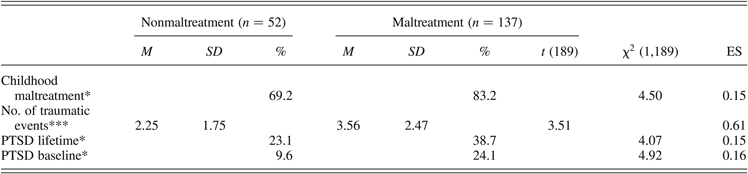
Table 1 presents descriptive data indicating the rate of childhood maltreatment and exposure to traumatic events reported by the mothers of children in the maltreated and nonmaltreated groups. Although prevalence of maternal history of childhood maltreatment was high in both groups, mothers in the maltreatment group were significantly more likely to have been abused and/or neglected as children than were mothers in the nonmaltreatment group (p = .03). Mothers in the maltreatment group also reported experiencing more traumatic events (p < .001) and were more likely to have a lifetime history of PTSD (p = .04). They also were more likely to have PTSD (p = .03) at the onset of treatment.
Maternal childhood maltreatment and trauma exposure between nonmaltreatment and maltreatment groups

Note: ES, effect size; PTSD, posttraumatic stress disorder.
*p < .05. ***p < .001.
Random assignment
Maltreating families were randomly assigned into one of three groups: CPP (n = 53), PPI (n = 49), or CS (n = 35). Nonmaltreating families formed the nonmaltreated comparison (NC) group (n = 52). At the onset of the intervention, groups did not differ on child gender, maternal age, maternal minority race/ethnicity, TANF receipt, income, or marital status. However, groups differed on family size, F (3, 188) = 38.82, p < .001, such that mothers in each of the maltreatment groups had given birth to more children than had mothers in the NC group (all p < .05). In addition, groups differed on high school graduation rate, χ2 (3, N = 189) = 10.37, p = .02, ES = 0.23, such that mothers in the NC group were more likely to have graduated from high school than were mothers in the maltreatment groups (all ps < .05).
Procedures
During the preintervention assessment, home and laboratory research sessions were conducted. Demographic and diagnostic interviews, as well as a variety of self-report measures, were administered to mothers during the home visit by trained research assistants who were unaware of maltreatment status or intervention group assignments. In addition, mothers and infants participated in the strange situation procedure (Ainsworth et al., Reference Ainsworth, Blehar, Waters and Wall1978) at a separate laboratory visit. The same home and laboratory procedures were repeated after the interventions for the CPP and the PPI groups were completed, when the children were approximately 26 months old, and again during a follow-up assessment when the children were approximately 38 months old.
The length of intervention averaged 46.4 (SD = 7.36) weeks for the CPP group and 49.4 (SD = 4.81) weeks for the PPI group. Although intervention sessions were scheduled weekly, an average of 21.56 (SD = 9.60) sessions were conducted in the CPP group and 25.35 (SD = 9.65) sessions in the PPI group owing to missed appointments and cancellations. Both the CPP and the PPI interventions were manualized, and therapists participated in weekly individual and group supervision sessions. Checks on the fidelity of intervention implementation were conducted periodically by reviewing videotapes of sessions and completing fidelity checklists.
Preventive interventions
CPP
CPP is an evidence-based therapeutic model that was developed to enrich the complex relationship between traumatized children and parents (Lieberman & Van Horn, Reference Lieberman and Van Horn2005). This treatment approach is based on the supposition that mothers are often unable to provide sensitive and responsive care to their children when they are preoccupied with insecure representational models of themselves and of the mother–child relationship that resulted from their own negative experiences (Fraiberg, Adelson, & Shapiro, Reference Fraiberg, Adelson and Shapiro1975). In CPP, the patient is not the mother or the infant, but rather the relationship between the mother and her baby. The approach is nondirective and nondidactic, and includes developmental guidance based on the mother's concerns. CPP is conducted in the clients' homes by master's level therapists, weekly, and over a 12-month period. The mother–child dyad is seen together, allowing for the therapist to comment on processes in the parent–child relationship as they occur. Sessions typically occur in the families' living rooms using toys and materials already present in the home. During sessions, the therapist observes and responds empathically to the interactions between the mother and the infant. Mothers utilize the support of the therapeutic relationship to challenge distorted perceptions of themselves and their children by differentiating between affect and impulses associated with past experiences versus current relationships (Lieberman, Reference Lieberman2007). For example, a mother may learn that her present view of her infant as “spoiled” or “undeserving” may stem from unresolved resentment from not having her own needs met as a young child. This insight may help the mother to more readily and sensitively respond to her infant's demands. The therapists' consistent support creates a corrective emotional experience that helps mothers to form positive representations of themselves and of the mother–child relationship. This process encourages positive and sensitive interactions between mothers and their children. All sessions include both the mother and the baby. Additional individual sessions with mothers were occasionally held to discuss content that may be distressing to a verbal child, such as the mother's physical or sexual abuse history.
PPI
The PPI preventive intervention was modeled after a program whereby nurses visited the homes of low-income mothers to provide education about infant physical and psychological development (Olds & Kitzman, Reference Olds and Kitzman1990). The PPI model was didactic in nature and was designed to provide mothers with education about child development and parenting skills, to reduce parenting stress, and to increase life satisfaction. In addition, therapists utilized a variety of cognitive and behavioral techniques to help parents develop parenting skills, problem solving skills, relaxation strategies, and social support resources. Time spent on each area was individually tailored to meet each mother's primary needs. PPI was conducted in the clients' homes by master's level therapists, weekly, and over a 12-month period. Unlike the CPP model, only mothers, and not the mother–child dyad, were the focus of sessions.
CS
Families in the CS condition received case management from the DHS, according to their customary approach. In addition, they received assistance in obtaining referrals to services and resources that may have been more difficult to access outside of the research trial. Service receipt within the CS condition varied from minimal contact to group parent skills training or individual counseling.
Measures
Strange Situation
During individual laboratory visits at preintervention, postintervention, and follow-up, dyads participated in the standard Strange Situation paradigm (Ainsworth et al., Reference Ainsworth, Blehar, Waters and Wall1978). The paradigm was videotaped through a one-way mirror. Children's attachment at preintervention was coded by two independent, reliably trained raters, who were unaware of children's maltreatment statuses or intervention group assignments. Ainsworth's criteria for the insecure–avoidant (A), secure (B), and insecure–ambivalent (C) classifications were utilized (Ainsworth et al., Reference Ainsworth, Blehar, Waters and Wall1978), and insecure–controlling/disorganized (D) classifications were based on the Main and Solomon (Reference Main, Solomon, Greenberg, Cicchetti and Cummings1990) criteria. At postintervention, the coding system developed by Schneider-Rosen, Braunwald, Carlson, and Cicchetti (Reference Schneider-Rosen, Braunwald, Carlson and Cicchetti1985) was used to code the four attachment categories (A, B, C, and D). At both the preintervention and the postintervention assessments, two raters coded all tapes and disagreements were resolved by conferencing. Interrater agreement for the four-category attachment classification system exceeded 88%.
Children's attachment at follow-up was coded independently by coders who had not coded earlier tapes and who achieved criterion-level reliability with expert coders on a separate sample of tapes. Neither of the coders was aware of children's maltreatment statuses, treatment conditions, or attachment classifications at previous assessments. Children's attachment was classified into one of five categories using the Attachment Organization in Preschool Children: Procedures and Coding Manual (Cassidy & Marvin, Reference Cassidy and Marvin1992): A, B, C, D, or insecure–other (IO). For the purposes of data analysis, children classified as insecure–other were combined with children classified as insecure–controlling/disorganized to form a single Type D group (Cassidy & Marvin, Reference Cassidy and Marvin1992). Overall agreement for the standard classifications (A, B, C, D), calculated on 30% of the sample, was 77.7% (κ = 0.70). Agreement between secure (B) and insecure/disorganized (A, C, D) classifications was 91.1% (κ = 0.82). Agreement between organized (A, B, C) and disorganized (D) classifications was 80% (κ = 0.60). Discrepancies were resolved by conferencing and by consulting with an expert panel.
The Childhood Trauma Questionnaire—Short Form (CTQ-SF)
The CTQ-SF (Bernstein et al., Reference Bernstein, Stein, Newcomb, Walker, Pogge and Ahluvalia2003) is a 28-item retrospective self-report inventory that was used to provide screening for histories of abuse and neglect in the mothers for descriptive purposes. Mothers were presented with statements reflecting childhood experiences that occurred before the age of 18 and were asked to rate items on a 5-point Likert scale ranging from never true to very often true. The five domains assessed were emotional abuse, physical abuse, sexual abuse, emotional neglect, and physical neglect. Preestablished cutoffs calculated from the CTQ-SF subscale scores were used to determine maternal history of maltreatment (Simon et al., Reference Simon, Herlands, Marks, Mancini, Letamendi and Li2009; Walker et al., Reference Walker, Unutzer, Rutter, Gelfand, Saunders and VonKorff1999).
The Diagnostic Interview Schedule—Version IV (DIS-IV)
Maternal lifetime and baseline (within the past year) PTSD was assessed at preintervention during interviews conducted by research assistants using the DIS-IV (Robins et al., Reference Robins, Cottler, Bucholz, Compton, North and Rourke2000), a structured interview designed to ascertain the presence or absence of major psychiatric disorders as outlined in DSM-IV. The PTSD interview section of the DIS-IV began with a gate question to determine whether participants had experienced a potentially traumatic event. The gate question included 13, noncombat related, qualifying events. For assessment of PTSD symptoms, participants who experienced more than one event were asked to focus on the most distressing event. PTSD symptoms were then queried in relation to that event. Lifetime and baseline PTSD symptoms were measured. In addition, a variable was created reflecting the total number of traumatic events experienced by each mother. This was chosen because of previous research demonstrating the association between cumulative trauma exposure and poor functioning (Banyard, Williams, & Siegal, Reference Banyard, Williams and Siegal2003; Cohen, Hien, & Batchelder, Reference Cohen, Hien and Batchelder2008).
The Child Behavior Checklist/2–3 (CBCL)
The CBCL (Achenbach, Reference Achenbach1992) was used to measure maternal report of children's behavior problems at the follow-up assessment. The CBCL contains items that describe internalizing and externalizing behavior problems rated on a scale of 0 (not true) to 2 (very true or often true). Because abusive parents overreport externalizing behavior problems, compared to independent observations (Lau, Valeri, McCarty, & Weisz, Reference Lau, Valeri, McCarty and Weisz2006), results were interpreted in terms of parental perceptions of behavior problems.
Treatment compliance and attrition
In all, 32 (60.4%) of the dyads randomly assigned to CPP and 24 (48.9%) of the dyads assigned to PPI participated in the interventions. Participation rates most likely reflect that the families did not actively seek treatment. Treatment decliners did not differ from those who engaged in intervention on any demographic variables or baseline measures. Because of the lack of differences, the primary data analytic comparisons involved families that engaged in CPP and PPI, and a group that did not receive active treatment, which included those randomly assigned to the CS group and those declining CPP or PPI. Intention to treat (ITT) analyses were also conducted in which the original random assignment was retained.
Forty-one families (21.7%) did not complete postintervention assessments. A significantly higher percentage of families in the CS group (33.4%, n = 27) were not available for this assessment than in the other groups. Attrition rates for the CPP (12.5%, n = 4), the PPI (8.4%, n = 2) and the NC (15.4%, n = 8) groups did not differ.
Results
Previously reported preintervention and postintervention results
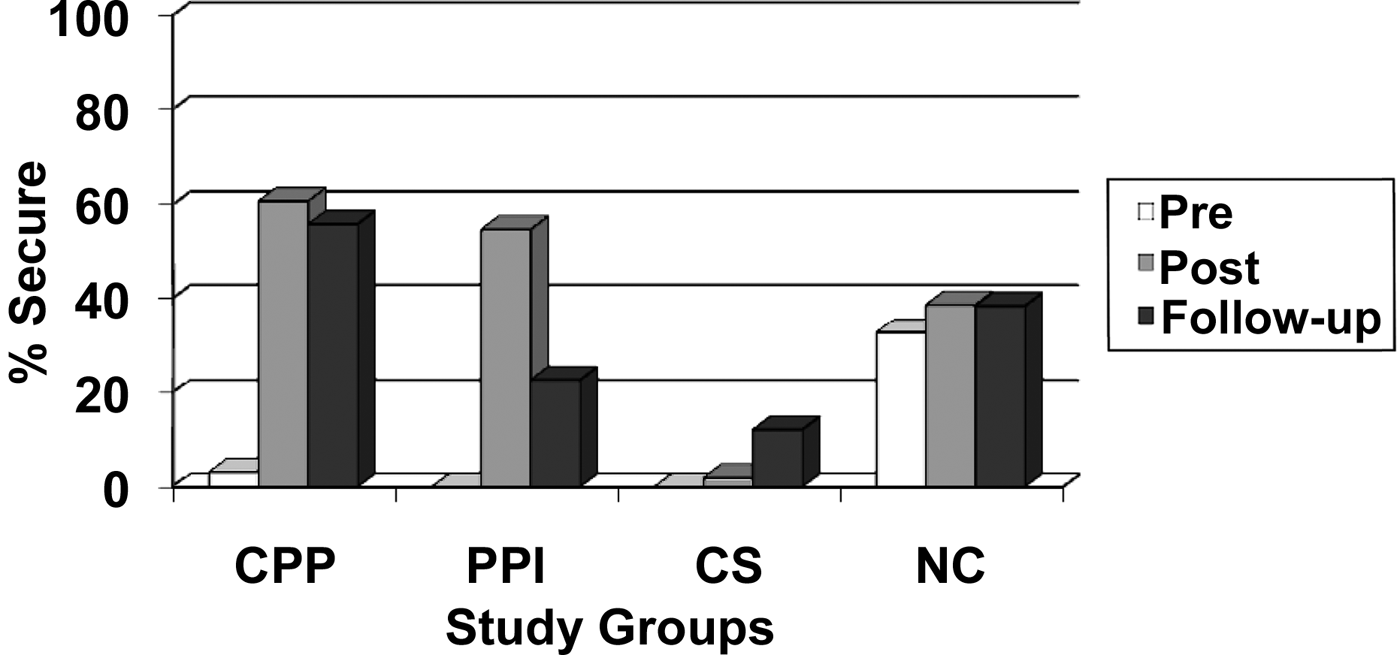
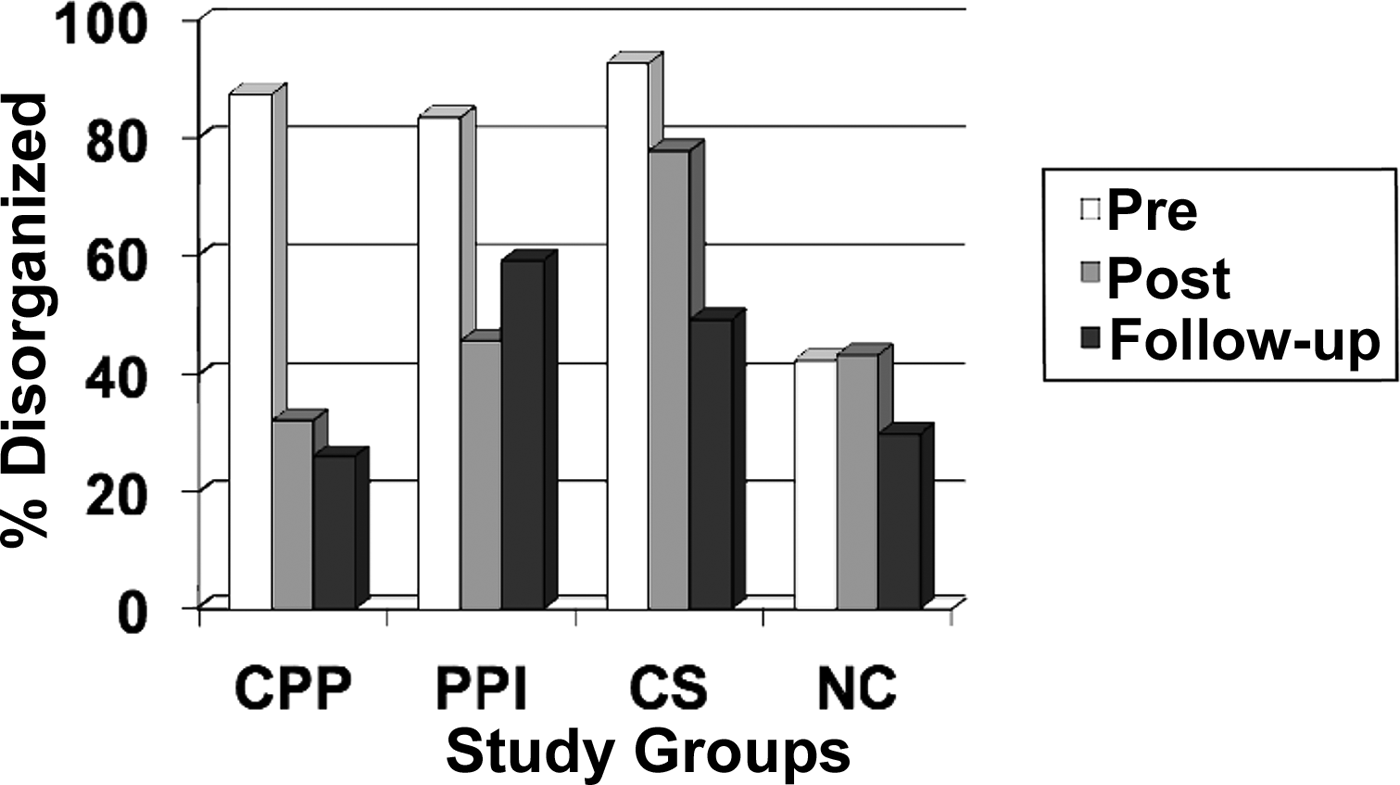
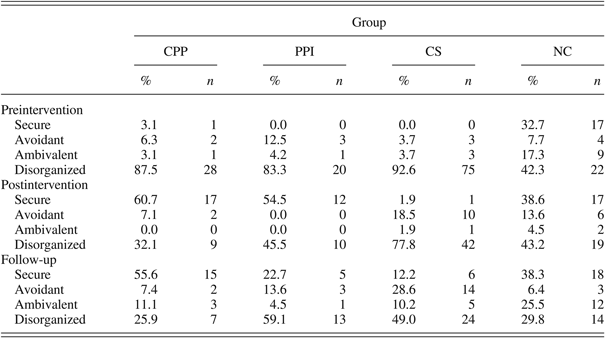
Attachment classifications for the four treatment groups at preintervention and postintervention are presented in Table 2. In addition, percentages of secure and disorganized attachment among the study groups are shown in Figure 1 and Figure 2. At preintervention, there were no differences among the maltreated groups (CPP, PPI, and CS) on rate of attachment security (Cicchetti et al., Reference Cicchetti, Rogosch and Toth2006). At postintervention, the CPP and the PPI interventions were equally effective in promoting attachment security (Cicchetti et al., Reference Cicchetti, Rogosch and Toth2006). Rates of secure attachment in the CPP and the PPI groups were significantly higher than in the CS group and did not differ significantly from the NC group. At postintervention, percentage of disorganized attachment dropped substantially for the CPP and the PPI groups, whereas infants in the CS group continued to exhibit high rates of disorganization. Disorganized attachment in the NC group remained relatively stable from pre- to postintervention (Cicchetti et al., Reference Cicchetti, Rogosch and Toth2006).
The percentage of secure attachment at preintervention, postintervention, and follow-up for intervention groups. CPP, child–parent psychotherapy; PPI, psychoeducational parenting intervention; CS, community standard; NC, nonmaltreated comparison.
The percentage of disorganized attachment at preintervention, postintervention, and follow-up for intervention groups. CPP, child–parent psychotherapy; PPI, psychoeducational parenting intervention; CS, community standard; NC, nonmaltreated comparison.
Attachment classifications at preintervention, postintervention, and follow-up for intervention groups
Note: CPP, Child–parent psychotherapy; PPI, psychoeducational parenting intervention; CS, community standard; NC, nonmaltreated comparison; Preintervention, N = 189; postintervention, N = 148; follow-up, N = 145.
12-Month follow-up results
Hypothesis 1
Chi-square analyses were conducted to determine if the four group attachment classifications (A, B, C, and D) differed significantly among the four experimental groups at follow-up. Significant differences were found, χ2 (9, n = 145) = 33.49, p < .001, ES = 0.28 (see Table 2 and Figures 1 and 2). Contrasts, with the Holm–Bonferroni correction (Jaccard & Guilamo-Ramos, Reference Jaccard and Guilamo-Ramos2002), were used to test specific study hypotheses. Consistent with Hypothesis 1, children in the CPP group had higher rates of secure attachment, χ2 (1, n = 76) = 16.33, p < .001, ES = 0.46, and lower rates of disorganized attachment, χ2 (1, n = 76) = 3.83, p = .05, ES = 0.23, at follow-up than did children in the CS group. However, the PPI and the CS groups did not differ on rates of attachment security, χ2 (1, n = 71) = 1.27, p = .26, ES = 0.13, or disorganization, χ2 (1, n = 71) = 0.62, p = .43, ES = 0.09. Of note, children who received CPP were more likely to demonstrate secure attachment, χ2 (1, n = 49) = 5.41, p = .02, ES = 0.33, and less likely to be classified disorganized, χ2 (1, n = 49) = 5.52, p = .02, ES = 0.34, at follow-up than were children who received PPI. In addition, rates of secure attachment in both of the active intervention groups did not differ from the NC group (CPP vs. NC): χ2 (1, n = 74) = 2.06, p = .15, ES = 0.17; (PPI vs. NC): χ2 (1, n = 69) = 1.64, p = .20, ES = 0.13, whereas security was lower in the CS group relative to the NC group, χ2 (1, n = 96) = 8.68, p = .003, ES = 0.30. The CPP group demonstrated rates of disorganized attachment that did not differ from the NC group, χ2 (1, n = 74) = 0.13, p = .72, ES = 0.04, whereas the PPI group had significantly higher rates of disorganization than did the NC group, χ2 (1, n = 69) = 5.40, p = .02, ES = 0.28.
Hypothesis 2
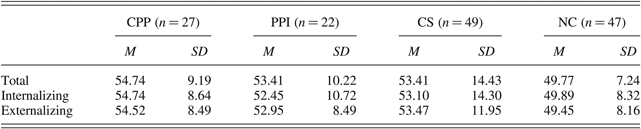
A multivariate analysis of variance was conducted to evaluate Hypothesis 2 in regard to child behavior problems at follow-up. Means and standard deviations are presented in Table 3. The multivariate effect for treatment group, Wilks λ = 0.95, F (9, 145) = 0.86, p = .56, was not significant, indicating that there were no significant differences at the follow-up assessment for maternal perceptions of internalizing, externalizing, or total behavior problems among the four study groups.
Maternal-reported child behavior problems for intervention conditions at follow-up
Note: CPP, Child–parent psychotherapy; PPI, psychoeducational parenting intervention; CS, community standard; NC, nonmaltreated comparison.
ITT analyses
For ITT analyses, treatment decliners were retained in the intervention groups to which the dyads were originally assigned. The four group attachment classifications (A, B, C, and D) continued to differ across groups as randomized at follow-up, χ2 (9, n = 145) = 28.49, p < .001, ES = 0.26. The CPP group continued to demonstrate higher rates of secure attachment (40.5%) than did the CS group (11.8%), χ2 (1, n = 59) = 4.57, p = .03, ES = 0.28, and the PPI group (17.9%), χ2 (1, n = 81) = 4.92, p = .03, ES = 0.25. The PPI and the CS groups continued not to differ on rates of attachment security, χ2 (1, n = 56) = 0.37, p = .56, ES = 0.08, or disorganization (43.6% vs. 29.8%), χ2 (1, n = 56) = 1.10, p = .29, ES = 0.14. However, the CPP group no longer differed significantly on disorganization (40.5%) from the PPI, χ2 (1, n = 81) = 0.08, p = .78, ES = 0.03, or the CS, χ2 (1, n = 59) = 1.64, p = .20, ES = 0.17, groups.
Just as in the primary analyses, the multivariate effect for treatment group on maternal perceptions of children's behavior problems, Wilks λ = 0.93, F (9, 145) = 1.15, p = .32, was not significant.
Discussion
Previous research has shown that CPP, an attachment theory informed preventive intervention, is efficacious in fostering secure attachment and reducing rates of disorganized attachment in high-risk children (Cicchetti et al., Reference Cicchetti, Rogosch and Toth2006; Lieberman et al., Reference Lieberman, Weston and Pawl1991, Reference Lieberman, Van Horn and Ghosh Ippen2005, Reference Lieberman, Ghosh Ippen and Van Horn2006). This is the first study to demonstrate the efficacy of CPP in promoting the maintenance of secure attachment in children 1 year after the conclusion of intervention. Among the many strengths of this investigation is the use of a randomized controlled design that compares two theoretically informed interventions with a CS condition. Thus, the results of this investigation have the potential to inform treatment planning and public policy by offering a superior alternative to the current standard of care. In addition, a sample of demographically similar nonmaltreated children and their mothers was included to compare treatment outcomes to the functioning of children in families without documented child abuse or neglect but who still received public assistance and thus were very likely to have experienced adversity.
The results from using data from dyads who participated in intervention versus those who did not demonstrated that children who received CPP had higher rates of secure attachment (55.6%) and lower rates of disorganized attachment (25.9%) at the 12-month follow-up assessment than children in the PPI (22.7% secure and 59.1% disorganized) and CS (12.2% secure and 49% disorganized) conditions. Both of the active intervention groups evidenced rates of security that were comparable to children in the NC group (38.3% secure). However, the PPI group demonstrated higher rates of disorganized attachment than did the NC group (29.8% disorganized). The percentages of disorganized attachment in the CPP and the NC groups were consistent with the results of a meta-analytic investigation of disorganized attachment in low socioeconomic status samples, approximately 25%, whereas percentages of disorganized attachment in the PPI and the CS groups were at or above rates typically seen in maltreated children who have not received intervention, approximately 48% (van IJzendoorn et al., Reference van IJzendoorn, Schuengel and Bakermans-Kranenburg1999).
PPI was previously demonstrated to be efficacious in promoting secure attachment in maltreated infants from pre to postintervention (Cicchetti et al., Reference Cicchetti, Rogosch and Toth2006). However, the current extension of this research indicates that these promising gains are not necessarily maintained. Although rates of secure attachment were not different from the NC group at the follow-up assessment, our analyses comparing dyads who participated in treatment showed that children who received PPI demonstrated substantially higher rates of disorganized attachment than did children in the CPP and the NC groups. A possible explanation is that the parenting intervention may not have adequately prepared mothers to respond sensitively to the changing attachment-related needs of their children over time. Disorganized attachment manifests differently in older children compared to infants. The majority of infants with disorganized attachment adopt controlling, role-reversed, or punitive behaviors as they get older (Main & Cassidy, Reference Main and Cassidy1988; Moss, Cyr, & Dubois-Comtois, Reference Moss, Cyr and Dubois-Comtois2004). Thus, appropriate parental responses to an infant's needs for comfort and proximity may not be developmentally on target or effective with toddlers. Promoting positive parenting skills alone may not prepare parents to spontaneously adapt to the changing needs of their child, particularly if the parent and/or the child have experienced trauma. However, interventions that target maternal representations and the parent–child relationship help a mother to develop a positive view of herself and her child. This change may assist mothers to more confidently and accurately identify their children's emotional states and goals and enable them to respond sensitively to their children's changing attachment-related needs. Further, it is known that a caregiver's response to her young child's cues is reflective of the quality of her own internal representations of attachment relationships (Main et al., Reference Main, Kaplan and Cassidy1985) and that interactions that trigger traumatic memories in parents may cause the parent to respond in an insensitive or frightening manner toward her child (Lyons-Ruth & Jacobvitz, Reference Lyons-Ruth, Jacobvitz, Cassidy and Shaver2008; Main & Hesse, Reference Main, Hesse, Greenberg, Cicchetti and Cummings1990). Thus, the opportunity to resolve her own attachment-related issues may help mothers avoid the frightened or frightening behaviors that contribute to disorganized attachment in children. Due to the overwhelmingly high rates of childhood maltreatment and trauma exposure reported by the mothers in this study, it was not possible to examine these as potential moderators of treatment efficacy. However, it is clear that the children of traumatized mothers derived a sustained benefit from the CPP intervention, whereas those in the PPI model did not. Future research should investigate more directly how the resolution of maternal trauma contributes to this outcome.
Child behavior problems
The hypothesis regarding child behavior problems was not confirmed, because none of the four study groups differed significantly from the others on maternal-reported child behavior problems at the 12-month follow-up assessment. Perhaps the young age of the children, 38 months, was a factor. According to the organizational perspective on development, successfully resolving an early task of development such as secure attachment contributes to the likelihood of subsequent positive adaptation. Future research would potentially reveal positive behavioral outcomes for children who maintained secure attachment into the school-age years or adolescence. In addition, the reliance on maternal reports to assess child behavior was not ideal. Mothers are not the most reliable source to report the anxious and depressed feelings of their children (Mesman & Koot, Reference Mesman and Koot2000). Moreover, it is possible that maltreating mothers and/or mothers exposed to multiple environmental stressors associated with poverty may be less in tune with, or willing to acknowledge, their children's behavior problems and therefore be particularly poor reporters of these symptoms (Lau et al., Reference Lau, Valeri, McCarty and Weisz2006).
ITT analyses
Even though many of the non-treatment-seeking dyads randomly assigned to the CPP and the PPI groups declined participation in the interventions, the majority of the study findings were maintained when ITT analyses were employed. Children who received CPP continued to demonstrate higher rates of secure attachment at follow-up than did those who received PPI or CS. In addition, children who received PPI demonstrated rates of secure and disorganized attachment that were not different from the CS group at follow-up. These results are compelling considering the refusal rate of this non-treatment-seeking sample. It is not surprising that some of the results pertaining to analyses that compared groups on disorganized versus organized attachment were not maintained. This was very likely because nearly 90% of the maltreated children were classified as disorganized at the baseline assessment. Thus, a high percentage of children with disorganized attachment who did not receive treatment were included in the analyses with children who received treatment when ITT analyses were employed, limiting the ability to detect group differences.
Study limitations
Although the current investigation provides valuable insight regarding the longitudinal effects of two theoretically informed preventive interventions on child outcomes, some limitations must be noted. Maltreating families recruited for this randomized controlled trial were identified as high risk and were not seeking treatment. Thus, the results may be generalizable only to maltreating, multiproblem families willing to participate and agree to random assignment. It also is important to note that the therapists who implemented the CPP and the PPI interventions received extensive training and supervision in the respective theoretical foundations of the models and treatment adherence. In addition, caseloads were limited to allow clinicians to devote considerable time and flexibility for engaging families in treatment. Because the client's relationship with the therapist is especially important in attachment-oriented treatment, study results may not be replicated in circumstances under which clinicians are not provided adequate time for training, supervision, and client outreach.
In order to compare treatment effects between dyads who actually received the interventions and those families who did not receive an active intervention, treatment decliners were grouped with dyads who were randomly assigned to the CS condition for the primary data analyses. Although treatment decliners and participators did not differ from each other on any demographic variables or baseline measures, the groups did differ on their willingness to participate in treatment. This is a common problem in randomized controlled trials, particularly when participants are not seeking treatment, and this needs to be recognized when interpreting the results.
The current investigation's sample size is considerable given the high-risk and non-treatment-seeking nature of the participants. However, a larger sample would have provided enhanced power and might have allowed a more thorough examination of the potential influence of the interventions on children with insecure–organized versus insecure–disorganized attachment. Due to the relatively small cell size for the insecure–avoidant and the insecure–ambivalent attachment categories, comparisons were limited to secure versus insecure and organized versus disorganized attachment. Future efforts should focus on whether preventive interventions are equally effective in fostering organized insecure versus secure attachment.
Finally, this is the first investigation to assess the 1-year sustained impact of CPP as compared with a PPI on children's attachment and behavior problems. Although the results of this investigation are compelling, replication would further strengthen this important finding.
Conclusion
This study provides strong support for the efficacy of CPP in promoting and maintaining positive developmental trajectories in young maltreated children. By intervening at an early age and targeting the parent–child relationship, attachment security in children can be not only promoted but also sustained over time. Conversely, although parenting interventions may be efficacious in promoting secure attachment early in development, the results of this investigation suggest that they may not be effective in sustaining attachment security over time. Previous research suggests that attachment-theory informed models of intervention are more effective at improving representations of self and of caregivers than are didactic models of intervention directed at parenting skills (Toth et al., Reference Toth, Maughan, Manly, Spagnola and Cicchetti2002). Improved representations of the mother–child relationship may help dyads adjust to changing attachment needs over time. The results of this investigation are encouraging because they highlight the malleability of developmental trajectories in high-risk maltreated children.
The current investigation joins previous studies in demonstrating that the non-evidence-based services typically provided to families involved with the child welfare system are not adequate. As noted by Osofsky and Lieberman (Reference Osofsky and Lieberman2011), because families do not receive appropriate therapeutic care, young maltreated children often spend extended periods of time in numerous foster care placements and endure repeated failed attempts to be reunited with their biological caregivers. These experiences are confusing and distressing to children and may result in the development of negative representations of the self and relationships. Thus, intervention plans for young maltreated children must include the training of case managers and decision makers in the legal and judicial systems on the importance of the attachment relationship and early intervention to assist them in making appropriate and timely decisions about treatment and children's permanent placement. Moreover, difficult economic times often lead to funding reductions for preventive therapeutic services. Policy makers must be made aware of the importance and longitudinal implications of evidence-based treatment for at-risk families. Preventive interventions are often more cost effective because they have the potential to promote permanent placements, thereby reducing the need for services for up to 2 years (Fisher, Kim, & Pears, Reference Fisher, Kim and Pears2009). It is clear that preventive attachment-theory informed interventions promote positive outcomes for maltreated children, and it is therefore imperative that such interventions be widely disseminated and implemented with fidelity to the CPP model.