


Introduction
Cognitive impairments are recognized as a core feature of schizophrenia also present in other psychotic disorders, as well as in adolescents and patients at high risk of psychosis. In view of their stability over time, their independence of other symptoms, their clear impact on functional outcome, and poor alleviation by available psychopharmacological treatments (Palmer, Dawes and Heaton, Reference Palmer, Dawes and Heaton2009), cognitive impairments constitute a key target for additional intensive treatments.
In this perspective, cognitive remediation therapy, which can be defined as “a behavioural training-based intervention that aims to improve cognitive processes (attention, memory, executive function, social cognition or metacognition) with the goal of durability and generalization” (Wykes, Huddy, Cellard, McGurk and Czobor, Reference Wykes, Huddy, Cellard, McGurk and Czobor2011, p. 472). Cognitive remediation therapy was demonstrated to be effective at enhancing cognitive functioning (see meta-analyses of McGurk, Twamley, Sitzer, McHugo and Mueser, Reference McGurk, Twamley, Sitzer, McHugo and Mueser2007 and Wykes et al., Reference Wykes, Huddy, Cellard, McGurk and Czobor2011).
In particular, cognitive enhancement therapy represents an evidence-based developmental cognitive rehabilitation approach for enhancing cognitive functioning (Uhlmann and Swanson, Reference Uhlmann and Swanson2004). More specifically, Eack and colleagues (e.g. Eack et al., Reference Eack, Greenwald, Hogarty, Cooley, DiBarry and Montrose2009, Reference Eack, Hogarty, Cho, Prasad, Greenwald and Hogarty2010) conducted, in a young adult sample suffering from schizophrenia or schizoaffective disorders, a 2-year randomized controlled trial comparing cognitive enhancement therapy to enriched supportive therapy (illness management and psychoeducation approach). Results indicated positive effects on social cognition, cognitive style, social adjustment and symptomatology as a result of cognitive enhancement therapy. These positive effects were shown to be sustained either at 1-year follow-up (Anderson, Reference Anderson2004) or at 2-year follow up (Eack et al., Reference Eack, Greenwald, Hogarty, Cooley, DiBarry and Montrose2009). Furthermore, Eack et al. (Reference Eack, Hogarty, Cho, Prasad, Greenwald and Hogarty2010) demonstrated that this type of treatment might have a neuroprotective effect as they showed a greater preservation of grey matter volume after 2 years of illness.
Another well-developed form of cognitive remediation is the computer-assisted cognitive remediation (CACR), which provides a standardized training with immediate feedback adapted to suit psychotic patients (Medalia, Aluma, Tryon and Merriam, Reference Medalia, Aluma, Tryon and Merriam1998). A variety of CACR programs improve cognitive deficits in adult psychotic patients, with smaller size effects on symptoms and psychosocial functioning (Grynszpan et al., Reference Grynszpan, Perbal, Pelissolo, Fossati, Jouvent and Dubal2011; McGurk et al., Reference McGurk, Twamley, Sitzer, McHugo and Mueser2007; Wykes et al., Reference Wykes, Huddy, Cellard, McGurk and Czobor2011), and some new adaptations are currently under evaluation (NEUROCOM trial; Wykes, Reeder, Corner, Williams and Everitt, Reference Wykes, Reeder, Corner, Williams and Everitt1999).
Treatment of cognitive impairments during adolescence, a period of high brain plasticity, may reduce disabilities in adulthood associated with early-onset psychosis. There is a general lack of research on cognitive remediation in adolescents (Wykes et al., Reference Wykes, Huddy, Cellard, McGurk and Czobor2011). A study observed (non significantly) larger improvements in cognitive functioning, psychiatric symptoms and psychosocial functioning in adolescents with early-onset psychosis receiving cognitive remediation training, compared to a control group (Ueland and Rund, Reference Ueland and Rund2004); and Wykes et al. (2007) found significantly larger improvements in the cognitive remediation group for cognitive flexibility only, in young early onset patients with schizophrenia. Note that these programs were not computer-assisted. Many arguments could be offered in favour of CACR, more specifically when working with adolescents. Indeed, the use of computerized technology is an everyday reality related to self-perceived competence that enhances the probability to engage in this form of cognitive remediation (Bremer and Rauch, Reference Bremer and Rauch1998). In addition, computer activities were thought to improve chances to acquire new compensatory strategies, an important component of CRT (Kurtz, Seltzer, Shagan, Thime and Wexler, Reference Kurtz, Seltzer, Shagan, Thime and Wexler2007). Finally, prolonged multimedia stimulation is believed to favour neural plasticity (Hogarty et al., Reference Hogarty, Flesher, Ulrich, Carter, Greenwald and Pogue-Geile2004). Therefore, the effectiveness and feasibility of a specific CACR program need to be confirmed in adolescents with psychosis or presenting a high risk. In such a case, a CACR program could easily be applied and generalized to everyday clinical practice, thus offering the possibility of being highly beneficial for adolescent health care.
In the current study, it was hypothesized that adolescents with psychosis or with high risk would be able to successfully complete the CACR program and would show significant improvements on cognitive tasks, negative and positive symptoms, and psychosocial functioning, compared to participants in the control condition who played computer games (CG). Here we present the results following a CACR program. However, the results of the 6-month follow-up have already been presented in detail elsewhere (Urben, Pihet, Jaugey, Halfon and Holzer, Reference Urben, Pihet, Jaugey, Halfon and Holzer2012). We can summarize the results as follows: with regard to the cognitive abilities no amelioration was found in the control group, while in the CACR group, significant improvements in inhibition and reasoning abilities were observed. Furthermore, symptoms were observed to decrease significantly in the control group and marginally in the CACR group. Finally, the enhancements in cognitive abilities were not related to the amelioration of symptoms.
Method
Sample
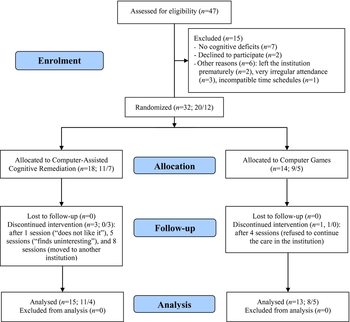
Inclusion criteria were: (1) diagnosis of psychotic disorder according to the DSM-IV (APA, 1994) using the French version of Diagnostic Interview for Genetic Studies (DIGS; Nurnberger et al., Reference Nurnberger, Blehar, Kaufmann, Yorkcooler, Simpson and Harkavyfriedman1994; Preisig, Fenton, Matthey, Berney and Ferrero, Reference Preisig, Fenton, Matthey, Berney and Ferrero1999) or diagnosis of at high risk of psychosis using the Structured Interview for Prodromal Symptoms (SIPS) and the Scale of Prodromal Symptoms (SOPS; Miller et al., Reference Miller, McGlashan, Woods, Stein, Driesen and Corcoran1999); (2) score below the 10th percentile in at least one of five domains of the Repeatable Battery for the Assessment of Neuropsychological Status (RBANS; Randolph, Tierney, Mohr and Chase, Reference Randolph, Tierney, Mohr and Chase1998). The 10th percentile best differentiated patients with psychotic disorders from patients with other diagnoses (Holzer et al., Reference Holzer, Chinet, Jaugey, Plancherel, Sofia and Halfon2007). Exclusion criteria included: (1) mental retardation (IQ<70), defined as the need for special education, assessed through a screening of the medical records about the activities before the enrolment in the study; (2) known neurological disease or developmental disability; (3) severe visual or motor disorder incompatible with computer use; (4) transient exclusion criteria: an acute clinical state that could disrupt the training, or a planned absence for more than 2 weeks during the period of intervention. Figure 1 presented the flow diagram.
Flow diagram of the study (n = whole sample, n with psychosis/n at risk)

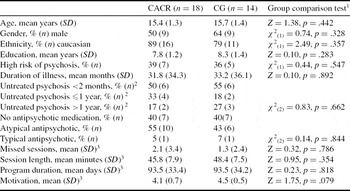
Thirty-two adolescents (n = 20 psychotic; n = 12 at risk) were randomized to CACR (n = 18) or CG (n = 14); 28 participants completed the study (15 in CACR, 13 in CG). As presented in Table 1, groups did not differ significantly in age, gender, ethnicity, number of school years completed, proportion of at risk participants, duration of illness, duration of untreated psychosis, and medication.
Demographic and clinical characteristics, and treatment compliance of the Computer Assisted Cognitive Remediation (CACR) and Computer Games (CG) groups

1For gender, ethnicity, high risk, untreated psychosis and medication: Chi-square test; for other variables: Mann-Whitney test.
2Missing information for 9 patients (6 in CACR and 3 in CG).
3Data provided only for the participants who finished the program (N = 15 in CACR and 13 in CG).
Procedure
A blinded 8-week trial of CACR treatment was compared to CG, with random assignment to groups, and assessments at baseline and post-intervention (week 9) of primary (cognitive abilities) and secondary (symptoms and psychosocial functioning) outcomes. Thus, the present study followed the guidelines regarding the complex intervention (Medical Council Research, www.mrc.ac.uk/complexinterventionsguidance)
Approval was received from the local ethics committee for human research, and informed consent was obtained from participants and their guardians. Participants were recruited from the Day Care Unit for Adolescents (DCUA) in Lausanne, Switzerland, while they were outpatients. The DCUA of Lausanne accommodates 15–20 adolescents (age ranging from 13 to 18 years) presenting with psychosis (more than half of the patients), mood disorders, anxiety disorders and conduct disorders. The mean duration of stay is about 5 months and the usual treatment program encompasses individual medical and psychological follow-up with special-school attendance, and occupational and work therapy. No longer able to attend school or apprenticeships, adolescents who are admitted (only after medical indication) neither required acute treatment in an inpatient unit nor could rely on a simple outpatient-clinic setting. Despite their relatively severe psychiatric disorders, adolescents attending the DCUA are clinically sufficiently stable to engage themselves in computerized task sessions and their presence 7 hours a day, 5 days a week, represents great availability for training sessions.
Clinical assessment was performed by LH and a senior child and adolescent psychiatrist, who was blind to group assignment during the study. Neuropsychological assessment was performed by one of the two neuropsychologists blind to diagnostic status at baseline and blind to group assignment during the study. After informed consent was given by both the patients and their parents, each adolescent was randomly assigned to the CACR group or the control group (videogames). A computer-generated randomization list was drawn up by the statistician. The group assignment was known only by the CACR trainer and videogames provider (and the adolescent). To ensure balance between groups during the trial, a blocked randomization was used. Thus randomization was completed by the statistician, using blocks of four patients with identical diagnoses (at risk versus with psychosis), with a 1:1 allocation ratio.
Treatment: computer-assisted cognitive remediation (CACR)
The original Captain's Log® software (see Sanford and Brown, Reference Sanford and Brown1988) consists of five modules; the software consists of 35 multi-level “brain-training” exercises designed to develop and remediate attention, concentration, memory, eye–hand coordination, basic numeric concepts, problem-solving/reasoning skills, self-esteem and self-control. The six modules encompass: (a) Attention Skills: Developmental (eight programs) is designed to train attention – general, alternating, focused and sustained – visual and auditory processing speed, response inhibition, visual scanning, categorization, and working memory; (b) Visual Motor Skills comprises seven programs to train eye-hand coordination, visual scanning, visual tracking, alternating and divided attention, fine motor control, response inhibition, and processing speed. As in the first module (Attention Skills: Developmental) the programs offer appropriate presentations for children, teenagers and adults; (c) Conceptual Skills consists of seven effective programs designed to train basic reasoning, short-term and working memory, perceptual discrimination, sequencing and categorization; (d) Numeric Concepts/Memory Skills consists of five effective programs designed to train basic reasoning, numeric skills, short-term and working memory, perceptual discrimination, sequencing and categorization; (e) Attention Skills: The Next Generation presents challenging exercises to develop higher level cognitive skills – auditory attention and discrimination, listening skills, divided attention, visual scanning, short-term memory, and faster mental processing speed. All of the three programs can also be used to develop problem-solving/reasoning skills; (f) Logic Skills is a new module consisting of five programs that focus on higher level executive functioning, organization, categorization, pattern recognition, sequencing and closure.
As the whole program is likely to provide more than 500 hours of cognitive training, a selection of specific tasks is needed. In order to limit variation in remediation tasks that might hamper comparability and generalization of findings, we selected a limited number of tasks to be administered to all patients in a standardized manner. Selection was inspired by the Bellucci, Glaberman and Haslam study (Reference Bellucci, Glaberman and Haslam2003). Out of 35 possible tasks, 12 were selected for the training program. From the “Attention skills: developmental” module we selected “auditory discrimination/rhythm” (trains working memory, auditory processing speed, sustained attention), “colour discrimination/inhibition” (trains visual scanning, response inhibition, general attention, central processing speed and working memory); from the “Visual motor skills” module we selected “visual timing” (trains fine motor control and visual perception), “visuospatial memory concentration” (trains visuospatial categorization and general attention), “visual tracking/discrimination” (trains visual tracking and visual perception); from the Conceptual skills module we selected “conceptual discrimination” (trains the conceptual abilities of perception, classification and recognition), “size discrimination” (trains selected attention, visual tracking skills), “symbolic display match” (develops complex conceptual reasoning and processing speed); from the “Numeric concept/memory skills” we chose “numeric classifications” (trains visuospatial classification and perception, working memory, general attention), “numeric distinctions” (trains visuospatial sequencing, conceptual reasoning, working memory, immediate memory), and from the “Attention skills: the next generation” module, “symbol search” (trains processing speed, visual scanning, self-control, short term memory); finally, from the Logic skills module “sequential logic” (develops conceptual reasoning and visuospatial sequencing) was selected.
Nearly all of the exercises in Captain's Log are non-language-based (apart from the task instructions). The trainer selected the tasks and provided the directions for the patient and assisted him/her during all the sessions with encouragement and positive feedback. The Captain's Log program began with an assessment phase and starts training for all people at the same difficulty level. Progression is based on the person's level of skill and speed of learning, with an increase in scores required before the next difficulty level is reached. Therefore, progress through levels is determined by the program, rather than by trainers. To summarize, participants received 16 45-minute individual sessions, with a frequency of two sessions per week for 8 weeks. Research psychologists guiding the CACR selected the tasks to match the cognitive deficits of the participant,Footnote 1 translated the instructions to the participant (as exercises are not language-based, except for the instructions, the original English version was used), and provided encouraging and positive feedback.
Control: computer game (CG)
A set of various videogamesFootnote 2 (essentially action videogames that require attention and visuo-motor skills) was offered to patients assigned to the control group with two half-hour sessions weekly for 8 weeks. Violent videogames were avoided as deleterious influences on aggressiveness have been described (Anderson, Reference Anderson2004; Uhlmann and Swanson, Reference Uhlmann and Swanson2004). The videogames program differed from the CACR program only in content (videogames instead of Captain's Log software) while the setting was the same (location, computer duration, frequency, trainer). The same trainer accompanied the patient during all the sessions. The trainer selected videogames and provided encouragement and positive feedback. The research psychologists provided a supportive climate during gaming. CG and CACR sessions took place in the same room, were conducted by the same psychologists, and had similar duration and frequency (see Compliance for details).
Measures
Primary outcomes. Cognitive functioning was measured by the Repeatable Battery for the Assessment of Neuropsychological Status (RBANS; Randolph et al., Reference Randolph, Tierney, Mohr and Chase1998), which has two psychometrically equivalent alternate forms: Intraclass correlation for the test-retest reliability for the total score is .83 and ranges from .51 to .72 for the domain scores. The RBANS assesses five domains: (1) immediate memory; (2) visuospatial/constructional; (3) language; (4) attention; (5) delayed memory. An adapted version of the RBANS for use in adolescents was employed (Holzer et al., Reference Holzer, Chinet, Jaugey, Plancherel, Sofia and Halfon2007). For most of the patients, the same trained neuropsychologist conducted the baseline and post-intervention assessments.
Secondary outcomes
Symptoms were assessed with the Positive and Negative Symptom Scale (PANSS; Kay, Fiszbein and Opler, Reference Kay, Fiszbein and Opler1987), comprising three subscales (positive symptoms; negative symptoms; general psychopathology). Psychosocial functioning was evaluated by the Social and Occupational Functioning Assessment Scale (SOFAS; APA, 1994) and the Health of Nation Outcome Scale for Children and Adolescents (HoNOSCA; Gowers et al., Reference Gowers, Harrington, Whitton, Lelliott, Beevor and Wing1999).
Engagement in treatment
For each participant, at the end of each session, trainers rated: 1) general motivation for treatment; and 2) engagement in the training tasks, using a 5-point scale ranging from 1 (very low) to 5 (very high). The two items were then averaged (Cronach's α = .90) into a single motivation score. The effective work time (EWT, i.e. time spent training or playing on the computer, outside explanations or discussion with the trainer, in minutes) was also recorded.
Statistical analysis
The analyses were performed with SPSS (version 20) software. We adopted an intention to treat (ITT) analyses in order to include the 32 participants who were randomly assigned either to the CACR or CG groups. According to the guideline proposed by Howell (Reference Howell, Outhwaite and Turner2008), we first analysed the pattern of the missing data, with Little's MCAR test revealing that the missing data could be considered as missing completely at random (MCAR, χ2 (57) = 70.77, p = .104). We could thus estimate the missing points with the regression procedure included in the SPSS software. We therefore analysed the completed data of the 32 participants for the treatment effects analyses.
Given the presence of significant deviations from normality, non-parametric tests were used. Change scores from baseline to post-intervention were computed for cognitive functions, symptoms and psychosocial functioning so that a positive score indicates improvement and a negative one deterioration. Group comparisons were conducted on change scores using Mann-Whitney tests. Baseline to post-intervention progresses were tested with Wilcoxon signed rank tests on the 32 randomized participants constituting the ITT sample.
Study's statistical power
First, the number of participants was chosen, in keeping with the only two previous studies exploring the outcome of cognitive remediation on young people. Wykes and colleagues (2007) enrolled 31 participants, and 25 adolescents participated in the Ueland and Rund (Reference Ueland and Rund2004) study, so with 32 participants included in the ITT analyses, we have more participants than previous studies exploring the outcome of cognitive remediation in young people with schizophrenia.
Second, a power analyses was conducted (with G*Power 3.1.3 software) to compute the probability of observing large size effect (those with clinical significance as observed in Bellucci et al., Reference Bellucci, Glaberman and Haslam2003) on the cognitive performances and clinical status of the ITT sample (N = 32) for two-tails tests at a level of significance of .05. A power above .8 could be considered sufficient to detect possible changes (Cohen, Reference Cohen1992). These analyses were computed regarding the assessment of the treatment outcomes on the primary measures (cognitive assessment: RBANS scores) and secondary measures (clinical evaluations: PANSS, SOFAS and HoNOSCA scores). The Mann-Whitney tests (assessing the group effect on the change scores of the cognitive and clinical measures, post-intervention minus baseline scores) had a power (1-β) to detect changes of .56, which is not acceptable. In contrast, the power (1-β) of the Wilcoxon (estimating time effect on the scores of the baseline compared to the post-intervention) is of .98 to detect changes, which is acceptable. Furthermore, 2 (time: baseline vs post-intervention) by 2 (groups: CACR vs CG) analyses of variance (ANOVA) allowing to assess the interaction of time and group effect had a power of .88, which could be considered as acceptable. So, in this context, all negative results of the Mann-Whitney tests (those perhaps due to a lack of statistical power) were re-examined by the interaction effect in the corresponding ANOVA in order to prevent type II error.
Results
Treatment compliance
Four patients interrupted their participation in the program: 3 in the CACR group (two due to lack of interest and one due to transfer to another care centre), and 1 in the CG group (due to poor attendance at the DCUA, resulting in transfer). They differed significantly from program completers only on having finished less school years (completers: mean = 8.2, SD = 1.1; dropouts: mean = 6.3, SD = 1.3; Z = 2.52, p = .012).
Treatment compliance was overall very high and similar in both groups (see Table 1): on average, only 2.3 sessions were missed (but later attended), sessions lasted the expected 45 minutes (47.2 min), and participants took around 3 months (92.4 days) to complete the full program. Motivation was also high (4.3), with a marginal advantage to the CG group (p = .079), probably due to the playful nature of the task and the free choice of games given to participants. Overall, the acceptance of the CACR intervention was therefore very satisfactory.
Equivalence between groups at baseline
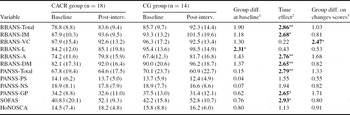
The 32 participants constituting the ITT sample were compared on baseline measures in function of treatment. Mann-Whitney tests revealed no significant differences (see Table 2), apart from lower language abilities for the CACR group. Given that language was not part of the trained cognitive abilities and neither CACR exercises nor CG were language-based, we considered these differences unlikely to bias the assessment of potential effects.
Mean and (SD) of study variables at baseline and post-intervention for the Computer Assisted Cognitive Remediation (CACR) and Computer Games (CG) groups, and tests of group differences at baseline and of time effects

RBANS: Repeatable Battery for the Assessment of Neuropsychological Status; IM: immediate memory; VC: visuospatial/constructional, L: language; A: attention; DM: delayed memory; PANSS: positive and negative symptom scale; PS: positive symptoms; NS: negative symptoms; GP: general psychopathology; SOFAS: Social and Occupational Functioning Assessment Scale; HoNOSCA: Health of Nation Outcome Scale for Children and Adolescents
1Mann-Withney test (Z) comparing CACR and CG on baseline scores; *p<.05, **p<.01
2Wilcoxon test (Z) comparing baseline and post-intervention scores for the whole sample; *p<.05, **p<.01
3Mann-Withney test (Z) comparing CACR and CG on change scores; *p<.05, **p<.01
Treatment effects
ITT analyses (N = 32) were conducted in order to assess differential treatment effects by group. Thus, Mann-Whitney tests were conducted on the change scores for RBANS, PANSS, SOFAS and HoNOSCA (baseline and post-intervention scores are presented in Table 2). Visuospatial abilities improved significantly more in CACR (mean = +4.9, SD = 10.3) than in CG patients (mean = −3.8, SD = 16.0; Z = 2.47, p = .013), corresponding to a large effect size (d = 0.62). This effect was found only in 47% of the patients in the CACR group, and 39% in the CG groupFootnote 3 scored below the 10th percentile on visuospatial abilities at baseline. No other significant group differences were found.
Given that improvement did not differ between groups on most variables, baseline and post-intervention scores were then compared using Wilcoxon signed rank tests on the ITT sample (N = 32). As reported in Table 2, improvements were significant for attention, immediate and delayed memory, general psychopathology, and social-occupational functioning. Both groups thus improved on most measures.
Subsequent analyses were conducted on the sample of participants who completed the trial, in order not to bias the analysis. One reason why visuospatial abilities may have improved more in CACR than in CG could be that they were particularly intensively trained in CACR exercises. To test this, we calculated for each participant the proportion of CACR exercises that involved each cognitive function. Indeed, on average, visual and visuospatial abilities were trained by 97% of the performed exercises (SD = 10.2), corresponding to the highest training intensity with attention (94% of exercises, SD = 9.2). This constitutes a significantly (Friedman test: χ2 (5) = 53.7, p <.001) more intensive training than for memory (66%, SD = 12.7), processing speed (55%, SD = 18.8), response inhibition (49%, SD = 15.2), and conceptual reasoning (63%, SD = 16.9), supporting our hypothesis.
We further examined the associations (using Spearman's rank correlation3) between cognitive improvements and motivation or compliance: larger gains in attention were significantly related to longer sessions (ρ = .53, p = .044) and higher motivation (ρ = .67, p = .007), the latter also being nonsignificantly related to progress in visuospatial abilities (ρ = .31, p = .266) and delayed memory (ρ = . 41, p = . 130). This result suggests that motivation for CACR treatment enhanced cognitive change. No significant correlations emerged in the CG group.
Discussion and conclusion
The findings with respect to the feasibility of CACR program are encouraging. All but three of the participants completed the program, attending the sessions with high motivation. The results demonstrated a superior improvement in CACR for the most intensively trained cognitive function, visuospatial abilities, and gains in both the control and treatment group for attention, immediate and delayed memory, and general psychopathology, as well as social-occupational functioning. A more intense CACR training might even further improve CACR over CG, consistent with previous evidence highlighting the importance of treatment intensity (McGurk et al., Reference McGurk, Twamley, Sitzer, McHugo and Mueser2007; Medalia and Richardson, Reference Medalia and Richardson2005). Although duration of intervention was not found to predict efficacy in the latest meta-analyses (Grynszpan et al., Reference Grynszpan, Perbal, Pelissolo, Fossati, Jouvent and Dubal2011; Wykes et al., Reference Wykes, Huddy, Cellard, McGurk and Czobor2011), according to a recent review, “30–40 hours of training and 3 months of trial duration is viewed as a minimum” (Keefe et al., Reference Keefe, Vinogradov, Medalia, Silverstein, Bell and Dickinson2011; p. 1059). Further research is definitely needed to determine the “minimum dose” of treatment in adolescents.
Motivation was also found to foster cognitive improvement in the CACR group, in line with recent findings showing that increased intrinsic motivation leads to better learning in schizophrenia (Choi and Medalia, Reference Choi and Medalia2009). CACR efficacy may be further improved by increasing the motivation-enhancing features, such as letting participants choose between a range of exercises, as was the case with CG. It is unclear whether the improvements in attention and delayed memory, symptoms and social-occupational functioning, which were also observed in the CG control group, are caused by CG and CACR, the individual support received from research psychologists, practice effects, or by the general participation in activities at the day clinic, which included psychiatric rehabilitation in both groups. According to two recent meta-analyses (McGurk et al., Reference McGurk, Twamley, Sitzer, McHugo and Mueser2007; Wykes et al., Reference Wykes, Huddy, Cellard, McGurk and Czobor2011), cognitive remediation combined with active psychiatric rehabilitation achieves the highest gains in psychosocial functioning for adult patients with schizophrenia. Despite its use of this combination, the present study found no specific effect of CACR on psychosocial functioning, suggesting this meta-analytical result might not hold for adolescents, as is the case for patients with heterogeneous diagnoses, for which lower efficacy has been documented (Wykes et al., Reference Wykes, Huddy, Cellard, McGurk and Czobor2011). However, this result might also be due to the lack of explicit transfer training in the present implementation, which is done in the NEUROCOM trial assessing the effect on cognitive and everyday functioning of a 16-week program of cognitive training (i.e. attention, executive function, learning and memory) included in a comprehensive psychosocial program on first-episode schizophrenia patients (Wykes et al., Reference Wykes, Reeder, Corner, Williams and Everitt1999). An additional treatment-as-usual control group could help disentangle some of these effects.
Limitations of the current work include a small sample size that may have precluded the detection of the smaller effects typically found for symptom and psychosocial functioning improvement (McGurk et al., Reference McGurk, Twamley, Sitzer, McHugo and Mueser2007; Medalia and Richardson, Reference Medalia and Richardson2005; Wykes et al., Reference Wykes, Huddy, Cellard, McGurk and Czobor2011) and the inclusion of adolescents with high risk of psychosis whose cognitive deficits may ameliorate spontaneously. Given the preliminary nature of these encouraging results, further studies on larger samples are needed to confirm the reported improvements, as type I error may have hampered a clear interpretation of the results.
In summary, CACR can be successfully administered to adolescents with psychosis or with high risk, yielding significant improvements in visuospatial abilities, which are important in everyday life situations including navigating familiar and new environments, visual decision making under time pressure (for example when driving a car), and inferring goals of others from analysing facial expressions.



Comments
No Comments have been published for this article.