Introduction
Psychotic disorders (both affective and non-affective disorders) are severe and disabling mental conditions characterized traditionally by positive symptoms (hallucinations and delusions) and negative symptoms (avolition or amotivation) alongside changes in mood (depression, mania) and alterations in information processing (cognitive deficits) (van Os & Kapur, Reference van Os and Kapur2009; Arango et al. Reference Arango, Fraguas and Parellada2014). Cognitive impairment has been shown to present from early in psychotic disorders (Zabala et al. Reference Zabala, Rapado, Arango, Robles, de la Serna, Gonzalez, Rodriguez-Sanchez, Andres, Mayoral and Bombin2010; Bora & Pantelis, Reference Bora and Pantelis2015; Daglas et al. Reference Daglas, Yucel, Cotton, Allott, Hetrick and Berk2015) and to a lesser extent from the outset (Reichenberg et al. Reference Reichenberg, Caspi, Harrington, Houts, Keefe, Murray, Poulton and Moffitt2010) and in at-risk mental states (Fusar-Poli et al. Reference Fusar-Poli, Deste, Smieskova, Barlati, Yung, Howes, Stieglitz, Vita, McGuire and Borgwardt2012), thereby contributing to ongoing cognitive impairment over time (Reichenberg et al. Reference Reichenberg, Caspi, Harrington, Houts, Keefe, Murray, Poulton and Moffitt2010; Bombin et al. Reference Bombin, Mayoral, Castro-Fornieles, Gonzalez-Pinto, de la Serna, Rapado-Castro, Barbeito, Parellada, Baeza, Graell, Paya and Arango2013). These changes in cognitive processing can be broadly partitioned into those that are trait related and those that are affected by mental state (Lopez-Jaramillo et al. Reference Lopez-Jaramillo, Lopera-Vasquez, Gallo, Ospina-Duque, Bell, Torrent, Martinez-Aran and Vieta2010; Kozicky et al. Reference Kozicky, Torres, Silveira, Bond, Lam and Yatham2014). Cognitive function serves as a proxy of the severity of psychosis and is associated with poor social, vocational and functional outcome (Martinez-Aran et al. Reference Martinez-Aran, Penades, Vieta, Colom, Reinares, Benabarre, Salamero and Gasto2002; Fett et al. Reference Fett, Viechtbauer, Dominguez, Penn, van Os and Krabbendam2011), and is also an important prognostic variable (Malhi et al. Reference Malhi, Ivanovski, Hadzi-Pavlovic, Mitchell, Vieta and Sachdev2007; Fett et al. Reference Fett, Viechtbauer, Dominguez, Penn, van Os and Krabbendam2011) providing a meaningful target for interventions.
While conventional antipsychotics are relatively effective in alleviating psychosis, their impact on cognitive function is minimal largely because pharmacotherapy has mainly targeted dopamine dysfunction. Regulation of the putative ‘hyperdopaminergic state’ with antipsychotic drugs effectively counters the positive symptoms of psychosis, but their effects on negative and cognitive symptoms are modest (Kahn & Sommer, Reference Kahn and Sommer2015). Thus, the development of novel treatments for cognitive dysfunction in psychotic disorders is of great importance. Along those lines, drug discovery for psychotic disorders has moved in recent decades beyond the ‘dopamine hypothesis’ towards approaches derived from pathophysiological investigations in this field (Davis et al. Reference Davis, Moylan, Harvey, Maes and Berk2014; Debnath et al. Reference Debnath, Venkatasubramanian and Berk2015; Howes et al. Reference Howes, McCutcheon and Stone2015).
One such example is the role of glutamate transmission in the development and maintenance of cognitive and negative symptoms (Rajasekaran et al. Reference Rajasekaran, Venkatasubramanian, Berk and Debnath2015). Specifically, glutamate is thought to have a critical role in cognitive and negative symptoms through the activation of N-methyl-d-aspartate (NMDA) glutamatergic receptors. The NMDA receptor (NMDA-R), is involved in synaptic plasticity, auditory information processing and cognitive functions, such as inhibitory control, working memory (Morgan et al. Reference Morgan, Mofeez, Brandner, Bromley and Curran2004), learning and memory (Riedel et al. Reference Riedel, Platt and Micheau2003), cognitive flexibility and information processing (Banks et al. Reference Banks, Warburton, Brown and Bashir2014).
Altered glutamate levels have been linked to the cortical response during executive functioning tasks in people at high risk for developing psychosis (Fusar-Poli et al. Reference Fusar-Poli, Stone, Broome, Valli, Mechelli, McLean, Lythgoe, O'Gorman, Barker and McGuire2011). This altered top-down procesing of sensory information has been proposed to mediate cognitive proceses such as altered attribution of salience or misattibution of meaningful emotion leading to cognitive bias (Kapur, Reference Kapur2003; Hoffman et al. Reference Hoffman, Woods, Hawkins, Pittman, Tohen, Preda, Breier, Glist, Addington, Perkins and McGlashan2007). In this regard, studies including key evoked sensory-related potentials such as mismatch negativity (MMN), a physiological indicator of the activity of NMDA receptors and a short-term memory paradigm in relation to sensory/auditory processing, describe a severe sensory auditory dysfunction both in schizophrenia (Gunduz-Bruce et al. Reference Gunduz-Bruce, Reinhart, Roach, Gueorguieva, Oliver, D'Souza, Ford, Krystal and Mathalon2012; Javitt et al. Reference Javitt, Zukin, Heresco-Levy and Umbricht2012) and in people at risk of developing psychosis (Shaikh et al. Reference Shaikh, Valmaggia, Broome, Dutt, Lappin, Day, Woolley, Tabraham, Walshe, Johns, Fusar-Poli, Howes, Murray, McGuire and Bramon2012).
In parallel, free radical scavenging in both psychotic bipolar disorder and schizophenia is unable to keep up with free radical production, leading to cumulative oxidative damage in critical brain regions, which eventuates in cognitive and behavioural symptoms (Ng et al. Reference Ng, Berk, Dean and Bush2008). Glutathione (GSH) is one of the main cellular non-protein redox regulators and free radical scavenger in the brain. Dysregulation of the GSH system reduces activity of NMDA glutamatergic receptors (Kantrowitz & Javitt, Reference Kantrowitz and Javitt2010; Stone et al. Reference Stone, Bramon, Pauls, Sumich and McGuire2010). An association between the observed GSH deficit during the first psychotic episode with global changes in cognition is noted (Martinez-Cengotitabengoa et al. Reference Martinez-Cengotitabengoa, Mico, Arango, Castro-Fornieles, Graell, Paya, Leza, Zorrilla, Parellada, Lopez, Baeza, Moreno, Rapado-Castro and Gonzalez-Pinto2014), particularly with high-order executive functions (Martinez-Cengotitabengoa et al. Reference Martinez-Cengotitabengoa, Mac-Dowell, Leza, Mico, Fernandez, Echevarria, Sanjuan, Elorza and Gonzalez-Pinto2012), indicating that changes in GSH and cognitive function are closely linked and suggesting that oxidative damage may contribute to cognitive impairment. Furthermore, inflammatory mediators such as cytokines have also been associated with cognitive dysfunction in patients with a first episode of psychosis (Martinez-Cengotitabengoa et al. Reference Martinez-Cengotitabengoa, Mac-Dowell, Leza, Mico, Fernandez, Echevarria, Sanjuan, Elorza and Gonzalez-Pinto2012; Bauer et al. Reference Bauer, Pascoe, Wollenhaupt-Aguiar, Kapczinski and Soares2014). In this regard, altered proinflamatory cytokines provoke glutamate hyperactivity leading to NMDA glutamate receptor activation, altered redox balance and oxidative stress accumulation (Hanson & Gottesman, Reference Hanson and Gottesman2005; Saetre et al. Reference Saetre, Emilsson, Axelsson, Kreuger, Lindholm and Jazin2007) which can modify cognitive function (Wilson et al. Reference Wilson, Finch and Cohen2002; Kahn & Sommer, Reference Kahn and Sommer2015).
N-acetylcysteine (NAC) is emerging as a useful agent in the treatment of a wide range of psychiatric disorders (Deepmala et al. Reference Deepmala, Slattery, Kumar, Delhey, Berk, Dean, Spielholz and Frye2015). In addition to its glutamatergic modulation effects, NAC has been shown to potently make an impact on oxidative biology, both by increasing GSH levels and directly scavenging free radicals (Choy et al. Reference Choy, Dean, Berk, Bush and van den Buuse2010; Holmay et al. Reference Holmay, Terpstra, Coles, Mishra, Ahlskog, Oz, Cloyd and Tuite2013). It also has been shown to decrease pro-inflammatory cytokines and enhance neurogenesis, mitochondrial function and regulate apoptosis (Berk et al. Reference Berk, Ng, Dean, Dodd and Bush2008c ; Samuni et al. Reference Samuni, Goldstein, Dean and Berk2013). NAC attenuates the cognitive and behavioural effects of NMDA receptor antagonists in rodents (Gunduz-Bruce, Reference Gunduz-Bruce2009). By rescuing depleted levels of GSH in the brain, NAC restores cognitive deficits such as short-term spatial memory deficits in rats in a dose-dependent manner (Choy et al. Reference Choy, Dean, Berk, Bush and van den Buuse2010). In human studies, NAC improves core negative symptoms of schizophrenia (Berk et al. Reference Berk, Copolov, Dean, Lu, Jeavons, Schapkaitz, Anderson-Hunt, Judd, Katz, Katz, Ording-Jespersen, Little, Conus, Cuenod, Do and Bush2008a ; Bulut et al. Reference Bulut, Savas, Altindag, Virit and Dalkilic2009), depressive symptoms in bipolar disorder (Berk et al. Reference Berk, Copolov, Dean, Lu, Jeavons, Schapkaitz, Anderson-Hunt and Bush2008b ) and functioning in both (Berk et al. Reference Berk, Copolov, Dean, Lu, Jeavons, Schapkaitz, Anderson-Hunt, Judd, Katz, Katz, Ording-Jespersen, Little, Conus, Cuenod, Do and Bush2008a , Reference Berk, Copolov, Dean, Lu, Jeavons, Schapkaitz, Anderson-Hunt and Bush b ), as well as improving MMN in psychosis (Lavoie et al. Reference Lavoie, Murray, Deppen, Knyazeva, Berk, Boulat, Bovet, Bush, Conus, Copolov, Fornari, Meuli, Solida, Vianin, Cuenod, Buclin and Do2008; Carmeli et al. Reference Carmeli, Knyazeva, Cuenod and Do2012; Gunduz-Bruce et al. Reference Gunduz-Bruce, Reinhart, Roach, Gueorguieva, Oliver, D'Souza, Ford, Krystal and Mathalon2012).
To date, studies on global neurocognitive effects of NAC in humans have demonstrated inconsistent results which may reflect variance in study design (Deepmala et al. Reference Deepmala, Slattery, Kumar, Delhey, Berk, Dean, Spielholz and Frye2015). For example, the addition of NAC to standard treatment produced specific improvements in verbal abilities/executive control cognitive tasks in Alzheirmer's disease in comparison with treatment-as-usual controls (Adair et al. Reference Adair, Knoefel and Morgan2001). More recently, adjunctive NAC administration provided significant gains in executive function in mild traumatic brain injury relative to controls (Hoffer et al. Reference Hoffer, Balaban, Slade, Tsao and Hoffer2013). In contrast, NAC pretreatment did not reduce the effect of ketamine on cognitive performance in healthy subjects with ketamine-induced psychosis (Gunduz-Bruce et al. Reference Gunduz-Bruce, Reinhart, Roach, Gueorguieva, Oliver, D'Souza, Ford, Krystal and Mathalon2012) or in patients with bipolar disorder (Dean et al. Reference Dean, Bush, Copolov, Kohlmann, Jeavons, Schapkaitz, Anderson-Hunt and Berk2012); however, the sample size in both studies was inadequate to detect small or moderate effect sizes. To our knowledge, no previous study has addressed this issue in individuals with psychosis (Deepmala et al. Reference Deepmala, Slattery, Kumar, Delhey, Berk, Dean, Spielholz and Frye2015).
The present study aims to assess the cognitive effects of adjunctive NAC treatment in participants with psychosis who underwent cognitive assessments in the context of two double-blind, randomized, placebo-controlled clinical trials in schizophrenia (Berk et al. Reference Berk, Copolov, Dean, Lu, Jeavons, Schapkaitz, Anderson-Hunt, Judd, Katz, Katz, Ording-Jespersen, Little, Conus, Cuenod, Do and Bush2008a ) and bipolar disorder (Berk et al. Reference Berk, Copolov, Dean, Lu, Jeavons, Schapkaitz, Anderson-Hunt and Bush2008b ). It was hypothesized that treatment with NAC would enhance cognitive functioning in participants with psychotic features. We anticipated a more specific improvement in superior cognitive functions (i.e. working memory, executive functioning and processing speed/attention) where there is a signal from preclinical and clinical studies and where other agents have shown promise (Miskowiak et al. Reference Miskowiak, Ehrenreich, Christensen, Kessing and Vinberg2014).
Method
Study participants and procedure
The overall pooled cohort consisted of individuals who participated in two multicentre, double-blind, randomized, placebo-controlled NAC trials in schizophrenia and bipolar disorder, respectively. A detailed description of the methodology, efficacy and outcome measures of the main studies has been provided elsewhere (Berk et al. Reference Berk, Copolov, Dean, Lu, Jeavons, Schapkaitz, Anderson-Hunt, Judd, Katz, Katz, Ording-Jespersen, Little, Conus, Cuenod, Do and Bush2008a , Reference Berk, Copolov, Dean, Lu, Jeavons, Schapkaitz, Anderson-Hunt and Bush b , Reference Berk, Munib, Dean, Malhi, Kohlmann, Schapkaitz, Jeavons, Katz, Anderson-Hunt, Conus, Hanna, Otmar, Ng, Copolov and Bush2011). In brief, a total of 215 participants [i.e. 140 participants diagnosed with schizophrenia and 75 individuals with bipolar disorder; Diagnostic and Statistical Manual of Mental Disorders, 4th edition (DSM-IV) criteria] were recruited from private and public psychiatry out-patient facilities in Victoria, Australia and one public clinic in Lausanne, Switzerland. The trials were approved by each participating research and ethics committee. After providing written informed consent, all randomized participants received adjunctive 2000 mg of NAC (1000 mg twice daily) or matching placebo, in addition to usual treatment, in a double-blind fashion over 24 weeks. Adherence was monitored by pill counts of returned medication packs (Berk et al. Reference Berk, Copolov, Dean, Lu, Jeavons, Schapkaitz, Anderson-Hunt, Judd, Katz, Katz, Ording-Jespersen, Little, Conus, Cuenod, Do and Bush2008a , Reference Berk, Copolov, Dean, Lu, Jeavons, Schapkaitz, Anderson-Hunt and Bush b ).
Participants had to meet the following criteria for the respective studies: DSM-IV criteria for schizophrenia with a Positive and Negative Symptoms Scale score (PANSS) of ⩾55 or at least two of the positive and/or negative items being >3, or have a Clinical Global Impression – Severity score ⩾3 (Berk et al. Reference Berk, Copolov, Dean, Lu, Jeavons, Schapkaitz, Anderson-Hunt, Judd, Katz, Katz, Ording-Jespersen, Little, Conus, Cuenod, Do and Bush2008a ); or criteria for bipolar disorder I or II with at least one documented episode of illness (depressive, manic or mixed) in the past 6 months (Berk et al. Reference Berk, Copolov, Dean, Lu, Jeavons, Schapkaitz, Anderson-Hunt and Bush2008b ). We then further selected out those with psychotic bipolar symptoms based on the DSM-IV criteria for meeting psychotic features. General exclusions for both studies included: those with abnormal haematological findings, a systemic medical disorder or a history of anaphylaxis with NAC, those taking therapeutic amounts of NAC, selenium and/or vitamin C, pregnant or lactating. Individuals on other psychoactive medications were required to be on stable treatment of ⩾1 month prior to commencing the study. The studies were registered on the Australian and New Zealand Clinical Trials Registry (schizophrenia trial ACTRN12605000363684; bipolar trial l no. 12605000362695) prior to enrollment.
Diagnosis was established at baseline using a structured clinical interview (Mini International Neuropsychiatric Interview for DSM-IV). The study design was broadly equivalent for both clinical trials. Clinical and functional outcome measures were assessed through a comprehensive set of rating scales that were included in the larger trials (Berk et al. Reference Berk, Copolov, Dean, Lu, Jeavons, Schapkaitz, Anderson-Hunt, Judd, Katz, Katz, Ording-Jespersen, Little, Conus, Cuenod, Do and Bush2008a ). Assessments were performed by formally trained clinical practitioners or researchers who underwent inter-rater reliability assessments.
The present study examines cognitive outcome measures in participants with psychosis at end point (24 weeks). Cognitive impairments have been shown to be present across psychotic disorders (Reilly & Sweeney, Reference Reilly and Sweeney2014) with schizophrenia and bipolar disorder, with psychosis presenting more severe cognitive deficits (Hill et al. Reference Hill, Reilly, Keefe, Gold, Bishop, Gershon, Tamminga, Pearlson, Keshavan and Sweeney2013). Therefore, the current analyses include only those subjects who fulfilled DSM-IV criteria for schizophrenia (n = 32) and bipolar disorder ‘with psychotic features’ (n = 26) that undertook the cognitive assessment. A comparison of the two diagnostic groups to determine potential differences that may have an impact on results was done before pooling the samples. Participants with schizophrenia and psychotic bipolar disorder did not differ in terms of duration of illness or cognitive performance at the time of the study entry (i.e. baseline). Of those, 31 participants (schizophrenia n = 17; bipolar disorder n = 14) received placebo and 27 participants (schizophrenia n = 15; bipolar disorder n = 12) were treated with NAC. There were no differences in baseline characteristics between those participants who completed and the ones who did not complete the cognitive testing (data not shown).
Clinical assessments
Clinical status at the time of baseline assessment was determined using the PANSS (Kay et al. Reference Kay, Fiszbein and Opler1987) (data available for schizophrenia participants only) and the Montgomery–Åsberg Depression Rating Scale (MADRS) (Williams & Kobak, Reference Williams and Kobak2008) together with the Young Mania Rating Scale (YMRS) (Young et al. Reference Young, Biggs, Ziegler and Meyer1978) (available for the bipolar disorder subsample only). Level of social, occupational and psychological functioning was measured using the Global Assessment of Functioning Scale (Hall, Reference Hall1995) and the Social and Occupational Functioning Assessment Scale (Goldman et al. Reference Goldman, Skodol and Lave1992) in both participant subgroups (schizophrenia and bipolar disorder).
Cognitive assessment
Cognitive measures were obtained at baseline and at the end of the 24-week treatment phase. Each individual underwent a brief neuropsychological battery assessing attention (digits forward from Wechsler Intelligence Scale for adults, WAIS-III), working memory (digits backwards from WAIS-III), and executive function (Trail Making Test, TMT derived scores – i.e. TMT B:A ratio, TMT B minus TMT A; and Controlled Oral Word Association Test) as cognitive functions previously described as being affected in both in schizophrenia and psychosis psychotic bipolar disorder (Heinrichs & Zakzanis, Reference Heinrichs and Zakzanis1998; Bora et al. Reference Bora, Yucel and Pantelis2009; Mesholam-Gately et al. Reference Mesholam-Gately, Giuliano, Goff, Faraone and Seidman2009). Raw scores were used in the statistical analyses because age-scaled scores have small variance.
Data analysis
An intention-to-treat analysis was conducted on all participants who had available cognitive data. Schizophrenia and psychotic bipolar disorder participants were pooled for the comparative analysis of treatment groups (NAC v. placebo). Normal distribution of quantitative variables was assessed by means of Kolmogorov–Smirnov and Shapiro–Wilk tests. Continuous data are presented as means and standard deviations. Frequencies and percentages were used to describe discrete variables. Independent Student's t tests or Pearson's χ2 tests were used to compare demographic variables between participants in the NAC and placebo groups. For frequency data, χ2 tests were employed.
To test for longitudinal changes in cognitive performance from baseline to the end of treatment (6-month time point) within each treatment group, Wilcoxon tests were used. Mann–Whitney tests were used to examine average treatment group differences (NAC v. placebo) at the end point. To rule out potential effects of age, gender or antipsychotic medication on cognitive performance, Spearman's rank-order correlation analyses were performed to examine associations between those possible confounders and cognitive outcome variables. To explore the association between diagnosis and cognitive change bivariate Spearman (rho) correlation analyses were used for the whole sample. Secondary exploratory Spearman correlations were also performed to assess the relationship between change (end point minus baseline) in symptoms and in cognition within each diagnostic subgroup evaluated. All variables were tested for collinearity assumptions. No autocorrelation or collinearity was observed in the a priori specified independent variables. Thus, corrections for multiple comparisons were not done because all comparison analyses were independent, they were specified ‘a priori’ and collinearity assumptions were met (Gelman et al. Reference Gelman, Hill and Yajima2009).
All statistical analyses were performed using IBM SPSS v21 (Statistical Package for the Social Sciences, IBM Corporation, USA). Statistical significance was set at α < 0.05.
Ethical standards
All procedures contributing to this work comply with the ethical standards of the relevant national and institutional committees on human experimentation and with the Helsinki Declaration of 1975, as revised in 2008.
Results
Sociodemographic and clinical characteristics
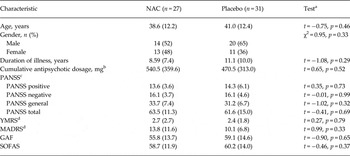
Participants in the NAC and placebo groups did not differ significantly in terms of age, gender, duration of the illness, antipsychotic treatment, severity of symptoms or functioning at the study entry (i.e. baseline visit, see Table 1 and online Supplementary Table S1). There were no significant between-group differences on any of the cognitive measures at baseline.
Characteristics of participants at baseline

Data are given as mean (standard deviation) unless otherwise indicated.
NAC, N-acetylcysteine; PANSS, Positive and Negative Symptoms Scale; YMRS, Young Mania Rating Scale; MADRS, Montgomery–Åsberg Depression Rating Scale; GAF, Global Assessment of Functioning; SOFAS, Social and Occupational Functioning Assessment Scale.
a Differences between the NAC and placebo groups based on two-sample t tests (equal variance) or Pearson's χ2 test. Significance was set at (p < 0.05).
b Chlorpromazine equivalents were used to derive the antipsychotic dosage and to calculate the cumulative doses taken at baseline.
cData available for the schizophrenia participants subgroup only: NAC n = 15; placebo n = 17.
d Data available for the bipolar disorder with psychotic features subgroup only: NAC n = 12; placebo n = 14.
Cognitive function
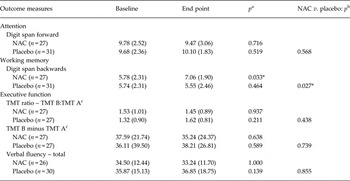
A Wilcoxon signed-rank test showed that 24 weeks of treatment with NAC significantly improved working memory performance in adults with psychosis (digit span backwards: Z = −2.13, p = 0.033) (Table 2). When testing for overall between-group differences, Mann–Whitney tests revealed that participants treated with NAC had significantly higher working memory performance at the end of 24 weeks of treatment than the placebo group (digit span backwards: U = 98.5, p = 0.027), as shown in Table 2. No significant differences were found either within or between the NAC and placebo groups following 24 weeks of treatment on measures of attention, or executive function.
Cognitive outcome measures for participants in the NAC and placebo groups at baseline and end point
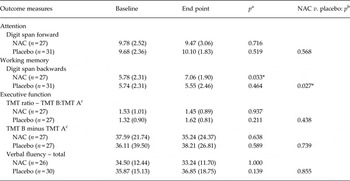
Data are given as mean (standard deviation).
NAC, N-acetyl cysteine; TMT, Trail Making Test.
a Differences between cognitive performance at baseline and end point based on Wilcoxon's test.
b Differences between the NAC and placebo groups in cognitive performance at end point based on the Mann–Whitney test. There was no association of cognitive performance with age, gender or antipsychotic medication.
c Time to complete the TMT (version A or B) is considered in these formulae.
* p < 0.05.
These results were independent of age, gender or medication status. There were no significant associations between diagnosis and cognitive change. Among participants on NAC, improvements in cognitive flexibility (TMT ratio score) and executive control ability (TMT B minus TMT A) correlated with a decrease in depressive symptom severity: MADRS (r s = 0.83 p = 0.010 and r s = 0.83 p = 0.010, respectively). No other associations were found between change in cognition and change in symptom measures.
Discussion
Our results suggest that NAC makes an impact on cognitive function in psychosis. A significant improvement in working memory performance was observed in participants treated with NAC following 6 months (24 weeks) of adjunctive treatment (2000 mg/day), although other measures of attention, as well as executive function remained unchanged. In particular, working memory deficits constitute a core feature and one of the most important prognostic variables that is not adequately treated by currently available pharmacological therapies (Miskowiak et al. Reference Miskowiak, Ehrenreich, Christensen, Kessing and Vinberg2014). These results indicate the potential of glutamatergic compounds such as NAC in the development of novel therapies for cognitive dysfunction, specifically focusing on psychotic disorders such as schizophrenia and/or psychotic bipolar disorder.
Improvements in working memory have also been observed in studies in clinical samples such Alzheimer's disease (Chan et al. Reference Chan, Paskavitz, Remington, Rasmussen and Shea2008) and traumatic brain injury (Amen et al. Reference Amen, Wu, Taylor and Willeumier2011) with strategies that use NAC within a nutraceutical formulation. These former positive results were replicated in healthy individuals (Chan et al. Reference Chan, Remington, Kotyla, Lepore, Zemianek and Shea2010; Amen et al. Reference Amen, Taylor, Ojala, Kaur and Willeumier2013), although the formulated brain enhancement supplement included a combination of nutrients like NAC and other compounds (i.e. folic acid, B12, vitamin E, S-adenosylmethionine or acetyl-l-carnitine) and as such these reported cognitive effects cannot be attributable to NAC alone. As previously reviewed, comparable studies examining the use of adjunctive NAC in Alzheimer's disease (Adair et al. Reference Adair, Knoefel and Morgan2001) and brain traumatic injury (Hoffer et al. Reference Hoffer, Balaban, Slade, Tsao and Hoffer2013) have likewise suggested the efficacy of NAC as a cognitive modulator, though working memory was not directly assessed.
The strongest evidence to date for the use of NAC for cognitive impairment in psychiatric disorders comes from preclinical studies where NAC supplementation has shown to improve induced changes in spatial (Otte et al. Reference Otte, Sommersberg, Kudin, Guerrero, Albayram, Filiou, Frisch, Yilmaz, Drews, Turck, Bilkei-Gorzo, Kunz, Beck and Zimmer2011) and working memory and to concurrently decrease oxidative stress damage in rats (Jayalakshmi et al. Reference Jayalakshmi, Singh, Kalpana, Sairam, Muthuraju and Ilavazhagan2007). Moreover, working memory deficits in rodents have been shown to be restored with treatment with NAC in a dose-dependent manner (Choy et al. Reference Choy, Dean, Berk, Bush and van den Buuse2010). Impairments in working memory have been proposed as a shared endophenotype of genetic vulnerability to schizophrenia and bipolar disorder (Kim et al. Reference Kim, Kim, Koo, Yun and Won2015) and described as a neurocognitive predictor of transition to psychosis in individuals at ultra-high risk (Bang et al. Reference Bang, Kim, Song, Baek, Lee and An2015). We postulate that improvements in working memory, related to glutamatergic function (Driesen et al. Reference Driesen, McCarthy, Bhagwagar, Bloch, Calhoun, D'Souza, Gueorguieva, He, Leung, Ramani, Anticevic, Suckow, Morgan and Krystal2013), may be further mediated by the effects NAC has on free radical-mediated neurotoxicity, inflammation, apoptotic pathways, mitochondrial dysfunction or neurogenesis in neuropsychiatric disorders (Morris & Berk, Reference Morris and Berk2015; Reus et al. Reference Reus, Fries, Stertz, Badawy, Passos, Barichello, Kapczinski and Quevedo2015). NAC reverses oxidative damage through the synthesis of GSH and directly scavenging free radicals (Dean et al. Reference Dean, Giorlando and Berk2011). NAC also decreases pro-inflammatory cytokines, reverses multiple models of mitochondrial toxicity, reduces apoptosis and enhances neurogenesis, factors also pertinent to the cognitive dysfunction observed in psychotic disorders (Berk et al. Reference Berk, Ng, Dean, Dodd and Bush2008c ; Shungu, Reference Shungu2012; Dodd et al. Reference Dodd, Maes, Anderson, Dean, Moylan and Berk2013). In this regard, our results are consistent with those studies in psychosis that have demonstrated an association between oxidative stress (Martinez-Cengotitabengoa et al. Reference Martinez-Cengotitabengoa, Mico, Arango, Castro-Fornieles, Graell, Paya, Leza, Zorrilla, Parellada, Lopez, Baeza, Moreno, Rapado-Castro and Gonzalez-Pinto2014) and peripheral inflammatory markers and cognitive impairment (Martinez-Cengotitabengoa et al. Reference Martinez-Cengotitabengoa, Mac-Dowell, Leza, Mico, Fernandez, Echevarria, Sanjuan, Elorza and Gonzalez-Pinto2012), as targets of NAC (Berk et al. Reference Berk, Malhi, Gray and Dean2013). However, more research on specific markers for neurotoxicity associated with cognitive impairment in psychosis would be needed to shed light on this issue.
These results need to be interpreted in the context of the methodological features of the study. The current findings are seated in the context of two larger clincial trials and the primary outcomes were based on symptom changes, not cognition. As such, cognitive functioning was not completed by all participants, which restricts our findings and requires replication. A specifically designed cognitive trial aimed to assess the effects of NAC on cognition should be implemented using a comprehensive neuropsychological battery, including different working memory domains (verbal, object and spatial), and a detailed exploration of superior learning, memory, and executive function abilities. The heterogeneity of the sample due to the differences in clinical diagnoses is another confounder. Although the literature provides evidence of a similar cognitive profile across psychotic disorders (Martinez-Aran & Vieta, Reference Martinez-Aran and Vieta2015), particularly related to working memory (Kim et al. Reference Kim, Kim, Koo, Yun and Won2015), the characteristics of the sample (stablished/chronic schizophrenia or bipolar disorder with psychotic features), together with the small sample size, prevented us from exploring the differences between early stages or diagnostic subgroups in detail. As we have previously suggested, NAC may possibly be more effective in the later stages (Rapado-Castro et al. Reference Rapado-Castro, Berk, Venugopal, Bush, Dodd and Dean2015). Although it is well established that cognitive dysfunction is one of the characteristics of psychosis, the evolution and course of the cognitive deficits are still controversial. Most evidence suggests that cognitive deficits in psychosis appear stable (Gelman et al. Reference Gelman, Hill and Yajima2009). However, a number of studies have also provided evidence indicating that some aspects of cognitive function might deteriorate over time as the disorder evolves (Lopez-Jaramillo et al. Reference Lopez-Jaramillo, Lopera-Vasquez, Gallo, Ospina-Duque, Bell, Torrent, Martinez-Aran and Vieta2010; Kozicky et al. Reference Kozicky, Torres, Silveira, Bond, Lam and Yatham2014; Rosa et al. Reference Rosa, Magalhães, Czepielewski, Sulzbach, Goi, Vieta, Gama and Kapczinski2014). Examining the effect of NAC on cognition at the time of a person's first psychotic episode or among individuals at ultra-high risk for psychosis would be informative of the potential benefits of NAC reversing plausible deleterious effects of biochemical processes on cognitive function triggered by redox imbalance. Finally, clinical status can have an effect on cognition (Lopez-Jaramillo et al. Reference Lopez-Jaramillo, Lopera-Vasquez, Gallo, Ospina-Duque, Bell, Torrent, Martinez-Aran and Vieta2010; Kozicky et al. Reference Kozicky, Torres, Silveira, Bond, Lam and Yatham2014). Even though this plausible interaction has been investigated, PANSS data were available for schizophrenia participants only whereas MADRS/YMRS scores were available for the bipolar disorder subsample only, which might not be fully representative of a broader overall pattern of symptom changes in this psychotic disorders group.
Notwithstanding the aforementioned limitations, the current study suggests an avenue for further exploration in a field that is critically lacking effective treatments. Cognitive impairment is a poorly treated and highly relevant dimension of psychosis that goes beyond traditional diagnostic boundaries (Millan et al. Reference Millan, Agid, Brune, Bullmore, Carter, Clayton, Connor, Davis, Deakin, DeRubeis, Dubois, Geyer, Goodwin, Gorwood, Jay, Joëls, Mansuy, Meyer-Lindenberg, Murphy, Rolls, Saletu, Spedding, Sweeney, Whittington and Young2012). As outlined above, both schizophrenia and bipolar disorder are associated with a similar pattern of neurocognitive deficits that persist in remission and may even worsen over time (Krabbendam et al. Reference Krabbendam, Arts, van Os and Aleman2005; Daban et al. Reference Daban, Martinez-Aran, Torrent, Tabares-Seisdedos, Balanza-Martinez, Salazar-Fraile, Selva-Vera and Vieta2006; Bora et al. Reference Bora, Yucel and Pantelis2009; Bora & Pantelis, Reference Bora and Pantelis2015; Pantelis et al. Reference Pantelis, Wannan, Bartholomeusz, Allott and McGorry2015). Working memory has been associated with the presence of depressive symptoms (Potvin et al. Reference Potvin, Pampoulova, Lipp, Ait Bentaleb, Lalonde and Stip2008), negative symptoms and functional outcome in psychosis (Gonzalez-Ortega et al. Reference Gonzalez-Ortega, de Los Mozos, Echeburua, Mezo, Besga, Ruiz de Azua, Gonzalez-Pinto, Gutierrez, Zorrilla and Gonzalez-Pinto2013; Frydecka et al. Reference Frydecka, Eissa, Hewedi, Ali, Drapala, Misiak, Klosinska, Phillips and Moustafa2014). Further, our results are consistent with the primary outcomes of the main clinical trials, where adjunctive NAC treatment improved not only measures of negative symptoms in schizophrenia (Berk et al. Reference Berk, Copolov, Dean, Lu, Jeavons, Schapkaitz, Anderson-Hunt, Judd, Katz, Katz, Ording-Jespersen, Little, Conus, Cuenod, Do and Bush2008a ; Bulut et al. Reference Bulut, Savas, Altindag, Virit and Dalkilic2009) and depressive symptoms in bipolar disorder (Berk et al. Reference Berk, Copolov, Dean, Lu, Jeavons, Schapkaitz, Anderson-Hunt and Bush2008b ) but also functioning in both (Berk et al. Reference Berk, Copolov, Dean, Lu, Jeavons, Schapkaitz, Anderson-Hunt, Judd, Katz, Katz, Ording-Jespersen, Little, Conus, Cuenod, Do and Bush2008a , Reference Berk, Copolov, Dean, Lu, Jeavons, Schapkaitz, Anderson-Hunt and Bush b ) and MMN in schizophrenia (Lavoie et al. Reference Lavoie, Murray, Deppen, Knyazeva, Berk, Boulat, Bovet, Bush, Conus, Copolov, Fornari, Meuli, Solida, Vianin, Cuenod, Buclin and Do2008). The direction of the relationship between clinical and congnitive change remains to be clarified, however.
In order to further determine the mechanism of action of NAC on cognitive function in psychotic disorders, future studies should include a biological component to determine levels of GSH, changes in glutamate pathways (i.e. cysteine/glutamate exchanger), inflammatory cytokines and other peripheral markers. Moreover, employing direct measurements of the brain would be of relevance, for example linking peripheral markers to advanced functional imaging or magnetic resonance spectroscopy to disentangle the proposed mechanism of NAC. GSH measurements were collected only in a subgroup of participants (Lavoie et al. Reference Lavoie, Murray, Deppen, Knyazeva, Berk, Boulat, Bovet, Bush, Conus, Copolov, Fornari, Meuli, Solida, Vianin, Cuenod, Buclin and Do2008) and were unable to be explored in the context of cognitive function. No other biological data were obtained, which limits the interpretation of the plausible biological mechanisms that may be operating with adjunctive administration of NAC. Identifying the specific mechanisms underlying cognitive effects of NAC administration could lead to a new therapeutic target, thus supplementing psycho/therapeutic approaches that have been used to date (Gray & Roth, Reference Gray and Roth2007; Vreeker et al. Reference Vreeker, van Bergen and Kahn2015). The results derived from this study have the potential to improve the core cognitive impairment of schizophrenia and psychotic bipolar disorder with a novel, safe and relatively inexpensive therapeutic approach. Data on the long-term/maintenance effects of the intervention are also necessary. These results suggest that NAC may be a promising agent to treat cognitive dysfunction in psychotic disorders.
Supplementary material
The supplementary material for this article can be found at https://doi.org/10.1017/S0033291716002932
Acknowledgements
M.R.-C. is a research fellow and was supported by a Sara Borrell Health Research Fellowship from the Institute of Health Carlos III, Spanish Ministry of Economy and Competitiveness, an Alicia Koplowitz Research Grant, an Alicia Koplowitz Short-Term Visiting Fellowship from the Alicia Koplowitz Foundation, an IiSGM Fellowship Award for Short-Term Placements from the Health Research Institute from the Hospital Gregorio Marañon (IiSGM) (Madrid, Spain) and a NARSAD independent investigator grant (no. 24628). G.S.M. is funded by a National Health and Medical Research Council (NHMRC) Program Grant (application ID: APP1073041). D.R.S. is supported by a Sydney Parker Smith scholarship, and the Cooperative Research Centre (CRC) for Mental Health. M.B. is supported by a NHMRC Senior Principal Research Fellowship (1059660). O.M.D. is a research fellow and has received grant support from the Brain and Behavior Foundation, Simons Autism Foundation, Australian Rotary Health, Stanley Medical Research Institute, Deakin University, Brazilian Society Mobility Program Lilly, NHMRC and an ASBD/Servier grant. This work was supported by a grant from the Stanley Medical Research Institute, as well as the Mental Health Research Institute of Victoria (Bipolar disorder trial registration: Australian Clinical Trials Registry 12605000362695) and by a grant from the Stanley Medical Research Institute (Schizophrenia trial registration: Australian Clinical Trials Registry, protocol 12605000363684, www.actr.org.au). A.I.B. is a shareholder in Costate Pty Ltd, Prana Biotechnology Pty Ltd, Mesoblast Pty Ltd and Nextvet Pty Ltd, he is a paid consultant for Collaborative Medicinal Development Pty Ltd and Brighton Biotech LLC. In the past 3 years, G.S.M. has served on a number of international and national pharmaceutical advisory boards, received funding for research and has been in receipt of honoraria for talks at sponsored meetings worldwide involving the following companies: Lundbeck, Servier and Janssen-Cilag. M.B. has received Grant/Research Support from Bristol Myers Squibb, Eli Lilly, Glaxo SmithKline, Meat and Livestock Board, Organon, Novartis, Mayne Pharma, Servier and Woolworths, has been a speaker for Astra Zeneca, Bristol Myers Squibb, Eli Lilly, Glaxo SmithKline, Janssen Cilag, Lundbeck, Merck, Pfizer, Sanofi Synthelabo, Servier, Solvay and Wyeth, and served as a consultant to Astra Zeneca, Bioadvantex, Bristol Myers Squibb, Eli Lilly, Glaxo SmithKline, Janssen Cilag, Lundbeck Merck and Servier. O.M.D. has received support in kind from BioMedica Nutracuticals, NutritionCare and Bioceuticals. All other authors declare no conflict of interest in relation to the subject of this study.
Declaration of Interest
None.