Introduction
In an article published in the 3 January 1951 issue of People's Daily, Kong Yuan, director of the China General Customs Administration, proudly recounted the changes that were afoot in the People's Republic of China (PRC). Within the first year of Communist rule, he claimed, the new government had already devised a foreign trade policy that better served the country's industrial development. Kong's agency played no small part in this transformation. Indeed, the new customs distinguished itself from its moribund predecessor by efficiently supervising trade and loyally supporting the revolution. Efforts to remake China's foreign commerce—along with its government, economy, and even culture—was ‘progressing at full speed’ (feisu jinbu), according to Kong.
Yet the news in New China was not all rosy. Nor was the break from Old China complete. In recounting his agency's ongoing fight against coastal illicit trade, in particular, Kong struck a decidedly more cautious tone that betrayed concern: ‘Although the customs’ anti-smuggling work has achieved much success nationwide, the smuggling situation remains serious.’Footnote 1 Even in the face of ever-tightening state strictures, commodities of all kinds continued flowing freely along the Chinese littoral and filtering into the heartland. Authorities in the early People's Republic, just like their predecessors (and successors), fretted over the scale of this problem and its many potential threats. Duty evasion siphoned critical revenues from the state. Contraband running brought undesirable goods into the country. Circumvention of trade controls undermined the command economy. All of this trafficking, according to official rhetoric, maintained China's dependence on foreign imperialists and exposed the country to the vicissitudes of global capitalism. To the leaders of New China, if industry was socialist and commerce was capitalist, then smuggling—illegal and unregulated commerce that ostensibly plagued Old China—was doubly offensive.
But smuggling was not only a threat in the early People's Republic economy; it was also a lubricant that smoothed the frictions generated by the tumultuous transition to socialism. During the formative years of the new order, smuggling helped meet the daily needs of many individuals and firms—private, joint state–private, or state-owned—in the face of chronic material shortages. During the years of famine, smuggling was a survival strategy to put food on the table. Trafficking operated in the shadow of the legal coastal economy, with one supporting the other under the ever-tightening constrains of socialism. At different times, in different places, authorities in Communist China adopted a range of responses to such trafficking—suppression, toleration, and even complicity. Such ambiguity once again underscores historian Eric Tagliacozzo's contention that smuggling as a crime has no fixed taxonomy—the commodities trafficked changed in tandem with fluctuating economic and political needs.Footnote 2
This article examines the ambiguous role of coastal smuggling in challenging and complementing Communist rule during its first decade and a half (1949–65). This period covers what scholars have identified as the three ‘high tides’ (gaochao) of trafficking before 1978, with each one driven by major economic changes—postwar recovery (1950–53), centralized planning (1956–57), and post-famine recovery (1961–65), respectively.Footnote 3 Ostensibly illegal, smuggling was actually pervasive throughout the early People's Republic. It was also diverse in its practices and meanings. Depending on one's perspective, smuggling represented an illicit threat, a campaign target, a business necessity, or a survival strategy. This article begins with an overview of Communist China's fear of illicit trade and the ways the new regime kicked off its own war on smuggling by appropriating the institutions and laws from its predecessor while employing novel tactics of its own. It then surveys the vast smuggling economy of merchants, consumers, and travellers moving and selling goods in defiance of domestic trade regulations. In the final sections, it looks at how trafficking alleviated widespread material shortages and supplied the quotidian needs of individuals and firms within the command economy. Given the prevalence of smuggling in the early People's Republic, this article shares the contention of Eastern European historians Paulina Bren and Mary Neuburger that ‘it is almost meaningless to explore “official” production, consumption, or exchange under communism without simultaneously looking at its “unofficial” underbelly’.Footnote 4 A fuller appreciation of everyday life under socialism requires an exploration into the workings of nominally disparate but deeply intertwined economies.
Historical evidence on illicit activities is invariably fragmentary and elusive, but the sheer volume of materials from this period attests to both official preoccupation with and pervasive practice of coastal smuggling. Accounts from state-controlled media certainly sensationalized individual incidents to drive home the regime's didactic messages on smuggling's social, economic, and even political harm. While ideologically tinged, such reports when read against the grain do offer snapshots of smuggling in practice, official anxieties over trafficking, and the degree of state reach in everyday life. Triangulating them with non-official writings and popular press accounts outside China, moreover, complicates state-centred discourse on criminality by incorporating alternative voices and important details omitted from publications inside China. Finally, archival materials from local governments, the China Customs, and Internal Reference bulletins (Neibu Cankao)—all circulated internally and never intended for public consumption—offer less varnished, more intimate accounts produced by routine encounters with trafficking.Footnote 5 By discussing not just individual motivations, but also institutional drivers behind smuggling, they inadvertently reveal the ways state policies themselves simultaneously suppressed and fostered illicit activities. Recovering varied lived experiences at the bottom—an approach drawn from the emerging research on ‘grassroots history’—offers a complementary perspective to the focus on elite factional infighting that concerned past social science research on the Maoist era.Footnote 6
This article argues that the nascent command economy and the vibrant underground economy existed symbiotically rather than antagonistically, thereby illustrating the ways coastal smuggling was embedded in both everyday life and ‘socialist transformation’ during Communist China's formative years. Exploring the scale and scope of this trafficking brings disparate research agendas into mutual conversation. First, by building on the emerging consensus of smuggling's historical importance, this article adds another perspective to prior research on underground economies and evasion of official controls in pre-reform China.Footnote 7 Studies on Communist China's ‘second economy’, in particular, have identified the widespread semi-legal or illegal practices in the countryside undermining state imperatives shortly before 1978 to account for the rapid revival of rural markets after 1978.Footnote 8 This article on coastal trafficking, by contrast, uncovers the transnational dimensions of the second economy beyond rural China and dates its operation much earlier to the formative years of the People's Republic. By revealing the many ways individuals have trucked, bartered, and exchanged on the margins of legality, it demonstrates that illicit trade was not merely a result of ‘corruption’ by officials, but also ‘creative accommodations’ made by wide swaths of social actors coping with the enormous (and often unintended) consequences of state policies.Footnote 9 Second, this article illustrates how such survival strategies embodied what William Kirby calls low-level ‘patterns of interaction, interpenetration and co-operation across national boundaries that have proved as least as important’ as high-level diplomacy in understanding Communist China's foreign engagements.Footnote 10 Shifting the preoccupation away from formal diplomatic relations sheds light on otherwise indistinct, informal foreign connections to the command economy and state authority. The dialectical relationship between coastal trafficking and official suppression campaigns, as this article shows, highlights the extent of state reach in everyday economic life as well as the persistence of Communist China's ties to capitalist economies after 1949 and beyond.
Smuggling as an illicit threat, real and imagined
During its formative years, Communist China did not object to engaging in foreign trade per se. As Mao Zedong himself declared in 1949: ‘The restoration and development of the national economy of the people's republic would be impossible without a policy of controlling foreign trade.’Footnote 11 To first rehabilitate and eventually develop the war-torn economy, Communist China promoted exports that could earn foreign exchange to purchase ‘necessary’ imports. It also harnessed foreign trade to realize geopolitical goals like fostering ties with the Soviet Bloc or meeting military exigencies. Shortly after the outbreak of the Korean War, for instance, high-level leaders including Zhou Enlai and Bo Yibo called for ‘organized mass smuggling’ (zuzhi qunzhong zousi) in South China to circumvent the United Nations embargo to secure desperately needed materiel including fuel, medicine, and industrial hardware.Footnote 12 As long as it satisfied any of the new regime's official aims, foreign trade was not only permitted, but actively encouraged.
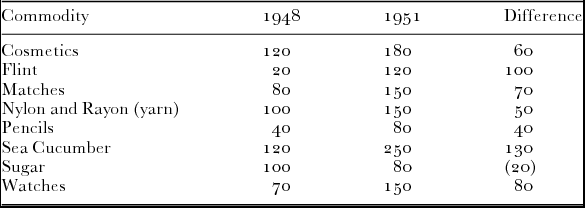
What Communist China defined as ‘smuggling’, then, was uncontrolled trade, which in the official imagination eroded tax revenues, stoked capital flight, and menaced public order. Smuggling in post-1949 China did not emerge de novo but actually traced its antecedents to smuggling in pre-1949 China. The two, in fact, were remarkably similar in their geography, vector, and operation. A key driver of this durability was continuity in policy. Communist China preserved—and increased—the protective tariffs Nationalist China introduced from the Nanjing Decade (1928–37). The new regime also maintained its predecessor's bold economic interventions, heavily taxing luxuries and strictly regulating commodities deemed unessential for the country's industrialization (Table 1).Footnote 13 More significantly, it introduced a raft of non-tariff restrictions like an elaborate foreign trade system that required all imports and exports to be licensed and processed through foreign trade bureaus.Footnote 14 Anyone who clandestinely imported commodities such as foodstuffs (such as sugar and sea delicacies), consumer goods (such as wristwatches), and industrial products (such as dyestuff and chemicals) thus avoided paying prohibitive tariffs that reached as high as 250 per cent. Anyone who exported precious metals and foreign currencies, meanwhile, circumvented restrictions on foreign exchange, thereby exacerbating the country's unfavourable balance of payments position and depriving the government resources to purchase what it considered as ‘useful’ imports. High tariffs and intricate regulations—inserted into the fluctuations of supply and demand—underpinned the financial calculus of smuggling.
Tariffs for frequently smuggled commodities, Nationalist China (1948) versus Communist China (1951).

Duties as a percentage of wholesale value (ad valorem). Data for 1948 is general tariff rate (guoding shuilü). Data for 1951 are the general import tariff rate (putong jinkou shuilü). Sources: Haiguan zong shuiwusi shu, Zhonghua Minguo haiguan jinkou shuize; and Haiguan guanliju, Zhonghua Renmin Gongheguo haiguan jinchukou shuize.
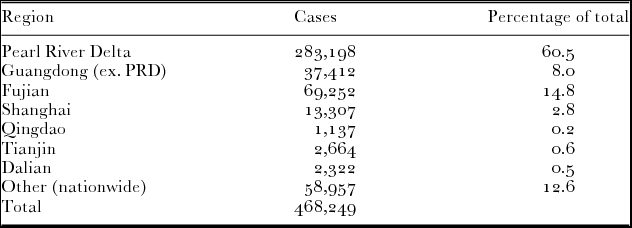
The geography of smuggling was another continuity that survived the 1949 divide. Just as was the case in Nationalist China, major channels of trafficking in Communist China still coursed through coastal cities like Shanghai, Tianjin, Xiamen, Shantou, and Guangzhou. The primary sources of smuggled goods still came from the colonial enclaves of Hong Kong and Macau, which remained as China's conduits to global markets even at the height of the Cold War. In the 15 years from 1950 to 1965, Chinese Customs nationwide recorded 468,249 cases of smuggling and confiscated more than 131 million yuans’ worth of goods.Footnote 15 Reflecting the geography of trafficking and enforcement, the Pearl River Delta made up nearly two-thirds of cases during the same period (Table 2). Even as the new People's Republic sought to consolidate its continental borders in the West, its maritime frontiers in the East remained porous to unsanctioned commerce.
Smuggling cases apprehended by China Customs, 1950–65.

Other (nationwide) calculated by subtracting the sum of coastal cases from the total. Pearl River Delta includes the Guangzhou, Jiulong, and Gongbei Customs. Fujian includes the Xiamen and Fuzhou Customs. Data for Xiamen until 1961 includes seizures via post. Data unavailable for Guangzhou 1951–52; Xiamen 1950; and Fuzhou 1959. Sources: Dangdai Zhongguo haiguan, p. 449; Guangdong sheng difang shi zhi bianzuan weiyuanhui (ed.), Guangdong sheng zhi: haiguan zhi, pp. 270–1; Fujian sheng difang zhi bianzuan weiyuanhui (ed.), Fujian sheng zhi: haiguan zhi [Fujian Provincial Gazetteer: Customs Gazetteer], Fangzhi chubanshe, Beijing, 1995, pp. 179–80; ‘Shanghai haiguan zhi’ bianzuan weiyuanhui (ed.), Shanghai haiguan zhi, pp. 390–1; Shandong sheng difang shi zhi bianzuan weiyuanhui (ed.), Shandong sheng zhi: haiguan zhi [Shandong Provincial Gazetteer: Customs Gazetteer], Shandong renmin chubanshe, Ji'nan,1997, p. 512; Tianjin haiguan bianzhi shi (ed.), Tianjin haiguan zhi [Tianjian Customs Gazetteer], Tianjin haiguan bianzhi shi, Tianjin, 1993, pp. 207–8; Dalian haiguan zhi bianzuan weiyuanhui (ed.), Dalian haiguan zhi [Dalian Customs Gazetteer], Zhongguo haiguan chubanshe, Beijing, 2005, p. 125.
Communist China shared Nationalist China's concerns over smuggling's pernicious effects on the economy. Yet it was also more concerned than its predecessor over smuggling's pernicious effects on governance. As an ‘antagonistic contradiction’ (diwo maodun) in the imagination of some officials, smuggling embodied all sorts of threats to the revolution.Footnote 16 First, it subverted the Communists’ idealized vision of socialist transformation, where city and countryside worked in concert to create a self-sufficient national economy. Second, it maintained Communist China's dependence on the hostile capitalist bloc and thereby hindered the regime from realizing the geopolitical aim of ‘leaning to one side’ in the Cold War. Finally, smuggling potentially challenged the new order itself. During the ‘century of humiliation’ before liberation, as officials consistently reminded the nation, smuggling violated China's sovereignty, destabilized the government, and destroyed native industries. Now, it was ostensibly practised by China's enemies and other counterrevolutionaries, who brought into the country anti-Communist propaganda and narcotics to lead the masses astray from the revolutionary path.Footnote 17
To wage its war on smuggling, Communist China blended old institutions with new tactics. During the final years of the Second Sino-Japanese War (1937–45), the Communists had already operated several customhouses along the North China coast. Within weeks of Japan's surrender in August and September 1945, they opened new customhouses at Yantai, Weihaiwei, and Longkou to form the core of the ‘People's Customs’ within the Shandong Liberation Area. Throughout the chaos of the Chinese Civil War (1946–50), the People's Customs struggled to monitor trade between liberated areas and enemy territories. It was also charged with suppressing smuggling, encouraging soldiers and cadres to combat illicit trade with slogans like ‘Smuggling means aiding the enemy, aiding the enemy means selling out your country’ (Zousi ji shi zidi, zidi jiu shi maiguo).Footnote 18 As the Communists drove farther south, they also assumed more control over the old Chinese Maritime Customs Service. This foreign-managed institution had taxed, regulated, and policed foreign trade on behalf of successive central Chinese governments—the Qing court, the Beiyang regime, and the Nationalists—since its founding in 1854.Footnote 19 The Communists recognized the importance of taking over this important institution. As Mao himself declared in the March 1949 report to the Second Plenum of the Seventh Central Committee: ‘[Taking] immediate control of foreign trade and reform[ing] the customs system—these are the first steps we must take upon entering the big cities.’Footnote 20
Months of planning thereafter culminated with the creation of the General Customs Administration (Haiguan Zongshu) on 19 October 1949. The new agency, made up of the old Maritime Customs, was now given a new mission to support the regime's aims. Loyal party operatives like Kong Yuan were placed in top leadership positions.Footnote 21 Foreign employees who had not already fled were unceremoniously discharged. Chinese employees, who remained at their posts even during the Nationalists’ steady southward retreat to Taiwan, occupied the rest of the agency's administrative hierarchy. Their ranks included not only low-ranking employees, but also high-ranking officials like the former Deputy Inspector General Ding Guitang who were valued (at least initially) for their technical and administrative expertise. Before they resumed their duties, these incumbents participated in re-education sessions designed to inculcate loyalty to the new order through a mixture of inducements, threats, and magnanimity.Footnote 22 Tensions between the two groups were sometimes palpable. New leaders like Kong frequently lambasted the old Maritime Customs’ ‘corrupt and degenerate style of work’ (tanwu fuhua de zuofeng), while party investigators uncovered cases of criminal acts and petty corruption within the agency during the Three-Anti Campaign (1951).Footnote 23 Meanwhile, holdovers like Ding later complained of being excluded by newcomers from major responsibilities, leaving people like himself with ‘an office but no authority’ (youzhi wuquan).Footnote 24
Besides assuming control of an old institution, the new regime also expanded the legal framework created by its predecessor to fight smuggling and broadcast central authority. It officially nullified all Nationalist laws,Footnote 25 but a closer inspection reveals continuities as well as ruptures between Communist laws and their defunct predecessors. Embodying this co-existence between new and old is the Provisional Customs Law of the People's Republic of China (Zhonghua Remin Gongheguo zanxing haiguan fa). Promulgated in 1951 and replaced only in 1987, the law governed the administration and responsibilities of the new People's Customs for more than three decades. Unlike Nationalist anti-smuggling laws, the Provisional Customs Law explicitly defined smuggling by enumerating violations and categorized their severity by intent and article trafficked. Minor smuggling, which included run-of-the-mill duty evasion and travel beyond designated waters, was punished with a minor fine or confiscation. Major smuggling encompassed serious violations that revealed the perpetrator's intent to harm the nation: using specifically constructed ‘hides’; employing violent resistance; trafficking narcotics and armaments; counterfeiting government documents; or colluding with government officials.Footnote 26 Besides being fined or having the illicit goods confiscated, violators would be transferred to local courts or public security agencies for further investigation and punishment.Footnote 27 Instructions to customs and public security officials often referenced such principles, stressing the importance of differentiating between major and minor cases of smuggling and ‘raising the masses’ socialist consciousness’ (tigao qunzhong shehui zhuyi juewu).Footnote 28 Such gradations also widened the scope of discretion for officials in meting out appropriate penalties, which Communist China accused its predecessor or indiscriminating applying.Footnote 29
Other features of the Provisional Customs Law were also built upon pre-1949 regulations and procedures. Jurisdictions over minor and major cases of smuggling, for instance, were more clearly delineated between the judiciary, public security, and the customs. Yet the decision to fine and confiscate remained the sole prerogative of customs commissioners. Furthermore, individuals dissatisfied with the penalties levied by the People's Customs were permitted to appeal their cases in accordance with procedures that echoed those of the old Maritime Customs.Footnote 30 The exclusive responsibility of the People's Customs over smuggling cases was among the key features of the new law Kong Yuan himself explicitly highlighted in a May 1950 nationwide radio broadcast.Footnote 31
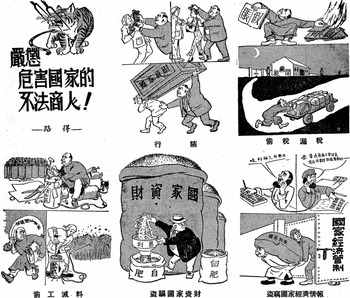
While employing inherited Nationalist institutions and laws to fight smuggling, Communist China also departed from its predecessor's policies in several distinct ways. As with other campaigns it launched, the new regime did not simply expect passive compliance in the fight against smuggling—it wanted active participation. During the Five-Anti Campaign (1952–53), for instance, state propaganda encouraged the public to help fight smuggling by pointing to the evasion of customs duties as a prime example of one of the anti's (Figure 1). That smuggling was so singled out should not be surprising. ‘Tax evasion’ (toushui loushui) through non-payment of tariffs or misreporting the value of imports were long-standing business practices before 1949, and many merchants were thus vulnerable to charges of evading duties, making excessive profits and owing back taxes. Reports of merchants and other ‘capitalists’ forced to pay back taxes on smuggled goods were replete in the popular press.Footnote 32 Other forms of mobilization included the various ‘mass anti-smuggling’ (qunzhong fan zousi) campaigns in the late 1950s encouraging the public to ‘report’ (jianju) potential offences to authorities. In one instance, a Guangzhou resident informed on her neighbour, a ‘habitual smuggler’ who lived a well-to-do life, making frequent trips to Hong Kong and returning with large suitcases despite ‘having no proper employment’.Footnote 33 In another instance, a Shanghai wristwatch store employee submitted more than 40 reports during the 1950s, leading to 2,000 yuans’ worth of seizures.Footnote 34 Mass anti-smuggling, according to the regime, yielded many arrests that would have otherwise gone undetected. From 1950 through September 1957, for instance, the Guangzhou, Jiulong (Kowloon), and Gongbei (Lappa) customs announced that they collectively uncovered more than 41,000 cases of smuggling based on the more than 123,000 letters they received from the public.Footnote 35
‘Severely punish lawless merchants who endanger the nation!’ The cartoon shows targets of the Five-Anti Campaign. From top, left to right: ‘bribery’ (xinghui), ‘tax evasion’ (toushui loushui), ‘corner-cutting in workmanship’ (tougong jianliao), ‘theft of state property’ (daopian guojia caichan), and ‘theft of state economic information’ (daoqie guojia jingji qingbao). ‘Tax evasion’ features a merchant pushing his cart of goods past the customs station, thereby avoiding ‘customs duties’ (guanshui). Source: Manhua (Cartoons), 22 March 1952, p. 8. Edward Hunter Collection, Chinese Pamphlet Digitization Project. Courtesy of Center for Research Libraries (CRL).

In another departure from Nationalist China, Communist China mounted successive outreach programmes designed to educate the public on the evils of smuggling. Mirroring ongoing efforts to rectify undesirable social behaviour, customs officials across China spearheaded anti-smuggling publicity campaigns by authoring essays in local newspapers, giving lectures over the radio, and showing short public service announcements in theatres.Footnote 36 The media also lionized ordinary Chinese whose laudable contributions in the fight against smuggling belied their modest positions. People's Daily, for instance, hailed a Shanghai railway inspector who rejected bribes offered from ‘treacherous merchants’ and persevered in the face of repeated beatings from smugglers—thereby doing his small part protecting the nation's revenues.Footnote 37 Finally, the People's Courts held public trials and sentencing rallies for accused smugglers throughout the country. In Guangzhou, an August 1957 public trial with 12,000 attendees sentenced someone to eight years of penal servitude for consistently misrepresenting his travel plans—visiting relatives or attending funerals, for example—in trafficking goods between Hong Kong and Guangzhou. Other defendants were sentenced from four to five years of penal servitude, save for one, who was sentenced to six months for providing information on other smugglers.Footnote 38 In Shanghai, a March 1958 anti-smuggling sentencing rally had 1,800 attendees, most of whom were merchants and the target of the event's message. In addition to high-level court and customs officials, ‘representatives of the people’ also made statements supporting serious punishments and expressing willingness to cooperate with the government in suppressing smuggling.Footnote 39 Other government agencies like the Ministry of Foreign Trade encouraged the People's Court to hold similar events to ‘help the masses recognize smuggling's harm to the nation’.Footnote 40
Other programmes were more expansive in scope. Officials organized many ‘anti-smuggling exhibitions’ (fan zousi zhanlanhui) throughout the country, the largest of which was held in the Guangzhou from November 1957 to January 1958 and jointly sponsored by the Guangzhou, Jiulong, and Gongbei Customs. The exhibition aimed to ‘concretely and systematically’ present smuggling's 100-year history to visitors from local residents to Chinese visitors from Hong Kong and Macau. Along with photographs and charts, the exhibition also featured more than 600 displays of items confiscated by authorities: tin cans concealing saccharine, water bottles storing wristwatches, and a radio transmitter purportedly used by Nationalist spies.Footnote 41 Strong attendance for the exhibition (716,000 visitors), combined with the government's concern about the increasing seriousness of illicit trade, prompted other cities to host their own anti-smuggling exhibitions. The 1958 Shanghai exhibition, in particular, attracted more visitors (800,000) despite running a month shorter than its Guangzhou counterpart. It also featured a satirical play—Under the X-Ray (Zai X guang xia)—performed by the Shanghai Municipal People's Theatre Company.Footnote 42 Whether using inanimate displays or performance art, the exhibitions sought to impress upon visitors the continuing threat illicit trade posed to national sovereignty. The efficacy of these campaigns is questionable—smuggling, after all, continued unabated throughout the Maoist era and beyond. Yet such didactic efforts represented a marked departure from the techniques of governance under the Nationalists, who never attempted such programmes at countering smuggling. Moreover, they accorded perfectly with the revolutionary state's goals of cultivating an ethic of volunteerism among the people and encouraging officials to ‘combine punishment with education’ (chengban yu jiaoyu xiang jiehe).Footnote 43 The fight against smuggling was yet another example of the new regime's belief that sociopolitical and economic transformations could be realized through mass mobilization.Footnote 44
Legal loopholes and profit opportunities
Who were the ‘smugglers’ at the other end of these campaigns? The anti-smuggling rhetoric of Communist China, which drew upon similar rhetoric from Nationalist China, articulated the fight against trafficking in the language of nationalism by linking the illicit pursuit of profit to the damage it inflicted on the welfare of the Chinese people. The same epithets ‘treasonous merchants’ and ‘bandits’ (tufei) aimed at smugglers before 1949 were still employed after 1949. The Communists, however, expanded the public vocabulary to describe those who purportedly collaborated with foreign imperialists and the ‘Chiang Kai-shek bandit gang’ (Jiang feibang) in undermining the laws, borders, and sovereignty of the People's Republic. The new labels they affixed on smugglers—‘lawless traders’ (bufa shangren), ‘lawless capitalists’ (bufa zibenjia), ‘rotten capitalists’ (yulan zibenjia), ‘feudal remnants’ (fengjian canyu), and ‘counterrevolutionary’ (fan geming fenzi)—reflect the regime's belief that private economic motivations were ultimately inseparable from insidious political motivations.Footnote 45 This alarmist rhetoric painting manichean pictures of illicit trade's threats was employed in both public pronouncements and government correspondences. A report from the Ministry of Foreign Trade to the State Council, for instance, notes: ‘[T]he nature of smuggling activities is not just an economic issue [but] also a political issue. Its essence is a struggle between socialism and capitalism.’Footnote 46 In the official imagination, then, smugglers were not merely committing an economic crime that reduced the efficiency of the new command economy; they were committing a political crime that potentially undermined the new revolutionary order itself.
A survey of the historical evidence, however, reveals that smugglers were actually a heterogeneous lot motivated less by politics and more by economics. Indeed, the desire to exploit regulatory loopholes and remedy widespread shortages created by the transition to socialism itself was not limited to any specific individuals or groups. Just as was the case in Nationalist China, the identities of smugglers in Communist China were as diverse as the commodities they trafficked. Residents of frontier towns, coastal villages, and remote islands traversed porous borders to profit from price disparities and material scarcities on the mainland. Traffickers in the interior then funnelled goods by rail and post. Some operated legitimate fronts, like the 37 smuggling rings in north-east Guangdong masquerading as inconspicuous ‘handicraft cooperatives’, ‘stationary factories’, or ‘watch factories’ that supplied assorted consumer goods to Shanghai, Fuzhou, Xiamen, and Wenzhou.Footnote 47 Some operated with official connivance, like the Guangzhou ‘female smuggling king’ (nü zousi dawang) Gao Yamei, who did brisk business ferrying goods between China and Hong Kong before 1949 until her arrest in 1952. Importing more than 25,000 pairs of watches, Western medicines, ginseng, and mechanical pencils, while exporting more than 200 liang of gold, Gao operated a vast smuggling network stretched across the Pearl River Delta from Shenzhen to Guangzhou.Footnote 48 Speculators—euphemistically called ‘cattle’ (huangniu)—made trafficking practically a fulltime profession, constantly seeking to profit from arbitrage opportunities in both rationed and smuggled goods.Footnote 49 For others, trafficking was a temporary expedient to make ends meet during economically uncertain times. Shao Maotang and four partners, for instance, led archetypical lives for smugglers in the early 1950s, peddling watches, batteries, and assorted foreign goods across Guangzhou, Shanghai, Tianjin, and Harbin. A decade later, they led unremarkable lives as factory workers and shopkeepers, leading the Shanghai customs officials who uncovered their offences to recommend minor financial penalties rather than jail time as punishment.Footnote 50
Everyone potentially practised smuggling, then, but certain individuals attracted particular attention for doing so. Overseas Chinese (huaqiao)—a wide category that encompassed travellers from Hong Kong and Macau or returnees (guiqiao) from Southeast Asia—were often portrayed in government correspondences and popular media as prominent carriers of illicit goods, given their mobility and access to foreign markets.Footnote 51 From the late Qing through the entire Republican period, Overseas Chinese freely travelled between China and the rest of Asia, leveraging their mobility and legal status to move smuggled goods. War, revolution, and decolonization starting from the 1940s, however, ended this long era of unrestricted mobility and forced millions of transnational families to choose between remaining in their adopted homeland or returning to their ancestral homeland. Yet Communist China preserved and even systematized the legally privileged status of Overseas Chinese, according returnees intending to resettle in China ‘special treatment’ (youdai) with preferential access to jobs, housing, and other social services. This policy was aimed at encouraging remittances and soliciting contributions from the vast Overseas Chinese community to the mainland's modernization, but it also created liminal spaces for smuggling. Regulations, for instance, permitted returnees to enter China with some personal effects duty-free, but this limit was frequently ignored. Some returnees arrived with ‘personal effects’ that far exceeded the duty-free limit: stockpiles of razor blades, lighter flints, pens, knives, bicycles, and other Western consumer goods.Footnote 52 Overseas Chinese visitors from Hong Kong and Macau, meanwhile, exploited similar loopholes, especially after 1956, when travel restrictions and duty-free limits on personal effects were relaxed.Footnote 53 A 1957 Guangdong customs report estimated that of the Overseas Chinese visitors from Hong Kong and Macau, 33 per cent were on legitimate business (such as tourism, commerce, or visiting relatives), 26 per cent were profiteers bringing in goods for sale in the mainland, 40 per cent were itinerant peddlers who relied on smuggling for a living, and 1 per cent were counterrevolutionaries plotting political sabotage.Footnote 54 Almost two-thirds of visitors, in other words, were suspected of engaging in one kind of nefarious activity or another. Putting aside the veracity of such figures, it is clear that officials cast a wary eye towards most Overseas Chinese travellers, even as the People's Republic formally welcomed returning ‘compatriots’ (tongbao).
Officials had reasons to worry. In China, Overseas Chinese who wanted to dispose of their personal effects were required to sell them to state-run companies or ‘purchasing stations’ (shougouzhan).Footnote 55 Yet the prices offered at these stations—based on wholesale prices plus any tariffs levied—were usually far lower than prices offered by non-official buyers. As some Overseas Chinese who relied on selling their personal effects to pay for their living expenses on the mainland complained: ‘The renminbi we get after [our goods] are purchased is not enough to buy similar goods on the market.’Footnote 56 Unable to profitably sell their goods through legal channels, many Overseas Chinese instead turned to black markets with sophisticated distribution and retail networks. Returnees in Fujian, for instance, could engage any one of the estimated 300 ‘middlemen’ (jingjiren) who brokered the sale of smuggled jewellery, Western medicines, foodstuffs, and other assorted merchandise to buyers in Shanghai, Tianjin, and Beijing.Footnote 57 Travellers in the Pearl River Delta, meanwhile, disposed of their smuggled wristwatches and fountain pens at hotels and other guesthouses, where reliable managers tapped local connections to find willing customers.Footnote 58 Finally, Overseas Chinese were also vectors of capital flight, working with Hong Kong remittance agencies (yinhao) to send gold, silver, jewellery, and currencies abroad in explicit defiance of state strictures.Footnote 59 Many travellers and returnees thus sought to profit (or even survive) by taking advantage of their politically privileged and separate status as well as their ties to foreign markets. Despite official exhortations that continued well into the 1960s encouraging them to turn instead to state-run units, many Overseas Chinese continued to rely on illicit channels to meet their needs.Footnote 60
Knowledge of such petty smuggling tactics circulated widely among Overseas Chinese communities not only through word of mouth or popular press reports, but also through travel guides. One guidebook, Things to Know Returning to Native Village and Returning to Hong Kong (Huanxiang fan Gang xuzhi), dispensed travel advice that spanned the spectrum of legality. Along with helpful information on train schedules and customs regulations, it also offered legally dubious answers to frequently asked questions including: ‘How to safely sell off wristwatches and fountain pens?’ and ‘How to rescue your gold jewellery from the mainland and bring them back to Hong Kong?’Footnote 61 For proffering such advice—which were blatantly illegal—Things to Know was banned in China and denounced by People's Daily as Nationalist propaganda designed to ‘stir up smuggling’ (shandong zousi).Footnote 62 The actual origin of the guide itself is unclear, but its many descriptions of trafficking in the mainland were undeniably accurate. Reports from both the popular press and internal government correspondences confirmed that guesthouses were indeed havens for illicit peddling and critical channels in the smuggling pipeline.Footnote 63 Literature like Things to Know, therefore, served less as an incitement to smuggle and more as a reflection of a sizeable Overseas Chinese readership that hungered for practical advice on profiting from cross-border arbitrage.
Another group that received widespread attention for their alleged propensity to smuggle were ethnic minorities—particularly Uighurs and Huis. Military conquest of the West and the creation of autonomous regions during the 1950s brought minority areas under the rule of the People's Republic. While some Han Chinese cadres and settlers made their way west, some minorities themselves made their way east to coastal cities and soon attracted official attention for being major carriers of illicit goods. Unlike their Overseas Chinese counterparts who leveraged their access to foreign markets, ethnic minority smugglers carved out a niche as traffickers who nimbly moved goods between cities. In February 1957, for instance, the Shanghai Customs arrested 86 Uighur and Hui merchants operating a network that brought smuggled goods from Guangzhou to Shanghai before transhipping them to far-flung cities including Wuhan, Chongqing, Ji'nan, Tianjin, and Shenyang.Footnote 64 Similarly spectacular cases testified to their extensive geographical reach and mobility.
Just like Overseas Chinese, ethnic minorities enjoyed a politically privileged status that complicated law enforcement efforts. To help consolidate the Chinese nation-state during the 1950s, the regime adopted for a bevy of conciliatory policies like favourable legal treatment and tax relief towards minorities. In the ‘Principles for Customs Organization’ issued by the State Council in December 1950, for instance, ‘minority nationalities and residents in frontier regions’ exchanging commodities of daily necessities in small volumes were explicitly permitted to pass in and out of China untaxed.Footnote 65 Meanwhile, top leaders including Mao himself explicitly denounced the widespread ‘Han chauvinism’ (da Han zhuyi) that presumably poisoned relations between the Han majority and other ethnic minorities.Footnote 66 In an attempt to best adhere to such top-down directives, officials pursued several strategies balancing competing imperatives when dealing with ethnic minority smugglers. Some sought to demonstrate leniency. A Ministry of Foreign Trade report, for instance, affirmed that ethnic minority smugglers should be strictly dealt with but recommended that their punishments should be a bit lighter than the punishments levied against Han smugglers. The State Council forwarded the report throughout the government, thereby implicitly endorsing the recommendation.Footnote 67 Others pushed for relocation with the assumption that removing ethnic minority residents from cities would also remove the smuggling problem. In Guangzhou, instructions for a 1957 anti-smuggling campaign ordered that any ethnic minority smuggler caught should have their goods confiscated but otherwise be sent home, with money for travel expenses if necessary.Footnote 68 In Shanghai, officials, implored their Xinjiang counterparts to encourage the city's Uighurs to return west but to no avail. Few left and those who did quickly returned to Shanghai or simply relocated their operations to another city.Footnote 69
Finally, even government officials themselves attracted considerable opprobrium for engaging in smuggling. The Three and Five-Anti Campaigns, in particular, exposed many cases of local officials exploiting state-sanctioned trafficking during the Korean War for private gains. A cadre stationed in Macau to purchase strategic materials for the Central Military Commission, for instance, was discovered to have forged receipts to avoid paying tariffs on foreign goods he purchased for personal use. Other officials used private firms as fronts and even engaged in armed smuggling (wuzhuang zousi) by employing soldiers to import non-strategic materials such as watches, pens, and sugar. More than 50 government units—many of them military—engaged in similar forms of duty evasion according statistics compiled by the Guangzhou Municipal Tax Bureau in 1951.Footnote 70 The problem became so acute at one point that General Ye Jianying, then in charge of Guangdong, arrested more than 500 cadres and army officers for trafficking.Footnote 71 Such incidents unfolded around the same time as the 1952 Statute of Penalties for Corruption added smuggling as a violation.Footnote 72 Compared with its treatment of other traffickers, the regime tended to be less lenient with officials accused of smuggling for personal gains, since their actions compromised its revolutionary aims and eroded its prestige.
Socialist shortages and capitalist goods
For the regime, coastal trafficking was unregulated commerce that threatened governance. For everyone else, however, it helped meet quotidian needs within the emerging command economy. As was the case in other socialist economies, bureaucratized production in China created what scholars have called ‘planned disequilibrium’.Footnote 73 Mismatches between supply and demand that were fundamental—and not aberrant—features of command economies led to chronic shortages of consumer goods often neglected by planners. The First Five-Year Plan (1953–57) was no exception, creating widespread material scarcities in both city and countryside despite being universally hailed for rapidly developing heavy industries and helping the country recover from wartime devastations. The plan's geographical biases, moreover, exacerbated austere conditions along the Chinese littoral. The central leadership ‘deliberately chose to redistribute human and investment resources from the advanced to the poorer regions’, thereby relocating China's industrial centre of gravity to the interior and leaving coastal enclaves more reliant on commerce for their development.Footnote 74 In theory, trade with the socialist bloc should have helped Communist China overcome shortages by serving as the ‘last resort to make up for scarcities and sell surpluses’.Footnote 75 In practice, socialist commerce often suffered from what William Kirby called ‘built-in disadvantages’ serving as disincentives to exchange: bilateral trade agreements that were inflexible and the Soviet model that reinforced inherent biases towards autarky.Footnote 76
In this environment, then, everyone—consumers and producers—had to improvise around plans. Scholars have identified tactics like bartering and hoarding employed by cadres, team leaders, and plant managers to overcome mismatches in supply and demand.Footnote 77 Less attention, however, has been paid to ways smuggling helped ameliorate shortages in the Chinese littoral created by the transition to the command economy and the early Cold War foreign trade regime. Smuggling effectively connected China with far-flung markets and made available a whole range of consumer goods government channels could not supply in adequate volumes. Outlets in Shanghai, for example, did brisk business selling foreign wristwatches, cosmetics, silk scarves, socks, and assorted plastic products—all trafficked from abroad via Guangdong (Guangzhou, Foshan, and Shantou), Fujian (Xiamen and Fuzhou), and Wenzhou. Suppliers included unemployed individuals, petty merchants, housewives, ethnic minorities, and Overseas Chinese who sold the ‘personal effects’ they brought into China duty-free.Footnote 78 Smuggled consumer products continued to be openly peddled in Shanghai markets well into the 1960s even after various anti-smuggling campaigns, while similar black markets operated in other cities including Guangzhou and Tianjin.Footnote 79 They attracted buyers from all walks of life, and even visiting foreigners could not resist their allure. Soviet technical advisors and their families then stationed in China during the 1950s, for instance, reportedly used their generous salaries from the Chinese governments to snap up smuggled foreign goods unavailable back home.Footnote 80
Among all smuggled consumer articles, wristwatches proved especially popular. Already the ‘ultimate object of desire’ before 1949, watches retained their allure even after 1949 as one of the ‘big three’ consumer items (san dajian) that conferred significant social status on owners.Footnote 81 They were also valued as ‘gifts’ that could be used to curry favour with officials, even cadres ostensibly hostile to products from ‘imperialist America’.Footnote 82 So insatiable was this demand that it easily survived the Three-Anti and Five-Anti Campaigns targeting ownership of luxury goods and other forms of ‘corruption’.Footnote 83 Meanwhile, small size made the clandestine transport, distribution, and sale of watches immensely profitable. Dealers in Hong Kong supplied mainland China and the rest of Asia with watches genuine (imported duty-free from Europe) and fake (manufactured locally).Footnote 84 Throughout the Maoist era and beyond, smuggled watches were widely available, retailed not only at stores, bazars, parks, teahouses, and guesthouses, but even on the factory floor. Authorities in Shenyang, for instance, uncovered several smuggling rings in factories throughout the city. Peddlers had been permitted by factory foremen to sell watches from far-flung Guangzhou and Shanghai in exchange for ‘petty favours’ (xiao'en xiaohui). With profits allegedly reaching 100 per cent, some factory workers even sought to abandon their fulltime occupations and engage in wristwatch trafficking instead.Footnote 85 That such an officially stigmatized commodity could be so easily procured reveals not only the persistence of consumer demand in defiance of state ideology. It also highlights the extent and durability of extensive smuggling networks linking coast and interior supplying that very demand.
Along with consumers, producers were also eager buyers of illicit goods. Hamstrung by storages of raw materials and key inputs, many of them also turned to the black markets for their needs. The trafficking of tungsten carbide cutters, valued for their high heat resistance and durability, exemplifies the symbiotic relationship between the command economy and the illicit economy. Under Soviet technical tutelage during the 1950s, Chinese factories were encouraged to replace older lathes and adopt tungsten cutters in their production lines. Domestic cutters at the time were produced solely at the Dalian Iron and Steel Factory, while foreign cutters were imported through local trade bureaus from the Soviet Union, West Germany, Japan, and Sweden. Distribution of cutters was coordinated through planning but, as the First Five-Year Plan kicked into high gear, demand quickly outstripped supply. Indeed, government reports confirmed widespread shortages of industrial equipment and metal hardware in early 1956, but shortages of cutters were most acute.Footnote 86 In Shanghai, large factories received cutters directly from central planners. Small factories, including joint state–private enterprises, received their cutters indirectly from central planners through branches of the Shanghai Municipal Hardware Company. Large factories ostensibly had first priority for cutters but frequently received far fewer than they needed. The Shanghai Electric Motor Factory, for instance, required at least 16 kilograms (32 shijin) of cutters for its operations but were allocated only one-third of that amount. To make up for the shortfall, the factory turned to the Shanghai Municipal Hardware Company, thereby placing downward pressures on other factories and creating a ripple effect throughout the market. As one report noted:
[The Shanghai Municipal] Hardware Company's normal supply is already far insufficient to satisfy market requirements, causing strained conditions where demand exceeds supply. Consequently, the ‘free market’ (ziyou shichang) has become active. Because [the allocation of] steel cutters is managed by the central state, the source of cutters from the so-called ‘free market’ all come from smuggling.Footnote 87
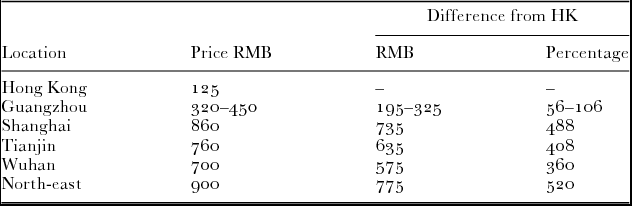
‘Free markets’ for cutters in cities like Shanghai were actually nodes within a larger network that stretched throughout the country and mapped along the same vectors for all smuggled goods. From Hong Kong and Macau, where supplies were plentiful and almost unrestricted, Overseas Chinese smuggled foreign cutters (primarily Swedish) into China across the border to Shenzhen and Guangzhou. There, merchants (many of them ethnic minorities) purchased the cutters and proceeded to ship them throughout the country, where they were then sold to local retail outlets like branches of the Shanghai Municipal Hardware Company before finally filtering into official supply channels. Reflecting this geography of smuggling, black-market prices for cutters were highly correlated with distance from Hong Kong. The farther away from the British colony, generally, the higher the premium commanded (Table 3). This traffic was very active. An April 1957 report by the Jiulong Customs, for instance, noted that, along the Sino–Hong Kong border, tungsten cutters had just displaced wristwatches as ‘first place among all smuggled articles [and] it is obvious that the situation is becoming more serious with each passing day’.Footnote 88 Shanghai, a major destination of smuggled cutters, attracted eager buyers near and far. Factories throughout the north-east as well as the Yangzi River Delta dispatched agents to scour the city and secure desperately needed inputs for their own production. Buyers and sellers reportedly converged at the New Asia Hotel to hash out deals.Footnote 89 Supplies otherwise scarce or unavailable in the command economy, then, were plentiful in the underground economy thanks to smuggling.
Black-market prices for tungsten carbide cutters, circa 1956.

Source: ‘Diaocha tanhua wugang daotou zousi de chubu cailiao’, Shanghai Customs to Shanghai Municipal People's Committee, 11 June 1957, SHMA, B6-2-286.
Tungsten carbide cutters were far from the only producer good that stood at the ambiguous intersection between the nascent command economy and the active illicit economy. Government reports consistently employed the phrase ‘supply falls short of demand’ (gong bu ying qiu) when explaining the widespread reliance by factories on a host of smuggled commodities. Nylon—a necessity in the production of toothbrushes, stockings, and other products—was frequently smuggled into the mainland from Hong Kong on board fishing trawlers and purchased by retailers for resale. Cocoa—used in the manufacture of sweets—was in such short supply that factories throughout China eagerly snapped up illicitly imported stocks from Hong Kong. In 1956, one jin of cocoa commanded 17 yuan on the black market—a substantial premium over the prevailing Hong Kong price of 1.27 yuan per jin. Yet buyers had few alternatives, since no cocoa whatsoever was available at the official price of 14 yuan per jin.Footnote 90 Besides state-owned enterprises (SOEs), according to reports, buyers of these smuggled goods included so-called ‘underground factories’ (dixia gongchang). These small economic units were mostly private businesses eking a shaky existence during the transition to socialism as they operated on the margins of the law and faced intense pressures to join state-sponsored cooperatives. Smuggling helped extend their precarious survival by offering alternative supply channels after being systematically excluded from legitimate supply channels. It thus underpinned what Lynn White considered to be these factories’ critical role in the command economy: ‘easing production bottlenecks that the economic planners had not anticipated.’Footnote 91
Officials worried that participation in the illicit economy, particularly by SOEs, had other pernicious effects. Since SOEs were rapidly becoming the biggest companies during the 1950s, their potential role in boosting demand for smuggled goods was not trivial. As a Ministry of Foreign Trade report noted:
There are some enterprises and commercial units sending agents to border regions or black markets to purchase high-priced foreign commodities, [thereby] greatly stimulating the development of smuggling and the flow of foreign goods into the interior. There are some employers of government offices who purchase smuggled foreign goods for personal use, [thereby] assisting in the sale of smuggled goods.Footnote 92
Even more worrisome was how SOEs helped legitimate black-market trade. Foreign luxuries like wristwatches and other consumer products were easily identifiable. Other illegally imported commodities, by contrast, were far less conspicuous in revealing their origins. ‘The problem that currently exists’, as one customs report noted, ‘is that there is no way to distinguish between smuggled [goods] and non-smuggled [goods]’.Footnote 93 This ambiguity afforded every participant within the smuggling chain—from traffickers, to retailers, to buyers—some plausible deniability that they were ignorant of the goods’ legal status. One report quoted a common refrain from smugglers that neatly encapsulates this attitude: ‘If state-owned [companies] purchase [smuggled] goods, how can it be called illegal?’Footnote 94
Smuggling as a survival strategy
Just as was the case with the First Five-Year Plan, state interventions during the Great Leap Forward and after created new incentives for smuggling. The introduction of the grain monopoly and collectivized agriculture led to devastating famine across China. Suffering was widespread but not always passively borne. As Jeremy Brown observes, some peasants retaliated against state restrictions by peddling foodstuffs hoarded during successive waves of collectivization and moving between city and country.Footnote 95 Other peasants, meanwhile, resorted to smuggling, the organization of which changed in response to famine and market shortages. Customs gazetteers often employed the euphemism ‘domestic economic hardships’ (guonei jingji kunnan) to account for the resurgence of illicit trade during this period.Footnote 96 Wristwatches remained popular articles of trafficking, but the most frequently smuggled commodity during this period were desperately needed foodstuffs. Sugar, for instance, commanded substantial premiums on the black market. A 1962 Shanghai Customs report recorded that foreign sugar, which was sold in Hong Kong for an equivalent of three to four yuan per pound, was illicitly sold in China for around 120 yuan per pound—roughly 40 times the cost.Footnote 97 Central government relaxation of private rural marketing after 1960 gave smuggling an additional boost. Promoted by Chen Yun and supported by the ‘marketeers and bureaucrats’ faction then ascendant in the aftermath of the Leap, the new policy sought to relieve famine conditions, but also stimulated more black-market activities.Footnote 98 In the face of widespread trafficking, officials grumbled that peasants confused ‘free markets’ with ‘the freedom to buy and sell anything’ (yangyang dou ke ziyou maimai).Footnote 99
Like previous rounds, this round of smuggling implicated the usual suspects—Overseas Chinese, ethnic minorities, speculators, and itinerant peddlers.Footnote 100 Yet it was the participation by coastal communities that most attracted official attention. From the late 1950s through the early 1960s, authorities detected an upsurge of trafficking by communes and production teams who ‘relied upon their favourable location’ (pingjie dili) to crisscross borders.Footnote 101 In some villages, 80–90 per cent of residents were estimated to have engaged in smuggling.Footnote 102 Even before the Leap, illegal crossings into Hong Kong and Macau by coastal peasants—whose ranks included nominally reliable Communist party branch members and production team leaders—were already a widespread, ‘serious situation’ (qingkuang hen yanzhong).Footnote 103 Dire conditions during the Leap only stimulated more illicit movement. An incident in the Pearl River Delta typified this problem. At the height of the Leap on 1 June 1959, a customs patrol apprehended three commune members in a newly built junk loaded with assorted foreign goods from Hong Kong returning to Fuyong Village in Bao'an County. The villagers funded their week-and-a-half journey and purchases with Hong Kong dollars remitted by overseas relatives. While commune leaders disavowed their claims, the apprehended villagers averred that the new boat was intended for the commune's use and that the purchases were sanctioned by the village party branch secretary. Further investigation revealed that this journey was not the first instance of cross-border smuggling: the villagers made at least another trip to Hong Kong a year earlier. Underscoring the frequency of such trafficking, the Guangzhou Customs candidly admitted in its summary of the incident: ‘It is our understanding that every county along the coast has similar cases.’Footnote 104 Scholars have identified many ‘informal strategies’ that communes in Maoist China pursued to enhance their collective welfare.Footnote 105 Besides altering the size of production teams, engaging in speculation, and withholding goods and services, cross-border trafficking could certainly be added to this constellation of tactics employed in response to new changes in the countryside.
Within coastal communities, fishermen attracted official opprobrium for their ‘insufferably extreme arrogance’ (qiyan feichang xiaozhang) and ‘very low political consciousness’ (sixiang juewu hen di). A Ministry of Foreign Trade report noted that fishermen frequently disregarded border controls and evaded inspections, sometimes even resorting to violence by beating up anti-smuggling officers. Communist China had not always been implacably hostile to such mobility across porous borders. At the height of the Korean War, for example, the regime actually encouraged coastal communities to ferry strategic materials from abroad and rewarded many fishermen handsomely for circumventing the United Nations embargo. But a decade of centralized planning meant such trafficking was no longer welcomed, or at least no longer useful to Beijing. The Ministry of Trade, which helped coordinate ‘strategic smuggling’ during the early 1950s, now complained of trawlers ‘brazenly’ (gongran) moving smuggled wares between Hong Kong and Guangzhou by the late 1950s.Footnote 106
Aside from blaming bad attitudes, officials also recognized more fundamental reasons fostering the antipathy of coastal communities and fishermen towards state authority. Long before 1949, coastal villagers thwarted official efforts to regulate maritime commerce, fishing, and movement, since ‘maritime nomadism’ had been a long-standing feature of life in the region.Footnote 107 After 1949 at the height of the Cold War, they were subjected to even more restrictions, forbidden from sailing to Hong Kong, Macau, and Taiwan to fish and trade.Footnote 108 State imperatives thus kicked off a vicious cycle of new strictures, more evasion, and more suppression. Just as they did before, anti-smuggling efforts provoked resentment as much as they suppressed trafficking. Officials from the Guangdong Provincial Bureau of Border Defense, for instance, candidly admitted that overly strict confiscations of cargo in trawlers often did not distinguish between personal goods and smuggled goods, thereby ‘harming the masses’ (shanghai le jiben qunzhong) and breeding hostility to authorities.Footnote 109 The creation of new fishing cooperatives and communes, meanwhile, raised the volume of catches but deepened the dissatisfaction of some fishermen, who responded by surreptitiously selling their catches at higher market prices in Hong Kong than at lower official prices in China.Footnote 110 Desperate conditions during the Leap even compelled others to brave the dangers of crossing the Taiwan Straits to fish or seek relief.Footnote 111 Fishermen were not alone in seeking better prices for their harvests but, unlike peasants in the interior, they were better able to exploit their mobility and proximity to markets outside China to profit from fundamental price disparities inside China.
Fishermen and communities along the China coast may not have always practised a ‘culture and agriculture of escape’, to borrow James Scott's description of peasants in upland Southeast Asia.Footnote 112 Yet their frequent exploitation of physical and political geographies to evade official controls of all sorts proved no less frustrating to Chinese state authority. Indeed, many fishermen ignored or circumvented official boundaries segmenting coastal waters by maintaining the same patterns of commerce they had practised well before the birth of the People's Republic. Seamlessly straddling different regulatory spaces, they engaged in an array of survival strategies—fishing, trafficking, and everything in between—in accordance with the circumstances and under the cover of practising their livelihood. To exploit multiple sovereignties in the Pearl River Delta, for instance, many based themselves in the traditional smuggling havens in the outlying islands of Hong Kong. Yuen Wah Chiu (Yuan Huazhao), a Guangzhou native who lived on Lantau Island for decades, was one such famed smuggler who ‘was well-known and well-respected by all those who earn their living in underground or semi-underground way in the whole of the Pearl River Delta’. While Yuen had retired by the 1950s, his younger counterparts from other islands continued plying this trade, which, in the description of one Hong Kong official:
. . . alter[ed] in nature according to the laws, restrictions and controls enforced by the Chinese, British and Portuguese governments at the mouth of the Pearl River. . . . Commodities var[ied], but there [was] always something worth smuggling from somewhere to elsewhere. In 1948 it was gold; in 1950 fuel oil; and so on.Footnote 113
Another article that could be added to this list was foreign currency. Along with Overseas Chinese, fishermen served critical conduit of capital flows from South China to Hong Kong on behalf of remittance agencies well after 1949.Footnote 114
Examining the Cold War tensions across the Taiwan Straits, Michael Szonyi notes that fishermen were ‘objects of special regulatory concerns’ given their mobility in the liminal and contested space spanning the Chinese littoral.Footnote 115 In the official imagination, fishermen were simultaneously viewed as vulnerable, gullible, unreliable, and intractable. Yet the complex motivations of coastal communities belied such broad descriptions. Wilfully or not, they flouted regulations imposed from without and engaged in smuggling throughout the Maoist period and beyond.Footnote 116 Problems with economic centralization—compounded by the disasters of the Great Leap Forward—only propelled them to further disregard state strictures. Ongoing trafficking by coastal communities in the face of famine once again underscores smuggling's moral ambiguity—as a form of resistance, indulgence, and survival.
Conclusion
A long-standing phenomenon, coastal smuggling both hurt and helped the People's Republic. With ample justifications, the new regime—like its counterpart before 1949 and successor after 1978—feared illicit trade's many pernicious effects on governance, economy, and society. Smuggling did deprive the state of revenues it might have otherwise collected through tariffs. It did undermine laws and policies designed to give the government a monopoly over foreign trade and thereby realize official visions of an idealized, socialist China. Yet, as this article suggests, coastal trafficking served different purposes for different actors at different times. Indeed, for all its real and purported harm, smuggling also helped smooth China's socialist transition by ensuring continued access to global markets during the regime's formative years. While it did not fully satisfy material shortages, smuggling did ameliorate the pressing circumstances of its practitioners. Profit—and even survival—was made possible by illicit trade.
In her survey of the Soviet and Eastern European experience, Maria Łoś argues that the primary economies inspired by Marxist ideology create a parallel second economy operating in defiance of that very ideology.Footnote 117 China was no exception in this regard, for its nascent command economy and vibrant illicit economy co-existed symbiotically rather than antagonistically. In the early People's Republic, illicit coastal trade was fostered in part by both the ‘failure’ and ‘success’ of the transition to the command economy. On the one hand, central planners’ neglect of light industries and disastrous policies like the Leap created the very material scarcities and pent-up demand for foreign goods that smuggling helped satiate. On the other hand, the smuggling of producer goods like tungsten cutters and nylon was in turn created by the overall success of crash industrialization programmes like the First Five-Year Plan. Yet China's economy and cross-border connections onto which new socialist constraints were grafted atop stimulated what one might call smuggling with Chinese characteristics. The elaborate ‘special treatment’ policy, in particular, created a parallel system accommodating Overseas Chinese to encourage financial contributions and political loyalty to the Chinese nation. The economic transnationalism at the heart of the People's Republic treatment of Overseas Chinese certainly helped ‘breach the Cold War cordon’ to foster surprising connections between Communist China and the capitalist world ostensibly severed after 1949.Footnote 118 Such connections, however, also brought their own unintended and unwanted consequences for central planners, serving as an example of how socialist policies of exchange also worked against the construct of the economy as a wholly state-managed domain.
Exploration into coastal smuggling and official efforts to suppress it also places continuities and ruptures across the 1949 divide into sharper focus, thereby underscoring Joseph Esherick's contention that the Communist Revolution was ‘a watershed, not an unbridgeable chasm’.Footnote 119 The post-1949 Chinese political order was undeniably different from its pre-1949 predecessor, and that difference was partly reflected in the new regime's approach to combating smuggling: employing mass campaigns, holding public exhibitions, and other didactic techniques designed to educate as much as punish. Yet Communist China's war on smuggling was built atop of Nationalist China's institutions and laws—re-staffed, reorganized, and repurposed but still bearing the indelible marks from the past. Moreover, while the commodities and logistics of trafficking might have changed after 1949, the geography and vectors of trafficking were remarkably similar to those before 1949. Economic patterns and social practices—and not just state policies and institutions—could thus be counted as among the survivors of the 1949 divide despite official efforts to remake them.
Recent scholarship has rightfully called our attention again to the violent and coercive tools the new regime wielded to realize its revolutionary goals.Footnote 120 Illegal trade implicated wide swaths of society, and the regime enjoyed considerable latitude to ascribe smuggling to a host of offences like evading taxes and violating trade regulations. Yet the prevalence of coastal trafficking in the face of repeated crackdowns—also violent and coercive—highlights the acute limits of state terror and mass mobilization. Despite official efforts to convince the public otherwise, the long-time scourge of smuggling was ultimately treated less as a political crime and more as an economic crime. Moreover, the persistence of coastal trafficking testifies yet again to the durability of ‘deviant’ social and economic behaviours once thought to have been eradicated before the reform era and flourished thereafter. Widespread smuggling before 1949 and 1978 thus shows how the second economy was not, contra previous assertions, ‘a product of the current economic reform policy’.Footnote 121 In weighing up—as one scholar did in 1985—to what degree the second economy of post-1978 China may be attributed to ‘structural factors’ or ‘disorganization that all attempts at reform inevitably bring in their wake’, the historical perspective this article offers suggests it was more of the former and less of the latter.Footnote 122 Indeed, by the early 1980s, when the People's Republic was confronted by successive waves of ‘smuggling crises’—once again concentrated in South China, widely practised by Overseas Chinese, and harshly punished by the state—a vibrant underground economy had already been operating for decades. Reforms might have amplified the scale of smuggling and changed the articles trafficked, but they certainly did not create smuggling de novo. Seen in this light, the explosion of smuggling after 1978 represents more of a continuity than a departure—an unending tug-of-war over the shifting line between ‘legal’ and ‘illegal’ commerce that continues to this day.