Introduction
The genus Paravulvus Heyns, Reference Heyns1968 is an interesting and widely distributed nygolaimid taxon. Its taxonomy was revised in 2002 by Lazarova et al. (Reference Lazarova, Peneva and Loof2002) and posteriorly by Gilarte et al. (Reference Gilarte, Carreira and Peña-Santiago2013). Currently, Paravulvus contains 16 valid species (Peña-Santiago, Reference Peña-Santiago2021).
Leaving aside the plant parasitic forms of the family Longidoridae Thorne, Reference Thorne1935, the study of dorylaims in China is in its infancy despite the great extent of the country and the abundance and diversity of these nematodes. The matter, however, has received more attention in recent years resulting in the discovery of several new and known species in Dorylaimina Pearse, Reference Pearse1936 (Wu et al., Reference Wu, Yan, Xu, Yu, Wang, Jin and Xie2016, Reference Wu, Huang, Xie, Wang and Xu2017, Reference Wu, Yu, Xu, Wang and Xie2018, Reference Wu, Xu, Xie and Wang2019) and demonstrating that Chinese dorylaims are likely as diverse as those from other regions of the world. Nygolaims are especially poorly known in China, with only three records, for example, Aquatides aquaticus Thorne, Reference Thorne1930 found in bottom mud of the Baoan Lake in Wuhan of Hubei Province (Wu, Reference Wu1999), Laevides laevis (Thorne, Reference Thorne1939) Thorne, Reference Thorne1974 found in soil of grassland and bottom mud of the Baoan Lake, but also in soil on the shore of Taiping Lake in Anhui Province and the soil of Xianhua Mountain in Jinhua of Zhejiang Province (Wu, Reference Wu1999) and Laevides rapax (Thorne, Reference Thorne1939) Ahmad & Jairajpuri, Reference Ahmad and Jairajpuri1982 found in bottom mud of the Poyang Lake in Jiangxi Province and the Baoan Lake in Hubei Province (Wu & Liang, Reference Wu and Liang1997).
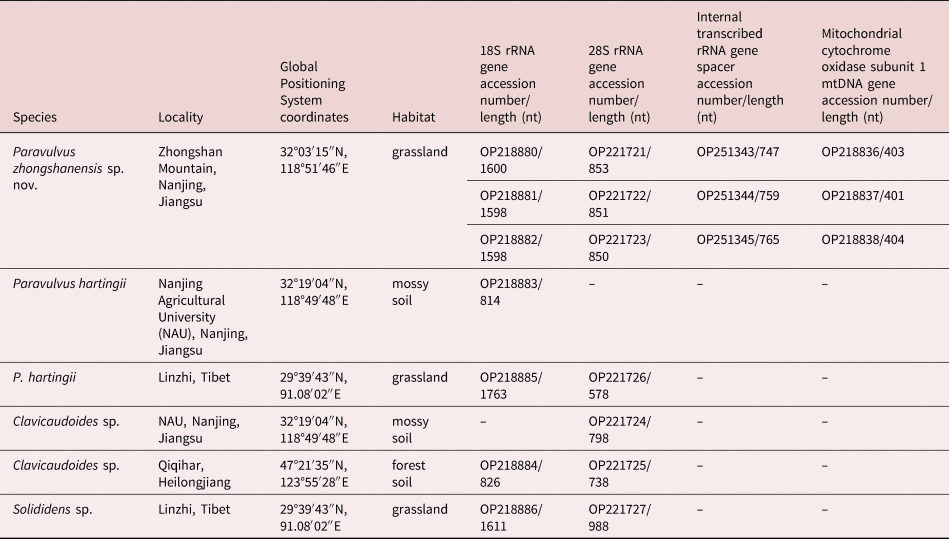
A general nematode survey was conducted in several provinces of China during 2020–2021. Six nygolaimid populations from genera Clavicaudoides Heyns, Reference Heyns1968, Paravulvus and Solididens Heyns, Reference Heyns1968, were recovered from moss, grass and forest soil samples (table 1). All these populations were morphologically and molecularly identified, and three populations of the genus Paravulvus were identified to species level, including one population of Paravulvus hartingii (de Man, Reference de Man1880) Heyns, Reference Heyns1968 recovered from grassland in the Tibet Autonomous Region, another population from mossy soil in the campus of Nanjing Agricultural University and one undescribed Paravulvus species from the rhizospheric soil of several grasses at the Zhongshan Mountain region in Nanjing. In the present study, we described this new species with a detailed morphological and molecular characterization, and we provided the first sequences for internal transcribed rRNA gene spacer (ITS) sequence as well as the mitochondrial cytochrome oxidase subunit 1 (COI) gene in suborder Nygolaimina Ahmad & Jairajpuri, Reference Ahmad and Jairajpuri1979.
The origin and molecular information of nygolaimid species in this study.

Materials and methods
Nematodes’ extraction and morphological observations
In April 2021, soil samples were collected from the rhizosphere of grass species including Digitaria sanguinalis L., Cynodon dactylon (L.) Pers., Erigeron acer Linn and Hemarthria altissima (Poir.) Hubb. at the Zhongshan Mountain region in Nanjing of Jiangsu Province, China (table 1). The nematodes were extracted using the modified Baermann tray method (Whitehead & Hemming, Reference Whitehead and Hemming1965). The fresh nematodes were killed by heat, fixed with formaldehyde solution at 60 °C and processed to ethanol–glycerine dehydration according to Seinhorst (Reference Seinhorst1959) as modified by De Grisse (Reference De Grisse1969), and mounted on permanent slides. Specimens were examined, photographed and measured using an Olympus BX51 microscope equipped with an Olympus DP72 camera (Olympus Corporation, Tokyo, Japan). Morphometrics included de Man's indices and standard measurements. The location of the pharyngeal gland nuclei was expressed according to Loof & Coomans (Reference Loof and Coomans1968).
DNA extraction and polymerase chain reaction (PCR) amplification
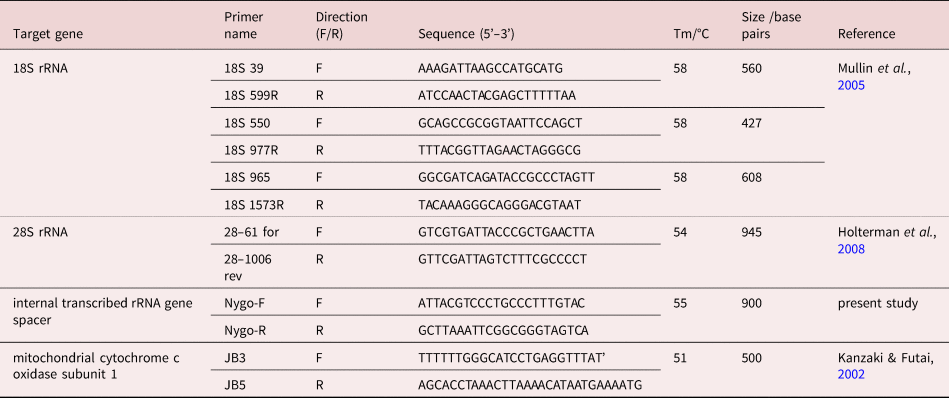
The DNA samples were extracted from nematode individuals according to Li et al. (Reference Li, Trinh, Waeyenberge and Moens2008). The fragments of 18S and 28S rRNA genes and the ITS, as well as that of the COI gene, were amplified with the corresponding primer pairs listed in table 2.
Information about primers used in this study. F = forward, R = reverse

The PCR reaction was carried out in a total volume of 25 μl containing 1 μl of DNA template, 2 μl of each primer (10 μM), 12.5 μl of Ex Taq DNA Polymerase Mix (Bioscience, Shanghai, China), and 7.5 μl double-distilled water. The thermal cycle programme was as follows: initial step of 95 °C for 4 min; 35 cycles of 30 s at 95 °C; 30 s at annealing temperature corresponded to the primer pair and 2 min at 72 °C; and finished at 72 °C for 10 min. PCR products were separated on 1% agarose gels and visualized by staining with ethidium bromide. PCR products of sufficiently high quality were purified for cloning and sequencing by Sangon Corporation (Sangon Biotech, Shanghai, China).
Phylogenetic analysis
The newly obtained sequences of all nygolaims (table 1) were subjected to a Basic Local Alignment Search Tool to check for closely related species on GenBank. The sequences of relevant species in Nygolaimina, representative species in Dorylaimina, typical species in Mononchida Jairajpuri, 1969 or Mermithida Hyman, 1951, were downloaded from the GenBank. All the collected sequences for each gene were aligned by using MAFFT v. 7.205 with the G-INS-i algorithm (Katoh & Standley, Reference Katoh and Standley2013), except the COI gene was aligned using TranslatorX (Abascal et al., Reference Abascal, Zardoya and Telford2010) under the invertebrate mitochondrial genetic code. The sequence dataset was analysed with Bayesian inference (BI) and maximum likelihood (ML) on CIPRES Science Gateway v.3.3 (Miller et al., Reference Miller, Pfeiffer and Schwartz2010) using MrBayes 3.2.3 (Ronquist et al., Reference Ronquist, Teslenko and van der Mark2012) and RAxML 8.1.11 (Stamatakis et al., Reference Stamatakis, Hoover and Rougemont2008), respectively. BI analyses of all genes were performed under the GTR + I + G evolutionary model. The Markov chains were set with 1 × 10⁷ generations, two runs and 25% burn-in and the sampling frequency was one per 100 generations. ML analysis included 1000 bootstrap (BS) replicates under the GTRCAT model. Trees were visualized and modified by using the FigTree v. 1.4.3 (Rambaut, Reference Rambaut2016) and the Adobe Illustrator CS5.
Results
Paravulvus zhongshanensis sp. nov.
ZooBank identifier: 1160E054-AC24-47F1-9491-D92A904CA653
Description
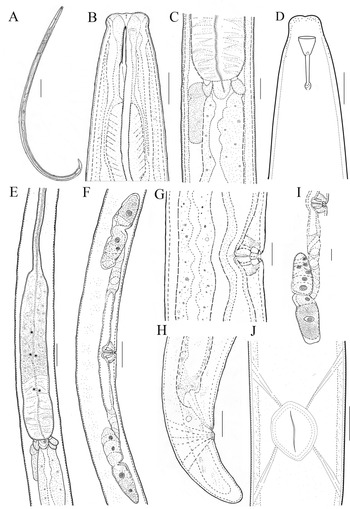
Line drawings of Paravulvus zhongshanensis sp. nov. female: (a) entire body; (b) anterior body region; (c) pharynx–intestinal junction; (d) amphidial fovea; (e) posterior part of pharynx; (f) genital system; (g) vulval region; (h) tail region; (i) posterior branch of genital system; and (j) ventral view of vulval region. Scale bars: (a) = 50 μm; (b–d) = 10 μm; (e, f) = 20 μm; (g–j) = 10 μm.

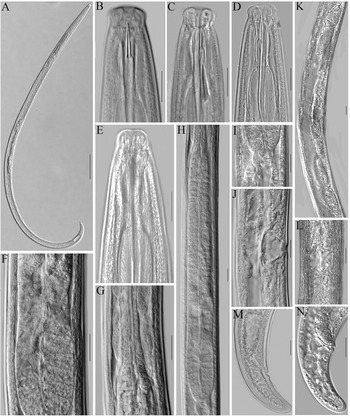
Photomicrographs of Paravulvus zhongshanensis sp. nov. female: (a) entire body; (b–d) anterior body region; (e) amphidial fovea; (f) basal part of pharynx; (g) anterior part of pharyngeal bulb; (h) entire expanded part of pharynx; (i) pharynx–intestinal junction; (j) vulval region; (k) genital system; (l) longitudinal opening of vulva; and (m, n) tail region. Scale bars: (a) = 100 μm; (b–n) = 10 μm.

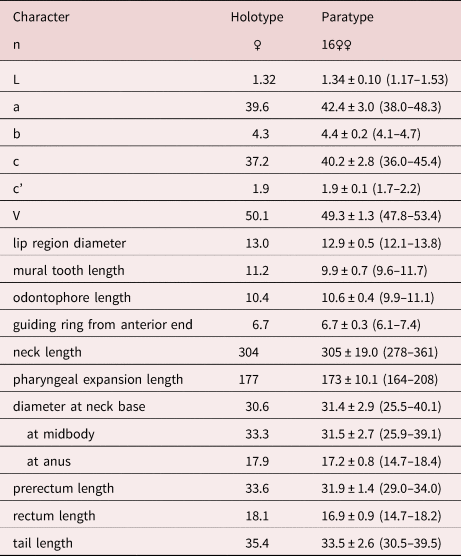
Morphometric data of Paravulvus zhongshanensis sp. nov. All measurements are in μm except L in mm, and in the form: mean ± standard deviation (range).

♀, female.
Female: Slender to very slender nematodes of medium size. Body cylindrical, tapering towards both extremities, but more so towards posterior end. Habitus curved ventrad after fixation, especially in posterior body region, to C-shaped. Cuticle smooth, two-layered, its thickness 1.5 μm on mid-body and 2.0 μm on tail tip. Lateral, dorsal and ventral body pores indistinct. Lip region offset by depression as a marked constriction (a deep furrow or groove separating two parts), with smooth or slightly angular contour, 2.0–2.5 times as broad as high and 41.1% (37.5–48.5%) of body diameter at neck base. Amphidial fovea cup-shaped, located at approximately 1.0 μm from lip region, its aperture 6.9 μm (6.5–7.5 μm) or 53.6% (50.4–56.9%) of lip region diameter. Cheilostom nearly cylindrical, lacking any differentiation. Mural tooth deltoid, with visible lumen throughout its length, 0.8–0.9 times as long as lip region diameter. Guiding ring simple, situated at 6.0–7.5 μm from anterior end. Odontophore well developed, 0.9–1.1 times the odontostyle length. Anterior region of pharynx weakly muscular and enlarging gradually, basal expansion occupying 56.6% (53.9–62.0%) of total neck length. Expanded part of pharynx differentiated into two parts of different texture, with anterior two-thirds part having a much coarser granular appearance. Pharynx gland nuclei located as follows: DO (orifice of dorsal gland)= 66.8% (66.1–68.8%); DN (dorsal gland nucleus at center of nucleolus) = 71.1% (70.8–72.6%); DO–DN = 3.95% (3.6–4.3%); S1N1 (anterior nucleus of the first pair of ventrosublateral glands)= 76.4% (74.7–78.9%); S1N2 (posterior nucleus of the first pair of ventrosublateral glands)= 77.0% (75.1–78.9%); S2N1 (anterior nucleus of the second pair of ventrosublateral glands)= 87.1% (85.9–88.5%); S2N2 (posterior nucleus of the second pair of ventrosublateral glands) = 87.7% (86.6–88.8%). Cardia rounded-conoid, 10.2 μm (9.5–11.5) long; cardiac glands longitudinal (longer than wide), 9.0 × 4.5–5.0 μm. A dorsal cell mass present at level of anterior end of intestine. Nerve ring located at 81.6 μm (71.0–91.0 μm) from anterior end or 26.8% (22.6–30.8%) of total neck length. Genital system didelphic–amphidelphic, with both branches equally and well-developed, anterior branch 173 μm (135–207 μm) or 13% (11–16%) of body length, and posterior one 172 μm (147–202 μm) or 13% (11–16%) of body length. Ovaries usually small, reflexed, not surpassing the sphincter level, anterior ovary 61.1 μm (52.3–72.9 μm) and posterior one 65.3 μm (59.0–80.0 μm) long; oocytes arranged first in two or more rows, then in a single row. Oviduct 63.8 μm (61.0–69.0 μm) long or 1.7–2.1 times corresponding body diameter, consisting of slender part made of prismatic cells and well-developed pars dilatata without distinct lumen. Oviduct–uterus junction barely marked. Uterus a short, simple, tube-like structure 34.1 μm (32.5–35.5 μm) long or 1.0–1.1 times corresponding body diameter. Vagina extending inwards for 14.6 μm (13.5–16.0 μm) or 46.3% (40.2–50.4%) of body diameter, pars proximalis 17–23 × 14–18 μm, with sigmoid walls and surrounded by weak musculature, pars refringens with (in lateral view) two slender pieces measuring 3.5–4.0 × 2.0–2.5 μm and separated by an intermediate hyaline area resulting in a combined width of 9.0–9.5 μm, and pars distalis 3.2 μm (3.0–3.5 μm) long (according to nomenclature proposed by De Ley et al., Reference De Ley, Loof and Coomans1993). Vulva longitudinal, slit 11.4 μm (11.0–11.5 μm) long. Paravulvae absent. Prerectum 1.7–2.2 times and rectum 0.9–1.0 times anal body’ diameters long. Tail subcylindrical conoid with broadly rounded terminus, ventrally concave, and dorsally convex, with thickened cuticle.
Male: Not found.
Diagnosis and relationship
The most characteristic feature of P. zhongshanensis sp. nov. is the combination of paravulvae absent and comparatively longer subcylindrical conoid female tail (c′ = 1.9 (1.7–2.2)), and none of the 16 currently valid species of the genus bears these kind of traits. The new species is further characterized by the female body length of 1.34 mm (1.17–1.53 mm), lip region offset by a marked constriction, mural tooth deltoid with 10.0 μm (9.5–11.5 μm) long, pharyngeal expansion occupying 56.6% (54.0–62.0%) of total neck length, dorsal cell mass present at level of anterior end of intestine, V = 49.3 (47.8–53.4), vulva slit longitudinal 11.4 μm (11.0–11.5 μm) long, paravulvae absent, and male unknown.
According to the key to species identification to the genus Paravulvus (Gilarte et al., Reference Gilarte, Carreira and Peña-Santiago2013), P. zhongshanensis sp. nov. is similar to six species by having conical tail, curved ventrad and c’ value between 1.3 and 2.8, which includes: Paravulvus acuticaudatus (Thorne, Reference Thorne1930) Heyns, Reference Heyns1968; Paravulvus confusus Akthar et al., Reference Akthar, Ahmad and Jairajpuri1994; Paravulvus hartingii; Paravulvus iranicus Olia et al., Reference Olia, Ahmad, Choudhary and Jairajpuri2004; Paravulvus loofi Ahmad et al., Reference Ahmad, Araki and Kaneda2003; and Paravulvus microdontus Olia et al., Reference Olia, Ahmad, Choudhary and Jairajpuri2004.
However, the new species differs from P. acuticaudatus by the shorter female body length (1.17–1.53 vs. 1.61–2.01 mm), mural tooth shape (deltoid vs. solididentoid–deltoid) and longer length (9.5–11.5 vs. 5.0–7.0 μm), larger pharyngeal expansion (53.9–62.0% vs. 46–52% of total length), comparatively shorter prerectum length (1.7–2.2 vs. 2.7–3.7 times of anal body diameter), and female tail shape (subcylindrical conoid with broadly rounded terminus vs. short conical with finely rounded tip); from P. confusus by the female mural tooth length (9.6–11.7 μm vs. 7.5–10.0 μm), dorsal cell mass at level of anterior end of intestine (present vs. absent), DN position (at 70.8–72.6% vs. 52–55% of total pharynx length), S1N1 position (at 74.7–78.9% vs. 64–67% of total pharynx length), prerectum length (29–34 μm vs. 39–45 μm, or 1.7–2.2 vs. 2–3 times of anal body diam.), V value (47.8–53.4 vs. 44–47), a value (38.0–48.3 vs. 31–39), c value (36.0–45.4 vs. 25–35), and tail shape (subcylindrical conoid with broadly rounded terminus vs. elongated-conoid, ventrally arcuate with finely rounded tip); from P. hartingii by lip region (offset by a marked constriction vs. continuous with body), S1N1 position (at 74.7–78.9% vs. 80–83% of total pharynx length), c′ value of female (1.7–2.2 vs. 1.9–3.8), and tail shape (subcylindrical conoid with broadly rounded terminus vs. elongated-conoid, ventrally arcuate with finely rounded tip) according to Gilarte et al. (Reference Gilarte, Carreira and Peña-Santiago2013); from P. iranicus by mural tooth length (9.6–11.7 μm vs. 7.5–8 μm), DN position (at 70.8–72.6% vs. 63–64% of total pharynx length), S1N1 position (74.7–78.9% vs. 73–74% of total pharynx length), V value (47.8–53.4 vs. 39–45), prerectum length (1.7–2.2 vs. 2.7–3.2 times of anal body diam.), female tail shape (subcylindrical conoid with broadly rounded terminus vs. conoid, with finely rounded terminus), and shorter female tail length (30.5–39.5, c = 36.0–45.4, c′ = 1.7–2.2 μm vs. 43.0–58.0 μm, c = 28.0–33.0, c′ = 2.3–2.6); from P. loofi by the longer female mural tooth length (9.5–11.5 vs. 6.5–7.5 μm), larger pharyngeal expansion (53.9–62.0% vs. 44.0–51.0% of total length), DN position (at 70.8–72.6% vs. 68–69% of total pharynx length), S1N1 position (at 74.7–78.9% vs. 72–74% of total pharynx length), tail shape (subcylindrical conoid with broadly rounded terminus vs. conoid with peg-like terminus), longer tail length (30.5–39.5 μm vs. 21.0–34.0 μm), and absence of male (vs. presence); and finally from P. microdontus by the longer female mural tooth length (9.5–11.5 μm vs. 4.0–5.0 μm), DN position at (70.8–72.6% vs. 56–57% of total pharynx length), S1N1 position at (74.7–78.9% vs. 67–68% of total pharynx length), comparative prerectum length (1.7–2.2 vs. 2.5–3.0 times of anal body diameter), female tail shape (subcylindrical conoid with broadly rounded terminus vs. short conoid ventrally arcuate with sharply-rounded tip), and lower c′ value (1.7–2.2 vs. 2.2–2.6).
Type host and locality
Rhizosphere of grasses including Digitaria sanguinalis, Cynodon dactylon, Erigeron acer and Hemarthria altissima at the Zhongshan Mountain region in Nanjing, China (Global Positioning System coordinates: 32°03′15″N, 118°51′46″E).
Type material
Holotype female and additional paratypes (six females and three juveniles in two slides) are deposited in the collection of the Nematology Laboratory of Nanjing Agricultural University. Four paratype females in two slides (collection numbers PTP16236A and PTP16236B), are deposited in the nematode collection of the National Museum of Natural Sciences, Madrid, Spain.
Etymology
The species epithet refers to the mountain where the species was recovered (Zhongshan Mountain in Nanjing, China).
Molecular characterization and phylogeny
The GenBank accession number and information on the length of the sequences of rRNA genes and COI mtDNA gene of P. zhongshanensis sp. nov. are listed in table 1. The molecular information of the Jiangsu and Tibet populations of P. hartingii, Jiangsu and Heilongjiang populations of Clavicaudoides sp. and Tibet population of Solididens sp., are also listed in table 1.
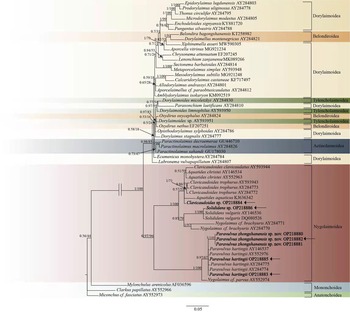
The phylogenetic relationships of P. zhongshanensis sp. nov. were revealed by the BI and ML analyses based on the sequences of the 18S and 28S genes. The 18S tree (fig. 3) showed the new species grouped with P. hartingii (AY146537, AY552976, AY284774 and AY284775) and two Chinese populations of P. hartingii obtained in this study (OP218883 and OP218885), with posterior probability (PP) and BS values as 0.97 and 67, respectively. This clade forms a monophyletic group with Nygolaimus cf. parvus Thorne, Reference Thorne1974 (AY552974) (PP = 1, BS = 100). The aforementioned clade is in sister relation with the clade including species of genera Aquatides Heyns, Reference Heyns1968, Clavicaudoides, Nygolaimus Cobb, Reference Cobb1913 and Solididens, representatives of the superfamily Nygolaimoidea Thorne, Reference Thorne1935 (PP = 0.97, BS = 96). The clade of Nygolaimoidea has separated from the clade including all other superfamilies of the order Dorylaimida Pearse, Reference Pearse1942. Intraspecific variation among the 18S gene of the new species is 0–1 nucleotide (99.9–100.0% identity, 1598–1600 base pairs (bp)). The new species (OP218880) differs from the Tibet population of P. hartingii (OP218885) by 51 nucleotides (97.4% identity, 1579 bp/1630 bp), and from Jiangsu population of P. hartingii (OP218883) by 14 nucleotides (98.3% identity, 800 bp/814 bp), and from P. hartingii PVulHar2 isolate (AY284775) by 67 nucleotides (96.6% identity, 1568 bp/1618 bp), and from Nygolaimus cf. parvus by 71 nucleotides (96.1% identity, 1559 bp/1630 bp).
Bayesian 50% majority-rule consensus tree of Paravulvus zhongshanensis sp. nov. and other related nematodes in the order Dorylaimida Pearse, Reference Pearse1942 inferred from 18S rRNA gene. Dataset was aligned with G-INS-i implemented in MAFFT. The values at clade node indicate posterior probability/bootstrap. Newly obtained sequences are indicated in boldface typ. The scale bar indicates expected changes per site.

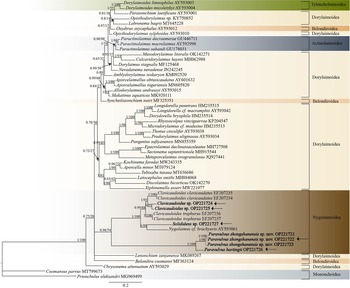
The 28S tree (fig. 4) showed similar relationships as that revealed by the 18S phylogeny. The new species grouped with the Tibet population of P. hartingii into a maximally supported clade (PP = 1, BS = 100). This clade was in sister relationship with a fully supported branch (PP = 1, BS = 100) containing species of Clavicaudoides and Nygolaimus, forming Nygolaimoidea clade (PP = 0.96, BS = 54) together. Intraspecific variation among the 28S gene of the new species is 2–19 nucleotides (97.8–99.8% identity, 850 bp–853 bp), while the new species (OP221721) differs from the Tibet population of P. hartingii (OP221726) by 141 nucleotides (78.4% identity, 437 bp/578 bp). Because only very few reference sequences are available in GenBank, ITS and COI genes were not used for phylogeny reconstruction. The intraspecific variation among the ITS sequences of the new species were 35–96 nucleotides (87.7–95.8% identity, 747–765 bp). Moreover, for the COI gene, the intraspecific variation of the new species is 1–4 nucleotides (99.1–99.7% identity, 401–404 bp).
Bayesian 50% majority-rule consensus tree of Paravulvus zhongshanensis sp. nov. and other related nematodes in Dorylaimida Pearse, Reference Pearse1942 inferred from 28S rRNA gene. Dataset was aligned with G-INS-i implemented in MAFFT. The values at clade node indicate posterior probability/bootstrap. Newly obtained sequences are indicated in boldface type. The scale bar indicates expected changes per site.

Discussion
Paravulvus zhongshanensis sp. nov. was characterized through morphological observation and molecular analysis in the present study. The new species fits the typical pattern of genus Paravulvus by having the longitudinal vulva, unusual arrangement of pharyngeal gland nuclei, presence of large dorsal cell mass(es) at level of anterior end of intestine and pars refringens vaginae present (Ahmad & Jairajpuri, Reference Ahmad and Jairajpuri1982; Jairajpuri & Ahmad, Reference Jairajpuri and Ahmad1992; Lazarova et al., Reference Lazarova, Peneva and Loof2002; Gilarte et al., Reference Gilarte, Carreira and Peña-Santiago2013).
According to intrageneric morphology variability in Paravulvus, this new species is easily distinguished from other species of the genus by its deltoid mural tooth, absence of paravulvae and subcylindrical conoid with broadly rounded terminus, although it is so similar to P. hartingii and P. confusus, two very similar species (Gilarte et al., Reference Gilarte, Carreira and Peña-Santiago2013).
The molecular data in genus Paravulvus are rather deficient. Currently molecular data available in GenBank for 18S rRNA gene are limited to P. hartingii and an unidentified Paravulvus species, whereas for 28S rRNA gene, there is only one, assigned to P. hartingii, and neither ITS rRNA gene nor COI mtDNA gene have been sequenced for the genus yet. Therefore, the molecular data, herein obtained, represent the first molecular information for the ITS rRNA and COI mtDNA genes for the suborder Nygolaimina. Based on the molecular data of the 18S and 28S marker genes, we resolved the evolutionary status of P. zhongshanensis sp. nov. by phylogenetic analysis. In this contribution, 20 sequences from six nygolaim populations were newly obtained, which enriched the nygolaim molecular database. The 18S and 28S phylogenetic trees in our study perfectly fit with previous results (Mullin et al., Reference Mullin, Harris and Powers2005; van Megen et al., Reference Van Megen, Van Den Elsen, Holterman, Karssen, Mooyman and Helder2009) and show that the members of the suborder Nygolaimina clustered together in a well-supported clade, comprising two subgroups, one clade including the sequences of the genera Solididens, Aquatides and Clavicaudoides or the genera Solididens and Clavicaudoides, respectively. in the 18S and 28S trees, and the other clade including sequences of the genus Paravulvus. Besides, the 18S tree shows that the sequences of the genus Nygolaimus have placed in two aforementioned clades, which is in accordance with a previous study (van Megen et al., Reference Van Megen, Van Den Elsen, Holterman, Karssen, Mooyman and Helder2009). Further analyses with broader sampling and more species of the members of Nygolaimina are needed to clarify the phylogenetic relationships between the families and genera of this suborder.
The recovery of six nygolaimid populations of the genera Clavicaudoides, Paravulvus and Solididens from moss, grass and forest soil samples indicated their wide distribution in different ecosystems on Chinese land. Further samplings for nygolaimid nematodes together with morphological and molecular analyses may present more useful and interesting information on diversity of this group in China.
Financial support
This research was supported by the National Natural Science Foundation of China (Grant number 32001876). S. Álvarez-Ortega thanks ‘AYUDA PUENTE 2020, URJC’ of the Universidad Rey Juan Carlos for financial support.
Conflicts of interest
None.
Ethical standards
The authors assert that all procedures contributing to this work comply with the ethical standards of the relevant national and institutional guides on the care and use of laboratory animals.