The salience of racial group identity is a central theme in the literature on black political attitudes, where perceptions of racial interdependence are said to account for both the homogeneity and the decidedly liberal bent that are the defining features of black public opinion (Kinder and Winters 2001; Tate 1993). There is considerable evidence that African Americans, believing that their individual fates are closely linked to that of blacks as a group, routinely substitute group utility for individual utility when evaluating policies, parties, and candidates (Dawson 1994). Furthermore, beliefs about the persistence of racial discrimination as a barrier to economic opportunity are integral to assessments of group interests (Hochschild 1995; Sigelman and Welch 1991). Perceptions of shared fate, together with continued concern over the obstacles to black socioeconomic attainment, have proven to be powerful constraints on incipient class divisions in black public opinion.
Although rooted in a history of racial inequality, research suggests that social environments play a role in maintaining the salience of racial identity (e.g., Gurin, Miller, and Gurin 1980; Lau 1989; and Welch et al. 2001). Scholars have emphasized, in particular, the influence of residential segregation, whose effects include the “freedom to maintain [black] cultural ties and identities” (Tate 1993, 27). By providing the social and institutional settings that facilitate interpersonal contact, draw attention to the collective aspects of black life, and allow for the transmission of group-based norms, residence in a predominantly black community may increase the likelihood that shared values and shared fate will be demonstrated and perceived.
Largely overlooked in the discussion of social environments is how the socioeconomic characteristics of neighborhoods affect the salience of racial group identity. Individual socioeconomic status is known to affect blacks' racial attitudes, with higher-status African Americans believing more strongly that race remains the defining interest in individuals' lives (Dawson 1994; Dillingham 1981; Hochschild 1995; but see Broman, Neighbors, and Jackson 1988).1
The positive association between individual socioeconomic status and black racial identification is well documented, though not well understood. Traditionally, social theorists have maintained that socioeconomic mobility weakens racial ties. Early accounts of the black middle-class included unflattering depictions of this social group as lacking in racial consciousness, concerned more with conforming to “(white) bourgeois ideals and standards of behavior” than playing “the role of a responsible elite in the Negro community” (Frazier 1957, 112, 235). Empirical studies, however, have found that higher-status blacks (as measured by education and, to a lesser extent, income) remain strongly racially identified. Tate (1993) hypothesizes that education brings greater awareness of the extent of racial inequality in the United States, and those more cognizant of racial inequality are more race-conscious. Others have hypothesized that with socioeconomic mobility comes greater interaction with whites and, as a consequence, more exposure to instances of racial discrimination (Cose 1995; Hochschild 1995; Landry 1987). Negative racial experiences may sustain racial identification among higher-status blacks.
If, as Huckfeldt and Kohlfeld (
1989) contend, “preferences are not constructed or sustained in a social vacuum,” then perhaps the racial predispositions of a community's dominant socioeconomic group are an important influence on the attitudes of individual neighborhood residents. Moreover, neighborhood socioeconomic conditions greatly affect how blacks evaluate their quality of life: the more African Americans are able to distance themselves from the social and economic dislocation suffered by poor communities, the more likely they are to express satisfaction with their lives (DeFrances
1996). Living in well-tended neighborhoods with safe streets and ample services also may affect African Americans' perceptions that their life chances remain overly determined by race.
With these considerations in mind, I examine the relationship between neighborhood socioeconomic context and black racial attitudes. I distinguish between the effects associated with the socioeconomic status of one's neighbors (i.e., How does living amongst higher-status blacks shape racial attitudes?) and the effects associated with the quality of one's neighborhood (i.e., How does access to the resources and opportunities available in some communities shape racial attitudes?). By putting race in context, the analysis reveals the conditional nature—and reminds us of the material roots—of black racial identity. In closing, I discuss the implications of shifting residential patterns for the future of political consensus and group-based mobilization among African Americans.
RACIAL ATTITUDES AND THE BLACK URBAN EXODUS
The last three decades have witnessed a steady out-migration of middle-class blacks from the nation's segregated central cities (e.g., Frey 2001, O'Hare and Frey 1992, and Schneider and Phelan 1993). This urban exodus, which has nearly doubled the rate of black suburbanization, from 19% in 1980 to 35% of the black population in 2000, has renewed scholarly interest in the role of racial environment as a determinant of blacks' racial attitudes (Bledsoe et al. 1995; Lau 1989; Welch et al. 2001). Consistent with social psychological theories emphasizing the importance of intragroup contact to group identification and consciousness (Demo and Hughes 1990; Gurin, Miller, and Gurin 1980), the empirical evidence suggests that residential segregation and expressions of racial solidarity are closely associated, leading some to predict that the move out of the inner city will precipitate a move away from group-based politics (Bledsoe et al. 1995; Welch et al. 2001).
The emphasis on the implications of neighborhood racial change has often overshadowed attention to the socioeconomic aspects of these recent demographic trends. For upwardly mobile African Americans the move out of the central city promises greater access to communities that may be not only more racially integrated, but also more uniformly middle-class and more insulated from the concentrated poverty of the urban core. In fact, neighborhood socioeconomic change has outpaced racial change; many middle-class blacks leave segregated urban neighborhoods only to find themselves in equally segregated suburban communities (Frey 1994; Logan, Alba, and Leung 1996; Phelan and Schneider 1996). Results from the 2000 Census indicate that the majority of suburban blacks reside in suburbs where the level of residential segregation not only is high, but has not changed since 1990 (Logan 2001). In short, the black urban exodus has succeeded less as a vehicle for racial change than for economic segregation.
As early as the 1960s, psychologists and sociologists have argued that socioeconomic conditions—concentrated poverty, in particular—influence black cultural identity (e.g., Anderson 1992, Clark 1965, and Wilson 1987). Variously described as an “oppositional identity” or “street culture,” scholars have identified a set of behaviors, attitudes, and values—many viewed as being at odds with those held in wider society—that have evolved as part of a psychological adaptation to the harsh conditions of ghetto life. The evolution and adoption of Black English Vernacular are cited as one example of this oppositional identity (Baugh 1983). Where socioeconomic conditions make it difficult for blacks to live up to the ideals of “middle-class American culture,” an alternative status system takes shape—one that “legitimates the social and economic shortcomings of ghetto blacks” by attaching “value and meaning to a way of life that the broader society would label as deviant and unworthy” (Massey and Denton 1993, 166–67). This psychological adaptation may extend to beliefs about race as a determinant of life chances; that is, both the content (i.e., what it means to be “black”) and the salience of black identity may reflect the opportunities and constraints present in the social environment. Thus, shifting patterns of economic segregation, and not simply changes in the spatial separation of whites and blacks, may have important consequences for the racial predispositions central to black political attitudes and behavior.
Few empirical studies have considered whether economically divergent residential experiences are associated with marked differences in African Americans' views on race. To the extent that scholars emphasize socioeconomic status, the focus generally has been on individual-level attributes as opposed to the socioeconomic characteristics of neighborhoods. Research by Cathy Cohen and Michael Dawson (1993) on the effects of neighborhood poverty was unique in its emphasis on contextual rather than individual poverty, establishing its consequences for black political beliefs and behavior. Drawing on a survey of African Americans in the Detroit metropolitan area, the authors found that the social isolation of extremely poor neighborhoods fosters political isolation, manifested in low levels of political efficacy and limited involvement in some forms of political activity. While Cohen and Dawson hypothesized that the social isolation of poor communities may also “break down feelings of racial group solidarity,” they did not address this relationship at length, noting only that they “found no systematic differences in racial attitudes among our respondents” (290). In this paper, I expand on their pioneering work by examining more closely how various aspects of the socioeconomic environment impact key elements of blacks' racial belief system.
Bledsoe and his colleagues provide indirect evidence of a potential role for socioeconomic context in shaping black racial attitudes (Bledsoe et al. 1995; Welch et al. 2001). Although primarily interested in the effect of racial context, after controlling for the racial composition of neighborhoods, the researchers find that blacks in the Detroit metropolitan area differ in their willingness to subscribe to notions of black autonomy (e.g., “Blacks should always vote for black candidates”) based on whether they live in urban or suburban communities; suburbanization is negatively associated with expressions of black autonomy. Differences in the socioeconomic character of these metropolitan communities may account for this relationship. Unfortunately, because cities and suburbs differ from each other in myriad ways, the operationalization used in this research (i.e., a dichotomous indicator of city or suburban residence) does not allow for sharp inferences about the role of socioeconomic context per se. The authors note, for instance, that the observed relationship may be an artifact of city–suburban differences in the presence and prominence of minority political leadership. Furthermore, suburbs themselves vary greatly, ranging from solidly middle-class communities well away from the central city to older, more economically heterogeneous inner-ring neighborhoods that border the city center and share many of its problems. Thus, while the findings on suburbanization, like the work of Cohen and Dawson on neighborhood poverty, suggest the importance of context, the relationship between socioeconomic environment and black racial attitudes remains undetermined.
NEIGHBORHOOD QUALITY AND STATUS AS DETERMINANTS OF RACIAL ATTITUDES
There are two aspects of African Americans' socioeconomic environments with the potential to affect attitudes. First, because racial attitudes vary systematically with individual socioeconomic status, the spatial concentration of socioeconomic groups may give rise to distinct racial norms. As individuals look to their environments for informational cues, “testing their judgments against social interaction” and adopting those that are positively reinforced, their opinions may come to mirror the attitudes and preferences of their neighbors (Huckfeldt and Kohlfeld 1989, 57). The centrality of neighborhood-based social interaction in the formation of attitudes, especially in the maintenance of ethnic ties (Huckfeldt 1986), suggests the importance of population composition for blacks' views on race. Prior research has shown that “higher-status” blacks, typically measured by educational attainment, are more likely than “lower-status” blacks to subscribe to notions of shared fate and to believe that racial group membership determines one's access to economic opportunity (Dawson 1994; Tate 1993). Thus, living primarily amongst higher-status African Americans may encourage the view that race remains the defining interest in one's life. Conversely, when an individual's neighbors are mostly of low socioeconomic status, that individual may be more likely to downplay racial group membership as a determinant of his or her own life chances.
The higher density of neighborhood institutions found in communities with high-status residents may amplify this spatial disparity in black racial attitudes. As William Julius Wilson and others have observed, neighborhoods with significant numbers of working- and middle-class families are more likely than poor neighborhoods to house a network of community organizations, including churches, block groups, athletic leagues, neighborhood associations, and social clubs (e.g., Berry, Portney, and Thomson 1993; Wacquant and Wilson 1993; and Wilson 1987). Neighborhood institutions not only provide a forum for social interaction, which enables the reinforcement and perpetuation of community norms, but also may shape the content of the norms themselves. Scholars have noted the important role played by black community institutions and networks in maintaining group beliefs and the salience of group identity (Dawson 1994, 2002; Demo and Hughes 1990). Institutions such as the black church, whose clerical and lay leaders often emphasize a “racially oriented analysis of…social progress” (Dawson 1994, 66), are instrumental in framing perceptions of racial group status and interests, as well as in facilitating the intergenerational transmission of community values and beliefs (Harris 1999; Hughes and Demo 1989). In lower-status neighborhoods, where the absence of economically stable and secure families may erode a community's organizational strength, the dearth of informal and formal institutions leaves residents largely disconnected from the “networks of communication and community learning” (Cohen and Dawson 1993, 290) so critical to the development and diffusion of African Americans' racial belief system. In contrast, communities with significant concentrations of higher-status blacks are better able to sustain numerous social institutions. The proliferation of such associational spaces, where attention to the collective aspects of black life is encouraged and social interaction is facilitated, may “foster a deeper and more assertive racial group consciousness” among neighborhood residents (Rogers 2001, 174).
These expectations regarding the effects of neighborhood socioeconomic composition lead to the following hypothesis: African Americans in neighborhoods with high-status black residents are more likely than African Americans in low-status neighborhoods to view race as the defining interest in their lives (H1).
In addition to the socioeconomic status of its residents, the quality of neighborhood resources is another aspect of the socioeconomic environment with the potential to affect blacks' views about race. Resources and opportunities are not distributed equally across neighborhoods; some residential areas enjoy better services, safer and cleaner streets, and higher home values than others, with favorable implications for the social and economic well-being of neighborhood residents. Historically, efforts by African Americans to convert occupational mobility and rising incomes into improved residential circumstances have met with limited success; a racially segregated housing market constrains their ability to move freely in search of more desirable neighborhoods (e.g., Alba and Logan 1991, Darden 1990, and Logan and Alba 1993). Reviewing the findings of prior research, Massey and Denton (1993, 151) conclude that “dollar for dollar, blacks are able to buy fewer neighborhood amenities with their income than other groups.” Because the residential returns to middle-class status are smaller for blacks, the majority of upwardly mobile African Americans reside in communities with more abandoned housing, higher crime rates, fewer local services, less spending on infrastructure and development, lower environmental quality, higher public debt, and poorer prospects for economic growth than the neighborhoods in which whites of comparable socioeconomic status reside (e.g., Alba, Logan, and Bellair 1994; Phelan and Schneider 1996; and Villemez 1980). If race limits the residential mobility of African Americans, then residential circumstances—for example, access to the amenities available in better neighborhoods—may factor into beliefs about the persistence of race as a defining interest in one's life. Moreover, when one considers the legacy of economic oppression that provides the objective, material basis for black racial identity—as Dawson (1994, 4) eloquently states, “The key to the historical origins of African-American social identity can be found ‘behind the mule’”—the significance that socioeconomic environs, and exposure to material deprivation, may have for African Americans becomes clear. The salience of an identity forged “behind the mule” may well depend on whether its standing image of the black experience (i.e., one in which racial and economic subordination are intertwined) fits one's own social reality.
Oliver and Mendelberg (2000, 576) discuss the “constellation of negative psychological states”—including feelings of relative deprivation, anxiety, and alienation—experienced by residents who find themselves trapped in decaying neighborhoods. Similarly, ethnographic accounts of African Americans in urban ghettos describe a worldview that includes a “tough, cynical attitude toward life, a deep suspicion of the motives of others, and a marked lack of trust in the goodwill or benevolent intentions of people and institutions” (Massey and Denton 1993, 172). For white Americans, the psychological response to adverse socioeconomic conditions includes a hardening of racial attitudes: Economic stress has been shown to provoke suspicion toward out-groups, in general, and antiblack hostility, in particular (Oliver and Mendelberg 2000; see also Olzak 1989 and Pinderhughes 1993). For African Americans, whose shared experience of deprivation is an integral part of their group identity (Dawson 1994), the inability to secure favorable residential circumstances may encourage the belief that race still defines and limits the prospects for socioeconomic attainment.
Conversely, in settings where residents do not contend with substandard housing, inadequate services, or few public goods, less racially deterministic attitudes may prevail. African Americans who enjoy access to the resources and opportunities available in better neighborhoods may identify only weakly with the history of racial suffering that underlies notions of shared fate and predisposes blacks to view race as the defining interest in their lives. As both an indicator of socioeconomic incorporation and a springboard to greater socioeconomic mobility, living in neighborhoods that offer some semblance of “the good life” may contribute to greater optimism about one's life chances.
These expectations regarding the effects of neighborhood quality lead to the following hypothesis: African Americans in neighborhoods with few amenities are more likely than African Americans in high-quality neighborhoods to view race as the defining interest in their lives (H2).
Quality and status composition are conceptually distinct dimensions of neighborhood socioeconomic contexts. They are also hypothesized to affect black racial attitudes through different causal mechanisms. Quality and composition are, however, empirically correlated; “high-status” neighborhoods are likely to be “high-quality” neighborhoods. To the extent that quality and socioeconomic composition are positively correlated, the two hypotheses above imply that they work at cross-purposes in affecting blacks' racial attitudes. The imitative learning processes that can lead individuals to adopt the attitudes of their neighbors may dispose the residents of a black middle-class enclave to embrace notions of shared values and shared fate (H1), while their access to the economic resources crucial to their families' well-being simultaneously may create some doubt about whether race remains the defining interest in their lives (H2).
In sum, the socioeconomic character of neighborhoods may be important in shaping African-American views about race. Contextual effects may arise from the status composition of neighborhoods—where concentrations of higher-status blacks provide social support for a worldview emphasizing the collective aspects of black life—and from neighborhood quality—where access to the resources available in better neighborhoods may encourage the belief that race no longer determines one's life chances.
DATA AND MEASURES
To test these propositions, I use data from the 1992–94 Multi-City Study of Urban Inequality (MCSUI), a linked survey of households and employers in four metropolitan areas: Atlanta, Boston, Detroit, and Los Angeles County. This analysis relies on the household survey component, consisting of face-to-face interviews with 8,916 adults (at least 21 years old), including an oversample of African Americans. I analyze data for the 3,109 respondents who self-identified as black. The survey instrument is supplemented with block-group–level census data on the racial and socioeconomic characteristics of respondents' neighborhoods.2
Block-group–level data are available for 3,102 of the 3,109 black respondents. The median population size for the 514 block-groups represented in this study is 1,140 residents. Because of its size, and the fact that its boundaries demarcate areas that are “relatively homogeneous with respect to population characteristics, economic status, and living conditions” (Bureau of the Census 1990), the block-group serves as the operational definition of a “neighborhood” and I use the two terms interchangeably. Thus, “neighborhood” as used here does not imply a cohesive community, nor does it assume that all residents identify that particular area as their neighborhood. “Neighborhood” refers only to the spatially defined set of “opportunities and constraints operating on social interactions” and potentially affecting individual socioeconomic mobility (Huckfeldt 1986, 10). As such, block-group seems a reasonable surrogate.
The inclusion of detailed contextual data from the 1990 Census, together with the large number of black respondents, makes the MCSUI a valuable data source for investigating the contextual determinants of African-American racial attitudes.
The data, however, are complex and require careful attention to the sampling procedures for proper analysis. In each metropolitan area, the MCSUI investigators sampled households using a multistage, stratified, clustered area-probability design. While each metropolitan survey was unique in terms of the criteria defining the strata and the target sample size, the designs typically included clusters of housing units taken disproportionately from areas with concentrated minority populations and/or low-income households. As a result, unadjusted estimates combining the reports of all black respondents in a metropolitan area overrepresent African Americans in heavily black and/or poor neighborhoods, leading to bias. Furthermore, since the effect of clustering is to sample individuals who are more alike—in income and levels of education, for example—than would be expected at random, standard errors may be underestimated, increasing the likelihood of finding statistically significant results. The statistical analyses below take into account these critical design elements, by using sampling weights to correct for the disproportionality introduced by oversampling and to generate unbiased estimates of population means and regression coefficients and by using the robust variance estimator (White 1982) to reflect the inefficiency associated with clustering.3
Ideally a hierarchical model would be used to analyze this multi-level dataset. However, because of the small size and the variability of the block–group–level samples, as well as the inability of commercial packages (such as HLM Version 5.04) to incorporate sampling weights into hierarchical nonlinear models, I used robust standard errors to address the statistical challenges (i.e., correlated error terms among respondents in the same block-group) presented by the clustered data.
Finally, the MCSUI consists of what should be seen as samples of residents of four large metropolitan areas, not necessarily a representative national sample of blacks. The data may not reflect the attitudes of blacks who live outside of these metropolitan areas or who do not live in urbanized areas at all. In terms of the distribution of responses on one common survey item, the measure of “linked fate” discussed below, the MCSUI compares favorably to the two most widely used national surveys of black Americans, the 1993 National Black Political Survey (NBPS) and the 1996 National Black Election Study (NBES).4
Do you think what happens generally to [black] people in this country will have something to do with what happens in your life? Will it affect you a lot, some, or not very much?
Nonetheless, using the MCSUI produces a trade-off: a wealth of information for an unusually large number of black respondents (i.e., more than double the size of the NBPS and NBES samples) but a sample that limits my ability to generalize to America's black population at large. I return to this issue in the conclusion.
Residential Context
Neighborhood socioeconomic composition is measured by the percentage of black residents over 25 with at least some college education (BLOCK-group education). At the individual level, education is known to affect racial attitudes among African Americans (Dawson 1994; Tate 1993). Thus, although there are numerous alternative indicators of neighborhood socioeconomic composition, including income and unemployment, education is the one most likely to affect the content of neighborhood racial norms.5
Dawson (1994) and Tate (1993) find no statistically significant relationship between income and racial attitudes at the individual level. To my knowledge, employment status has not been used in models predicting black racial attitudes. Additionally, educational composition is better distributed across block-groups than either black per capita income or black unemployment, which are both highly skewed.
Furthermore, I emphasize the socioeconomic composition of the
black community to focus attention on how the spatial concentration of particular groups of African Americans may, through various social influence mechanisms, produce “spatially structured patterns of preferences” (Huckeldt and Kohlfeld
1989, 57). In practical terms, living amongst highly educated blacks, in particular, as opposed to highly educated people, in general, is likely to matter more for whether certain racial attitudes are socially supported. The black percentage college-educated has a weighted mean of 47%, with a standard deviation of 22%.
A survey-based measure of NEIGHBORHOOD quality is constructed from a series of four-point Likert scales on which respondents indicate the extent of neighborhood problems with neglected “housing and property” and with “city services, such as street cleaning and garbage collection” and evaluate the quality of neighborhood amenities, including access to “shopping; that is, grocery and drug stores.” DeFrances (1996) relies on similar indicators to measure the neighborhood characteristics that drive quality-of-life assessments for middle-class blacks and whites (see also Basolo and Strong 2002). Although correlated with measures of socioeconomic composition, the use of these survey-based indicators allows me to consider more directly how residential quality of life affects whether individuals believe their social and economic opportunities remain inextricably tied to being black.6
The correlation between black percentage college-educated and neighborhood quality, as measured by the combined assessments of all respondents in the block-group, is 0.40. See the Appendix for discussion of diagnostic tests on the neighborhood quality measure.
Rather than infer the sense of deprivation on the basis of aggregate statistics such as block-group education, these survey items identify the conditions that contribute to the stigmas and stresses of living in undesirable neighborhoods and that may lead to pessimism about one's life chances. The three items were combined in an unweighted average to generate a scale that ranges from a minimum value of 1 (“low quality”) to a maximum value of 4 (“high quality”). The weighted mean (and standard deviation) for the quality scale is 3.1 (0.61).
Racial context is measured by the percentage of block-group residents who are black (BLOCK-group percent black). Although there is variation across and within metropolitan areas, the racial composition of many block-groups shows signs of the hypersegregation common in American cities (Iceland, Weinberg, and Steinmetz 2002; Massey and Denton 1993). In Boston, for instance, where African Americans constitute only 5.2% of the SMSA, black residents live in neighborhoods that are, on average, 59%±2.3% black. Not all blacks, however, are racially isolated; one-quarter of the African Americans in these four metropolitan areas reside in neighborhoods that are less than 23% black. Another 13% live in block-groups with populations less than half black. In addition to the census measure of actual racial context, the data include an indicator of preferred racial context.7
Respondents were shown and asked to rank-order a series of cards depicting neighborhoods with different racial compositions. Each card displayed 15 homes, with “black” households identified by color. The “preferred racial balance” is measured by the proportion of “black” households (of 15) in the respondent's top-ranked neighborhood: 0 (no blacks), 0.13 (two black households), 0.47 (seven black households), 0.66 (10 black households), 1 (all black).
The median preferred racial balance is 47% black.
Racial Attitudes
The MCSUI includes an array of questions exploring racial attitudes. Here I restrict my attention to African Americans' perceptions of “linked fate” (Dawson 1994) and to their beliefs about barriers to black socioeconomic attainment. Whereas Bledsoe and his colleagues emphasized “black autonomy” in their research on the contextual determinants of racial solidarity, focusing on indicators such as support for black political candidates and preference for Afrocentric school curricula, it is African Americans' sense of linked fate and their continuing concerns over discrimination that have been shown to be central to their political attitudes and political behavior (Dawson 1994, 2002; Tate 1993). The belief that one's own life chances depend critically on the well-being of blacks as a group—and that those chances are “uniformly bleak in the face of persistent racial exclusion and discrimination” (Rogers 2001, 169)—has measurable cognitive effects that distinguish the group identifier from the objective group member. Such beliefs define what individuals consider personally relevant, and that, in turn, shapes the perceptual viewpoint they bring to politics. As long as race is perceived to be a defining interest, racial group concerns “[will be] an important component of the way individual blacks go about evaluating policies, parties, and candidates” (Dawson 1994, 57).
I measure LINKED fate with a single two-part question: “Do you think what happens generally to [black] people in this country will have something to do with what happens in your life? Will it affect you a lot, some, or not very much?” Responses were summarized on a four-point scale ranging from 1 (low fate) to 4 (high fate). Across metropolitan areas, linked fate scores ranged from a mean of 2.7±0.11 in Boston to 3.0±0.09 in Los Angeles.
To assess attitudes about the barriers to black socioeconomic attainment, I use the following question: “In general, how much discrimination is there that hurts the chances of [blacks] to get good-paying jobs? Do you think there is a lot, some, only a little, or none at all?”8
The disadvantage of this survey item is that it is concerned only with employment discrimination and is silent on other barriers to black socioeconomic attainment. As a result, the full effect of context on beliefs about discrimination may be underestimated.
Few African Americans (5%±0.5%) believe that discrimination poses little or no threat to black socioeconomic attainment, whereas 63%±2% are convinced that there is “a lot” of discrimination blocking the group's access to job opportunities. Responses to the
PERCEIVED discrimination item were summarized on a three-point scale, constructed by collapsing “only a little” and “none at all” into a single category; the measure ranges from 1 (none or a little) to 3 (a lot).
Individual-Level Traits
Finally, the MCSUI includes data on the respondents' demographic characteristics and socioeconomic status, including AGE, gender (FEMALE), EDUCATION, and FAMILY income. Respondents were also asked about their CHURCH attendance.9
The item regarding church attendance asked, “Do you attend religious services every week, almost every week, once or twice a month, a few times a year, or never?” Responses to this item were recoded into two dichotomous variables, indicating “high” attendance (i.e., “once a week or more”) and “low” attendance (i.e., “a few times a year” to “almost every week”). Respondents who indicated that they never attended religious services were the omitted category.
Prior research has documented the influence of these factors on black racial attitudes (Dawson
1994; Demo and Hughes
1990; Harris
1999). Furthermore, an analysis of the data revealed that such individual-level factors are related to place of residence.
10 Individual education and family income are each moderately correlated with block-group education (r=.35 and .32, respectively). Church attendance is positively correlated with neighborhood quality (r=.11).
For these reasons, they are incorporated in the analysis as control variables.
THE EFFECT OF SOCIOECONOMIC CONTEXT ON RACIAL ATTITUDES
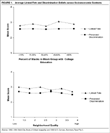
Figure 1 summarizes the bivariate relationships between racial attitudes and socioeconomic contexts. The graphs depict the mean scores on the linked fate and perceived discrimination items across levels of block-group education and neighborhood quality. Black racial attitudes vary little with the educational composition of neighborhoods. Among blacks who live in the most educated contexts, where at least 60% of black residents have attended college, the average linked fate (2.9) and perceived discrimination (2.6) scores are almost identical to the values—2.8 and 2.6, respectively—observed in block-groups where fewer than 15% of residents are college-educated. Although perceptions of linked fate are more variable across contexts than perceptions of discrimination, the small differences in linked fate are statistically insignificant.
Average Linked Fate and Discrimination Beliefs across Socioeconomic Contexts
Contrary to the stability of racial attitudes across block-group education, opinions vary negatively with neighborhood quality. There is a modest decline in expressions of linked fate and perceptions of discrimination as we move from blacks who reside in the least desirable neighborhoods to those who reside in the best. Between “low-” and “high-”quality neighborhoods, the mean score on the linked fate item declines by 10%, from 3.0 to 2.7, and the mean discrimination score declines by 7%, from 2.7 to 2.5. In the case of beliefs about discrimination, the attitude differences are statistically significant at a level below 1%.
Thus the preliminary evidence suggests that (1) the more pronounced contextual effects arise from the quality of the neighborhood, not from its concentration of college-educated blacks, and (2) blacks in high-quality neighborhoods are less inclined to believe that race remains the defining interest in their lives. These cross-tabulations, however, may mask some unmeasured effects. For instance, neighborhood quality varies negatively with the racial composition of the environment; the effects shown in Figure 1 may be confounded in part by the consequences of living amongst few blacks.
To properly estimate the effects of socioeconomic context, I estimated a set of equations that included measures of block-group education and neighborhood quality, as well as other relevant contextual and individual demographic variables. Because of the relationship between the racial and the socioeconomic characteristics of neighborhoods, and the effect of each on racial attitudes, the models control for the racial composition of block-groups. To allow for the possibility that the effect of racial composition may be nonlinear (Lau 1989), I include both a linear and a quadratic term.11
In his study of racial identification among blacks, Lau (1989) found an “inverted-U” relationship between identification and black population density. Identification increased with black population density until one reached census tracts in which more than 70% of residents were black. Beyond that point, the probability of identifying with blacks decreased.
In addition to the actual racial composition of the neighborhood, the models include a control for the respondent's preferred neighborhood racial balance (
PREFERRED percent black). This specification takes into account the potentially reciprocal relationship between racial composition and racial attitudes. Simply put, the salience of racial group identity not only may be affected by residential context but also may drive residential choice. As Bledsoe et al. (
1995, 450) observed, “Racial solidarity [is] a key to sorting out the blacks who prefer to reside in predominantly black or racially integrated neighborhoods.” Black residential choice may operate within the constraints imposed by discrimination in the housing market, but failure to take into account that racial considerations play a role in location decisions could obscure the causal linkages between context and opinion and bias our estimates of the effect of neighborhood racial composition.
12 Once Bledsoe et al. (1995) and Welch et al. (2001) control for “preferred neighborhood racial mix,” the coefficient on neighborhood racial composition declines by 50% and loses statistical significance. Lau (1989) does not control for residential preferences. In the models estimated here, excluding the neighborhood preference measure modestly inflates the coefficients on actual racial composition (though not to the point of statistical significance) and has no appreciable effect on the core relationships of interest—the relationships between racial attitudes and socioeconomic context.
The model also incorporates controls for metropolitan area, including interaction terms between city and the measures of block-group racial and educational composition and neighborhood quality. The four metropolitan areas in this study differ in ways that may affect residents' racial attitudes, as well as the role of neighborhood social contexts in shaping these attitudes. For example, in a city such as Detroit, where the tensions between a predominantly black and poor central city and a predominantly white suburban community have defined politics for more than three decades, African Americans may be more likely to believe that their individual life chances remain limited by the social, economic, and political status of blacks as a group. In such a polarized environment, levels of neighborhood racial integration may also assume added significance in shaping opinions about race. In Atlanta, a city with a well-established black middle-class, a history of black suburbanization, and a tradition of biracial politics, the racial composition of a neighborhood may be less important than whether it offers the resources and amenities that facilitate socioeconomic mobility. As former Mayor William B. Hartsfield famously proclaimed, Atlanta may be a city “too busy to hate.”
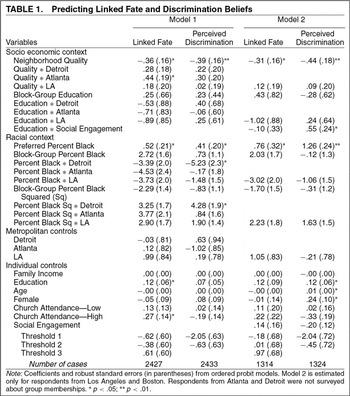
Table 1 presents coefficients from ordered probit models predicting racial attitudes. The relationships depicted in the first two columns of numbers in the table (Model 1) are similar to the bivariate patterns observed in the initial cross-tabulations. Racial attitudes differ significantly based on neighborhood quality, even when other respondent and community characteristics are taken into account. The coefficient for neighborhood quality is negative and statistically significant in both equations. Blacks who reside in neighborhoods offering the security that comes with well-tended homes and easy access to public and private services are less likely to believe that race remains the defining interest in their lives. This pattern holds in three of the four metropolitan areas. The one exception is Atlanta, where expressions of linked fate are unrelated to neighborhood quality; the positive and statistically significant coefficient on the interaction term in the linked fate model essentially translates into an effect size of zero (−0.36+0.44). As for beliefs about discrimination, however, the (negative) effect of neighborhood quality is the same across all metropolitan areas, including Atlanta; the interaction terms between city and neighborhood quality are statistically insignificant in the discrimination model.
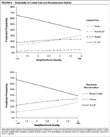
To assess the magnitude of this effect, I plot in Figure 2 the variation in racial attitudes across levels of neighborhood quality, holding all other variables constant at their mean or modal values. (Gender is specified as female, the frequency of church attendance as high, and city of residence as Boston.) For African Americans who reside in the lowest-quality neighborhood, the models predict that they are 66% likely to express a strong belief in linked fate (top panel, solid line) and 67% likely to view racial discrimination as a significant barrier to black socioeconomic attainment (bottom panel, solid line). When neighborhood quality is at its highest, the probability of holding such racially deterministic views declines considerably, to 40% and 39%, respectively. Conversely, between low- and high-quality neighborhoods, the likelihood of believing that one's life chances are not linked to the status of blacks as a group (top panel, dotted line) increases by 18 percentage points, from 13% to 31%; that discrimination does not limit black employment opportunities (bottom panel, dotted line), by 17 percentage points, from 11% to 28%.
Probability of Linked Fate and Discrimination Beliefs
The simulations in Figure 2 also show that African Americans are more likely to express concern about the persistence of antiblack discrimination than they are to subscribe to notions of linked fate. Across neighborhoods, the probability of believing that there is at least “some” job discrimination against blacks exceeds the probability of believing that the status of blacks as a group will have at least “some” effect on one's own life chances. Thus, in neighborhoods with the maximum quality score (4), more than one-third of blacks will assert that their group's status will have nothing or “not very much” to do with their own life chances, but only one-quarter will believe that there is little or no job discrimination against blacks. In fact, at that level of neighborhood quality, African Americans are almost as likely to express strong linked fate beliefs as they are to reject the notion altogether. By comparison, the lower probability of perceiving “a lot” of discrimination when neighborhood quality is high is matched by a higher probability of perceiving “some” discrimination. While discrimination and linked fate attitudes are both responsive to shifts in residential circumstances, African Americans more readily discard notions of linked fate (i.e., shifting from “a lot” to “none” or “not very much”) than they do their firm belief that discrimination remains a barrier to black socioeconomic attainment (i.e., shifting only from “a lot” to “some”).
The contextual effects associated with the quality of a neighborhood exceed those associated with its level of education. In both the linked fate and the perceived discrimination models, the coefficient for block-group education is statistically insignificant, suggesting that no differences exist among African Americans based strictly on the socioeconomic status of their neighbors. Whereas individual socioeconomic status, as measured by educational attainment, affects racial attitudes, there is no evidence that attitudes are shaped further by the racial predispositions of the block-group's dominant socioeconomic group.
The apparent asymmetry in the relative importance of neighborhood quality and neighborhood educational composition may be misleading. The latter requires an underlying mechanism of neighborhood-based social interaction in order to translate context into a source of influence on racial attitudes. Simply put, in order for an individual to learn and adopt the racial predispositions of his or her neighbors, some degree of interpersonal interaction—on the front porch or at a church picnic—is necessary. (By comparison, neighborhood quality might be important even for social isolates who have no friends, no clubs, and few casual interactions with their neighbors.) Block-group education was hypothesized to affect racial attitudes largely through its effect on the content of such social relations. Furthermore, I argued that neighborhood organizations, by providing a forum for social interaction and, in some cases, explicitly advocating a race-oriented perspective, were critical to the transmission of racial norms. (The ability of higher-status neighborhoods to support a network of clubs and organizations, where neighbors can interact and share ideas, was thought to contribute to the spatial disparity in racial attitudes.) Yet this implies that the initial model specification is incomplete. If social influence demands social interaction, then the contextual effects associated with block-group education should be most visible among blacks who are engaged in neighborhood social networks, who actually interact with other residents. In other words, if the composition hypothesis is true, then socially engaged African Americans in highly educated contexts should believe more strongly that race remains a defining interest than either socially engaged blacks in less educated contexts or their unengaged neighbors.
To test for these effects, I reestimated the initial model, adding an indicator for SOCIAL engagement and an interaction term between engagement and block-group education to the original set of predictors. The engagement measure is based on responses to a series of questions about the groups and organizations to which respondents belonged; the items include groups that are often oriented around neighborhoods and, as a result, provide a forum for contact with other neighborhood residents. Respondents indicated whether they had “attended one or more [group] meetings in the last 12 months” for a “neighborhood or tenant group or block association,” “PTA or school-related groups,” “social clubs or sports teams,” and “church-related groups.” Social engagement is measured by the total number of groups and organizations whose meetings the respondent attended. Unfortunately, these items were included only in the surveys fielded in Boston and Los Angeles; the second model could be fitted only to those data. The results are presented in the last two columns in Table 1.
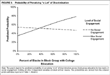
Consistent with the composition hypothesis, the effect of block-group education on perceptions of discrimination depends on the individual's level of social engagement. While the direct effect of educational composition remains statistically insignificant, the interaction between composition and engagement is positive and statistically significant in the discrimination model. African Americans who live amongst and interact with highly educated blacks believe more strongly than socially engaged blacks in less-educated contexts—or their unengaged neighbors—that race will limit their opportunities for socioeconomic attainment. Figure 3 illustrates the conditional nature of this relationship by plotting the predicted probability of perceiving “a lot” of discrimination across block-group educational composition for two levels of social engagement: (1) individuals who are not involved in any groups or organizations and (2) individuals who participate in all four types of organizations. (All other independent variables are held constant at their means; Boston is the assumed metropolitan area.) The slope of the line graph is positive only for those individuals actively engaged in groups and organizations where they are likely to come into contact with their neighbors. Among individuals with high social engagement, the probability of perceiving “a lot” of discrimination increases from one-third in block-groups where less than 10% of black residents are college-educated to over 75% in block-groups with 80% or more college-educated. In the absence of any organizational involvement, the graph is flat, indicating that the beliefs of socially unengaged African Americans are unaffected by the status composition (and, thus, the racial predispositions) of their neighbors.
Probability of Perceiving “a Lot” of Discrimination
There is no evidence that perceptions of linked fate vary with block-group education, even for socially engaged African Americans. In the model predicting perceptions of linked fate both the direct effect of block-group education and the interaction effect between education and engagement are statistically insignificant. African Americans who live in highly educated contexts and interact with their neighbors are no more likely to subscribe to the notion of linked fate than socially engaged residents in less educated contexts, or their unengaged neighbors. Thus, the socioeconomic composition of a neighborhood, regardless of its implications for prevailing racial norms, has only a limited effect on the salience of race for individual residents. Not only does the effect depend on social engagement, but even among blacks who are deeply involved in community organizations and networks, there is no wholesale adoption of the racial predispositions of their neighbors. Only beliefs about discrimination appear to be vulnerable to processes of social influence. Compared to the impact of neighborhood quality, which affects the linked fate and discrimination beliefs of the socially isolated and the socially engaged, these results suggest that educational composition is the less salient feature of neighborhood socioeconomic environments.13
The data also find variation across racial attitudes in the relative importance of quality and composition. This variation may reflect a basic difference in the nature of discrimination and linked fate beliefs, at least as measured here. Whereas beliefs about discrimination consist of a fairly broad statement about the (employment) condition of blacks in general, linked fate refers directly to the particular facts of the respondent's life. Opinion on the former is likely a function of both the respondent's own lived experience and the knowledge gained through engagement and discourse with others. As such, it is not surprising that both quality (i.e., the material conditions of the respondent's life) and composition (i.e., the type of people with whom the respondent interacts) shape beliefs about the severity of antiblack discrimination. By contrast, responses to the more narrowly constructed linked fate question may derive less from social influence than from the respondents' own assessments of their particular circumstances (e.g., whether they have the resources to control their life outcomes); this would account for the significance of neighborhood quality. Whether the differential effects are simply an artifact of question wording, or evidence of conceptually distinct racial attitudes, cannot be determined here.
In addition to the effects of neighborhood quality and, to a more limited extent, neighborhood educational composition, the models uncover an interesting relationship between block-group racial composition and black racial attitudes. Consistent with the claim of Bledsoe et al. (1995) regarding racial solidarity as a determinant of residential choice, the results indicate that African Americans who express a preference for predominantly black neighborhoods are also more likely to subscribe to the notion of linked fate and to believe that their race will limit their opportunities for socioeconomic attainment. The coefficient on preferred percent black is consistently positive and statistically significant.
However, while perceptions of linked fate and skepticism about discrimination may lead African Americans to seek out black communities, the actual experience of living in these communities does not necessarily reinforce these beliefs. Unlike past research, I find no relationship between actual block-group racial composition and racial attitudes in Boston, Los Angeles, or Atlanta; the interaction terms between city and block-group percentage black are statistically insignificant for each of these metropolitan areas. In Detroit, there is limited evidence of a curvilinear relationship between racial composition and racial attitudes, a “U-shaped” function (as opposed to Lau's [1989] “inverted-U”) in which low black population density is associated with more attention to race. In the equation predicting beliefs about discrimination (Table 1, second column of numbers), the interaction term between Detroit and the linear racial composition measure is negative and statistically significant; the interaction with the quadratic racial composition measure is positive and statistically significant. All else equal, it is the African Americans who reside in Detroit's more racially integrated neighborhoods who are the most pessimistic about the barriers to black socioeconomic attainment. Living in integrated or predominantly white communities may expose blacks to more incidents of discrimination, thus heightening the salience of race for this group. As the percentage black in the block-group increases, African Americans in Detroit begin to express less racially deterministic attitudes. This trend persists until one reaches block-groups in which more than 65% of residents are black. When residential segregation increases beyond that point, the likelihood of perceiving race as a barrier to opportunity also increases.
In sum, features of the socioeconomic environment can shape perceptions of linked fate and beliefs about discrimination. African Americans fortunate enough to reside in the most desirable communities—where homes are well-tended, streets are kept clean, and residents have access to public and private services—are less inclined to believe that race will determine their life chances or limit the opportunities for socioeconomic attainment. A second, albeit more limited, influence on racial attitudes derives from the educational composition of a neighborhood. Pessimism about the severity of antiblack discrimination is deepest in neighborhoods with large concentrations of college-educated blacks, although only for those African Americans who are socially engaged with their neighbors. For residents who are disconnected from neighborhood social networks, as evidenced by their lack of participation in the community organizations that facilitate contact between residents, attitudes about discrimination do not vary with the socioeconomic status of their neighbors; not surprisingly, without social engagement there is no potential for social influence. Regardless of the level of social engagement, however, perceptions of linked fate are unaffected by the educational context.
CONCLUSION
The movement of African Americans out of the central city is among the most significant demographic trends of the last several decades. Empirical research on this urban exodus has emphasized the link between black racial attitudes and neighborhood racial change, while largely overlooking the socioeconomic dimensions of these recent trends. Yet the findings here indicate that socioeconomic environments play a role in sustaining the belief that race remains the defining interest in individuals' lives. The quality of a neighborhood is perhaps its most salient socioeconomic feature. In neighborhoods offering the resources and opportunities that facilitate future socioeconomic mobility, the likelihood of believing that one's fate is closely linked to the fate of blacks as a group declines, and pessimism about the severity of antiblack discrimination recedes. The educational composition of neighborhoods also influences the salience of race, as African Americans who live amongst and interact with highly educated blacks express more pessimistic attitudes about discrimination. Notably, their perceptions of linked fate are unaffected.
The influence of neighborhood quality on the salience of race is evidence of the material roots of black racial identity. It is because African-American beliefs about race are strongly informed by a legacy of economic oppression, and as such have a distinct economic component (as opposed to being strictly an expression of cultural solidarity), that actual exposure to material deprivation impacts the salience of race. To wit, neighborhood quality affects the salience of race by providing blacks with an objective basis on which to either accept or reject the standing belief that their lives remain overly determined by their racial group membership.
The impact of neighborhood quality also reminds us that neighborhoods are important not just as arenas for social engagement and, thus, for the development and transmission of community norms. Much of the extant literature on neighborhoods has emphasized this social function (Huckfeldt 1986), whose effect, in the case of black racial attitudes, is limited. At least as important as the social function of neighborhoods is simply their physical characteristics. A decade ago, Cohen and Dawson (1993) linked the physical condition of neighborhoods to levels of political engagement among neighborhood residents, arguing that access to key resources and institutions affects the costs and, therefore, the likelihood of political participation. In this analysis, I demonstrate that neighborhood conditions, because of their real consequences for individual socioeconomic well-being and future socioeconomic mobility, serve as the basis for inferences about the larger social world and the individual's place in it. For African Americans confined to decaying neighborhoods, their physical surroundings encourage racially deterministic explanations of the social world. While the relative importance of the social function and the physical characteristics of neighborhoods may vary across behaviors and attitudes—for example, black attitudes toward other minority groups may reflect the social influence of neighbors more than the psychological response to material deprivation—the findings here highlight the need to think broadly about the nature of contextual effects.
The fact that core racial attitudes are influenced by neighborhood socioeconomic contexts may shed light on a central paradox in black public opinion, the well-documented tendency of middle-class blacks to be more racially oriented than lower-status blacks. Some have theorized that middle-class African Americans are encouraged to emphasize their racial identity within the context of social and cultural institutions, such as the black church or local chapters of Jack & Jill of America, where they interact with one another (Dawson 1994). However, living amongst and interacting with higher-status blacks was found to have only a limited effect on individual racial attitudes; while it fosters greater pessimism about the severity of antiblack discrimination, it does not nurture a stronger sense of linked fate. This result challenges the notion of social engagement as the central force in the heightened racial consciousness of middle-class blacks.14
I credit an anonymous reviewer for this important insight.
What one journalist described as the “rage of a privileged class” may stem, instead, from the difficulty that middle-class blacks encounter when trying to convert rising incomes, greater educational attainment, and occupational mobility into more desirable residential circumstances (Cose 1995). Results from the 2000 Census reveal that the “neighborhood gap,” the difference between one's household income and the quality of one's neighborhood, is larger and growing faster for the most affluent blacks than for those close to the poverty level (Logan 2002). Perhaps it is because of the high value placed on neighborhood amenities (Basolo and Strong 2002), including well-maintained homes, access to local shopping, and reliable garbage collection, and the failure of residential mobility to keep pace with individual socioeconomic progress, that middle-class blacks perceive more acutely the constraints imposed by one's racial group membership.15
As a preliminary test of this hypothesis, I reestimated the equations in Table 1, including among the predictors an indicator of the neighborhood racial gap, the absolute value of the difference between the preferred and the actual racial composition of the neighborhood. The gap, measured as standard deviations from the mean (0.34±0.01), is positively associated with the view that discrimination remains a barrier to black socioeconomic attainment. This result is consistent with the argument presented here, that unmet residential preferences may foster pessimism about race.
In short, it may be the “tarnished success of life in the middle” (Landry
1987, 111), exemplified by their thwarted efforts to improve their neighborhood surroundings, that contributes to the more racially deterministic attitudes prevalent among higher-status African Americans. If the residential returns to middle-class status improve—for example, with tougher enforcement of fair housing laws—the paradox of heightened race consciousness may disappear.
As I noted earlier, using the MCSUI requires caution when interpreting the empirical results. The strength of the database is the large sample of black respondents. The weakness is that the data are a sample of four large metropolitan areas—only two metropolitan areas, in the tests of the composition hypothesis—that are not necessarily representative of the nation's black population. While this sampling strategy may limit the generalizability of the results, I believe the analysis presented here makes a compelling case for scholars to pay more attention to socioeconomic contexts in their research on black racial attitudes. With the benefit of national data, and a survey instrument concerned with both the individual attributes of respondents and the collective attributes of their communities, future research may reveal more fully the environmental factors that encourage blacks to believe that “color still plays a major role in the prospects of people who look like us” (Cose 1995, 34–35).
Whether African Americans perceive race as the defining interest in their lives is of central political importance. A worldview in which racial group membership is thought to determine one's life chances underlies support for black political candidates, disposes African Americans to policy solutions that emphasize government intervention, and encourages collective mobilization to improve the status of blacks. Hence, if the salience of race is vulnerable to processes of neighborhood socioeconomic change, the political cohesiveness that this salience sustains may be equally vulnerable. The growing insulation of upwardly mobile blacks from the social and economic dislocation suffered by disadvantaged communities may pose a greater challenge to African Americans' political consensus than does racial integration. Even if there is no change in the spatial separation of whites and blacks, the movement of African Americans out of resource-deprived communities may erode the sense of collective identity and fate, and with it the potential for group-based political mobilization. And while the economic segregation of high-status blacks, a group predisposed to view race as a defining interest, may create social environments in which attention to the collective aspects of black life (e.g., the shared experience of discrimination) is encouraged, this social pressure may not be enough to offset the optimism bred by improved residential circumstances. Thus, the dilemma for black politics is how to sustain the cohesiveness that has enabled black political gains and, by extension, has expanded social and economic opportunities for the black community. Clearly, the solution is not to confine blacks to disadvantaged neighborhoods so as to ensure their allegiance to black interests. Rather, black politicians, in much the same way as they build biracial coalitions, will have to develop compelling messages that do not rely exclusively on race consciousness for their appeal. What is necessary is an agenda that can engage all black Americans, including those for whom the everyday hardships that typically sustain the salience of race have attenuated. While this is not a simple task, it may be a critical one if the growing diversity of black residential circumstances is not to undermine the solidarity and commitment needed to address the continuing problem of racial inequality.
APPENDIX
Assessing the Validity of the Neighborhood Quality Measure
Each of the three items used to assess neighborhood quality—evaluations of “housing and property,” “city services,” and “shopping”—was first tested for evidence of simultaneity with the measures of racial attitudes. The results of Hausman specification tests (Hausman 1978; see also Gujarati 1995, 669–72) found no statistically significant correlation, at the 5% or 10% levels, between these regressors and the error terms in the models predicting racial attitudes. From this I concluded that the quality assessments, while subjective, are not simultaneous with the racial attitudes of interest here, obviating the need for a simultaneous-equation model.
To gauge the external validity of the subjective assessments of neighborhood quality, I performed several diagnostic tests in which I compared the quality scores assigned by different respondents from the same block-group. (Ninety-three percent of the 930 block-groups represented in the complete MCSUI dataset have two or more respondents. The median number of respondents [of all races] per block-group is eight, and 25% of the block-groups have more than 12 respondents.) A maximum of three points can separate the neighborhood quality scores assigned by any two residents of a block-group: One respondent can evaluate the neighborhood as a “one” (low quality); the other, as a “four” (high quality). On average, however, less than 1.3 points separates the maximum and the minimum quality scores that a block-group receives. The average within–block-group standard deviation for neighborhood quality is 0.49, which is 22% smaller than the overall standard deviation for neighborhood quality. Furthermore, there is no evidence of statistically significant racial differences in the quality scores assigned by different respondents in a given block-group. In the 235 block-groups in which there were both white and black respondents, the average difference in the neighborhood quality scores was only 0.10; the median difference was 0.08. (Black respondents in a block-group assign the higher-quality scores; these differences, however, are not statistically significant.) The implication is that blacks and whites, when assessing neighborhood conditions, generally perceive the same reality.
The average neighborhood quality score assigned by respondents in a block-group varied systematically with the socioeconomic attributes of the area. In regressions of mean quality on a variety of block-group demographic indicators, quality scores were positively associated with the percentage college-educated and the rate of home ownership. When responses are aggregated by race, the average quality score assigned by black respondents in a block-group and the average score assigned by whites vary as functions of the same set of block-group socioeconomic indicators. Thus, not only do blacks and whites perceive the same reality, but also their assessments are guided by similar considerations. Interestingly, mean quality scores—whether aggregated by race or across all respondents in a block-group—are negatively associated with black population density, even after controlling for the socioeconomic characteristics of the block-group.
Taken together, the results of these diagnostic tests suggest (1) that assessments of neighborhood quality are correlated across respondents within block-groups (i.e., there is some degree of agreement among respondents) and (2) that the subjective assessments are driven by actual conditions within neighborhoods.
The quality measure is not ideal. While there are no systematic racial, gender, or income differences in neighborhood quality assessments—as well as no evidence, among blacks, of simultaneity between these assessments and racial attitudes—I found evidence of small differences based on education and age. After controlling for the mean quality score assigned by all respondents in a block-group (as well as for race, gender, and income), older respondents tend to assign above-average scores and more educated respondents assign below-average scores. One additional year of age increases the quality score by 0.002 point above the block-group mean; a one-point increase on the five-point education scale lowers the quality score by 0.02 point below the block-group mean. In the statistical analysis, I take these confounding effects into account by including controls for both education and age.
Finally, we should bear in mind that the “neighborhood” assessed in these survey items is not necessarily defined by the specific boundaries of the respondent's census block-group. Certainly, the fact that the neighborhood assessments vary systematically with block-group socioeconomic indicators suggests overlapping geography. But the “neighborhood” that respondents have in mind may extend beyond the block group's borders or may consist of only a portion of the block group. However, for the hypothesis (H2) tested here, where respondents place their “neighborhood” geographically is less important than how they characterize it. What matters here is whether the “neighborhood”—whatever its physical boundaries—is perceived to offer the resources and opportunities that might inspire optimism about one's life chances.
The author would like to thank Chris Afendulis, Mike Alvarez, John Brehm, Chris Federico, Darren Davis, Eric Oliver, Andrea Simpson, Kira Sanbonmatsu, Debbie Schildkraut, and Katherine Tate; seminar participants at Notre Dame, the Research Institute for the Comparative Study of Race and Ethnicity at Stanford, U.C. Berkeley, U.C. San Diego, University of Minnesota, and Yale; and the anonymous APSR referees for comments and assistance on early drafts. This research was completed with support from the American Association of University Women and the Center for Advanced Study in the Behavioral Sciences.






Comments
No Comments have been published for this article.