During the last century, a large number of developed and developing countries underwent higher education expansion.Footnote 1 Since 1960, the number of students in college worldwide increased by almost five times, from 29 to 141 million.Footnote 2 This expansion has resulted in a much greater number of individuals, from a wide variety of social and economic backgrounds, accessing college and benefiting from the higher economic payoffs associated with college.Footnote 3
Although expansion allows more students to access (and benefit from) college, it does not unambiguously reduce gaps in access between students from disadvantaged (for example, poor, rural) and advantaged backgrounds. Empirical research from specific countries shows, for example, that substantial gaps in access to college (especially elite colleges) may persist after expansion.Footnote 4 Understanding whether gaps in access persist is important, since large gaps may lead to greater social and intergenerational inequality, as well as have an impact on national economic development.Footnote 5
Indeed, although China underwent one of most rapid college expansions in history in 1998, researchers have not examined China's post-expansion gaps in college and elite college access accurately or in sufficient detail. For example, some studies have shown a gap in college access between poor and non-poor households.Footnote 6 However, they have relied on survey samples that were not nationally representative and thus the findings of these studies might have suffered from sample selection bias (either overestimating or underestimating the gap in college access) and/or might have lacked generalizability. One exception is Hongbin Li and Binzhen Wu, who use nationally representative data from 2003 to show that only 43 per cent of students who accessed elite Project 211 collegesFootnote 7 and 18 per cent of students who accessed China's top two colleges were from rural areas (despite the population shares of rural students being higher than urban students).Footnote 8 While these findings are important, they do not estimate the gap in college access between more specific groups such as rural students from poor counties and urban students from non-poor counties. Furthermore, with the exception of Li and Wu, we are unaware of any study that has examined gaps in elite college access. Moreover, no study we know of has used nationally representative data to examine the degree to which rural youth from poor counties were able to access college and elite college versus more advantaged groups of youth.
The overall goal of our paper is to examine the nature of access to college and elite college for rural youth (students with a rural as opposed to an urban residential permit or hukou 户口) from poor counties (one of the 592 counties that the government in China designates as “poor”) and other youth in China. We use a unique set of micro-level data on all students (6.2 million) who took the college entrance exam in China in 2003 as well as supplemental data from the 2000 Census to estimate differences in the proportion of rural youth from poor counties (versus urban youth from non-poor counties) who were able to access (a) any college; (b) four-year colleges (benke 本科); or (c) various levels of elite colleges. In addition to examining access gaps for rural youth from poor counties (in general), we also estimate the nature of access to college and elite college for subgroups in China's poor areas (for example, female, ethnic minority). Unlike previous studies, our data allow us to examine nationwide inequalities in access to college in general, and access to elite college in particular, at a period several years after Chinese policymakers initiated the mass expansion of college enrolments.
According to our analysis, we find large and significant differences in the degree to which rural youth from poor counties access college and elite colleges compared to more advantaged youth. We find that 7 per cent of rural youth from poor counties could access any college in 2003, compared to 48 per cent of urban youth. In other words, urban youth were able to access (any) college at rates nearly seven times more than rural youth from poor counties (48/7). The gap in access to elite colleges was even wider. For example, only 0.6 per cent of rural youth from poor counties were able to access China's elite Project 211 colleges compared to 7 per cent of urban youth (a gap of 11 times). Even wider gaps in elite college access existed for disadvantaged subgroups of rural youth from poor counties. For example, only 0.4 per cent of rural, female, minority youth from poor counties could access an elite 211 college in 2003, compared to 7.5 per cent of urban, male, Han youth from non-poor counties (a gap of 19 times). Taken as a whole, the findings clearly indicate that, after expansion, youth from disadvantaged backgrounds were not accessing college (and elite college) at rates anywhere near those of youth from advantaged backgrounds.
Background
College access was extremely limited in China in the 1990s. In 1990, the gross enrolment rate for college (the percentage of 18- to 22-year-olds in the population that attended college) was only 3.4 per cent.Footnote 9 The gross enrolment rate was not only much lower than that of developed countries such as the United States (71 per cent), but was even lower than that of developing countries such as Brazil (11 per cent) or India (6 per cent).Footnote 10
The low college enrolment rate in China meant that disadvantaged students had fewer chances to access college than advantaged students.Footnote 11 In 1990, rural 19- to 22-year-olds were seven times less likely to access college compared to urban youth.Footnote 12 The large gap in college access, in fact, persisted throughout the 1990s. By 2000, rural youth were eight times less likely to access college compared to urban youth.Footnote 13
In 1998, the dynamics of college access started to change as China's policymakers initiated one of the largest expansions in college enrolments in history. The number of students who could attend college increased from one million to 5.7 million, or from 6 per cent to 22 per cent of the age cohort from 1998 to 2007.Footnote 14 The improved access to college led many to believe that rural students from poor counties would gradually obtain more equal access to college.Footnote 15
Even with college expansion, however, there were reasons to believe that rural students from poor counties would continue to have unequal access to college. First, along with expansion, college tuition rates rose. The rising tuition rates made it difficult for rural households from poor counties to afford a college education.Footnote 16 Second, rural students from poor counties had fewer resources with which to prepare for China's increasingly competitive high school and college entrance exams.Footnote 17 Because rural students from poor counties tended to have lower exam scores than urban students from non-poor counties, they were expected to be less qualified for academic high schools, colleges and elite colleges.Footnote 18 Part of the problem was that rural students from poor counties had unequal access to high quality kindergartens, primary schools and junior high schools, which could help to prepare them for competitive entrance exams.Footnote 19 Poor preparation for competitive entrance exams combined with high and rising opportunity costs may have also caused many rural students from poor counties to drop out before high school.Footnote 20
In addition to having less access to college, rural students from poor counties may have had even less access to elite colleges. Policymakers in China expanded college enrolment quotas by five times from 1998 to 2006, but only expanded elite college enrolment quotas by 30 per cent.Footnote 21 Thus, even if the expansion in enrolments improved access to college for rural students from poor counties, it is not clear if the expansion movement did anything to improve their access to elite colleges.
Data and Methods
Our main source of information on access to college and elite colleges comes from a dataset that contains records on every student who took the college entrance exam (CEE). We call this dataset the 2003 CEE dataset. The data include records on the entire population of 6.2 million students who took the college entrance exam in China in 2003. The 2003 CEE dataset contains information in two blocks that allow us to achieve our objectives of documenting the education gaps (and the nature of the gaps) between rural students from poor counties and other students in China.
The first block of the 2003 CEE dataset contains detailed information on student backgrounds. We have information on whether a particular student's hukou is urban or rural. Importantly, we also know each student's county of residence. If a student resides in one of the 592 nationally designated poor counties (as identified by the Chinese government in 2003), we determine that student to be “from poor counties.”Footnote 22 With the information on each student's residential permit status and county name, we can identify whether the student is a rural student from a poor county. Other variables allow us to identify student gender and ethnicity. In particular, we use the information on ethnicity to identify whether a student belongs to one of China's 55 minority groups or belongs to the Han majority.
The 2003 CEE dataset also contains information on each student's college admissions outcome. China's college admissions process assigns each student to only one college (or to no college). After the admissions process is finished, students cannot transfer between colleges. By appropriately categorizing the college admissions outcome for each student, we can calculate how many students from different backgrounds could access (a) any college; (b) four-year colleges; (c) elite Project 211 colleges; (d) elite Project 985 colleges;Footnote 23 or (e) the top two colleges in China (Peking University or Tsinghua University).
To supplement information from the 2003 CEE dataset, we also use a 1 per cent random sample of the 2000 Census data to calculate the number of youth from different backgrounds/localities in each age cohort. The number of youth in each age cohort represents the number of youth who could have gone to college if college access was universal. In particular, we use the 2000 Census data to estimate the total number of 18-year-olds in 2003 (that is, by counting the number of 15-year-olds in 2000). Because the Census data have the same information on background characteristics as does the 2003 CEE dataset (gender, ethnicity, hukou and locality of residence), we can estimate the number of 18-year-olds with different background characteristics in China's population in 2003 (the number of 15-year-olds from different backgrounds in 2000).
By dividing the number of students from different backgrounds who can access college and elite college (calculated using the CEE data) by the total number of 18-year-olds from different backgrounds in China's population (estimated using the 2000 Census data), we can estimate the proportion of 18-year-olds from different backgrounds that were able to access college and elite colleges. For instance, we can estimate the number of rural students from poor counties who can access college by using the CEE data and the total number of rural youth (18-year-olds) from poor counties by using the Census data. We can then estimate the proportion of rural youth from poor counties that were able to access college by dividing the number of rural students from poor counties who can access college by the total number of rural youth (18-year-olds) from poor counties. With the same method, we can estimate the proportion of urban youth from non-poor counties that were able to access college.
By comparing the proportion of rural students from poor counties and the proportion of urban students from non-poor counties who were able to access college, we are able to examine the college access gap between rural students from poor counties and urban students from non-poor counties. This information can also be used to look at the elite college access gap in China in 2003.
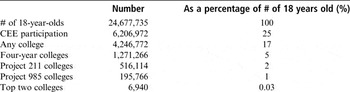
To provide a baseline from which to compare the degree of college and elite college access for 18-year-olds from different backgrounds, we first estimate the degree of college and elite college access for all 18-year-olds (both urban and rural, poor counties and non-poor counties). Table 1 shows the overall college and elite college admission rate for the entire cohort of 18-year-olds in China in 2003. Only 25 per cent of 18-year-olds took the CEE and only 17 per cent could access any college in 2003. Only 5 per cent of all 18-year-olds were able to access four-year colleges. As for elite colleges, only 2 per cent of all 18-year-olds were able to access the elite Project 211 colleges and only 1 per cent could access the even more elite Project 985 colleges. Finally, only 0.03 per cent of 18-year-olds were able to access China's top two colleges, Peking University or Tsinghua University. Our objective in the rest of the paper is to compare the shares of rural youth from poor counties and urban youth (each relative to their cohort size) that were able to access college and elite college.
College Access among 18-Year-Old Youth

Sources:
2003 CEE dataset, 1% 2000 Census.
Results
Inequality in college and elite college access
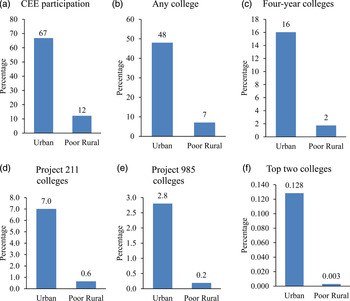
According to our data, there was a huge gap in college and elite college access in 2003 between rural youth from poor counties and urban youth. Moreover, the access gap began with the rate of those taking the CEE. Only about 12 per cent of rural youth from poor counties took the CEE compared to 67 per cent of urban youth (Figure 1a). This means that urban youth were more than five times more likely to take the CEE than rural youth from poor counties (67/12).
Gaps in College Access between Rural Youth from Poor Counties and Urban Youth

The rates of admission, naturally, were lower (since not everyone who took the CEE gained admission to college) and, more importantly for this paper, the gap in access to any college between urban youth and rural youth from poor counties was wider. Only about 7 per cent of rural youth from poor counties were able to access any college in 2003. During the same year, nearly 48 per cent of urban youth were able to access any college (Figure 1b). Hence, the most general measure of the access gap of rural youth from poor counties and urban youth was wide (nearly seven times).
The gaps in access to four-year college and elite college between rural youth from poor counties and urban youth were even larger. Only 2 per cent of rural youth from poor counties could access four-year colleges compared to 16 per cent of urban youth (Figure 1c). Only 0.6 per cent of rural youth from poor counties could gain access to elite Project 211 colleges compared to 7 per cent of urban youth (Figure 1d). The gap in access to the most elite colleges was the widest. At the extreme, only 0.003 per cent of rural youth from poor counties could access China's top two colleges compared to 0.13 per cent of urban youth (Figure 1f). In summary, rural youth from poor counties were eight times, 11 times, and 43 times less likely to access four-year colleges, elite Project 211 colleges and the top two colleges than urban youth, respectively.
To understand our results better, the gaps in college access between rural youth from poor counties and all urban youth are further decomposed into three separate components. The first component is gaps in college access between rural youth and urban youth. The second component is gaps in college access between rural youth from poor counties and rural youth from non-poor counties. The third component is gaps in college access between urban youth from poor counties and urban youth from non-poor counties.
To understand the gap between rural and urban better, we start by noting the work undertaken by Li and Wu.Footnote 24 According to Li and Wu, 52 per cent of students in any college were from rural areas. They also found that 49 per cent and 43 per cent of students in four-year and elite Project 211 colleges were from rural areas. However, they did not estimate the share of rural youth in the population that could access college and elite college (which is important in determining the access gap as we are defining it in this paper – since the population share of rural youth is higher than the population share of urban youth).
When we estimate the first gap between rural and urban students, we find that only 10 per cent of rural youth could access any college in 2003 compared to 48 per cent of urban youth. Hence, rural youth (those in both poor and non-poor areas) were approximately five times less likely than urban youth to access any college. The rural and urban gap was even wider in access to elite colleges. Only 3 per cent of rural youth gained access to four-year colleges compared to 16 per cent of urban youth (see Table 2, row 2). Moreover, only 1 per cent of rural youth accessed elite Project 211 colleges compared to 7 per cent of urban youth (Table 2, row 3).
Gaps in College Access between Urban and Rural Youth (%)

Sources:
2003 CEE dataset, 1% 2000 Census.
In other words, rural youth were five times less likely than urban youth to access four-year colleges and seven times less likely than urban youth to access elite Project 211 colleges. This first gap (between any rural youth and urban youth) is narrower than the overall access gap between poor, rural youth and urban youth for four-year colleges (eight times) and elite Project colleges (11 times). However, a large part of the overall access gap in four-year college and elite college access between poor, rural youth and urban youth is owing to the gap in access between rural youth and urban youth.
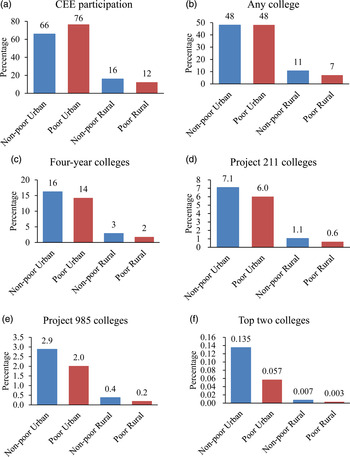
When we examine the second gap (between rural youth in poor versus non-poor counties), we find significant but less stark differences in college and elite college access. In 2003, 7 per cent of rural youth from poor counties accessed any college. In the same year, 11 per cent of rural youth from non-poor counties accessed any college (Figure 2b). Hence, the access gap between rural youth from poor counties and rural youth from non-poor counties was only about 1.5 times – 11/7).
Gaps in College Access between Urban Non-poor, Urban Poor, Rural Non-poor and Rural Poor Youth

The access gaps between rural youth from poor counties and rural youth from non-poor counties were also relatively narrow for four-year and more elite colleges. While only 2 per cent of rural youth from poor counties could access four-year colleges, the rate was not that much higher for rural youth from non-poor counties – 3 per cent (Figure 2c). Likewise, only 0.6 per cent of rural youth from poor counties were able to access elite Project 211 colleges compared to only 1.1 per cent of rural youth from non-poor counties (Figure 2d).
In summary, although within the population of rural youth, rural youth from poor counties were disadvantaged compared to rural youth from non-poor counties in access to college (any, four-year and elite college), the second gap is relatively modest compared to the first gap. That is, the rural–urban access gap is far wider than the access gap between poor and non-poor counties in rural areas.
When we examine the third gap between urban poor and urban non-poor counties, we find that the gap is almost non-existent. In fact, the gap in taking the CEE was reversed. According to our data, 76 per cent of urban youth from poor counties took the CEE in 2003. In the same year, only 66 per cent of urban youth from non-poor counties took the CEE (Figure 2a).
When accounting for admission to any college, both urban youth from poor counties and urban youth from non-poor counties had almost the same access to college. In Figure 2b, we can see that 48 per cent of urban youth from poor counties gained access to any college and 48 per cent of urban youth from non-poor youth gained access to any college. Hence, in terms of accessing any college, being born in a poor, urban area (versus a non-poor, urban area) did not put one at a disadvantage as it did (albeit modestly) in the case of being born in a poor, rural area.
The gap between urban youth from poor counties and urban youth from non-poor counties reappears when considering four-year and elite colleges, although it remains narrow. For example, 14 per cent of urban youth from poor counties were able to access a four-year college compared to 16 per cent of urban youth from non-poor counties (a gap of 1.1 times, see Figure 2c). At the same time, 6 per cent of urban youth from poor counties were able to access elite Project 211 colleges compared to 7 per cent of urban youth from non-poor counties (Figure 2d). Hence, within urban areas, the college access gaps between youth from poor counties and youth from non-poor counties were either non-existent or absolutely quite small.
Taken together, our results show that there is a substantial gap in college and elite college access between rural students in poor counties versus urban students. The widest gap is between rural and urban students and, to a lesser extent, between rural students in poor counties versus non-poor counties. There is almost no gap between urban students in poor versus non-poor counties.
Sources of the college access gaps
In this subsection, we aim to identify the sources of the gaps in access that we have identified above. Specifically, we examine gaps separately by geographical regions to identify which region contributes most to the gaps. We examine two gaps in turn. We first examine the largest source of inequality in access – the rural–urban gap. Then, we examine the gap between rural youth from poor counties and rural youth from non-poor counties. Finally, we seek to understand why there is almost no access gap between urban youth from poor counties and urban youth from non-poor counties.
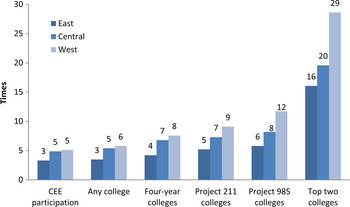
Sources of the gap between rural youth and urban youth. To gain insight into why the gap in college access was so large between rural and urban youth, we examine gaps separately for eastern, central, and western regions.Footnote 25 In eastern China, urban youth were three times more likely to access any college than rural youth (Figure 3). In central China, urban youth were five times more likely to access any college. In western China, the rural–urban gap was six times. As for access to elite colleges across regions, urban youth in eastern China were five times more likely to access elite Project 211 colleges than rural youth. In central China, urban youth were seven times more likely to access Project 211 colleges than rural youth. In western China, the rural–urban gap in access to Project 211 colleges was nine times. Hence, even though there was a large gap between rural and urban youth in access to any college, the major sources of the rural–urban gap were in central and western China.
Rural–Urban Gaps in College Access across Regions

There are two potential reasons for the differences in rural–urban access gaps by region. On one hand, urban youth in western China may be just as likely to attend college or elite college as those in eastern China, but rural youth in western China may be far less likely to attend college or elite college. Or, on the other hand, it could be that rural youth are equally likely to attend college or elite college across the region, but urban students in western China are far more likely to attend college or elite college.
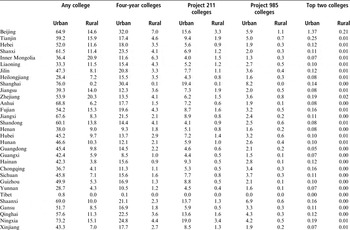
To determine further if the rural–urban gap across regions was coming from urban differences across regions or rural differences across regions, we examine the rate of college access for urban and rural youth separately in each region. Table 2 shows that in eastern, central, and western China, urban youth had almost the same chances to access any college, four-year colleges, elite Project 211 colleges and Project 985 colleges (columns 3, 5 and 7, rows 1 to 4). However, college access for rural youth varied across regions. For example, 14 per cent of rural youth in eastern China accessed any college compared to 9 per cent of rural youth in central China. At the same time, only 7 per cent of rural youth in western China accessed any college. The rural youth in eastern China were between 1.5 times and two times more likely to access four-year and elite colleges than rural youth in central and western China (columns 4, 6 and 8, rows 2 to 4). In summary, college access for all urban youth in each region was almost the same, while college access for rural youth in central and western China was lower than that for rural youth in eastern China. Differences in the rate of college access for rural youth across regions were thus a major driver of differences in the rural–urban gap across regions.
We conduct a similar analysis across provinces. Table 3 shows that (with the exception of Shanghai, where the extremely low percentage of rural students accessing college may be a statistical anomaly) urban students are 1.7 (Inner Mongolia) to 11.5 (Anhui) times more likely than rural students to access any college. Urban students are also 2.7 (Inner Mongolia) to 18.6 (Hainan) times more likely than rural students to access elite Project 211 colleges. Similar to the across-region comparison, differences in the rate of college access for rural youth across provinces were a major driver of the rural–urban gap across provinces. For example, while the urban youth in Beijing were approximately four times more likely to access elite Project 211 colleges than urban youth in Yunnan province, the rural youth in Beijing were approximately nine times more likely to access elite colleges than rural youth in Yunnan province. In other words, although the rate of college access differs for both urban youth and rural youth across provinces, the across-province differences are even greater for rural youth.
College Access of Urban and Rural Youth across Provinces (%)

Sources:
2003 CEE dataset, 1% 2000 Census.
Sources of the gap between rural youth from poor counties and rural youth from non-poor counties. Again, to determine the source of the college and elite college access gap between rural youth from poor counties and rural youth from non-poor counties, we examine the access gaps separately for central and western China. We do not do the same exercise for eastern China since there is only one poor county in eastern China (while there are over 500 in central and western China).
According to our data, the gap between rural youth from poor counties and rural youth from non-poor counties could not be attributed to regional differences in either central or western China. From Table 2 we can see that the gap between rural youth from poor counties and rural youth from non-poor counties in central China was narrow for the three largest categories of college – any college, four-year colleges and elite 211 colleges (columns 9 and 10, rows 1 to 3). The gap ranged from 1.1 to 1.4 times. Similarly, the gaps between rural youth from poor counties and rural youth from non-poor counties in western China for these same three categories of colleges also were narrow (columns 11 and 12, rows 1 to 3). In western China, the access gap ranged from 1.3 to 1.5 times. The lesson from this table and the analysis above is that the majority of rural youth – those in central and western China and those in both poor and non-poor areas – were driving the rural–urban access gap in China (which in turn was the largest segment of the gap in access between rural youth from poor counties and urban youth).
Why was there no gap between urban youth from poor counties versus non-poor counties? We now seek to understand why it is that the college access gap between urban youth from poor counties and urban youth from non-poor counties was so narrow (as discussed above). The absence of a larger gap in college access between urban youth from poor counties and urban youth from non-poor counties may be surprising since, in the aggregate, there are large discrepancies in household earnings between poor and non-poor areas; educational investments between poor and non-poor areas also differ sharply.Footnote 26
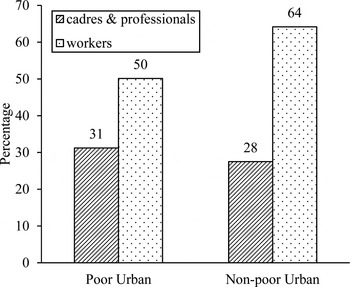
One reason for the narrow gap between urban youth from poor counties and urban youth from non-poor counties could have been the occupational structure in the urban areas of poor and non-poor regions. According to the 2000 Census data, a relatively large share of the parents of urban youth from poor counties (31 per cent) were government officials, bureaucrats or state-owned enterprise cadres or professionals (ganbu 干部). At the same time, only 28 per cent of the parents of urban youth from non-poor counties were ganbu. The opposite is true for the case of workers in both the manufacturing and service sectors (gongren 工人). While only 50 per cent of the parents of urban youth from poor counties were workers, 64 per cent of the parents of urban youth from non-poor counties were workers (see Figure 4). Since it is well documented in the international literature that the profession of a parent (and their education) is a strong predictor of the educational attainment of children,Footnote 27 and since in China the average level of education of ganbu (13 years) is higher than the average level of education of workers (9 years), the occupational structure in poor, urban areas and non-poor, urban areas seems to be at least one reason why the access gap is narrow.Footnote 28
Occupational Structure in Poor, Urban Areas and Non-poor, Urban Areas

Other gaps
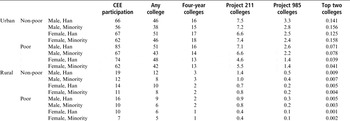
When we extend the concept of disadvantaged to also include females and minorities, we find that disadvantaged subgroups of rural youth from poor counties were severely limited in access to college and elite college. For example, 66 per cent of urban, male, Han youth from non-poor counties took the CEE. The CEE participation rate of urban, male, Han youth from poor counties was even higher (85 per cent). This is consistent with our above findings that urban youth from poor counties were more active in taking the CEE than urban youth from non-poor counties, since urban youth from poor counties had a better family background.
However, as the most vulnerable subgroup of rural youth from poor counties, only 7 per cent of rural, female, minority youth from poor counties took the CEE (see Table 4). In other words, urban, male, Han youth from poor counties were 12 times more likely to take the CEE than rural, female, minority youth from poor counties (85/7). Urban, male, Han youth from non-poor counties were ten times more likely to take the CEE than rural, female, minority youth from poor counties (66/7). The subgroups of rural youth from poor counties were more disadvantaged in access to any college. Only 5 per cent of rural, female, minority youth from poor counties accessed any college compared to 46 per cent of urban, male, Han youth from non-poor counties (or an access gap of nine times).
Gaps in College Access between Subgroups of Poor, Rural Youth and Others (%)

Sources:
2003 CEE dataset, 1% 2000 Census.
The subgroups of rural youth from poor counties had even less access to four-year and elite colleges than their advantaged counterparts. For both urban, male, Han youth from non-poor counties and urban, male, Han youth from poor counties, 16 per cent accessed four-year colleges in 2003. However, only 1 per cent of rural, female, minority youth from poor counties gained access to four-year colleges. At the same time, only 2 per cent of rural, male, minority youth from poor counties accessed four-year colleges. This means that urban, male, Han youth, either from non-poor or poor counties, were 16 times more likely to access four-year colleges than rural, female, minority youth from poor counties (16/1). The gap in elite college access was even larger. For example, 7.5 per cent of urban, male, Han youth from non-poor counties gained access to Project 211 colleges compared to 0.4 per cent of rural, female, minority youth from poor counties (or an access gap of 19 times). The gap in access to elite Project 211 colleges was also nearly ten times between urban, male, Han youth from non-poor counties and rural, male, minority youth from poor counties (7.5/0.8).
Finally, the gap in access to the top two colleges in China was the widest. Whereas 0.14 per cent of urban, male, Han youth from non-poor counties could access China's top two colleges, only 0.002 per cent of rural, female, minority youth from poor counties and 0.003 per cent of rural, male, minority youth from poor counties could access the top two colleges (Table 4, column 6). Hence, urban, male, Han youth from non-poor counties were 70 and 45 times more likely to access China's top two colleges than rural, female, minority youth from poor counties and rural, male, minority youth from poor counties (0.14/0.02; 0.14/0.03).
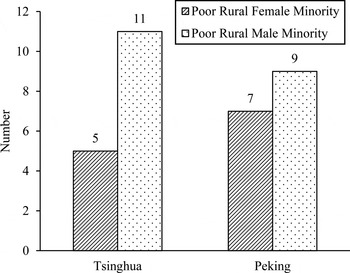
When we examine the absolute numbers (instead of the proportions) of rural, minority youth from poor counties who could access China's top two colleges, the barriers to access appear even more formidable. In 2003, Peking University and Tsinghua University admitted around 6,600 students. However, in that year, only 12 rural, female, minority students from poor counties were admitted to these colleges. Of these 12, five gained access to Tsinghua University and seven were admitted to Peking University (see Figure 5). Only three of them came from poor, western provinces. At the same time, only 20 rural, male, minority youth from poor counties gained access to the top two colleges: 11 to Tsinghua University and nine to Peking University. Clearly, subgroups of rural youth from poor counties were left behind in the chance to access China's top two colleges.
Numbers of Rural, Minority Youth from Poor Counties Accessing Tsinghua or Peking University

Conclusion
Our study shows that even after the mass expansion of college enrolments in China, rural students from poor counties were still much less likely to go to college and elite colleges than more advantaged students. Although we cannot show whether inequality in college access changed from before to after college expansion (because we could not obtain similar data on those taking the college entrance exam before 1998), there are reasons to believe that the degree to which inequality in access was reduced was either small or negligible. First, the gap in access to any college (between poor, rural and urban students) was still substantial (seven times) in 2003. If the gap, in fact, did lessen, this would have meant that the pre-1998 gap was extraordinarily large. Second, experiences from other countries show that even if college expansion reduces inequality in access to any college, it increases inequality in access to elite colleges.Footnote 29 We do not know if this is true in China but there is really no reason to think that China would have moved in a different direction to other countries. Therefore, even if gaps in access to any college decreased from 1998 to 2003, it is unlikely that the gap in access to elite colleges decreased significantly over the same time period.
We also show that inequality in access between rural youth from poor counties and urban youth was driven mostly by differences in access between rural and urban youth rather than by differences in access between poor and non-poor youth. The rural–urban access gap, in turn, primarily arose from the rural–urban access gaps between youth in China's central and western rural regions and youth in the central and western urban regions. By contrast, the poor–non-poor access gap was narrower (in nearly all regions: eastern, central, and western China). In particular, youth in poor, urban areas attended college (and elite college) at about the same rates as youth in non-poor urban areas. Our analysis suggests that, at least in part, the narrow poor and non-poor urban gap exists because a larger share of the parents of youth from poor, urban areas were professionals (and a smaller share were workers) than the parents of the youth in non-poor urban areas.
What are the policy implications? Prior to the expansion of the university system, policymakers in China hoped that expanding college enrolments would substantially reduce inequalities in access.Footnote 30 This paper, however, indicates that even one of the most rapid expansions of college enrolments in history was not, in and of itself, able to reduce inequality in access substantially. If such inequalities in access have persisted over the last decade since 2003, policymakers may wish to take a more active role in helping poor, rural students from China's central and western regions in particular to gain access to college and elite college.
Unfortunately, there are strong reasons to believe that the gaps in college access have persisted over the last decade. The financial burden of attending academic high school and college remained high for poor, rural students.Footnote 31 The opportunity costs of going to high school and college also grew substantially.Footnote 32 Many youth from poor, rural areas dropped out of junior high school.Footnote 33 In most general terms, China's education system remained extremely competitive and largely kept students in poor, rural areas from continuing on to higher levels of schooling.Footnote 34 Owing to the persistence of all of these factors, we suggest that future studies continue to examine more recent trends in gaps in access to college and elite college and the sources of those gaps.
Indeed, the inability of youth from poor, rural areas to gain more equal access to college has implications for China's future social and economic development. China has continued to shift from lower value-added to higher value-added industries, and its need for skilled labour has correspondingly increased.Footnote 35 China is, in fact, already faced with a shortage of skilled technical labour.Footnote 36 Moreover, approximately 78 per cent of children under the age of 14 in China are from rural areas.Footnote 37 These children constitute the majority of China's future workforce. If those of relatively high ability are later unable to access college and elite colleges, it will hamper the efficiency of China's human capital accumulation and economic growth. Ultimately, without a labour force with sufficient skills, China's economy (like that of other developing countries, for example, Argentina after the Second World War) could stagnate.Footnote 38
If the youth from poor, rural areas are unable to gain fair access to college, there will be implications for social inequality and ultimately social cohesion. The returns to attending college are high and have been increasing over the last two decades in China.Footnote 39 If poor, rural youth are unable to access college, they will be unable to achieve the higher levels of social and economic status of their advantaged peers. Gaps in access to college will therefore continue to be an important source of social inequality and intergenerational immobility. Furthermore, as poor, rural youth increasingly perceive that they are not able to access college at the same rate as their more advantaged counterparts, they may feel excluded from society.Footnote 40 Thus, gaps in access to college could ultimately become a source of social instability and a barrier to social cohesion.