Introduction
Theileria is tick-transmitted apicomplexan parasites of vertebrates that also serves as carrier hosts (Bishop et al., Reference Bishop, Musoke, Morzaria, Gardner and Nene2004). Tick vector competence and geographic distribution, persistence in the host, as well as host specificity and host geographic distribution determine parasite prevalence (Mans et al., Reference Mans, Pienaar and Latif2015). The question of how host specific Theileria is, given incidental records for Theileria species in atypical hosts, remain (Mans et al., Reference Mans, Pienaar and Latif2015). Host specificity may impact on hypotheses for speciation, epidemiology, geographic distribution and clinical disease etiology.
Theileria sp. (sable) infection causes a high-mortality rate in antelope calves. The infections in these rare and endangered species constrain their translocation and animal breeding. The introduction of naive animals into endemic areas can result in high fatalities (Wilson et al., Reference Wilson, Bartsch, Bigalke and Thomas1974; Nijhof et al., Reference Nijhof, Pillay, Steyl, Prozesky, Stoltsz, Lawrence, Penzhorn and Jongejan2005; Steyl et al., Reference Steyl, Prozesky, Stoltsz and Lawrence2012). Theileria sp. (sable) and its disease have mostly been identified in roan and sable antelope.
Using reverse line blot (RLB) analysis, T. sp. (sable) has been detected in African buffalo (Syncerus caffer), cattle, blesbuck (Damaliscus pygargus), blue wildebeest (Connochaetes taurinus), klipspringer (Oreotragus oreotragus), reedbuck (Redunca arundinum), nyala (Tragelaphus angasii), sable antelope (Hippotragus niger), roan antelope (Hippotragus equinus) and dogs (Nijhof et al., Reference Nijhof, Pillay, Steyl, Prozesky, Stoltsz, Lawrence, Penzhorn and Jongejan2005; Matjila et al., Reference Matjila, Leisewitz, Oosthuizen, Jongejan and Penzhorn2008; Muhanguzi et al., Reference Muhanguzi, Matovu and Waiswa2010; Yusufmia et al., Reference Yusufmia, Collins, Nkuna, Troskie, Van den Bossche and Penzhorn2010; Chaisi et al., Reference Chaisi, Sibeko, Collins, Potgieter and Oosthuizen2011; Pfitzer et al., Reference Pfitzer, Oosthuizen, Bosman, Vorster and Penzhorn2011; Adamu et al., Reference Adamu, Troskie, Oshadu, Malatji, Penzhorn and Matjila2014; Eygelaar et al., Reference Eygelaar, Jori, Mokopasetso, Sibeko, Collins, Vorster, Troskie and Oosthuizen2015; Njiiri et al., Reference Njiiri, Bronsvoort, Collins, Steyn, Troskie, Vorster, Thumbi, Sibeko, Jennings, van Wyk, Mbole-Kariuki, Kiara, Poole, Hanotte, Coetzer, Oosthuizen, Woolhouse and Toye2015; Tembo et al., Reference Tembo, Collins, Sibeko-Matjila, Troskie, Vorster, Byaruhanga and Oosthuizen2018). It was also detected using sequencing in red hartebeest (Alcelaphus buselaphus caama) (Spitalska et al., Reference Spitalska, Riddell, Heyne and Sparagano2005). It, therefore, seems to be ubiquitous in a variety of host species and may be described as a host generalist parasite. However, cross reactivity on RLB has been noted between T. sp. (sable) and T. velifera (Brothers et al., Reference Brothers, Collins, Oosthuizen, Bhoora, Troskie and Penzhorn2011; Mans et al., Reference Mans, Pienaar, Latif and Potgieter2011), while direct next-generation sequencing (NGS) did not detect T. sp. (sable) in cattle or buffalo (Mans et al., Reference Mans, Pienaar, Ratabane, Pule and Latif2016). Therefore, host specificity and correlations on co-infection with other genotypes remain uncertain (Njiiri et al., Reference Njiiri, Bronsvoort, Collins, Steyn, Troskie, Vorster, Thumbi, Sibeko, Jennings, van Wyk, Mbole-Kariuki, Kiara, Poole, Hanotte, Coetzer, Oosthuizen, Woolhouse and Toye2015).
A closely related genotype, T. sp. (sable-like), was previously detected in a cattle individual with extreme signs of theileriosis, using conventional cloning and sequencing of the 18S rRNA gene (Mans et al., Reference Mans, Pienaar, Latif and Potgieter2011), but was not detected using NGS of larger buffalo and cattle populations (Mans et al., Reference Mans, Pienaar, Ratabane, Pule and Latif2016). The host of this genotype and its relationship to T. sp. (sable) remains obscure. In the current study, we investigated the host specificity of two Theileria genotypes with controversial host associations: T. sp. (sable) and T. sp. (sable-like). The prevalence of these two genotypes in various bovids was studied by using a novel real-time hybridization assay capable of distinguishing these two genotypes. The study was conducted to specifically test the hypothesis that African buffalo and cattle are hosts for these genotypes, as reported previously using RLB analysis, where high prevalence ranging from 18–47% was observed (Muhanguzi et al., Reference Muhanguzi, Matovu and Waiswa2010; Yusufmia et al., Reference Yusufmia, Collins, Nkuna, Troskie, Van den Bossche and Penzhorn2010; Eygelaar et al., Reference Eygelaar, Jori, Mokopasetso, Sibeko, Collins, Vorster, Troskie and Oosthuizen2015; Njiiri et al., Reference Njiiri, Bronsvoort, Collins, Steyn, Troskie, Vorster, Thumbi, Sibeko, Jennings, van Wyk, Mbole-Kariuki, Kiara, Poole, Hanotte, Coetzer, Oosthuizen, Woolhouse and Toye2015; Tembo et al., Reference Tembo, Collins, Sibeko-Matjila, Troskie, Vorster, Byaruhanga and Oosthuizen2018). To validate the novel assay, the Theileria diversity in various antelopes was also investigated using a NGS approach previously used to study diversity in cattle and African buffalo (Mans et al., Reference Mans, Pienaar, Ratabane, Pule and Latif2016). The study also describes several novel genotypes from antelope and giraffe.
Materials and methods
Samples and DNA extraction
Blood samples (n = 979) submitted to the Agricultural Research Council – Epidemiology, Parasites and Vectors (ARC-EPV) diagnostic laboratory for routine T. parva testing were selected for analysis in this study. These included African buffalo (n = 238), black wildebeest (Connochaetes gnou) (n = 16), blesbuck (n = 22), blue wildebeest (n = 20), bushbuck (Tragelaphus scriptus) (n = 4), cattle (mixed breeds) (n = 428), eland (Taurotragus oryx) (n = 10), gemsbuck (Oryx gazella) (n = 18), giraffe (Giraffa camelopardalis) (n = 31), impala (Aepyceros melampus) (n = 17), kudus of the genus Tragelaphus (n = 10), nyala (n = 14), red hartebeest (n = 8), sable antelope (n = 73), sheep (Ovis aries) (n = 29) from Free State Province, springbok (Antidorcas marsupialis) (n = 35) and waterbuck (Kobus ellipsiprymnus) (n = 6). Cattle and antelope samples originated from the Corridor-disease endemic region in KwaZulu-Natal (Pienaar et al., Reference Pienaar, Latif and Mans2018). The sable antelope originated from Zambia. Buffalo were sampled from the Kruger National Park (KNP) or Hluhluwe-Imfolozi National Park (HIN) and cattle (mixed Nguni breeds) from diptanks adjacent to the parks. DNA was extracted from 200 µL blood and eluted in 100 µL elution buffer using automated MagNa Pure technology (Roche Diagnostics, Mannheim, Germany). Each polymerase chain reaction (PCR) reaction included 2.5 µL of DNA (~15–50 ng µL−1).
Theileria sp. (sable) and T. sp. (sable-like) real-time PCR assay conditions
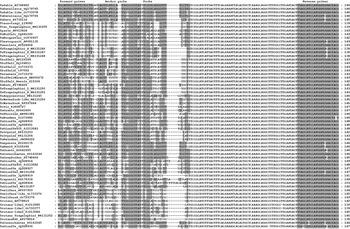
Hybridization assays for T. sp. (sable) and T. sp. (sable-like) were designed for use on the LightCycler® 480 (Roche Diagnostics, Mannheim, Germany). Each reaction consisted of 0.5 pmol of the T. sp. (sable) forward and reverse primers (TspSF: TGCATTGCCTTTTCTCCT TG, TspSR: CCTACTTTATTATTCCATGCTAA), 0.1 pmol of the T. sp. (sable) anchor (5′-GAGTTGATGCATTGCGGCTTAT-FL) and probe (LC640-TCGGTCATGGTTTTCCTTG-PH) (Fig. 1), 1U uracil deoxy-glycosylase (UDG) (Roche Diagnostics, Mannheim, Germany) and 4 µL of the Hybrid PCR mix in a final volume of 20 µL. The Hybrid PCR mix consists of 2 µL each of the LightCycler® Fast Start DNA Master Plus and LightCycler® Genotyping Master mix (Roche Diagnostics, Mannheim, Germany) (Pienaar et al., Reference Pienaar, Potgieter, Latif, Thekisoe and Mans2011b). Cycle conditions were started with 10 min UDG activation at 40 °C, followed by pre-incubation at 95 °C (10 min). An initial 10 cycles of denaturation at 95 °C (10 s), annealing at 57 °C (10 s) and extension at 72 °C (15 s) were followed by a 2-cycle touch-down of 5 °C in annealing temperature to 47 °C. This was followed by 34 cycles of denaturation at 95 °C (10 s), annealing at 47 °C (10 s) and extension at 72 °C (15 s). A positive and negative control was included in each run. Positive controls used was T. sp. (sable) originally isolated and propagated in culture from an infected roan antelope (Hippotragus equinus) (Zweygarth et al., Reference Zweygarth, Benade, Steyl, Prozesky, Koekemoer and Josemans2009), while for T. sp. (sable-like), the bovine field isolate (28 914) previously confirmed through sequencing and RLB analysis was used (Mans et al., Reference Mans, Pienaar, Latif and Potgieter2011). The negative control was from a bovine born and raised under quarantined tick-free conditions. Samples were also tested using the real-time PCR assays for T. parva, T. sp. (buffalo) and T. sp. (bougasvlei) as previously described (Pienaar et al., Reference Pienaar, Potgieter, Latif, Thekisoe and Mans2011a, Reference Pienaar, Potgieter, Latif, Thekisoe and Mans2014).
Multiple sequence alignment of the 18S hypervariable region for various Theileria species. Conserved regions for the primer, anchor and donor sequences for T. sp. (sable) are shaded in grey.

Analytical sensitivity of the real-time PCR assays
A T. sp. (sable) and T. sp. (sable-like) 18S DNA template was prepared by a conventional PCR from the positive controls using the 18S primers from Allsopp et al. (Reference Allsopp, Baylis, Allsopp, Cavalier-Smith, Bishop, Carrington, Sohanpal and Spooner1993) that yielded a ~1100 bp product. The PCR products were fractionated by agarose electrophoresis and the bands cut out before purification using Wizard® SV Gel and PCR Clean-Up System (Promega). The purified products were quantified spectrophotometrically using an ND-1000 NanoDrop spectrophotometer (NanoDrop Technologies, Inc) and concentrations confirmed by agarose electrophoresis against quantified size standards. A tenfold serial dilution was made from quantified 18S templates and tested in triplicate using the various assays to determine the analytical sensitivity. Crossing point (Cp) values were generated using the software methodology of the LightCycler for qualitative detection. The percentage efficiency of the PCR reactions was determined from the slopes of the regression lines of the Log [C]/Cp value plots using the formula, Efficiency = 100( − 1 + 10(−1/slope)) according to Pfaffl (Reference Pfaffl and Bustin2004).
Specificity of the real-time PCR assays
Samples identified as positive for various Theileria genotypes using Sanger sequencing was used to confirm the analytical specificity of the T. sp. (sable) and T. sp. (sable-like) real-time PCR assays. The various genotypes tested are indicated in the Results section.
Next-generation sequencing of antelope samples
The procedures to sequence and analyse the 18S V4 hypervariable region using Roche GS-Junior NGS technology was followed as described (Mans et al., Reference Mans, Pienaar, Ratabane, Pule and Latif2016). This included amplification of the 18S V4 hypervariable region using universal RLB primers, tagging with sample specific identification tags, quality processing, using Basic Local Alignment Search Tool (BLAST) analysis (Altschul et al., Reference Altschul, Gish, Miller, Myers and Lipman1990) and pattern searching using electronic signatures to identify and count specific genotypes (Supplementary material). Unique genotypes were also confirmed using conventional ABI sequencing of the 18S gene as previously described, by sequencing 10 random clones from each sample (Mans et al., Reference Mans, Pienaar, Latif and Potgieter2011). Sequences were deposited in Genbank under the accession numbers MK131245–MK131258.
Bioinformatic analysis of the 18S rRNA V4 hypervariable region
Sequences were retrieved from Genbank using BLAST analysis (Altschul et al., Reference Altschul, Gish, Miller, Myers and Lipman1990), using the novel sequences to retrieve closely related sequences. A curated non-redundant Theileria sequence dataset (Mans et al., Reference Mans, Pienaar and Latif2015) was also included that represent the Theileria sensu strictu clade (Oosthuizen et al., Reference Oosthuizen, Allsopp, Troskie, Collins and Penzhorn2009). Theileria equi was used as an appropriate root for the tree since it generally groups outside the Theileria sensu strictu clade (Mans et al., Reference Mans, Pienaar and Latif2015). Sequences were aligned using multiple alignment using fast Fourier transform with parameters Q-INS-I that takes RNA secondary interaction into consideration and a 20PAM/k = 2 nucleotide scoring matrix (Katoh and Standley, Reference Katoh and Standley2013). The alignment was trimmed to yield an alignment size of 264 bp that included the V4 hypervariable region. Phylogenetic analysis was performed with Mega 5 (Tamura et al., Reference Tamura, Peterson, Peterson, Stecher, Nei and Kumar2011), using neighbour-joining with 10 000 bootstraps and the Kimura 2-parameter nucleotide substitution model. Uniform rates among sites and homogenous patterns among lineages were used and gaps or missing data were treated as partial deletion at 90% site coverage cutoff resulting in 224 sites used in the final analysis.
Results
Development of the T. sp. (sable) and T. sp. (sable-like) real-time PCR assay
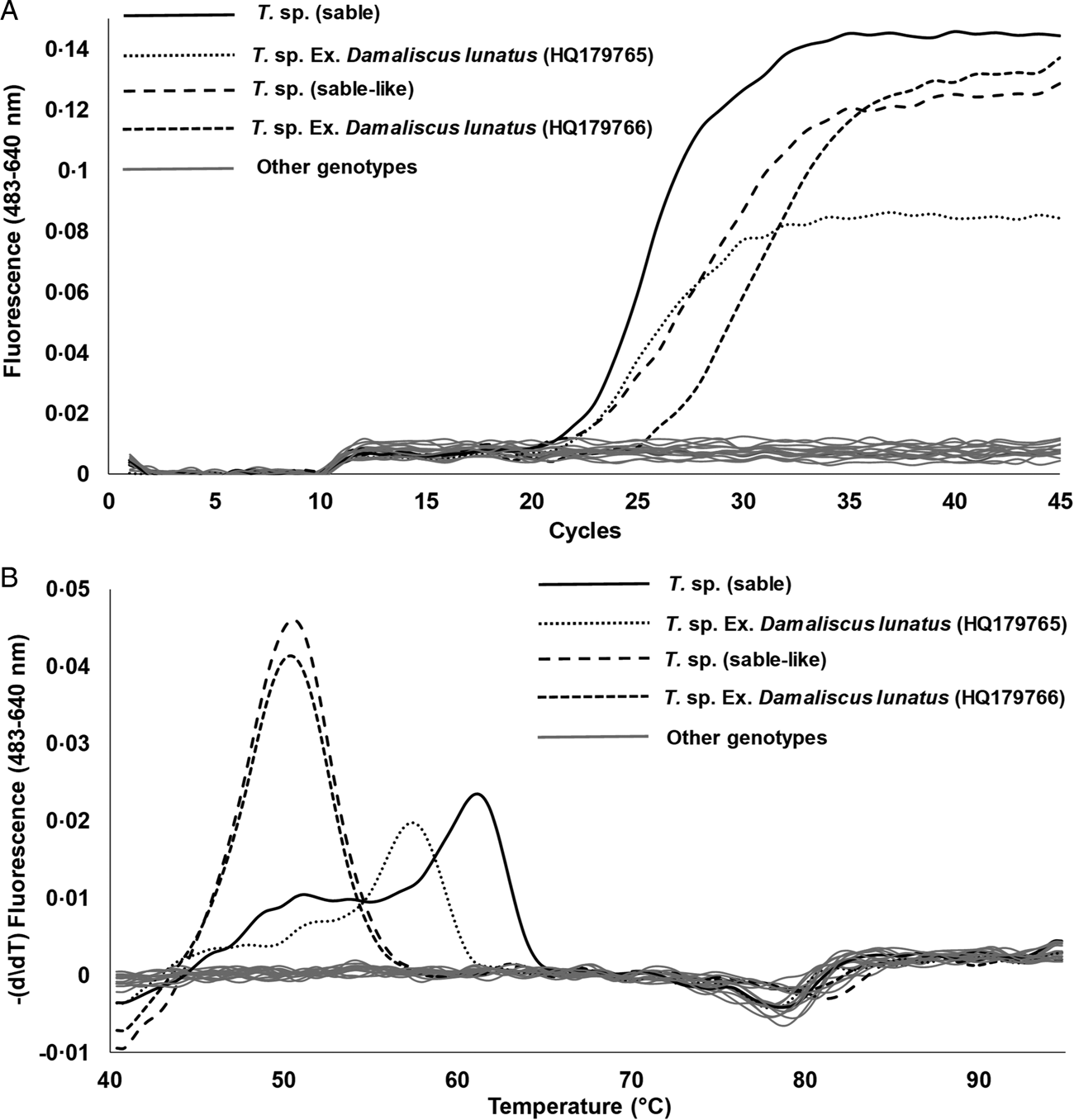
Primers that specifically amplify both T. sp. (sable) and T. sp. (sable-like) were designed with a single set of anchor–donor hybridization probes (Fig. 1). The anchor–donor hybridization probes can differentiate both genotypes, but with different melting profiles and T m values, for T. sp. (sable-like) at 50 ± 2 °C and T. sp. (sable) at 60 ± 2 °C (Fig. 2). During screening, another genotype was also detected that corresponded with T. sp. Ex. Damaliscus lunatus (HQ179765) (Brothers et al., Reference Brothers, Collins, Oosthuizen, Bhoora, Troskie and Penzhorn2011), which gave a T m at 58 ± 2 °C (Fig. 2). However, the difference in sequence of the V4 hypervariable region consists of only a single bp with T. sp. (sable) and we consider this a variant of the same genotype (Mans et al., Reference Mans, Pienaar, Latif and Potgieter2011). Conversely, T. sp. (sable) and T. sp. (sable-like) differ by four nucleotides in the V4 hypervariable region, suggesting they are different species (Mans et al., Reference Mans, Pienaar, Latif and Potgieter2011, Reference Mans, Pienaar and Latif2015). Theileria sp. (sable-like) also differs from T. sp. Ex. Damaliscus lunatus (HQ179766) (Brothers et al., Reference Brothers, Collins, Oosthuizen, Bhoora, Troskie and Penzhorn2011), with one nucleotide difference outside the probe area. We consider this to be a variant of the same genotype as well, based on the arguments of Mans et al. (Reference Mans, Pienaar, Latif and Potgieter2011). The latter showed that single nucleotide polymorphisms occur in the V4 hypervariable region for T. parva, while established species always differ by greater than three nucleotide differences in the V4 hypervariable region. One to three differences in the V4 hypervariable region may therefore be indicative of variation within a species.
The hybridization assay for T. sp. (sable) and T. sp. (sable-like). (A) Amplification profiles for the positive controls and other genotypes tested in the study (section ‘Specificity of the assay’). (B) Melting curves for the positive controls and other genotypes tested in the study (section ‘Specificity of the assay’).

Analytical sensitivity of the real-time PCR assays
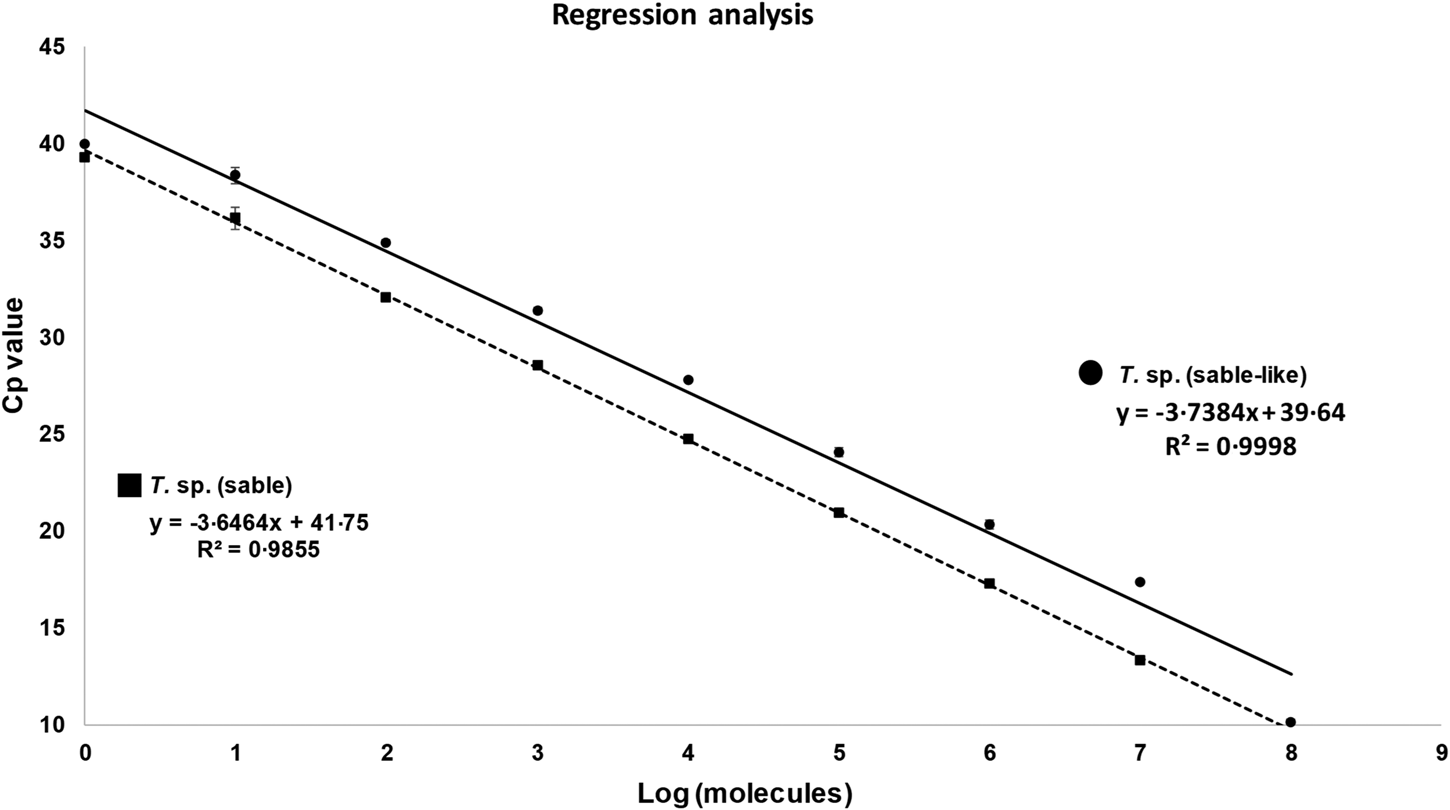
Analytical sensitivity was determined using ten-fold serial dilutions of a quantified 18S rRNA template. Both assays had similar sensitivity capable of detecting up to ~10 molecules per reaction with an efficiency of 85–88% (Fig. 3). For each assay a cut-off was instated at 37 cycles.
Sensitivity of the T. sp. (sable) and T. sp. (sable-like) assays. A ten-fold dilution series were performed in triplicate using a quantified 18S DNA template for each genotype. Indicated regression analysis of Cp values for triplicate samples and the equation for the regression analysis, its R 2 value and the efficiency calculated from the slope. s.d. values are indicated by error bars.

Specificity of the assay
The assay only detected T. sp. (sable) and T. sp. (sable-like) genotypes and did not detect any genotypes found in cattle and buffalo including T. annulata (AY524666), T. buffeli (Warwick) (AB000272), T. cf. buffeli C (GU733373), T. lestoquardi (AF081135), T. mutans (AF078815), T. mutans-like 1 (FJ213585), T. mutans-like 2 (FJ213586), T. mutans-like 3 (GU733377), T. mutans MSD (AF078816), T. parva (AF013418), T. taurotragi (L19082), T. sp. (buffalo) (DQ641260), T. sp. (bougasvlei) (GU570997), T. velifera (AF097993), T. velifera A (GU733375) and T. velifera B (GU733376) (Fig. 2). In addition, 22 genotypes unique to antelope identified in samples from the current study using NGS were also not detected (Fig. 2). This included T. mutans-like (Tragelaphini) (MK131252), T. ovis (FJ608727), T. separata (AY260175), T. sp. (Aepycerotini) (MK131245), T. sp. (giraffe) 1 (MK131257), T. sp. (giraffe) 2 (MK131258), T. sp. (giraffe) 405 (FJ213582), T. sp. (giraffe) 505 (FJ213583), T. sp. (giraffe) (JQ928914), T. sp. (giraffe) (JQ928927), T. sp. (impala) Cervidae-like 1 (MK131253), T. sp. (impala) Cervidae-like 2 (MK131254), T. sp. (kudu) (AY748465), T. sp. Ree (FJ155995), T. sp. (Tragelaphini) A (MK131246), T. sp. (Tragelaphini) B (MK131247), T. sp. (Tragelaphini) C (MK131248), T. sp. (Tragelaphini) D (MK131250), T. sp. (Tragelaphini) E (MK131251), T. sp. (waterbuck) (KF597064), T. sp. (waterbuck-like) (MK131256) and T. taurotragi-like (Tragelaphini) (MK131255).
Real-time PCR assay results for antelope, buffalo, cattle and sheep
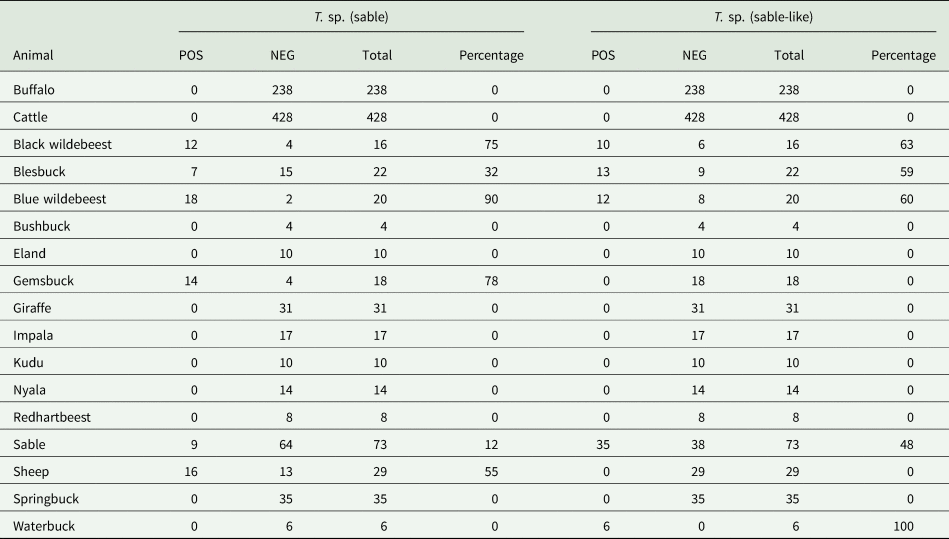
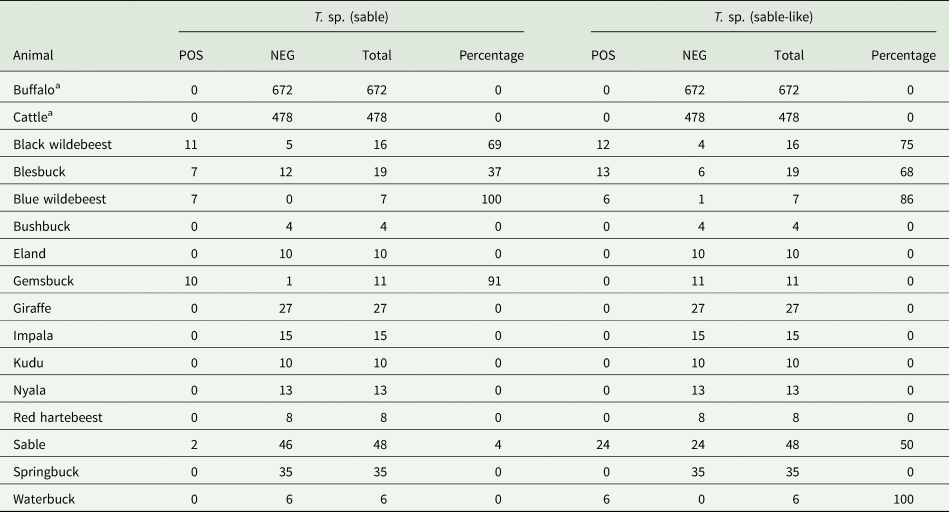
A variety of animals that included antelope, buffalo, cattle and sheep were screened using the T. sp. (sable) and T. sp. (sable-like) assays (Table 1). Animals positive for T. sp. (sable) included black wildebeest, blue wildebeest, gemsbuck, sable and sheep, while animals positive for T. sp. (sable-like) included black wildebeest, blesbuck, blue wildebeest, sable and waterbuck. Neither buffalo nor cattle were positive for T. sp. (sable) or T. sp. (sable-like). Conversely, none of the antelope tested were positive for T. parva, T. sp. (buffalo) or T. sp. (bougasvlei) (results not shown).
Summary of results for T. sp. (sable) and T. sp. (sable-like) obtained from the real-time hybridization assay

Relative parasitaemia of T. sp. (sable) and T. sp. (sable-like)
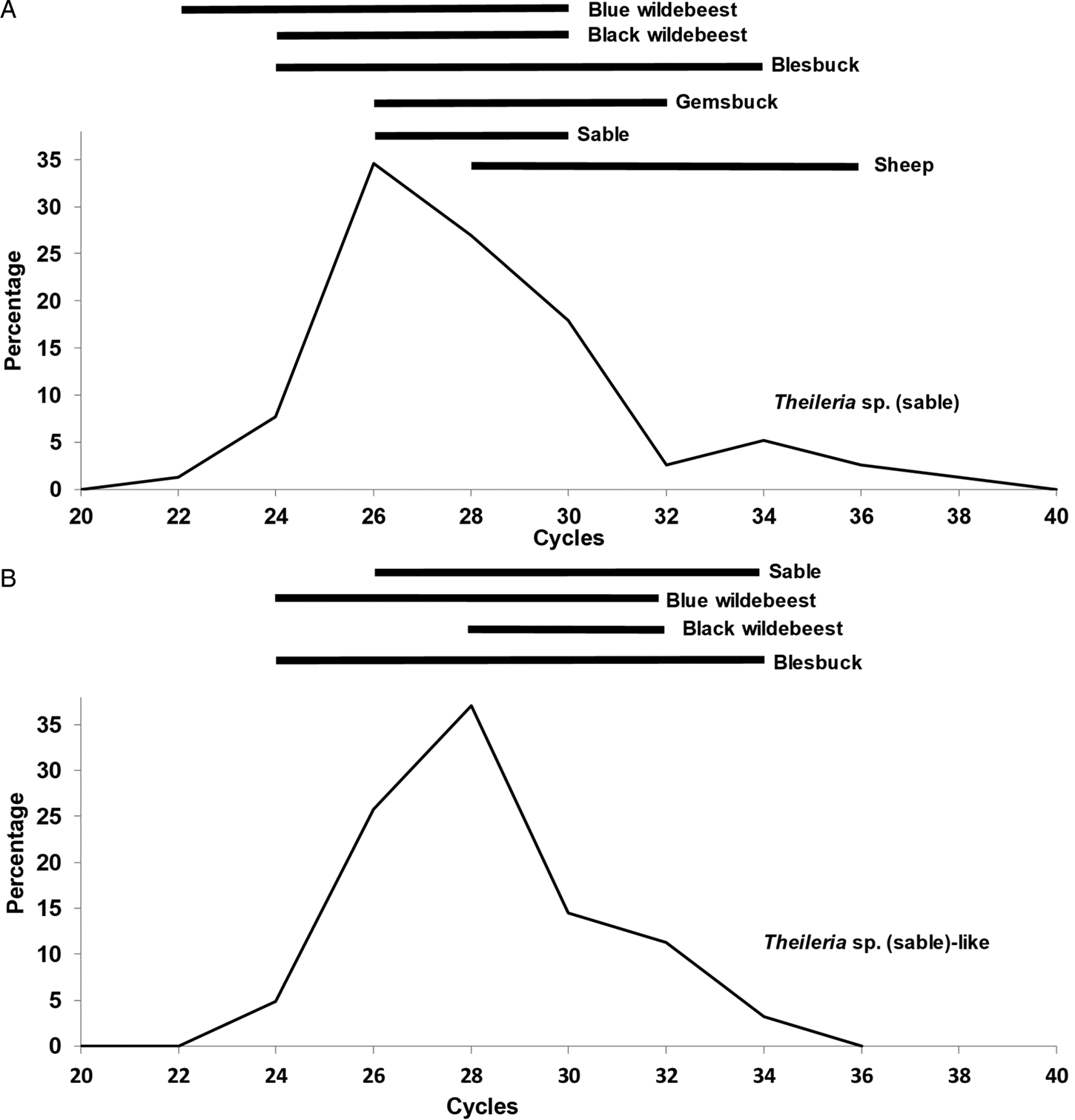
Frequency distribution curves of the crossing-point values indicate that for both T. sp. (sable) and T. sp. (sable-like), a normal distribution is observed that range from 22–34 cycles (Fig. 4). Within this range, the Cp value distribution is similar for different antelope species, suggesting that the parasitaemia range for these species lies well within the detection range of the real-time PCR assays. As such, the majority of field carrier animals should be detectable.
Frequency distribution plots of the Cp values for (A) T. sp. (sable) and (B) T. sp. (sable-like). Horizontal bars indicate the distribution range found in different hosts that covers >80% of the distribution values for that host.

Validation of the T. sp. (sable) and T. sp. (sable-like) assays using next-generation sequencing
Previously, the Theileria diversity in cattle and buffalo was validated using conventional and NGS approaches, to allow confidence when assessing specificity of the T. parva, T. sp. (buffalo), T. sp. (bougasvlei) and T. taurotragi real-time PCR assays (Mans et al., Reference Mans, Pienaar, Latif and Potgieter2011, Reference Mans, Pienaar, Ratabane, Pule and Latif2016; Pienaar et al., Reference Pienaar, Potgieter, Latif, Thekisoe and Mans2011a, Reference Pienaar, Potgieter, Latif, Thekisoe and Mans2011b, Reference Pienaar, Potgieter, Latif, Thekisoe and Mans2014, Reference Pienaar, Latif and Mans2018). In the case of antelopes, a large-scale diversity assessment has never been performed, making the assessment of potential false positive detection difficult when implementing new assays. To address this and assist in the estimation of specificity of the T. sp. (sable) and T. sp. (sable-like) assays, the V4 hypervariable region of the 18S rRNA gene from various antelopes was sequenced using a NGS approach.
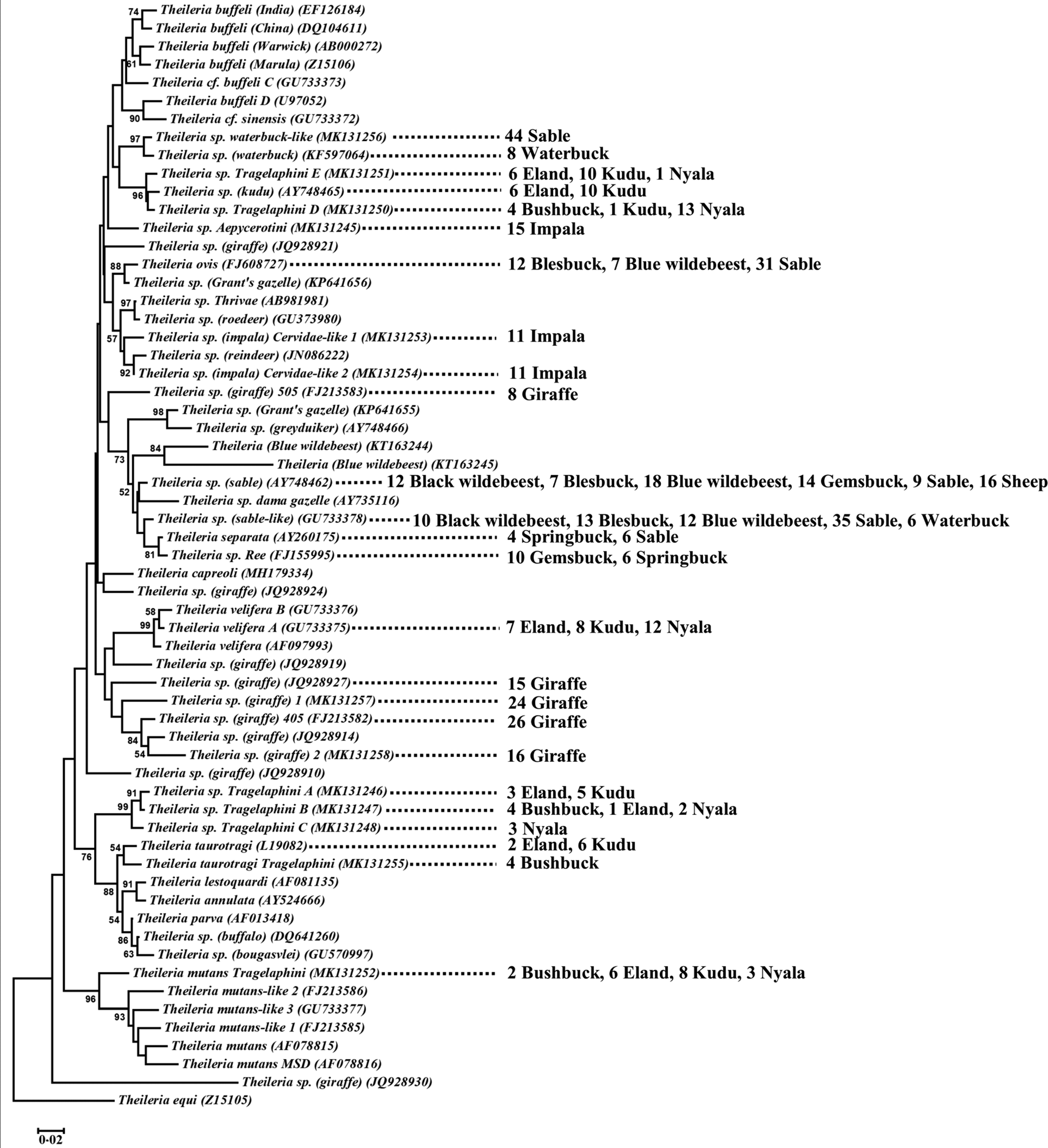
The majority of common genotypes found in cattle or buffalo were not found in any antelope using NGS. This included T. parva, T. sp. (buffalo), T. sp. (bougasvlei), T. mutans 1, T. mutans 2, T. mutans 3, T. mutans, T. mutans MSD, T. buffeli Warwick, T. buffeli C, T. velifera and T. velifera B. Genotypes previously detected in cattle or buffalo were T. taurotragi and T. velifera A. Theileria taurotragi was found in eland and kudu (Fig. 5). Theileria velifera A was found in eland, kudu and nyala (Fig. 5).
Phylogenetic analysis of the Theileria sensu strictu clade. Indicated are various Theileria genotypes or species, their Genbank accession numbers in brackets and the number of animals in which Theileria were detected for various host species using next-generation or Sanger sequencing. The neighbour-joining tree was constructed using Mega 5 (Tamura et al., Reference Tamura, Peterson, Peterson, Stecher, Nei and Kumar2011). Theileria equi was used to root the tree. Nodal support is for 10 000 bootstraps and only support above 50% is shown.

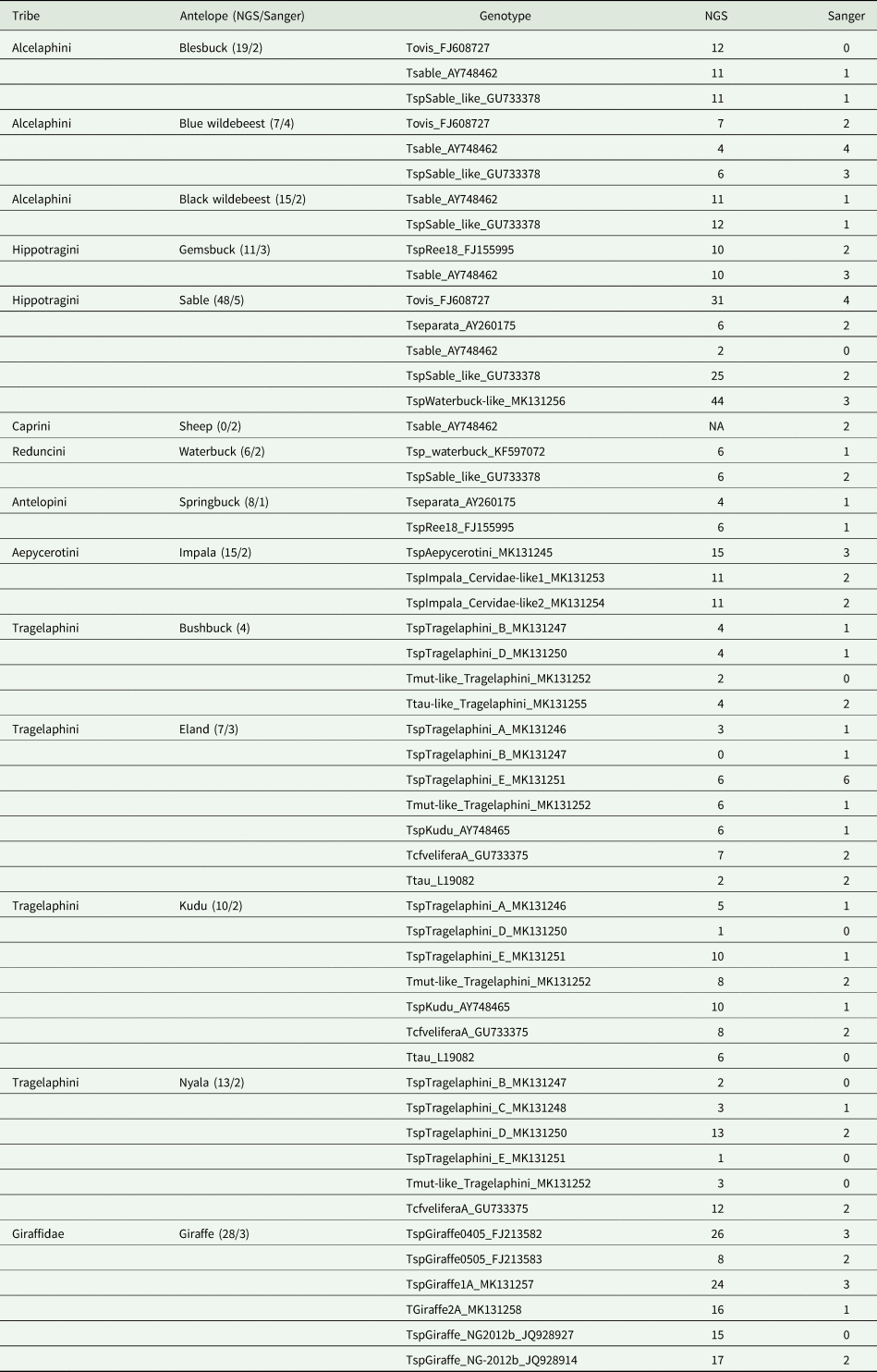
NGS confirmed the positive status of those samples detected with the hybridization assay, while no T. sp. (sable) or T. sp. (sable-like) sequences were detected in samples that tested negative for these genotypes using the real-time PCR assays (Table 2). Conversely, thirteen novel genotypes not previously published were detected in various antelopes and confirmed using conventional sequencing (Fig. 5; Table 3). This included novel genotypes found in bushbuck, eland, giraffe, impala, kudu, nyala and sable, namely T. sp. (Aepycerotini) (MK131245), T. sp. (giraffe) 1A (MK131257), T. sp. (giraffe) 2A (MK131258), T. sp. (impala) Cervidae-like 1 (MK131253), T. sp. (impala) Cervidae-like 2 (MK131254), T. mutans-like (Tragelaphini) (MK131252), T. sp. (Tragelaphini) A (MK131246), T. sp. (Tragelaphini) B (MK131247), T. sp. (Tragelaphini) C (MK131248), T. sp. (Tragelaphini) D (MK131250), T. sp. (Tragelaphini) E (MK131251), T. sp. (waterbuck-like) (MK131256) and T. taurotragi-like (Tragelaphini) (MK131255).
Summary of results for T. sp. (sable) and T. sp. (sable-like) obtained from NGS.

Indicated are the number of positive and negative animals for each animal species tested.
a Results collated from Mans et al. (Reference Mans, Pienaar, Ratabane, Pule and Latif2016).
Sequencing results for NGS and Sanger sequencing

Indicated are the number of animals that was positive using either NGS or Sanger sequencing. Genotypes shows an abbreviated name with its Genbank accession number.
Known genotypes were also found that included T. ovis (FJ608727), T. separata (AY260175), T. sp. (giraffe) 405 (FJ213582), T. sp. (giraffe) 505 (FJ213583), T. sp. (giraffe) (JQ928914), T. sp. (giraffe) (JQ928927), T. sp. (kudu) (AY748465), T. sp. Ree (FJ155995), T. sp. (waterbuck) (KF597064) in blesbuck, black wildebeest, blue wildebeest, eland, gemsbuck, giraffe, kudu, sable, sheep, springbuck and waterbuck. The majority of antelope species were infected with more than one Theileria species or genotype.
Discussion
Accurate diagnostics and epidemiological data depend on sensitive and specific assays to be of any practical or scientific utility (Mans et al., Reference Mans, Pienaar and Latif2015). Accurate quantitative real-time hybridization PCR assays have been developed for T. parva, T. sp. (buffalo) and T. sp. (bougasvlei) (Sibeko et al., Reference Sibeko, Oosthuizen, Collins, Geysen, Rambritch, Latif, Groeneveld, Potgieter and Coetzer2008; Pienaar et al., Reference Pienaar, Potgieter, Latif, Thekisoe and Mans2011b, Reference Pienaar, Potgieter, Latif, Thekisoe and Mans2014). Hybridization probe assays can differentiate genotypes based on differences in anchor and probe regions (Mans et al., Reference Mans, Pienaar, Latif and Potgieter2011). The current study describes the development of a sensitive and specific real-time hybridization probe assay capable of differentiating T. sp. (sable) and T. sp. (sable-like).
The analytical sensitivity of the assays is comparable to other Theileria real-time PCR assays (Sibeko et al., Reference Sibeko, Oosthuizen, Collins, Geysen, Rambritch, Latif, Groeneveld, Potgieter and Coetzer2008; Papli et al., Reference Papli, Landt, Fleischer, Koekemoer, Mans, Pienaar, Josemans, Zweygarth, Potgieter and Latif2011; Pienaar et al., Reference Pienaar, Potgieter, Latif, Thekisoe and Mans2011b, Reference Pienaar, Potgieter, Latif, Thekisoe and Mans2014, Reference Pienaar, Latif and Mans2018). The frequency distribution of the Cp values follows normal distributions with parasitaemia levels in carrier hosts spanning detectable ranges of the assay. Ranges observed are similar to T. parva, T. sp. (buffalo), T. sp. (bougasvlei) and T. taurotragi (Pienaar et al., Reference Pienaar, Potgieter, Latif, Thekisoe and Mans2011b, Reference Pienaar, Potgieter, Latif, Thekisoe and Mans2014, Reference Pienaar, Latif and Mans2018). Parasitaemia levels range from 0.001–0.1% and seem to be the norm for the carrier state in Theileria sensu strictu (Pienaar et al., Reference Pienaar, Potgieter, Latif, Thekisoe and Mans2011a, Reference Pienaar, Potgieter, Latif, Thekisoe and Mans2011b).
The assays for T. sp. (sable) and T. sp. (sable-like) detected no positive cattle (n = 428) or buffalo (n = 238), while antelope showed prevalence's of 12–90% for much smaller sample sizes. Prevalence estimates ranged from 18–47% for buffalo and cattle using RLB analysis (Muhanguzi et al., Reference Muhanguzi, Matovu and Waiswa2010; Yusufmia et al., Reference Yusufmia, Collins, Nkuna, Troskie, Van den Bossche and Penzhorn2010; Eygelaar et al., Reference Eygelaar, Jori, Mokopasetso, Sibeko, Collins, Vorster, Troskie and Oosthuizen2015; Njiiri et al., Reference Njiiri, Bronsvoort, Collins, Steyn, Troskie, Vorster, Thumbi, Sibeko, Jennings, van Wyk, Mbole-Kariuki, Kiara, Poole, Hanotte, Coetzer, Oosthuizen, Woolhouse and Toye2015; Tembo et al., Reference Tembo, Collins, Sibeko-Matjila, Troskie, Vorster, Byaruhanga and Oosthuizen2018). The presence of T. sp. (sable) in cattle and buffalo reported using RLB is therefore probably erroneous (Mans et al., Reference Mans, Pienaar, Latif and Potgieter2011, Reference Mans, Pienaar, Ratabane, Pule and Latif2016).
The current study highlights a pitfall of RLB analysis, i.e. cross-hybridization may lead to erroneous detection of species. The probe for T. velifera differs in three nucleotides from T. sp. (sable) suggesting this similarity level may result in cross-hybridization under non-stringent hybridization conditions. Cross-hybridization may not be restricted to T. sp. (sable) and T. velifera, since the probe for T. mutans differs with 2–3 nucleotides for members of the T. mutans clade and cross-reactivity was observed for members (T. mutans-like 1, T. mutans-like 2 and T. mutans-like 3) exclusive to African buffalo (Mans et al., Reference Mans, Pienaar, Latif and Potgieter2011, Reference Mans, Pienaar, Ratabane, Pule and Latif2016). Cross-reactivity may also occur with T. mutans-like (Tragelaphini) identified in bushbuck. The probe for T. buffeli is identical for the majority of clade members including T. buffeli C and T. sinensis-like that seem to be specific for African buffalo (Mans et al., Reference Mans, Pienaar, Latif and Potgieter2011, Reference Mans, Pienaar, Ratabane, Pule and Latif2016). Since many genotypes show host specificity, RLB analysis could lead to under- or overestimation of prevalence reducing the impact of epidemiological studies (Mans et al., Reference Mans, Pienaar, Ratabane, Pule and Latif2016). Other drawbacks of RLB such as PCR competition for the universal primers may lead to suppression of low-abundance templates and underestimation of genotypes since the majority of hosts are infected by multiple species (Mans et al., Reference Mans, Pienaar, Latif and Potgieter2011, Reference Mans, Pienaar, Ratabane, Pule and Latif2016), PCR suppression is a major factor limiting the use of RLB for epidemiological studies. The classic example is T. parva in African buffalo, where 27–64% infection was detected using RLB, while real-time PCR assays detected ~70% positive samples (Pienaar et al., Reference Pienaar, Potgieter, Latif, Thekisoe and Mans2011a). Alternatives to RLB would be species-specific real-time PCR assays (Mans et al., Reference Mans, Pienaar and Latif2015). Conversely, RLB has been successful in detecting novel genotypes when present as single infections but still needs sequencing for identification and confirmation (Nijhof et al., Reference Nijhof, Penzhorn, Lynen, Mollel, Morkel, Bekker and Jongejan2003, Reference Nijhof, Pillay, Steyl, Prozesky, Stoltsz, Lawrence, Penzhorn and Jongejan2005; Oosthuizen et al., Reference Oosthuizen, Zweygarth, Collins, Troskie and Penzhorn2008, Reference Oosthuizen, Allsopp, Troskie, Collins and Penzhorn2009; Chaisi et al., Reference Chaisi, Janssens, Vermeiren, Oosthuizen, Collins and Geysen2013, Reference Chaisi, Collins and Oosthuizen2014). An alternative to this would be a direct sequencing approach as described in the current and previous studies (Mans et al., Reference Mans, Pienaar, Latif and Potgieter2011, Reference Mans, Pienaar, Ratabane, Pule and Latif2016). While NGS may replace real-time PCR applications in the long term (Mans et al., Reference Mans, Pienaar, Ratabane, Pule and Latif2016), the latter remains cheaper and faster for routine diagnostics making species-specific PCR assays the current preferred choice within a diagnostic setting.
NGS of antelope confirmed that the primers and probes for the T. sp. (sable) and T. sp. (sable-like) hybridization assays are specific, while also allowing discovery of a number of unique genotypes specific to antelopes. A number of novel genotypes were exclusive to the Tragelaphini (bushbuck, eland, kudu and nyala) suggesting that these are unique species that may infect the Tragelaphini in general. Theileria sp. (kudu) (AY748465) was found in the greater kudu (Nijhof et al., Reference Nijhof, Pillay, Steyl, Prozesky, Stoltsz, Lawrence, Penzhorn and Jongejan2005) and the current study found this genotype in eland, suggesting that Tragelaphini may be general hosts. Theileria cf. velifera A was shown to be prevalent in the Tragelaphini while extensive screening showed its presence in cattle but not in African buffalo (Mans et al., Reference Mans, Pienaar, Latif and Potgieter2011, Reference Mans, Pienaar, Ratabane, Pule and Latif2016). Conversely, the related genotypes T. velifera and T. velifera B were extensively detected in cattle and African buffalo (Mans et al., Reference Mans, Pienaar, Ratabane, Pule and Latif2016), but not in any wild antelope from the current study.
With regard to host specificity in antelope, it was indicated that T. taurotragi infect the Tragelaphini, possibly due to evolution of this species in the last common ancestor, with only a more recent adaptation to cattle (Pienaar et al., Reference Pienaar, Latif and Mans2018). It was suggested that Tragelaphini in general may be hosts for T. taurotragi (Pienaar et al., Reference Pienaar, Latif and Mans2018) and was confirmed for the mountain bongo (Tragelaphus eurycerus isaaci) (Bishop et al., Reference Bishop, Odongo, Dolan, Dolan, Skilton and Sayer2019). NGS of the wildlife samples confirmed this again.
The discovery of the related novel T. sp. taurotragi-like genotype is of interest since it was unique to bushbuck, a member of the Tragelaphini, suggesting speciation due to geographic isolation of bushbuck. It is of interest that bushbuck in the current study was negative for T. taurotragi, but positive for T. sp. taurotragi-like, although bushbuck was found to be carriers of T. taurotragi in Uganda (Oura et al., Reference Oura, Tait, Asiimwe, Lubega and Weir2011). Genetic incompatibility has been suggested as a mechanism for speciation in Theileria as observed for T. sp. (buffalo) and T. sp. (bougasvlei) (Pienaar et al., Reference Pienaar, Potgieter, Latif, Thekisoe and Mans2014), and may operate here as well, but will need a larger sampling of bushbuck to confirm this. Mitochondrial analysis indicated that bushbuck may consist of different species in Central and South Africa (Hassanin et al., Reference Hassanin, Delsuc, Ropiquet, Hammere, Jansen van Vuuren, Matthee, Ruiz-Garcia, Catzefli, Areskoug, Thanh Nguyen and Couloux2012), so that host specificity may also play a role in this instance. Alternatively, the possibility exists that the bushbuck from Uganda was carriers of T. sp. taurotragi-like and not T. taurotragi, since these genotypes differ by one nucleotide in the RLB probe area and would probably show cross-reactivity. In this case, host specificity will exist within the Tragelaphini for T. taurotragi and related genotypes. An important question is whether the hydrolysis probe assay for T. taurotragi (Pienaar et al., Reference Pienaar, Latif and Mans2018), would also detect T. sp. taurotragi-like, since these genotypes differ by one nucleotide in the hydrolysis probe region. However, the T. taurotragi forward primer differs in three positions towards the 3′end of the primer and linked with the touchdown PCR conditions employed ensure specificity, since none of the bushbuck samples tested positive with this assay (Pienaar et al., Reference Pienaar, Latif and Mans2018). Piroplasms previously observed in bushbuck from South Africa were named Theileria tragelaphi (Neitz, Reference Neitz1931; Bigalke et al., Reference Bigalke, Keep and Schoeman1972). The current study indicated at least four different genotypes associated with bushbuck that would obscure the identity of the original named piroplasm species.
Antelope infected by T. sp. (sable) and T. sp. (sable-like) includes Alcelaphini (blesbuck, blue wildebeest, black wildebeest, red hartebeest and tsessebe) and Hippotragini (gemsbuck and sable antelope) which form a monophyletic clade. They also form a larger monophyletic group with the Caprini (goats and sheep) (Hassanin et al., Reference Hassanin, Delsuc, Ropiquet, Hammere, Jansen van Vuuren, Matthee, Ruiz-Garcia, Catzefli, Areskoug, Thanh Nguyen and Couloux2012), suggesting that these species may also be infected by T. sp. (sable) and T. sp. (sable-like). Screening of 29 sheep indicated 55% infected with T. sp. (sable) and was confirmed for two sheep using conventional Sanger sequencing. Theileria sp. (sable) was also reported for sheep in South Africa using RLB (Berggoetz et al., Reference Berggoetz, Schmid, Ston, Wyss, Chevillon, Pretorius and Gern2014). Extensive screening of small ruminants (chamois, sheep and goats) from the northern hemisphere did not report T. sp. (sable) (Altay et al., Reference Altay, Dumanli and Aktas2007; García-Sanmartín et al., Reference García-Sanmartín, Aurtenetxe, Barral, Marco, Lavin, García-Pérez and Hurtado2007; Torina et al., Reference Torina, Vicente, Alongi, Scimeca, Turlá, Nicosia, Di Marco, Caracappa and de la Fuente2007; Iqbal et al., Reference Iqbal, Khattak, Ozubek, Khattak, Rasul and Aktas2013; Aydin et al., Reference Aydin, Aktas and Dumanli2015; Ozubek and Aktas, Reference Ozubek and Aktas2017; Chaligiannis et al., Reference Chaligiannis, Fernández de Mera, Papa, Sotiraki and de la Fuente2018). This is likely due to Rhipicephalus appendiculatus and Rhipicephalus evertsi evertsi, considered tick vectors for T. sp. (sable) (Steyl et al., Reference Steyl, Prozesky, Stoltsz and Lawrence2012), only occurring in sub-Saharan Africa (Walker et al., Reference Walker, Keirans and Horak2000). The Alcelaphini, Hippotragini and Caprini with the Oreotragini (klipspringer), Cephalotragini (duiker), Reduncini (waterbuck, Leche, Reedbuck), Antelopini (Gazelle and Springbuck), Neotragini (Suni, Royal antelope) and Aepycerotini (Impala) form the Antilopinae (Hassanin et al., Reference Hassanin, Delsuc, Ropiquet, Hammere, Jansen van Vuuren, Matthee, Ruiz-Garcia, Catzefli, Areskoug, Thanh Nguyen and Couloux2012). The waterbuck screened in the current study showed the presence of T. sp. (sable-like). Theileria sp. (sable) was also previously detected in klipspringer and reedbuck (Nijhof et al., Reference Nijhof, Pillay, Steyl, Prozesky, Stoltsz, Lawrence, Penzhorn and Jongejan2005). All Antilopinae may therefore be potential hosts. The original description of T. sp. (sable-like) in a single cattle sample seemed to have been incidental, since it has not been found in other cattle sampled to date (Mans et al., Reference Mans, Pienaar, Latif and Potgieter2011, Reference Mans, Pienaar, Ratabane, Pule and Latif2016), but has now been extensively found in various antelope species.
Additional Theileria genotypes detected in the Antilopinae included T. ovis, T. sp. Ree, T. sp. waterbuck, T. separata and T. sp. waterbuck-like (sable). These genotypes do not seem to be host specific within the Antilopinae (Hassanin et al., Reference Hassanin, Delsuc, Ropiquet, Hammere, Jansen van Vuuren, Matthee, Ruiz-Garcia, Catzefli, Areskoug, Thanh Nguyen and Couloux2012).
The only genotypes that fall outside this picture are specific for impala, including T. sp. (Aepycerotini), T. sp. (Impala) Cervidae-like 1 and T. sp. (Impala) Cervidae-like 2. Impala did not present any of the genotypes found in other Antilopinae. The impala (with the Neotragini) group basals to all other Antilopinae (Hassanin et al., Reference Hassanin, Delsuc, Ropiquet, Hammere, Jansen van Vuuren, Matthee, Ruiz-Garcia, Catzefli, Areskoug, Thanh Nguyen and Couloux2012). Their relationship to the Antilopinae has been considered uncertain leading to the elevation of its own evolutionary lineage, Aepycerotinae (Ansell, Reference Ansell, Meester and Setzer1971; Vrba, Reference Vrba1979; Gentry, Reference Gentry1992; Matthee and Davis, Reference Matthee and Davis2001). Their unique makeup of Theileria genotypes would support this. An unnamed Theileria species serologically distinct from Theileria isolated from Bovidae in East Africa, not infective to cattle but infective to impala by piroplasm inoculation was described (Grootenhuis et al., Reference Grootenhuis, Young, Kimber and Drevemo1975). Using RLB analysis T. bicornis, T. buffeli and T. sp. (sable) were detected in impala from South Africa (Berggoetz et al., Reference Berggoetz, Schmid, Ston, Wyss, Chevillon, Pretorius and Gern2014). While these species may also infect impala, the current study suggests that further investigation need to confirm this.
The Theileria sp. (Aepycerotini) group with no defined clade, while T. sp. (Impala) Cervidae-like 1 and T. sp. (Impala) Cervidae-like 2 groups within a well-supported clade with T. sp. (reindeer), a genotype related to Theileria from North Texas white-tail deer (Garner et al., Reference Garner, Holman and Berent2012). Reindeer and white-tail deer belong to the Odocoileini (Cervidae) and are genetically distant from Bovidae (Hassanin et al., Reference Hassanin, Delsuc, Ropiquet, Hammere, Jansen van Vuuren, Matthee, Ruiz-Garcia, Catzefli, Areskoug, Thanh Nguyen and Couloux2012). The high sequence similarity observed between Theileria from Cervidae and impala is of interest, suggesting that the presence of these parasites (either in impala or reindeer/white-tail deer) was due to a recent introduction into Africa or into North America. It is tempting to speculate that impala is the ancestral host since their origin could be dated to ~16–18 MYA, while the Odocoileini (reindeer/white-tail deer) has originated only ~5.7 MYA (Hassanin et al., Reference Hassanin, Delsuc, Ropiquet, Hammere, Jansen van Vuuren, Matthee, Ruiz-Garcia, Catzefli, Areskoug, Thanh Nguyen and Couloux2012). However, the diversity of Theileria genotypes in antelope from various continents and their evolutionary origins still needs elucidation.
The current study identified numerous genotypes described in giraffe from South Africa and Kenya (Oosthuizen et al., Reference Oosthuizen, Allsopp, Troskie, Collins and Penzhorn2009; Githaka et al., Reference Githaka, Konnai, Skilton, Kariuki, Kanduma, Murata and Ohashi2013). In addition, two novel genotypes (T. sp. giraffe 1 and T. sp. giraffe 2) were detected, the former identical to a giraffe genotype sampled from a zoo in China, originating from South Africa (Zhang et al., Reference Zhang, Li, Cui, Wang, Lv, Wang, Jian, Zhang, Wang, Yang and Ning2016). As such, Theileria diversity in giraffes from southern Africa is as extensive as in East Africa (Githaka et al., Reference Githaka, Konnai, Skilton, Kariuki, Kanduma, Murata and Ohashi2013).
Lineage specificity seems to emerge as a theme for Babesia and Theileria species, suggesting co-evolution of parasite and host with origins in the last common host ancestors. This may enable dating of the origin of parasite lineages using fossil and molecular clock records for various antelopes (Hassanin et al., Reference Hassanin, Delsuc, Ropiquet, Hammere, Jansen van Vuuren, Matthee, Ruiz-Garcia, Catzefli, Areskoug, Thanh Nguyen and Couloux2012). For T. sp. (sable) and T. sp. (sable-like) this implies that they originated ~16–12 MYA in the ancestral lineage of the Alcelaphini, Caprini, Hippotragini and Reduncini (Hassanin et al., Reference Hassanin, Delsuc, Ropiquet, Hammere, Jansen van Vuuren, Matthee, Ruiz-Garcia, Catzefli, Areskoug, Thanh Nguyen and Couloux2012). This is similar to the origin estimated for the T. taurotragi clade that occurred after divergence of the Bovini and Tragelaphini (Pienaar et al., Reference Pienaar, Latif and Mans2018).
In conclusion, the current study indicated host specificity for T. sp. (sable) and T. sp. (sable-like) within the Tragelaphini, with no conclusive evidence of infection of African buffalo or cattle. NGS indicates that Theileria genotypes are specific to either antelope or bovines, even though host specificity may be for lineages and not necessarily individual species. While a variety of novel Theileria genotypes have been detected, their tick vectors remain unknown, impacting on a full understanding of their epidemiology, geographical ranges and veterinary significance.
Financial support
The research project was funded and approved by the Department of Agriculture, Forestry and Fisheries (DAFF) (Project number: P10000062).
Conflict of interest
None.
Ethical standards
Not applicable.
Supplementary material
The supplementary material for this article can be found at https://doi.org/10.1017/S003118201900132X.