I. INTRODUCTION
The iron based alloys are of fundamental importance for technological applications because of their wide range of properties (mechanical, electrical, thermal, magnetic, etc.). Special interest has been devoted to the study of magnetic properties and electronic structure of ferromagnetic (FM) iron based interstitial compounds. These compounds are formed by the insertion of light elements (usually hydrogen, boron, carbon and nitrogen) interstitially in iron.
Iron-based interstitial compounds have played, since a long time, an important role in steel technology. Particularly, nitriding is used to harden steel surfaces and to passivate them against oxidation. On other hand, nitrogen has the potential to alter the properties of iron-based alloys in a useful sense. Iron nitrides have attracted considerable attention because of their excellent magnetic properties, low coercivity over pure iron, good mechanical properties, and corrosion resistance. Reference Jack1–Reference Rissanen, Neubauer, Lieb and Schaaf4 Among these compounds, γ-Fe4N is an interstitial compound formed by incorporating N atoms into the lattice of a thermodynamically unstable phase of iron (fcc-Fe) under normal conditions. Reference Jack5 It crystallizes in a Perovskite-type structure having five atoms in the unit cell, two nonequivalent Fe site and with N atoms at the body centered positions of the cubic cell (octahedral interstice). The simple crystallographic structure of this compound makes it attractive for fundamental investigation, both theoretical and experimental.
The earliest investigations, in the 1950s, were dedicated to the experimental study of the magnetic properties of Fe4N. Magnetic measurements found a moment of 8.86 µB/f.u. Reference Wiener and Berger6 The neutron diffraction study determined that Fe4N is a FM compound with high magnetic moment: 3 and 2 µB for the corner and face centered iron sites in the unit cubic cell, respectively. Reference Frazer7 Mössbauer effect measurements of57Fe provided results for the hyperfine fields of 345 kOe for the corner Fe and 215 kOe for the face-centered Fe, approximately proportional to the magnetic moments of 3 and 2 µB, Reference Shirane, Takei and Ruby8 confirming the values indicated by neutron diffraction.
Due to the potential applications as high-density magnetic recording material, Reference Suzuki, Sakumoto, Minegishi and Omote9–Reference Sifkovits, Smolinski, Hellwig and Weber19 Fe4N was intensively studied in the 1980–1990 decades using various band structure methods. The theoretical investigations of Fe4N were devoted principally to study the N–N interactions, to determine the Fe and N electronic configurations and study the effect of the interatomic interactions on the stability of the face centered cubic Fe (fcc-Fe) structure.
Matar et al. Reference Matar, Mohn, Demazeau and Siberchicot11 studied the electronic and magnetic structure of Fe4N using the augmented spherical wave method, and described the FM ordering of the compound as covalent magnetism. The spin-polarized band calculation for Fe4N was performed by Sakuma Reference Sakuma12 using the linear muffin-tin orbital (LMTO-ASA) method and concluded that the N atom not only brings about the magnetic moments of the Fe atoms through the magneto volume effect, but also prevents the exchange-splitting by helping the hopping of the electrons. In addition, he made a comparison of the charge density between an N atom in Fe4N and one of the free N atoms within the atomic sphere. The results indicated that the N atoms in Fe4N play a role of electron acceptor.
Paduani and Krause Reference Paduani and Krause16 calculated the hyperfine parameters, the magnetic moments and the local density of states (DOS) at both non-equivalent iron sites in Fe4N by using the discrete variational method in the self-consistent charge approximation (DVM-SCC), and investigated the dependence of these quantities on the lattice spacing and the local properties at nitrogen sites. Their results indicated that N atoms act as electron acceptors. Sifkovits et al. Reference Sifkovits, Smolinski, Hellwig and Weber19 carried out a comparative study of chemical bonding and magnetism in iron nitrides (including Fe4N) and determined a strong covalent Fe–N bond, as a result of a substantial σ-type p–d hybridization with some charge transfer to N. Because of the large exchange fields, the majority spin d bands are always fully occupied, while the minority spin d bands are close to half-filling thus optimizing the Fe d–d covalent bonding.
To better understand the intrinsic magnetism of Fe4N, several elements were used to substitute N in the structure. Kong et al. Reference Kong, Zhou and Li20 using the LMTO-ASA method calculated the electronic structure of γ-Fe4X (X = H, C, and N) to investigate the chemical bonding effect of interstitial X atom. Their results indicated that the insertion of the X atom changes not only the Fe–Fe interaction, but also the Fe–X interaction. They concluded that the interstitial chemical bonding effect in γ-Fe4X is mainly determined by the covalent feature of the Fe–X bonds. Santos et al. Reference dos Santos, da Costa and Kuhnen21 analyzed the electronic structure of γ-Fe4C using LMTO-ASA method, and concluded that the compound shows a stable FM structure and that the C atoms in the interstices, as well as Fe atoms occupying the corners of the cubic fcc structure acts as donors of electrons to the Fe atoms in the face centers. However, DVM calculations performed by Krause et al. Reference Krause, Paduani and da Costa22 in the same system indicated that the C atoms act as electron acceptors.
Ishimatsu et al. Reference Ishimatsu, Maruyama, Kawamura, Suzuki, Ohishi, Ito, Nasu, Kawakami and Shimomura23 performed experimental investigations of Fe4N under high pressure. They observed a decrease of the magnetic moment due to decreasing volume at room temperature and suggested that Fe4N undergoes a second-order phase transition from the FM state to a paramagnetic state, but no structural phase transformation was observed. Ogura and Akai Reference Ogura and Akai24 discussed the magnetic properties and hyperfine interaction of Fe4N and Fe4C under high pressure on the basis of first-principle electronic structure calculations performed by the Korringa-Kohn-Rostoker (KKR) Green's function method and its extension into a full potential scheme (FP-KKR). Their results showed that both compounds undergo a weak first order transition from high to low spin states under pressure.
To improve the structural and magnetic properties of γ-Fe4N, many theoretical and experimental researchers did studies of ternary systems of the XFe3N-type. A great amount of ternary iron nitrides (XFe3N) were obtained experimentally by mechanical alloying, Reference de Figueiredo and Foct25–Reference de Figueiredo, Foct, dos Santos and Kuhnen28 and many theoretical studies were reported describing the effects of the Fe substitution by X [e.g., X = Mn, Au, Ag, Sn, Pd, Ni, Pt, In, and Zn (Refs. Reference Foct, de Figueiredo, Richard and Mormiroli29–Reference Zhang, Wang and Cao35)].
Recently, Fe4N has been proposed as a ductile and hence damage-tolerant material due to its high ratio of the bulk to shear modulus (B/G) according to the results of ab initio calculations. Reference Music and Schneider36–Reference Yan, Wu and Liu38
Timoshevskii and coworkers Reference Timoshevskii and Yablonovskii39 studied the atomic structure of Fe–N and Fe–C austenite using ab initio calculations to obtain the pair potential of interactions N–N and C–C and modeling the short range order in Fe–N and Fe–C systems with Monte Carlo simulations. They concluded that N-atoms in Fe–N austenite can be partially ordered. In contrast, the C-atoms in Fe–C austenite show a repulsive interaction and settle at maximum possible distances from each other. Lv et al. Reference Lv, Gao, Sun, Qv, Wang, Shi and Fu40 investigated the crystal structure, elastic properties and some electronic properties of γ-Fe4X (X = B, C, and N) via first principles calculations, using the Cambridge Serial Total Energy Package (CASPEL) based on the density functional theory (DFT). According to their results, the nature of Fe–X chemical bonding is a complex mixture of metallic, covalent, and ionic characters.
Although lots of works have been done up to date on γ-Fe4N and γ-Fe4C, there are not still enough studies, principally using DFT theory, about the effects of the sequential substitution of 2p elements on the magnetic properties and hyperfine interactions in fcc-Fe. Because of this, in this paper, the initial results of a systematic study are presented that aims to investigate via first principles calculations using the computational code Wien2k the effects of sequential substitution of 2p interstitial atom (X = B, C, N, and O) on the electronic structure of γ-Fe4X.
II. COMPUTATIONAL METHOD AND STRUCTURE
The calculations were performed with the linearized augmented plane wave (LAPW) method. The electron exchange and correlation energy were calculated using the parametrization of Perdew, Burke, and Ernzerhof functional Reference Perdew, Burke and Ernzerhof41 within the generalized gradient approximation (PBE-GGA). Reference White and Bird42 The method was used as implemented in the Wien2k computational code. Reference Blaha, Schwarz and Luitz43 In the LAPW method the electronic wave function was expanded in spherical harmonics inside the non-overlapping spheres, centered at each nuclear position and in plane waves in the interstitial region of the unit cell. The convergence was controlled by a cut-off parameter R mt K max, where R mt was the smallest atomic sphere radius and K max the plane wave cut-off. In the present work, the R mt of particular atoms were set to conform to the criterion of almost-touching spheres: 2.07/1.99/1.96/1.92 a.u. for Fe in γ-Fe4X (X = B, C, N, and O), respectively, and 1.53/1.55/1.60/1.66 a.u. for B, C, N, and O, respectively. The cut-off parameter (R mt K max) was fixed at −7 Ry. The Brillouin zone integrations were performed with the tetrahedron method in a grid (21 × 21 × 21) with 286 k-points and the convergence criteria for energy calculations of 0.01 mRy.
Theoretical calculations were performed for γ-Fe4X (X = B, C, N, and O) modeled with a unit cell with crystal structure of face centered cubic type and space-group
 $Fm\bar 3m$
. This structure has five atoms in the unit cell and two nonequivalent Fe sites. There is one type of iron at the corners (0,0,0) labeled FeI and the other, FeII, occupies the face-centered positions (½,½,0), (½,0,½), and (0,½,½) of the cubic cell. The X atom (X = B, C, N, and O) is located at (½,½,½), the center of the elementary cell, and is surrounded by six Fe atoms in an octahedral interstice.
III. RESULTS AND DISCUSSION
A. Formation and cohesive energy
The ab initio calculations of the total energy (E T), for γ-Fe4X (X = B, C, N, and O) were performed in the nonmagnetic (NM) and FM states. The formation energy (E F) was calculated by the relation:
 $${E_{\rm{F}}}\left( {\gamma {\rm{ - F}}{{\rm{e}}_4}{\rm{X}}} \right) = {E_{\rm{T}}}\left( {\gamma {\rm{ - F}}{{\rm{e}}_4}{\rm{X}} \right) - \sum\nolimits_i {{n_i}{E_{\rm{T}}}\left( i \right)} \quad ,$$
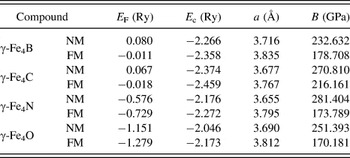
where E T(i) is the total energy of the i atom in bulk (pure) and at ground state (0 K and 0 Pa), also calculated by first principles, and n i the number of this type of atom in the compound. As can be seen in Table I the difference between the formation energy in NM and FM states (∆E F = E F(NM) − E F(FM)) is very similar for γ-Fe4B and γ-Fe4C (∆E F ≈ 0.09 Ry) and for γ-Fe4N and γ-Fe4O (∆E F ≈ 0.14 Ry). The negative sign of E F indicated the necessity to provide energy to form a compound. The compounds γ-Fe4N and γ-Fe4O are stable in the NM state. The compound that requires the smaller amount of energy for its formation is γ-Fe4B in the FM state.
The calculated parameters at ground state: formation energy (E F); equilibrium cohesive energy (E c); lattice parameter (a); and bulk modulus (B).

To discuss the stability of the compounds, it is necessary to calculate the cohesive energy E c, which is understood as the energy needed to break a solid mass apart into neutral free atoms. The magnitude of E c varies with the distance between the atoms (unit cell volume) and exhibits a minimum value. The E c value corresponding to this minimum is the equilibrium cohesive energy. The determination of the magnetic ground state of a given compound can be made by comparing the equilibrium cohesive energy in the NM and FM states. E c can be obtained from the following equation:
 $${E_{\rm{C}}}\left( {\gamma {\rm{ - F}}{{\rm{e}}_4}{\rm{X}}} \right) = {E_{\rm{T}}}\left( {{\rm{\gamma - F}}{{\rm{e}}_4}{\rm{X}}} \right) - \sum\nolimits_i {{n_i}{E_i}} \quad ,$$
in this, E i corresponds to the energy of each i atom of the compound, in its free state, calculated from first principles.
From the cohesive energy point of view, all the compounds investigated are more stable in the FM state (Table I). The stability increases in the sequence: γ-Fe4O, γ-Fe4N, γ-Fe4B, γ-Fe4C. The calculated values of the equilibrium cohesive energy were used to determine the ground state structural properties (lattice parameters, a) of the compounds (Table I). The lattice parameters for γ-Fe4B, γ-Fe4C, and γ-Fe4N are very close to other calculations reported in literature: 3.817, 3.748, and 3.780 Å. Reference Lv, Gao, Sun, Qv, Wang, Shi and Fu40
According to the values of the Bulk modulus (Table I) the compressive strength (in the FM state) increases following the same sequence of E c (γ-Fe4O, γ-Fe4N, γ-Fe4B, γ-Fe4C); the higher the value of E c, the larger the value of the Bulk modulus is. In contrast, the unit cell volume of the compounds diminishes with the increase of E c: compounds with higher cohesive energy have smaller unit cell volume.
B. The ground state properties
1. Electronic properties
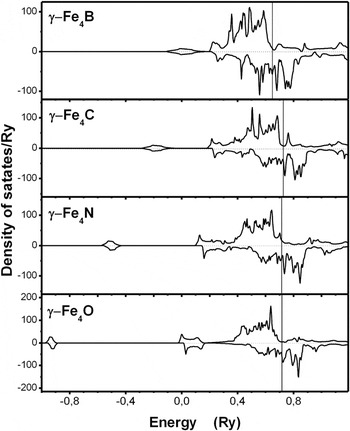
The calculated total densities of states (tDOSs) at T = 0 K and P = 0 Pa for γ-Fe4X (X = B, C, N, and O) are depicted in the Fig. 1. The profiles of the tDOS are similar, but the substitution of X leads to an increase of the number of electrons in the system and produces modifications of the electronic structure. The Fermi level (E Fer) is located at 0.722, 0.723, and 0.734 Ry for γ-Fe4O, γ-Fe4N, and γ-Fe4C, respectively, while that for γ-Fe4B is at 0.655 Ry. Furthermore the tDOS profile spreads out toward lower energy values below the Fermi level by the substitution of X = B by C, N, and O.
The calculated total DOS for γ-Fe4X (X = B, C, N, and O). The vertical solid line indicates the Fermi level.

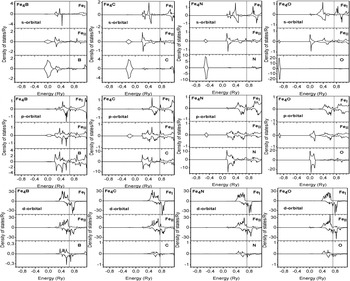
To get a better understanding of the electronic structure, the partial densities of states (pDOSs) were calculated at each atomic site for γ-Fe4X (X = B, C, N, and O), Fig. 2. As can be observed, the s-states of X atoms dominate the pDOS at the range of lower energy, below E Fer. There are also contributions of the s-states and p-states of FeII. With the substitution of B atom by C, N, and O, these states are shifted toward lower energies. The peaks of pDOS at lower energy are located between: −0.10 and 0.15 Ry for γ-Fe4B; −0.27 and −0.07 Ry for γ-Fe4C; −0.57 and −0.44 Ry for γ-Fe4N; and −0.97 and −0.90 Ry for γ-Fe4O. This result indicates that the line width of the peaks associated to X s-states and FeII s-states and p-states decrease in the sequence γ-Fe4B, γ-Fe4C, γ-Fe4N, and γ-Fe4O. The shapes of the peaks are almost identical for both spin states (spin-up and spin-down) of the electrons and there is a slight shift in energy between them.
Calculated partial DOS for γ-Fe4X (X = B, C, N, and O).

The region of middle energy of the pDOS' profile (Figs. 1 and 2) is located approximately between: 0.20 and 0.32 Ry for γ-Fe4B, 0.20 and 0.45 Ry for γ-Fe4C, 0.10 and 0.38 Ry for γ-Fe4N, and −0.02 and 0.17 Ry for γ-Fe4O. There is an energy gap between this region and that of lower energy. The energy gap increases from: 0.05 Ry for γ-Fe4B to 0.21 Ry for γ-Fe4C, 0.55 Ry for γ-Fe4N and 1.00 Ry for γ-Fe4O. The middle energy region is composed mainly by the p-states of X atoms (B, N, C, and O), s and p-states of FeI, and s, p, and d-states of FeII.
The high energy section of the pDOS' profile is located between 0.4 Ry and the Fermi level for all γ-Fe4X (X = B, C, N, and O). This energy region is dominated by the d states of FeI and FeII. There are also small contributions of the p-states of these atoms and of the p and d-states of X atoms. As shown in Fig. 2 the contribution of the spin-up d-states of both iron atoms are greater than the spin-down contribution. Furthermore the d-state density of FeI is narrower than that of FeII. It can be noted that the most important contribution to the tDOS at the Fermi surface arise from spin-down FeI and FeII d-electrons in all γ-Fe4X (X = B, C, N, and O).
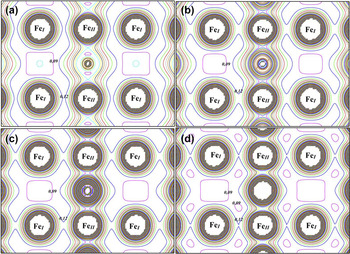
The electron density (ED) is useful to analyze the nature of the bond character. To investigate the chemical bonding in γ-Fe4X (X = B, C, N, and O), the ED behaviors in two-dimension are calculated in the (101) crystallographic plane of the fcc unit cell, Fig. 3. This plane contains all of the nonequivalent atoms of the crystal structure. The isocurves (curves of constant charge density) indicate that the ED within the muffin-tin radius of X atoms increases as follows: γ-Fe4B, γ-Fe4C, γ-Fe4N, γ-Fe4O. This is consistent with the fact that the 2p electron number at X atoms changes from 2p 1, to 2p 2, 2p 3 and 2p 4. The inspection of Fig. 3 shows that there is a large electronic charge shared between X atoms and their near neighbors, FeII. This sharing of charge causes a strong covalent interaction of the X–FeII bond with directional character. According with the DOS (Figs. 1 and 2) the covalence is related, mainly, to a high hybridization of p-orbitals of the X (X = B, C, N, and O) atoms with d-orbitals of the FeII.
ED contour in the plane (101) plotted from 1.8 to 0 e/Å3 and delta of 0.03 e/Å3 for: (a) γ-Fe4B; (b) γ-Fe4C; (c) γ-Fe4N; (d) γ-Fe4O. The X atom is located at the center of the figure.

There is not a clear evidence of the bond character between FeI and X atoms. But some features can be highlighted. The ED at the FeI sites is almost spherical. There exists a delocalized electron charge between the FeI and X sites. This electron charge tends to spread in the space when X = B is substituted by C, N, and O. These results suggest that there is a bond partially ionic and partially covalent between the atoms FeI and X. The covalent bond seems to be stronger with the increase of the atomic number of X (B, C, N, and O).
2. Magnetic moment
Figure 4 shows the calculated total magnetic moment per unit cell (M) for γ-Fe4X, as function of X (X = B, C, N, and O). As can be observed M changes irregularly with the increase of the atomic number of X. M is larger for γ-Fe4N (9.91 µB) and lower for γ-Fe4C (8.11 µB). These values of M are in good agreement with theoretical values related in the literature: 8.1 µB (Ref. Reference Kong, Zhou and Fashen18) and 9.89 µB (Ref. Reference Peltzer y Blanca, Desimoni and Christensen44) for γ-Fe4C and γ-Fe4N, respectively.
Calculated local magnetic moment at FeI (
 ${m_{{\rm{F}}{{\rm{e}}_{\rm{I}}}}}$
) and FeII (
 ${m_{{\rm{F}}{{\rm{e}}_{{\rm{II}}}}}}$
) sites and total magnetic moment (M, open circles) for γ-Fe4X as function of X (X = B, C, N, and O) atoms.

The effect of the X (X = B, C, N, and O) substitution on the local magnetic moment at FeI (
 ${m_{{\rm{F}}{{\rm{e}}_{\rm{I}}}}}$
) and FeII (
 ${m_{{\rm{F}}{{\rm{e}}_{{\rm{II}}}}}}$
) sites is illustrated in Fig. 4. The calculated
 ${m_{{\rm{F}}{{\rm{e}}_{\rm{I}}}}}$
(3.02/2.94 µB) and
 ${m_{{\rm{F}}{{\rm{e}}_{{\rm{II}}}}}}$
(1.76/2.30 µB) values for γ-Fe4C/γ-Fe4N are in good agreement with the values found in the literature: 3.0 and 2.0 µB experimental values
Reference Choo and Kaplow45
; 2.63 and 1.77 µB theoretical values for γ-Fe4C (Ref. Reference Krause, Paduani and da Costa22); 2.97 and 2.03 µB theoretical results for γ-Fe4N.
Reference Paduani and Krause16
It can be noticed that
 ${m_{{\rm{F}}{{\rm{e}}_{\rm{I}}}}}$
decreases slightly and linearly from B to O while
 ${m_{{\rm{F}}{{\rm{e}}_{{\rm{II}}}}}}$
shows an increasing trend with exception for X = C.
 ${m_{{\rm{F}}{{\rm{e}}_{\rm{I}}}}}$
is larger than
 ${m_{{\rm{F}}{{\rm{e}}_{{\rm{II}}}}}}$
in the series X = B, C, N, and O. The outstanding difference between the
 ${m_{{\rm{F}}{{\rm{e}}_{\rm{I}}}}}$
and
 ${m_{{\rm{F}}{{\rm{e}}_{{\rm{II}}}}}}$
values can be understood by geometrical considerations. As previously discussed, the two crystallographic sites occupied by iron atoms in the fcc lattice of γ-Fe4X (X = B, C, N, and O) have different environments. It is observed that the interatomic distance between the FeII and X atoms is shorter than the distance value between the FeI and X atoms. For FeI site, the d states are more localized than that in FeII. According the pDOS, the d states of FeII exhibit a considerable overlap with the p states of the nearest neighbor X. This implies a strong hybridization between the d-states of the FeII atoms and p-states of X atoms causing a broadening of 3d states of FeII atoms. This broadening of the d states (below the Fermi level) reduces the magnetic moment of the FeII atoms relative to FeI atoms. The difference (
 ${m_{{\rm{F}}{{\rm{e}}_{\rm{I}}}}} - {m_{{\rm{F}}{{\rm{e}}_{{\rm{II}}}}}}$
) is larger in γ-Fe4C (1.24 μB) and lower in γ-Fe4O (0.44 μB). The influence of C atoms in the reduction of the magnetic moment of their nearest neighboring atoms (FeII), relative to the FeI atoms, is stronger than the influence of B, N, and O atoms. The calculations results show that X atoms have low magnetic moments (around 0.10 µB). What attracts attention is that for B and C the magnetic moment is negative while for N and O, it is positive.
3. Hyperfine interactions
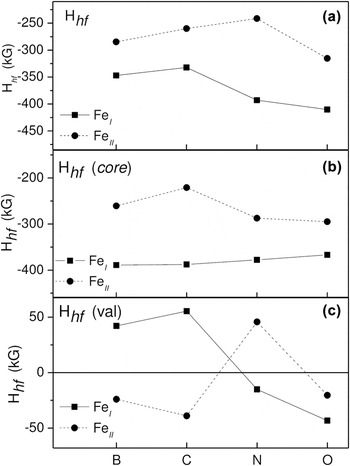
Figure 5(a) displays the magnetic hyperfine field (H hf) dependence with the X composition at both non-equivalent iron sites in γ-Fe4X (X = B, C, N, and O). As can be observed H hf values at the FeI sites show a similar behavior to that exhibited by M: H hf decreases when B is substituted by C and grows when N or O substitutes C. For FeII sites H hf decreases linearly from X = B, to N and then increases abruptly for X = O.
(a) The magnetic hyperfine field (H hf), (b) the core contribution (H core) and (c) the valence contribution (H val) to H hf as function of X atoms in γ-Fe4X (X = B, C, N, and O).

At 0 K, the H hf value is −332.00/−260.00 kG for FeI/FeII site in γ-Fe4C and −387.00/−234.00 kG in γ-Fe4N. These values are in agreement with the theoretical results: −288/−266 kG (Ref. Reference Krause, Paduani and da Costa22) for γ-Fe4C; and −333.00/−267.00 kG for γ-Fe4N (Ref. Reference Paduani and Krause16); and the experimental data: 386.00/280.00 kG, for γ-Fe4C (Ref. Reference De Cristofaro and Kaplow46); and −341.00/−217.00 kG, for γ-Fe4N. Reference Kuhnen, de Figueredo, Drago and da Silva13
The H hf acting on an iron nucleus (as measured by Mossbauer spectroscopy), in the absence of an external field, can be expressed as a sum of three contributions: the orbital magnetic moment (H o), the dipole term (H d), and the Fermi contact term (H Fc). The first two contributions are often small even in the case of ordered alloys (including 3d-metals: ∼20 kG), thus a good approximation for H hf is:
 $${H_{{\rm{hf}}}} = {H_{{\rm{Fc}}}} = - {8 \over 3}\pi {\gamma _{\rm{N}}}\left[ {{{\left| {{\Psi _{ \uparrow \left( 0 \right)}}} \right|}^2} - {{\left| {{\Psi _{ \downarrow \left( 0 \right)}}} \right|}^2}} \right]\quad ,$$
in this γN is the nuclear gyromagnetic ratio and
 ${\Psi _{ \uparrow \left( 0 \right)}}$
and
 ${\Psi _{ \downarrow \left( 0 \right)}}$
are the densities of s electrons at the nucleus (r = 0) for up (↑) and down (↓) spins, respectively. The spin density arises partly from core electrons, partly from the conduction 4s electrons and indirectly as a result of polarization effects on filled s orbitals by unpaired d electrons. Having this in mind, H
hf can be regarded as consisting of two contributions: H
hf(core) representing the field due to the polarization of core (1s, 2s, 3s) electrons and H
hf(val) representing the one due to the polarization of valence (4s, 3d, 4p) electrons.
H hf(core) and H hf(val) contributions to H hf in γ-Fe4X (X = B, C, N, and O) are shown in Figs. 5(b) and 5(c). H hf(core) is the dominant contribution to H hf at both Fe sites. A linear relation between H hf(core) and the local magnetic moments is observed at both Fe sites [Figs. 5(b) and 4]. The proportional coefficient (H hf(core)/m Fe) is estimated to be around −128.0 and −131.0 kG/µB for FeI and FeII sites, respectively. These results are coherent with theoretical calculations that indicated that H hf(core) is proportional to the 3d shell magnetic moment Reference Watson and Freeman47 and are also consistent with those of Kong et al. Reference Kong, Zhou and Li20 for γ-Fe4Z (Z = H, C, and N) that found a (H hf(core)/m Fe) coefficient to be around −130.0 kG/µB.
The valence contributions to the Fermi contact field, H hf(val), is more complex. H hf(val) consists of two parts: the self-polarization valence hyperfine field due to the s–d exchange interaction within the atom and the transferred valence hyperfine field which arises due to s–d hybridization between s orbitals of the atom and the spin polarized d orbitals of the neighboring atoms. Furthermore, although the H hf(val) contribution to the H hf is small, its role is important because it contains large contribution from the neighboring atoms. Reference Watson and Freeman47
At FeI site of γ-Fe4B and γ-Fe4C the H hf(val) is positive and reduces the H hf values relatively to H hf(core). In contrast, in γ-Fe4N and γ-Fe4O the H hf(val) is negative and increases the H hf absolute values. At FeII site of γ-Fe4X (X = B, C, and O), the H hf(val) is negative and increases the H hf values relatively to H hf(core). On the other hand, in γ-Fe4N, H hf(val) is positive and contributes to reduce the H hf. This result is indicative of an antibonding state between FeII and FeI atoms.
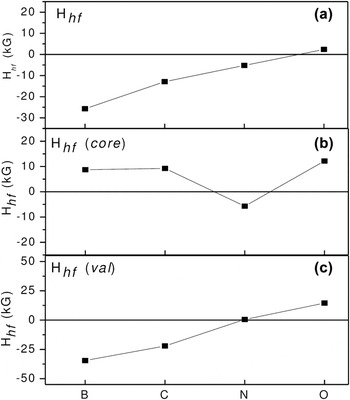
The calculation results indicated that the H hf value at X (X = B, C, and N) atom in γ-Fe4X, decreases linearly and for X = O, it changes the signal, Fig. 6. With the exception of X = N, H hf(val) is the dominant contribution to H hf. This fact is consistent with the low magnetic moment of X atoms. In γ-Fe4N both contributions, H hf(val) and H hf(core), are practically negligible.
(a) The magnetic hyperfine field (H hf), (b) the core contribution (H core) and (c) the valence contribution (H val) to H hf at X atoms in γ-Fe4X (X = B, C, N, and O).

To better understand the charge distribution in γ-Fe4X (X = B, C, N, and O) the isomer shift (IS) was calculated. The origin of IS lies in the finite size of the nucleus. The electric monopole interaction between the nuclear charge and the electrons at the nucleus shifts nuclear energy levels without changing the degeneracy and it arises due to the size effect of the nucleus during its excitation, the charge distribution and the effective radius change and therefore the shift of the energy levels of the ground state and excited state is different. This shift cannot be measured directly, thus a suitable reference such as a specific source or an absorber is necessary. To investigate the ED at the Fe nucleus, the IS relative to the body centered cubic Fe (bcc-Fe) was calculated.
The Mössbauer spectroscopy is a powerful tool to study the IS. The IS is influenced by the oxidation state of the atom through the occupation number of the electronic orbital and can be calculated using the following expression:
 $${\rm{IS}} = \alpha \left[ {{\rho _{\rm{n}}}\left( 0 \right) - {\rho _{\rm{s}}}\left( 0 \right)} \right]\quad ,$$
where ρ n (0) is the ED on the sample nucleus and ρs(0) is the electronic density on the source nucleus. In this,
 $$\alpha = \beta \Lambda {r^2}\quad ,$$
where β is characteristic of the Mössbauer isotope. Although the magnitude β must be evaluated from nuclear calculations, the constant α can be estimated by calibration Reference Timoshevskii, Timoshevskii and Yanchitsky48–Reference Duff50 and the IS, in mm/s, can be estimated through the results obtained from the first principles calculations.
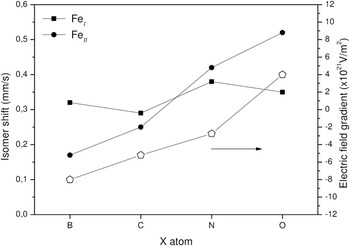
Figure 7 displays the IS dependence with the X composition at both non-equivalent iron sites in γ-Fe4X (X = B, C, N, and O). The calculated IS values for FeI and FeII are 0.29 and 0.25 mm/s in γ-Fe4C, and 0.38 and 0.42 mm/s in γ-Fe4N. These values are in good agreement with reported theoretical IS, 0.28 and 0.25 mm/s for γ-Fe4C, Reference Kong, Zhou and Fashen18 and 0.39 and 0.45 mm/s for γ-Fe4N. Reference Timoshevskii, Timoshevskii and Yanchitsky48
The IS values at the each Fe sites (left side) and the EFG (right side) at FeII site as function of X atoms in γ-Fe4X (X = C, N, and O).

The IS values of the FeI atoms varies little but irregularly (around 0.34 mm/s) whereas that for FeII are more sensitive to the X composition, Fig. 7. In γ-Fe4B and γ-Fe4C the IS values of FeII are lower than the ones of FeI, whereas that in γ-Fe4N and γ-Fe4O are higher. The iron IS measures the total s-ED at the iron nucleus (core: 1s, 2s; semi-core: 3s; and, valence: 4s, electrons). A more positive IS manifests a reduction of this density. The iron IS is known to be more sensitive to changes in 4s population. With this in mind it is possible to suggest that the observed sensitivity of IS values of FeII is associated to the increase of 4s-electron transference to the conduction band by changing X from B to O. This fact appears to be consistent with the increase of the electronegativity of the X (X = B, C, N, and O) atoms. This result is in good agreement with recent theoretical results published by Lv et al. Reference Lv, Gao, Sun, Qv, Wang, Shi and Fu40 that suggest an increase of the ionic character of Fe–X bond in the following sequence: Fe–B, Fe–C, Fe–N. It should not be forgotten that 3d-electrons can also influence the nuclear ED through the screening effect and the polarization of core s electrons. An increase in the number of 3d electrons at an iron atom will therefore increase this screening reducing the s-ED at the iron nucleus and causing a more positive IS. On the other hand, modifications on the distribution symmetry of 3d electrons can also affect the values of the IS. The Fig. 4 gives evidence of changes on 3d electron behavior through the increase of the local magnetic moment at FeII site with the increase of the atomic number of X (B, C, N, and O).
To investigate the local site symmetry effect on the electronic structure, the electric field gradient (EFG) was calculated. The EFG is an important property of a solid and arise from the electrostatic interaction of a nucleus with its surrounding electronic charge. The EFG reflects the deviation of the electronic charge distribution from cubic symmetry. In the fcc lattice of γ-Fe4X (X = B, C, N, and O) the corner iron atoms (FeI) have local cubic symmetry and, consequently, a zero EFG. The EFG at FeII site is strongly dependent of the nature of the X atom, Fig. 7. The EFG is negative and decreases (absolute value) from −8.4 × 10⁻²¹ V/m2, in γ-Fe4B, to −2.75 × 10⁻²¹ V/m in γ-Fe4N. This behavior reflects an increase of the symmetry of the electron distribution at FeII site. The increase of electronic symmetry can be related to the decrease of the number of 3d-electrons with spin-down below the Fermi level.
C. Properties under pressure
1. Magnetic moment and hyperfine interactions
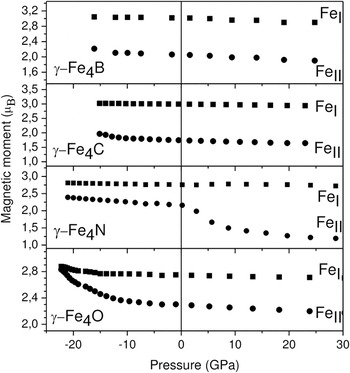
Figure 8 shows the behavior of the magnetic moments at each iron site (
 ${m_{{\rm{F}}{{\rm{e}}_{\rm{I}}}}}$
and
 ${m_{{\rm{F}}{{\rm{e}}_{{\rm{II}}}}}}$
) as function of pressure for γ-Fe4X (X = B, C, N, O).
 ${m_{{\rm{F}}{{\rm{e}}_{\rm{I}}}}}$
is quite insensitive to the variation of pressure (remains almost constant).
 ${m_{{\rm{F}}{{\rm{e}}_{{\rm{II}}}}}}$
decreases slowly and nearly in linear form in all the pressure ranges for X = B, C, and O. While for γ-Fe4N
 ${m_{{\rm{F}}{{\rm{e}}_{{\rm{II}}}}}}$
shows a sudden decrease (from 2.13 to 1.30 μB) between 3.5 and 20.5 GPa. The local magnetic moment behavior as a function of pressure at both Fe sites shows that FM order remains practically unaltered in γ-Fe4B, γ-Fe4C, and γ-Fe4O. In contrast, in γ-Fe4N the ferromagnetism tends to collapse.
Calculated magnetic moment at FeI sites (full squares) and FeII sites (full circles) against pressure.

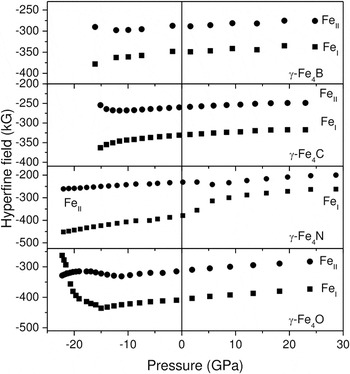
The dependence of the magnetic hyperfine field with the pressure at 0 K for γ-Fe4X (X = B, C, N, and O) is shown in Fig. 9. As can be observed H hf (absolute value) at each Fe site shows a slow and linear decrease for X = B, C, and O. The analytic fits of the curves (H hf versus P), between −15 and 25 GPa indicate that H hf at FeI and FeII sites decrease with a slope of 0.60 and 0.55 kG/GPa in γ-Fe4B, 0.76, and 0.66 kG/GPa in γ-Fe4C, and with slope of 1.67 and 1.46 kG/GPa in γ-Fe4O. In γ-Fe4N, H hf also demonstrates a linear decreasing behavior induced by the applied pressure, however, an anomalous conduct is observed between 3.5 and 10.0 GPa for both iron sites. It is noteworthy fact that the H hf acting at FeII site increases slightly, while H hf acting at FeI site decreases in this pressure interval. The fitting results between −15 and 3.5 GPa indicated a decrease of H hf with a value of ∆H hf/∆P = 3.1 and 1.2 kG/GPa for FeI and FeII, respectively. These results are in good agreement with those of Yang et al. Reference Yang, Abd-Elmeguid, Micklitz, Michels, Otto, Kong, Xue and Li51 who investigated the electronic and magnetic properties of γ-Fe4N using the 57Fe Mossbauer effect under pressure (up to 5.6 GPa) at 4.2 K. They observed a linear-decrease of H hf with the increase of pressure for the two inequivalent iron sites. They point to the fact that H hf of FeI decreases more rapidly with pressure than that of FeII atoms. It is possible that Yang et al. have not observed any change in the behavior of H hf of FeI and FeII atoms because of the limited values of the applied pressure (5.6 GPa).
Magnetic hyperfine field at FeI sites (full squares) and FeII sites (full circles) against pressure.

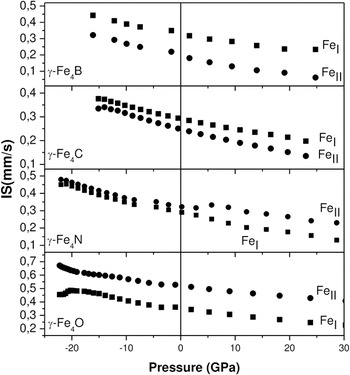
The IS values for each iron site show similar behaviors with the pressure increase in the γ-Fe4B, γ-Fe4C, and γ-Fe4O, Fig. 10. For FeI and FeII atoms IS decrease almost linearly at a rate of 0.005 and 0.007 mm/(s GPa) in γ-Fe4B, 0.005 and 0.004 mm/(s GPa) in γ-Fe4C, and 0.005 and 0.004 mm/(s GPa) in γ-Fe4O. In γ-Fe4N, IS for FeI atoms also decreases linearly, but at a rate of 0.007 mm/(s GPa), meanwhile, for FeII, it shows an anomalous behavior with the pressure increase: IS decreases quasi linearly at a rate of 0.005 mm/(s GPa) and around P = 3.5 GPa increases slightly and then, continues decreasing linearly.
IS at FeI sites (full squares) and FeII sites (full circles) against pressure.

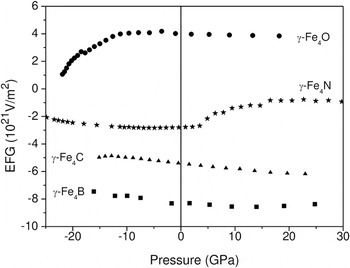
The pressure dependence of the EFG at FeII sites for γ-Fe4X (X = B, C, N, and O) is given in Fig. 11. The greater values of the EFG are observed for γ-Fe4B, followed by that of γ-Fe4C and γ-Fe4O. The first two increase (in absolute values) for pressures between −10 and 20 GPa, while the EFG for γ-Fe4O is practically constant. For γ-Fe4N, the EFG shows an anomalous behavior around P = 3.5 GPa.
EFG at FeII sites for γ-Fe4X (X = B, C, N, and O) against pressure.

IV. CONCLUSION
The LAPW method, as implemented in the Wien2k computational code, was used to investigate the electronic structure of γ-Fe4X (X = B, C, N, O) and its associated properties at the ground state and under pressure. Many of the calculated parameters of γ-Fe4C and γ-Fe4N (lattice parameters, local magnetic moment, hyperfine field, etc.) are in good agreement with experimental and theoretical results. From the equilibrium cohesive energy point of view, all the compounds are FM and the stability increases in the following sequence: γ-Fe4O < γ-Fe4N < γ-Fe4B < γ-Fe4C. The Fermi level increases in the following sequence: γ-Fe4B < γ-Fe4O < γ-Fe4N < γ-Fe4C (0.655, 0.722, 0.723, and 0.734 Ry, respectively). On the other hand, the total magnetic moment per unit cell is 8.81, 9.01, 9.88, and 9.91 µB for γ-Fe4C, γ-Fe4B, γ-Fe4O, and γ-Fe4N, respectively. The ED indicated that the bonds between FeI, FeII, and X atoms are a complex mixture of ionic and covalent characters that vary in intensity from one compound to another. As can be observed, there is no linear relation between the properties prior cited and the 2p electrons number in the X atoms (2p 1, 2p 2, 2p 3, and 2p 4 for B, C, N, and O, respectively). The substitution of X atoms (B, C, N, and O) in γ-Fe4X results in a drastic change of the electronic structure. The results showed that the effect of C and N atoms in γ-Fe4X is more remarkable.