INTRODUCTION
Hydatidosis or cystic echinococcosis (CE) is a zoonosis caused by infection with the larval stage of the cestode tapeworm Echinococcus granulosus. The parasite has a cosmopolitan distribution with a high prevalence documented in some areas such as North Africa, Australia and South America (Eckert et al. Reference Eckert, Conraths and Tackmann2000; McManus et al. Reference McManus, Zhang, Li and Bartley2003). In Tunisia, human CE is a public health concern with an annual surgical incidence estimated at 15 cases/100 000 inhabitants (Ministère de la Santé Publique, 1993; Oudni-M'Rad et al. Reference Oudni-M'Rad, M'Rad, Gorcii, Mekki, Belguith, Harrabi, Nouri, Azeiz, Mezhoud and Babba2007). Diagnosis of CE is mostly based on clinical findings (X-ray, ultrasonography [US], computed tomography [CT] and magnetic resonance imaging [MRI]). In certain cases immunodiagnosis is a useful support for the clinical diagnosis and to confirm the hydatid nature of the cyst (Babba et al. Reference Babba, Messedi, Masmoudi, Zribi, Grillot, Ambroise Thomas, Beyrouti and Sahnoun1994). Approximately 10% of the CE cases occur in children, but in certain areas, e.g. in some countries of North Africa, the percentage of young patients may be much higher (Oudni-M'Rad et al. Reference Oudni-M'Rad, M'Rad, Gorcii, Mekki, Belguith, Harrabi, Nouri, Azeiz, Mezhoud and Babba2007).
Surgery is the treatment of choice, offering in certain cases a complete cure and recovery. However, in some cases of complicated cysts (such as fissured or super-infected), surgical procedures and inadequate cyst removal can lead to the spillage of parasite material including protoscoleces, which can be the origin of newly developing cysts and thus relapse of disease. Another post-surgical complication is the appearance of ‘new’ cysts not previously detected due to their size and/or localization.
One of the major problems of human CE encountered by clinicians is the frequency of relapses, affecting approximately 2–20% of cases after surgery according to WHO (Reference Eckert, Gemmel, Meslin and Pawlowski2001) and 14–25% of cases after chemotherapy, according to Franchi et al. (Reference Franchi, Di Vico and Teggi1999) and Pawlowski et al. (Reference Pawlowski, Eckert, Vuitton, Amman, Kern, Craig, Dar, De Rosa, Filice, Gottstein, Grimm, Macpherson, Todorov, Uchino, Von Sinner, Wen, Eckert, Gemmel, Meslin and Pawlowski2001). Therefore, there is a need for evaluation of markers which could be used post-operatively, that allow rapid detection of newly growing or relapsing cysts. Many serological tests have been used for post-surgical or post-treatment follow-up of hydatidosis, including the indirect haemagglutination (IHA) test, the enzyme-linked immunosorbent assay (ELISA), and immunoblotting (Force et al. Reference Force, Torres, Carrillo and Busca1992; Ravinder et al. Reference Ravinder, Parija and Rao1997; Zarzoza et al. Reference Zarzoza, Orduna, Gutierrez, Alonso, Cuervo, Prado, Bratos, Garcia Yuste, Ramos and Torres1999; Gadea et al. Reference Gadea, Ayala, Diago, Cunat and Garcia De Lomas2000; Bulut et al. Reference Bulut, Ilhan, Yucef, Onal and Godekmerdan2001; Doiz et al. Reference Doiz, Benito, Sbihi, Osuna, Clavel and Gomez Lus2001; Rigano et al. Reference Rigano, Ioppolo, Ortona, Margutti, Profumo, Ali, Di Vico, Teggi and Siracusano2002; Lawn et al. Reference Lawn, Bligh, Craig and Chiodini2004). Their usefulness for monitoring CE patients after surgery was variable among different laboratories, a fact that may be related to the type and procedure of antigen preparation used (Lightowlers and Gottstein, Reference Lightowlers, Gottstein, Thompson and Lymbery1995). The period of time between surgery and serum collection is important with regard to the predictive value indicating either recovery or relapse. Few studies have been designed so far to evaluate modern immunodiagnostic tests for their predictive value after surgery, and/or chemotherapy (Moosa and Abdel-Hafez, Reference Moosa and Abdel-Hafez1994; Zarzosa et al. Reference Zarzoza, Orduna, Gutierrez, Alonso, Cuervo, Prado, Bratos, Garcia Yuste, Ramos and Torres1999; Rigano et al. Reference Rigano, Ioppolo, Ortona, Margutti, Profumo, Ali, Di Vico, Teggi and Siracusano2002; Nasrieh and Abdel-Hafez, Reference Nasrieh and Abdel-Hafez2004). One promising approach was recently reported by Hernandez et al. (Reference Hernandez, Cardozo, Dematteis, Baz, Trias, Hunez, Nunez, Barrague, Lopez, Fuentes, Lopez and Ferreira2005) who demonstrated a correlation between selected risk factors for CE and seropositivity using crude antigens of E. granulosus (ELISA) or purified antigen B. An improved immunodiagnostic performance was achieved using a synthetic peptide derived from the antigen B sequence (Gonzales-Sapienza et al. Reference Gonzales-Sapienza, Lorenzo and Nieto2000). This peptide had not been evaluated for the post-operative follow-up of CE patients.
In the present study, we assessed ELISA and immunoblotting as tests for post-therapeutical follow-up of CE in young patients. Children and adolescents, when compared to adult CE patients, more frequently present immunodiagnostic problems post-operatively (WHO, Reference Eckert, Gemmel, Meslin and Pawlowski2001). Children not only represent the largest proportion of CE patients when clustered according to age distribution (WHO, Reference Eckert, Gemmel, Meslin and Pawlowski2001), but young patients also require special attention with regard to surgical and medical intervention (Dincer et al. Reference Dincer, Demir, Sayar, Gunluoglu, Kara and Gurses2006; Durakbasa et al. Reference Durakbasa, Tireli, Sehiralti, Sander, Tosyali and Mutus2006). Also, in relatively high endemic areas such as Tunisia, CE commonly starts during childhood or adolescence (Oudni-M'Rad et al. Reference Oudni-M'Rad, M'Rad, Gorcii, Mekki, Belguith, Harrabi, Nouri, Azeiz, Mezhoud and Babba2007). The young CE patients participating in the present study were placed either into a cured (CCE) group of patients, which presented no signs of relapse for a period of up to 4–5 years following initial treatment, or into a non-cured (NCCE) group who presented still active cysts at 4–5 years following initial treatment or diagnosis, and despite an initial attempt to curative surgery of the cysts in all but 2 of these cases.
MATERIALS AND METHODS
Sera from CE patients
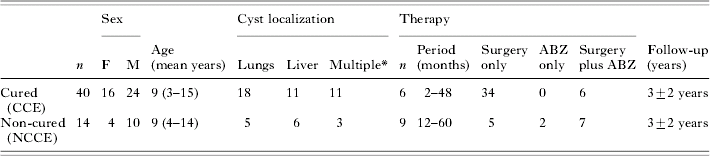
A total of 290 sera were collected from 54 children or adolescents affected by CE (mean age 9 years, range 3 to 15 years). In each case a first sample was obtained at the time of diagnosis (prior to medical intervention, day 0) and further samples during a follow-up period ranging between 7 days and 5 years post-surgery and/or chemotherapy (Table 1). The intervals and numbers of follow up steps were variable between the patients, and the mean serum sample number per patient was 7±2. All specimens were stored at −20°C prior to laboratory testing. For follow-up studies, all patients were subjected to serological and radiological investigation 1 week after surgery and/or start of chemotherapy, then 1 month, 6 months and subsequently once per year. Clinical and parasitological examinations were carried out at the E.P.S. Hospital of Monastir (Tunisia) in the Pediatric Surgery Service and in the Laboratory of Diagnostic Parasitology of Monastir University. The patients were reviewed with respect to parameters like number and anatomical localization of the cyst(s), radiological determination of the type of the cyst(s) (according to the guidelines published by WHO, 2003), clinical complications and need of benzimidazole treatment.
Overview of the clinical features of the two groups of CE patients included in the present study
(For CCE patients, chemotherapy (albendazole, ABZ) was added to surgery when cysts were considered as fissured. In NCCE patients, ABZ was administered in cases exhibiting fissured cysts, multiple cysts, and disseminated or inoperable cysts left after surgery.)
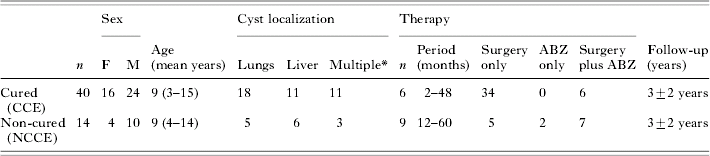
* Multiple locations indicate cysts detected in the liver and the lungs (10 cases), liver and spleen (1 case), liver and mediastinum (1 case), liver, lungs and heart (2 cases).
Forty CCE-patients had cured or stable disease with no clinical or radiological evidence of recurrence or remaining cyst activity through a follow-up period ranging between 1 and 5 years (Table 1). Five showed totally calcified hepatic cysts at their last time-point.
Fourteen NCCE-patients were still sick at the end of the study, despite an initial attempt to carry out curative surgery of the cysts: 12 of them finally presented active cysts and progressive disease (3 patients suffered from fissured lung cysts, 6 had liver cysts and 3 had multiple localizations, including liver/spleen for 1 patient and liver/lungs for 2 patients) at the end of the study period. Another 2 patients were initially considered as inoperable cases and were treated with albendazole only (Zentel 10 mg/ kg/ day) for 5 and 3 years, respectively. In both patients disseminated cysts were visualized upon radiological examination. All NCCE patients presented at least 1 intact/viable cyst at the end of the follow-up study period, as detected by radiological examination.
In summary, 54 patients were clustered into 2 different groups i.e. (A) cured or inactive hydatid disease cases (CCE; n=40/54), where the hydatid cyst had disappeared following surgery or had fully calcified in 5 cases, and the other cases remaining inactive for the study period, and (B) cases with active CE (NCCE; n=14/54) who presented a progressive form of disease after an obviously unsuccessful surgical intervention, or where no surgery was possible. Sera were collected at various time-intervals ranging from 1 week to 60 months post-surgery, and then tested in both ELISA and immunoblotting.
Antigens
Crude hydatid fluid (CHF) was obtained in Sardinia by aspiration from fertile sheep liver cysts. Inclusion criteria for CHF was fertility, a clear fluid consistency and a protein concentration of >0·95 mg per ml. The CHF was supplemented with 1% 100 mm PMSF (phenylmethyl sulfonyl fluoride) solution, and subsequently sedimented at 10 000 g at 4°C for 30 min. The supernatant was stored at −20°C until used for ELISA and immunoblotting.
SDS-PAGE
Parasite antigens were separated on a 5–20% linear gradient polyacrylamide gel as described by Poretti et al. (Reference Poretti, Felleisen, Grima, Pfister, Teuscher, Zuercher, Reichen and Gottstein1999), using reducing and non-reducing conditions in parallel for comparative purposes (Bio-Rad apparatus). CHF, after thawing, was brought into 10 mm Tris-HCl with 10% SDS and 9 m urea, and heated either for 20 min at 65°C (non-reducing condition) or for 5 min at 100°C with 5% β-mercaptoethanol (reducing condition). Proteins were loaded at a concentration of 150 μg/gel, and the electrophoresis was done at 500 V for 2 h at 4°C.
Immunoblotting
Electrophoretically resolved proteins were transferred onto nitrocellulose membranes as previously described by Poretti et al. (Reference Poretti, Felleisen, Grima, Pfister, Teuscher, Zuercher, Reichen and Gottstein1999). Nitrocellulose strips (3 mm wide) were then incubated with human sera diluted at 1:100 in phosphate-buffered saline containing 0·3% Tween and 5% skim milk powder overnight at 4°C; strips were then washed and incubated with goat anti-human IgG horseradish peroxidase conjugate (Sigma A6029; diluted 1:200) for 2 h at room temperature. Immunoreactive antigenic bands were visualized using 3,3′-diaminobenzidine tetrahydrochloride (DAB) and 0·03‰ H2O2. The main diagnostic bands yielded in the immunoblot carried out under reducing conditions were the 8, 12, 16, 21 and 37 kDa bands. Under non-reducing conditions, bands that localized at 8, 12, 16, 21, 55 and 65 kDa were considered as diagnostically relevant. In order to report a positive serology, at least 1 of the AgB components had to show up. These AgB subunits localized at 8 and 16 kDa for both reducing and non-reducing conditions (Lightowlers and Gottstein, Reference Lightowlers, Gottstein, Thompson and Lymbery1995).
Enzyme linked immunosorbent assay (ELISA)
Nunc Immulon ELISA microplate strips were coated with 100 μl per well of CHF diluted in ELISA coating buffer (0·1 m Na HCO3/Na2CO3, pH 9·6, containing 0·02% NaN3) to a concentration of 10 μg/ml. ELISA strips were washed 3 times with washing buffer (PBS, 3% Tween 20) and blocked with blocking buffer containing 0·05% bovine haemoglobin and 0·02% sodium azide in PBS, pH 7·2. Sera were diluted 1:100 in blocking buffer, and alkaline-phosphatase-labelled anti-human IgG conjugate (Sigma A 5403) was used at a 1:2500 dilution. All incubations were done at 37°C for 30 min. Plates were finally washed 3 times and then incubated with the substrate for 15 min. The reaction was stopped with 3 m NaOH. The absorbances (A) were measured at 405 nm using a microplate reader (Dynex Technologies Bioconcept). The results were expressed in arbitrary defined antibody units (AU), which relate antibody activity in the test serum to a positive reference serum with an arbitrary antibody activity of 100 AU (Gottstein et al. Reference Gottstein, Jacquier, Bresson-Hadni and Eckert1993). Mathematically, AU were defined by the following formula:
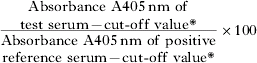
The cut-off value(*) was determined based upon a threshold determined by the mean of the respective A405 nm values plus 3 standard deviations (cf.Gottstein et al. Reference Gottstein, Saucy, Deplazes, Reichen, Demierre, Zürcher, Busato and Pugin2001) of 100 blood donor sera, i.e. the A405 nm-values of negative sera were ranging within the 99% confidence limit of a healthy control population. When plotted, the respective A405 nm values essentially represented a normal distribution. Inter-test and intra-test variations were assessed by determining the coefficients of variation for reference negative and positive sera, all having been tested in triplicate on each test plate; variation of ⩽15% was recorded, which is considered acceptable for immunological assays (Pfister et al. Reference Pfister, Gottstein, Cerny and Cerny1999). Since this latter finding was essentially the same as that described previously for the EgHF-ELISA (Gottstein et al. Reference Gottstein, Jacquier, Bresson-Hadni and Eckert1993), no modification was required for the present study.
Protein concentration
Protein concentrations were determined using the Bio-Rad Bradford protein assay and bovine plasma immunoglobulin as a standard.
Statistical analyses
The Epi Info 6 program was used to calculate the Chi-square-test for comparing the rates of seropositivity between each group of patients during each period of follow-up. P⩽0·05 was considered as statistically significant.
RESULTS
ELISA
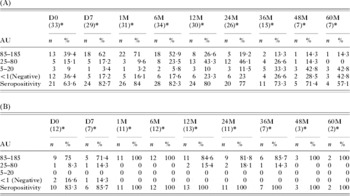
The post-treatment evolution of antibody concentrations was comparatively assessed in CCE cases versus NCCE patients. Antibody levels were arbitrarily clustered into high (85–185 AU), medium (25–80 AU), low (5–20 AU) and negative (<1AU). CCE patients who were cured by radical cyst removal or who finally presented ‘stable’ non-viable cysts showed different antibody kinetics than NCCE patients who presented active (viable) cyst(s) (Table 2) at the end of the study period. In CCE patients, antibody levels increased within the first 6 months post-surgery in most cases with 7 (Table 2A) initially seronegative CE patients becoming seropositive at 1 month post-surgery. Subsequently, in most patients antibody levels decreased progressively with time, 12 out of 40 patients (30%) being seronegative at the end-point of the serodiagnostic investigation, which varied between 1 and 5 years post-surgery. In contrast, most NCCE patients maintained high antibody levels (>85 AU), with a few in the medium (>25 AU) antibody concentration class. An actual decrease of antibody levels was not found for the whole study time-period of up to 5 years in these patients (Table 2B). With regard to the overall final serodiagnostic positivity of ELISA, 71·4% of the CCE patients were still seropositive at 4 years post-surgery and 57·1% at 5 years post-surgery. Furthermore, 2 CCE patients, who had fully calcified (surgically non-resected) cysts, still showed high antibody concentrations of 106 and 95 AU at 4 years post-surgery, and 3 patients had antibody levels of 84, 39 and 84 AU after 2, 5 and 1 year post-surgery, respectively. The decrease of antibody concentrations with time was considerably slower in these cases when compared to surgically treated CCE patients.
Percentage of seropositivity determined by ELISA in 40 patients with CCE (A) and 14 NCCE patients (B) plotted against the follow-up time
(D0: serum samples collected before surgery and/or initiation of therapy; D7: sample collected 1 week after surgery, 1M: one month after, 6M: six months after, 12M: twelve months; and so on. *Numbers in parenthesis indicate number of cases examined (P>0·05).)

In NCCE patients, high antibody levels persisted in all of the patients (Table 2B). Overall, however, there was no statistically significant difference (P>0·05) in seropositivity of samples from cured individuals (CCE) and those from NCCE patients at any time-point of the follow-up period.
With ELISA, 12 out of 34 (66·6%) CCE patients treated by surgery alone reached seronegativity by their last serum sample. None of the 6 patients who received combined surgery/ABZ-treatment were negative at the end of the follow-up period. However, the differences in antibody concentrations between CCE patients who underwent combined surgery and ABZ-therapy versus those treated surgically were statistically not significant. Nevertheless, in both approaches a progressive decrease of antibody concentrations was observed (data not shown).
Immunoblotting
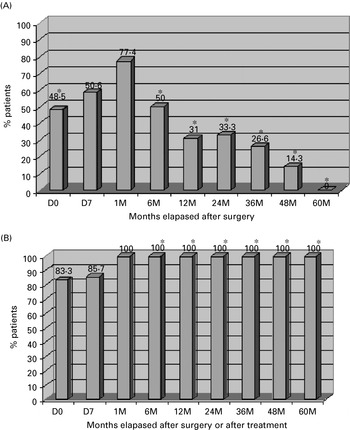
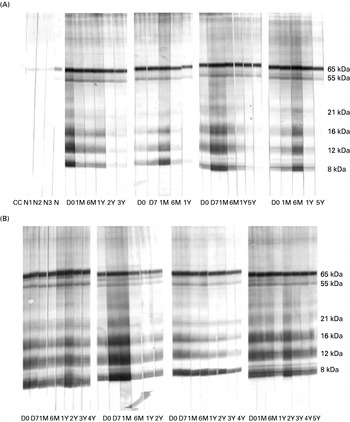
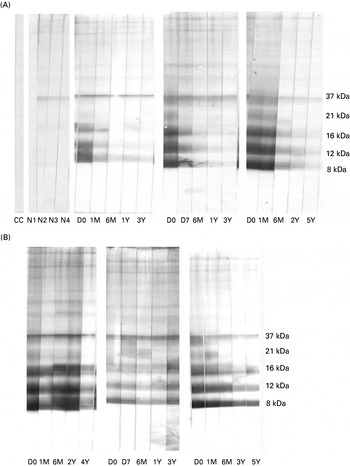
Immunoblotting profiles obtained with sera from 30 out of 40 CCE and all NCCE patients showed an initial (day 0) strong recognition of 4 major bands localizing at 8, 12, 16, and 21 kDa for both reducing, and non-reducing conditions (Figs 1–3). Two of these bands (8 and 16 kDa) were attributed to AgB subcomponents as referenced by Lightowlers and Gottstein (Reference Lightowlers, Gottstein, Thompson and Lymbery1995). Another two bands at 55 and 65 kDa appeared under non-reducing (Fig. 2) conditions, while a 37 kDa band was visualized under reducing (Fig. 3) conditions. These 55/65 kDa and 37 kDa bands were also recognized by negative control sera, thus demonstrating a non-specificity of these signals. Clearly different patterns became evident between the two groups of patients over time. Sensitivity based on the detection of at least 1 of the AgB subcomponents, decreased sharply from 77·4% to 50% within 1 month and 6 months, respectively, in CCE cases, and subsequently to 14·3% at 4 years after surgical treatment (Fig. 1A). No detectable bands were observed 5 years post-surgery in these patients (Fig. 1A). However, in 5 CCE patients whose clinical examination had indicated the presence of calcified cysts, and who were estimated as clinically cured from hydatidosis, at least 1 of the antigen B subcomponents remained immunoreactive during a relatively long time of follow-up. Interestingly, we noticed the complete absence of anti-AgB antibody reactivity before surgery and during follow-up in 10 out of 18 patients with lung cysts. Four of these 10 cases were also negative in ELISA during the same period of follow-up, the other 6 ELISA-positive cases showed a progressive decrease of antibody levels during the follow-up period. In contrast to these CCE lung cases, NCCE patients, independent of the organ localization, showed a persistent recognition of AgB subcomponents that was still significantly high even 5 years post-treatment (Fig. 1B). At the time of diagnosis (day 0), high antibody concentrations were generally detected by ELISA in patients with liver cysts and in multiple cyst localizations including the lungs. Throughout subsequent follow-up, the progressive decrease of antibodies was more rapid for lung and liver localization than for multiple locations. Thus, seronegativity was reached at the end time-point of follow up in only 1 out of 11 multiple cyst localization (9%) versus 7 out of 18 (39%) lung cysts and 4 out of 11 (36·4%) liver cysts.
Temporal evolution of AgB-band-recognition by immunoblotting in 30 CCE (A) and 14 NCCE patients (B) before and after treatment. Sera from 10 CCE patients with lung cysts, who were persistently seronegative by immunoblotting between day 0 and 5 years after diagnosis, were not included in this figure. D0: serum samples collected before surgery, D7: one week after surgery, 1M: one month after, 6M: six months after, 12: twelve months after treatment, and so on. * P<0·05 (between A and B).

Immunoblotting follow up, exemplified with sera from 4 out of 40 CCE (A) and 4 out of 14 NCCE patients (B) under non-reducing conditions. D0: serum samples collected before surgery, D7: one week after surgery, 1M: one month after, 6M: six months after, 1Y: 1 year post surgery, 2Y: 2 years, and so on. Four negative control sera (N1–N4) as well as a conjugate control (CC) are included in (A).

Immunoblotting follow up, exemplified with sera from 3 out of 40 CCE (A) and 3 out of 14 NCCE patients (B) under reducing conditions. D0: serum samples collected before surgery, D7: one week after surgery, 1M: one month after, 6M: six months after, 1Y: 1 year post surgery, 2Y: 2 years and so on. Four negative control sera (N1–N4) as well as a conjugate control (CC) are included in (A).

Statistically significant differences were observed between the two groups (CCE and NCCE) at day 0 (before surgery: P=0·04) and starting from 6 months until 5 years follow up (6M/P=0·010), (12M/P=10−4), (24M, 36M, 48M/P=10−3), (60M/P=0·02). Furthermore, CCE patients who were cured by surgery showed a progressive disappearance of the different antigen bands starting from 6 months post-surgery, as exemplified in Figs 2 and 3. Interestingly, in some cases, there was an earlier disappearance of the 16 kDa AgB subcomponent, while the 8 kDa disappeared later.
No significant effect on the antibody binding activity in immunoblotting was observed when comparing surgery/ABZ-treatment versus surgery alone (data not shown), irrespective of the CCE or NCCE status. Nevertheless, CCE patients exhibited a slightly higher rate of seronegativity by immunoblotting than by ELISA, but the discriminating power was also no better when comparing the combined surgery/ABZ-treatment with surgery alone (4 immunoblot negatives out of 6 patients treated with surgery/ABZ versus 26 out of 34 patients only treated by surgery, respectively). The 2 NCCE patients who were only medically treated with ABZ exhibited no decrease in the banding pattern and no decrease in the band-staining intensity.
DISCUSSION
Hydatidosis is a cosmopolitan disease and is highly endemic in most of the Mediterranean countries. One of the characteristics of hydatid disease is the relatively frequent occurrence of relapses after surgery. Such relapses may be due to several reasons, predominantly as follows: (i) cyst (or cysts) has (have) been incompletely removed by surgery, or the cyst has ruptured, and spilling of hydatid fluid containing protoscolices occurred, causing secondary infection; (ii) cyst (or all the cysts) has (have) been completely removed as reported by the surgeon, but additional small, initially undetectable cysts were growing months or years after initial therapy; (iii) patients cured by surgery may putatively become reinfected months or years after successful therapy. However, such an event may be relatively unlikely, and is also controversially discussed, as protective immunity may prevent reinfection in former cured CE patients, but such protective immunity has not yet been really proven. Nevertheless, the relatively high frequency of relapses requires follow-up methods that are suitable for monitoring the radicality of surgical cyst resection or the viablity status of putatively remaining cyst material, including protoscolices. Follow-up sera from cured (CCE) and non-cured (NCCE) young hydatidosis patients treated by surgery were subjected to ELISA and immunoblot testing; both methods were based upon crude sheep hydatid fluid as a source of parasite antigen. Serological reactivities of CCE patients in ELISA increased during an initial 6-month period after surgery, followed later by a progressive decrease. In NCCE patients, a similar increase was observed for the first 6-month period, but the subsequent decrease was less pronounced. This difference between CCE and NCCE patients was not marked enough to allow a statistically significant differentiation between the two groups. These ELISA results are consistent with those found in other studies such as those published by Gottstein et al. (Reference Gottstein, Shantz, Todorov, Saimot and Jacquier1986) ; Craig et al. (Reference Craig, Zeyhl and Romig1986) ; Bulut et al. (Reference Bulut, Ilhan, Yucef, Onal and Godekmerdan2001) and Force et al. (Reference Force, Torres, Carrillo and Busca1992). In contrast, Zarzoza et al. (Reference Zarzoza, Orduna, Gutierrez, Alonso, Cuervo, Prado, Bratos, Garcia Yuste, Ramos and Torres1999) reported a higher rate of sera becoming seronegative in their study (25·9% and 16·6% of cured patients at 4 and 5 years post-surgery, respectively). However, this effect may be attributable to the fact that only cases of pulmonary cyst localization were investigated. It has been shown that lung cysts yield lower serological responses than hepatic ones (Babba et al. Reference Babba, Messedi, Masmoudi, Zribi, Grillot, Ambroise Thomas, Beyrouti and Sahnoun1994; Force et al. Reference Force, Torres, Carrillo and Busca1992). Immunoblotting data demonstrated that there was a decrease in antibody reactivities with regard to the 8 and 16 kDa AgB subunits, as seen as a 50% recognition rate at 6 months and a 14·3% recognition rate at 4 years post-surgery. None of the sera reacted with these bands at 5 years post-surgery. All non-cured cases (100%) showed a strong persistence in reactivities with these bands during the follow up. Thus, our results are similar to those of Doiz et al. (Reference Doiz, Benito, Sbihi, Osuna, Clavel and Gomez Lus2001), in which reactivities with AgB fractions (12, 16, 20 kDa) disappeared within 11 months of treatment, whereas non-cured patients remained seropositive for a 3-year period post-surgery in 50%, 75% and 75% for the 12, 16 and 20 kDa bands, respectively. AgB exhibits an improved diagnostic value respective to infection risk factors (Hernandez et al. Reference Hernandez, Cardozo, Dematteis, Baz, Trias, Hunez, Nunez, Barrague, Lopez, Fuentes, Lopez and Ferreira2005). Therefore, the assessment of purified antigens such as the synthetic AgB peptide published by Gonzales-Sapienza et al. (Reference Gonzales-Sapienza, Lorenzo and Nieto2000) for the follow-up of CE patients may be of interest.
In our study, 10 CE patients presented both negative ELISA and immunoblot findings for the whole study period. Seronegativity in cases of lung cyst localization had for long been recognized as a diagnostic problem (Lightowlers and Gottstein, Reference Lightowlers, Gottstein, Thompson and Lymbery1995), and this problem also holds true for post-treatment follow-up studies. The generally accepted explanation for this phenomenon is a marked separation of the cysts from the surrounding pulmonal tissue and a consequent weak release of parasite metabolites (antigens) into the pulmonal circulation, resulting in a greatly diminished antigen stimulation and host immune response at the immunologically competent sites in the lungs. The consequence is that such cases should be monitored by imaging techniques rather than by serology. With regard to ABZ-therapy, ELISA and immunoblotting yielded no significant differences between sera from CCE or NCCE patients who underwent combined surgery and ABZ-therapy or those who were operated and received no therapy.
In conclusion, ELISA and immunoblotting have demonstrated their relative usefulness in the post-therapeutic serological follow-up of patients presenting different courses of disease, i.e. cure or non-cure as monitored by the occurrence of relapses or persitence of symptoms during a 4–5 year period after initiation of treatment. Immunoblotting appears to be the test that best reflects the evolution of disease after curative surgery, since it becomes negative with regard to AgB banding reactivity, the effect starting from 6 months post-surgery. However, the lack of sensitivity of immunoblotting in certain cases of lung cyst localization limits its employment in these cases. Physical imaging examinations are also very useful in predicting cyst evolution, since it has been shown to be more sensitive than serology (Babba et al. Reference Babba, Messedi, Masmoudi, Zribi, Grillot, Ambroise Thomas, Beyrouti and Sahnoun1994). This reinforces the necessity to combine both serology and imaging procedures for optimal monitoring of cystic echincoccosis/hydatidosis.
In the light of our findings, we suggest that immunoblotting should be carried-out to follow-up operated hydatidosis patients at least 6 months and 12 months post-operatively, respectively, and subsequently once a year for a minimum period of 4 years, using the interpretation criteria as outlined above.
Finally, the search for new approaches to improve respective serological tools is still needed. Using other sources of antigens such as protoscoleces or recombinant proteins may be an option to develop serological means with an improved prediction of the disease activity. Furthermore, we anticipate a more detailed analysis of non-cured patients, who will have to be grouped according to different means of relapses (as outlined above). The search for parameters that could discriminate between such subgroups of NCCE patients may provide additional useful information for clinicians to facilitate decisive selection of further treatment strategies to be implemented for such patients.
This work was supported by the Swiss National Science Foundation (grant no. 31-111780/1), by the Hans-Sigrist Foundation (grant no. 31-111780/1) and by the Tunisian High Education Ministry (grant no.65/05).