Lactic acid bacteria (LAB) are microorganisms related to various habitats and are known as probiotics in food and pharmaceutical industries (Holzapfel et al. Reference Holzapfel and Schillinger2002). They are used as starter cultures in meat and dairy products (Salminen et al. Reference Salminen, von Wright and Ouwehand2004) and have important antagonistic activity against pathogens in food (de Martinis et al. Reference de Martinis, Alves and Franco2002). These applications show the significance of LAB contribution to microbial safety in food, in addition to organoleptic, technological and nutritional advantages that they offer (Leroy & de Vuyst, Reference Leroy and de Vuyst2004).
Screening and enumeration of LAB in food products is usually done using de Mann-Rogosa-Sharpe (MRS) agar under microaerophilic or anaerobic conditions (Wher & Frank, Reference Wehr and Frank2004), but non-LAB microorganisms can growth in this culture media due to its various nutrients and the absence of selective agents (Kang & Fung, Reference Kang and Fung1998). One way to provide selectivity to MRS is the addition of supplements such as phenylethanol and lactic acid, which are used in Kang-Fung (KF) and Kang-Fung-Sol (KFS) culture media to inhibit the growth of Gram-negative bacteria and Gram-positive pathogens, such as Listeria monocytogenes and Staphylococcus aureus (Kim et al. Reference Kim, Fung and Kang2001).
Petrifilm™ plates (3M Microbiology, St. Paul, MN) are widely used in the food industry for monitoring the microbiological quality of food products (Byrne & Bishop, Reference Byrne and Bishop1991; Beuchat et al. Reference Beuchat, Copeland and Curiale1998; Ferrati et al. Reference Ferrati, Tavolaro, Destro, Landgraf and Franco2005; Tavolaro et al. Reference Tavolaro, Ferrati, Destro, Landgraf and Franco2005). These plates are commercialized in a double layer format that allows their ready use, simply by dilution and direct inoculation of the sample to be tested. Petrifilm™ Aerobic Count (AC) plates are conventionally used for mesophilic aerobic enumeration, but also can be used for LAB enumeration, particularly in fermented products (Champagne et al. Reference Champagne, Gardner, Piette and St-Gelais1994; McGregor et al. Reference McGregor, Traylor, Gough, Hazlett and Bird1995; Nero et al. Reference Nero, Beloti, Barros, Ortolani, Tamanini and Franco2006). For this purpose, the manufacturers of Petrifilm™ plates recommend dilutions of samples in conventional methods and the use of MRS broth in the final dilution step, followed by incubation at microaerophilic or anaerobic conditions. However, no information is available on possible interference of selective agents added to Petrifilm™ AC plates for proper LAB screening and enumeration in foods.
This study aimed to evaluate Petrifilm™ AC plates and conventional pour plate methodology for screening and enumeration of 10 different species of LAB inoculated in reconstituted powder skim milk, using three different culture media: MRS, KF and KFS. To verify the reproducibility of Petrifilm™ AC performance, raw milk samples with no experimental LAB inoculation were also tested.
Material and Methods
Strains and inocula preparation
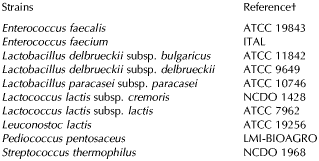
The microbial strains used in this study were reference LAB cultures (Table 1), maintained in MRS agar (Oxoid, Basingstoke, U.K.) slants under refrigeration. For use, each strain was plated on MRS agar and incubated at 30°C for 24 h in microaerophilic conditions. One isolated colony was transferred to tubes containing MRS broth (Oxoid) and incubated at 30°C for 24 h. Cultures in MRS broth were submitted to decimal dilutions in NaCl solution (8·5 g/l), and the dilution with turbidity equivalent to McFarland scale 1 was selected. This dilution was then submitted again to decimal dilutions in NaCl solution to obtain a culture with approximately 105 cells/ml.
Lactic acid bacteria strains used in the study
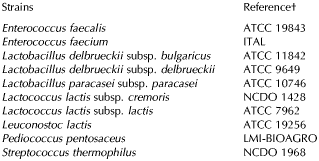
† ATCC, American Type Culture Collection, Manassas, VA, USA. ITAL, Institute of Food Technology, Campinas, SP, Brazil. NCDO, National Collection of Dairy Organisms (currently, National Collection of Food Bacteria, Aberdeen, Scotland). LMI-BIOAGRO, Industrial Microbiology Laboratory (LMI, Bioagro), Universidade Federal de Viçosa, Viçosa, MG, Brazil.
Preparation of experimental LAB suspensions
Powdered skim milk (Molico, Nestlé, São Paulo, Brazil) was reconstituted in recently sterilized distilled water (100 g/l), distributed in sterile flasks (100 ml per flask), and 1 ml of each LAB culture to be tested was added. After homogenization, the flasks were kept under refrigeration for 24 h and then submitted to microbiological analysis. Immediately before testing, the samples were thoroughly homogenized.
Counting of LAB in the suspensions
The suspensions of LAB in reconstituted milk were submitted to serial decimal dilutions in NaCl solution (8·5 g/l) following by an additional dilution in MRS, KF and KFS broths. The dilutions were then pour plated in MRS, KF and KFS agars, respectively, and in Petrifilm™ AC plates, following the recommendations of the manufacturer. The plates were placed in anaerobic jars with anaerobic generators (Anaeropac, Probac do Brasil, São Paulo, S.P., Brazil) and were incubated at 37°C for 48 h. Plates containing 25–250 colonies were selected, and the colonies were enumerated. The number of colony-forming units per milliliter milk sample (CFU/ml) was calculated.
The culture media used in this study were prepared according to Kim et al. (Reference Kim, Fung and Kang2001). MRS medium was obtained from Oxoid, KF was prepared by adding phenylethanol (1·75 ml/l) (VETEC, São Paulo, S.P., Brazil) into a MRS medium and KFS was prepared by adding phenylethanol (1·75 ml/l) and lactic acid (2 ml/l) (VETEC) to MRS medium, to reduce the pH to 5·5. For conventional plating, agar (Oxoid) was added to each medium prior to autoclaving (15 g/l). Phenylethanol and lactic acid were added after autoclaving and pH was ascertained after sterilizing and cooling at room temperature.
Counting of naturally occurring LAB
Raw milk samples (n=30), obtained from dairy industries located in the region of Viçosa, M.G., Brazil, were thoroughly homogenized, submitted to serial dilutions in NaCl solution (8·5 g/l) and then MRS, KF and KFS broths, and pour plated in MRS, KF and KFS agars, respectively, and Petrifilm™ AC plates, using the same incubation and counting procedures described for the experimental suspensions.
Statistical analysis
The experiments with the suspensions of LAB in reconstituted milk were repeated at least three times. The average colony counts, expressed as log CFU/ml, were subjected to regression analysis. Also, the results were compared by Tukey's HSD test, considering P⩽0·05 as significance differences between the two evaluated methods and three culture media. Both tests were done using Statistica 6.0 software (Stat Soft, Inc., Tulsa, OK).
Results and Discussion
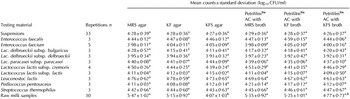
Results of mean counts of each LAB species and raw milk samples plated in conventional methodology and Petrifilm™ AC with MRS, KF and KFS media are shown in Table 2. For LAB suspensions the differences between results of both methodologies were not significant, at a level of significance of 0·05, regardless of the species tested. However, for raw milk samples the mean count obtained in KF and KFS media were lower compared with the results in MRS, but only in the conventional methodology using KFS was this difference significant (P⩽0·05). The lower counts in raw milk samples using KF and KFS media occurred due to the addition of the selective substances phenylethanol and lactic acid. According to Kim et al. (Reference Kim, Fung and Kang2001), KFS medium has a greater selectivity potential when compared with MRS and KF due to the addition of an organic acid.
Means counts of Lactic Acid Bacteria and raw milk samples using MRS, KF and KFS culture media in conventional plating and Petrifilm™ AC plates
Values are mean counts (CFU/ml)±sd for n=number of repetitions

a,b Values in the same row with common superscript letters are not significantly different (Tukey's HSD test, P⩽0·05)
When the mean counts of LAB from each culture media were compared between both methodologies, no significant differences were observed (P⩾0·05), indicating equivalency as previously described (Champagne et al. Reference Champagne, Gardner, Piette and St-Gelais1994; McGregor et al. Reference McGregor, Traylor, Gough, Hazlett and Bird1995; Nero et al. Reference Nero, Beloti, Barros, Ortolani, Tamanini and Franco2006). But, the mean counts of microorganisms in raw milk obtained in KF and KFS media using Petrifilm™ AC plates tended to be higher than those obtained by the conventional methodology, suggesting a smaller interference of the added supplements in the first method. Ferrati et al. (Reference Ferrati, Tavolaro, Destro, Landgraf and Franco2005) found a similar interference in Petrifilm™ AC plates in an evaluation of this method to enumerate microorganisms from acid juices.
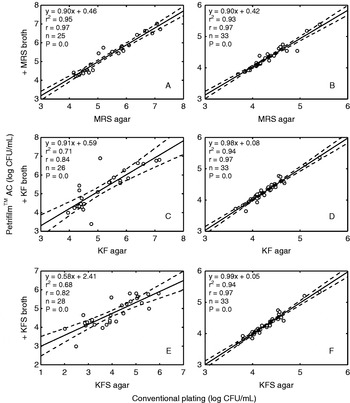
Figure 1 shows the dispersion of the counts of LAB species and raw milk samples obtained in MRS, KF and KFS media using Petrifilm™ AC and conventional pour plate methodology. These results indicate an excellent correlation (r=0·97) between results obtained in both methodologies using MRS media for LAB strains and raw milk samples. For KF and KFS media, the results indicate excellent correlation between methodologies when LAB strains are tested (r=0·97 for both cases), but lower correlation indexes for enumeration of microorganisms from raw milk samples (r=0·84 for KF, r=0·82 for KFS). For these culture media, the correlation indexes between Petrifilm™ AC and the conventional methodology can be classified as good. All obtained correlations were highly significant (P=0·00 in all cases, Fig. 1).
Relationship between counts of microorganisms in raw milk (left) and Lactic Acid Bacteria cultures (right) by conventional methodology and Petrifilm™ Aerobic Count (AC), using de Mann-Rogosa-Sharpe (MRS, graphs A and B), Kang-Fung (KF, graphs C and D), and Kang-Fung-Sol (KFS, graphs E and F). In each graphic: r=correlation index, r2=determination coefficient, n=number of repetitions, P=level of significance.

The convenience of using Petrifilm™ AC plates associated to MRS broth for LAB enumeration in fermented foods was previously described by Nero et al. (Reference Nero, Beloti, Barros, Ortolani, Tamanini and Franco2006), but it is well known that MRS media does not provide proper selectivity for LAB, since non-LAB microorganisms can develop colonies in this medium (Kang & Fung, Reference Kang and Fung1998). The addition of phenylethanol and lactic acid to MRS medium resulted in an increase in the selectivity for LAB, since all strains tested could be appropriately recovered in KF and KFS media and the raw milk samples showed lower counts when tested with these media. However, the added supplements generate some interference for Petrifilm™ AC plates. Also, the lower correlation between the methodologies using KF and KFS media for Lactococcus lactis subsp. lactis (r=0·42 and r=0·17, respectively – data not shown) could be a probable reason for the same low correlation in raw milk samples. This microorganism is an important component of this product microbiota (Zamfir et al. Reference Zamfir, Vancanneyt, Markras, Vaningelgem, Lefebvre, Pot, Swings and de Vuyst2006) and has already shown a poor recovery performance in MRS with these supplements (Kim et al. Reference Kim, Fung and Kang2001).
The small size of the colonies from LAB cultures that grew on KF and KFS, when compared with MRS, can be considered as an indication of the selective activity of the supplements. Especially in KFS, the colonies showed a smaller size when compared with those on MRS and KF media, showing the inhibitory activity especially of the lactic acid. Even with this evident selectivity, all LAB strains could be properly recovered in this media. LAB are known as acid tolerant (Muyanja et al. Reference Muyanja, Narvhus, Treimo and Langsrud2003), and the pH 5·5 used in this study was sufficient to allow their growth and recovery. Zamfir et al. (Reference Zamfir, Vancanneyt, Markras, Vaningelgem, Lefebvre, Pot, Swings and de Vuyst2006) used a low pH to select Lactococccus spp. and Lactobacillus spp. in dairy products.
Although the enumeration of all strains tested in Petrifilm™ AC was possible, some of them showed almost transparent colonies in these plates. This particularly occurred with Leuconostoc lactis and Streptococcus thermophilus strains, and had already been observed by Nero et al. (Reference Nero, Beloti, Barros, Ortolani, Tamanini and Franco2006) in a previous study. Beloti et al. (Reference Beloti, Barros, Freitas, Nero, Souza, Santana and Franco1999, Reference Beloti, Barros, Nero, Pachemshy, Santana and Franco2002) reported that the performance of Petrifilm™ AC plates for enumeration of aerobes in Brazilian pasteurized milk was not good as described in the literature due to the presence of high levels of thermoduric species that are unable to reduce the dye (2,3,5-trypheniltetrazolium chloride) used as indicator in these plates. The inability of some bacterial strains to form visible colonies in Petrifilm™ AC was described by Dawkins et al. (Reference Dawkins, Hollingsworth and Hamilton2005) who related this deficiency of Streptococcus spp., as observed in this study.
KFS could be used as a selective media for screening LAB in foods, including raw milk, as proposed by Kim et al. (Reference Kim, Fung and Kang2001). However, a descriptive study of the different microorganism genera that can be recovered in each culture media and methodology must be conducted to confirm the selectivity of KF and KFS, associated or not to Petrifilm™ AC, for LAB screening.
Petrifilm™ plates are well known for being an important tool for control of quality in industry, optimizing hands-on work, space and costs in laboratories (Byrne & Bishop, Reference Byrne and Bishop1991; Beuchat et al. Reference Beuchat, Copeland and Curiale1998, Ferrati et al. Reference Ferrati, Tavolaro, Destro, Landgraf and Franco2005; Tavolaro et al. Reference Tavolaro, Ferrati, Destro, Landgraf and Franco2005). For LAB enumeration, the present study confirms the efficiency of Petrifilm™ AC plates, despite the supplements added to MRS broth.
The authors are thankful to 3M do Brasil Ltda. for providing the Petrifilm™ AC plates used in the study. Also to Juliana Scombatti Martins for the grammar and spelling review.