INTRODUCTION
Traumatic events involving threat to life such as those experienced by a large number of people in Yugoslav's wars are important factors in predicting post-traumatic stress disorder (American Psychiatric Association 1994; Marinic et al. Reference Marinic, Supek, Kovacic, Rukavina, Jendricko and Kozaric-Kovacic2007; Sambunjak Reference Sambunjak2007). The concept of war-related distress is used since our instrument captures war-related symptoms. The effects of traumatic war experiences may also be present many years after exposure to traumatic events (Owens et al. Reference Owens, Baker, Kasckow, Ciesla and Mohamed2005; Klaric et al. Reference Klaric, Klaric, Stevanovic, Grkovic and Jonovska2007; Hasanovic, Sinanovic and Pavlovic Reference Hasanovic, Sinanovic and Pavlovic2005; Kozaric-Kovacic, Kocijan-Hercigonja Jambrosic Reference Kozaric-Kovacic, Kocijan-Hercigonja and Jambrosic2002; Ringdal, Ringdal and Simkus Reference Ringdal, Ringdal and Simkus2008a, Reference Ringdal, Ringdal and Simkus2008b).
Religious beliefs and activities are frequently mentioned sources of hope, comfort, acceptance, and strength among diverse groups including cancer patients and persons suffering from rheumatoid arthritis, kidney transplant, HIV/AIDS, heart transplant, and chronic pain patients (Siegel, Anderman and Schrimshaw Reference Siegel, Anderman and Schrimshaw2001). It seems likely that religiosity may be a source of strength also in times of war. In this study, we will focus on the relationship between religiosity and war-related distress among the residents of Bosnia and Herzegovina several years after the war ended.
It is common to focus on the negative effects of highly stressful events, such as post-traumatic stress (Park & Ai Reference Park and Ai2006). This approach has expanded in new directions in order to take into account more recent research findings. For instance, some researchers have begun to emphasize the importance of identifying factors that may protect against developing disorders following trauma. One such protective factor may be religiosity (Siegel, Anderman and Schrimshaw Reference Siegel, Anderman and Schrimshaw2001; Trevino & Pargament Reference Trevino and Pargament2007; Park and Ai Reference Park and Ai2006). Religiosity may mediate physical and mental health by providing mental strength and social support (Flannelly, Ellison and Strock Reference Flannelly, Ellison and Strock2004).
The present study is based on a survey conducted in late 2003 and early 2004, about eight years after the war ended in November 1995. The main purpose of the article is to test whether religiosity serves to protect against war-related distress. After a short description of the consequences of the war, the potential beneficial effects of religiosity will be discussed.
CONSEQUENCES OF THE 1992–1995 WAR
Bosnia and Herzegovina is a multi-ethnic state with Bosniaks (40%), Serbs (33%), and Croats (20%) as the largest ethnic groups. Their separate ethnic identities stem from different religious affiliations. The Bosniaks are Muslims, the Croats are Roman Catholics, and the Serbs are Orthodox. The Bosnian war (1992–1995) was one of the most devastating wars in Europe since World War II. The most recent figures indicate that about 100,000 out of a population of 4.4 millions were killed and at least as many were injured (Nilsen Reference Nilsen2007; Research and Documentation Center Sarajevo 2007). More than two million were driven from their homes in a process described as ethnic cleansing. About 60% of all houses in Bosnia and Herzegovina, half of the schools, and a third of the hospitals were damaged or destroyed according to World Bank estimates (2004). War on this scale can leave no inhabitants untouched, although some were harmed far more than others (Nelson Reference Nelson2003; Ramet Reference Ramet2006).
RELIGIOSITY, WAR EXPERIENCES, AND WAR-RELATED DISTRESS
Our main explanatory variables of war-related distress are religiosity and reported war experiences. In two earlier articles, we have shown that war experiences are strongly related to war-related distress both in Bosnia and Herzegovina and Kosovo (Ringdal, Ringdal and Simkus Reference Ringdal, Ringdal and Simkus2008a, Reference Ringdal, Ringdal and Simkus2008b). Before developing hypotheses on the role of religiosity in preventing war-related distress, the concept of religiosity needs a closer examination.
Religiosity refers to the numerous aspects of religious activity, dedication, and belief. Historically, research on religiosity and spirituality has involved one-dimensional and often single-item measures (Neff Reference Neff2006) such as religious affiliation (church membership and/or denominational affiliation) and religious participation (e.g., frequency of attendance). Acknowledging limitations of single-item measures, religiosity has long been recognized as a multi-dimensional concept (Flannelly, Ellison and Strock Reference Flannelly, Ellison and Strock2004). More complex measures, such as the Fetzer Multi-dimensional Measure (Neff Reference Neff2006), follow the classic conceptual distinction between religiosity and spirituality, where religiosity involves sub-dimensions of formal/public services (participate at religious services), informal/private religious practice (pray, meditate) and self-rated religiosity, and sub-dimensions of spirituality involving daily spiritual experiences, spiritual values/beliefs, forgiveness, positive and negative spiritual coping, and religious support. Spirituality is said to represent an integrative force in an individual's life, providing meaning, and core values and principles for organizing one's life. In this article, religiosity is measured by questions about religious beliefs and behavior, attendance at religious services, and frequency of prayers.
It is well-established that social support has a strong positive effect on mental health (Berkman and Syme Reference Berkman and Syme1979; House, Landis and Umberson Reference House, Landis and Umberson1988; Ringdal et al. Reference Ringdal, Ringdal, Jordhøy and Kaasa2007). As regards religious activities, it involves interaction with other people in a way that may create social support. Religious institutions often provide formal support through church programs, and other religious activities (Flannelly, Ellison and Strock Reference Flannelly, Ellison and Strock2004; Neff Reference Neff2006). People who regularly attend religious services have larger social networks, which provide companionship and access to the resources of the religious community, including financial and other forms of assistance (Flannelly, Ellison and Strock Reference Flannelly, Ellison and Strock2004; Georg, Ellison and Larson Reference Georg, Ellison and Larson2002).
The literature shows that religious beliefs may be a source of inner strength that may protect against war-related distress. According to Park (Reference Park2005), the nature of the event determines the likelihood of religious involvement. If the stressful event is one that is not amenable to being “repaired” (i.e., problem-solved) such as illness or death, meaning-making efforts become more central. It is in these situations that religiosity may have its greatest impact, by helping to restore beliefs that the world is safe, predictable, fair, and controllable, and that there is, perhaps, a benevolent God in charge of it all (Pargament Reference Pargament1997). As regard war-experiences to which the respondents in the present study were exposed, they are clearly examples of stressful events not amenable to being “repaired,” which mean the kind of situations where religiosity may have its greatest impact. Thus, based on these theoretical and empirical findings, we formulated the following hypotheses:
Hypothesis 1:
Religiosity protects against war-related distress independently of war experiences
Hypothesis 2:
Religiosity will buffer the effect of war experiences on war related distress
MATERIALS AND METHODS
Sampling Design
The data source is the South-East European Social Survey Project (SEESSP) fielded in December 2003–January 2004, covering most of former Yugoslavia with a total sample size of 21,000 respondents. The SEESSP surveys measured attitudinal variables related to a large number of subjects, from ethnic relations to gender roles. The field-work in Bosnia and Herzegovina was carried out by the private survey organization PULS.
The survey design for Bosnia and Herzegovina was intended to provide samples of the three main ethnic groups that were large enough to allow ethnic group comparisons with a minimum of sampling error. For this reason, three separate samples were chosen: one from the Federation municipalities that were predominantly Bosniak in population composition, one from the Federation municipalities that were predominantly Croat, and one from the Republic of Srpska. In addition, a sample from the municipality of Brčko was included. The predominantly Croat municipalities were over-sampled relative to their share of the population, to yield estimates for Croats with smaller standard errors (see Ringdal, Ringdal and Simkus Reference Ringdal, Ringdal and Simkus2008b, for more details). The total gross sample size is 3,313.
Respondents were asked for their verbal consent to be interviewed, and were told that participation was voluntary. The overall refusal rate was approximately 30%. The entire interview was conducted face-to-face by the survey organization interviewer. The names and addresses of respondents were held in confidentiality by the survey organization and only the interviewer and data entry personnel saw the original questionnaire. We were concerned that the war-related questions could be experienced as “disturbing,” by the respondents, but pre-tests did not indicate any problems, and the main survey confirmed this.
Documentation of the Variables
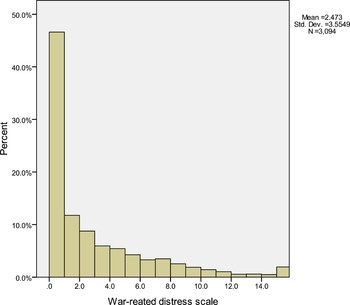
The war-related distress scale (Fig. 1) is based on 15 dichotomous items used in a survey in Croatia in 1996 (Kunovich and Hodson Reference Kunovich and Hodson1999). The sequence of the identically formatted questions, preceded by an introduction, is documented in the appendix. In earlier publications, we have shown that a reliable one-dimensional scale may be formed from the reported war experiences in Bosnia and Herzegovina (Ringdal, Ringdal and Simkus Reference Ringdal, Ringdal and Simkus2008a, Reference Ringdal, Ringdal and Simkus2008b). The scale was computed as the sum of valid answers, 0 or 1, for the 15 items. Respondents with less than 13 valid answers are set to a missing value for the scale and excluded from the analyses involving the war-related distress scale.
Histogram of war-related distress in Bosnia and Herzegovina.

War experiences are captured by 13 identically formatted yes/no-questions on personal, direct exposure to violence as documented in the appendix. We have earlier shown that a reliable and one-dimensional scale may be formed as a sum of 12 of the 13 items (Ringdal, Ringdal and Simkus Reference Ringdal, Ringdal and Simkus2008b).
The survey questionnaire includes 10 questions on religiosity covering religious beliefs and religious activity or behavior (see Appendix). A factor analysis confirmed the two-dimensionality of the response patterns. Accordingly, we constructed religiosity scales for these two dimensions. The measure of religious beliefs was constructed as the mean of at least two valid answers to the questions on degree of believing in: “The existence of God,” “Life after death,” and “Religious miracles.” Each item was rescaled so that the minimum scale value of 1 indicates that the respondent does not believe in any of the three aspects of faith, whereas those scoring the maximum of 3 believed in all three. The scale is strongly left skewed, that is, the number of believers outnumbers the disbelievers. The scale has excellent psychometric properties: it is one-dimensional with high internal consistency measured by Cronbach's alpha (0.85).
We have constructed several versions of the religious activities scale. The first problem was whether the frequency of participation in religious services and praying could be considered to tap the same dimension. Factor analysis indicated that the answer is yes. The second problem concerned the inclusion of questions about participation in religious services in 1990 and in childhood. Factor analysis indicated that they all tap the same dimension. Still, we have tried out both versions. A third problem was the scaling of the response categories. The response categories on all items vary from 1 “Never” to 11 “Several times a day.” They can be used with this arbitrary scoring or the scores could be replaced by the implied frequencies per year. To reduce the skew, we transformed the scale by replacing the raw scores by their natural logarithm. We have tried out all four versions of the religious activities scale in the analysis. All versions are one-dimensional and have internal consistency that exceeds 0.90 measured by Cronback's alpha.
The questionnaire also includes a general direct question where the respondents are asked to rate themselves on a scale where 0 means “Not at all religious” to 10 “Very religious” (see Appendix). This question loads on both dimensions and will be used separately in the analysis to follow.
Finally, the survey also includes a question on change in religiosity since 1990, before the Yugoslav wars. The response categories vary from 1 “Much more religious” through 3 “Stayed the same” to 5 “Much less religious.” This question may be used for evaluation of reversed causality. From this we have created a measure of religious stability which will be included in the analysis.
RESULTS
We will start by presenting the distribution of the war-related distress scale in Bosnia and Herzegovina. The scale is the sum of the number of symptoms reported by the respondents in the interviews. The scale takes the value of zero if no symptoms were reported and the maximum value of 15 if all symptoms were reported. The distribution of the scale shows a strong clustering at the lower end. More than 45% of the respondents scored 0, that is, they did not report any symptoms of war-related distress. The mean scale score is 2.47, that is, the average respondent reported about 2.5 symptoms.
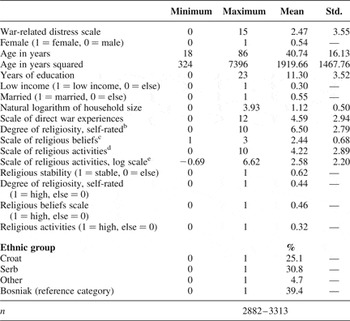
In addition to the war experiences scale, and the religiosity measures, the following variables were included as controls in the regression analyses: gender, age in years, years of education, an indicator of low income, being married, and the natural logarithm of household size. Ethnicity in four categories, with Bosniaks as the reference category is also added to the model. Some descriptive statistics for the variables are presented in Table 1.
Descriptive statistics for Bosnia and Herzegovinaa

a Std.: Standard deviation.
bDegree of religiosity, self-rated: based on a single question (see Appendix).
cScale of religious beliefs: mean of 2–3 of three items on the existence of God, life after death, and miracles (see Appendix).
dScale of religious activities, mean of yearly frequencies of participation in religious services and praying (see Appendix).
eScale of religious activities, log scale: the natural logarithm of the scale of religious activities.
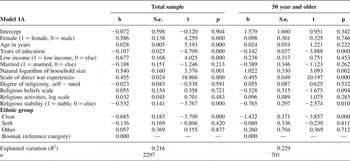
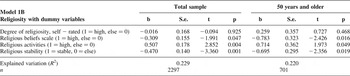
There are two sets of religiosity variables: a set of four religiosity scales that are measured at the ordinal or higher level of measurement, and a set of 0–1- variables that, with one exception, are dichotomous versions of the former scales. All of these were tried out in various regression models, the continuous ones in model 1A and the dichotomous versions in models 1B, and 2 to 4 reported in Tables 2 and 3.
Religiosity and war-related distress, a multiple regression analysisa

a b: unstandardized (metric) regression coefficient, S.e.: the standard error of b, t: the t-statistic, p: the probability value of t.
Religiosity, war experiences and war-related distress, a multiple regression analysis with dummy variables for religiosity and interaction effectsa

Table 2 shows the results from model 1A for the whole sample and for respondents aged 50 or more. The reason for this is simply that older persons tend to be more religious and we also know that older people are more vulnerable to war-experiences than younger people.
Let us first comment on the non-religiosity variables. In the total sample, women score significantly higher on war-related distress than men. However, for those aged 50 or more, the gender difference is not statistical significant. Age is positively correlated with war-related distress. On the average, 30 years increase in age means an extra war-related distress symptom reported.
Years of education are, as expected, negatively correlated with war-related distress. This means that people with long education report fewer symptoms of war-related distress than people with short education. Low income is associated with more frequent reporting of war-related distress.
Those who are currently married are not significantly different from others in terms of war-related distress. Household size is positively correlated with war-related distress. The reason for this finding is probably that the larger the household, the greater the chances that someone close to them lost his or her life or was otherwise exposed to violence during the war.
At the bottom of the table, a set of variables identifying ethnic groups are included. The coefficients should be interpreted as differences in war-related distress in relation to the reference category, the Bosniaks. The negative coefficient for the Croats shows that they report less war-related distress than the Bosniaks, more so for the older respondents than for the total sample.
The most important explanatory variable in Table 2 is, no doubt, the war experiences scale. A 10-point difference on the war experiences scale is expected to result in a change of close to 5 points on the war-related distress scale.
Finally, let us look at the result for the religiosity variables. None of the scales has any effects in the total sample. Only the indicator of religious stability shows a significant coefficient. The religious stable score is about 0.5 point lower on the war-related distress scale than those who had changed their religiosity since 1990.
The results for those 50 years of age or more, show stronger relationships than for the total sample. The effect of religious stability is stronger, and more important, the religious beliefs scale shows the expected negative sign, indicating that believing may protect against war-related distress. We must, however, interpret this with care since the effect is only marginally statistical significant (p < 0.10).
It is quite possible that the scaling of the religiosity variable in model 1A is not optimal. In model 1B, reported in Table 3, we use the dichotomous versions of the three religiosity scales. Before we comment on the results for the religiosity variables, note that the results for the other variables from Table 2 are not reported.
For the total sample, all religiosity variables except self-rated religiosity gave significant effects. The effect of religious beliefs is negative and twice as strong in the old part as in the total sample. On the other hand, religious activities show a positive effect on war-related distress, which is stronger among those 50 years or older than in the total sample. This means that the most religious active also show increased level of war-related distress. Religious stability shows about the same effects as in Table 2. This is to be expected since this variable was identical in both models.
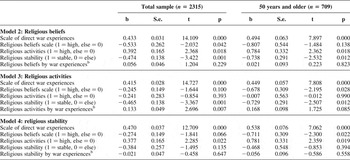
The last step is to add the statistical interactions between the war experiences scale and the religiosity variables. The second hypothesis on the potential buffer effect of religiosity implies significant interaction effects. Since the strongest effects were observed for the dichotomous version of the religiosity variables, those are the ones used in the analysis of interaction effects. The results are presented in Table 4, as before for the total sample and for those 50 years of age or more separately. Based on the results in Tables 2 and 3, self-rated religiosity is dropped from the analysis reported in Table 4. Each model includes three identical religiosity variables and each model has a different interaction effect.
Religiosity, war experiences and war-related distress, a multiple regression analysis with interaction effectsa

The results are easy to sum: there are simply no interaction effects. There is one exception from this observation; religious activities show a statistically significant interaction effect in the total sample (p < 0.01), and close to statistical significance (p < 0.09) in the old part of the sample. This interaction effect does, however, tend to amplify rather than dampen the effect of war experiences on war-related distress.
CONCLUSIONS
We started out with two hypotheses on the ways religiosity may protect against the negative effects of war experiences. Religiosity may have a protective effect independently of war experiences, or religiosity may buffer the effect of war experiences on war-related distress. The first one implies negative effects of religiosity after controlling for all other explanatory variables including war experiences, and the second hypothesis implies interaction effects. We did find some statistical effects of the religiosity measures, especially with the dichotomous versions of the religiosity scales. Some of the effects were, however, in the opposite direction. Religious beliefs and religious stability seem to protect against war-related distress as implied by the first hypothesis, but religious activity worked in the opposite direction to increase war-related distress. In conclusion, we found weak support for the first hypothesis, but the effects of religiosity on war-related distress seem more complex than expected.
The second hypothesis stated that religiosity may serve to buffer the effects of war experiences on war-related distress. Operationally, this means locating statistical significant interactions between war experiences and the religiosity variables. Without capitalizing on chance, we must conclude that the second hypothesis finds no support in our analysis.
ACKNOWLEDGMENT
The South-East European Social Survey Project was founded by The Research Council of Norway within the South-Eastern Europe Programme, grant no 144826/S30.
APPENDIX: DOCUMENTATION OF VARIABLES
War-Related Distress Items
Now we want to ask you some questions about your thoughts and feelings, some maybe due to the war, others about your feelings in general. We appreciate that these are private feelings. But, we definitely will not reveal anything about your answers personally. It is interesting and important to know how many people feel the kinds of feelings and thoughts that you do. Or how many do not. There are no “right” or “wrong” answers; we only want to try to see how many people have these kinds of feelings or experiences.
For each of the following questions, answer “yes,” or “no,” depending on whether you have or have not had these feelings, thoughts, or ways of acting. Have you had…?
1. Recurrent and bothersome thoughts or memories about a traumatic war-related event.
2. Recurrent distressing dreams about a traumatic war-related event.
3. A recurrent sense of reliving past war trauma in the present such as flashback kinds of experiences.
4. Persistent intense emotional or physical distress at exposure to cues that symbolize or resemble an aspect of war trauma (inside or outside yourself).
5. Persistent avoidance behaviors, thoughts, or feelings related to war trauma such as avoiding certain conversations, ideas, or activities that arouse painful memories.
6. Persistent loss of memory for important parts of a war trauma.
7. Markedly diminished interest or participation in usual activities.
8. Persistent feelings of being detached or estranged from others such as family members with whom you have felt close.
9. Persistent reductions in the ability to feel your emotions or feelings of emotional numbness.
10. A persistent sense of a foreshortened future.
11. Persistent difficulty falling or staying asleep.
12. Persistent irritability or outbursts of anger.
13. Diminished ability to concentrate.
14. Being easily startled or panicked frequently.
15. Significant impairment in social, occupational, or other important areas of functioning (as a result of emotional distress).
War Experiences Items
The next set of questions is about things you yourself experienced directly. During the period of war, from 199x to 199x, which of the following things did you actually personally directly see or witness with your own eyes and ears, directed at you, your family, or community?
1. Shooting (even if no one was hurt).
2. Artillery bombardment (even if no one was hurt).
3. Bombing from airplanes or missiles (even if no one was hurt).
4. Attacks with knives or clubs.
5. People being seriously wounded from your own family or friends.
6. Other people, not family or friends, being seriously wounded.
7. Persons being raped.
8. Family members or friends being killed or taken away and never seen again.
9. Other persons being killed.
10. The destruction of your home, farm, or business.
11. Being captured and held prisoner by enemy forces.
12. Being forced to leave your home and move to another part of the country.
13. Having to leave the country and live in a country abroad as a refugee.
Religiosity
Do you believe, have doubts about, or do not believe in the following?
CARD 10.2-B shows the possible answers (1. Believe 2. Somewhat believe, 3 Don't believe 8 Don't know/No answer).
1. The existence of god.
2. Life after death.
3. Religious miracles.
Now, several questions about how often you go to religious services — not counting weddings, baptisms, or funerals. Look at CARD 12 to see the categories for how often. Keep looking at CARD 12, because we are going to use the same answers next in asking how often you pray.
1. First, how often did you yourself attend religious services during the last year (apart from weddings, baptisms, and funerals)?
2. How often did you attend religious services in 1990?
3. How often did you attend religious services when you were 14 years old?
4. How often do you pray now (usually during the last year)?
Regardless of whether you belong to a particular religion, how religious would you say you are? This is one of those questions where we want you to answer using a number from 1 to 10, where “0” means “not at all religious,” and “10” means “very religious.” Look at CARD 13 and tell me the score that is closest to indicating how religious you are now.
Have you changed how religious you are since 1990? Would you say that you have become …
1. Much more religious,
2. More religious,
3. Stayed the same, not more religious, not less religious,
4. Less religious,
5. Much less religious,
8. Don't know/No answer.