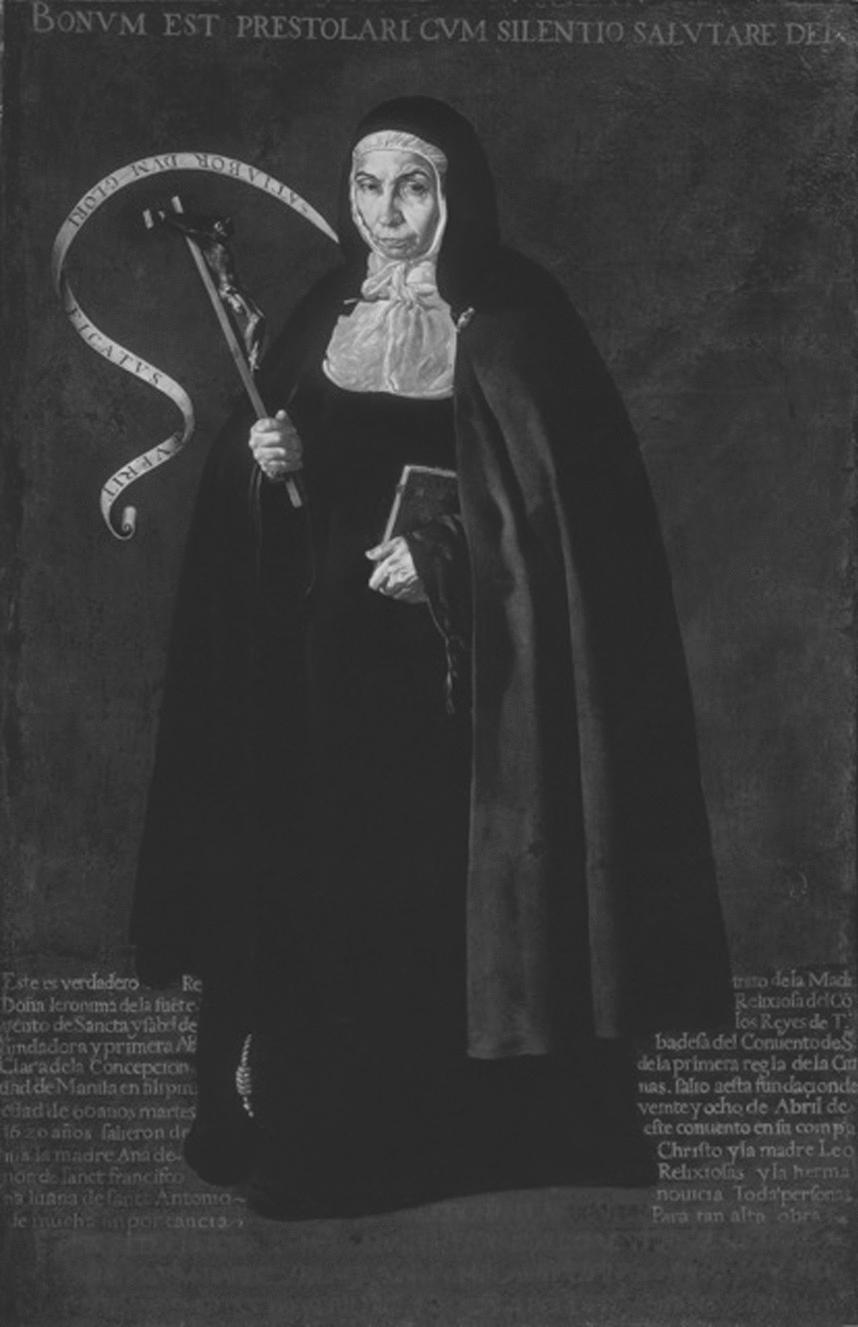
In 1620, almost a hundred years after the Virgin of Guadalupe is said to have appeared to Juan Diego on the Hill of Tepeyac, a small group of Spanish nuns paid a visit to the chapel dedicated to Our Lady of Guadalupe. Like many others before and after them they stopped at the shrine on their way to Mexico City. The Franciscan nuns were traveling from Toledo to Manila and were about to cross Mexico to board the yearly Manila Galleon at the port of Acapulco.
The leader of the expedition, Sor Jerónima de la Asunción (1556–1630), is relatively well known because her portrait hangs in the Prado Museum in Madrid (see Figure 1).Footnote 1 She posed for the portrait during a stopover in Seville on the way to the port of Cádiz. The painter was none other than Diego Velázquez. His brushstrokes capture the essence of the nun from Toledo, a religious woman who had already received much acclaim as a would-be saint. By the time of the portrait Sor Jerónima had spent the majority of her life depriving herself of material comforts, living on bread and water, wrapping her skeletal body in coarse hair shirts, and tending to the sick, poor, and destitute. Her wrinkled face and veined hands reveal the intractable desire of the 64-year-old nun to traverse two hemispheres to establish the first convent in the Far East under the strict First Rule of Saint Clare.
Portrait of La Madre Jerónima de la Fuente, 1620, by Diego Rodríguez Velázquez

The nuns who journeyed with Sor Jerónima to the Philippines played an important role in the foundation of the new convent, yet until recently they remained virtually unknown. Most notably, one of the women, Sor Ana de Cristo (1565–1636), penned a 450-folio manuscript that provides a fresh look into the trajectory and byways of the nuns' journey from Spain to the Philippines.Footnote 2 Her unique voice recounts the saga that began in their cloistered convent of Santa Isabel de los Reyes Toledo in Spain. Although the nuns lived enclosed, they had received special dispensation to leave their community to establish a new one, and to do so the group had no choice but to sail across the Atlantic Ocean to New Spain on their way Manila.Footnote 3 A series of papal bulls issued during the preceding years by Alexander VI led to the Treaty of Tordesillas (June 7, 1494), which granted the other feasible route to the East, that is, around the Cape of Good Hope, to the Portuguese.Footnote 4 The odyssey took the small group of religious approximately 15 months; they left Toledo at the end of April 1620 and arrived in Manila in early August 1621.Footnote 5
This article focuses on the women's transatlantic journey, in particular their short stop on the Caribbean islands of Guadeloupe, and then their crossing of Mexico from the port of Veracruz on the Gulf of Mexico to Acapulco. For many reasons, their transatlantic voyage and the time they spent on the North American continent are noteworthy. First, there are very few other texts (if any) written from the perspective of a nun that describe the actual route to the Philippines. Sor Ana's account provides the reader with a bird's-eye view of the sights, challenges, and dangers that this small entourage faced in the Caribbean and Mexico, and for this reason several fairly lengthy quoted passages are included here. Her telling of the sisters' encounters with multiple indigenous populations enriches our knowledge of the mentality of female religious and how they reacted to these completely new experiences. Moreover, Sor Ana's depiction of the shrine of the Virgin of Guadalupe sheds light not previously seen in historical studies of this religious site. To explore some of the reactions and descriptions penned by Sor Ana, this study begins by analyzing the missionary impulse behind the sisters' travels across New Spain, including their stopover at three convents in Mexico City.
The nuns carried with them the mandate to be models for the Franciscan order, advocating the simple lifestyle of discalced Poor Clares.Footnote 6 Although Jerónima herself had followed these precepts in Toledo, her home convent of Santa Isabel adhered to the less strict Second Rule of Saint Clare, also known as the Urbanist Rule.Footnote 7 In general, the Urbanist Rule was much more common in Spain and the Americas than the First Rule—the majority of convents attracted upper-class and noble women whose families wanted them to continue their lifestyle of relative affluence. In order to profess, they needed to come from ‘Old Christian’ families and pay a considerable sum of money in the form of a dowry. These women took their vows as black-veiled nuns, and devoted their time to praying the Divine Office. Within their communities black-veiled nuns were the only women allowed to hold office, or to become an abbess, vicaress (similar to vice-abbess), or treasurer. Within the convent hierarchy, women whose families could not afford to pay a dowry often had to profess as white-veiled nuns.Footnote 8 These women were classed as second to the black-veiled nuns. They often worked in the kitchen, infirmary, and laundry, but they ranked above other servants and slaves allowed by most Urbanist convents (the latter were common in New World convents).
Sor Jerónima and her followers believed that convents should not require dowries but instead live off alms from the general population. They wanted to follow the First Rule of Saint Clare, which embraced poverty and rejected riches. If possible, the nuns also wanted to allow native Filipino women to profess as nuns (later a very difficult and controversial subject). Years earlier, in 1584, Sor Jerónima had been named abbess of a planned convent of discalced Poor Clares in Toledo but for reasons unknown the convent never came to be.Footnote 9 Deprived of her chance to serve as abbess in Spain, Sor Jerónima most likely saw her voyage to Manila as her last opportunity to lead a new convent under the strict auspices of the First Rule of Saint Clare.
Sor Ana de Cristo and Her Female Role Models
The Franciscan friar José de Santa María, who accompanied the cohort of founding nuns and served as their confessor, taught Sor Ana how to write during the journey and during their early years in Manila. Sor Ana undertook the task of writing the life of Sor Jerónima, completing most of the work between 1623 and 1626 after arriving in the Philippines. Her writing continued until 1629 a year before Sor Jerónima's death. Evidently, Sor Ana knew how to read before she undertook the voyage, but not how to write, a somewhat common scenario in early modern Europe where reading and writing were taught as two separate skills.Footnote 10 A sample from Sor Ana's manuscript is shown in Figure 2. Fray José’s main reason for teaching the semiliterate nun how to write was so that she could draft the biography of Sor Jerónima de la Asunción, the first record of her life.Footnote 11 Although Sor Ana did accomplish this task, it is difficult to define the text as a pure biography. Instead, it is a hybrid, a combination of biography, autobiography, travel chronicle, and history of the new convent.Footnote 12
Manuscript Page: Vida de Sor Jerónima de la Asunción by Sor Ana de Cristo
Sor Ana's manuscript, although never published in Spanish nor in English, adds a new dimension to the growing field of Iberian Atlantic and Pacific studies.Footnote 13 Although Sor Ana learned how to compose a biography only late in life, at about age 55, she had obviously done quite a bit of reading and listening. Like others in the convent, she was exposed to a very strong auditory culture that helped cultivate her formation. Not only did women religious spend a considerable amount of time listening to sermons, but they also read to each other at meal times, or during work time, often on the lives of saints.Footnote 14 In addition to evidencing a basic knowledge of Latin (she sprinkles Latin phrases throughout her text), Sor Ana cites inspirational religious men and women from the orders of Saint Francis and Saint Clare of Assisi, important contemporary church leaders such as the Pope, the archbishop of Toledo, and many others within the Franciscan order. She also mentions key political officials, including the governor of Manila. Sor Ana may not have had much practice in putting quill to paper—she stated herself that she did not know how to write—but it did not take long for her to learn. In addition to her lengthy biography of Jerónima, she wrote at least one letter to the Spanish crown when she was an abbess, many years later.Footnote 15 On a superficial level, Sor Ana depicts herself as an ignorant and wretched being (“ruin sujeto”), but a closer analysis of her manuscript reveals a savvy woman capable of navigating not only the rhetoric of humility and obedience but also the patriarchal and misogynist discourse common in early modern Spain. Her words attest to the fact that men were not the only players in the building of the Iberian empire.
The nuns brought with them on the journey the teachings of the Franciscan campaign of the Immaculate Conception, a devotional movement based on the belief that the Virgin Mary was preserved from all sin at the moment of her conception. Indeed, the name of their future convent in Manila would be the Convento de Madre de Dios de la Concepción, although it is commonly known as the Convento de Santa Clara. The Spanish nuns found inspiration in this movement, especially since some of their foremothers and female contemporaries were active members of the campaign.Footnote 16 Sor Ana's manuscript often refers to these female role models and emphasizes how they provided inspiration for the group to complete their mission in Mexico as exemplary nuns. Furthermore, Sor Jerónima's devotion to the Virgin of the Immaculate Conception helped form bonds with local peoples on the trip. According to Jaime Cuadriello, “images of the Inmaculada acquired enormous power to bring people together both socially and politically within the vast and diverse dominions of the Spanish monarchy.”Footnote 17
Two famous role models for the group were Saint Clare of Assisi and Saint Teresa of Ávila. Sor Ana held both of these women in high esteem. She makes countless references to Saint Clare as the founder of the Poor Clares and as the ultimate model for humility and poverty. Sor Ana also draws on the image of Saint Teresa, albeit less frequently. Most likely she found inspiration not only in her writings, but also in her reformation of the Carmelite order and her travels related to that task, which correlated with Sor Jerómina's role as reformer of Franciscan convents. Furthermore, Saint Teresa was canonized in 1622, shortly after the nuns arrived in Manila. The other women that Sor Ana treated as models and wove throughout her text all belonged to the Franciscan order. These women, lesser known today, were much revered (and at times vilified) during their lifetimes and provided immense pride and inspiration to Spanish nuns. The two women she mentions most as inspirations during the nuns' time in Mexico are Sor Juana de la Cruz (1481–1534), commonly known as “Saint” Juana (la santa Juana) although she was never canonized, and Sor Luisa de la Ascensión (1565–1636), often referred to as the nun from Carrión (la monja de Carrión). The lives of both women speak to the close-knit community of the Franciscan order and how religious women found inspiration in their own members.
It would be difficult to overstate the importance of Sor Juana de la Cruz to this group of Spanish nuns, just as it would be difficult to overstate her fame in Spain and in the Americas. Sor Ana felt especially inspired by Santa Juana because Juana's companion and first biographer, Sor María Evangelista, supposedly received the gift of literacy through divine intervention—thus providing Sor Ana with both a solid role model and an inspiration to write her biography of Sor Jerónima.Footnote 18 Two of the founding sisters on the journey had come from the Franciscan convent located in the town of Cubas near Madrid: María Magdalena de la Cruz and María Magdalena de Cristo.Footnote 19 Almost certainly, they were chosen to form part of the future convent in the Philippines because of their connection to Sor Juana and because they had access to her miraculous rosary beads.
In a miracle recounted by several biographers, including two editions by Antonio Daza (1610; 1613) and another by Pedro Navarro (1622), we learn that the Holy Spirit blessed a large chest of rosary beads belonging to Juana de la Cruz.Footnote 20 She then distributed the beads as relics, and over the years they gained much acclaim for their miraculous powers. Supposedly, the rosaries and any other beads that touched the originals, known as contact relics, had the power to heal the sick, ward off the devil, calm storms, or blow wind into slack sails. The nuns carried several of these rosaries with them on their journey and used them during their time in Mexico as medicine, grinding up a bead like a pill and administering it with a drink of water. Sor Ana describes how the beads twice saved Sor Jerónima from a mortal illness, once in the port of Acapulco and again while aboard the ship to Manila. The beads did not, however, protect Sor María de la Trinidad, who died after setting sail from Acapulco.
The cult of Juana de la Cruz was already established in Mexico when the nuns arrived in New Spain.Footnote 21 However, the sisters' immediate connection to the would-be saint through the two nuns from Cubas, and their access to her beads, endeared them to the local community, both Spanish and indigenous. Sor Ana describes how one of the nuns from Cubas was asked to stay in Mexico and found a community of discalced Poor Clares. She declined, stating that she had left one saint, referring to Santa Juana, for another: Sor Jerónima. In another example, Sor Ana's account also speaks to the diverse cultures in New Spain's convents. At the Franciscan convent of La Visitación in Mexico City (known today as Santa Isabel), the group met an indigenous servant called Inés who professed her devotion to Juana de la Cruz.Footnote 22
Juana de la Cruz, along with her close ally Cardinal Cisneros, was one of the original supporters of the doctrine of the Immaculate Conception.Footnote 23 Looking more closely at Sor Juana and this Franciscan movement, we see that several key players have connections to Sor Jerónima and her founding sisters.Footnote 24 Perhaps the most important promoter of the Immaculist campaign in the early seventeenth century was Sor Luisa de la Ascensión from Carrión (Palencia, Spain). She made a name for herself as a holy woman, and her greatest fame came from her founding of a confraternity in defense of the Immaculate Conception of the Virgin.Footnote 25 By 1619 the confraternity had more than 80,000 members, including King Phillip III, several cardinals, and other powerful leaders both religious and secular. Her confessor and staunch supporter was none other than Antonio Daza, mentioned previously as Juana de la Cruz's biographer. The Inquisition persecuted Sor Luisa toward the end of her life, imprisoning her in Salamanca, although her name was cleared posthumously.Footnote 26
Sor Luisa's persecution occurred after the death of Sor Jerónima, who had never had any reason to doubt the sanctity of the nun from Carrión. One of the few extant documents penned by Sor Jerónima, a letter she wrote to King Philip IV in 1623 after arriving in the Philippines, justifies her reasons for adopting the First Rule of Saint Clare and bolsters her argument by referring to a letter she received from Sor Luisa de la Ascensión while in Mexico City. Luisa told her in the letter to persevere in her mission to found a convent under the First Rule of Saint Clare.Footnote 27 This study looks at the importance of Sor Luisa's support, along with other letters that she sent the nuns during their short stay at the Convent of Saint Clare in the capital of New Spain.
From the Islands of Guadeloupe to Mexico City
Sor Luisa's letters probably followed the same route as the Spanish nuns. All Spanish ships, known together as the fleet of New Spain (flota de la Nueva España), sailed through the Caribbean islands when en route to Veracruz.Footnote 28 According to Sor Ana's account, the ships stopped for 24 hours on the islands of Guadeloupe: “There are said to be fourteen islands with beautiful land. There is a river, which is really welcome as the ships are in dire need of fresh water. They are also stocked with poultry, swine, fruit, and firewood. Since there is Christianity and beautiful tree-covered mountains, they say it would be a good place to build ships. We saw it at sunrise and it seemed to be an earthly paradise.”Footnote 29
Sor Ana's description of the short stop on Guadeloupe serves as a prism for understanding the mentality of the Spanish nuns, not only as reformers of the Poor Clares in the Americas, but as missionaries to its native peoples. The nuns were mortified that the ships passed through the Caribbean islands with little concern for the spiritual well-being of their inhabitants. In the words of Sor Ana: “The Indians of Guadalupe shed many a tear when they see the armada of Christians that comes every year.”Footnote 30 Her narrative affirms that women had direct contact with the location population, the infamous Island Caribs who had taken over the islands centuries earlier. Indeed, one of the Caribs asked a nun for a rosary. On the one hand, the nuns were impressed that the Amerindians wanted to learn more about the Catholic faith, but on the other, they were saddened by their nakedness: “They brought the women and children to us, all naked, and our souls loathed to see them condemned, unless God helped them.”Footnote 31 Sor Ana's description highlights the nuns' missionary zeal to bring Christianity to indigenous populations, and we also learn from her account that Sor Jerómina wrote a letter to the king to remedy the situation: “Thus, she wrote a letter to the king so that he would give an order to send missionaries to the island to instruct the natives in the [Catholic] faith and that he do this on a yearly basis.”Footnote 32 The native peoples of the Caribbean were just the first in a series of indigenous populations that the nuns encountered on their long journey to the Philippines. Like the local peoples from Guadeloupe, the other Amerindians that the women encountered on the trail from Veracruz to Acapulco had some basic experience with the Christian faith, most of them living on Franciscan or Dominican doctrinas (parishes of converted indigenous).Footnote 33
During the colonial period, there were two main routes of passage from Veracruz to Mexico City. The first, used by Hernán Cortés, went by way of the Orizaba volcano, but was less used after the conquest because of tough terrain and a lack of villages where travelers could get supplies. Accompanied by friars, servants, the ship's captain Diego Meléndez, and several indigenous guides, the nuns took the more common route to the capital (412 kilometers), passing through the Spanish settlement of Xalapa and then on to Perote.Footnote 34 From Perote, the trail greatly improved and carriages were used the rest of the way to the capital. Despite the welcome presence of some rustic inns, the path from Veracruz to the capital was still wild when the nuns set foot on Mexican soil in early September of 1620. The entourage had to cross many rivers, and the rains made the dirt paths muddy and slow going. In this inclement weather, the women mounted mules for the first time in their lives, and with their long habits they must have ridden sidesaddle, an awkward position that would have thrown them off balance. Sor Ana describes two major falls: in the first, she fell off her own mule into the mud and, in the second, the nuns witnessed the elderly abbess and her mule tumble down a ravine. The group believed that Sor Jerónima had met her death, but they all rejoiced when Fray José “found her tranquil and calm, hanging from a small branch.”Footnote 35 Even though Sor Jerónima had subjected herself to a life of penance and deprivation, and had suffered from much illness during her 64 years, she survived the fall and weathered many other obstacles on the trail.
While in New Spain the nuns slept in roadside inns, huts, local homes, Franciscan monasteries and churches, and in the open air, except in the capital. Sor Ana's descriptions of the rustic inns paint a picture of the diverse milieu of those who lived and worked in these places. Most of the innkeepers were women, and in some cases are depicted as negras. The treatment of the nuns ranged from a cold reception—one woman gave the group only green wood to light a fire and hid a basket of bread under her bed—to just the opposite; another innkeeper welcomed the women with open arms and provided them with a warm meal. In the latter inn, the nuns rewarded the woman by letting her touch her rosary with one of Juana de la Cruz's original beads. The beads repeatedly served as a nexus with the local population. In another inn, Sor Jerónima cured a local Spanish farmer from a strange illness by having him hold a bead in his mouth all night long. Sor Ana affirms that many people came to touch their rosaries to one of the originals that the nuns carried; there was a great devotion to Juana de la Cruz everywhere they went.
On the other hand, the culture shock for the group of nuns sleeping beneath the stars must have been extreme, since they had spent the vast majority of their lives behind the thick walls of their convent (50 years in the case of Sor Jerónima). Nevertheless, Sor Ana always views these experiences from a positive angle, and at times with a sense of humor. Shortly before arriving in Xalapa, she wrote: “We felt tremendous joy seeing ourselves in that countryside. It was Thursday evening and because of the trees and river we felt ourselves accompanying the Lord in his garden and so we said psalms together.”Footnote 36 She then explained how a late-night shower had drenched the group, and reported that the next day “we rode the mules like wet chickens, but all in a good mood as we crossed the river, our mother in the lead like a flagship.”Footnote 37
Soon thereafter, as the nuns approached Xalapa, they came across their first Franciscan doctrina. In this section of the manuscript, Sor Ana again weaves in threads of Sor Jerónima's missionary efforts. As she portrays reactions of the local indigenous to the saintly nun from Toledo, her descriptions show how the nuns transcended the limits of agency typically assigned to women religious. In this case, she writes: “The whole village processed with cross and banners. They held bouquets of flowers, which they presented to us and they gave our holy mother a crown of flowers, and they put a garland around her neck. They asked for her in their language, causing great devotion in everyone. This lifted her spirits; she kept saying, ‘Blessed be God.’”Footnote 38 These moments of Sor Jerónima's contact with the native people provide salient examples of the Spanish nun's effect on indigenous and Spanish populations alike, and, albeit briefly, the natives' inspirational effect on her, as depicted in the preceding excerpt. According to the account, Sor Jerónima caused awe wherever she went, especially in remote outposts among recently converted Amerindians: “And since in those lands they had never seen nuns before, they thought they had come down from heaven. They beat their chests, saying, ‘How could it be possible for us to see such things in our lifetime?’”Footnote 39
Sor Ana's descriptions of the trail between Veracruz and Mexico City puts into sharp relief the utter incongruity of women dressed in dark habits, with veils covering their faces, traversing the trade routes of New Spain. Again, Sor Ana captures the astonishment of the local people:
An innkeeper sent one of her sons to another innkeeper to see if the nuns had arrived. She told him that they had not come, but instead some priests dressed in robes and black headdresses. The mother raced across the countryside on horseback so she could see this. She brought us some eggs and bread to eat and she relaxed with us. She said that her son had called us priests but did not know anything else, and others were saying that we were the priests' wives that they had brought from Castile, that we were not nuns. And so we traveled with such confusion amongst the Indians as if one had come from another world.Footnote 40
Furthermore, Sor Ana's account speaks to the complex fabric of Spanish missions in Mexico, especially the lack of ordained friars and diocesan priests outside the bigger cities.Footnote 41 “We came across several doctrinas where the Indians serve as curas (priests) since there are so few ministers other than those who come from Spain, and they are spread thin throughout these places.”Footnote 42 Most likely Sor Ana was referring to indigenous lay brothers and not to ordained clergy, since the Mexican provincial councils of 1555, 1565, and 1585 had prohibited such ordinations. The Third Council of 1585, however, was later revised with vague language from the Holy See and could have allowed for a few exceptions.Footnote 43
The Shrine of Our Lady of Guadalupe
Sor Ana's vivid descriptions of the road between Veracruz and Mexico City not only provide insight into the dynamic interplay between the Spanish nuns and the local inhabitants, but also bring us to one of the sites most visited in Mexico today. The most important shrine in New Spain (at least by the 1620s) was located on the main thoroughfare leading into Mexico City. Like many other travelers at the time, the small group made a stop to pay homage at the Chapel of Our Lady of Guadalupe.Footnote 44 Sor Ana describes their visit:
The next day's journey in New Spain was to a chapel that they call Our Lady of Guadalupe; we spent the night there. It is a paradise and the image is one of much devotion. It was manifested when Mexico was won and dust was being thrown in the eyes of the enemies. She appeared to an Indian in that place where [the chapel] is now, that is, between two boulders, and she told him to have a church built for her. A little fresh water sprang from the ground where her feet had touched. We saw it when we passed by the spot and it is boiling as if over a very large fire. We were given a jug and it tasted salty. Also, some lay women (beatas) who were taking care of the chapel, told us that the Virgin herself asked the Indian for his cloak made of cloth, which measured from head to toe. Her image was imprinted on it and then she gave it back to the Indian, telling him to put it in that place, where it would make many miracles. There are more than forty silver lamps [in the chapel] and there are rooms for people who go there to pray novenas.Footnote 45
There is much to say about this short description of Guadalupe and her miraculous image. Foremost, it is one of the earliest accounts written in Spanish by a woman. It not only describes the site of the apparition of the Virgin Mary, but also provides a description of the miraculous imprint of the Virgin on Juan Diego's cloak (although his name is omitted). What is particularly significant is that Sor Ana's account of the site has never been studied as such and is absent from historical studies on the cult of the Virgin of Guadalupe.Footnote 46
We do know that other texts penned by women in the sixteenth century mention Guadalupe, but those references are in last wills and testaments. For example, Elvira Ramírez included in her will of 1557 a brief request for masses to be said at the Church of the Virgin of Guadalupe.Footnote 47 Sor Ana's account has very little in common with these Spanish wills but can be better compared to other travel narratives, such as the autobiographical account by the Englishman Miles Philips, who survived the botched John Hawkins expedition at San Juan de Ulúa in 1568. Later, as a Spanish prisoner, Philips visited the Guadalupe shrine on his way to Mexico City. He writes:
The next morning we departed from thence on our journey towards Mexico, and so travelled till we came within two leagues of it, where there was built by the Spaniards a very fair Church, called our Lady's Church, in which there is an image of our Lady of silver and gilt, being as high and as large as a tall woman, in which Church, and before this image, there are as many lamps of silver as there be days in the year, which upon high days are all lighted. Whensoever any Spaniards pass by this Church, although they be on horseback, they will alight, and come into the Church, and kneel before the image, and pray to our Lady to defend them from all evil, so that whether he be horseman or footman he will not pass by, but first go into the Church, and pray as aforesaid, which if they do not, they think and believe that they shall never prosper; [this] image they call in the Spanish tongue Nuestra Senora de Guadalupe. At this place there are certain cold baths which arise, springing up as though the water did seethe; the water whereof is somewhat brackish in taste, but very good for any that have any sore or wound, to wash themselves therewith, for as they say, it healeth many. And every year once, upon our Lady Day [March 25, the feast of the Annunciation] the people use to repair thither to offer, and to pray in that Church before the image; and they say that Our Lady of Guadalupe doth work a number of miracles. About this Church there is not any town of Spaniards that is inhabited, but certain Indians do dwell there in houses of their own country building.Footnote 48
In comparing Sor Ana and Miles Philips's descriptions we see that they were both amazed by the numerous silver lanterns hanging in the church (now the old basilica). They also partook of the healing waters at the sanctuary, mostly likely the site of the modern-day Chapel of the Pocito.Footnote 49 Philips does not mention the role of Juan Diego; he emphasizes instead the silver statue of the Virgin.Footnote 50 In contrast, Sor Ana specifically describes the Virgin's apparition to an Indian and the imprint on his cloak. This difference is not a surprise; as Barbara Fuchs has pointed out, Philips's description of “the chief Catholic icon of New Spain . . . oscillates between detached skepticism and less critical acceptance.”Footnote 51 Sor Ana, on the other hand, never wavers.
Sor Ana's matter-of-fact description of the site underscores the Spanish belief in the superiority of the Catholic faith in the conquest of the indigenous nations.Footnote 52 She does not, however, cite any connection between the Catholic Virgin of Guadalupe and the Aztec goddess Tonantzín, a correlation that had been made earlier by another Franciscan, Fray Bernardino de Sahagún.Footnote 53 Moreover, Sor Ana omits any reference to the tension prevalent between Franciscans and Dominicans during the mid sixteenth century regarding the Virgin and her relationship to Tonantzín.Footnote 54 It is not surprising that she ignores the power struggles between the orders, especially those regarding any relationship to an Aztec goddess. Her worldview, although expanded by her travels, did not accommodate other belief systems; she firmly believed in the superiority of the Catholic faith as the only true religion. When describing the local Amerindians, she reduced them to naked primitives in need of evangelization. Unlike some of her male Franciscan counterparts (most famously those from the previous century such as Fray Toribio de Benavente Motolinía and Fray Bernardino de Sahagún), she shows no indication that Sor Jerómina and her companions had any wish to learn indigenous languages or understand native belief systems.Footnote 55 Sor Ana's portrayal of Juan Diego and his encounter with the Virgin speaks more to the influence of the Council of Trent in the Americas, which promoted devotion to the Virgin and other saints, than to any interest in native peoples in their own right. At the same time, Sor Ana had to tread lightly in the complex religious landscape where women's writing was already viewed with skepticism.
Sor Ana's account provides the modern-day reader with some fascinating clues about the shrine in the early 1620s. Her allusion to the beatas is particularly intriguing. We know very little about these women who took care of the chapel, although at least one testimony describes how indigenous peoples of Cuauhtitlan would visit the shrine to clean and repair it.Footnote 56 Miles Philips also mentions the indigenous people who lived in the vicinity of Tepeyac and took care of the chapel. It is noteworthy that the beatas, rather than the local friars or priests, assumed the role of cultural informants; it was they who told the group about the miraculous encounter between the indigenous man and the Virgin of Guadalupe. It is possible that Sor Ana was referring also to a group of local Spanish orphan girls sponsored by a cofradía (confraternity or pious society) that paid for their dowries. Yet, according to Gustavo Watson Marrón, the documentation for the orphans' dowries covers only the period between 1576 and 1593, so the practice probably ended around that time.Footnote 57 It is doubtful also that the beatas were precursors to the Capuchin nuns who founded their community much later in the 1780s. This section of Sor Ana's record might well lend itself to more study.
After paying homage to the Virgin of Guadalupe, the nuns continued on to the capital of New Spain. Sor Jerónima's wealthy cousin, Gonzalo Sánchez de Herrera, wanted the group to stay at his house, but Sor Jerónima insisted on staying in a convent, although they later stayed with him when they left the city. She also wanted to arrive in secret to evade the pomp created by such a visit. Sor Jerónima had already rejected the opportunity to stop in Puebla, and she had “asked our father [Santa María] to take another route to avoid ostentation.”Footnote 58 Things did not occur as planned, however, and many high-ranking officials, including the archbishop of Mexico, accompanied the group to the convent of La Visitación. The women lived in the Franciscan community for approximately five months while they waited for the yearly departure of the Manila Galleon from the port of Acapulco.
There were no discalced Franciscan convents in the city at the time, and Sor Jerónima most likely opted for La Visitación to encourage the community to return to its austere roots. Founded in 1601 as a discalced order of Poor Clares, the community shortly thereafter adopted the less strict Second Rule of Saint Clare.Footnote 59 During their sojourn in Mexico City, the Spanish women accepted two nuns from La Visitación to join their new foundation in Manila: Leonor de San Buenaventura, the vicaress of the Mexican convent, and María de los Ángeles, a nurse. Sor Ana does not explain why they chose these particular women. We can only speculate that as vicaress in Mexico, Sor Leonor had the necessary leadership skills to become future abbess in Manila (a post she would later hold) and that as a nurse Sor María possessed healing skills that would prove useful on the rest of the long voyage.Footnote 60 Sor Ana remarked that many other nuns offered to accompany the group, but since there was not enough space on the ship and they lacked the proper documentation, they could accept only the two women from La Visitación. During their stay at this convent many wealthy visitors showered the women with gifts, but Sor Jerónima gave strict orders to accept none of them. She made only two exceptions: a crucifix and a large image of the Immaculate Conception.Footnote 61 The latter was to be the name of their future convent in Manila, and the image would also serve as a reminder of the aforementioned Franciscan campaign of the Immaculate Conception.
Shortly before departing from the capital the nuns paid a visit to the two other Franciscan convents in the city. They spent three days at Santa Clara and another three at San Juan de la Penitencia, itself an offshoot of the convent at Santa Clara. The nuns in those two convents had a lavish lifestyle, and as a member of the same order, Sor Jerómina probably felt obligated to visit them to encourage them to adopt a stricter observance of Saint Clare's precepts of poverty. Sor Ana relates the impression that Sor Jerónima made on New Spanish convents when she summarizes a letter that they received from a friar: “He wrote to our mother, saying how her example had benefitted those convents of nuns.”Footnote 62 The nuns from Santa Clara welcomed the Spaniards with open arms. At the convent, they came into contact and established bonds with the disparate classes and races that inhabited this large calced community. Sor Ana writes: “We especially enjoyed Madre Leonor de los Ángeles who is greatly venerated in the convent and in town.”Footnote 63 We know that Leonor de los Ángeles, originally from Oaxaca, was a donada, “donated” to the convent by her father at a young age, that is, she took the habit as part of the servant class. Over the years she became greatly revered as a visionary but as a mulata she could not profess as a black-veiled nun.Footnote 64 She might, however, have taken the vows of the Third Order, thus her title of madre. Madre Leonor told the women about a vision she had of the Spanish nun Sor Luisa de la Ascensión, who supported the sisters' travels to the Philippines. In fact, during their time at the convent the Spanish women received letters from Sor Luisa encouraging them to found the discalced convent in Manila. Sor Ana cites a short fragment from one letter: “Do not give up this undertaking that will result in boundless glory for my sweet Jesus.”Footnote 65 Sor Luisa's words must have provided tremendous encouragement to the small group of founders, especially because the most difficult portion of their journey still lay ahead of them.
The China Road: From Mexico City to Acapulco
The route from Mexico City to the Pacific coast was known as the China Road (camino de China) because it provided the main thoroughfare for the transport of goods—mainly through Chinese commerce—from Manila to the port of Acapulco and then on to the capital of New Spain.Footnote 66 The China Road, which passes through the modern-day states of Morelos and Guerrero for a total of 408 kilometers, proved extremely challenging to the nuns, as it would have to any traveler of the time. The nuns mounted mules again at the end of February 1621 as they continued their trek to the coast. Sor Ana describes a stop en route:
We arrived at another place where a priest was saying mass. He had two sacristans on either side of him fanning away mosquitoes, since there were a myriad of them. We made confession, received communion, and right there in the church he [the priest] gave us dinner. Then he went with us as far as the River Balsas, which we crossed in dugout canoes (calabazas), each one tied to the other and rowed by Indians. We then crossed the River Papagayo, which was the most demanding part of the journey due to its ups and downs and rocky cliffs. God saved us from great dangers because there were jaguars (tigres) and other wild beasts.Footnote 67
All the women suffered from intermittent fever, most likely caused by swarms of mosquitoes that carried malaria or other tropical diseases. Nevertheless, the beauty of the landscape astounded Sor Ana, especially the cultivated native fields and orchards near Cuernavaca:
There were many rivers and streams with lovely water and wooded springs. There were fruit trees, coconut palms, orange groves, banana plants, and a type of plant that they use to make pita thread [thread made from the inner part of the agave]. . . . There were vineyards and trees where cotton grows; reeds so tall and thick that they are used to build houses and churches; sturdy pines and solid hardwoods. There were such pleasant fields, flowers, fruits, and trees that it seemed like paradise. Indeed, we were told that we were very close to it and to the River Jordan.Footnote 68
Sor Ana's description of these native lands as a type of earthly paradise echoes the common trope used first by early explorers, conquistadores, and missionaries, and later by poets and authors such as Bernardo de Balbuena and Carlos de Sigüenza y Góngora.Footnote 69 Jorge Cañizares-Esguerra affirms that this mentality evolved into the notion that God resided in his garden while the devil lurked in the wilderness. He notes, “Sixteenth- and seventeenth-century Catholic observers in the New World were not willing to concede the realm of Nature to the devil.”Footnote 70 For Sor Ana, the comparison of the cultivated fields and orchards to Paradise provided a metaphor for the triumph of Christian evangelization in the area. Indeed, on the trail from Veracruz to Acapulco, the travel party faced real dangers from wild animals, airborne pests, and raging rivers, but Sor Ana mostly highlights their positive encounters with converted natives at the Franciscan and Dominican doctrinas.
When at last the women arrived at the port of Acapulco some time in mid March, they had to wait almost another month for the departure of the nao de China, known also as the Acapulco Ship, the Pacific Galleon, or the Manila Galleon, all terms used to denote the large sailing vessels that made the yearly crossing to and from the Philippines.Footnote 71 The galleons generally came and went from Acapulco between January and March. There was only a short window, due to the monsoon season, for the ships to make the return trip from Manila to Acapulco safely.Footnote 72 After stopping at the Franciscan monastery in the port, the nuns went directly to their housing. Sor Ana describes the place as a type of rustic room with a cane grille; there they cloistered themselves for close to a month.Footnote 73
Thus, Sor Ana never mentions, perhaps because the nuns never left their room, the tremendous commerce and activity generated by the arrival of the Manila Galleon. The annual Feria de Acapulco attracted thousands of people involved in the buying and selling of Asian goods. Spaniards, criollos, mestizos, mullatos, Indians, Chinese, Filipinos, and more converged for these few short weeks every year, making the normally desolate port of Acapulco a very diverse place.Footnote 74 During their cloistered stay, fevers afflicted all of the women, but none so severely as Sor Jerónima. She fell so ill that she was administered the Viaticum and there was talk of leaving her at the port. Shortly before departure, she rallied, and insisted on walking to the ship of her own accord.
Although not the focus of this study, it would be remiss not to report that the crossing took approximately four months, and that the nuns finally made it to the Philippines at the end of July 1621 and to Manila on August 5. Sadly, they lost one of their sisters on the oceanic crossing, but it was the white-veiled nun Sor María de la Trinidad from Belalcázar, Spain, and not Sor Jerónima, who died shortly after setting sail. Sor Jéronima went on to live another nine years in their newly founded convent in Manila. Upon her death in 1630, Sor Ana de Cristo became abbess of the community. Throughout those years and beyond, the nuns faced many obstacles, especially in continuing to profess the strict First Rule of Saint Clare. It was a goal they never fully achieved.Footnote 75
Conclusion
Sor Ana's narration of the sisters' trek across Mexico finds a place in a growing corpus of studies that highlight the agency of early modern women religious. Instead of ascribing to Sor Jerónima the constricted role of a passive and meek nun, she depicts a woman filled with a missionary zeal to spread Catholicism to the Americas and to reform the Franciscan order. To accomplish her objective, she mentions, at times, Sor Jerónima's virile qualities. In her prologue, for example, Sor Ana characterizes the abbess's accomplishments as manly acts (hechos varoniles). Although today, this could be constructed as a type of anti-feminism that identifies strength and self-assurance as exclusively masculine characteristics, it was a typical descriptor used in the early modern period for accomplished women.Footnote 76 This is not to imply that Sor Ana's account does not include other rhetorical strategies common to nuns' discourse, such as hagiographical descriptions of the abbess undergoing harsh dietary restrictions, strapping hair shirts around her waist, or humiliating herself before her companions. The picture that emerges is one of contrasts. On the one hand we see a nun who yearned for apostolic poverty, and on the other, as masterfully captured in Velázquez's portrait, we see an indomitable abbess wielding a crucifix in her endeavor to found the first convent in the Far East.
I contend that if we interpret writings like Sor Ana's by contextualizing them within their historical framework, we can come closer to the mindset of the early modern nun who lived within a complex and fluid religious climate. Indeed, following the development of Sor Ana's own subjectivity is paramount to understanding her account of their travels. As her words trace the nuns' path across Mexico describing each new experience, her rhetorical negotiation of Sor Jerónima's missionary agenda gradually begins to dovetail with her own personal identity as biographer. For example, Sor Ana personally identifies with Santa Juana's first female biographer, Sor María Evangelista, who received the gift of miraculous literacy to pen her work on the nun from Cubas.
The nuns' collective identity as Franciscans and transporters of the doctrine of the Immaculate Conception frames Sor Ana's narrative, providing yet another important piece of the context. However, we should be careful in comparing the nuns' experience in Mexico with that of Franciscan friars and their roles as missionaries to the natives. The Spanish women wanted to see the conversion of the indigenous to Christianity but their mission did not include any mandate to learn about their culture or language. This does not detract from the novelty of their experience nor from the unique perspective that the narrator provides us in her descriptions of the indigenous populations or the cultivated farmlands near Cuernavaca. Her words paint a picture of the diverse cultural milieu that unfolded as the nuns arrived at different sites, from the Franciscan doctrinas near Xalapa to the shrine of Guadalupe, from the large calced convents of Mexico City to the entrepôt of Acapulco. Bolstered by the network of her female predecessors and contemporaries, Sor Ana's text stakes a claim for a woman's voice in the Atlantic and Pacific world.