Introduction
Many studies have demonstrated that exposure to chronic stress in adulthood is related to increases in “comfort food” intake, Reference Dallman, Pecoraro and Akana1,Reference Adam and Epel2 defined as foods rich in sugar and/or fat and used as a self-medication to dampen stress responses. Reference Pecoraro, Reyes, Gomez, Bhargava and Dallman3–Reference Krolow, Noschang and Arcego7 The combination of stress and “comfort food” consumption for an extended period can cause abdominal fat accumulation. Reference Adam and Epel2,Reference Tomiyama, Dallman and Epel4 Glucocorticoids, released in chronic stress situations, act systemically to increase abdominal fat depots, and an enhanced signal from abdominal energy stores inhibit catecholamines in the brainstem and Corticotropin-releasing factor (CRF) expression in hypothalamic neurons regulating adrenocorticotropin release. Reference Dallman, Pecoraro and Akana1 As a consequence, the reduction in central glucocorticoid signaling could lead to a reduction of glucocorticoid stimuli on leptin secretion, increasing appetite. Reference Danese, Dove and Belsky8 Leptin activation of its receptors induces SOCS-3 production intracellularly. The activation of SOCS-3 inhibits the phosphorylation of STAT3, which is an essential part of leptin signaling cascade, and therefore this inhibition leads to a dysfunction on the biological function of leptin, which may persist as leptin resistance. Reference Lubis, Widia, Soegondo and Setiawati9
Only a few studies explored the idea that early-life stress (ELS) can have a persistent effect increasing the intake of “comfort foods” in adulthood Reference Maniam and Morris10,Reference Krolow, Noschang and Arcego11 mostly from our group. Reference Machado, Dalle Molle and Laureano12–Reference Silveira, Portella and Clemente14 We have showed an increased preference for “comfort foods” in adult females exposed to ELS, coupled with higher corticosterone secretion in response to acute stress and anxiety-like behaviors in adulthood, Reference Machado, Dalle Molle and Laureano12 but the mechanisms involved are not clear. Our hypothesis is that chronic intake of “comfort foods” is able to dampen the stress responses at the behavioral, neuroendocrine and neurobiochemical levels, by modifying the expression of glucocorticoid receptors in brain areas involved in the HPA axis’ negative feedback such as the hippocampus in animals submitted to ELS.
Methods
Animals
Pregnant Wistar rats, bred at our animal facility, were single housed in home cages (40 cm × 40 cm × 30 cm) with a wire mesh bottom (1 cm × 1 cm), kept 2 cm above a removable metal plate used to collect urine and droppings. During pregnancy, the floor was covered with wood chips and dams were kept in a controlled environment (standard dark/light cycle, lights on between 09:00 a.m. and 07:00 p.m.; temperature of 22 ± 2 ºC; cage cleaning once a week; food and water provided ad libitum).
The date of birth was considered as day 0. On day 2, dams and pups were randomly allocated to two groups (see below) and kept undisturbed until day 9. On day 10, dams and pups were removed to Plexiglas home cages (46 cm × 31 cm × 16 cm) with a wood chip-covered floor and kept in the same controlled environment cited above. Reference Ivy, Brunson, Sandman and Baram15 The litter sizes are not statistically different (Control 10.87±0.29, ELS = 11.20±0.55, p = 0.613). Litters were not culled to avoid affecting maternal care levels.
On postnatal day 21, pups were weaned, separated by sex into groups of two or three per cage and kept in a controlled environment similar to that described above, except for the light cycle (lights on between 07:00 a.m. and 07:00 p.m.). In this study, we used only males. At the time of weekly cage cleaning, body weight was measured using a digital scale with 0.01-g resolution (Marte, Canoas, Brazil). Females were used in a different project.
Forty-five adult male rats derived from 14 litters were used in the behavioral tasks started on postnatal day 97. All animal procedures followed international standards and were approved by the Research Ethics Committee of Hospital de Clínicas de Porto Alegre (GPPG/HCPA, project number 13–0424). Tasks were performed in climate-controlled behavioral rooms within our animal research facility (Unidade de Experimentação Animal/HCPA).
Early-life stress model
By the second day of life, litters of Wistar rats were subjected to the reduced nesting material protocol (ELS) or standard care (Controls):
ELS: as described elsewhere, Reference Machado, Dalle Molle and Laureano12 in the morning of PND2, wood chips were removed, without touching the animals, and nesting material consisting of paper towels (approximately 2000 cm3) was provided. This was the only material available for the dam to construct a rudimentary nest area. All litters were left undisturbed, and bedding was not changed during PND2–PND9.
Control group: dams and pups were left undisturbed, in a home cage identical to that of the ELS group, but with abundant nesting material available (approximately 7200 cm3 of wood chips), replenished as needed.
Maternal care
Maternal behavior of each dam was observed for five periods per day (72 min each period) from PND1 to PND9, by observers who received standardized training in the research group. Briefly, the observations occurred at regular times each day with three periods during the light phase (10:00, 13:00, 17:00 h) and two periods during the dark phase (07:00 and 20:00 h) of the light/ dark cycle. Within each observation period, the behavior of each dam was scored every 3 min. The behavioral data for each female were analyzed as a percentage of the total number of observations for that female, over the entire observation period. The measure of licking and grooming (LG) was evaluated as an indicator of maternal care in early life. A lower LG indicated worse quality of maternal care demonstrated by the dam.
Dietary groups
From day 60 of life onwards, the two neonatal groups were subdivided into four experimental groups, receiving 5 weeks of diet in their home cage:
1) Control: continued receiving only standard chow diet Nuvilab® (historical cohort—previously published data).
2) Control: started to receive the option of “comfort-food” and continued with regular diet (Prag Soluções®), both continuously offered in the homecage
3) ELS: continued receiving only standard chow diet Nuvilab® (historical cohort—previously published data)
4) ELS: started to receive the option of “comfort-food” and continued with regular diet (Prag Soluções®), both continuously offered in the homecage
The historical cohort of groups 1 (Control-chow) and 3 (ELS-chow) data were previously published, and are included in this study for comparative analysis. More information about the historical groups can be found elsewhere. Reference Dalle Molle, Portella and Goldani16,Reference Baram, Davis and Obenaus17 The diets’ nutritional composition were as follows: standard chow diet (3.06 kcal/g, ingredients in 1 kg of food; 22% protein, 4% fat, 45.5% carbohydrate; no sucrose; 7% of crude fiber; 9% material matter; 12.5% of humidity Nuvilab®, Colombo, Brazil); “comfort food” diet (HFS diet; 4.82 kcal/g, ingredients in 1 kg of food, 14% protein, 34% fat, 30% carbohydrate being 20% from sucrose, 6% crude fiber, 8% material matter, 8% of humidity; Prag Soluções®, Jaú, Brazil); regular diet (nutritional values basead on the standard chow diet). To compensate for the neophobia effect among the groups, both regular and palatable (Prag Soluções®) diets were new.
After this period, the following experiments were performed: (1) anxiety-like behaviors were assessed using the elevated plus maze test, (2) the neuroendocrine stress response to 20-min restraint stress was verified by measuring plasma corticosterone levels at baseline and immediately, 20, 40, and 90 min after the end of the stress session, and (3) receptor levels of glucocorticoids at hippocampus were assessed.
In the anxiety-like behavior (Plus Maze) and corticosterone tests, the four groups were compared. It is important to highlight that rats feeding with standard chow diet (NUVILAB®) are from historical cohort of animals, thus the experiments did not occur at the same time.
Elevated plus maze test
All male animals were transferred to the observational room with red-light illumination and were allowed to habituate for 30 min. The elevated plus maze apparatus was made of wood, and consisted of two opposite open arms (50 cm × 10 cm), two opposite enclosed arms with no roof (50 cm × 10 cm × 40 cm) and an open square (10 cm × 10 cm) in the center. The maze was elevated 64 cm above the floor. The animal was placed in the center of the maze, facing one of the open arms, and remained in the apparatus for 5 min, being filmed during this period. The maze was cleaned after each trial with 70% ethanol. Films were scored using PlusMZ v1.0 software (available at http://blog.sbnec.org.br/2010/07/softwares-gratuitos-para-analise-do-labirinto-em-cruz-elevado-e-campo-aberto/) by the same observer blind to the neonatal intervention. The number of entries, the time spent in open or enclosed arms, and the frequency of head dips were analyzed. We used the time and frequency in open arms as a measured of lower anxiety. To standardize the measure across different batches of animals, we calculated the z-score of each one of the behaviors analyzed.
HPA response to acute restraint stress
Pre-stress blood samples were taken from rats within 30 s of removal from the home cage, by cutting of 3 mm of the tip of the tail and drainage of a small amount of blood (0.15 mL) through gentle massage from the base to the tip of the tail. Rats were immediately and individually placed in Plexiglas restrainers (8.5 cm x 21.5 cm), with an open end for air intake, for a 20-min period. Restraint stress was performed during the light cycle, between 09:00 a.m. and 11:00 a.m., with blood sampling from the tail vein at 20, 40, 60 and 90 min after the onset of restraint. Tail blood was collected into microtubes and plasma was separated and frozen at –20ºC until the day of analysis. Plasma corticosterone was measured with a commercially available ELISA kit (Life Sciences Int’l Inc., Plymouth Meeting, PA, USA; intra-assay coefficient of variation: 6.6–8.0, inter-assay coefficient of variation: 7.8–13.1; sensitivity: 26.99 pg/mL) at the Biochemistry Department (Laboratory 37), UFRGS.
Neurochemical analysis
At 120 days old, the animals were decapitated immediately after a 4 h fast. Brain tissue and blood were collected for analysis. Blood was collected in tubes and centrifuged at +4ºC at 4000 rpm for 10 min. Plasma was then separated in aliquots and frozen at −80ºC until analysis. Brains were flash frozen in isopentane stored at −80 ºC until analysis. The brains were then warmed to −20ºC and cut into thick sections of 0.1 cm with the aid of an Atlas Reference Paxinos and Watson18 and macroscopically examined. Punches were subjected to Western blot analysis, as described below.
Tissue samples were homogenized in cytosol extraction buffer supplemented with protease (Protease Inhibitor Cocktail, Sigma-Aldrich, P8340) and phosphatase inhibitors (PhosSTOP Phosphatase Inhibitor Cocktail Tablets, Roche, 4906845001) and centrifuged to 6000 RPM during 2 min at 4ºC. Total protein was quantified using a BCA kit with bovine serum albumin as a standard (Pierce BCA Protein, Thermo Scientific, 23225). Aliquots of the supernatant containing 11 μg (hippocampus) or 70 μg of protein (hypothalamus) were incubated with LDS (Invitrogen, NP0007) and DTT (Sigma-Aldrich, 43815) at 99ºC for 3 min. These samples were subjected to electrophoresis using a 4 to 12% polyacrylamide gradient gel (Invitrogen, NP0323BOX) together with a standard molecular weight (Spectra™ Multicolor Broad Range Protein Ladder, Thermo scientific, 26634), before being transferred to a nitrocellulose membrane (GE Healthcare, RPN303C). Blots were blocked in Tris buffer saline containing 5% non-fat milk concentrate and 1% Tween®20 (Sigma, P1379). We measured GR in the hippocampus, SOCS3 and pSTAT in hypothalamus. The membrane was incubated overnight at +4ºC with primary antibodies: GR 1:1000 (glucocorticoid receptor, molecular weight: 95/90 KDa, Santa Cruz, sc-1004), SOCS3 1:500 (suppressor of cytokine signaling, molecular weight: 26 KDa, Cell Signaling, #2923) and pSTAT3 (1:1000) (phospho-STAT3 antibody, molecular weight: 79/86 KDa, Cell Signaling, #9145), followed by anti-mouse secondary antibody (1:2000) (Anti-Mouse IgG, Cell Signaling, #7076s) or anti-rabbit (1:2500) (Anti-Rabbit IgG, Cell Signaling, #7074s) at room temperature for 1h. The membrane was then exposed on ImageQuant LAS 4000 GE Healthcare Life Sciences using ECL (ECL western blotting analysis system, GE healthcare, RNP2106). Results were calculated as a ratio of intensity of the protein of interest to that of tubulin 1:2000 (hippocampus) or 1:2000–4000 (hypothalamus) (α-tubulin, molecular weight: 50 KDa, Sigma, T6074) in the same membrane, followed by anti-mouse secondary antibody (1:2500) (Cell Signaling, #7076s). The results were expressed as percentage of controls. Reference Dalle Molle, Laureano and Alves19–Reference Laureano, Dalle Molle and Alves21
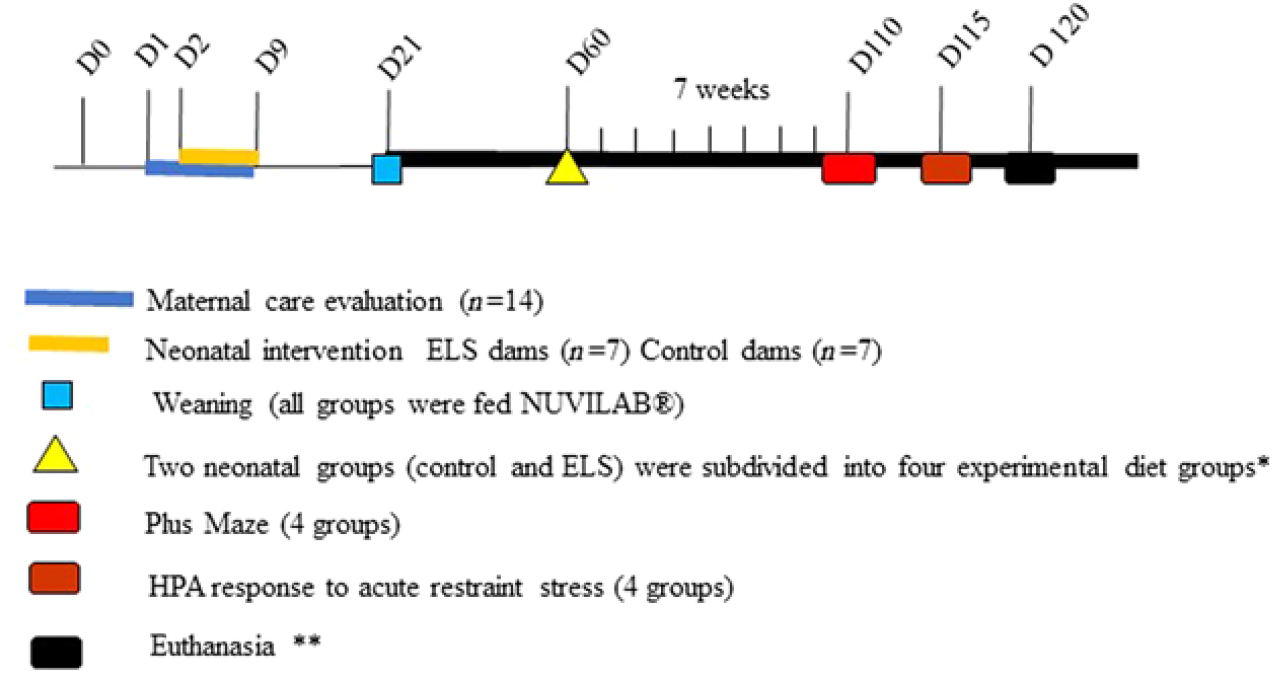
Leptin and corticosterone concentrations were quantified by the Enzyme Linked Immunosorbent Assay (ELISA), using reagents from the respective commercial Rat Leptin ELISA kits (Millipore® USA) and Rat Corticosterone ELISA kit (Corticosterone EIA Kit (Enzo Life Sciences® Int’l Inc., USA) following the manufacturers’ instructions. Biochemical analyzes were performed at the Unidade de Análises Moleculares e de Proteínas (UAMP) at Hospital de Clínicas de Porto Alegre (HCPA). See below the timeline for the experiments (Fig. 1).
Timeline. D = days of life; n = number of animals. After weaning we used male rats. *Control receiving Nuvilab® diet (historical cohort) or the option of “comfort-food” and continued with regular diet (from Prag Soluções, similar to Nuvilab®). *ELS received diets on the same scheme. Regular diet® contains the same characteristics of Nuvilab® diet and was offered to compensate the effects of food neophobia. **Biochemical analyzes and abdominal fat were investigated only on the groups exposed to the two options of diets. Biochemical analyzes control n = 6, ELS n = 10; abdominal fat: Control n = 8, ELS n = 10).

Abdominal fat weight
At approximately 120 days of life, animals from the two groups (control and ELS) that had the option of the two diets (“comfort-food” and regular diet) were weighed and decapitated, and the two major portions of abdominal fat (gonadal and retroperitoneal adipose tissue depots) were dissected and weighted using a scale with 0.01 g resolution (Marte, Canoas, Brazil). Results were expressed as % of body weight.
Statistical analysis
When comparing the four groups, Kruskal–Wallis test was used to analyze the plus maze test, and Generalized Estimating Equation (GEE) analysis was used for the hormonal response to acute stress (corticosterone). It is known that GEE is ideally suited for within-subject repeated measures that are likely to be correlated. When comparing two groups, one way ANOVA was used to: hippocampal glucocorticoid receptor protein (adjusted for LG), abdominal fat and maternal care (adjusting for litter size); and Mann-Whitney test were performed to analyze the variables SOCS-3, pSTAT3 and leptin. Significance levels for all measures were set at p<0.05.
Results
Maternal care
The dams of ELS group showed a lower LG score compared to the control group [F(1, 11) = 7.421, p = 0.020].
Plus maze
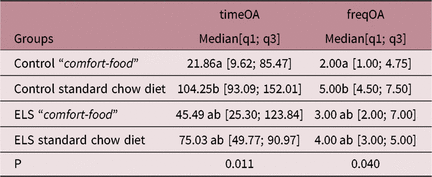
The Kruskal–Wallis demonstrated, analyzing time and frequency in the open arm, that the historical control group receiving a standard chow diet spend more time (H = 11.073; DF = 3; p = 0.011)/frequency at the open arm (H = 8.337; DF = 3; p = 0.040) compared to the control group that received “comfort-food”. In other words, the control group feeding with “comfort-food” behaved in accordance with an anxiety-like behavior. There were no other effects (Table 1).
Variables analyzed at plus maze apparatus, according the diets comparing the groups

Different letters represent statistically different distributions. Kruskal–Wallis test. timeOA = time (s) in open arms. freOA = frequency in open arms. Control “comfort-food” n = 8; Control standard chow diet n = 9, ELS “comfort-food” n = 9, ELS and ELS standard chow diet n = 19.
HPA response to acute restraint stress
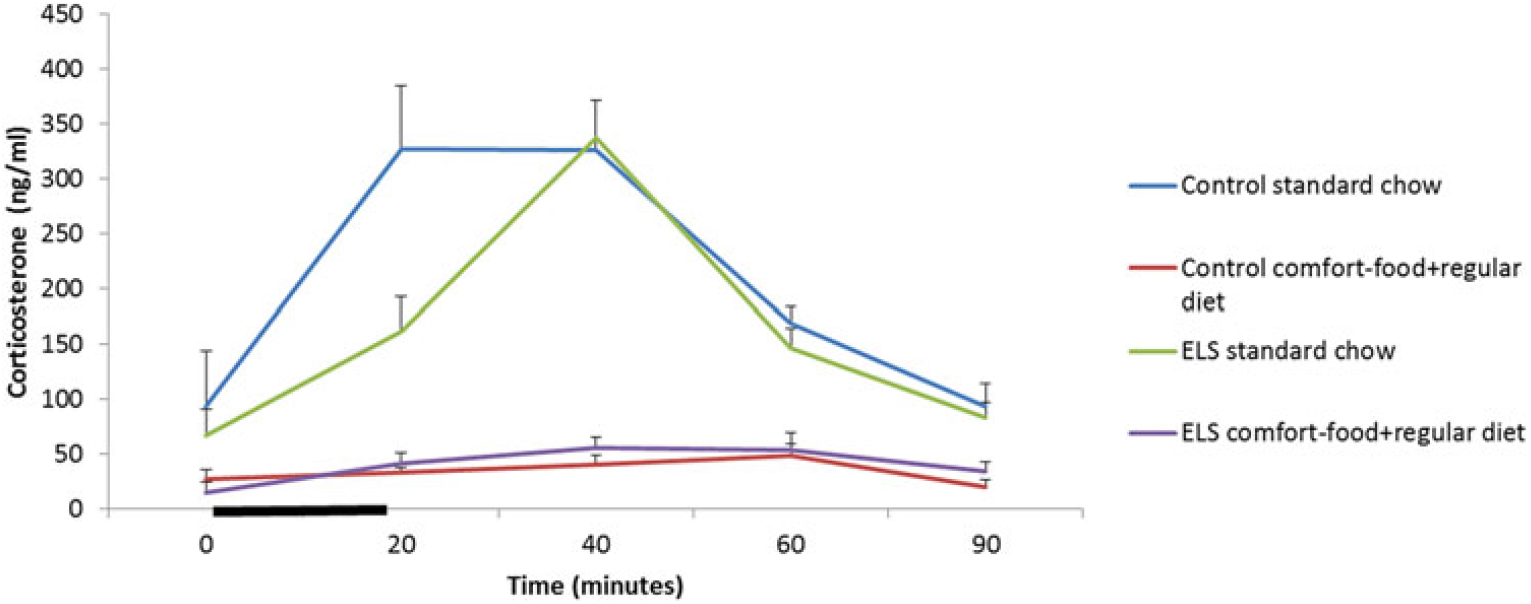
There is an interaction between diet and time (GEE, 86, 203: 4, p<0.0001], so over time the standard and palatable diet groups are different at all points, independently of the neonatal group. In other words, we see that there is no effect of the neonatal group, but rather of the diet in both neonatal groups. Rodents, regardless of the neonatal group who received a “comfort-food” diet had lower levels of corticosterone over time. There is no interaction between time, group and diet (GEE, 5, 430: 4, p = 0.246], (Fig. 2).
HPA response to acute stress. Analysis of corticosterone secretion in males exposed to different neonatal environments and adult diets (Control standard chow n = 8, Control comfort food+regular diet n = 7, ELS standard chow n = 10, ELS comfort food+regular diet n = 9). The dark line on the x-axis represents time of exposure to restraint stress (T0´ to T. 20´). Data are expressed as mean ± SEM. Groups exposed to the two options of diets demonstrated lower levels of corticosterone compared to the historical cohort that standard rat chow, p<0.0001.

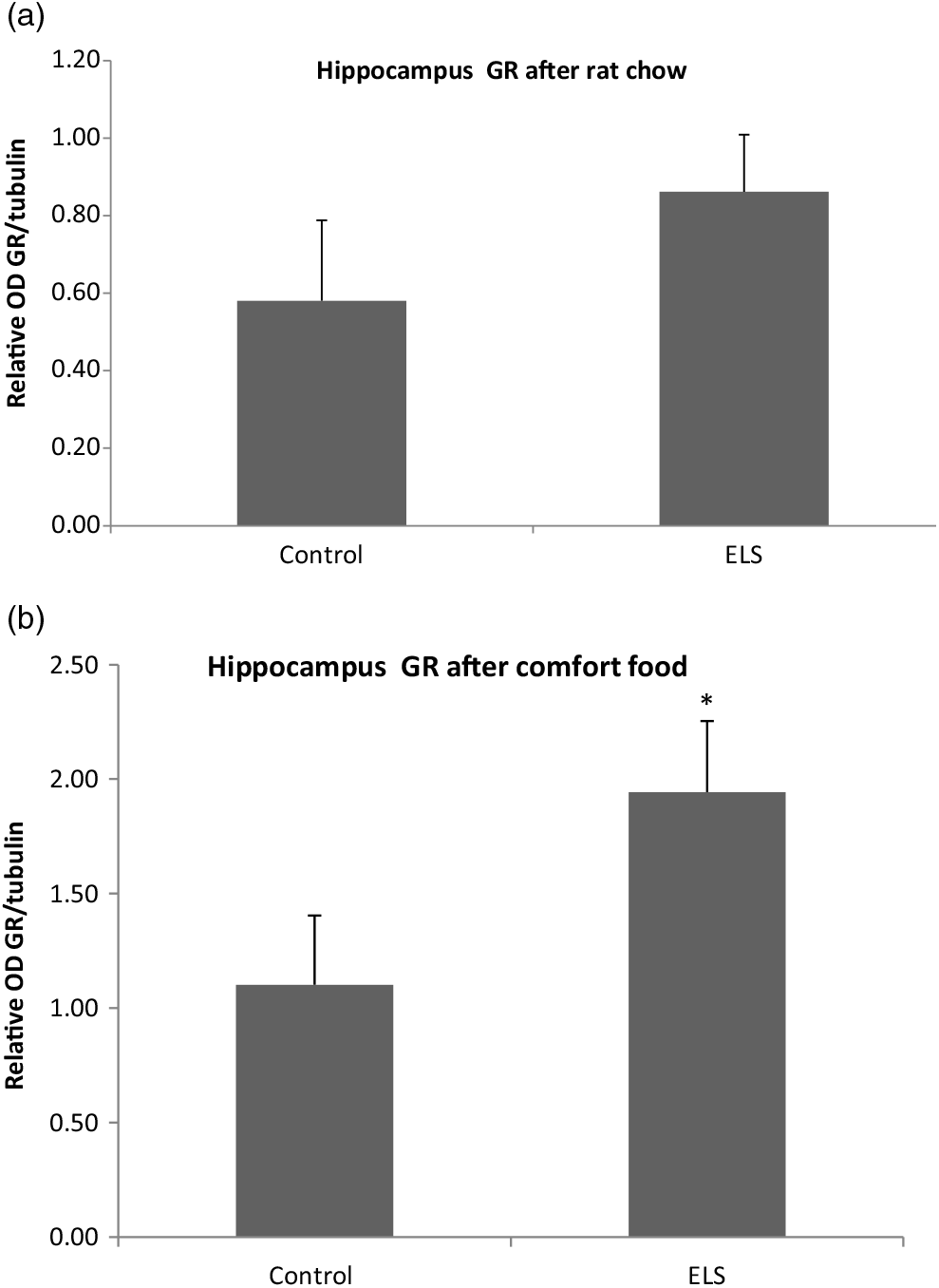
Quantification of Hippocampal GR. (A) Hippocampal GR after rat chow and (B) after comfort food. Hippocampal GR levels. Data are expressed as mean ± SEM. Two-way ANOVA demonstrated that neonatal groups exposed only to standard chow diet (historical cohort) did not have differences on hippocampal GR levels p = 0.410 (Control n = 7; ELS n = 7) (A). ELS is associated with increased hippocampal GR levels when fed with option of “comfort-food” p = 0.040 (Control n = 5; ELS n = 7) (B).

Neurochemical and biochemical analysis: Hippocampal GR, hypothalamic pSTAT-3 and SOCS-3
The neonatal groups exposed to standard chow diet only (NUVILAB®) did not demonstrate differences on hippocampal GR levels [F(1, 11) = 0.732, p = 0.410]. However, when fed with two options (“comfort-food” + regular diet) GR receptor levels were increased in the ELS group [F(1, 9) = 5.750, p = 0.040] (Fig. 3).
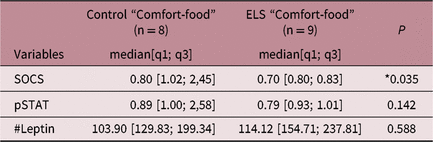
There were no differences in plasma leptin levels or on hypothalamic pSTAT3 levels. However, ELS animals had lower levels of SOCS-3 in the hypothalamus [U = 8; p = 0.035], see Table 2.
Biochemical analyzes: central measurements in the hypothalamus and plasma leptin

Mann–Whitney test. Values expressed in median and percentile (q1 = 25; q3 = 75). # (n = 6–10/group).
Abdominal fat weight
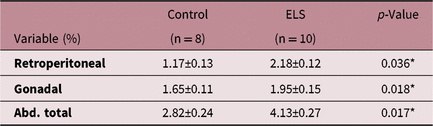
Analysis of abdominal fat as a percentage of body weight, using one-way ANOVA, using litter size as co-variable, showed statistical difference between groups. The effect of the neonatal group on both retroperitoneal fat [F (1, 15) = 5.306, p = 0.036] and gonadal fat [F (1,15) = 7.007 p = 0.018] was observed, and consequently total abdominal fat [F (1, 15) = 7.214, p = 0.017], with the percentage of abdominal fat being higher in the intervention group, as shown in Table 3.
Percentage of abdominal fat in males, according to neonatal group

One-way ANOVA adjusting for litter size number, date are expressed as mean ± SEM; * statistical differences (p< 0.005). Abd. total: abdominal total fat.
Discussion
We demonstrated that ELS dams showed a lower LG compared to the control group, and adult ELS pups showed higher percentage of abdominal fat, increased hippocampal GR levels, lower hypothalamic SOCS-3 without plasma leptin differences from the control animals. When exposed to chronic comfort food, rats (regardless of the neonatal group) had lower levels of corticosterone over time, although this type of diet had an anxiogenic effect only in control animals.
Our neonatal stress model induces a fragmented and dysfunctional maternal behavior, with dams manipulating the pups roughly. Reference Ivy, Brunson, Sandman and Baram15,Reference Baram, Davis and Obenaus17 We reproduced the finding of lower LG associated with trauma Reference Ivy, Brunson, Sandman and Baram15,Reference Dalle Molle, Portella and Goldani16 showing that the model is consistent.
The ELS group showed higher accumulation of visceral adipose tissue. Previously, following the same protocol of neonatal stress when using only females, we did not observe differences in the amount of abdominal fat after consumption of palatable diet for 4 weeks. Reference Machado, Dalle Molle and Laureano12 ELS leads to chronic hyperactivity of the HPA axis, which in turn can cause visceral adipose tissue accumulation Reference Bjorntorp22 promoting metabolic changes and mobilization of amino acids and peripheral fatty acids to be used in the synthesis of glucose by the liver. Reference Dallman, Pecoraro and Akana1 Animals submitted to a stress protocol of maternal separation and fed chronically with palatable diet have increased visceral adipose tissue. Reference Maniam and Morris10,Reference Buwalda, Blom, Koolhaas and van Dijk23 It is important to emphasize that ELS animals exposed to a standard lab diet do not have increased accumulation of abdominal fat. Reference Dalle Molle24 The concept that ELS affects metabolic outcomes is reviewed in. Reference Maniam, Antoniadis and Morris25
The literature is controversial about “comfort-food” consumption and the density of hippocampal GR. Our results corroborate with Morris 2016 that found a 45% increase in the content of GR in the hippocampus of rodents exposed to postnatal stress and after the chronic consumption of palatable diet (rich in fat and sucrose) compared to controls. Reference Maniam, Antoniadis, Le and Morris26 Despite that, a reduction in GR expression in the hippocampus has been documented in females receiving a 60% fat high-fat diet for 12 weeks. Reference Sivanathan, Thavartnam, Arif, Elegino and McGowan27 Another study demonstrates that GR expression in the hippocampus is unchanged after submission of rodents to different types of diets for 8 weeks. Reference Hryhorczuk, Decarie-Spain and Sharma28 A limitation of comparing the studies cited to ours is that they do not use stress protocols Reference Hryhorczuk, Decarie-Spain and Sharma28 and the fact that several studies use diets containing only fat without sucrose. Reference Hryhorczuk, Decarie-Spain and Sharma28–Reference Sasaki, de Vega, Sivanathan, St-Cyr and McGowan30 It is interesting to note that when adrenal-intact rats are given free access to 30% sucrose solution, large portions of their daily caloric intake derives from sucrose, which is associated with a blunted HPA axis responses. Reference Corona-Perez, Diaz-Munoz and Rodriguez31–Reference Strack, Akana, Horsley and Dallman34
We emphasize that the intervention group had lower levels of hypothalamic SOCS-3 compared to the control group, although there was no difference in plasma leptin levels. Children exposed to maltreatment have lower levels of leptin in relation to the body adipose tissue, indicating a deficiency of this hormone secretion. Reference Danese, Dove and Belsky8 There is evidence that obese individuals would have elevated blood levels of leptin, despite the lack of consensus. Reference Lubis, Widia, Soegondo and Setiawati9 One of the mechanisms of leptin resistance would be the disruption in the transduction process through the activation of transcription-activating kinase 2-activator 3 (JAK2-STAT3) at the leptin receptors by cytokine-3 signaling suppressor (SOCS-3), a protein that inhibits the signal transduction process of various cytokines, including leptin. Reference Lubis, Widia, Soegondo and Setiawati9 Such inhibition will consequently cause leptin resistance, characterized by a dysfunction of the biological function of this hormone. Reference Lubis, Widia, Soegondo and Setiawati9 The ELS rodents in our study were not obese, but had greater abdominal fat accumulation compared to controls, as well as lower levels of SOCS-3. It is possible that a process of resistance to leptin is being established in these animals, induced by the combination trauma/diet. It is known that diets rich in fats and sugars (high fat, high sugar) can lead to hyperleptinemia, causing leptin receptor desensitization and leptin resistance, Reference Matheny, Shapiro, Tumer and Scarpace35 corroborating to our findings.
Surprisingly, we observed that the neonatal historical control group when received “comfort food” chronically shows a shorter permanence / frequency in the open arm of the plus maze, compatible with an anxiety-like behavior induced by the diet. Our findings are in agreement to those from Reference Souza, Moreira and Siqueira36 and. Reference Sharma and Fulton37 On the other hand, other findings suggest that the consumption of palatable diet reduces anxiety-like behaviors in rodents independent of the neonatal group. Reference Maniam and Morris10,Reference Buwalda, Blom, Koolhaas and van Dijk23,Reference Maniam, Antoniadis, Le and Morris26,Reference Auvinen, Romijn and Biermasz38–Reference McNeilly, Stewart, Sutherland and Balfour40 A classic study demonstrates that even short-term exposure (7 days) to a high-fat diet decreases anxiety parameters in male adult rats evaluated in the high-labyrinth test. Reference Prasad and Prasad41 It is possible that more subtle aspects of the diet composition, such as the polyunsaturated fatty acids content, may be involved in these differences.
The groups exposed to two option of diets (comfort food + regular diet) exhibit lower levels of corticosterone in response to a stressful situation as compared to the group exposed only to standard chow diet. In response to stress, corticosterone is produced by the adrenal cortex Reference Herman and Cullinan42 and the process of negative feedback is activated to finalize the axis activity. Reference Halasz, Rittenhouse, Zorrilla and Redei43 Chronic “comfort-food” consumption could diminish corticosterone release induced by stress exposure in adulthood, Reference Dallman, Pecoraro and Akana1 as shown in our study. Surprisingly this mechanism seems to operate independently of the neonatal group. A limitation of our study is the use of a “historical cohort”, leading to a situation of limited interpretation at times.
Chronic “comfort-food” diet consumption is able to reduce corticosterone levels independently of the neonatal history of trauma experienced. Chronic exposure to this diet can induce anxiety in animals without previous history of trauma. Lower hypothalamic SOCS-3 with no difference in peripheral leptin levels, and the accumulation of abdominal fat in the ELS group suggests a possible leptin resistance which could induce the ELS animals to eat more “comfort-food” leading to a vicious cycle.
Financial Support
This work was supported by Brazilian National Council for Technological and Scientific Development (CNPq), Coordination for the Improvement of Higher Education Personnel. (CAPES), and Fundo de Incentivo à Pesquisa e Eventos do Hospital de Clínicas de Porto Alegre (FIPE/HCPA).
Conflict of Interest
The authors declare no conflict of interest.
Ethical Standards
The authors assert that all procedures contributing to this work comply with the ethical standards of the relevant national guides on the care and use of laboratory animals (Lei 11.794/2008; Diretrizes para o Cuidado e a Utilização de Animais para Fins Científicos e Didáticos (DBCA Resolução Normativa no 30, 2016, CONCEA) and has been approved by the institutional committee (Research Ethics Committee of Hospital de Clínicas de Porto Alegre (GPPG/HCPA, project number 13–0424).