Introduction
Fundamental question in biological control is how multiple predators interact collectively to suppress the populations of herbivorous pests (Denoth et al., Reference Denoth, Frid and Myers2002; Wilby & Thomas, Reference Wilby and Thomas2002; Symondson et al., Reference Symondson, Sunderland and Greenstone2002; Cardinale et al., Reference Cardinale, Harvey, Gross and Ives2003; Mills, Reference Mills, Brodeur and Boivin2006). Inter- and intraspecific competitions are important interactions among organisms which share the same food. Cannibalism and intraguild predation (IGP) have attracted much attention as these interactions are significant and widespread among many taxa of predatory arthropods. In biological communities, complex interactions and more specifically cannibalism and IGP are considered as key determinants of population dynamics and community structure (Polis & Holt, Reference Polis and Holt1992; Wagner & Wise, Reference Wagner and Wise1996; Holt & Polis, Reference Holt and Polis1997). Cannibalism and IGP determine the fate of a community (Godfray & Pacala, Reference Godfray and Pacala1992). IGP could be either symmetric when species are mutual predators of one another or asymmetric when one species consistently prey upon the other (Polis et al., Reference Polis, Myers and Holt1989). Thus, IGP may have a negative effect on the outcome of biological control (Snyder & Ives, Reference Snyder and Ives2001; Rosenheim, Reference Rosenheim2005). However, studies have shown that the incidence of IGP could have a positive effect on biocontrol of pests (Schausberger & Walzer, Reference Schausberger and Walzer2001; Snyder et al., Reference Snyder, Ballard, Yang, Clevenger, Miller, Ahn, Hatten and Berryman2004; Gardiner & Landis, Reference Gardiner and Landis2007). In pest management, usage of multiple predators remains contentious, as there are extensive data both for and against the suppression of pest populations (Denno & Finke, Reference Denno, Finke, Brodeur and Boivin2006). There are evidences showing that multiple natural enemies can exert a strong collective control on agricultural pests (Symondson et al., Reference Symondson, Sunderland and Greenstone2002; Cardinale et al., Reference Cardinale, Harvey, Gross and Ives2003). Yet, some studies confirmed that employing multiple agents to control pest herbivores disrupt biological control (Snyder & Ives, Reference Snyder and Ives2001; Prasad & Snyder, Reference Prasad and Snyder2004). The ability of a natural enemy complex to curtail a pest population is depending on the strength of interactions among themselves. There is a possibility that multiple predators may interact synergistically to enhance pest suppression (Losey & Denno, Reference Losey and Denno1999) or their effects on pest populations are simply additive when they do not interact at all (Chang, Reference Chang1996; Straub & Snyder, Reference Straub and Snyder2006). However, some species of predators may interact antagonistically wherein they consume each other, which affect pest control (Finke & Denno, Reference Finke and Denno2003; Prasad & Snyder, Reference Prasad and Snyder2004). A few are known about the basic components of these interactions, which are directly associated with cannibalism and IGP in ladybird beetles (Yasuda et al., Reference Yasuda, Kikuchi and Kindlmann2001). Thus, in a biological control perspective it becomes essential to critically assess the nature of interactions (i.e., antagonistic, synergistic or no interaction between predators), the frequency and strength of such interactions in the food web, how such interactions affect pest suppression, and how habitat and landscape structures might rage predator-predator interactions (Denno & Finke, Reference Denno, Finke, Brodeur and Boivin2006).
Several species of mealybugs (Hemiptera: Pseudococcidae) are serious pests on various crops e.g., coffee, citrus, cocoa, guava, grapes, papaya, cotton, mango, mulberry, vegetable crops, ornamental plants, etc. worldwide (Browning, Reference Browning1992; Franco et al., Reference Franco, Gross, Carvalho, Blumberg and Mendel2001; Dinesh & Venkatesha, Reference Dinesh and Venkatesha2011a , Reference Dinesh and Venkatesha b ). Mealybugs possess a protective wax body coating and have the ability of being protected inside bark crevices and other inaccessible parts of plants; hence satisfactory control measures have not been achieved with insecticides (Joyce et al., Reference Joyce, Hoddle, Bellows and Gonzalez2001). Thus, management of mealybugs by biological control provides a sustainable and efficient control approach (Bentley, Reference Bentley2002).
The apefly Spalgis epius (Westwood) (Lepidoptera: Lycaenidae) is a potential predator of different species of mealybugs (Dinesh & Venkatesha, Reference Dinesh and Venkatesha2011a , Reference Dinesh and Venkatesha b ). S. epius occurs in India, Burma, Sri Lanka, Philippines, Java, Bangladesh, Thailand and Krakatau Island (Indonesia) (see Dinesh & Venkatesha, Reference Dinesh and Venkatesha2011a ). Studies on the biology, development, mating and egg laying behaviour, feeding potential and mass rearing of S. epius have been conducted (Venkatesha et al., Reference Venkatesha, Shashikumar and Gayathri Devi2004, Reference Venkatesha2005; Venkatesha & Shashikumar, Reference Venkatesha, Shashikumar, Ignacimuthu and Jayaraj2006; Dinesh et al., Reference Dinesh, Venkatesha and Ramakrishna2010; Dinesh & Venkatesha, Reference Dinesh and Venkatesha2011a , Reference Dinesh and Venkatesha b , Reference Dinesh and Venkatesha2012, Reference Dinesh and Venkatesha2013a , Reference Dinesh and Venkatesha b ; Venkatesha & Dinesh, Reference Venkatesha and Dinesh2011). S. epius has four larval instars and completes its life cycle in 23.8 days at laboratory condition (Dinesh et al., Reference Dinesh, Venkatesha and Ramakrishna2010).
Another mealybug predator Cryptolaemus montrouzieri Mulsant (Coleoptera: Coccinellidae) is one of the most widely used natural enemies of mealybugs (Heidari & Copland, Reference Heidari and Copland1992; Perez-Jaggi, Reference Perez-Jaggi1995). Both adults and larvae of C. montrouzieri actively search for prey on vegetation and consume all stages of mealybugs (Clausen, Reference Clausen1978). C. montrouzieri has four larval instars and completes its life cycle in 28.4 days at laboratory condition (Mani & Thontadarya, Reference Mani and Thontadarya1987).
S. epius and C. montrouzieri found to coexist in agricultural fields sharing common prey resources (Mani, Reference Mani1995). Although both the predators are considered as potential predators of various species of mealybugs, no information is available about their interactions in the presence and absence of a prey species to utilize these predators together in the field as biocontrol agents against mealybugs. Hence, a study was carried out to explore the role of IGP, cannibalism and competition as possible mechanisms to understand a relationship between these two predators. Further, to assess whether the combination of these two major predators could result in a better biological control of mealybugs in the field, we tested their voracity on mealybugs.
Materials and methods
Laboratory rearing of S. epius and C. montrouzieri
To rear S. epius and C. montrouzieri in the laboratory, their host mealybug Planococcus citri (Risso) was cultured on pumpkins (Cucurbita maxima Duchesne) as described by Serrano & Lapointe (Reference Serrano and Lapointe2002). S. epius and C. montrouzieri were reared separately on the mealybug-infested pumpkins at 28±1 °C, 65±5% RH and photoperiod 12:12 L:D in an environment chamber following the methods of Chacko et al. (Reference Chacko, Krishnamoorthy Bhat, Anand Rao, Deepak Singh, Ramanarayan and Sreedharan1978) and Venkatesha & Dinesh (Reference Venkatesha and Dinesh2011). All experiments were conducted at 28±1 °C, 65±5% RH and photoperiod 12:12 L:D in an insect environment chamber.
Interaction and voracity of two predators
To study the interaction and prey consumption of S. epius and C. montrouzieri, plastic cups (5 cm diameter) with cut-opened bottom were fixed on the surface of a pumpkin using melted paraffin wax and this served as an arena for the experiment. Through the open end of the cup, 200 mealybug crawlers (first instar nymphs) were released on the pumpkin and the mouth of the cup was closed using muslin cloth. When nymphs reached the adult stage, the number of adult mealybugs present inside the cup was counted and the newly hatched first instar larva of S. epius and C. montrouzieri were released into the cup in three different combinations: (a) one larva each of S. epius and C. montrouzieri, (b) two larvae of C. montrouzieri, and (c) two larvae of S. epius. Observations were made on inter- and intraspecific larval interactions, their feeding behaviour and the number of prey consumed in the three combinations. Observations were made daily 5–6 times for about 2 h at an interval of 3–4 h until all the larvae pupated. Each experiment was replicated five times with ten trials per replication.
Interspecific interaction in the absence of prey
All the four larval instars of S. epius and C. montrouzieri were collected from mealybug-infested pumpkins and kept individually in Petri dishes (5 cm diameter). These larvae were starved for 12 h to induce hunger. Larvae of identical age and size were used based on the day of their ecdysis. In the first set of experiment, to investigate interactions between the similar instar larvae of S. epius and C. montrouzieri, a single first instar larva of both S. epius and C. montrouzieri were transferred to a clean Petri dish (5 cm diameter) at opposite poles with the help of a single-bristle paintbrush. The mode of interaction between the two larvae was recorded after 24 h. Similarly, experiments were conducted for the second, third and fourth instar larvae of the two predators. Each combination was replicated 50 times.
In the second set of experiment, IGP studies were conducted in two different combinations: (a) younger instar larva of S. epius vs. one instar older larva of C. montrouzieri (i.e., I instar S. epius larva vs. II instar C. montrouzieri larva, II instar S. epius larva vs. III instar C. montrouzieri larva, and III instar S. epius larva vs. IV instar C. montrouzieri larva) and (b) younger instar larva of C. montrouzieri vs. one instar older larva of S. epius (i.e., I instar C. montrouzieri larva vs. II instar S. epius larva, II instar C. montrouzieri larva vs. III instar S. epius larva, and III instar C. montrouzieri larva vs. IV instar S. epius larva). Based on the day of larval ecdysis, larval instars were determined and utilized in the experiment. In all combinations one larva of each predator was used. Each experiment was replicated 50 times. Larvae were transferred to a Petri dish at opposite poles and the modes of interactions were recorded after 24 h.
Intraspecific interaction in the absence of prey
In the first set of experiment, intraspecific interactions were studied both in S. epius and C. montrouzieri. Two first instar S. epius larvae of identical age and size were transferred to a Petri dish at opposite poles, and the type of interaction between them was noted after 24 h. Similarly, experiments were conducted for the second, third and fourth instar larvae of S. epius and C. montrouzieri separately. Each larval combination was replicated five times with ten trials per replication.
In the second set of experiment, intraspecific interaction studies were conducted in two different combinations: (a) younger instar larva of S. epius vs. one instar older larva of S. epius (i.e., I instar larva vs. II instar larva, II instar larva vs. III instar larva, and III instar larva vs. IV instar larva) and (b) younger instar larva of C. montrouzieri vs. one instar older larva of C. montrouzieri (i.e., I instar larva vs. II instar larva, II instar larva vs. III instar larva, and III instar larva vs. IV instar larva). In all combinations a newly moulted single larva from each instar of the predators was used. Larvae were transferred to a Petri dish at opposite poles and the modes of interactions were recorded after 24 h. Each experiment was replicated five times with ten trials per replication. The percentage of cannibalism was calculated in each combination for both the predators.
Egg, prepupa and pupal predation/cannibalism
Egg, prepupa and pupal predation/cannibalism studies were conducted in five different combinations: (a) ten eggs of S. epius vs. one I/II/III/IV instar larva of S. epius, (b) ten eggs of C. montrouzieri vs. one I/II/III/IV instar larva of C. montrouzieri, (c) ten eggs of S. epius vs. one I/II/III/IV instar larva of C. montrouzieri, (d) ten eggs of C. montrouzieri vs. one I/II/III/IV instar larva of S. epius, and (e) ten eggs, one larva each from four larval instars, one prepupa and one pupa of S. epius independently vs. one adult of C. montrouzieri. As S. epius adults are non-predacious and feed on nectar/water, they were not utilized in the experiment like C. montrouzieri adults. Thus, there were eight intraspecific and 15 interspecific combinations. Each experiment was replicated five times with ten trials per replication.
Data analysis
The outcome of interspecific interactions was classified as: S. epius acted as an intraguild (IG) prey, S. epius acted as an IG predator or no incidence of IGP occurred. For each species-pair comparison, the level of IGP between S. epius larvae and C. montrouzieri larvae was determined as the proportion of replicates in which IGP occurred out of the total number of replicates for that combination. Following the method of Lucas et al. (Reference Lucas, Coderre and Brodeur1998) an index of symmetry was measured by the proportion of replicates in which S. epius was the IG predator out of the total number of replicates wherein IGP occurred. Thus, a symmetry index of >0.5 IGP was in favour of S. epius, while an index of <0.5 IGP was in favour of C. montrouzieri. The symmetry indices for each combination were compared with the theoretical index of 50% corresponding to a symmetrical interaction, using a Chi-square test (χ2, P<0.05) (SPSS Inc. 2008). The symmetry of IGP between S. epius and C. montrouzieri at different larval instar was analysed by using the binomial test, the null hypothesis being that predation is equally likely to occur in both the ways. The strength of IGP between the two species of predators for a given combination was assessed using the χ 2 test with an expected value of 50% and was considered (i) symmetrical, when the χ 2 value was not significant, wherein the rate of predation of the two predators was similar, (ii) asymmetrical, when the χ 2 value was significant, in which the rate of predation of the two predators was different, and (iii) not significantly asymmetrical, when the χ 2 value was not significant, wherein the rate of predation of the two species not much differed.
The voracity of larvae in different combinations was subjected to analysis of variance (ANOVA). When ANOVA was significant at the P<0.05 level, differences were determined by post hoc Tukey's HSD (Honestly Significant Difference) multiple range test at probability level P<0.05 as significant (SPSS Inc. 2008). The percentage of cannibalism in each experimental combination and overall predation (i.e., pooled data of the percentage of predation/cannibalism) in both species were arcsin transformed and subjected to non-parametric analysis of variance using Kruskal–Wallis test. A non-parametric approach was used because of heteroscedasticity and departures from normality (Zar, Reference Zar1984). When significant difference was found in Kruskal–Wallis test at the P<0.05 level, multiple pairwise Mann–Whitney U test was used to know the differences in the cannibalism in different larval instars of each predator and overall predation and cannibalism in both the predators. Alpha values were adjusted according to the Bonferroni correction for multiple comparisons (referred to in text as αB).
Results
Interaction and voracity of two predators
In the presence of prey, no cannibalism and predation were observed both in S. epius and C. montrouzieri larvae. When C. montrouzieri and S. epius larvae were maintained together, they fed on prey at different places in the arena. S. epius larva was found feeding continuously throughout its development, whereas C. montrouzieri larva was feeding and resting at times. A pair of S. epius larvae consumed more number of mealybugs compared to one larva of S. epius/C. montrouzieri or two larvae of C. montrouzieri (F 2, 12=545.14; P<0.05) (fig. 1).
Mean (±SE) voracity of Spalgis epius (Se) and Cryptolaemus montrouzieri (Cm) larvae. Bars with different letters indicate the significant difference in the number of prey consumed (ANOVA; Tukey HSD test P<0.05). Vertical lines indicate the SE of the mean number of prey consumed.

Interspecific interaction in the absence of prey
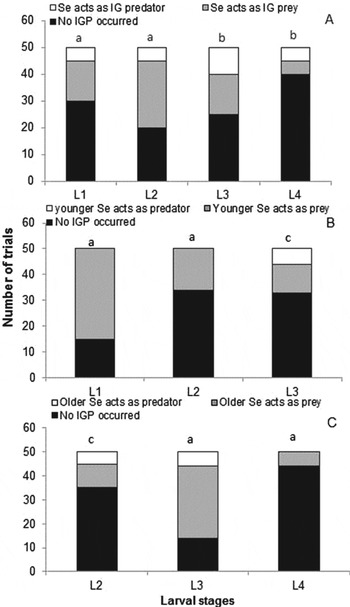
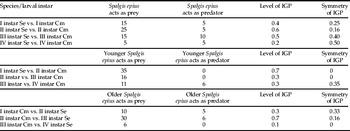
The level and symmetry index of IGP between S. epius and C. montrouzieri from first to fourth instar larvae is presented in table 1. In interactions between the similar larval instars of two predators, IGP was significantly asymmetrical and in favour of C. montrouzieri in the first (χ 2 1=5; P<0.05) and second instar larvae (χ 2 1=13.3; P<0.05) (fig. 2A). Whereas, IGP was symmetrical in the third (χ 2 1=1; P=0.317) and fourth (χ 2 1=0; P=1) larval instar combinations of the two predators (fig. 2A).
Symmetry of IGP between Spalgis epius and Cryptolaemus montrouzieri. (A) IGP between similar instar larvae, (B) IGP between younger S. epius and older C. montrouzieri larvae and (C) IGP between older S. epius younger C. montrouzieri larvae. Analysis shows that larval instars marked a, IGP was asymmetric; larval instars marked b, IGP was symmetric; and larval instars marked c, IGP was not significantly asymmetric.

Interspecific interaction between Spalgis epius and Cryptolaemus montrouzieri.

Se- Spalgis epius. Cm- Cryptolaemus montrouzieri. N=50 for each pairing.
In interactions between younger S. epius and older C. montrouzieri larval instars, IGP was significantly asymmetrical and exclusively in favour of older C. montrouzieri against the first (χ 2 1=35; P<0.05) and second (χ 2 1=16; P<0.05) instar larvae of S. epius. IGP was not significantly asymmetrical between the third instar larva of S. epius and the fourth instar larva of C. montrouzieri (χ 2 1=1.47; P=0.225) (fig. 2B).
In interactions between older S. epius and younger C. montrouzieri larval instars, IGP was not significantly asymmetrical between the second instar larva of S. epius and the first instar larva of C. montrouzieri (χ 2 1=1.6; P=0.196). Whereas, IGP was significantly asymmetrical and in favour of younger C. montrouzieri against the third (χ 2 1=16; P<0.05) and fourth (χ 2 1=6; P<0.05) instar larvae of S. epius (fig. 2C).
Intraspecific interaction in the absence of prey
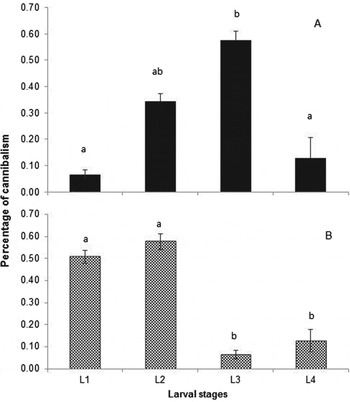
In intraspecific interactions between the same larval instars of S. epius, cannibalism was significantly different among four larval instars (H 3=14.35; P<0.05). Cannibalism was maximum in the third instar larva compared to other larval instars, and it was significantly different from the first (αB 6 tests; P=0.008) (U=0.00; P=0.006) and fourth (U=0.00; P=0.007) instar larvae (fig. 3A). Similarly, in C. montrouzieri there were significant differences in cannibalism among different larval instars (H 3=15.84; P<0.05). Cannibalism was greater in the first and second instar larvae than in the third and fourth instar larvae (P<0.008) (fig. 3B).
Mean (±SE) percentage of cannibalism in the same larval instars of Spalgis epius (Se) and Cryptolaemus montrouzieri (Cm) in the absence of prey. (A) Se cannibalized by Se, (B) Cm cannibalized by Cm. Bars with different letters indicate the significant difference in the percentage of cannibalism (Mann–Whitney U test αB P<0.008). Vertical lines indicate the SE of the mean number of percentage of cannibalism.

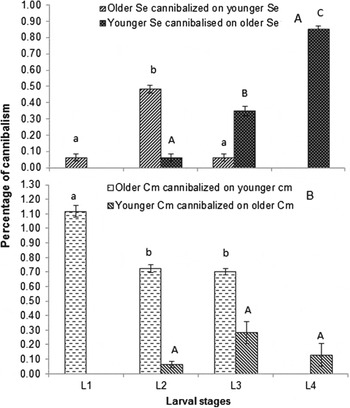
In conspecific interactions between young and one instar older larva of S. epius, cannibalism was significantly different in different larval instars of S. epius (i.e., older larval instars cannibalized on younger larval instars: H 2=11.29; P<0.05 and younger larval instars cannibalized on older larval instars: H 2=11.35; P<0.05). The third instar larva of S. epius was significantly more cannibalistic both on second (αB 3 tests; P=0.016) (U=0.00; P=0.005) and fourth instar larvae (U=0.00; P=0.006) than other larval instars (fig. 4A). Whereas, the second instar larva of C. montrouzieri was significantly more cannibalistic on first instar larva than other larval instars (H 2 =10.72; P<0.05) (αB 3 tests; P=0.016) (U=0.00; P=0.007) (fig. 4B). Cannibalism by younger larva on older C. montrouzieri larva was minimum and there were no significant differences among different larval instars (H 2=4.04; P=0.132) (fig. 4B).
Mean (±SE) percentage of cannibalism in different larval instars of Spalgis epius (Se) and Cryptolaemus montrouzieri (Cm) in the absence of prey. (A) older and younger Se cannibalized on younger and older Se, (B) older and younger Cm cannibalized on younger and older Cm. Bars with different letters indicate the significant difference in the percentage of cannibalsm (Mann–Whitney U test αB P<0.016). Vertical lines indicate the SE of the mean number of percentage of predation.

Overall predation/cannibalism
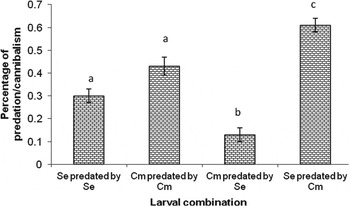
Overall predation between S. epius larva and C. montrouzieri larva was significantly different (H 3=64.47; P<0.05). Overall predation of S. epius larva by C. montrouzieri larva was significantly more than that of C. montrouzieri by S. epius (αB 6 tests; P=0.008) (U=147.0; P<0.0001) (fig. 5). Overall cannibalism was more in C. montrouzieri larva than that in S. epius larva and it was not significantly different (U=987.0; P=0.062) (fig. 5).
Mean (±SE) percentage of cannibalism and predation in Spalgis epius (Se) and Cryptolaemus montrouzieri (Cm) in the absence of prey. Bars with different letters indicate the significant difference in percentage of predation/cannibalism (Mann–Whitney U test αB P<0.008). Vertical lines indicate the SE of the mean number of percentage of predation.

Egg, prepupa and pupal predation/cannibalism
Conspecific and interspecific egg predations were absent both in S. epius and C. montrouzieri larvae in the absence and presence of prey. C. montrouzieri adults predated on all larval instars, prepupa, and fresh pupa of S. epius in the absence of prey. Except the first instar larva of S. epius and C. montrouzieri, all larval instars of both the predators attacked the prepupa and fresh pupa of S. epius in the absence of prey. In C. montrouzieri no larval instars attacked conspecific pupa.
Discussion
The results of our study indicated that no cannibalism and predation exist both in S. epius and C. montrouzieri in the presence of prey. S. epius is known to deposit a maximum number of eggs on the mealybug-infested pumpkins containing conspecific eggs (Dinesh & Venkatesha, Reference Dinesh and Venkatesha2013b ), which may be because of the absence of egg/larval cannibalism. Maximum prey consumption in combination of two S. epius larvae may be due to their voracious and continuous feeding habit. Thus, S. epius could be a potential predator of mealybugs as reported by Dinesh and Venkatesha (Reference Dinesh and Venkatesha2011a , Reference Dinesh and Venkatesha b ). When S. epius larvae voraciously fed on the main mass of mealybugs, C. montrouzieri larvae cleared leftover eggs, nymphs, and half-eaten adults of mealybugs from the margin. The coexisting feeding behaviour of these two predators could be additive in the suppression of pest populations. Larvae of both S. epius and C. montrouzieri known to coexist in agricultural fields sharing common prey resources and successfully reducing prey populations (Mani, Reference Mani1995).
IGP and cannibalism are two important mortality factors in predators and these could be a regulatory mechanism of population growth operating through a negative density-dependent feedback. IGP is generally considered as an important mechanism underlying the success of biological control (Grez et al., Reference Grez, Viera and Soares2012). Asymmetrical IGP in favour of C. montrouzieri larvae in the absence of prey could be due to the sluggish nature of S. epius larvae, which are more prone to interspecific attack. Larvae of S. epius mimic a mealybug colony by placing the mealybug debris on their back (Dinesh et al., Reference Dinesh, Venkatesha and Ramakrishna2010) and thus escape from the attack of mealybug attendant ants (Venkatesha et al., Reference Venkatesha, Shashikumar and Gayathri Devi2004). However, in the absence of mealybugs, exposed larvae of S. epius may be prone to interspecific attack by C. montrouzieri larvae. Similarly, the coccinellid aphid predator Harmonia axyridis (Pallas) feeds on lepidopterous larvae in the absence of its prey (Kim et al., Reference Kim, Noh and Kim1968; Shu & Yu, Reference Shu and Yu1985; Hoogendoorn & Heimpel, Reference Hoogendoorn and Heimpel2003; Koch et al., Reference Koch, Hutchison, Venette and Heimpel2003). In the absence of prey, predation between C. montrouzieri and S. epius is similar to that reported among predatory coccinellids under scarce prey density (Hironori & Katsuhiro, Reference Hironori and Katsuhiro1997; Schellhorn & Andow, Reference Schellhorn and Andow1999; Musser & Shelton, Reference Musser and Shelton2003).
Maximum cannibalism by the third instar larva of S. epius could be due to their voracious feeding habit, which consumes a large quantity of prey compared to other larval stages (Dinesh & Venkatesha, Reference Dinesh and Venkatesha2011a , Reference Dinesh and Venkatesha b ). Among younger and older conspecific larval interactions, the third instar larva of S. epius was more cannibalistic as it attacked both the smaller second instar and the sluggish fourth instar larva. Conspecific predation in Lepidoptera with a moderate food supply or no food is common and the smallest, less healthy or less active larvae are usually attacked by more robust individuals (Dethier, Reference Dethier1937).
All larval instars of C. montrouzieri potentially predated on all larval instars of S. epius in the absence of prey. The relative aggressive behaviour of hungry larvae of C. montrouzieri towards S. epius may be because of their active movement compared to S. epius larvae. A greater cannibalistic nature of older larval instars of C. montrouzieri on first instar larva may be due to their differences in their body size. Moreover, the incidence of conspecific and heterospecific predation is greater when an attacker is one instar older and thus, bigger in size than its victim (Omkar et al., Reference Omkar, Gupta and Pervez2005). As well, in most of ladybird species older larvae move faster than young larvae (Ng, Reference Ng, Niemczyk and Dixon1988), thus fast moving older larval instars of C. montrouzieri easily attack and consume younger larval instars. Moreover, the bioconversion efficiency of older larval instars in predatory coccinellids is less than that of younger larvae, which suggests that older larvae feed more and convert less prey biomass into predator biomass because of high metabolic cost (Baumgartner et al., Reference Baumgartner, Bieri and Delucchi1987). Hence, requirement of more food intake in older larval instars of C. montrouzieri may drive them to increasingly indulge in cannibalism as well as IGP.
Absence of interspecific predation of eggs of C. montrouzieri by S. epius may be because coccinellid eggs are protected from defensive alkaloids such as pyrazines and quinolones (Agarwala & Yasuda, Reference Agarwala and Yasuda2001). Hence, eggs of coccinellids are less attacked by predator species compared to eggs of pest species even in the same habitat (Cottrell & Yeargan, Reference Cottrell and Yeargan1998). In contrast, some species of coccinellids feed on eggs of other coccinellids (Cottrell, Reference Cottrell2005). However, in C. montrouzieri conspecific and interspecific egg predation is absent. Predation by adults of C. montrouzieri on all larval stages, prepupa, and pupa of S. epius may be due to the sluggish nature of S. epius larvae; and prepupa and newly formed pupa are more prone to attack as they clear prey debris present on their back during the formation of prepupa.
All in all our study provides an insight into the possible complex inter- and intraspecific predatory phenomena occurring in S. epius and C. montrouzieri in the field. In the presence of prey, the absence of cannibalism and IGP in these two species suggests that they can be employed together in biological control when a prey population is abundant. C. montrouzieri larvae may serve as an additive along with voracious S. epius larvae in the control of mealybugs. Both S. epius and C. montrouzieri can maintain a stable coexistence in abundant prey populations and at the time of prey scarcity and at patchy prey habitats they may possess asymmetric IGP. Thus, C. montrouzieri may dominate the guild and becomes a threat to larvae of S. epius under the situation of total absence of prey. This first information is helpful to use these two predator species in the biological control of mealybugs.