Weed Management: Past, Present, and Future
Growers use multiple tools (e.g., mechanical, chemical, cultural, biological) to control weeds in cropping systems. Herbicides and cultivation have proven to be very effective at controlling weeds, yet environmental and human health concerns have led farmers and regulators to search for ways to reduce their use (Slaughter et al. Reference Slaughter, Giles and Downey2008). Most weed control applications are based on the assumption of uniform weed distribution. However, weeds exhibit patchy growth in crop fields, leading to unnecessary applications to bare soil, plant residue, or a crop (Nordmeyer Reference Nordmeyer2006). Precision weed control reduces broadcast post-emergence applications and often involves the use of advanced technology to identify and then apply a tool (e.g., herbicide) directly onto an individual weed or small cluster for removal (Gerhards and Christensen Reference Gerhards and Christensen2003; Vrindts and Ramon Reference Vrindts and Ramon2002). Although precision weed control can significantly reduce herbicide inputs by placing more on the weed or patch and less on the surrounding area, this approach offers little advancement toward integrated weed management (IWM). True IWM incorporates multiple weed control tools along with decision support and high-speed, quickly actuating and articulating machinery capable of making micro-applications to individual weeds in a total systems approach (Young et al. Reference Young, Pitla, Van Evert, Schueller and Pierce2017). Currently, no company sells equipment that can perform true IWM, although a few are making progress (e.g., Blue River Technology, Inc., Sunnyvale, CA).
Over the past several decades, research has proceeded rapidly in precision weed control that incorporates robotics, sensors, and advanced computer systems (Bogue Reference Bogue2016; Christensen et al. Reference Christensen, Sogaard, Kudsk, Norremark, Lund, Nadimi and Jorgensen2009). Worldwide, research on precision weed control has been conducted mainly on high-value crops, such as cotton (Gossypium hirsutum L.) (Lamm et al. Reference Lamm, Slaughter and Giles2002), broccoli (Brassica oleracea L.) and lettuce (Lactuca sativa L.) (Fennimore et al. Reference Fennimore, Tourte, Rachuy and George2010), carrots [Daucus carota subsp. sativus (Hoffm.) Arcang.] (Dammer Reference Dammer2016), sugar beet (Beta vulgaris subsp. vulgaris) (Nieuwenhuizen et al. Reference Nieuwenhuizen, Tang, Hofstee, Müller and van Henten2007), and onions (Allium cepa L.) and cabbage (Brassica oleracea var. capitata L.) (Melander et al. Reference Melander, Lattanzi and Pannacci2015) as well as pastures (Van Evert et al. Reference Van Evert, Polder, Van der Heijden, Kempenaar and Lotz2009). The basic approach has been to test a single tactic, either herbicide or cultivation, applied through a re-engineered implement or robotic platform equipped with vision sensors to locate the crop and fast-acting actuators to quickly spray or disturb the weed or weeds (Fennimore et al. Reference Fennimore, Tourte, Rachuy and George2010; Zhang et al. Reference Zhang, Staab, Slaughter, Giles and Downey2012). Slaughter et al. (Reference Slaughter, Giles and Downey2008), Fennimore et al. (Reference Fennimore, Slaughter, Siemens, Leon and Saber2016), and others (e.g., Singh et al. Reference Singh, Agrawal and Bora2011) provide extensive reviews that focus on many different aspects of precision weed control, such as weed and crop detection, weed control actuators, and cropping systems adaptation. Still, very little discussion focuses on IWM. In essence, precision weed control consists of scaling down what is practiced with large broadcast equipment into a smaller version. In this type of precision weed control, integration of tactics is still spatially and temporally discreet, similar to traditional IWM (Young et al. Reference Young, Pitla, Van Evert, Schueller and Pierce2017) and dissimilar to true IWM (Young Reference Young2012).
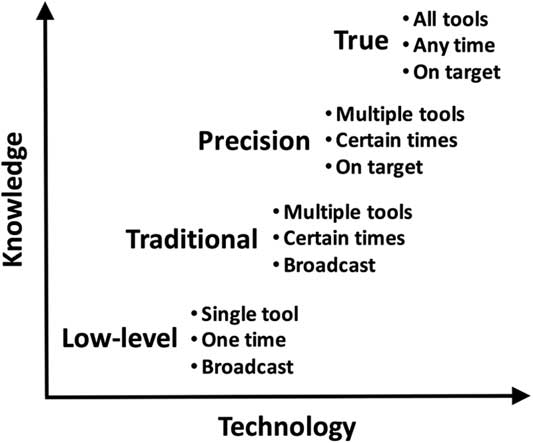
True IWM requires high levels of plant ecological and biological knowledge and the corresponding technological machinery and algorithm-based decision-making controls that can respond to changes in weeds and the environment (Figure 1). Young et al. (Reference Young, Pitla, Van Evert, Schueller and Pierce2017) categorized true IWM based on the degree of application specificity and level of integration of tactics or tools. From low-level IWM with low application specificity (e.g., broadcast) and integration (e.g., single tools) to traditional IWM (low application specificity, low integration) to precision IWM (high application specificity, low integration) to true IWM (high application specificity, high integration), the amount and depth of knowledge required increases with increasing specificity and integration. In addition, the incorporation of technology is largely scale dependent, as smaller farms can have high specificity and integration without the use of robotics and advanced technology (e.g., hand hoeing), whereas larger farms can maximize computerized technology.
Integrated weed management (IWM) continuum from low, traditional, precision, to true IWM. The corresponding requirement for increasing the level of advanced technology (x-axis) and user knowledge (y-axis).

Field-scale examples of true IWM are non-existent because the technology is not ready (Emmi et al. Reference Emmi, Gonzalez-de-Soto, Pajares and Gonzalez-de-Santos2014), nor is it incorporated in most university or grower weed control programs (Owen et al. Reference Owen, Beckie, Leeson, Norsworthy and Steckel2015). Optimal weed control occurs when a particular method or a set of methods is precisely matched with plant type and growth stage in a range of environmental conditions. Such ideal control can be difficult to achieve with automated systems, as the incorporation of many electronic components for performing various functions impairs reliability and increases the cost (Emmi et al. Reference Emmi, Gonzalez-de-Soto, Pajares and Gonzalez-de-Santos2014). Research-grade robotic fleets that perform specialized tasks and operate together via either ground-based or aerial (e.g., unmanned aerial vehicles or UAVs) control systems can reduce the impediments associated with carrying excessive hardware and software on a single platform while maximizing ease of integration (Young et al. Reference Young, Meyer and Woldt2014). In addition to the need for readily available technology, research and extension weed science programs must undergo a paradigm shift that includes the concepts of true IWM. Beckie and Harker (Reference Beckie and Harker2017) and Norsworthy et al. (Reference Norsworthy, Ward, Shaw, Llewellyn, Nichols, Webster, Bradley, Frisvold, Powles, Burgos, Witt and Barrett2012) list their top choices or best management practices for controlling herbicide-resistant weeds; yet neither mentions computer-based sensors and automation technology as major advances to help in implementing the fundamental principles for sustainably managing weeds in cropping systems.
In the near future, the practice of true IWM will most likely come from a combination of university research and company investment where outside-the-box thinking is routine. In 2016, 128 robotics-related startups received funding from investment groups for a total of $1.95 billion (Tobe Reference Tobe2017). Increasingly, agriculture is a focus of these startups, which are gaining the interest and attention of large companies seeking innovative ideas. Monsanto, which reinvests $1.5 billion annually into research and development, reviewed over 300 venture capital opportunities and made investments in more than 20 startups, which included robotic technologies for weed control (Hamer Reference Hamer2016). Many universities now have centers for venture development leading to startup companies and incubators that bring together academic and company researchers to accelerate innovations for solving problems and creating new ideas (Etzkowitz et al. Reference Etzkowitz, Webster, Gebhardt and Terra2000).
The Model Company
True integrated management of weeds requires improved application specificity and tactic integration that incorporates technology allowing for greater flexibility of inputs and enhanced responsiveness to field conditions. However, growers are not willing to invest in clever and expensive, unproven gadgetry that fails or falls apart soon after installation (Alsever Reference Alsever2016). What characteristics must a startup company have to be capable of providing a true IWM approach for growers? To be successful in this field, a company must prioritize connecting with growers and then selling the idea of the technology––not necessarily the technology itself. Chesbrough (Reference Chesbrough2003) describes open innovation as a new era of abundant knowledge, in which companies no longer lock up their intellectual property but instead find ways to profit from others’ use of their technology that ultimately leads to value for them. The merging of ideas associated with traditional and new approaches to IWM is the epitome of open innovation, which some in the private and public sectors are now beginning to discover.
In addition to connecting with growers, a startup company that manufactures units that perform true IWM must have investors who are diversified and strongly committed to the company’s mission. The technology must perform reliably and accurately while displaying obvious advantages over existing equipment or approaches––speed and precision being the primary functions. Over the course of 1 to 5 years, several iterations of a weeding robot could be developed with the ultimate goal of identifying and precisely targeting a suite of control tactics to individual weeds in real time as the platform moves autonomously through the field. During that same period, the crop or crops would need to be grown often enough in both controlled and uncontrolled conditions for thorough testing.
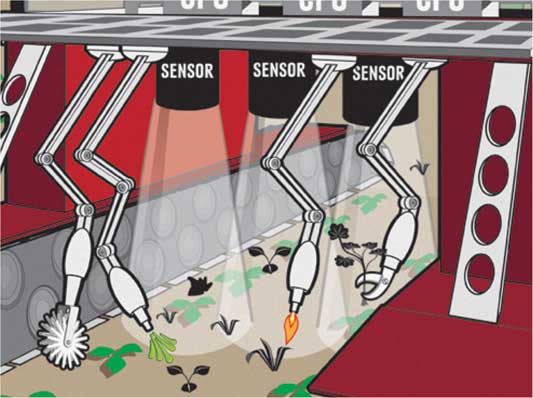
The actual technology that could be patented would perform a “three-step automated weeding process” for (1) identifying individual weeds, (2) determining the most effective micro-based tactic, and (3) making the application with advanced robotics that specialize in actuating and articulating capabilities (Figure 2). Whether the units are sold directly or provided as a service, the company would fully support the grower to ensure through education that the technology is being used for maximum efficiency, thus increasing customer satisfaction. In addition, the patented technology could be developed by the same company or others for application to other pests or systems.
Diagram of articulating tools and sensor technologies on a field-based robotic platform for integrated weed control.

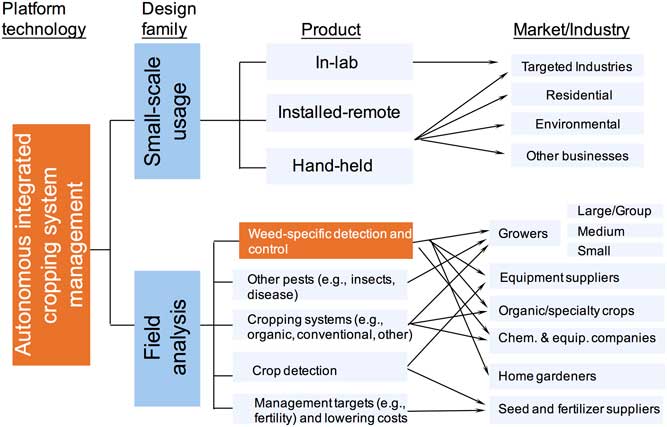
Weed-specific control and detection could be one of several products supplied by a company that develops platforms for autonomous integrated cropping system management (Figure 3). The basic platform design could have applications for small-scale use, such as laboratory, hand-held, or remote installations, or field analyses, which in addition to weeds, could include other pests or parameters (e.g., nutrient) and whole cropping systems. Numerous markets exist for each design and may include individual growers, input suppliers, environmental businesses, and home gardeners. However, startup companies face significant challenges; 90% fail to advance a product to market, with the primary reason being a lack of perceived need (Patel Reference Patel2015). The intent of this paper is not to cover every aspect of a startup company’s evolution, but instead to provide an idea and general guidelines for what features a potential company might offer.
Map of potential applications and end points for a commercially available robotic integrated weeding unit.

The value in the technology from a startup company developing true IWM approaches is being able to hit the target for sustainable crop production. Growers would value the precision that allows for greater flexibility of inputs and enhanced responsiveness to field conditions. A regulator would value the precision for the reduced environmental impacts from chemical inputs or soil disturbance. A consumer would value the precision for the absence of chemical residues on the produce they buy or the reduced threat of contaminated ground water. Broadcast applications of the same tactics repeatedly for controlling weeds is not sustainable and ignores advanced technology, an advantage that is replete in other areas, such as health care, medicine, and engineering.
A company focused on the true IWM approach could be well positioned in the marketplace, as in-field equipment is not part of most agricultural technology startups. The niche may have broad appeal to investors, who are interested in seeing applications in the field for execution by growers for immediate results. As sustainability continues to be the focus of food suppliers and retailers, like Wal-Mart and Sysco, and other groups interested in the agricultural supply chain (e.g., Field to Market®), practices that match their guidelines will be required. True IWM fully supports such practices.
Conclusions
Many research engineers and a few companies are working on precision weed control with a focus primarily on single tactics, either herbicides or cultivation, applied to plants. The next step is true IWM. Weed scientists have strongly advocated for the “many little hammers” approach first described by Liebman and Gallandt (Reference Liebman and Gallandt1997) that is common for traditional IWM. However, 20 years of technological advances have greatly expanded application specificity and tactic integration, such that the hammers are no longer blunt-force objects but instead smart and agile devices. The tactics of IWM applied together so as to be considered as truly integrated are still too few in most cases. Instead of reduced-scale versions of broadcast applications that are dependent on favorable field conditions, interested stakeholders should consider technology-enhanced, information-based, and decision-focused true IWM approaches as described by Young et al. (Reference Young, Pitla, Van Evert, Schueller and Pierce2017). The startup company that can (1) convince venture capital backers to engage in long-term support during the development phase of the technology, (2) consistently and economically deliver reliable weed control, and (3) convince growers to buy its integrated product will be able to capitalize on the concept of true IWM and help make it a market reality.
Acknowledgments
Funding for this work was provided by the National Institute of Food and Agriculture, United States Department of Agriculture under Agreement No. 2014-70006-22484 via the Northeastern IPM Center Advanced Production System Signature Program (Project No. 2014-07524).