Poor sleep quality and short sleep duration, as public health issues, have a considerable impact on human health(Reference Hu, Chu and Chen1). Poor or inappropriate sleep quality could manifest itself in the following ways: difficulty in falling asleep, waking up feeling tired and sluggish, daytime sleepiness, frequent awakenings during the night and excessive snoring and nightmares. Short sleep duration, besides inappropriate sleep quality, influence physical and mental health, including chronic pain, CVD, depressive and anxiety symptoms(Reference Hu, Chu and Chen1,Reference Bercovitz, Woodard and Daniel2) . Sleep deficiency may raise hypertension, obesity, type II diabetes and mortality, although the definite relationship is not yet explained(Reference Antza, Kostopoulos and Mostafa3). Inappropriate sleep quality has been linked to chronic pain and main depressive and anxiety disorders(Reference Lichman, Przeradzki and Borycka4). Rate of poor sleep quality and short duration varies in different populations. This rate is about 0·4–48·0% and 8·8–59·2%, in the USA and Iran, respectively(Reference Khazaie and Komasi5).
Environmental factors and life style variables such as air pollution, light at night, noise, vibrations, social stressors and dietary habits may shift the circadian rhythm and influence the quality and duration of sleep(Reference Jackson and Gaston6,Reference Godos, Ferri and Lanza7) . Studies have revealed that intake of antioxidants, high-fibre and low-sugar carbohydrates, vitamins, fatty acids, proteins, branched-chain and aromatic amino acids, electrolytes and low-glycaemic-index foods can promote healthy sleep(Reference Jackson and Gaston6,Reference Alibabaei, Jazayeri and Vafa8,Reference Noori, Nadery and Ghaffarian-Ensaf9) . Conversely, excess sugar, alcohol and caffeine intake may disrupt sleep(Reference Jackson and Gaston6,Reference Alibabaei, Jazayeri and Vafa8,Reference Noori, Nadery and Ghaffarian-Ensaf9) . Mediterranean-DASH Intervention for Neurodegenerative Delay (MIND) diet, a combination of the Mediterranean and DASH diets, has been investigated for its association with sleep parameters, as well(Reference Aminianfar, Hassanzadeh Keshteli and Esmaillzadeh10). Vegetables, berries, nuts, whole grains, olive oil, fish, beans, poultry and moderate wine consumption as well as reducing intake of red meat, dairy products and fried foods are among the key components of MIND diet(Reference Aminianfar, Hassanzadeh Keshteli and Esmaillzadeh10). High adherence to MIND dietary style has been suggested to be related to a lower risk of Alzheimer’s disease, cognitive decline, dementia(Reference Aminianfar, Hassanzadeh Keshteli and Esmaillzadeh10), multiple sclerosis(Reference Noormohammadi, Ghorbani and Naser Moghadasi11), cardiovascular events(Reference Song, Chang and Jia12), insomnia and daytime sleepiness(Reference Seifollahi, Sardari and Yarizadeh13).
Multiple studies have examined the potential relation between DASH and Mediterranean dietary patterns and nighttime sleep, but their results are controversial. Recent research suggested that certain dietary styles not only can affect awareness during daytime but also may alter nighttime sleep(Reference St-Onge, Mikic and Pietrolungo14). Rostami et al. showed that men with greatest adherence to MIND diet had lower odds of poor sleep quality(Reference Rostami, Parastouei and Samadi15). In contrast, a cross-sectional study on 162 participants with Parkinson’s disease found no significant association between MIND and sleep problems and daytime sleepiness(Reference Lawrie, Coe and Mansoubi16). Another cross-sectional study in 282 obese Iranian women also indicated no remarkable link between MIND diet adherence and sleep quality(Reference Seifollahi, Sardari and Yarizadeh13). Studies also suggested diet may alter sleep through oxidative stress and inflammation; and thus, oxidative stress and inflammatory biomarkers should be also assessed in regard to MIND adherence, along with sleep itself(Reference Lei, Xu and Chen17,Reference Feuth18) . According to these abovementioned studies, associations of MIND with sleep quality were inconclusive. So, investigation of the linkage of MIND pattern with sleep quality and duration may be crucial due to its potential impact on mental health and overall well-being. Thus, in this study, we aimed to determine the relation of MIND diet and sleep quality and duration in Iranian adults, considering both inflammation and oxidative stress biomarkers.
Materials and methods
Study population and design
This cross-sectional study was performed on 535 adult males and females with ages between 20 and 65 years, employed in twenty schools in Isfahan, a megacity in the centre of Iran. The protocol of this investigation was published in detail(Reference Poursalehi, Shahdadian and Hajhashemy19). To have a somewhat randomised sample of general population, we selected schools from different districts varying in educational and socio-economic classes by a stratified multistage cluster sampling approach, and all male and female teachers, assistants, administrative and managerial employees and crews of these schools were invited to participate in the study. A prior study reported a 35 % prevalence of sleep disorders among adults in Iran(Reference Haghighatdoost, Karimi and Esmaillzadeh20). Given to this prevalence, 95 % CI, precision (d) of 4·1, a minimum of 519-participant sample was determined for this cross-sectional study. Keeping COVID-19 crisis in mind during the data collection, we invited 600 adults to participate. Individuals who were pregnant or lactating, followed a specific weight loss or weight gain dietary pattern, or had a history of chronic disease were not included; which resulted in a response rate of 90·5 percent with 543 adults being sampled. However, subjects with the following conditions were excluded: (1) refused to give blood samples, (2) left more than seventy questions of the FFQ unanswered and (3) reported daily total energy intake outside the range of 800–4200 kcal/day. Thus finally, 535 participants were included in the analyses. The study protocol was approved by the local Ethics Committee of Isfahan University of Medical Sciences, and an informed written consent was provided by each participant.
Assessment of exposure (dietary intake and Mediterranean-DASH Intervention for Neurodegenerative Delay diet)
Dietary intakes of participants and their adherence to MIND pattern were evaluated through a validated Willet-format semi-quantitative 168-item FFQ, designed and validated specially for Iranian adults(Reference Mirmiran, Esfahani and Mehrabi21). The validity of this FFQ has been previously approved by a study on 132 middle-aged men and women, which showed reasonable associations for dietary intakes obtained from this FFQ with values from the twelve 24-h dietary recalls. The comparison of nutrient intakes acquired from this FFQ at two different times, 1 year apart, showed it reliable. Overall, this FFQ was proven to be valid and reliable for measuring common dietary intakes of Iranian adults(Reference Mirmiran, Esfahani and Mehrabi21). A trained dietitian informed subjects to report the frequency and amount of food items consumed in the preceding year by completing this FFQ. Then, portion sizes of all items were converted to grams per day by using household measures. All data on daily intake were entered into Nutritionist IV software (Version 3.5.2. Axxya Systems, LLC; 2005) to estimate energy and nutrient intake. Data provided by this FFQ were utilised to assess MIND diet adherence. MIND diet consists of fifteen items, ten of which (include beans, nuts, fish, green leafy and other vegetables, whole grain, berries, poultry, olive oil and wine) are categorised as brain healthy; while the other five items (cheese, red meat, butter and margarine, fried/fast food, pastries and candies) are identified as brain-unhealthy food groups(Reference Morris, Tangney and Wang22). Due to religious restrictions among the Iranian population, individuals might not report consumption of wine correctly; therefore, this item was not involved in the calculation of MIND score in the current investigation. Individuals in the lowest tertile of brain healthy food groups were given a score of 0, while those in the middle tertile were given 0·5 and those in the highest tertile were scored 1. In contrast, the ones in the lowest, middle and highest tertile of brain unhealthy food groups were, respectively, given scores of 1, 0·5 and 0. Each participant was given a total MIND score between 0 and 14, by summing the score of all fourteen dietary items.
Assessment of outcomes (quality and duration of sleep, inflammatory and oxidative stress biomarkers)
To evaluate sleep quality and duration, the Pittsburgh Sleep Quality Index (PSQI) questionnaire, which was formerly validated among Iranian adults(Reference Farrahi Moghaddam, Nakhaee and Sheibani23), was used(Reference Farrahi Moghaddam, Nakhaee and Sheibani23). This questionnaire contains nine questions, one of which has ten sub-questions. PSQI assesses seven domains of sleep. Each domain is given a point from 0 to 3 (3 determining poor status). An overall score of 0 to 21 is calculated. Participants with higher scores are considered to have more disordered sleep. To examine sleep quality, participants were categorised into three groups in the current investigation: good quality (score of 0–3), average quality (score of 4–5) and poor quality (score of ≥6). Sleep duration was additionally studied via the fourth question from PSQI, which was ‘How many hours do you truly sleep at night?’ Men and women sleeping less than 7 h per night were indicated as short sleepers.
Concentrations of the following biomarkers were assessed in the fasting blood sample of each participant via commercial ELISA kits: malondialdehyde (Kiazist Co), superoxide dismutase (Kiazist Coglutathione peroxidase (Kiazist Co, Hamedan, Iran) and high-sensitive C-reactive protein (CRP) (turbidimetry kit, latex enhanced turbidimetric method, Delta. DP).
Assessment of covariates
Anthropometric indices were assessed by a trained dietitian. Height (m) was measured by a wall-mounted tape measure with an accuracy of 1 mm. Individuals were weighed (kg) by a body composition analyser (Tanita MC-780MA). By taking weight and height into account, BMI (kg/m2) of each participant was calculated. Waist circumference (cm) was measured with an accuracy of 1 mm by an unstretched elastic tape measure. Data on age, sex, education, smoking habits, drinking tea or coffee after 8:00 PM and history of diabetes were provided via a self-reported questionnaire. The validated International Physical Activity Questionnaire was utilised to measure physical activity levels of participants(Reference Moghaddam, Aghdam and Jafarabadi24). Socio-economic status of individuals was assessed using a pre-tested questionnaire evaluating house ownership, number and type of automobile, number of laptops/computers, number of family members and travelling in the previous year(Reference Garmaroudi and Moradi25). The self-report STOP-Bang questionnaire was applied to evaluate obstructive sleep apnoea in participants by asking eight ‘yes or no’ questions of having snoring, fatigue, observed apnoea, high blood pressure, BMI > 35 kg/m2, age > 50 yr, neck circumference > 40 cm and male sex(Reference Sadeghniiat-Haghighi, Montazeri and Khajeh-Mehrizi26,Reference Kroll, Mastroeni and Czarnobay27) . Individuals were defined as having obstructive sleep apnoea if their answers to ≥5 questions were positive.
Statistical analysis
Participants were classified into three groups based on tertiles of their MIND scores (T1: score of <6·5; T2: score of 6·5–7·5; T3: score of >7·5). Across tertiles of MIND diet, continuous and categorical features of participants were, respectively, compared by ANOVA and χ 2 tests and reported as mean (sd/se) and percentage. In addition, intake of energy, macronutrients and food groups of individuals across three categories of MIND adherence were evaluated by ANCOVA. Binary logistic regression was utilised to examine possible associations between MIND diet with sleep disorders and domains of sleep quality. Three models of adjustments were made; first model: controlling for age, gender and energy intake; second model: additional adjustments for education levels, physical activity levels, socio-economic status, having type II diabetes, drinking tea and coffee intake after 8:00 PM, having obstructive sleep apnoea and smoking status; last model: considering BMI besides previous adjustments. First tertile of MIND diet was considered as the reference tertile and then OR were calculated. A stratified analysis based on BMI levels was also performed. Linear logistic regression was applied to evaluate the linkage between each tertile increase in MIND diet and inflammatory and oxidative stress biomarkers. Age and sex were controlled in first model as confounders; BMI was additionally controlled in second model. Analyses were done by SPSS software version 26 (IBM), and we considered P values lower than 0·05 as statistically significant.
Results
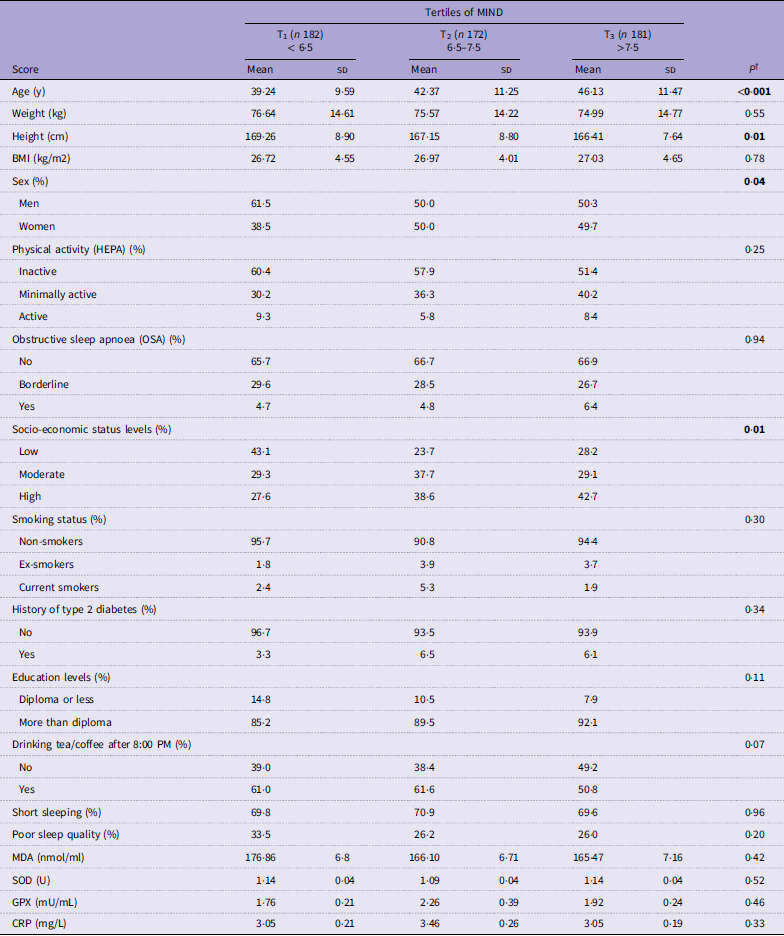
This study was conducted on 535 Iranian adults, 46 % of whom were female; the mean age was 42·6 ± 11·1 yr, and BMI was 26·9 ± 4·4 kg/m2. General characteristics of study participants across tertiles of MIND score are shown in Table 1. Subjects in the highest (v. lowest) tertile of MIND score were older, shorter and more likely to be female and had a higher socioeconomic status level. Concerning other socio-demographic characteristics, inflammatory and oxidative stress biomarkers, no significant differences were observed across various tertiles of MIND score.
General characteristics of study participants across tertiles of MIND score (n 535) *

Table 1. Long description
A table comparing general characteristics of study participants across tertiles of MIND score. The table has 18 rows and 10 columns. Column headers are Score, T1 (n 182) < 6-5, T2 (n 172) 6-5-7-5, T3 (n 181) >7-5, and P1. Row labels include Age (y), Weight (kg), Height (cm), BMI (kg/m2), Sex (%), Physical activity (HEPA) (%), Obstructive sleep apnoea (OSA) (%), Socio-economic status levels (%), Smoking status (%), History of type 2 diabetes (%), Education levels (%), Drinking tea/coffee after 8:00 PM (%), Short sleeping (%), Poor sleep quality (%), MDA (nmol/ml), SOD (U), GPX (mU/mL), and CRP (mg/L). Each row provides mean, standard deviation (SD), and percentage values for the respective tertiles of MIND score. Notable trends include increasing age, height, and socioeconomic status levels across higher tertiles of MIND score.
MIND, Mediterranean-DASH Intervention for Neurodegenerative Delay; OSA, obstructive sleep apnoea; HEPA, health-enhancing physical activity; MDA, malondialdehyde; SOD, superoxide dismutase; GPX, glutathione peroxidase; CRP, C reactive protein.
* For continuous variables, values are mean ± sd, for categorical variables, values are percentage. Significant values (p < 0.05) are presented in bold.
† Obtained from ANOVA for continuous variables and χ 2 chi-square test for categorical variables.
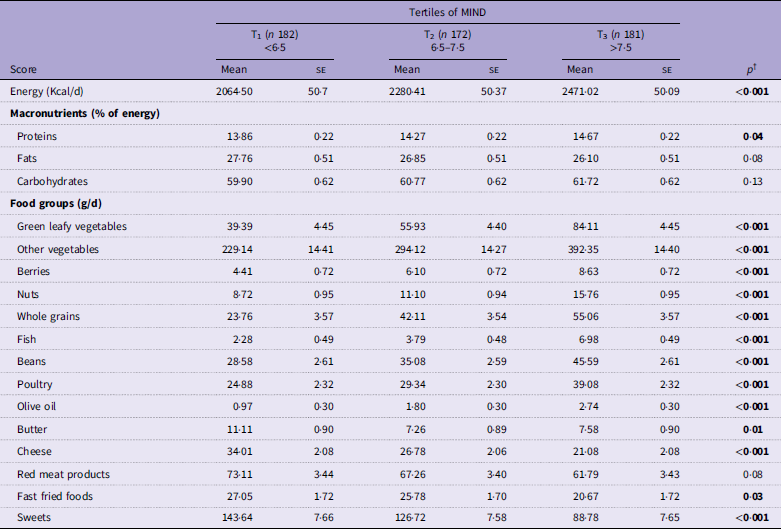
Dietary intakes (multivariable-adjusted) of study participants across tertiles of MIND score are displayed in Table 2. Participants in top (v. bottom) tertile of MIND had higher energy and protein intake. No significant difference was found in carbohydrate or fat consumption across tertiles of MIND diet. Those in third (v. first) tertile of MIND also consumed more of healthy groups of MIND diet and less of unhealthy groups of MIND diet, while consumption of red meat products did not significantly vary across tertiles of MIND.
Multivariable-adjusted intakes and selected nutrients of study participants across tertiles of MIND score (n 535)*

Table 2. Long description
A table comparing dietary intakes across tertiles of MIND score. The table has 19 rows and 10 columns. The columns are labeled as Score, T1 (n 182) <6-5, T2 (n 172) 6-5-7-5, T3 (n 181) >7-5, and p†. The rows are grouped into Energy (Kcal/d), Macronutrients (% of energy), and Food groups (g/d). Each group contains specific items with their mean and standard error (SE) values across the tertiles. Notable trends include higher energy and protein intake in the top tertile compared to the bottom tertile. Consumption of green leafy vegetables, other vegetables, berries, nuts, whole grains, fish, beans, poultry, olive oil, butter, cheese, red meat products, fast fried foods, and sweets are also compared across the tertiles.
MIND, Mediterranean-DASH Intervention for Neurodegenerative Delay.
* All values are means ± se; energy intake and macronutrients are adjusted for age and sex; all other values are adjusted for age, sex and energy intake; significant values (p < 0.05) are presented in bold.
† Obtained from ANCOVA.
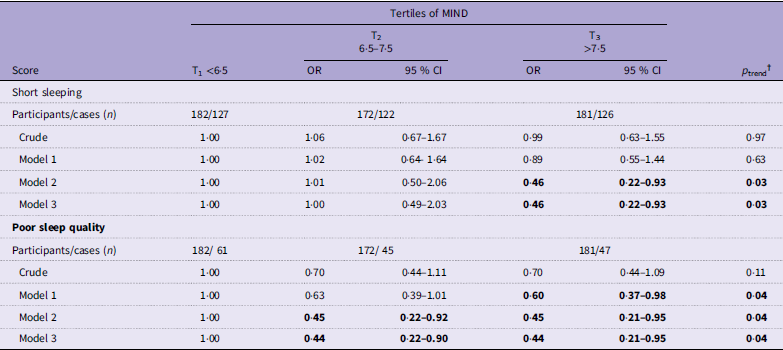
Among the studied participants, 70·1 % (n 375) slept less than 7 h per night, and 28·6 % (n 153) had poor sleep quality. OR (multivariable-adjusted) for short sleeping and poor sleep quality across tertiles of MIND score are presented in Table 3. In crude model, adults with high MIND score (v. low) MIND score had slightly and insignificantly lower odds of being short sleepers (OR = 0·99; 95 % CI: 0·63–1·55). After adjusting for confounding factors, individuals in top tertile of MIND diet were 54 % less likely to have short sleeping compared to those in bottom tertile (OR = 0·46; 95 % CI: 0·22–0·93). A similar pattern was observed in the case of sleep quality; such that, the observed association was not significant in crude model (OR = 0·70; 95 % CI: 0·44–1·09); but after adjusting for potential confounders, participants with the highest (v. lowest) adherence to MIND diet showed a 56 % odds reduction for poor sleep quality (OR = 0·44; 95 % CI: 0·21–0·95).
Multivariable-adjusted OR for short sleeping and poor sleep quality across tertiles of MIND score (n 535) *

Table 3. Long description
A table comparing odds ratios for short sleeping and poor sleep quality across tertiles of MIND score. The table has 10 rows and 8 columns. Column headers are Score, T1 <6-5, OR, 95 % CI, OR, 95 % CI, and ptrend†. Row labels include Short sleeping and Poor sleep quality, with sub-rows for Participants/cases (n), Crude, Model 1, Model 2, and Model 3. For short sleeping, the participants/cases (n) are 182/127, 172/122, and 181/126 for T1, T2, and T3 respectively. The crude odds ratios are 1.00, 1.06, and 0.99. Model 3 shows odds ratios of 1.00, 1.00, and 0.46 for T1, T2, and T3 respectively. For poor sleep quality, the participants/cases (n) are 182/61, 172/45, and 181/47 for T1, T2, and T3 respectively. The crude odds ratios are 1.00, 0.70, and 0.70. Model 3 shows odds ratios of 1.00, 0.44, and 0.44 for T1, T2, and T3 respectively.
MIND, Mediterranean-DASH Intervention for Neurodegenerative Delay.
Model 1: Adjusted for age, sex and energy intake.
Model 2: More adjustments for education levels, physical activity levels, socio-economic status, type 2 diabetes, tea and coffee intake after 8 pm, obstructive sleep apnoea and smoking status.
Model 3: Further adjustment for BMI.
* All values are OR and 95 % CI; significant values (p < 0.05) are presented in bold.
† p trend was obtained by considering the tertiles of MIND as ordinal variable.
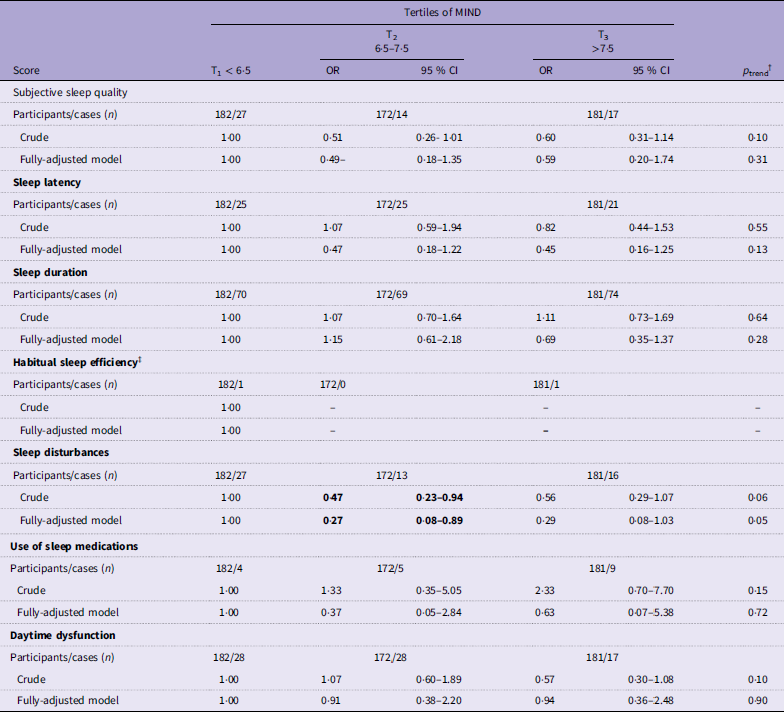
Table 4 illustrates multivariable-adjusted OR of domains of sleep quality across tertiles of MIND score. Among different domains of sleep quality, individuals with moderate adherence to MIND diet, compared with the reference category (tertile 1), demonstrated a 73 % odds reduction for sleep disturbances in fully adjusted model (ORT2v.T1 = 0·27; 95 % CI: 0·08–0·89). In addition, participants in top tertile had marginally lower odds of having sleep disturbances than those in bottom tertile (OR T3v.T1 = 0·29; 65 % CI: 0·08–1·03). No significant differences were observed between other domains of sleep quality and adherence to MIND dietary pattern.
Multivariable-adjusted OR for individual domains of sleep quality across tertiles of MIND score (n 535) 1

Table 4. Long description
A table comparing sleep quality across tertiles of MIND score with 535 participants. The table has 7 rows and 10 columns. Column headers are Score, Participants/cases (n), Crude OR, Crude 95% CI, Fully-adjusted model OR, Fully-adjusted model 95% CI, and p_trend. Row labels are Subjective sleep quality, Sleep latency, Sleep duration, Habitual sleep efficiency, Sleep disturbances, Use of sleep medications, and Daytime dysfunction. Each row provides data for three tertiles of MIND score: T1 < 6.5, T2 6.5-7.5, and T3 > 7.5. The table includes odds ratios (OR) and 95% confidence intervals (CI) for each tertile compared to the reference group (T1). Notable trends include a reduction in odds for sleep disturbances in the fully adjusted model for T2 and T3 compared to T1.
MIND, Mediterranean-DASH Intervention for Neurodegenerative Delay.
1 All values are OR and 95 % CI; significant values (p < 0.05) are presented in bold. For each domain of sleep quality, the odds were reported for score 2–3 of that domain (as poor quality); while score 0–1 was considered as the reference category. Fully-adjusted model: Adjusted for age, sex, energy intake, education levels, physical activity levels, socio-economic status, type 2 diabetes, tea and coffee intake after 8 pm, obstructive sleep apnoea, smoking status and BMI.
† p trend was obtained by considering the tertiles of MIND as ordinal variable.
‡ OR (95 % CI) could not be calculated, due to not having cases in one tertile.
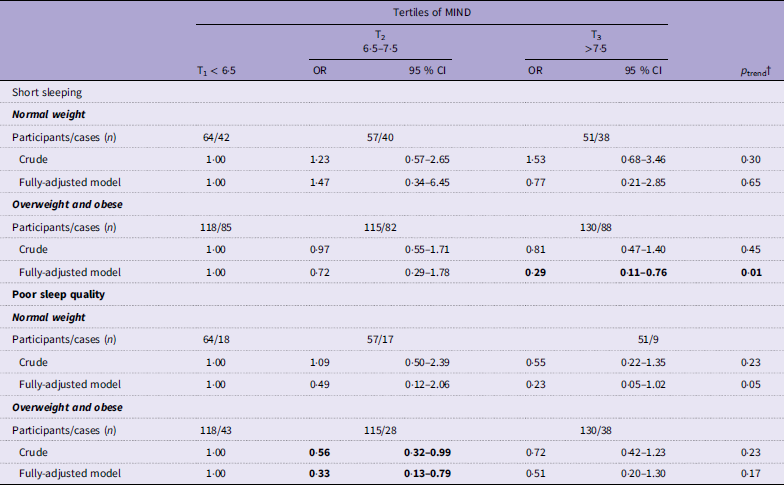
Multivariable-adjusted OR for having short sleep duration and poor sleep quality across tertiles of MIND score, stratified by BMI levels, are shown in Table 5. Although the association between adherence to MIND dietary pattern and short sleeping was statistically insignificant in individuals with normal weight (fully adjusted model OR = 0·77; 95 % CI: 0·21–2·85), those with overweight and obesity who demonstrated greater adherence to MIND diet had 71 % lower odds of experiencing short sleeping (fully adjusted model OR = 0·29; 95 % CI: 0·11–0·76). In normal-weight participants, those in the highest (v. lowest) tertile were relatively less likely to report poor sleep quality, after adjusting for all potential confounders (OR = 0·23; 95 % CI: 0·05–1·02). In overweight and obese individuals, an inverse association was observed between odds of poor sleep quality in participants in second (v. first) tertile of MIND score (fully adjusted model ORT2 v. T1 = 0·33, 95 % CI: 0·13–0·79).
Multivariable-adjusted OR for short sleeping and poor sleep quality across tertiles of MIND score, stratified by BMI categories (n 535)*

Table 5. Long description
A table comparing odds ratios for short sleeping and poor sleep quality across tertiles of MIND score, stratified by BMI categories. The table has 12 rows and 10 columns. Column headers include T1 < 6.5, OR, 95 % CI, T2 6-5-7.5, OR, 95 % CI, T3 > 7.5, OR, 95 % CI, and p trend. Row labels include Short sleeping Normal weight, Participants/cases (n), Crude, Fully-adjusted model, Overweight and obese, Participants/cases (n), Crude, Fully-adjusted model, Poor sleep quality Normal weight, Participants/cases (n), Crude, Fully-adjusted model, Overweight and obese, Participants/cases (n), Crude, and Fully-adjusted model. The table presents data on the association between adherence to the MIND dietary pattern and sleep quality, showing odds ratios and confidence intervals for different BMI categories and MIND score tertiles.
MIND, Mediterranean-DASH Intervention for Neurodegenerative Delay.
* All values are OR and 95 % CI; significant values (p < 0.05) are presented in bold.
Fully-adjusted model: Adjusted for age, sex, energy intake, education levels, physical activity levels, socio-economic status, type 2 diabetes, tea and coffee intake after 8 pm, obstructive sleep apnoea and smoking status.
† p trend was obtained by considering the tertiles of MIND as ordinal variable.
In Figure 1, linear associations between tertiles of MIND with malondialdehyde, superoxide dismutase, glutathione peroxidase and high sensitivity CRP levels are shown. Linear analysis demonstrated that each tertile increase in MIND diet score was related to higher values of superoxide dismutase and glutathione peroxidase and lower values of malondialdehyde and CRP, but none of these relations were statistically significant (P > 0·05).
Linear associations between each tertile increase in MIND diet score and malondialdehyde (MDA), superoxide dismutase (SOD), glutathione peroxidase (GPX) and high sensitivity C-reactive protein (hs-CRP). All values are regression coefficient and 95 % CI for each tertile increase in MIND adherence. Model 1: Adjusted for age and sex; model 2: additionally adjusted for BMI. MIND, Mediterranean-DASH Intervention for Neurodegenerative Delay.

Discussion
This population-based cross-sectional study showed that higher adherence to MIND was associated with a decreased likelihood of having short sleeping and inappropriate sleep quality. Greater adherence to MIND diet was associated with a lower likelihood of sleep disturbances. Individuals with overweight and obesity with a higher adherence to MIND (in comparison with those with a normal weight) had lower odds of having short sleeping and to some extent inappropriate sleep quality. There were no notable differences across different tertiles of MIND score regarding concentrations of inflammatory and oxidative stress biomarkers, but this investigation demonstrated important trends that might be clinically significant.
Findings of the current investigation suggested that in addition to improving brain and neurological health, MIND diet can be recommended in sleep clinics and to general populations, with advice to increase green leafy vegetables along with other vegetables, berries, nuts, whole grains, fish, beans, poultry and olive oil and to decrease red meat, butter and margarine, fast-fried food and sweets, especially in young adults, students and those with long work shifts.
The study by Rostami et al. revealed that male adults with higher adherence to MIND were less likely to have poor sleep quality(Reference Rostami, Parastouei and Samadi15). On the other hand, another cross-sectional investigation on Iranian women with obesity found no association between MIND diet adherence and sleep quality(Reference Seifollahi, Sardari and Yarizadeh13); women with moderate adherence were more likely to experience poor sleep quality, but there was no association between the highest v. lowest adherence and poor sleep quality. The mentioned study was conducted only on a small sample of females (n 282), which may be the reason for this insignificance(Reference Seifollahi, Sardari and Yarizadeh13). Golmohammadi et al. examined effects of a 12-week low-calorie MIND dietary intervention on sleep quality of diabetic women with overweight/obesity(Reference Golmohammadi, Attari and Salimi28). This trial showed beneficial effects on sleep quality. Another cross-sectional study on 503 university students in United Arab Emirates, in which the association of Mediterranean diet and sleep quality was assessed, showed a good adherence to the pattern was inversely associated with inappropriate sleep quality(Reference Naja, Hasan and Khadem29). Liang et al. investigated the association between DASH diet adherence and sleep quality and did not find any significant association, either in total-sample analysis or in stratified analysis by sex(Reference Liang, Beydoun and Hossain30). Numerous reasons may contribute to the variation of results in those studies, such as different confounders being adjusted, study designs, populations and dietary and outcome assessments.
MIND diet contains nutrients such as n-3 fatty acids and vitamins, including vitamin E, which possess anti-inflammatory properties. Foods such as fish, olive oil and nuts are examples of these sources. Therefore, anti-inflammatory effects of MIND diet might influence sleep quality and duration(Reference Rostami, Parastouei and Samadi15). Although in the current investigation greater adherence to MIND was not substantially associated with CRP values, systemic inflammation is believed to be associated with sleep disorders, such as poor sleep quality and short sleep duration. Sympathetic nervous system and hypothalamic–pituitary axis can be affected by sleep, through regulation of gene expression, changes in proinflammatory cytokines and production of systemic inflammation biomarkers(Reference Balbo, Leproult and Van Cauter31–Reference Garbarino, Lanteri and Bragazzi33). Although sympathetic activity decreases during the night, a significant association between sleep disturbances and changes in sympathetic activity has been demonstrated(Reference Chung, Kuo and Hsu34). In addition, pro-oxidants (less accessible in MIND dietary pattern) can induce oxidative stress by increasing reactive oxygen species, while antioxidants (highly available in MIND dietary style) may enhance the defense activity of antioxidant systems and shift the balance towards a less oxidative condition (Reference Chandimali, Bak and Park35,Reference Bin Heyat, Akhtar and Sultana36) . Prior investigations have documented that oxidative stress, as an imbalance between pro-oxidants and antioxidants, can result in cellular injury and apoptosis and may have a vital role in determining sleep quality(Reference Bin Heyat, Akhtar and Sultana36–Reference Davinelli, Medoro and Savino38).
The present study has several strengths and limitations. A validated FFQ was used in our study for dietary assessments; however, there could potentially be some misreports as questionnaires were completed based on self-report data. Additionally, recall bias was inevitable in the FFQ fulfillment; however, a large sample containing both male and female subjects was considered, which could alleviate the trace of this bias. No significant associations between adherence to MIND and oxidative stress or inflammatory biomarkers were identified, likely due to the small studied sample size; the sample size was not calculated by considering those biomarkers, due to insufficient research budget. Additionally, results were insignificant for normal-weight participants (compared to those with obesity/overweight) as well as for some sleep domains; which may be a result of not keeping stratified analysis in mind during the sample size estimation, again, because of having an insufficient budget for the study. Finally, a cross-sectional design cannot test the causality; thus, prospective cohorts as well as trials are required in that regard in future studies.
Our results indicated that individuals with a higher adherence to MIND diet were less likely to experience short sleeping and inappropriate sleep quality. Those with moderate (and to some extent high) adherence to MIND diet demonstrated a decreased likelihood of sleep disturbances. The linkage between MIND diet adherence and sleep quality and quantity was stronger in those with overweight or obesity versus individuals with normal weight. While reductions in malondialdehyde and CRP levels and enhancements in superoxide dismutase and glutathione peroxidase levels were observed with greater adherence to MIND diet, these relations were not statistically significant; but this study demonstrated important trends that might be clinically significant. Future research should utilise prospective or trial designs to investigate our findings in a clinical context.
Data availability statement
Data of these findings are available from the corresponding author, upon a reasonable request.
Acknowledgements
None.
Financial support
The financial support for conception, design, data analysis and manuscript drafting come from Nutrition and Food Security Research Center, Isfahan University of Medical Sciences, Isfahan, Iran (No. 2404137).
Author contributions
ZM, MM, AL, AH, FS, PR and PS contributed to the conception, design, data collection, data interpretation, manuscript drafting and approval of the final version of the manuscript. All authors agreed on all aspects of this work.
Competing interests
None of the authors had any personal or financial conflicts of interest.
Ethical standards
The study procedure was performed according to the declaration of Helsinki and STROBE checklist. All participants provided informed written consent. The study protocol was approved by the local Ethics Committee of Isfahan University of Medical Sciences.