

In recent years, there has been growing emphasis on integrating students with special learning needs into regular classrooms (Mastropieri & Scruggs, Reference Mastropieri and Scruggs2014), and the number of settings where students with and without disabilities are educated together has been increasing worldwide (You et al., Reference You, Kim and Shin2019). The movement to teach all students in an inclusive education system can be regarded as one of the most important school reforms (Savolainen et al., Reference Savolainen, Malinen and Schwab2020). Over the past two decades, inclusion for students with special learning needs has gained international support (Armstrong et al., Reference Armstrong, Armstrong and Spandagou2010), and programs that educate students with such needs in a classroom separate from the majority of students are diminishing globally (Loreman et al., Reference Loreman, Sharma and Forlin2013). Instead, there is increasing emphasis on the inclusion of students with special learning needs in the same classroom as their peers (Ainscow & Sandill, Reference Ainscow and Sandill2010). However, even though there has been substantial support for educating students with special learning needs in regular classrooms (Song, Reference Song2016), increased inclusion has placed significant responsibilities on teachers, who are often charged with dealing with a variety of special needs in the classroom (Armstrong et al., Reference Armstrong, Armstrong and Spandagou2010).
The most important factor in the effective implementation of inclusive education is the teacher (Loreman et al., Reference Loreman, Sharma and Forlin2013). In other words, the effectiveness of inclusive education for students with special learning needs basically depends on the teachers themselves (Savolainen et al., Reference Savolainen, Engelbrecht, Nel and Malinen2012). It is a fact that, in some implementations so far, inclusive education has become a practice that can do more harm than good to the student due to incorrect practices being implemented (Mastropieri & Scruggs, Reference Mastropieri and Scruggs2014). The main reason for this is that teachers do not have adequate knowledge of inclusive education, its aims, and its benefits (Shillingford & Karlin, Reference Shillingford and Karlin2014). So, in order to successfully implement inclusive education in the classroom, teachers must have competence in inclusion as well as their subject knowledge (Bradshaw & Mundia, Reference Bradshaw and Mundia2006).
Regardless of students’ disabilities, teachers are responsible for the learning of all the students in the classroom (Borich, Reference Borich2016). Therefore, at the start of the school year, teachers need to be familiar with the special learning needs of their students. Teachers are responsible for the teaching of all students, and thus they must address the different characteristics and learning needs of all of them in the classroom. Because of this, teachers’ attitudes have a significant role in the successful inclusion of students in the classroom (Ross-Hill, Reference Ross-Hill2009). However, not only must teachers have a positive attitude (Avramidis & Norwich, Reference Avramidis and Norwich2002) but they must also have efficacy for inclusive education (Forlin et al., Reference Forlin, Loreman and Sharma2014).
Since efficacy shapes teachers’ attitudes towards inclusive education (Sokal & Sharma, Reference Sokal and Sharma2014), they, for example, must know the characteristics of all the students, make changes to educational objectives, make adaptations in teaching and learning, and use the tools available in the evaluation of students (Friend & Bursuck, Reference Friend and Bursuck2006). Furthermore, they are required to have an understanding of providing appropriate learning and instruction for students with special learning needs, compared to other students, by implementing the curriculum and a facilitative classroom environment (Lindsay, Reference Lindsay2007). Acceptance of inclusive education increases teachers’ efficacy — that is, the belief that they can deal with the teaching of students having special learning needs in regular classrooms (Leyser et al., Reference Leyser, Zeiger and Romi2011). Conversely, the rejection of inclusive education is influenced by a low level of efficacy (Lee et al., Reference Lee, Tracey, Barker, Fan and Yeung2014), meaning that students with special learning needs must be educated in regular classrooms.
A review of the literature reveals that research has mostly focused on teachers’ efficacy in inclusive education, showing that teachers have a low level of efficacy. Research has focused on determining teachers’ efficacy in inclusive education rather than revealing the factors influencing it. However, besides determining teachers’ efficacy in inclusive education, determining the factors affecting such a kind of efficacy is very important to develop an education policy on the issue. The present research differs from earlier studies in that it focuses on the factors influencing teachers’ efficacy in inclusive education rather than on the determination of the level of such a kind of efficacy. Therefore, the purpose of the present research was to examine the relative importance of student-related and school-related factors in accounting for teachers’ efficacy in inclusive education in the Turkish context. The research questions addressed in the study were as follows:
RQ1. How well do the student-related variables explain the variance in teacher efficacy in inclusive education?
RQ2. How well do the school-related variables explain the variance in teacher efficacy in inclusive education?
Theoretical Framework
Teacher Efficacy
Efficacy belief is an important element that affects how much effort individuals will make to perform a certain task when they encounter difficulties (Bandura, Reference Bandura and Anderson2004). Efficacy, which was originally characterised by Bandura (Reference Bandura1977) in his social learning theory, is the belief that one is capable of accomplishing a specific task (Bandura, Reference Bandura1997). Efficacy is based on the capacity to mobilise personal skills and the importance of self-belief about what an individual can do with their skills (Bussey & Bandura, Reference Bussey and Bandura1999). Bandura (Reference Bandura1986) defines efficacy as ‘a judgement of one’s capability to accomplish a given level of performance’ (p. 391), and he describes it as a quality that is effective in the formation of behaviours and the self-related judgement about the individual’s capacity to organise and perform a certain performance (Bandura, Reference Bandura1977). Efficacy is the judgement of an individual about the ability to perform or achieve a task (Zimmerman, Reference Zimmerman2000); therefore, it affects individuals’ feelings, thoughts, and the way they motivate themselves (Bandura, Reference Bandura1997). Individuals with a high efficacy are able to accomplish difficult tasks more easily, but those who have a low efficacy tend to move away from difficult tasks (Bandura, Reference Bandura and Ramachandran1994). Individuals having a high efficacy can be more comfortable and productive when faced with difficult tasks. However, those with a low efficacy believe that their work is even harder than it actually is (Bandura, Reference Bandura and Anderson2004).
Efficacy, which has been given considerable attention in the teacher education literature (Tschannen-Moran & Woolfolk Hoy, Reference Tschannen-Moran and Woolfolk Hoy2001), is defined as a teacher’s belief that they can foster all students’ learning regardless of their prior knowledge or ability (Woolfolk Hoy et al., Reference Woolfolk Hoy, Davis, Pape, Alexander and Winne2006). Efficacy is a teacher’s belief regarding their capability to perform effectively within the teaching profession (Tschannen-Moran et al., Reference Tschannen-Moran, Woolfolk Hoy and Hoy1998), which has a significant influence on learning and instruction practices (Tschannen-Moran & Woolfolk Hoy, Reference Tschannen-Moran and Woolfolk Hoy2007). Teachers with a high level of efficacy are more open to new ideas and are willing to try new methods to better meet the needs of their students (Tschannen-Moran & Woolfolk Hoy, Reference Tschannen-Moran and Woolfolk Hoy2001). Such teachers seek out new approaches in learning and instruction (Stein & Wang, Reference Stein and Wang1988) and use effective classroom management strategies (Emmer & Hickman, Reference Emmer and Hickman1991), while also taking responsibility for the success or failure of their instruction (Roeser et al., Reference Roeser, Marachi, Gehlbach and Midgley2002). They maximize the available time for teaching, praise students for their increased competence, avoid rewards to control behaviour, and persevere with low achievers (Ware & Kitsantas, Reference Ware and Kitsantas2007). Therefore, there is a strong relationship between the efficacy of teachers and academic achievement of students (Eggen & Kauchak, Reference Eggen and Kauchak2010). In contrast, low-efficacy teachers are more likely to blame low achievement for lack of intelligence, poor home environments, uncooperative administrators, or other external causes (Brouwers & Tomic, Reference Brouwers and Tomic2001). They have low expectations, spend less time on learning activities, give up on low achievers, and are more critical when students fail (Henson et al., Reference Henson, Kogan and Vacha-Haase2001). Therefore, students taught by higher-efficacy teachers learn more and are more motivated than those taught by lower-efficacy teachers (Tschannen-Moran et al., Reference Tschannen-Moran, Woolfolk Hoy and Hoy1998).
Efficacy in Inclusive Education
Teachers are considered the key elements of inclusive education because their actions are expected to represent inclusive practices (Ainscow & Sandill, Reference Ainscow and Sandill2010). Although many factors such as age, training in pedagogy, and teaching experience with children with disabilities may have an influence on inclusive practices (Tiwari et al., Reference Tiwari, Das and Sharma2015; Waitoller & Artiles, Reference Waitoller and Artiles2013), teacher efficacy is among the most important factors determining the success of the implementation of inclusive education (Sharma et al., Reference Sharma, Loreman and Forlin2012). Since efficacy is identified as crucial for inclusive education (Loreman et al., Reference Loreman, Sharma and Forlin2013), teachers need to be adequately prepared and supported to teach in inclusive classrooms (San Martin et al., Reference San Martin, Ramirez, Calvo, Muñoz-Martínez and Sharma2021). Therefore, they are required to have an understanding and confidence in providing appropriate services to students with special educational needs by practising a facilitating learning environment (Lindsay, Reference Lindsay2007).
Recent research has demonstrated that the efficacy of teachers is one of the strongest predictors of inclusive practices (Chao et al., Reference Chao, Forlin and Ho2016). Teachers with a high efficacy are successful in performing inclusive practices (Sharma et al., Reference Sharma, Loreman and Forlin2012). Teachers’ efficacy in inclusive education is positively related to their attitudes towards inclusive practices in the classroom (Savolainen et al., Reference Savolainen, Engelbrecht, Nel and Malinen2012; Sharma et al., Reference Sharma, Loreman and Forlin2012). Efficacy shapes teachers’ attitudes towards inclusive education (Kristiana & Widayanti, Reference Kristiana and Widayanti2017); thus, teachers having a high efficacy towards inclusion have more positive attitudes towards inclusive practices (Weisel & Dror, Reference Weisel and Dror2006). High-efficacy teachers give priority to students with learning and behavioural problems in inclusive classrooms (Leyser, Reference Leyser2002) and spend more time with students with learning difficulties (Chao et al., Reference Chao, Forlin and Ho2016). According to Sharma and Jacobs (Reference Sharma and Jacobs2016), teachers’ intentions to cope with inclusive practices in the classroom are mostly predicted by their efficacy. Thus, such teachers are more sensitive to students with special learning needs (Soodak et al., Reference Soodak, Podell and Lehman1998), and they are more willing to satisfy the needs of those students (Paneque & Barbetta, Reference Paneque and Barbetta2006).
The efficacy of teachers is influenced by many factors, including, for example, gender, attitudes towards inclusive education, teaching experience in inclusive classrooms, and training in inclusive education. First, in the literature, there is an attempt to relate efficacy in inclusive education with gender. Although research has mostly demonstrated that female teachers have a high level of efficacy in inclusive education rather than their male colleagues (Chao et al., Reference Chao, Sze, Chow, Forlin and Ho2017), other studies have shown that there is no connection between gender and efficacy (Kuyini et al., Reference Kuyini, Desai and Sharma2020). Also, the role of teachers’ attitudes has been extensively studied in understanding inclusive practices in the classroom (Van Mieghem et al., Reference Van Mieghem, Verschueren, Petry and Struyf2020). Attitudes of teachers towards inclusive education are one of the key factors affecting efficacy (Avramidis & Norwich, Reference Avramidis and Norwich2002). Research has indicated that the attitudes of teachers play a significant role in the implementation of inclusive practices (Sharma & Sokal, Reference Sharma and Sokal2016). However, teaching experience may change the attitudes of teachers towards inclusive education over time. Research has shown that with more teaching experience, the attitudes of teachers towards inclusive education may become more negative (Schmidt & Vrhovnik, Reference Schmidt and Vrhovnik2015), although other research has found a weak link between teaching experience and attitudes (Savolainen et al., Reference Savolainen, Engelbrecht, Nel and Malinen2012). In addition to attitudes, teaching experience in inclusive classrooms is related positively to attitudes and efficacy (Avramidis et al., Reference Avramidis, Bayliss and Burden2002). Teachers having teaching experience with students with special learning needs not only have positive attitudes towards inclusive education (Leatherman & Niemeyer, Reference Leatherman and Niemeyer2005) but they also have a high level of efficacy (Carroll et al., Reference Carroll, Forlin and Jobling2003). Teachers look at their past performance to determine how capable they see themselves and others when using inclusive education strategies (Wilson et al., Reference Wilson, Woolfson, Durkin and Elliott2016), which improves both their attitudes and efficacy in inclusive education. Lastly, training of teachers in inclusive education is related to their efficacy. Research results have indicated that training focused on students with special learning needs increases teachers’ efficacy (Chao et al., Reference Chao, Forlin and Ho2016; Forlin et al., Reference Forlin, Loreman and Sharma2014; Yada et al., Reference Yada, Tolvanen and Savolainen2018) and attitudes towards inclusive education (Carroll et al., Reference Carroll, Forlin and Jobling2003). Moreover, teachers who are subjected to substantial training are more positive about inclusive education (Avramidis et al., Reference Avramidis, Bayliss and Burden2002) and they display a positive improvement in efficacy (Chao et al., Reference Chao, Forlin and Ho2016).
Present Research
Although the research literature has focused on the efficacy of teachers in inclusive education (Avramidis et al., Reference Avramidis, Bayliss and Burden2000; Avramidis & Norwich, Reference Avramidis and Norwich2002; Brownell & Pajares, Reference Brownell and Pajares1999; Savolainen et al., Reference Savolainen, Engelbrecht, Nel and Malinen2012; Weisel & Dror, Reference Weisel and Dror2006), it has neglected the factors influencing it mostly. In recent years, the attempt to determine the factors impacting the success of the implementation of inclusive practices has gained widespread attention (Chao et al., Reference Chao, Forlin and Ho2016); however, the research has mainly focused on basic factors, including, for example, gender (Alghazo & Naggar Gaad, Reference Alghazo and Naggar Gaad2004; Avramidis et al., Reference Avramidis, Bayliss and Burden2000), attitude (de Boer et al., Reference de Boer, Jan Pijl and Minnaert2011; Sharma & Sokal, Reference Sharma and Sokal2016), teaching experience in inclusive classrooms (Avramidis et al., Reference Avramidis, Bayliss and Burden2002; Leatherman & Niemeyer, Reference Leatherman and Niemeyer2005), and training in inclusive education (Avramidis et al., Reference Avramidis, Bayliss and Burden2000; Chao et al., Reference Chao, Forlin and Ho2016) rather than on teacher efficacy. Although the number of studies regarding teacher efficacy in inclusive education has substantially increased over the last decade, the research has focused mostly on teacher-related factors, ignoring student-related and school-related factors (Avramidis & Norwich, Reference Avramidis and Norwich2002). The success of inclusive practices may not depend only on teacher-related characteristics, despite the teacher being a key element in inclusive education; it may depend on other variables related to the student and the school. In terms of student-related factors, gender, grade, socioeconomic status (SES), and parental involvement may have a significant influence on the efficacy of teachers in inclusive education. Also, school-related factors, including, for example, class size, school facilities, getting help from colleagues or colleague support, and teacher in-service training, may explain the efficacy of teachers in inclusive practices. Although the research literature has previously studied some teacher-related factors, including, for instance, teacher in-service training, the present research included this variable to bring a more comprehensive view to school-related factors influencing the efficacy of teachers in inclusive education. Therefore, the present study focused on student-related and school-related factors in explaining the efficacy of teachers in inclusive education.
Methodology
Model
In the present study, a predictive research model, one of the models in correlation research that aims to identify variables that will predict an outcome or criterion, was used (Creswell, Reference Creswell2012). In the research, student-related factors and school-related factors were used as independent variables to predict teacher efficacy in inclusive education.
Sample
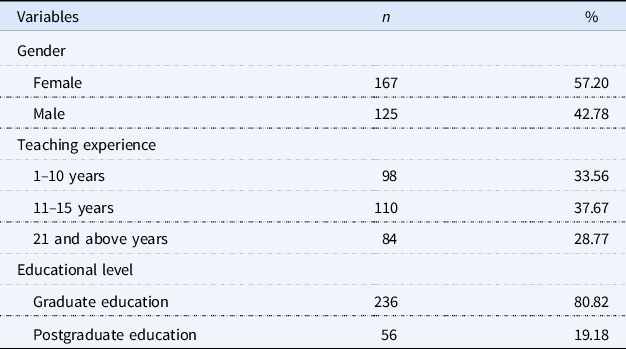
The sample of the research consisted of teachers working in public middle schools in the province of Niğde in the Central Anatolia Region of Turkey. There were 1,686 teachers working in middle schools in the population (National Directorate of Education on Niğde, 2019); therefore, 314 teachers were recruited in the research, with 95% probability and 5% error level based on the cluster random sampling method (Fraenkel et al., Reference Fraenkel, Wallen and Hyun2019), which includes a group of individuals who are gathered naturally (Ary et al., Reference Ary, Jacobs and Sorensen2010). After the instruments were implemented, 292 (93%) of them were returned, which indicated a relatively high response rate (Johnson & Christensen, Reference Johnson and Christensen2012). The demographics of the sample are given in Table 1.
Demographics of the Sample

Instruments
Demographic Information Questionnaire
To determine the factors influencing teacher efficacy in inclusive education, the Teacher Demographic Information Questionnaire (TDIQ) was used. The questionnaire has two sets of independent variables: student-related factors and school-related factors. The first set of variables in the TDIQ consisted of student-related factors: gender, grade, SES, and parental involvement. It was considered that teacher efficacy in inclusive education could be influenced by students’ gender, grade, SES, and parental involvement. On the other hand, the second set of variables in TDIQ consisted of school-related factors: teacher education level, teacher in-service training, class size, school facilities, and getting help from colleagues. Teacher efficacy in inclusive education was considered to be affected by factors such as teacher education level, teacher in-service training, class size, school facilities, and getting help from colleagues.
Teacher Efficacy for Inclusive Practices Scale
To determine teacher efficacy in inclusive education, the Teacher Efficacy for Inclusive Practices (TEIP) scale, developed by Sharma et al. (Reference Sharma, Loreman and Forlin2012) and adapted into Turkish by Bayar (Reference Bayar2015), was used in the research. The TEIP scale is a 6-point Likert instrument, with responses ranging from 1 = totally disagree to 6 = totally agree. The scores obtained from the TEIP scale can range between 18 and 108; thus, high scores indicate that teachers have a high level of efficacy, whereas low scores show that teachers have a low level of efficacy. The scale has a three-factor structure: Instruction Efficacy in Inclusive Education (Item 14; I am confident in getting students to work in pairs or groups; α = .88), Collaboration Efficacy in Inclusive Education (Item 16; I am confident in informing people about laws and policies regarding inclusive education; α = .90), and Classroom Management Efficacy in Inclusive Education (Item 8; I can control the undesired behaviour in the classroom; α = .86). The total Cronbach’s alpha coefficient of the TEIP scale is .89, which indicates that the scale has enough reliability to be used in the research (Bayar, Reference Bayar2015). Also, Cronbach’s alpha of the factors was recalculated in the present research, which displayed high coefficients (Instruction Efficacy in Inclusive Education = .91, Collaboration Efficacy in Inclusive Education = .89, Classroom Management Efficacy in Inclusive Education = .90).
Procedure
Ethical issues are of great importance in educational research (Strike, Reference Strike, Green, Camilli and Elmore2006); therefore, due to ethical sensitivities (Hammersley & Traianou, Reference Hammersley and Traianou2012), necessary permission was obtained to conduct the research with teachers from the National Directorate of Education of Niğde. Prior to data collection, informed consent was gathered verbally from the teachers who took part in the research. After obtaining the informed consent of the teachers, the data were collected by the researcher, who visited the selected schools one by one. At every school visit, the instruments were administered to the teachers during working hours. During the implementation of the instruments, the aim of the research and completion procedure of the instruments were explained to the teachers, and teachers were assured that their identity would be kept confidential. It took approximately 20 minutes for the teachers to fill in the instruments. In addition, the collection of the research data was completed within 2 months.
Analysis
In the research, multiple regression analysis was conducted to examine how well each set of independent variables — student-related factors and school-related factors — predicted teacher efficacy in inclusive education over and above other sets. The models also suggested how teacher efficacy in inclusive education was influenced when student-related factors and school-related factors were combined.
Prior to the data analysis, the assumptions of the multiple regression analysis were checked. First, the normality of the data was examined, which indicated that the variables had a normal distribution, with skewness (−.133/−1.406) and kurtosis (−.428/−1.257) values all between −1.96 and 1.96 respectively (Howell, Reference Howell2006). Also, Durbin–Watson statistic was performed (Tabachnick & Fidell, Reference Tabachnick and Fidell2007), and as a result, an autocorrelation between variables did not exist (DW = 1.88). Lastly, the data were also checked to test the multicollinearity assumption, which showed that there was no multicollinearity between the independent variables. Variance inflation factor and tolerance values ranged between 1.242 and 3.099 and .423 and .805 respectively, which indicated that there was no evidence to suggest the final model specification suffered from any multicollinearity problem (Shavelson, Reference Shavelson1996).
Results
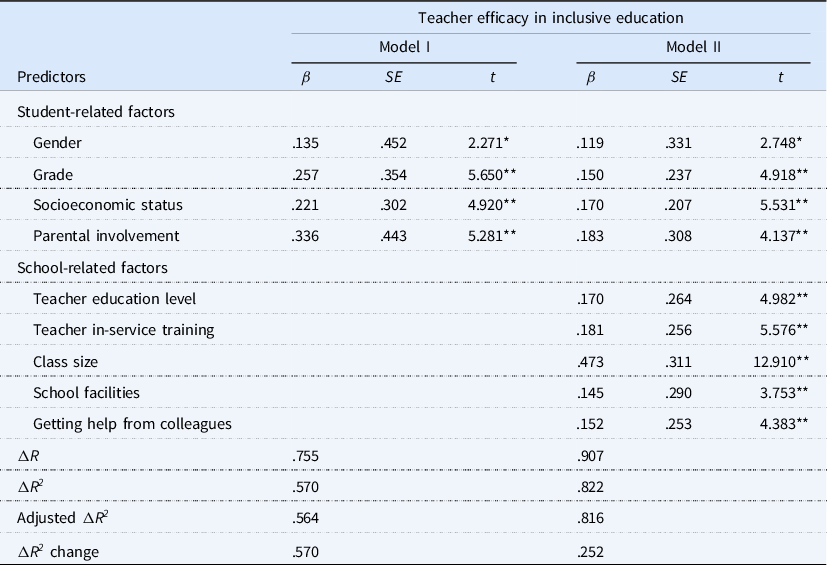
Table 2 shows the results of the multiple regression analysis conducted with teacher efficacy in inclusive education as the dependent variable and student-related and school-related factors as independent variables.
Standardised Regression Coefficients for Relations Between Student-Related Factors, School-Related Factors, and Teacher Efficacy in Inclusive Education
*p < .01. **p < .001.
The first equation in the research included as predictors only those variables associated with student-related factors. Multiple regression analysis indicated that student-related factors were significantly related to teacher efficacy in inclusive education, F(4,288) = 95.503, p < .05, and they explained 57% of the total variance, ΔR 2 = .570. Standardised regression coefficients in Model I showed that gender, β = .119, grade, β = .150, SES, β = .170, and parental involvement, β = .183, have significant effects on teacher efficacy in inclusive education. The absolute t values associated with Model I revealed that parental involvement was the most substantial predictor of teacher efficacy in inclusive education. Teachers feel themselves more efficacious in inclusive education when parents are more involved in their children’s schooling.
In the second equation, the second set of variables — school-related factors — was added to the first set of variables, which are student-related factors. Multiple regression analysis indicated that school-related factors were significantly related to teacher efficacy in inclusive education, F(9,283) = 144.994, p < .05, and they explained 82% of the total variance, ΔR 2 = .822. Standardised regression coefficients in Model II showed that teacher education level, β = .170, teacher in-service training, β = .181, class size, β = .473, school facilities, β = .145, and getting help from colleagues, β = .152, have significant effects on teacher efficacy in inclusive education. The absolute t values associated with Model II revealed that class size was the most substantial predictor of teacher efficacy in inclusive education. Teachers feel themselves more efficacious in inclusive education in classrooms where there are fewer students.
In sum, the set of student-related factors in Model I accounted for 57% of the variance. The combination of student-related factors and school-related factors in both models accounted for 25% of the variance in teacher efficacy in inclusive education. The analysis, in general, indicated that student-related factors as well as school-related factors are significant predictors of teacher efficacy in inclusive education.
Discussion
The present research aimed to examine the relative importance of student-related and school-related factors in accounting for teacher efficacy in inclusive education. First, the results of the research revealed that the set of variables categorised as student-related factors accounted for 57% of the variation in teacher efficacy in inclusive education. The research indicated that gender, grade, SES, and parental involvement have significant effects on teacher efficacy in inclusive education. Among the student-related factors, parental involvement was more effective in teacher efficacy in inclusive education compared to the other factors. That is, teachers feel themselves more efficacious in inclusive education when parents are more involved in their children’s schooling. Cooperation of parents with the teacher regarding the inclusion of the child positively affects the outcome of the education process (Smith et al., Reference Smith, Polloway, Patton and Dowdy2008). As the participation in education increases, the awareness of parents about the needs and abilities of their children increases; this means seeking support for the child outside of school (Leal et al., Reference Leal, Smith, Shank, Turnbull and Turnbull2002). Getting support from outside of school improves the quality of inclusive education of the child. By participating in the education process, parents can find more accurate solutions to the problems experienced by providing more conscious support to the development of their children (Smith et al., Reference Smith, Polloway, Patton and Dowdy2008). Parents who obtain information about how programs are carried out at school will help their children to repeat or apply what they have learnt at home, so this will ultimately increase the likelihood that the student will be accepted by their peers (Leal et al., Reference Leal, Smith, Shank, Turnbull and Turnbull2002). However, teachers have expressed concern about the lack parental involvement in inclusive education (Leyser & Kirk, Reference Leyser and Kirk2004), which can lead to problems in inclusive education. Inadequate parental involvement in schooling may prevent teachers from obtaining sufficient information about the child, which in turn can neutralise the strategies to be applied towards inclusive education.
The research also indicated that gender, grade, and SES, which are student-related factors, have significant effects on teacher efficacy in inclusive education. First, the research reported that gender is one of the important predictors of teacher efficacy in inclusive education. This implied that the gender of the student, whether male or female, does have an impact on teacher efficacy in inclusive education. This result revealed that teachers feel more efficacious with the inclusion of female students in particular, which suggests that they may experience hardships with the inclusion of male students. This result is in line with the research literature (Sadioğlu, Reference Sadioğlu2011), which has reported that the inclusion of male students may create problems for teachers, due to the nature of those students who are physically more active. Moreover, the grade level of students was found to have an influence on the efficacy of teachers in inclusive education. According to this result, teachers feel themselves more efficacious in lower grades in inclusive education, compared to upper grades in middle school. As the grade level of students rises, their ages also rise, which in turn can lead teachers to experience problems adjusting their instruction in terms of inclusive education to such students. The problem areas of those students are more diverse, in that they need a broad spectrum of instructional strategies, including direct teaching in academic areas, tutoring in subject areas, direct teaching in learning strategies, and self-control training (Mercer, Reference Mercer1997). In the research, SES of students was also found to have an influence on the efficacy of teachers in inclusive education. This result revealed that teachers feel more efficacious in the inclusion of high-SES students in particular. SES, which refers to the combination of parents’ income, education level, and the kinds of jobs they have (Sirin, Reference Sirin2005), exerts its most powerful influence at the lower income levels (Allington & McGill-Franzen, Reference Allington and McGill-Franzen2003). Poverty can have negative impacts on inclusive education, because parents from low SES backgrounds may lack the means to provide their child with access to out-of-school facilities, support services, and materials. Furthermore, high-SES parents can have higher expectations for their children and encourage them to succeed, compared to parents from low SES backgrounds (Brown et al., Reference Brown, Anfara and Roney2004). Moreover, low-SES parents are less likely to care about their children’s inclusive education (Leyser & Kirk, Reference Leyser and Kirk2004); thus, they pay less attention to the efforts made by teachers on the issue and provide less support to their children in out-of-school facilities.
Second, the results of the research revealed that the set of variables categorised as school-related factors accounted for 82% of the variation in teacher efficacy in inclusive education. The research indicated that teacher education level, teacher in-service training, class size, school facilities, and getting help from colleagues have significant effects on teacher efficacy in inclusive education. Among these factors, class size was found to be more effective in teacher efficacy in inclusive education, compared to other factors. According to this result, class size influences teacher efficacy in inclusive education; that is, teachers feel themselves more efficacious in classrooms where the physical conditions are adequate and where there are few students. The total number of students in the classroom negatively influences the success of inclusive education (McLeskey et al., Reference McLeskey, Waldron, So, Swanson and Loveland2001). Crowded classrooms prevent teachers from spending enough time on inclusive practices, thus making it difficult for the inclusive students to get the support they need (Soodak & McCarthy, Reference Soodak, McCarthy, Evertson and Weinstein2006). Research has indicated that class size has a significant impact on teacher efficacy (Kargın et al., Reference Kargın, Güldenoğlu and Şahin2010; Soodak et al., Reference Soodak, Podell and Lehman1998; Werts et al., Reference Werts, Wolery, Snyder, Caldwell and Salisbury1996), indicating that teachers can both cope with problems and implement necessary strategies easily in inclusive classrooms.
The research also showed that teacher education level, teacher in-service training, school facilities, and getting help from colleagues, which are other school-related factors, have significant effects on teacher efficacy in inclusive education. First of all, teacher education level was found to be significant on efficacy in inclusive education. This indicated that teachers with postgraduate-level education feel more efficacious in inclusive education compared to teachers with graduate-level education. Research literature has reported that teachers with a graduate-level education feel less efficacious in inclusive education (Sadioğlu, Reference Sadioğlu2011), claiming that graduate-level education does not prepare teachers sufficiently in order for them to confidently implement inclusive education practices. However, teachers need to have adequate expertise in teaching practice and evaluation in the successful outcome of inclusive education (Moran, Reference Moran2007); therefore, without having sufficient efficacy it seems difficult for teachers to implement instructional strategies for students with special learning needs (Tomlinson, Reference Tomlinson2005). On the other hand, parallel to teacher education level, teacher in-service training was also found to be effective in the efficacy of inclusive education. The teaching skills of teachers working in inclusive classrooms should be sufficient (Moran, Reference Moran2007); therefore, they need to be constantly trained in the education of students with special learning needs (McLeskey et al., Reference McLeskey, Waldron, So, Swanson and Loveland2001). Although adequate knowledge and skills of teachers are important in developing positive attitudes towards inclusive education (Voltz et al., Reference Voltz, Brazil and Ford2001), it is also of great importance for teachers to effectively practise inclusive education in the classroom. Teachers need to have a good understanding of the child and their specific learning needs and make classroom arrangements regarding educational practices and evaluations (Avramidis & Kalyva, Reference Avramidis and Kalyva2007). Providing teachers with the opportunity to receive in-service training before starting inclusive education helps them to be more successful in such an education (Migyanka, Reference Migyanka2006). Research has shown that these teachers can make more comfortable instructional implementations for inclusion students in the classroom (King-Sears & Cummings, Reference King-Sears and Cummings1996), meaning that teacher efficacy in inclusive education is significantly influenced by in-service training (Kargın et al., Reference Kargın, Güldenoğlu and Şahin2010). In the research, getting help from colleagues was also found to be effective in teacher efficacy in inclusive education. Teachers need to learn new strategies for inclusive education (Florian, Reference Florian2008); thus, they can engage in professional dialogue with colleagues, sharing ideas and knowledge and participating in collaborative problem-solving (Hernandez, Reference Hernandez2013). Thus, getting help from colleagues can promote the learning of all students, in that it can direct teachers to find solutions to instructional and behavioural problems (Meyen & Bui, Reference Meyen and Bui2007). Lastly, school facilities were found to be effective in the efficacy of teachers in inclusive education. Research has reported that school facilities are important determinants of an effective inclusive education (Hofman & Kilimo, Reference Hofman and Kilimo2014). The teaching and learning facilities schools provide may encourage teachers to use a variety of opportunities, such as materials, sports events, playgrounds, computer labs, and so on, to support the students who have special learning needs. When teachers have sufficient facilities within schools, they may use them in the inclusive education of students, which in turn may assist students with special learning needs to better progress in cognitive, social, and affective domains.
Limitations
The present research is not without its limitations. The research was conducted only in middle schools, which limited the generalisability of the findings. In the data collection process, teachers working in primary schools and high schools were not included in the research. Including teachers from all instructional levels in future research may improve the understanding of factors influencing the efficacy of teachers in inclusive education. In addition, the efficacy of teachers in inclusive education was measured in terms of student-related and school-related factors, excluding teachers’ personal characteristics. Teachers’ personal characteristics may have a significant influence on their efficacy in inclusive education. Another limitation is that the effect of the school curriculum as a factor was not included in the research. As a school-related factor, school curriculum may have an influence on teachers’ efficacy in inclusive education; it may create opportunities for teachers to implement a facilitative environment or it may deter teachers from meeting the needs of inclusive students. One further limitation may be that the results obtained from the research are based on the participating teachers’ self-report responses; therefore, it is assumed that the teachers gave sincere answers.
Conclusions
The findings of the present research showed that teachers’ efficacy in inclusive education is influenced by both student-related and school-related factors. The research indicated that student-related factors as well as school-related factors are significant predictors of teacher efficacy in inclusive education. Regarding the student-related factors, parental involvement, among the other variables in the research such as gender, grade, and SES, was more effective in teacher efficacy in inclusive education. Therefore, parental involvement is proposed in inclusive classrooms, where the teacher and parents collaborate for the improvement of students with special learning needs. This not only influences the improvement of the children in terms of cognitive, social, and affective aspects, but also improves teachers’ efficacy, which means that teachers feel better able to implement inclusive practices. Also, the findings indicated that school-related factors have a significant influence on the efficacy of teachers in inclusive education. The present research showed that teacher education level, teacher in-service training, class size, school facilities, and getting help from colleagues have significant effects on teacher efficacy in inclusive education. Among these factors, class size was found to be more effective in teacher efficacy in inclusive education, compared to other factors. Although education level, in-service training, school facilities, and getting help from colleagues are important aspects, class size is determined to be the leading factor in explaining teacher efficacy in inclusive education. This implies that teachers feel themselves better able to implement inclusive practices, mostly determined by the number of students in a classroom.