Introduction
Chronic rhinosinusitis is a common disorder of multifactorial origin involving inflammation of the mucosa of the nose and paranasal sinuses.Reference Fokkens, Lund and Mullol1 It would be useful, in everyday clinical practice, to be able to identify those chronic rhinosinusitis patients whose nasal obstruction includes a significant reversible mucosal component, as these patients may be more likely to respond to medical therapy.
Rhinomanometry, although considered to be the ‘gold standard’ for assessing nasal resistance,Reference Starling-Schwanz, Peake, Salome, Toelle, Ng and Marks2 is impractical for routine use in the out-patient setting. Nasal peak inspiratory flow (NPIF) is a more readily available alternative which can easily be used in out-patients, and which has been shown to have a reasonable correlation with rhinomanometry.Reference Holmstrom, Scadding, Lund and Darby3 Nasal peak inspiratory flow measures the highest airflow achieved through both nostrils during maximal forced nasal inspiration, and is fast, simple and cheap.
The change in NPIF following nasal decongestion, due to vasoconstriction and shrinkage of the nasal mucosa, provides an objective measure of the reversible mucosal component of nasal resistance. Patients with bony or cartilaginous deformities respond poorly to decongestants; diagnostic decongestion can therefore help to differentiate mucosal from structural components of nasal resistance.Reference Bermuller, Kirsche, Rettinger and Riechelmann4 One would expect that chronic rhinosinusitis patients with a greater change in NPIF following decongestion (implying a greater reversible mucosal component of nasal resistance) would respond better to the anti-inflammatory effects of topical nasal steroids. This should lead to a corresponding reduction in the 22-item Sinonasal Outcome Test score; this questionnaire is currently considered the ideal patient-centred outcome tool for chronic rhinosinusitis,Reference Hopkins, Gillett, Slack, Lund and Browne5 and includes a question on nasal blockage.
Our aim was to investigate this hypothetical correspondence further, by assessing whether the change in NPIF following maximal decongestion at first visit could predict the response to topical steroids, as measured by the 22-item Sinonasal Outcome Test, in patients with chronic rhinosinusitis.
Methods
We analysed our prospectively updated, computerised database and we reviewed our case notes for consecutive new adult patients (above 18 years of age) who presented with nasal obstruction due to chronic rhinosinusitis with and without polyps at Glasgow Royal Infirmary between January 2008 and July 2010.
We excluded the following patients: those who had taken a prolonged course of steroids prior to their first clinic visit (more than six weeks); those with previous sinonasal surgery; those with unilateral nasal obstruction; those with a significant, fixed, visible skeletal nasal deformity (e.g. deviated nasal septum); and those with a pre-decongestion NPIF of more than 120 l/min (considered to be the cut-off threshold between normal and pathological airflow).Reference Bermuller, Kirsche, Rettinger and Riechelmann4
Each patient was asked to complete the 22-item Sinonasal Outcome Test, and at their first clinic visit was assessed by a clinician and examined using rigid nasal endoscopy. In those patients whose main complaint was nasal obstruction thought to result from chronic rhinosinusitis with or without nasal polyps, NPIF was measured using a Youlten meter (Clement Clarke, London, UK), following a standardised protocol. The patient was asked to apply the face mask, obtaining an airtight seal, and then to inspire through the nose, following which the maximal flow rate was read from the meter. The highest of three readings was recorded.
A standardised protocol was then followed to maximally decongest the nose, by applying two puffs of lidocaine hydrochloride 5 per cent and phenylephrine hydrochloride 0.5 per cent topical solution to each nostril. After 10 minutes, the NPIF was reassessed, again recording the highest of three readings. The change in NPIF following nasal decongestion was then calculated by subtracting the pre-decongestion NPIF from the post-decongestion NPIF.
Patients were prescribed regular topical nasal steroids for at least six weeks, continuing until review within three months of initial assessment. Patients with polyps were given betamethasone nasal drops (two drops twice daily in each nostril), and those without polyps were given mometasone nasal spray (two puffs once daily in each nostril).
Each patient was reviewed six weeks to three months after their initial assessment. At this review, the 22-item Sinonasal Outcome Test was re-administered and the difference in questionnaire scores calculated by subtracting the post-steroid score from the pre-steroid score.
The change in NPIF following nasal decongestion and the change in 22-item Sinonasal Outcome Test score following steroid treatment were statistically analysed and the correlation between these two parameters assessed, including calculation of Spearman's rank correlation. Patients with polyps were analysed separately from those without polyps.
Results
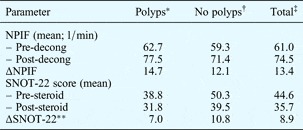
There were 128 chronic rhinosinusitis patients who fulfilled the inclusion criteria, all with complete data, of whom 51 patients (39.9 per cent) had polyps and 77 patients (60.1 per cent) did not (Table I).
Chronic rhinosinusitis patient data

* n = 51;
† n = 77;
‡ n = 128.
** Absolute value. NPIF = nasal peak inspiratory flow; ΔNPIF = post-decongestion NPIF − pre-decongestion NPIF; SNOT-22 = 22-item Sinonasal Outcome Test; ΔSNOT-22 = pre-steroid SNOT-22 score − post-steroid SNOT-22 score
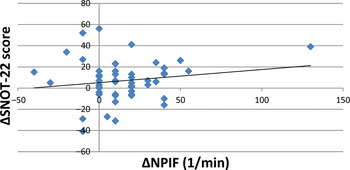
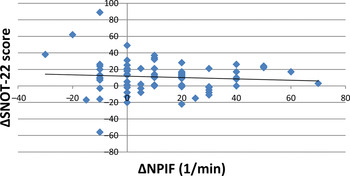
Correlation studies showed no relationship between the change in NPIF following decongestion and the change in 22-item Sinonasal Outcome Test score following steroid treatment, based on absolute values for chronic rhinosinusitis patients with polyps (Spearman rank coefficient = 0.088, p = 0.533) (Figure 1) and without polyps (Spearman rank coefficient = −0.031, p = 0.789) (Figure 2).
Change in nasal peak inspiratory flow (ΔNPIF) versus change in 22-item Sinonasal Outcome Test score (ΔSNOT-22; absolute values) for chronic rhinosinusitis patients with polyps.

Change in nasal peak inspiratory flow (ΔNPIF) versus change in 22-item Sinonasal Outcome Test (ΔSNOT-22; absolute values) in chronic rhinosinusitis patients without polyps.

Analysis was also performed based on percentage changes of the same two parameters. Similarly, no correlation was found, either for patients with polyps (Spearman rank coefficient = −0.010, p = 0.945) or without polyps (Spearman rank coefficient = 0.007, p = 0.950).
Discussion
These results show that the observed change in NPIF following maximal nasal decongestion at the first visit did not predict subsequent response to topical steroids as measured by the 22-item Sinonasal Outcome Test, in chronic rhinosinusitis patients both with and without polyps. Overall, our patients showed an increase in mean NPIF (from 61.0 to 74.5 l/min) following decongestion at first visit, indicating that they had an element of mucosal reversibility. Likewise, there was overall a corresponding improvement in sinonasal symptom scores, with a mean 22-item Sinonasal Outcome Test score reduction of 8.9 following a course of topical nasal steroids; however, we were unable to predict the response of individual patients.
Some authors have found a strong positive correlation between NPIF and the subjective sensation of nasal obstruction (as assessed by patient questionnaires).Reference Fairley, Durham and Ell6 However, others have reported that subjective and objective measurements of nasal obstruction do not always correlate.Reference Morrissey, Alun-Jones and Hill7 This study was based on changes, rather than absolute values, in NPIF and SNOT-22 in individual patients so this would have been less of a factor. However, we found wide inter-patient variation in the NPIF change following decongestion and the 22-item Sinonasal Outcome Test score change following steroid treatment. For example, one chronic rhinosinusitis patient without polyps had a post-decongestion NPIF change of 70 l/min but a post-steroid symptom score change of only 3, whereas another patient had corresponding changes of 0 l/min and 49.
• Identifying chronic rhinosinusitis patients with reversible nasal obstruction could prevent unneeded surgery
• Change in nasal peak inspiratory flow (NPIF) following decongestion can provide an objective measure of mucosal reversibility
• In this study, post-decongestion NPIF change did not predict symptomatic response to topical steroids
• Thus, NPIF measurement does not appear valuable in this setting
Following nasal decongestion, surprisingly, a few patients showed a decrease in NPIF. This parameter has been shown to be highly reproducible (although there is a training effect between the first and second NPIF readings,Reference Starling-Schwanz, Peake, Salome, Toelle, Ng and Marks2 hence our use of the best of three readings), so the observed increase in nasal resistance post-decongestion in these few patients is not easily explainable. Conversely, following their course of topical steroids some patients had a higher 22-item Sinonasal Outcome Test score, suggesting that their symptoms had worsened during the six weeks to three months after their initial consultation. This was found for patients both with and without polyps, and with a wide range of post-decongestion NPIF changes; thus, it was not possible to predict which patients would report worse symptoms.
Likewise, in their smaller study of 31 allergic rhinitis patients, Barnes et al. Reference Barnes, Biallosterski, Gray, Fardon and Lipworth8 found no correlation between acute response to xylometazoline decongestion and chronic response to mometasone furoate, as measured by NPIF, nasal forced inspiratory volume in 1 second, and nasal blockage score (using a 4-point scale from 0 to 3). This result agrees with our finding that, in chronic rhinosinusitis patients, the change in NPIF following maximal nasal decongestion at first visit did not predict response to topical steroids as measured by the 22-item Sinonasal Outcome Test and suggests that predicting subjective response to medical therapy in chronic rhinosinusitis is more complex.