INTRODUCTION
Mediterranean horse mackerel Trachurus mediterraneus (Steindachner, 1868) is an important commercial fish species distributed along the coast of Turkey. According to national fisheries statistics, anchovy and Mediterranean horse mackerel constitute the main catches in the Black Sea and the Sea of Marmara (TÜİK, 2011). In addition, this species is important for recreational fisheries in the Marmara region.
Many studies have examined the population, stock structure and reproductive biology of this species along the Turkish Black Sea coast (Ünlüata et al., Reference Ünlüata, Bingel, Bekiroğlu, Gücü, Niermann, Kıdeyş, Mutlu, Doğan, Kayıkçı, Avşar, Genç, Okur and Zengin1996; Turan, Reference Turan2004; Bektaş & Beldüz, Reference Bektaş and Beldüz2008). Previous reports on this species also include one on the fecundity and Black Sea spawning ground for the Black Sea stock (Pora, Reference Pora1979), one identification of the histomorphology of ovaries in fish caught in Egyptian waters (El-Gharabawy & Abdel-Aziz, Reference El-Gharabawy and Abdel-Aziz1988) and one description of ovarian development in the Bay of Biscay (Viette et al., 1997). Detailed studies of the reproductive biology and strategy of T. mediterraneus in the eastern Mediterranean were undertaken in the Saronikos Gulf (Karlou-Riga, Reference Karlou-Riga1995). Given its importance, there is a clear need for detailed reproductive studies of this species, especially in the Sea of Marmara, an area where there have been few accounts on the life history of the species (Slastenenko, Reference Slastenenko1956; Demir, Reference Demir1961).
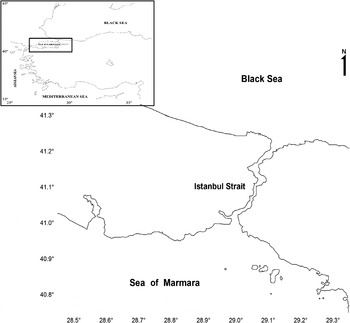
The Sea of Marmara (Figure 1) forms the transitional environment between the Black Sea and the Mediterranean Sea. This unique marine environment exchanges waters with the Black Sea through the İstanbul Strait (Bosphorus) and with the Mediterranean Sea through the Dardanelles Strait. In the Bosphorus, this exchange of water is achieved by a surface current entering from the Black Sea and a deep current flowing from the Mediterranean towards the Black Sea (Beşiktepe et al., Reference Beşiktepe, Sur, Özsoy, Latif, Oguz and Ünlüata1994). Kocataş et al. (Reference Kocataş, Koray, Kaya and Kara1993) defined the Sea of Marmara as an enclosed basin where Atlanto-Mediterranean originated commercial pelagic fishes spawn while migrating from the Mediterranean and Aegean Sea to the Black Sea. Besides the well-established importance of the Black Sea fisheries for Turkey, the catches from the Sea of Marmara, despite its small surface area (11,111 km2), constitute a significant fraction of catches in Turkey (TÜİK, 2011).
Map of the Sea of Marmara and sampling area.

There are no published data on the reproductive strategy of T. mediterraneus in the entire Mediterranean basin to compare with the results of the present study. However, many studies included experimental investigations conducted to identify fecundity type (Gordo et al., Reference Gordo, Costa, Abunza, Lucio, Eltink and Figueiredo2008), macroscopic and microscopic criteria of ovaries (Costa, Reference Costa2009), oocyte development, spawning frequency and batch fecundity (Karlou-Riga & Economidis, Reference Karlou-Riga and Economidis1997) for the related Atlantic horse mackerel Trachurus trachurus (L.), for which there has also been a comprehensive review of its biology (Abaunza et al., Reference Abaunza, Gordo, Karlou-Riga, Murta, Eltink, Garcia Santamaria, Zimmermann, Hammer, Lucio, Iversen, Molloy and Gallo2003). Detailed knowledge about the reproductive characteristics of a species in a given genus may be informative for related species, however, even different stocks of a species may show significant differences in reproductive strategy or fecundity (Hunter & Macewicz, Reference Hunter, Macewicz and Lasker1985a; Murua et al., 2003) or size at first maturity (Templeman, Reference Templeman1987), and whether or not this is the case for T. mediterraneus remains to be tested.
In this study, we present the reproductive characteristics of T. mediterraneus in the Sea of Marmara for the first time. Samples were collected monthly throughout a one-year period. Spawning season, gonad histology, oocyte development, batch fecundity and size at sexual maturity were examined. Finally, we document the differences of sexual maturity, batch fecundity, timing and duration of spawning from the Mediterranean stock.
MATERIALS AND METHODS
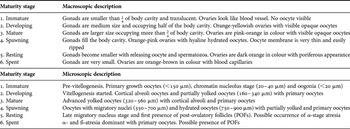
Samples were collected monthly from commercial fishing vessels in the north-eastern Sea of Marmara. These vessels caught fish by purse seine (mid-September to mid-May) and gillnet (mid-May to mid-September) in accordance with Turkish fishery law and allowances for small-scale fisheries in the summer season both in the Sea of Marmara and the Black Sea. Monthly water temperature and salinity at 5 m depths were recorded by a SeaBird 9/11 conductivity–temperature–depth system from a station that represents the hydrographical conditions of the sampling area. A total of 1224 specimens of T. mediterraneus (652 females, 533 males and 39 unknown) were collected from March 2009 to February 2010 (Figure 1). Fish were measured by total length (±0.1 cm) and total weights were recorded (±0.01 g). The gonads were removed, weighed (±0.001 g), and preserved in 10% buffered formalin. The developmental stages of gonads were determined with naked eye based on the general macroscopic criteria suggested by Murua et al. (Reference Murua, Kraus, Saborido-Rey, Witthames, Thorsen and Junquera2003) (Table 1). In order to identify the spawning season, temporal changes in the gonadosomatic index (GSI) were assessed using the relation:
 $$\hbox{GSI} = \lsqb \hbox{GW}/\lpar \hbox{W} - \hbox{GW}\rpar \rsqb ^{\ast} 100$$
where GW is the gonad weight and W is the total body weight. Size at first maturity was determined for both sexes with parameter estimation into logistic model given by King Reference King(1995):
 $$\hbox{p} = \lsqb 1 + \hbox{e}^{\lpar -{\rm r}\lpar {\rm TL} - {\rm L}_{50}\rpar \rpar }\rsqb ^{-1}$$
where p is the proportion of the mature stages of fish at each length-class, TL is the total length (cm) and L50 is the size at first maturity (cm). Statistical analyses were conducted using STATISTICA® (v. 8.0).
Description of gonad stages and oocyte development for Mediterranean horse mackerel in the Sea of Marmara.

Histological analyses were performed on 115 of the 652 female ovaries. Tissues were removed from the centre of each ovary, dehydrated and cleared in xylol before embedding in paraffin. Each tissue was sectioned in 4–6 µm thick slices and stained with Mayer's haematoxylin and eosin. Sections from each ovary were examined under light microscope between 20 and 100 × magnification and the diameters of oocytes were measured using the Leica image analysis software. Ovaries were classified according to: (i) developmental stages of most advanced oocytes (West, Reference West1990); and (ii) microscopic criteria of ovarian maturity (Hunter & Macewicz, Reference Hunter, Macewicz and Lasker1985a). We also examined α- and ß-atresia of yolked oocytes in ovaries through atretic states that were defined by Hunter & Macewicz Reference Hunter, Macewicz and Lasker(1985a, Reference Hunter and Macewiczb). According to their definitions, α-atresia was resorption of entire oocytes including yolk, and ß-atresia was the major degeneration and resorption of the follicles.
Oocyte development was followed by size–frequency analysis in whole mount of preparation of pre-spawning ovaries. Oocytes (≥100 µm) were measured in diameters and classified in 50 µm ranges. However, oocytes are rarely exactly round in shape and it can be difficult to choose the right axis for measuring the diameter. For this reason we performed oocyte diameter measurements using the open software ImageJ and the rapid method developed by Thorsen & Kjesbu (Reference Thorsen and Kjesbu2001). Examination of oocyte development makes it possible to identify reproductive strategies of species such as ovary organization, fecundity type and spawning pattern (Murua et al., Reference Murua, Kraus, Saborido-Rey, Witthames, Thorsen and Junquera2003).
Previous studies performed investigations on the homogeneity of the lobes in gonads and pointed out that no significant difference existed between left and right lobes in fish species (Hunter et al., Reference Hunter, Lo, Leong and Lasker1985). We also estimated batch fecundity with whole mount preparations of gonads separately for left lobes and for right lobes in 30 females. As expected, no significant difference was found in batch fecundity estimation between right and left lobes (analysis of variance (ANOVA), F = 0.0730, P > 0.05). Because of the low number of hydrated females sampled (N = 2), we used two methods for estimating batch fecundity. Firstly the hydrated oocyte method, which applies to females with hydrated oocytes, and secondly the oocyte size–frequency method (Hunter et al., Reference Hunter, Lo, Leong and Lasker1985), which applies to females with migratory nucleus or early hydrated oocytes. Hunter et al. (Reference Hunter, Lo, Leong and Lasker1985) pointed out that if highly advanced oocytes (≥500 µm) are used for batch fecundity estimation, the results become usually similar to the hydrated oocytes methods. Taking into account these considerations, three subsamples, weighing 30–50 mg, were taken from anterior, middle and posterior part of the ovaries. The relationships between number of eggs per batch (BF) and total length (TL) and ovary free weight (Wof) were determined by linear regression. Additionally, batch fecundity was estimated by six size-classes and two months separately. ANOVA models were used to test differences of the estimated values to evaluate the effects of size and season.
RESULTS
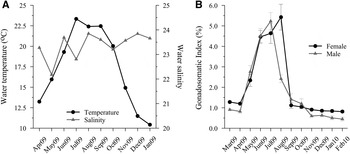
Temporal changes in GSI for both sexes were used to determine the spawning season of T. mediterraneus in the Sea of Marmara (Figure 2B). GSI values started to increase in May (2.0–2.5%), peaked in July–August (4.0–6.0%) and decreased in September (1.5–2.0%). Values were very low (0.5–1.0%) in the late spring and winter seasons. A sharp decrease in the female GSI was observed after August while male GSI values were decreasing gradually.
Hydrographical conditions and mean gonadosomatic index values in the sampling area. (A) Monthly distribution of water temperature and salinity; (B) monthly changes of mean gonadosomatic index (GSI%) for female and male with ±SE.

Temporal trends in water temperature and salinity were observed at a depth of 5 m in 4 stations (Figure 2A), and these measurements represent the hydrographical conditions in the sampling area. Water temperature was lower in the winter period (10–150C) and started to increase from May (>150C) and the highest values were recorded in June and July (20–240C). Water temperature started to decrease quickly in September (>200C) and the lowest values were recorded in January (~100C). Water salinity was at stable values (around 22–24) in the region throughout the year.
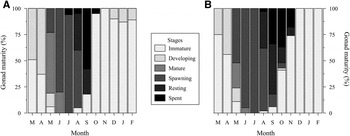
Macroscopic stages of gonads verified that temporal changes in GSI values indicated the reproductive period (Figure 3). As expected, gonads were inactive (stage 1) from September to April. Developing processes (stage 2) were observed in April, and later gonads became mature (stage 3) in May. Ripening gonads at spawning (stage 4) were most frequently observed in the samples collected in June and July. At the end of the spawning season gonads started to reduce in size and resting stages (stage 5) were evident. After the spawning season, almost all gonads were found at the recovering condition (stage 6) during September. Resting and spent ovaries (stages 5 and 6) were observed frequently in August (Table 1; Figure 3).
Monthly frequency distribution of macroscopic gonad stages for females (A) and males (B) in the Sea of Marmara.

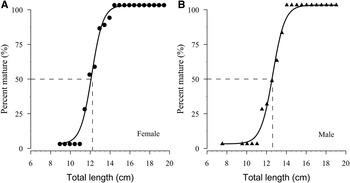
The mean sizes at first maturity were estimated by logistic regression. Females reach maturity at smaller sizes than males. Sizes at 50% maturity in females were 12.2 cm (Figure 4A) and in males were 12.5 cm (Figure 4B). All collected samples were mature by 14 cm TL.
Maturity oogives estimated for female (A) and male (B) Trachurus mediterraneus in the Sea of Marmara.

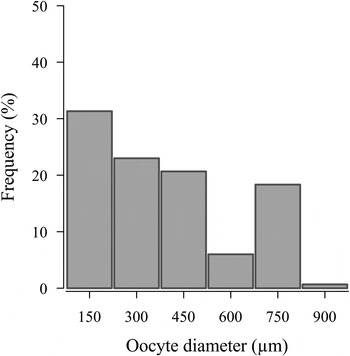
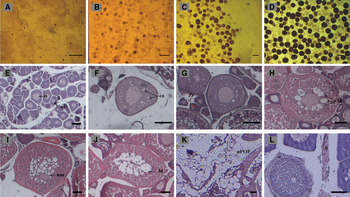
Ovary organization of T. mediterraneus indicated asynchronous oocyte development which defines the presence of different oocytes stages. According to the distribution of oocyte size–frequency results (Figure 5), a continuous range of diameters from primary growth to the migratory nuclei oocytes also provides the asynchronous organization for this species. Primary growth or pre-vitellogenic stage oocytes (<150 µm) were defined by one nucleus with a few nucleoli that arranged themselves around it. Early vitellogenesis or yolked formation followed primarily yolk vesicle appearance in cytoplasm (cortical alveoli), constitution of zona radiata and lipid droplets accumulation (160–340 µm). Late vitellogenesis or advanced yolked oocytes were distinguished with well-formed zona radiata, lipid droplets increasing in number and deformation of nucleus shape (320–560 µm). Oocytes with migratory nuclei were 550–700 µm in diameter and hydrated oocytes were easily separated with their size and hyaline appearance (750–900 µm). Thus, it follows that every stage of developing oocytes were random cohorts in the ovaries and no size-hiatus was observed in the oocyte size–frequency distribution (Table 1; Figure 6). In light of these data it was concluded that T. mediterraneus is an indeterminate batch spawner.
Frequency distribution of oocyte diameter from the ovary of Trachurus mediterraneus females sampled in July 2009 from the Sea of Marmara.

Oocyte development stages of Mediterranean horse mackerel. Whole oocytes on the slices (A–D) and histological sections (E) primary oocytes, (F–G) early vitellogenesis, (H) late vitellogenesis, (I) migratory nucleus, (J) late migratory nucleus, (K) new-post ovulatory folicles, (L) α- and β-atresia. n, nucleus; ni, nucleoli; ca, cortical alveoli; Zr, zona radiata; g, granulose cells; ld, lipid droplet; mn, migrating nucleus. Scale bars = 500 μm (A–D) and 100 μm for (E–L).

Yolked and migratory nuclei oocytes were observed in individual ovaries, which indicated that fish may spawn multiple times in a given season. Also, the presence of advanced yolked oocytes and post-ovulatory follicles (POFs) in the ovarian samples showed that fish continuously developed new spawning batches as a typical batch spawner. Ovary samples taken in July were found with α-stage atresia. Early stage atretic follicles were recognized in six ovaries (of fish 12.5–13.2 cm TL). These were among the advanced stage oocytes of the peak spawning season.
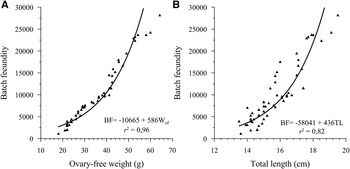
Eighty-six female gonads (2 with hydrated oocytes and 84 with migratory nucleus stages) that were sampled in the spawning period were used to estimate batch fecundity. No significant differences were found between the batch fecundity estimation of hydrated and non-hydrated oocytes (P > 0.05). Batch fecundity was calculated as 1058–28116 eggs for fish ranging in total length from 13.5–19.5 cm and in ovary-free weight from 18–64 g. Relationships between batch fecundity and ovary-free weight (Figure 7A), batch fecundity and total length (Figure 7B) were found to be strongly correlated (r2 = 0.96 and r2 = 0.82 respectively). Linear regression analysis between batch fecundity (BF) and ovary-free weight (Wof) resulted in the following equation:
 $$\hbox{BF} = -10638 + 588\hbox{W}_{\rm of} \lpar \hbox{r}^{2} = 0.95\rpar$$
Modal group of female weight in the examined females was 35.4 g (15.7 cm TL). According to this equation, batch fecundity size was found as 10136.6 ± 703 oocyte/individual. The term ‘relative batch fecundity' implies the number of oocytes per g fish weight and this value was calculated as 287 oocyte g−1.
Relationship between batch fecundity–ovary-free weight (A) and batch fecundity–total length (B) for Mediterranean horse mackerel during the spawning season of 2009–2010.

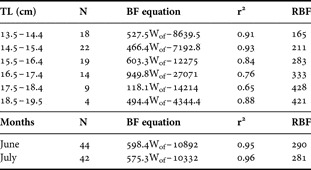
Batch fecundity and 6 size-class relationships were described by linear models separately (Table 2). Batch fecundity estimates between size-classes were significant (ANOVA, F = 67.209, P < 0.05), whilst no significant differences were found between months (ANOVA, F = 0.046, P > 0.05; Table 2). The differences among size-classes were the expected results that larger fishes were capable of producing more eggs relative to body mass (Murua et al., 2003).
Estimated batch fecundity (BF) and relative batch fecundity (RBF) in size-classes and months.

TL, total length.
DISCUSSION
In this study, reproductive aspects and spawning patterns of T. mediterraneus were studied. Considering the monthly variations in GSI values and development of gonads, it was clear that T. mediterraneus spawns in the summer in the Sea of Marmara. Spawning started in May, peaked in July–August and ended in September. However, the spawning season extended to October for males. Similar conditions for the same species were underlined by Viette et al. (Reference Viette, Giulianini and Ferrero1997) as a reproductive strategy to ensure fertilization of the eggs released from late spawners. The spawning period of this species in the Sea of Marmara was given as March to August by Slastenenko (Reference Slastenenko1956), which is actually the only previous reference for this sea. Previous studies performed in different seas mainly found summer spawning periods, with some minor differences (Ünlüata et al., Reference Ünlüata, Bingel, Bekiroğlu, Gücü, Niermann, Kıdeyş, Mutlu, Doğan, Kayıkçı, Avşar, Genç, Okur and Zengin1996; ; Viette et al., 1997; Karlou-Riga, Reference Karlou-Riga2000). Regional differences in spawning time of a species may be the result of synchronization with the zooplankton bloom for the successful first-feeding of larvae (Otterå et al., Reference Otterå, Agnalt and Jørstad2006).
Sizes at 50% maturity of T. mediterraneus in the Sea of Marmara were found to be 12.2 and 12.5 cm TL for females and males, respectively. Our results were compatible with the results from the Black Sea by Pora Reference Pora(1979: 11.8 cm fork length). On the other hand, our results showed significant differences from the results of the studies performed in the Mediterranean Sea. Ragonese et al. (Reference Ragonese, Fiorentino, Garofalo, Levi, Gancitano, Giusto, Rizzo and Sincori2002) reported first maturity of T. mediterraneus to range between 17.0 and 22.4 cm TL from the Spanish coast to the Aegean Sea (including the Gulf of Lion, Adriatic Sea and Ionian Sea). Significant differences in the size at maturity may be the result of stock differentiation between the Mediterranean Sea and the Sea of Marmara. Templeman (Reference Templeman1987) underscored the importance of the differences in size at sexual maturity between fish populations as an indicator of fishing pressure or other causes. However, many studies also argued for a different stock structure of T. mediterraneus in the Black Sea, the Sea of Marmara and Mediterranean Sea on the basis of phylogenetic, morphological and genetic characteristics (Prodanov et al., Reference Prodanov, Mikhailov, Daskalov, Maxim, Chashchin, Arkhipov, Shlyakhov and Özdamar1997, Turan Reference Turan2004; Bektaş & Beldüz Reference Bektaş and Beldüz2008). Although considerable differences have been discussed for a long time, stock structure of the T. mediterraneus is still controversial. Hypotheses include the presence of a different stock (Turan, Reference Turan2004; Bektaş & Beldüz, Reference Bektaş and Beldüz2008) or a subpopulation of the Black Sea stock (Prodanov et al., 1997) in the Sea of Marmara. Therefore, without extensive sampling covering the whole Sea of Marmara, we think that the idea of the existence of a different Marmara stock would not be substantiated.
Oocyte development in T. mediterraneus was found to be asynchronous with indeterminate fecundity. Observations of all stages of oocytes, with a continuous size distribution and no distinct hiatus in the pre-spawned ovaries were defined as asynchronous ovarian organization and indeterminate fecundity type (Hunter et al., Reference Hunter, Lo, Leong and Lasker1985; Murua et al., 2003). We found yolked oocytes and oocytes with migratory nuclei together in the mature ovaries during the spawning season and a clear size separation was only observed in the hydrated oocytes, which were found in limited numbers. Those results are similar for batch spawners that were defined as the continuity of spawning activity throughout a typically protracted spawning season (Hunter et al., 1985). Additionally, we observed POFs and yolked oocytes together in the mature ovaries during the spawning season that indicated spawning occurs multiple times. In order to determine the end of the spawning season accurately, the proportion of α-stage atretic follicles in the ovary are usually considered (Hunter & Macewicz, Reference Hunter, Macewicz and Lasker1985a). On the contrary, we recognized α-stage atresia in the ovary of small females which were classified as recently matured during the active spawning time. In general, females spawning for the first time are expected to have higher atretic rates and shorter spawning season than the rest of the population (Hunter & Macewicz, Reference Hunter and Macewicz1985b). Moreover, Hunter & Macewicz Reference Hunter, Macewicz and Lasker(1985a) suggested that a low percentage of females in the population might be found with atresia in the early months of spawning and this does not necessarily signify the end of season. Females sampled in September contained primary growth oocytes but the remaining advanced oocytes in the ovary were resorbed and subsequently went through α- and ß-atresia (Hunter & Macewicz, Reference Hunter, Macewicz and Lasker1985a).
Previously, limited fecundity data were available for T. mediterraneus in the Mediterranean basin. Pora (Reference Pora1979) reported batch fecundity values between 2369 and 46,200 eggs for fish ranging from 11.8–19.5 cm fork length caught in the Black Sea. We found batch fecundity to be 1058–28116 eggs for fish ranging in total length from 13.5 cm to 19.4 cm that refers to an almost similar size-range but lower fecundity compared to that study. Fecundity estimation of fish species is highly dependent on environmental and biological factors (Murua et al., 2003). It is well known that the Black Sea and the Sea of Marmara differ in their specific hydrographical conditions such as temperature, salinity and dissolved oxygen levels (Beşiktepe et al., Reference Beşiktepe, Sur, Özsoy, Latif, Oguz and Ünlüata1994) and species compositions (Kocataş et al., 1993), which could influence the different results discussed here. On the other hand, Karlou-Riga (Reference Karlou-Riga1995), reported that batch fecundity varied between 17,977 and 155,747 eggs for females 93–366 g (ovary-free weight) and relative batch fecundity was calculated as 403 oocytes.g−1 for the samples taken from the Saronikos Gulf. Samples collected in our study ranged between 18 and 64 g (ovary-free weight) that presented a much smaller size-range and should be considered the reason for lower relative batch fecundity compared to Karlou-Riga (Reference Karlou-Riga1995).
Our study provided a considerable amount of new information on the reproductive biology and strategy of T. mediterraneus and forms the basis of further studies in the Sea of Marmara. Future work on spawning frequency and location of spawning grounds may provide a more complete understanding for improved fisheries management of T. mediterraneus.
ACKNOWLEDGEMENTS
We thank J. Ellis and M. Yücel for their valuable contribution to editing of the draft manuscript, E. Murat-Dalkara for her help in laboratory analysis, N. Yılmaz for his collaboration in sample collection, C. Demirci-Tansel and B. Ergin from the Department of Zoology, Istanbul University, for their help with using the microtome and sectioning. This study represents part of a PhD thesis submitted to the Institute of Marine Sciences and Management, Istanbul University, Turkey.