Introduction
Companies in the food industry are driven to improve their traceability for several reasons. Primary among these are food safety and legal aspectsReference Coff, Barling, Korthals and Nielsen1. Another is the increased interest among consumers in imperceptible product attributes such as organic, fair trade, dolphin-safe and non genetically modified (non-GMO). This has led to an emergent area for actors to engage in gaining and maintaining traceability to ensure these qualities and to communicating them to consumersReference Coff, Barling, Korthals and Nielsen1. Such attributes are, however, hard to distinguish since they cannot be judged either on their appearance or on past experienceReference Michalopoulos, Korthals and Hogeveen2. Thus, they generally require more qualified traceability to verify their existenceReference Zsidisin and Ritchie3. One concrete example is the growing trend toward organic food and the importance of origin to consumers. This trend is driven in part by consumers' increased concern for food safety, animal welfare, as well as the environmental and ecological impact of food processing and productionReference Tavernier4. A future challenge for companies is how to ensure and communicate to consumers that their organic products are organic in all aspects from farm to fork (i.e., the entire food system).
Both products and activities are important entities to trace5, Reference Moe6. For products to be traceable, unique identification of them or of groups of products is required. This can be achieved through labeling directly on the product or package and through record keeping. The activities have to be traceable to describe the history of a product through the different processes/activities it passes on its way through the supply chain (SC)Reference Moe6. The history of a food product can include practical, physical as well as ethical aspectsReference Coff, Barling, Korthals and Nielsen1.
Chain traceability is dependent on the participation of all the actors in the SC. Successful implementation calls for co-operation among them allReference Kelepouris, Pramatari and Doukidis7, Reference Viaene and Verbeke8. As in all chains, the weakest link determines its capacity. In the SC management literature, the importance of collaboration is also highlighted as a general concern. Since today's competition is no longer between companies, but rather between SCsReference Mentzer, DeWitt, Keebler, Min, Nix, Smith and Zacharia9–Reference Lambert and Cooper11, managing complex food SCs has proven to be challenging. It is imperative that all actors contribute to successfully maintain traceability throughout an SC.
This challenge is shown, for instance, when companies assume that by optimizing their own interests they also maximize the SC's interests. To overcome sub-optimization in a food system or SC, it has been suggested that management focus on aligning the incentivesReference Narayanan and Raman12. Contracts, sharing of information and trust are different ways to govern the relations and align the incentivesReference Narayanan and Raman12, Reference Norrman, Persson and Jahre13. A contract is the solution that Narayanan and RamanReference Narayanan and Raman12 most strongly suggest. Coming from a more sociological research tradition, BromReference Brom14 focuses on the importance of building trust in the relations between actors in an SC.
It is thus of great importance to understand these relations as well as the actors' different objectives for engaging in traceability. This paper describes the relations between the actors in an SC in an organic food system. It examines the objectives the actors have for gaining and maintaining traceability throughout the chain. The focus on organic relates to the challenge for the companies to ensure this imperceptible product attribute throughout the entire food system. The core research question is: Why do actors in food SCs want to gain and maintain chain traceability?
The paper starts with a theoretical elaboration of three categories of objectives for food system traceability derived from the research literature. This is followed by method and case descriptions. Results from the study are then analyzed. The paper concludes with practical aspects of traceability and their use in the food system, linking them to the theoretical aspects.
Objectives for Food Traceability
Actors in food SCs have different objectives for their efforts to gain and maintain traceabilityReference Coff, Barling, Korthals and Nielsen1, Reference Moe6, Reference Golan, Krissoff and Kuchler15–Reference Furness, Osman and Lees18. According to Golan et al.Reference Golan, Krissof, Kuchler, Calvin, Nelson and Price16, ‘different objectives help drive differences in the breadth, depth and precision of traceability systems’. These objectives play an important role in chain traceability, since one actor's objectives place demands or limitations on the traceability in the SC and thereby on other actorsReference Moe6.
The objectives found in the literature can be grouped into categories. Inspired by Golan et al.Reference Golan, Krissof, Kuchler, Calvin, Nelson and Price16, three categories of objectives were selected: food safety and quality, managing the SC and internal resources and communication with consumers.
Food safety and quality
Food safety is a consumer concernReference Brom14 and deals with whether or not food is fit for consumptionReference Deblonde, Graaff and Brom19. Although food safety is considered an obligation to the consumer that has to be assured by governments through legislation and regulationsReference Deblonde, Graaff and Brom19, several illnesses caused by food-borne pathogens are still reported every year. The number of unrecorded cases is estimated to be large according to the Swedish National Food Administration20. Legislation can be regarded as ‘a driving influence in this respect’, according to Furness and OsmanReference Furness, Osman and Lees18.
Food quality of today is a complex concept with several componentsReference Deblonde, Graaff and Brom19. It does not only encompass the traditional view of appearance (looks good), technical quality (tastes good) and biological quality (does good or at least no harm), but also includes aspects that express cultural, environmental and ethical valuesReference Beer, Eastham, Sharples and Ball21.
Traceability is considered essential for food safety and quality control since it helps companies isolate products with deficiencies and find the causeReference Golan, Krissof, Kuchler, Calvin, Nelson and Price16. Hence, traceability can contribute to resolving food safety and food quality problems. An incentive for companies to invest in traceability is the potential reduction of the production and distribution of unsafe or poor-quality products. This minimizes the risk for bad publicity, liability and recalls. However, traceability as such does not provide safer food. It only offers information as to whether or not control points along the SC have been metReference Golan, Krissof, Kuchler, Calvin, Nelson and Price16.
Managing the supply chain and internal resources
Managing the SC marks the difference between the successful and failed firmsReference Golan, Krissof, Kuchler, Calvin, Nelson and Price16. This is because the movement, storage and control of products through the chain are very costly and of competitive importance for companies. This is particularly the case in the food industry where margins are low. The traceability system can be an important tool in such competition as a crucial way of determining the most efficient way to produce, assemble, warehouse and distribute products. The more co-ordination is valued in the SC, the greater will be the benefits from a traceability systemReference Golan, Krissoff and Kuchler15, Reference Golan, Krissof, Kuchler, Calvin, Nelson and Price16. The interaction and relations between companies in an SC affect the overall traceability from farm to fork, and it is argued that the performance of an SC can be improved by alignment of the actors' incentives through contracts, sharing of information and/or trustReference Narayanan and Raman12.
Ghosh and FedorowiczReference Ghosh and Fedorowicz22 state that trust, power and contracts are important elements in enabling relationship governance between different actors in an SC. Their study shows that ‘trust works in conjunction with power and contracts’. However, they point out that when the power is exercised it is likely to have a negative impact on trust. Contracts can be used to increase the level of trust between actors in cases of unequal power levels, emanating from, for instance, differences in company sizeReference Ghosh and Fedorowicz22. Poppo and ZengerReference Poppo and Zenger23 and Seshadri and MishraReference Seshadri and Mishra24 conclude that trust and contracts are complementary and not substitutes for one another as researchers in sociology and economics in general claimReference Norrman, Persson and Jahre13, Reference Poppo and Zenger23.
Co-ordination in the SC is needed to ensure not only a timely flow of materials and information. It also influences traceability, which is dependent on the flow of materials and the recorded information along the flowReference Ghosh and Fedorowicz22.
Communication with consumers
The shift in perception of food quality among consumers from the traditional view to more qualitative aspects reflects increased concern for the environment, animal welfare and culture, according to BeerReference Beer and Edwards25. He states that these qualitative aspects carry associated costs, but also provide companies in the SC with an opportunity for differentiation and premium pricesReference Beer and Edwards25.
With the food we choose, we make a statement about our identity and connect ourselves with other people who make the same kind of food choicesReference Coff, Barling, Korthals and Nielsen1.
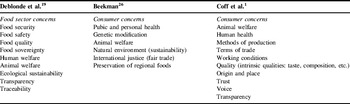
BeekmanReference Beekman26 states that consumer concerns can also regard: (i) public/personal health, (ii) genetic modification, (iii) animal welfare, (iv) natural environment (sustainability), (v) international justice (fair trade) and (vi) preservation of regional foods. He calls theseReference Beekman26 ‘moral concerns’ as they all ‘go beyond merely personal interests like availability, convenience, price and taste’. BeekmanReference Beekman26 elaborates on the distinct difference between the first two and the others. With the first two, ‘it is perfectly possible to test products to ensure the accuracy of information about food safety or genetically modified ingredients’, whereas the last four ‘qualities can only be verified with the help of recorded identifications of product (hi)stories through the food chain’. There is also a relation between consumers' preferences for organic food and their concerns for the above-mentioned parameters, such as animal welfare or the environmentReference Tavernier4. Michalopoulos et al.Reference Michalopoulos, Korthals and Hogeveen2 agree that consumers nowadays have concerns or preferences regarding ‘imperceptible’, ‘intrinsic’ or ‘unobservable’ food characteristics that cannot be judged either on their appearance or on past experience. The absence of appropriate information on imperceptible food characteristics limits the ability of concerned consumers to consider ethical issues in their food consumption and purchasingReference Michalopoulos, Korthals and Hogeveen2. Consumer concerns thus present an opportunity for food companies or SCs to communicate added values to consumers at the point of purchase. Table 1 presents a framework of concerns derived from the food sector and from consumer concerns. The challenge for companies is to turn the traceability concerns of the actors in the SC into value-added information that attracts consumers.
List of food industry and consumer concerns.

Method
This paper presents an exploratory, single case study including several actors in a food system providing organic ice-cream products. It includes companies mainly, but not exclusively, situated in Sweden. The case study was chosen as a research strategy in accordance with YinReference Yin27. This allows for an in-depth understanding of the contemporary phenomena being examined in the selected food system. It is a preferred strategy when the study is exploratory in natureReference Yin27.
The study was conducted in the food industry since chain traceability is a current topic in that sector. This is due not only to recent food scares and tougher legislation in Europe, but also to increased consumer concerns.
This research aims to gain knowledge of traceability interactions between SC actors. A systems approach was thus applied, since the sum of the traceability performances within the companies does not necessarily equal the total traceability performance of the entire SC. The issues examined are described and elaborated from the characteristics of the whole food system, since the knowledge is dependent on the entire system.
Case description—the food system studied
The focal company was chosen because it was a special case, due to interesting characteristics. It produces entirely organic food products and is about to engage in a change process to make its entire SC more transparent. The goal of this change is to better communicate the organic product attribute and its origin to the consumers. Traceability is high on the company agenda due to customer and consumer demands, and the company's internal strategy of food safety and quality control. Information from the company was easily accessible due to their genuine interest in organic food and traceability.
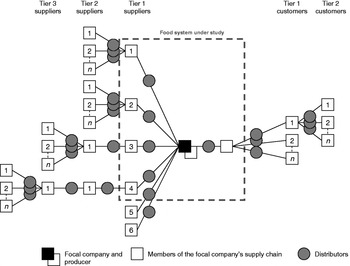
This case study encompasses the four main suppliers of ingredients (milk/cream, sugar, eggs and flavor) of a specific ice-cream product in the focal company's product range. In addition to the four suppliers, the focal company (the brand owner), the producing company and one distributor are included (see Fig. 1).
The different actors (the amounts of actors are illustrated by the numbers) in the SC for the product studied, inspired by Lambert and CooperReference Lambert and Cooper11, and the selected focus of the study (i.e., the food system under study).

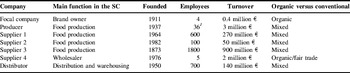
The focal company has a long and strong tradition of being careful with ingredients; trust and personal relations are of great importance when choosing suppliers. In 1993, the company was KRAV certified (KRAV develops organic standards and inspects food and food products to meet these standards in Sweden). All of the products of the focal company are organic. In recent years, they have outsourced their production to another company, which is family-owned and also recognized for manufacturing quality products (information provided by the production company and their homepage). The vision of the focal company is to communicate product attributes, such as origin and production history to the consumer through their web page and packaging. Key characteristics of the companies involved are presented in Table 2.
Key characteristics of the companies involved.

1 Yearly average.
Data collection
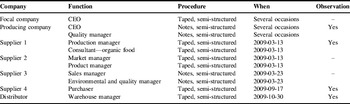
Data were collected through semi-structured interviews, a review of internal documents and observations of the production and the storage sites. The observations followed the flow of products through the process and were conducted to achieve a clear picture of the process. This is in line with YinReference Yin27 who argues that the data in a case study can come from many different sources. Respondents and interview procedures are presented in Table 3. The interviews were complemented with a survey completed by the participating companies to encompass quantitative aspects of the actors' traceability objectives. The survey consisted of 19 statements regarding traceability objectives. The respondents indicated on a five-point scale if they agreed, partly agreed, had no opinion, partly disagreed or disagreed.
Interview respondents and procedure.

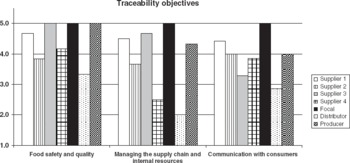
The collected data from the interviews were analyzed by coding the interview material into different thematic groups related to the actors' traceability objectives and the interaction between the actors. The data from the survey were analyzed through graphical comparisons as shown in Figure 2.
Aggregated survey answers in the three categories of traceability objectives indicated on a five-point scale (1–5) if they disagreed, partly disagreed, had no opinion, partly agreed or agreed.

Observations were used to gain deeper insights and an overall understanding of the actual physical flow and the related flow of information.
Why Actors Engage in Traceability—Empirical Results
The interviews all revealed that the focal company, as well as its suppliers, considers traceability an important matter. A contributing reason mentioned by most of the respondents was a change in consumer needs to know more about products, such as imperceptible attributes. In line with this, they prioritize the objective of communicating with the consumers.
The chief executive officer (CEO) of the focal company used herself as an example of a consumer when explaining why the focal company engages in traceability. As a consumer she wants to know what she is buying, how it is transported and where it is from. If the product is labeled ‘organic’, she wants to be sure that it is entirely organic. Based on the CEO's personal values, the bottom line of the focal company is to ‘provide more information to the interested consumer’ through traceability. In addition, this ambition to use traceability leads to increased food safety. The company plans to inform consumers about the origin and history of the product and its ingredients, either through a web page or through supplier information on the package.
The producer stated that legal compliance is an important reason as to why they engage in traceability. They also emphasize the importance of being able to quickly follow up on mistakes, such as where in the process a problem has occurred. Another reason is the ability to proudly sell their products and be confident that they measure up to the company policy of selling high-quality products.
Supplier 1 stated that they have experienced an increased desire among consumers for more information about the products, such as origin. Hence, the supplier is now working to refine the traceability to meet this consumer-driven request. Supplier 1 was at the time of the interview soon to launch a traceability system (which is now up and running) where the consumer can see what geographical areas the product comes from and its history from farm to fork through the company website. This is a new approach for the company, where traceability is used to communicate product attributes to the consumers. Before, traceability was used only to ensure food safety and quality. The supplier hopes through this ‘communication with the consumer’ to develop a closer relation with the consumer through traceability and to generate interest. The supplier also stated that at the end of the day, the goal of making more money has an impact on why they engage in improving their traceability.
Supplier 2 mentioned that the primary objective for which they engage in traceability is not only legal requirements, but also monetary reasons. They want to avoid loss and facilitate follow-ups as organic products are more expensive than conventional ones. Traceability according to the focal company's aim is regarded by supplier 2 as an opportunity and means of gaining a competitive edge by describing their excellence. This is especially true when it comes to industrial products, since suppliers are not normally displayed on or in connection with the final product.
Supplier 3 mentioned an increased demand from the consumers for fair trade and organic products: ‘Consumers care about where it comes from and how it is handled’.
Supplier 4 did not usually think in terms of traceability, but when doing so it was primarily as a means to trace products downstream through the best-before-date in case of a recall. When it comes to traceability upstream, the objective is to visualize the origin of the product, and foremost the producer, because that is one of the core values of the company. Supplier 4 also mentioned improved quality but rather as a beneficial outcome than an objective for engaging in traceability.
The distributor, who also warehouses the finished products, states that legal requirements are an important objective, although the company had traceability long before it became a legal stipulation. He mentioned that it was very important for them to have control of product location. But it is also an economical issue, as many of the products are very expensive.
The results from the surveys of the different actors' objectives for engaging in traceability are summarized under three main categories in Figure 2: food safety and quality, managing the SC and internal resources and communication with consumers. These categories are based on the literature study, and the survey was structured according to the same categories.
The survey confirms the results from the interviews that all actors want to engage in traceability. However, they have different priorities for different objectives, as shown in Figure 2. The focal company graded all categories as having the highest priority, while it is clear that the main objectives vary among the actors.
Analysis and Discussion
The interviews and survey results in accordance with the literature reveal that actors in food SCs have different objectives for their engagement in gaining and maintaining traceabilityReference Coff, Barling, Korthals and Nielsen1, Reference Moe6, Reference Golan, Krissoff and Kuchler15–Reference Furness, Osman and Lees18.
In the literature search, monetary considerations or the ability to charge premium prices due to market differentiation were not explicitly mentioned as reasons for engaging in traceability. However, the distributor, supplier 1 and supplier 2 mentioned monetary reasons in the interviews. Supplier 2 and the distributor connected monetary earnings gained through traceability with the ability to avoid loss and facilitate follow-ups. Supplier 1 regarded it more in general terms to generate financial benefits. The other objectives identified from the interviews and the survey fall into the following three categories.
Food safety and quality
In the survey, all actors in the participating companies agreed or partly agreed that improved food safety and quality was an objective for which they engaged in gaining or maintaining their traceability. Both the focal company and supplier 4 stated in the interview that increased food safety was a beneficial outcome.
According to the literature, legislationReference Furness, Osman and Lees18 can be regarded as a driver for traceability. Legislation was not covered specifically in the survey but was mentioned by three of the actors as an objective. Supplier 2 added that it was their primary objective. Both the producer and supplier 4 found the ability to trace products downstream in case of a recall as an important objective, one which was also found in the literatureReference Golan, Krissof, Kuchler, Calvin, Nelson and Price16. This objective certainly relates to food safety in that suppliers do not want consumers to buy or consume food products that are unsafe.
For the focal company, ensuring that the organic products are in fact organic is based on co-operation with KRAV. The ingredients are assumed to be organic as long as the supplier has a valid certificate. This can be related to the legislative aspects, even though it is not clearly expressed as such. Furthermore, this view indicates a link between food quality and safety and the ability to guarantee the organic origin. As with the focal company, suppliers 1, 2 and 3 also rely on inspections from KRAV to ensure that the organic products supplied to them are organic. Furthermore, the primary producers are not allowed to have parallel production of organic and conventional production according to the KRAV regulations (i.e., the risk of getting conventional products from a primary producer with a valid certificate is considered very low). Supplier 4 also relies on the certification system to ensure that the products supplied meet the guaranteed/labeled attributes (i.e., fair trade and organic). In this respect, the organic certification and non-parallel production increase producer trust that they are being supplied with organic products and are delivering organic products to their consumers. The organic certification can therefore be seen as a quality attribute.
Managing the supply chain and internal resources
Despite the theoretical claim that the traceability system is crucial in finding the most efficient way to produce, assemble, warehouse and distribute productsReference Golan, Krissoff and Kuchler15, Reference Golan, Krissof, Kuchler, Calvin, Nelson and Price16, the survey and interview results reveal that the participants (apart from the focal company) generally do not regard managing the SC and internal resources as an objective for traceability to the same extent as they regard food safety and quality. The CEO of the focal company, on the other hand, states in the interview that co-operation between the actors in the chain is important for traceability, although she finds that trust between the companies is even more important. Because the products are organic, you have to, above all, trust that the suppliers are doing what they say they are.
Some of the relations in the SC studied are formalized in contracts, whereas others are not. In general, relations with the larger companies are more formalized, whereas those with smaller companies are more based on trust and close co-operation without formal agreements. The interviews indicated that a good customer–supplier relation on which you can build co-operation is important. Agreements formalized in contracts are important although a good relation is even more important. Researchers such as Bowersox et al.Reference Bowersox, Closs and Cooper28, Lambert and CooperReference Lambert and Cooper11 and Mentzer et al.Reference Mentzer, DeWitt, Keebler, Min, Nix, Smith and Zacharia29 state that the competition of today is no longer at the level of company versus company but in SC versus SC, which requires good relationships. Narayanan and RamanReference Narayanan and Raman12 state that companies tend to optimize themselves rather than the SC. This means that efforts are needed to get an entire SC to move in the same direction. These efforts can be in the form of contracts, sharing of information and/or trustReference Narayanan and Raman12.
Even though all actors in the SC are responsible, it is primarily the focal company's responsibility, as the CEO states, for the overall traceability of their products, since they put the products together. Supplier 1 agrees but emphasizes the importance of all of them contributing. Supplier 4 closely co-operates with their sub-supplier of ingredients to the focal company. The sub-supplier has no production of its own but purchases the raw material from the co-operatives and works with yet another company that processes the raw material into the two ingredients supplied to the focal company. Supplier 4 does not generally supply producing companies with raw ingredients, but has a special arrangement with the focal company in which the products supplied are currently exclusively supplied to them. This testifies to the importance of close relations among the SC actors and that traceability matters in the field of the organic products studied.
For all of the actors studied in general, the relations among them have existed for a long or very long time. Supplier 4 has closely co-operated with its large suppliers and as the number of actors in Europe is limited, they meet each other regularly at different arrangements such as conferences. Most of their suppliers have worked with them for 15–20 years. The relations are not formalized in any contract but rely instead on long trust building. One exception is supplier 3 that has recently contracted a new sub-supplier of the organic product supplied to the focal company. This is different from the established relations in that building on trust requires time and effort, while signing agreements is rather quick.
The CEO notes that for them as a small company it has been hard to establish good relations with retail organizations, which have such large purchasing organizations. The ability to influence other companies in traceability issues is dependent on company size, according the CEO. Small companies are limited in their ability to influence large companies but the CEO states that they do what they can to ‘plant the idea’.
Communication with consumers
All the interviewed suppliers and the focal company rely on the certification process to ensure that the products they supply meet the desired organic product attribute (and also fair trade for supplier 4). This relates to the objective and importance of communicating imperceptible attributes to consumers.
BeerReference Beer and Edwards25 claims that the shift in perception of food quality among consumers also includes qualitative aspects related to cultural, environmental and ethical values. This shift is sensed by supplier 1 as an increased desire among consumers for more information about the products, such as knowledge of origin. This is also sensed by supplier 3 as an increased demand for fair trade and organic products. The response to this shift for supplier 1 has been a refinement of their traceability to meet these requests for more information and communicating it to consumers. This is in line with the ambitions of the focal company that wants to ‘provide more information to the interested consumer’ through traceability. Supplier 1 hopes for a closer relation with the consumer through traceability and to create an interest among consumers through the company's communication of imperceptible attributes such as organic and origin. In line with this, an important objective for supplier 4 is to communicate to the consumer where the product comes from, but primarily who the producer is since this is one of the core values of the company.
Supplier 3 has the lowest average agreement among the suppliers when it comes to consumer communication as an objective for traceability. This is, however, caused by two sub-issues in the survey: they disagree on market differentiation and partly disagree on certification of authenticity. On the rest of the consumer communication sub-issues, however, they partly agree, which means that they consider consumer communication to be one of their objectives.
Meeting consumer demands for more information on qualitative aspects such as cultural, environmental or ethical values carries associated costs, according to BeerReference Beer and Edwards25, but also provides the SC companies with the opportunity for differentiation and premium prices. As revealed in the interviews, this potential is realized by supplier 1, since they also see a monetary reason behind their investment in refining the traceability to communicate product attributes to the consumers. Consumer communication through traceability is regarded by supplier 2 as an opportunity and means of competition for them. This is especially the case when it comes to industrial products where suppliers are generally not displayed on or in connection with the final product. Communication with consumers is an important objective for the focal company as the brand owner and for the other actors that indirectly benefit from increased sales volume, or if the communication can contribute to making the product a high margin product. However, if the focal company succeeds in reaching its goal of visualizing the SC for consumers and displaying the company names of the suppliers, they would benefit from the communication both indirectly and directly.
Conclusions
Actors in food SCs have different objectives for their engagement in gaining and maintaining food system traceabilityReference Coff, Barling, Korthals and Nielsen1, Reference Moe6, Reference Golan, Krissoff and Kuchler15–Reference Furness, Osman and Lees18. These objectives can be divided into three categories: food safety and quality, SC management and internal resources and communicating with consumers. The different objectives among actors were confirmed by the survey conducted with the companies participating in the study.
The EC Food Safety Regulation 178/2002 can be regarded as a baseline that safeguards a certain level of food safety. However, as consumer awareness increases, driven by food scares and scandals, focus has been placed not only on using traceability to achieve food safety but to address consumer concerns regarding product and process characteristics, such as the imperceptible organic attribute.
Thus, for an SC to succeed in communicating imperceptible product and/or process characteristics to the consumer, enhanced traceability is requiredReference Zsidisin and Ritchie3. This requires, in turn, co-operation among the actors in the SC regarding the physical and informational flows in the chain. This SC perspective was not regarded as the main objective for the actors in this study, except in the focal company. In order to move forward, relational aspects such as trust among actors are equally important to information and physical flow. For small actors trust is the key, as they rely on each other without formal agreements and on the certification process for ensuring the desired product attributes, which is organic in this case.
A suggestion for further research is the ability to include demands regarding traceability breadth (amount of information), depth (how far back and forward in the SC) and precision [resolution, size of the traceable resource unit (TRU)] in the supplier evaluation and screening. This will safeguard that the information recorded by the suppliers enables the breadth, depth and precision of traceability required by the focal company to ensure and to communicate desired imperceptible product attributes.
Acknowledgements
We are grateful to the participating companies for their patience and contribution to the case study reported in this paper. This research was financially supported by Swedish VINNOVA through the Next Generation Innovative Logistic Vinn Excellence Centre.