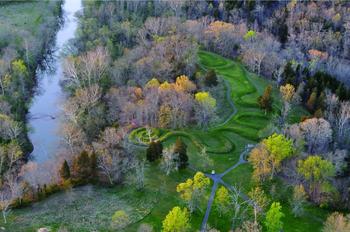
Serpent Mound (site code 33AD1), located in northern Adams County, Ohio, USA, is one of the largest prehistoric effigy mounds, or geoglyphs, in the world (Fig. 1). It is a sinuous earthen embankment 435 m (1427 ft) long when measured along the winding course of its body from the tip of the tail to the farthest anterior extremity of the earthwork. Ephraim Squier and Edwin Davis (Reference Squier and Davis1848, 97), the first scholars to survey the mound, reported its original height as ‘upwards of five feet’ (1.5 m).
Aerial photograph of Serpent Mound. (Photograph: Timothy E. Black, Newark Earthworks Center.)

Serpent Mound is one of the most iconic symbols of ancient America. It is a National Historic Landmark and is currently on the United States Department of the Interior's Tentative List of sites to be considered for nomination to the UNESCO World Heritage List. It has been and remains the focus of a great deal of interest and speculation, but surprisingly little scientific inquiry.
The most intensive investigation of the site was undertaken by Frederic W. Putnam (Reference Putnam1890) between 1887 and 1889. His work revealed the presence of three components at the site, which now are identified as an Adena culture occupation consisting of two conical burial mounds and a small area of habitation remains, a terminal Late Woodland (so-called ‘Intrusive Mound’ culture) component consisting of burials added to the Adena burial mounds, and a Fort Ancient culture component including a small, oblong burial mound and a relatively large habitation area that overlaid the more restricted Adena occupation (Fig. 2). Putnam's excavations did not recover any culturally diagnostic artefacts within the effigy mound itself that might link it to one or another of the major periods of site use, and archaeologists are divided as to whether they attribute the original construction of Serpent Mound to the Adena or Fort Ancient cultures.
Maps of Serpent Mound showing (a) general location in southwestern Ohio; (b) grey-scale LiDAR elevation map of the Serpent Mound area showing topography, soil core locations and outlines of selected archaeological structures and features; and (c) outline of Serpent Mound showing locations of excavations and cores from this and previous investigations.

Prior to the advent of radiocarbon dating and in the absence of culturally diagnostic artefacts in direct association with Serpent Mound, efforts to place the effigy within a cultural or temporal context appear to have been based mainly on arguments from association. More recently, three separate teams of researchers have undertaken limited efforts to locate and extract samples of organic material from the mound for use in obtaining reliable radiocarbon dates for its construction. Finally, arguments from iconography, or style, have been used in attempts to establish which culture has the closest relationship to the effigy. The purpose of this paper is to review and evaluate the evidence and arguments for the age and cultural affiliation of Serpent Mound and offer new evidence and arguments to contribute to a resolution of this important debate.
Argument from association
Putnam (Reference Putnam1888, 51) believed, for reasons that he did not make explicit, that Serpent Mound was built by what later archaeologists would refer to as the Adena culture, the same culture responsible for the earliest habitation remains and the two conical burial mounds at the site. He asserted only that ‘everything relating to the construction of the great earthwork points to antiquity’.
Henry Shetrone (Reference Shetrone1920, 153) expressed the opinion that Serpent Mound had been built by ‘the Fort Ancient peoples’. Subsequently, however, in an unpublished manuscript, he decided that ‘on the assumption that the builders of the adjacent burial mounds also constructed the effigy, the origin of Serpent Mound, for the time at least, may be attributed to the Adena culture’ (Shetrone Reference Shetrone1947, 162).
William Webb and Charles Snow ([Reference Webb and Snow1945] 1974, 341) stated that Serpent Mound ‘is now believed to be of Adena origin’, but they listed it as an element of the ‘Southeastern ceremonial complex appearing in Hopewell-Adena’ ([1945] 1974, 340). Webb and Raymond Baby (Reference Webb and Baby1957, 106) included Serpent Mound as an Adena motif in their tabulation of artistic motifs and other traits that suggested a relationship between Adena-Hopewell and the ‘Southern Cult’ (1957, 104). It was the only example they could provide of serpent iconography associated with the Adena culture.
Emerson Greenman (Reference Greenman1967, 17) recognized that, on the basis of the available information, Serpent Mound could not be assigned to ‘a particular culture . . . with certainty’, but offered his opinion that Serpent Mound was likely to have been built by the Adena culture. His argument was that, since the Adena burial mounds appear to have included the interments of ‘priests or medicine men’ and Serpent Mound appeared to have a ‘ceremonial or religious’ function, there was therefore a plausible connection between the effigy mound and the religious specialists buried in such close proximity.
James Griffin (Reference Griffin1966, 57) believed that ‘although the artifacts taken by Putnam from the conical mound south of the serpent and from the lower level of the near-by village site cannot be positively assigned to the builders of the effigy, it is considerably less likely that the later Fort Ancient occupants built the serpent’. He presented no substantive evidence in support of his conclusion though, in a later article, the likelihood that the effigy mound had been built by the Adena culture had hardened into a certainty: ‘Serpent Mound, the burial mound near it, and the lower levels of the village site are Adena’ (Griffin Reference Griffin and Jennings1978, 242).
Attempts to provide an age for the original construction of Serpent Mound based merely on its association with nearby documented features cannot be definitive, due to the presence of multiple components at the site. An argument from association therefore could support either an Adena or Fort Ancient affiliation.
Argument from chronometric dating
Fort Ancient culture affiliation
There have been three attempts to resolve the question of the age of Serpent Mound by obtaining radiocarbon dates on materials recovered from within and below Serpent Mound. In 1991, Robert Fletcher et al. (Reference Fletcher, Cameron, Lepper, Wymer and Pickard1996) sought to relocate deposits of ‘clay, mixed with ashes’ that Putnam (Reference Putnam1890, 875) described as having been used in the construction of Serpent Mound. Fletcher and colleagues extracted a systematic series of soil cores from along the axis of the effigy mound in order to locate one of Putnam's old trenches. Once the team identified disturbed stratigraphy consistent with expectations for a back-filled trench, they excavated a narrow trench into the disturbed fill and continued excavating laterally until undisturbed deposits were encountered. No clay-and-ash layer was observed at the base of the mound, so the team extracted bulk soil samples from undisturbed portions of the mound in an attempt to recover dateable charcoal through flotation analysis.
Fletcher and colleagues successfully recovered charcoal fragments from two sediment samples separated by approximately 23 cm (Fletcher et al. Reference Fletcher, Cameron, Lepper, Wymer and Pickard1996, 119). The charcoal was identified as white oak and the two samples produced identical AMS radiocarbon dates of 920±70 bp (Beta-55277/CAMS-3566 and Beta-55278/CAMS-3567). They interpreted these dates as evidence for the construction of Serpent Mound by the Fort Ancient culture during the early Late Prehistoric period (Fletcher et al. Reference Fletcher, Cameron, Lepper, Wymer and Pickard1996, 133). Particulate charcoal within the matrix of a mound, however, may or may not derive from fires burning during the construction of the mound. It is possible that younger or older charcoal fragments might have been mechanically introduced into the mound strata through subsequent bioturbation. On the other hand, the samples were obtained from clearly defined stratigraphic contexts without apparent evidence for later intrusions.
Adena culture affiliation
In 2011, Herrmann et al. (Reference Herrmann, Monaghan and Romain2014, 119) initiated a multidisciplinary investigation to ‘reevaluate when and how Serpent Mound was built’. The team extracted 18 ‘continuous solid-earth cores’ from which they obtained samples of dispersed organics in mineral sediment or soil. They obtained nine AMS radiocarbon dates on this material. The samples were taken from various depths and include material from a palaeosol beneath the mound, as well as material incorporated into the mound fill. The resulting dates ranged from 2530±80 bp (Beta-337166) to 2170±30 bp (Beta-337163) (Herrmann et al. Reference Herrmann, Monaghan and Romain2014, 119).
On the basis of these dates, Herrmann et al. (Reference Herrmann, Monaghan and Romain2014, 124) concluded that Serpent Mound was ‘initially constructed 2,300 years ago during the Early Woodland (Adena) period’. The team attributed the dates that were ‘200–300 years older’ than their proposed date for the initial construction of the mound to ‘charcoal from deeper, older horizons that were borrowed from their original context in order to be placed on the mound’ (Herrmann et al. Reference Herrmann, Monaghan and Romain2014, 121). Herrmann et al. (Reference Herrmann, Monaghan and Romain2014, 124) cited the ‘complete lack of post-Adena charcoal’ in the soil cores they analysed as ‘the strongest evidence for when the submound paleosol was buried and Serpent Mound construction began’. They attempted (2014, 122) to resolve the apparent discrepancy between the dates they obtained for the Serpent and the much later dates obtained by Fletcher and colleagues by postulating that the portion of the Early Woodland mound investigated by the latter had been repaired or refurbished by the Fort Ancient culture.
Issues with Herrmann et al.’s interpretations of soils and radiocarbon dates
Herrmann et al. (Reference Herrmann, Monaghan and Romain2014, 119) described their cores in terms of colour, texture, horizon contacts, and inclusions, but they conducted no physical or chemical analyses to provide support for their interpretations. Nowhere in their discussion of the supposed submound palaeosol do they acknowledge the very different parent materials (aeolian and residual) that actually comprise the Bratton silt loam soil that is present on the Serpent Mound ridgetop and other upland sites nearby (Lucht & Brown Reference Lucht and Brown1994; Williams & Kerr Reference Williams and Kerr1977). This apparent lack of understanding of the nature of the surface beneath the mound becomes problematic when assigning horizons to this extensively disturbed surface. None of their core descriptions, either presented in their paper or recorded in their field notes deposited at the Ohio History Connection, reveal the sequence of silty horizons (A/E/B1) that would be present overlying a redder, more clay-rich residual subsoil (2Bt2) if the basal mound fill had been loaded directly onto the A horizon of an undisturbed Bratton silt loam soil.
The absence of an intact palaeosol is not surprising, since Putnam (Reference Putnam1890, 875) stated that the builders of Serpent Mound stripped off the upper, organic levels of the soil prior to initiating mound construction. This observation was, in fact, the only explicit, empirical argument Griffin (Reference Griffin1966, 57) offered in support of his firmly expressed belief that Serpent Mound was built by the Adena-Hopewell, since ‘the removal of the topsoil preparatory to constructing such an earthwork is a fairly consistent Hopewellian trait’. Putnam's observation that the builders of the mound had stripped the ‘black soil’/A horizon prior to constructing the effigy is supported by the profile exposed by his excavation of the sides of the effigy ‘throughout’ its length (Putnam Reference Putnam1890, 875) as illustrated in a contemporary photograph of the serpent's tail immediately after the excavation, which clearly shows dark-coloured mound fill in contact with a light-coloured subsoil (Fletcher et al. Reference Fletcher, Cameron, Lepper, Wymer and Pickard1996, 120). Further confirmation is provided by the stratigraphic profile exposed in Fletcher et al.’s (Reference Fletcher, Cameron, Lepper, Wymer and Pickard1996, 118–19) re-excavation of one of Putnam's trenches, as well as by the lack of identifiable buried silty A and E horizons in field examinations of eight soil cores extracted by Frolking and Lepper in 2014 from locations in close proximity to the cores removed by Herrmann et al. (Reference Herrmann, Monaghan and Romain2014, 118; see Fig. 2c for core locations).
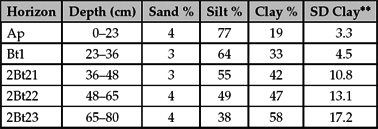
To illustrate the textural changes between topsoil and subsoil, average soil horizon texture data from five Bratton silt loam profiles in Adams County are presented in Table 1. The silty zone comprising the A/E or Ap horizons averaged 23±4.4 cm thickness with 19 per cent clay. The clay content increases to about 30–35 per cent in the upper B horizon and increases further to 40–70 per cent in the residual subsoil. Because loess is predominantly silt with a relatively constant clay content when deposited, the clay content itself provides a useful horizon indicator when differentiating loessial topsoil from illuvial clay-enriched loess Bt horizons and the underlying clayey residuum 2Bt and 2C horizons.
Average horizon depths and textures for five Bratton sill loam profiles in Adams County, Ohio, USA.*

* Ohio State University Soil Testing Lab data, profiles ad-s03 (1955), ad-s06 (1957), ad-s15 (1961), ad-s23 (1962), ad-032 (1982).
** Standard deviations of clay contents for each horizon.
To gain a clearer picture of the horizons and parent material transitions of the Bratton silt loam soil within the Serpent Mound National Historic Landmark property, 14 locations at varying distances from the mound were cored with an Oakfield soil tube (2 cm diameter) and briefly described (Fig. 2b). Ten of the 14 cores revealed Bratton profiles with a silty topsoil having a shallow 5 cm weak A horizon developed since the cessation of agricultural activity and occasionally traces of a thicker 20 cm degraded Ap horizon. Unlike the cores taken from Serpent Mound discussed below, all of these cores showed a smooth transition from the silty 8.5-10YR top soil to a significantly heavier, silty clay loam to clay loam 8.5-5YR subsoil. The thickness of what could be considered a loess cap varied widely from perhaps 20 to 68 cm (8–27 in). Some of this variation was undoubtedly due to erosion subsequent to post-European settlement agriculture. Cores taken on the sloping flanks of the upland lacked a significant silty cover and revealed a darker A horizon developed in silty clay with a substantial residual contribution (Opequon silty clay loam soil series).
On Serpent Mound itself, we examined eight Oakfield cores from three coils of the serpent to find a site with the expected buried soil horizonation of a Bratton silt loam profile (Fig. 2c). None of these revealed a clearly identifiable buried silty A horizon lying directly below the mound fill. Texturally, there was no clear silt loam surface horizon that graded into the silty clay loam (Bt1) and silty clay (2Bt2) of the buried subsoil. In terms of colour, there was no apparent melanization, darkening of a horizon from humification of organic material, which would indicate a stable soil surface upon which the mound had been constructed. We ultimately selected a site in the centre of the coil between Herrmann et al.’s (Reference Herrmann, Monaghan and Romain2014) sites C-6 and C-7. Here we extracted a 120 cm long, 4.5 cm diameter core from 20 cmbs to 140 cmbs. Based on Herrmann et al.’s (Reference Herrmann, Monaghan and Romain2014) descriptions and what we observed in our preliminary cores, the contact between mound fill and buried soil probably occurred at a depth of 90–100 cmbs.
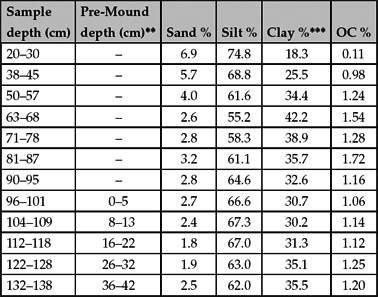
Both loess and clay-rich residual soil materials were used in mound construction. The upper 33 cm of the mound was dominantly silt loam with a few pebbles present, likely fill from Putnam's or a later reconstruction (Table 2). Below this was a 20 cm thick variegated zone, perhaps taken from the E/2B1 transitional zone of an excavated Bratton profile. Below this, extending to 90 cm, were irregular zones of 10YR silt and 5–7.5YR silty clay loam to silty clay material, perhaps suggesting successive dumps of basket loads drawn from different portions of an excavated profile. The zone from 90–102 cm, the likely contact region, appeared to be looser, and perhaps slightly more granular, than the zones above and below, but there was no apparent change in organic matter content or degree of melanization that would suggest a buried A horizon. There was also no clear contact between mound fill and the underlying soil. Based on this core, we cannot explain the apparent physical disturbance of what we interpret to be subsoil material, but there is no question that much of any silty topsoil that should have been present had been truncated.
Textures and organic carbon content of samples from core into Serpent Mound fill and underlying soil.*

* Particle-size data determined by the pipette method (Gee & Bauder Reference Gee, Bauder and Klute1986) and oxidizable soil organic carbon measured gravimetrically by loss on ignition (450°C for 4 hours) following Hoskins (Reference Hoskins2002).
** Assumes 96 cm below surface represents ground surface for mound construction.
*** The increase in clay toward the base of the core reflects an increased contribution of silty clay residuum. Even excluding the silty surface sample with low carbon content, there is a weak positive linear correlation between carbon content and percent clay (OC=0.0348 clay(p)+0.0684; r2=0.534), suggesting much of the organic matter resides in stable clay-humus complexes (Duchaufour Reference Duchaufour and Paton1982). This conclusion was supported by the microscopic examination of the sand fraction (0.064–2.0 mm) and the coarse fraction (>2 mm) isolated by wet sieving in the pipette process. The transitional zone of basal mound fill and underlying soil (90– 110 cmbs), i.e. the putative buried A horizon, revealed at most a few minuscule specks of charcoal per 20 g soil sample.
Laboratory analyses support the field observations that the sub-mound surface was disturbed and the topsoil stripped prior to mound construction. The 30–32 per cent clay content in the zone of the buried surface (90–110 cmbs) refutes the presence of an eluviated loess-based buried silty A/E horizon (Table 2). These results suggest that the radiocarbon dates of Herrmann et al. (Reference Herrmann, Monaghan and Romain2014) more likely reflect the age distribution of finely disseminated carbon rather than charcoal that might date a singular event.
Mean carbon radiometric age increases down through a soil profile from A to E to upper B horizons because annual additions of labile carbon are concentrated near the soil surface, whereas predominantly older, more resistant pools of carbon dominate the subsoil. In a review of several papers analysing modern forest and prairie soils, Oades (Reference Oades, Dixon and Weed1989, fig 3–21) showed a mean bulk radiocarbon age of 1000 years at a 20 cm depth increasing to 2000 years at 35 cm. Thus the loss or removal of topsoil prior to burial would skew the radiocarbon age of the buried surface toward even older dates.
From these studies, it follows that if the topsoil at the Serpent Mound was removed prior to mound construction, then the dating of dispersed soil carbon at the truncated surface would yield ages considerably older than the date of mound construction. Indeed, Herrmann et al. (Reference Herrmann, Monaghan and Romain2014, 121) correctly conceded that the dates they obtained on dispersed organic material could provide only a maximum age for the effigy: ‘the mound could have been constructed any time after 300 BC’.
A final point of consideration is Herrmann et al.’s claim that the Fletcher et al. profile indicates that the original mound in this location, as well as at least 0.70 m of underlying sediment, might have been completely eroded by ‘long-term processes associated with gully formation’ (Herrmann et al. Reference Herrmann, Monaghan and Romain2014, 123). Their interpretation of the Fletcher et al. profile is based principally on the assertion that there is no Ab/Eb horizon present (Herrmann et al. Reference Herrmann, Monaghan and Romain2014, 123); however, they offer no objective evidence in support of this claim. It is important to note that Hermann et al.’s topographic map, while commendable for the level of detail revealed by 10 cm contours, visually exaggerates the apparent steepness of slopes near the mound. The steep slope to the west of the mound coil with the two Putnam trenches, which lacks the ‘V’ contours typical of a gully, has a maximum slope of about 20 per cent decreasing to 10 per cent adjacent to the mound, suggesting that any focused long-term slope erosion had not extended headward to the mound itself. Particularly problematic for their argument is that this steep area is to the west of the mound axis, whereas Fletcher et al.’s trench was on the east side of the divide. Gullies do not tend to extend headward across divides where there would be no contributing water flow.
There is no evidence in the stratigraphy revealed in the cross-section exposed by Fletcher and colleagues of gully incision or of soil material washing in or slumping in to fill the supposed gully. Indeed, the clay-rich 2Bt horizon of the palaeosol was present along the extent of the Fletcher trench, clearly indicating a lack of extensive erosion. Therefore, the notion that erosion destroyed this portion of an Adena effigy that was later repaired by the Fort Ancient culture appears to be an ad hoc explanation to account for the otherwise anomalous Late Prehistoric radiocarbon dates on charcoal recovered from mound fill in this location.
In spite of the apparent consistency in five of the seven dates that Herrmann and colleagues obtained for the surface beneath Serpent Mound, their claim that these five dates provide a reliable estimate for the age of the original construction of the effigy is compromised by their inability to demonstrate that these samples are directly associated with that construction event. Rather, as they state, these dates simply provide an earliest possible construction date for the mound.
A new radiocarbon date supporting a Fort Ancient culture affiliation
In 2017, the Ohio History Connection (OHC) removed stone steps that had been installed across the tail of Serpent Mound by the Civilian Conservation Corps (CCC). In so doing, two artificially shaped sandstone slabs were exposed, which appear to be remnants of a previously undocumented stone stairway that had been partially dismantled and buried by the CCC in the course of building a more elaborate stairway in the same location. In the course of removing the CCC fill around the stone slabs, the OHC archaeologists exposed a portion of the surface of the intact earthwork.
The original mound fill consists of brown (10YR 5/6) silty clay loam with minute, scattered flecks of charcoal (around 0.18 mm in diameter). In contrast to the loose CCC fill, the mound fill was very firm and showed no signs of bioturbation. OHC archaeologists extracted a bulk soil sample, which subsequently yielded an AMS radiocarbon date on the organic material of 720±30 bp (Beta-470763; cal ad 1246–1302). Because the date was run on soil humates rather than solely charcoal, the association of the date with mound construction is likely to be imprecise; however, a radiocarbon date on soil humates from the fill of Alligator Mound was found to be broadly corroborative of a date obtained on charcoal from the base of the mound (Lepper & Frolking Reference Lepper and Frolking2003, 159). Therefore, the soil humates date for Serpent Mound likely does reflect the approximate date of mound construction. This third Fort Ancient-era radiocarbon date for Serpent Mound, obtained from a segment of the earthwork far from the area suggested by Herrmann and colleagues to have been subject to damage and later repair, provides additional support for the argument that the Fort Ancient culture constructed Serpent Mound.
Argument from iconography
George Kubler (Reference Kubler1962, 9) argued that a ‘shape in time’ emerges from a study of the history of things: ‘all materials worked by human hands under the guidance of connected ideas developed in temporal sequence’. One of the implications of this observation is that a monumental earthwork constructed in the shape of a serpent is not likely to have existed in a cultural vacuum. It may, therefore, be possible to link Serpent Mound either to the Adena or the Fort Ancient cultures, or indeed some other culture, based on whether or not effigy mounds were an important part of their cultural repertoire, as well as on the overall importance and the specific characteristics of serpent iconography in those cultures.
Original configuration of Serpent Mound
Squier and Davis produced the first published map of Serpent Mound and, because it was the first, it has been assumed that it represents the mound in its most pristine state (Fig. 3). Their map shows two distinct elements: the serpent itself and an oval embankment with a ‘small circular elevation of large stones much burned’ (Squier & Davis Reference Squier and Davis1848, 97) at its centre. But Squier and Davis, particularly Squier, had preconceptions about the Serpent that may have influenced how they perceived and depicted the effigy.
Squier and Davis’ map of Serpent Mound. The earliest published map of Serpent Mound. (Courtesy of Ohio History Connection.)

According to Squier, Serpent Mound represented a serpent with an egg gripped in its gaping jaws. He believed that ‘the Serpent and Egg of Ohio are distinctly allusive to the specific notions of cosmogony which prevailed among the nations of the East’ (Squier Reference Squier1851, 251).
Putnam, in his early surveys of Serpent Mound, documented the same two elements, but he also observed a ‘slightly raised circular ridge of earth, from either side of which a curved ridge extends towards the sides of the oval figure’ located between the oval figure and the edge of the bluff (American Antiquarian Society 1884, 11; Willoughby Reference Willoughby1919, 159). Ultimately, like Squier and Davis, he disregarded that earthwork and did not include it in his restorations of the Serpent. He also agreed with Squier's interpretation and rhetorically asked whether it would be ‘forcing the facts to argue . . . that in the oval embankment, with its central pile of burnt stones, in combination with the serpent, we have the three symbols everywhere regarded in the Old World as emblems of those primitive faiths?’ (Putnam Reference Putnam1890, 876).
William H. Holmes (Reference Holmes1886, 627) thought it certainly was forcing the facts. He rejected Squier and Davis’ speculations, arguing that ‘it is manifestly wrong to go thus out of our way to seek a symbolism for the oval enclosure, as do Squier and Davis, who liken it to the symbolic egg of old-world philosophy’. He surveyed Serpent Mound in 1886 and his map included the wishbone-shaped earthwork (Holmes Reference Holmes1886).
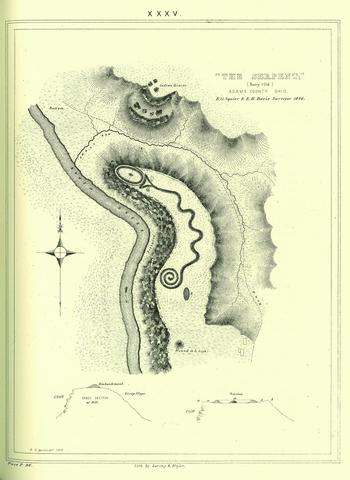
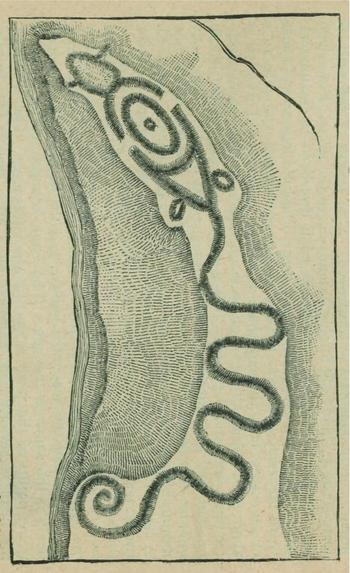
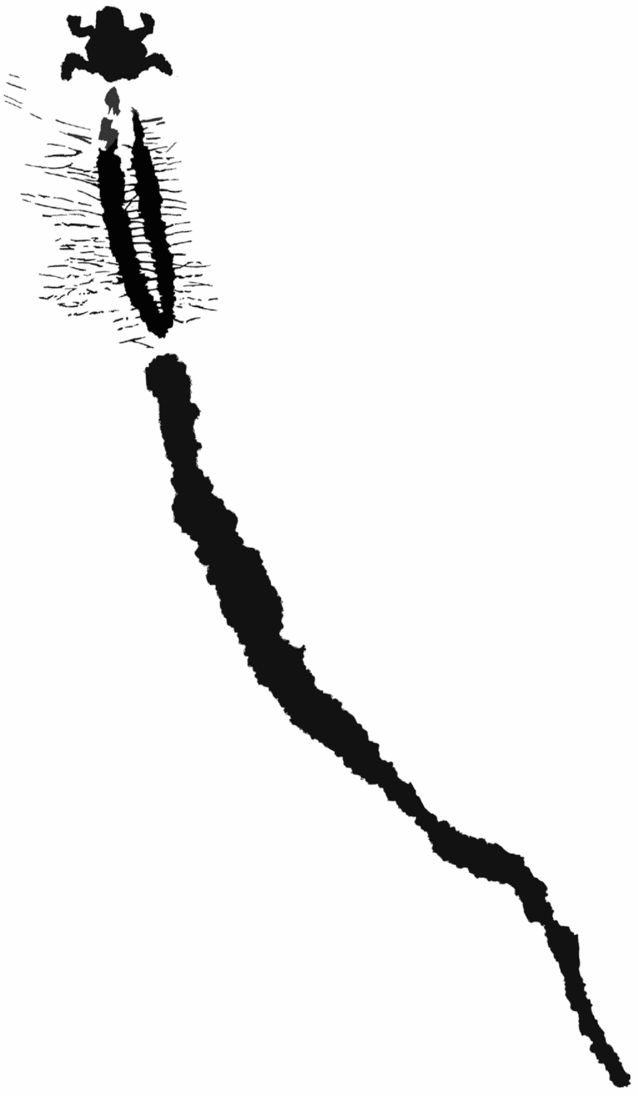
John P. MacLean conducted two independent surveys of Serpent Mound in 1884, two years prior to Putnam's investigations and subsequent restoration (Fig. 4). He argued that the wishbone-shaped earthwork, which Putnam had observed but dismissed, actually was a separate effigy of a frog. He described it as ‘in the act of leaping; the hind legs stretched backward, the fore legs outward and forward, the body drawn up at the back, and the head depressed’ (MacLean Reference MacLean1885, 45).
John P. MacLean's (Reference MacLean1885) map of Serpent Mound showing the wishbone-shaped earthwork, which he interpreted as a frog. (Courtesy of Ohio History Connection.)

Holmes’ Reference Holmes1886 survey and map confirmed MacLean's observation that the embankment forming the body of the serpent continued around the oval enclosure terminating in ‘a rounded and slightly widened point’ (Holmes Reference Holmes1886, 626). Holmes was not, however, convinced by MacLean's argument that the earthwork was a frog effigy. He noted that the appendages of the alleged frog were ‘too obscure to be identified with absolute certainty’, but, regardless of its interpretation, the main part of the frog-like earthwork was ‘distinctly traceable’ leaving ‘no doubt’ as to its artificial character (Holmes Reference Holmes1886, 626).
Charles Willoughby visited the Serpent Mound in 1919, after Putnam's restorations. He stated that the wishbone-shaped earthwork, though unrestored, was nonetheless unmistakably present and he felt it should have been considered part of the original earthwork and restored (Willoughby Reference Willoughby1919, 159).
This extended discussion of the original configuration of the anterior portion of Serpent Mound has been necessary in order to provide a more secure basis on which to build an iconographic interpretation of the entire effigy. This, in turn, will facilitate comparisons with other depictions of serpents in the archaeological and ethnohistoric records of the Eastern Woodlands.
The age of effigy mounds in eastern North America
Naturalistic effigy mounds are a particular class of geoglyph, which, in eastern North America, include a limited number of motifs. For the effigy mounds of the Upper Midwest, Robert Birmingham (Reference Birmingham2010, 29) has observed that ‘bears, water spirits, and snakes loom especially important’. He identified the general period of effigy mound construction as between ad 700 and 1100, though he notes (2010, 203) that this range ‘is based on comparatively few precise radiocarbon dates from the mounds themselves’.
A few mounds from earlier periods have been claimed to be effigy mounds, but all of these are more or less problematic, due either to issues with their identification as effigy mounds, or to the determinations of their age. For example, Mound A at the Late Archaic site of Poverty Point is thought by some to represent a bird. Diana Greenlee, however, concluded that ‘there is no way to know . . . if that's what the builders of Mound A intended. We can only speculate’ (Ellerbe & Greenlee Reference Ellerbee and Greenlee2015, 59). Similarly, Cath Oberholtzer (Reference Oberholtzer, Munson and Jamieson2013, 163) acknowledged ‘the ambiguity of the zigzag shape’ of the Middle Woodland Ontario Serpent Mound.
The only other well-documented naturalistic effigy mound in Ohio is the so-called Alligator Mound (Squier & Davis Reference Squier and Davis1848, 98–100). It has been securely dated to the Late Prehistoric period with two AMS radiocarbon dates of 820±40 bp (Beta-134236) and 840±40 bp (Beta-134237) (Lepper & Frolking Reference Lepper and Frolking2003, 159).
There are two relatively small stone serpent effigies in the valley below Fort Ancient (White Reference White1986; Reference White1987). Known as the Kern Effigies, they lack the sinuous naturalism of Serpent Mound and some question whether they are indeed serpent effigies. John White, however, argued that their configurations were dictated by astronomical alignments, rather than a commitment to strict naturalism. Kern Effigy 1 is aligned to the summer solstice sunrise, whereas Kern Effigy 2 is aligned to the winter solstice sunrise. Kern Effigy 1 yielded two radiocarbon dates: 530±95 bp (SI-6267) and 765±80 bp (SI-6268) (White Reference White1986, 150), which correspond to the age of the nearby Anderson Village (White Reference White1986, 151).
There are, therefore, no effigy mounds in eastern North American that have been chronometrically dated to the Early Woodland period. All of the securely dated effigy mounds in this region were built in the Late Woodland and Late Prehistoric periods.
Serpent iconography in the Eastern Woodlands
Serpent imagery is virtually absent in the iconography of the Adena culture, apart from the apparently serpentine pattern on the loincloth of the male human depicted on the Adena Effigy Pipe (Lepper Reference Lepper2010). There are occasional serpents in Hopewell art, but a wide variety of other species, especially birds and mammals, are more frequently depicted.
In stark contrast, during the Late Prehistoric period in Ohio, as well as throughout the broader Mississippian world, serpents were one of the most frequently depicted creatures. James Howard (Reference Howard1968) observed that ‘gorgets showing the rattlesnake, in either realistic or highly conventionalized form, are among the most common of items’ associated with the Southeastern Ceremonial Complex.
Penelope Drooker (Reference Drooker1997, 326) presented numerous examples of serpent imagery from Madisonville and other Fort Ancient culture sites, including the ‘snakelike intertwining of the guilloche motifs that decorate ceramic vessels during Early-Middle Fort Ancient times’ as well as ‘the serpents engraved in stone . . ., carved in antler . . ., and formed of metal . . . during Late Fort Ancient times’. Three copper serpent effigy pendants from a single burial at Madisonville are of particular interest in this regard, because they bear a marked resemblance to Serpent Mound (Drooker Reference Drooker1997, 273).
Fletcher et al. (Reference Fletcher, Cameron, Lepper, Wymer and Pickard1996, 134–8) drew particular attention to similarities between the iconography of the head of Serpent Mound and the way rattlesnake heads are depicted on the late Mississippian Citico-style shell gorgets. Fletcher et al. (Reference Fletcher, Cameron, Lepper, Wymer and Pickard1996, 138) noted that, although these gorgets ‘appear to have originated in the eastern Tennessee-northern Georgia region’, similar gorgets have been documented in ‘late Fort Ancient burials’ (see also Sharp Reference Sharp and Lewis1996, 173; Spencer Reference Spencer2016, 27).
The Birger figurine is a richly evocative sculpture of a woman and a large serpent with the teeth of a mammalian carnivore, which was found at the BBB Motor site, a Middle Mississippian ceremonial location associated with Cahokia. Natalie Mueller and Gayle Fritz (Reference Mueller, Fritz and Claassen2016, 122–3, 242) argue that the woman is the Siouan Grandmother, First Woman, or ‘Old-Woman-Who-Never-Dies’.
The numerous examples of serpents in Mississippian iconography, coupled with the virtual absence of serpents in Adena art, suggest that Serpent Mound fits more comfortably within a Fort Ancient cultural context and it is within this time frame that clues to its purpose and meaning might more fruitfully be sought.
Iconography of Picture Cave: a ‘Rosetta Stone’ for the interpretation of Serpent Mound
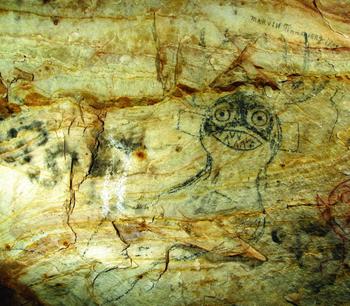
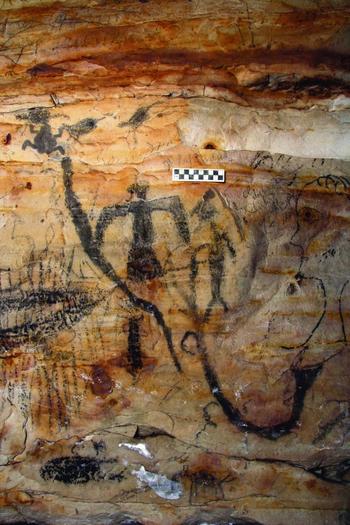
Picture Cave in Missouri contains a remarkable series of pictographs that appear to be ‘discrete vignettes depicting a series of important cosmic events’ in the beliefs of the ancestors of the Dhegihans (Duncan Reference Duncan, Diaz-Granádos, Duncan and Reilly2015, 209) (Fig. 5). The images provide rich insights into the Mississippian Ideological Interaction Sphere (Reilly & Garber Reference Reilly, Garber, Reilly and Garber2007, 3). Serpent iconography is especially prominent in the corpus of images and includes a large black serpent confronting a figure variously thought to represent either a frog (Townsend Reference Townsend, Diaz-Granádos, Duncan and Reilly2015, 156) or a humanoid female that James Duncan (Reference Duncan, Diaz-Granádos, Duncan and Reilly2015, 224) identified specifically as ‘First Woman on her back with legs drawn up and with a prominent pudendum, in a coital position’ (Fig. 6). According to Siouan oral traditions referenced by Duncan, First Woman is intimately connected with serpents: ‘she is the consort of First Man, but she is also the consort of the Snakes, the Lower World water spirits’ (Duncan Reference Duncan, Diaz-Granádos, Duncan and Reilly2015, 224).
Beneath World Spirit. Glyph 43 from Panel 3 at Picture Cave. The similarity between its ‘toothy mouth’ and the bi-convex Glyph 59 suggested to Reilly (Reference Reilly, Garber, Reilly and Garber2007, 137) that Glyph 59 was a pars pro toto representation of the same supernatural being. The blocky projections extending from each side of the creature's head have analogues in the projections extending from the head of Serpent Mound (Figs 2 & 3).

Serpent (Glyph 67), woman (Glyph 64) and a small part of the bi-convex vulvoid (Glyph 59) pictographs from Panel 3 at Picture Cave. These three glyphs appear to have been painted onto the rock face using the same pigment and technique.

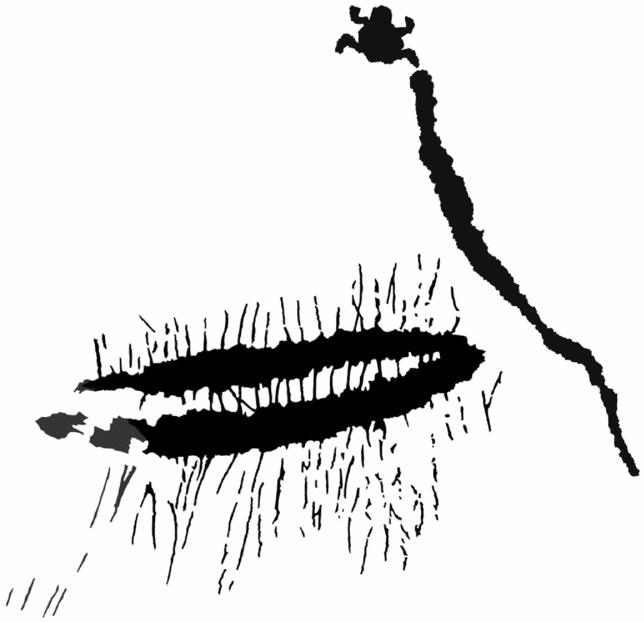
Associated with the Picture Cave images of the serpent and the frog/First Woman is a large, bi-convex figure that Kent Reilly (Reference Reilly, Diaz-Granádos, Duncan and Reilly2015, 137–8) interprets as a ‘toothy mouth,’ a ‘pars pro toto representation’ of the Great Serpent, the ‘Lord of the Beneath World and Guardian of the Realm of the Dead’ (Fig. 7). Richard Townsend (Reference Townsend, Diaz-Granádos, Duncan and Reilly2015, 156) identifies the glyph not as a mouth, but as a vulva, or the ‘Old Woman Earth Deity Vagina’. These three elements of this panel of pictographs at Picture Cave bear a striking resemblance to the three principal elements that comprise Serpent Mound and we suggest that this vignette may provide a sort of Rosetta Stone for the interpretation of the iconography of the serpent, ‘egg’ and ‘frog’ at Serpent Mound (Fig. 8; compare with Fig. 4). When read in this light, the serpent effigy would be the Lord of the Beneath World, the ‘frog’ would be First Woman with spread legs in a coital position, and the ‘egg’ would be the ‘toothy mouth’ of the Great Serpent or First Woman's symbolically enlarged vulva. In support of the interpretation of the ovals at both Serpent Mound and Picture Cave as vulvae, Carol Diaz-Granádos (Reference Diaz-Granádos, Lankford, Reilly and Garber2011, 83) noted that there is ‘a variety of vulva forms’ in Missouri rock art and ‘at times the vulva is portrayed in conjunction with . . . serpents’.
Serpent, woman and vulvoid group from Panel 3 at Picture Cave. (Courtesy of Peter Lepper.)

Serpent, woman and vulvoid group from Panel 3 at Picture Cave re-arranged and with the size of Glyph 59 adjusted to show the resemblance of the group to the three elements comprising Serpent Mound. (Courtesy of Peter Lepper.)

If an antlered serpent pictograph at Picture Cave, referred to by Reilly (Reference Reilly, Diaz-Granádos, Duncan and Reilly2015, 135) as ‘Beneath World Spirit I’ (Fig. 5) represents the same character depicted in the tableau with First Woman and the enlarged vulva/toothy mouth (Fig. 6), then there is another important connection with the iconography of Serpent Mound. Beneath World Spirit I has large, blocky projections extending from the side of its head. One suggestion is that these projections represent earspools (Diaz-Granádos et al. Reference Diaz-Granádos, Rowe, Hyman, Duncan and Southon2001, 52; Reilly Reference Reilly, Diaz-Granádos, Duncan and Reilly2015, 136). There are similar projections extending from the head of Serpent Mound. They appear on both the Squier and Davis (Fig. 3) and MacLean (Fig. 4) maps, but although Putnam observed these features (American Antiquarian Society 1884, 12), he did not include them in his restorations of the effigy. They have been interpreted variously as ‘wings’ (MacLean Reference MacLean1887, 56) or ‘horns’ (Willoughby Reference Willoughby1919, 162), but in the context of the Picture Cave iconography, they can be understood as the earspools of the great Beneath World Spirit. The Beneath World Spirit I pictograph produced an AMS radiocarbon date of 950±100 bp (CAMS-41465) (Diaz-Granádos et al. Reference Diaz-Granádos, Rowe, Hyman, Duncan and Southon2001, 489), which interestingly, though not, we think, coincidentally, is virtually identical to the dates of 920±70 bp obtained by Fletcher et al. (Reference Fletcher, Cameron, Lepper, Wymer and Pickard1996) for Serpent Mound.
Picture Cave and Dhegihan oral traditions
Based on more than 50 years of style analysis and dating in the Western Mississippian region, co-authors Duncan and Diaz-Granádos have concluded that the Picture Cave serpent, vulva and coital figure were created between ad 950 and 1025. Jon Muller (Reference Muller1966, 25–39; Reference Muller and Galloway1989, 23–4) first recognized a distinct and naturalistic style of shell engraving and repoussé copper plates from around the confluence of the Ohio River and the Mississippi River. Meanwhile, in the late 1960s and early 1970s, Philip Phillips and James Brown (Reference Phillips and Brown1978, 69–102) had begun the monumental task of describing the hundreds of shell engravings from Spiro and subjecting them to style analysis. Brown (Reference Brown and Galloway1989, 193–8) continued this task by assigning the oldest and most realistic style, Braden, to the Cahokia area. Continuing work by the Linda Schele Workshop, led by F. Kent Reilly III, has anchored this classic Braden style to the Cahokia region and its southern environ, the Ohio/Mississippi confluence (Reilly & Garber Reference Reilly, Garber, Reilly and Garber2007).
In 2011, Brown (Reference Brown, Lankford, Reilly and Garber2011) and Diaz-Granádos (Reference Diaz-Granádos, Lankford, Reilly and Garber2011) assigned the Cahokia region and the Braden art style to the ancient Dhegihans, ancestors of the modern day Quapaw, Osage, Kansas, Ponca and Omaha. Finally, in 2015, Brown and Muller (Reference Brown, Muller, Diaz-Granádos, Duncan and Reilly2015, 114–24) identified Picture Cave as the seminal expression of the Braden art style, firmly placing the beginnings of a religious resurgence in the prairie/plains adjacent to the lower Missouri River and its confluence with the Mississippi.
There is little doubt that the Western Mississippian region was the focal point of long-enduring religious traditions between ad 1050 and 1250. Evidence for shared religious and ritual knowledge over a large part of eastern North America long has been key to defining what is now referred to as the Mississippian Ideological Interaction Sphere (Reilly & Garber Reference Reilly, Garber, Reilly and Garber2007). The core elements of these interacting, yet regionally distinctive, belief systems remained surprisingly steady over time; and we argue that the meaning of Ohio's Serpent Mound and the corresponding glyphs from Picture Cave may be found in the oral traditions of groups whose ancestors were a part of that interaction sphere.
According to Alice Fletcher, Putnam's colleague who greatly assisted in the fund-raising that allowed Harvard University to purchase Serpent Mound, and Francis LaFlesche (e.g. Fletcher & LaFlesche Reference Fletcher and LaFlesche1992, 171), the Dhegiha had a shared oral tradition of the creation of the earth (Middle World). After long years of searching for and recovering bits and pieces of this lore, LaFlesche was able to identify components of one of what had been two paramount Dhegihan rites.
Comparing three templates from similar oral traditions, ‘medicine rites’ collected by Alfred W. Bowers (Reference Bowers1950; Reference Bowers1992), Alanson Skinner (Reference Skinner1926) and Paul Radin (Reference Radin1948, 115–36), along with John Matthews’ (Reference Matthews1961, 735–70) descriptions of the Osage Native American Church rites, LaFlesche's vast ethnographic collections (Bailey Reference Bailey1995, 276–305) and the images from Picture Cave, co-authors Duncan and Diaz-Granádos have constructed a coherent narrative of what we believe to be the essential elements of the genesis story of the Dhegiha, the Mon-Thin-Ka-Ga'-Xe, ‘The Making of the Earth Rite’. What follows is a brief version of that reconstructed story.
The Making of the Earth Rite
Long before time began, the Water Spirits, the Great Serpent and his children the snakes, coerced First Man's eldest son, Morning Star, the one who would succeed First Man as the Sun, and some companions into coming down to the Beneath World and engaging in some friendly competitive games of chance. The final game, the single stick ball game, involved high stakes—the losers’ heads. The Water Spirits won and the Great Serpent, the chief of the Water Spirits, cut off their heads. One of the Water Spirits, a particularly greedy, bloated, and eyeless creature representing death, swallowed all but Morning Star's head.
The Upper Worlds were thrown into darkness, there being no shining Sun to rise into the sky. Morning Star's sister, Evening Star, had two sons, Stone and the Grey Wolf, whom Morning Star had helped to raise. These two young men went to visit their grandmother, First Woman or Old-Woman-Who-Never-Dies.
First Woman lived in her lodge at the top of the Beneath Worlds, the Moon. She fed the two young men and gave them several powerful sacred weapons to defeat the Water Spirits. First Woman also painted her grandsons: Grey Wolf was painted black, a signal to all that he would kill all foes and take no prisoners; Stone was painted red and white and he was given a holy bull snake's hide, to tie on the left arm of a vanquished enemy to make him a prisoner.
Grey Wolf was sent to scout and find the town of the Water Spirits. First Woman changed into a spider and carried her grandson Stone down into the Beneath World to help Grey Wolf attack and defeat the Water Spirits. The two boys, Stone and Grey Wolf, gave a whoop and attacked the town of the Water Spirits. They quickly shot the bloated Water Spirit, Death, and he vomited up Morning Star's companions in his death throes. These resurrected companions joined in the fight with Stone and Grey Wolf.
The two boys and their companions attacked the Water Spirits. They shot the Great Serpent, wounding him and causing him to fall. Stone rushed up to him and tied the holy bull snakeskin to his upper left arm; Grey Wolf picked up the war club that the Great Serpent had taken from Morning Star after beheading him. Walking among the writhing and bleeding snakes, Grey Wolf collected their scalps and weapons, while Stone made the Great Serpent lead him to the centre of the town to retrieve Morning Star's head. Singing their victory songs, Stone, Grey Wolf and their companions danced into the sky, taking the head of Morning Star to his mother, First Woman.
First Woman and her grandsons made a feast at which the Great Serpent was given gifts and First Woman adopted him as a husband to replace her loss. As her adopted husband, the Great Serpent then had intercourse with First Woman and she gained his ability to resurrect or reincarnate and rejuvenate herself. In this crucial event, First Woman became a holy or sacred vessel, receiving from the Great Serpent his unique power of resurrection. This is the image rendered in black pigment on the wall at Picture Cave (Duncan Reference Duncan, Diaz-Granádos, Duncan and Reilly2015, 224). This graphic and salient image mirrors the Serpent Mound as mapped by MacLean in 1885.
This imagery records the moment when First Woman bridges the cosmos, bringing the life-giving powers from the Beneath Worlds to the Middle World, the Earth. With this crucial acquisition, First Woman becomes the sacred receptacle of these vital, animating powers.
First Woman again became Grandmother Spider and wove a holy web of life, the Earth, the snare where all life takes on a bodily form. Into this web Stone and the Grey Wolf placed the head and body of Morning Star, who then burst forth from this snare as the axis mundi or sacred tree with the risen (resurrected) Sun. The Middle World was then ready for all living things, including humans. The Great Serpent coils around the sacred tree or axis and becomes the rainbow in the daytime sky and the Milky Way in the night sky.
What has just been narrated is a widespread genesis tradition: while differing in details, its central or core theme is amazingly similar across many nations. This genesis rite is widespread in the eastern United States and it is known by some as the Great Medicine Rite (Hall Reference Hall1997, 59–74; Weeks Reference Weeks2009). The culmination of this great rite is the adoption ritual where Stone and the Grey Wolf gave the war captive, the Great Serpent, as a replacement husband to First Woman (Hall Reference Hall1997, 10–13, 32–5, 50–58). This adoption ritual was the foundation for the next rite, the most important, Mon-Thin-Ka-Ga'-Xe, ‘The Making of the Earth’.
This ritual, the coital act between First Woman, the spirit of the Earth, and the Great Serpent has enormous symbolic significance throughout North America. Alice Kehoe (Reference Kehoe1970) and Alfred Bowers (Reference Bowers1950) have extensively documented these sexual rites known as ‘walking with the buffalo’. The participating women passed this power directly to their husbands through intercourse and indirectly to their people, enabling them to enjoy increased power in warfare and hunting (Bowers Reference Bowers1950, 284).
Conclusions
‘. . . we always may be sure that every man-made thing arises from a problem as a purposeful solution.’ (Kubler Reference Kubler1962, 8)
Determining the age of Serpent Mound is an important goal, because of the necessity of having a cultural context in which to situate the largest effigy mound in North America. Previous efforts to assign an age and cultural affiliation to the mound have been unsuccessful, for a variety of reasons.
If Serpent Mound represents the solution to a problem, as Kubler suggests, then it is a Fort Ancient solution to a Mississippian problem. Early Fort Ancient communities were becoming larger, more sedentary, and frequently organized around a central plaza (Henderson et al. Reference Henderson, Pollack, Turnbow and Henderson1992, 261; see also Cook Reference Cook2008). These changes coincided with the development of new leadership roles, and such nascent elites would have benefited from grander expressions of unifying religious beliefs coupled with a more consistent iconography. Susan Power (Reference Power2004, 177) has observed that ‘while the snake was an ancient image, new serpentine expressions were created in the Mississippian period, often distinguished by their unique size, placement, elaboration, and at times function’.
A Fort Ancient Serpent Mound fits well within the context of Robert Cook's (Reference Cook2008) research indicating that there were significant interactions between Fort Ancient peoples and Mississippians. A further implication of our interpretation of Serpent Mound as a symbolic representation of a key moment in the Dhegihan creation story is that the Fort Ancient culture may have included some Dhegihan groups. This possibility is affirmed by the migration stories of some Dhegihan tribes (Henning Reference Henning1993). Alternatively, elements of the Dhegihan creation story may have been a part of the cosmologies of other groups that subsequently lost them due to the catastrophic cultural disruptions following European contact.
If Serpent Mound was created by the Adena culture, then it existed in a splendid isolation that persisted for nearly a thousand years before anything else like it appeared in eastern North America. If it was created by the Fort Ancient culture, then it has a clear cultural context in the cosmology of contemporary Mississippian and related groups, including the Fort Ancient culture.
The similarities between the iconography of Picture Cave and Serpent Mound suggest that they are telling the same or a closely related story. The Dhegihan oral traditions appear to contain these same elements and provide the rest of that story. Fletcher and La Flesche (Reference Fletcher and La Flesche1911, 171) wrote that the Omaha's Making of the Earth Rites ‘not only dramatized the myth of Creation, but were believed to insure the continuance of that which had been created’. Similarly, Birmingham (Reference Birmingham2010, 202) has proposed that ‘the effigy mound landscape did not merely symbolize periodic recreation of the world and its people in the form of their animal and spirit-being ancestors, but the landscape itself was perceived by the mound builders as creation in progress’. Therefore, if we are correct, that the same iconography is represented both at Picture Cave and at Serpent Mound and that this iconography represents the Dhegihan Creation story, then Serpent Mound would not have been conceived as a static monument, but rather as an instrument through which the world could be actively renewed. That would provide a compelling reason for the construction of such a monumental earthwork—a reason that makes the most sense in a Mississippian context.
Acknowledgements
The 2014 field crews that assisted Frolking and Lepper in the extraction of soil cores included, on 16 September: Steven Forman with the Department of Geology at Baylor University, Ohio History Connection staff Linda Pansing, Bill Pickard, Kellie Locke Rogers and Logan Miller; and on 16 October: Ohio History Connection staff Kellie Locke Rogers and Logan Miller and Denison University student Logan Eyer. We thank William Romain and William Monaghan for sharing raw data recorded during the Herrmann et al. (Reference Herrmann, Monaghan and Romain2014) investigation. We thank Peter Lepper for creating Figures 7 and 8. Finally, we thank two anonymous reviewers for their helpful suggestions for improving this paper.