In recent years, the variable use of sociolinguistic features of discourse among second language (L2) learners has received increased attention in the SLA and applied linguistics literature. A great deal of research on patterns of sociolinguistic and stylistic variation among L2 users—including instructed L2 learners (see, e.g., Bayley & Preston, Reference Bayley and Preston1996; Bayley & Regan, Reference Bayley and Regan2004)—has drawn from methodology inspired by Labov (Reference Labov1972). Thus, the sociolinguistic interview, usually between the researcher and the L2 learner (cf. Dewaele, Reference Dewaele2004b), has emerged as the preferred performance data collection method. These performance data (which provide instances of the variable in a natural context) are correlated with various factors—most notably, contact with native speakers (NSs) of the target language and time spent in a country where the language is spoken. Rather consistently, the more time L2 learners spend in target language communities in which they have access to NSs in authentic cultural contexts, the higher their rates of informal variant use. However, Dewaele noted that L2 learners’ rates of informal variant use rarely match those of NSs: “Instructed second language users [...] seem reticent about using informal variants, using higher proportions of formal variants instead” (p. 434). Dewaele further pointed out that although much attention has been paid to L2 users’ patterns of variation, little is known about when these L2 users “start copying linguistic usage of groups within the [target-language] community” (p. 434).
This article presents a cross-sectional study of the development of sociolinguistic competence among instructed learners of French at three instructional levels (i.e., first-, second-, and third-year university level in the United States) and focuses specifically on the variable use of yes/no question (YNQ) structures and the replacement of the first-person plural pronoun nous “we” with on “one” or “we.” The study departs from earlier research in two ways: First, our data come from a nontraditional type of written discourse, synchronous (i.e., real-time) interlearner computer-mediated communication (CMC; see also van Compernolle & Williams, Reference van Compernolle and Williams2009). Although this type of communication is essentially a written form of language, it takes place in a real-time, conversationlike context. Previous studies of synchronous French-language CMC (e.g., van Compernolle, Reference van Compernolle2008a, Reference van Compernolle2008b; van Compernolle & Williams, Reference van Compernolle and Williams2007; Williams & van Compernolle, Reference Williams and van Compernolle2007, Reference Williams and van Compernolle2009) have demonstrated that NS patterns of sociolinguistic variation align very closely with the patterns reported for informal conversational French. In the present study, we use noneducational synchronous CMC data as a point of comparison for NS norms in this communication context. Second, we have treated time (i.e., instructional level) as our primary correlate of the development of sociolinguistic competence. Thus, we compare the discourse of instructed learners of French at three instructional levels to infer the development of sociolinguistic competence across time (see also Sax, Reference Sax2003).
The decision to examine these two types of linguistic variation (i.e., YNQ structures and nous “we” vs. on “one” or “we”) was motivated by the fact that both variables are well-known areas of stylistic variation in the speech of NSs of French and that the distribution of each variant is similar across social categories. Several scholars have recently commented on the all-but-completed replacement of nous “we” by on “one” or “we” in informal speech (e.g., Blondeau, Reference Blondeau2003; Coveney, Reference Coveney2000; Fonseca-Greber & Waugh, Reference Fonseca-Greber, Waugh, Leistyna and Meyer2003) and French-language chat (van Compernolle, Reference van Compernolle2008b), although nous “we” persists mainly as a formal variant reserved for public, prescripted speech and the standard written language. Similarly, variation in the use of YNQ structures has recently received attention from several researchers (e.g., Coveney, Reference Coveney1996; Deweale, Reference Dewaele1999; Elsig & Poplack, Reference Elsig and Poplack2006) who have demonstrated that each of the variants available to speakers of French is associated with specific stylistic values. Additionally, variation in the use of YNQ structures and nous “we” versus on “one” or “we” was analyzed because these discourse features occur frequently in many types of written and spoken communication contexts. Thus, students are likely to frequently encounter these discourse features in both educational and noneducational contexts, which might not necessarily be the case for other types of variation, such as lexical variation.
CONCEPTUAL FRAMEWORK
Sociolinguistic Competence
The present study is situated within the strand of SLA research that focuses on language learners’ development of communicative competence. This area of inquiry is based in large part on the work of Hymes (Reference Hymes, Huxely and Ingram1971), an anthropologist and linguist, who, in reaction to Chomsky’s (Reference Chomsky1965) asocial, acontextual transformational grammar, argued that “the normal child acquires knowledge of sentences not only as grammatical but also as appropriate” (p. 5). Although Chomskyan generative grammar divides linguistic theory into two areas—linguistic competence (i.e., the innate ability to determine grammaticality) and linguistic performance (i.e., the often imperfect formation of sentences by real speakers)—Hymes’s approach aims to account for the interaction between a speaker’s assumed unconscious knowledge of grammaticality and his or her knowledge of the social appropriateness of an utterance (i.e., a speaker’s communicative competence). As Davies (Reference Davies2003) put it,
communicative competence [means] that knowing what to say is never enough; it is also necessary to know how to say it. And by ‘how’ is not meant the performing of the speech that is getting the words out; rather what is meant is using the appropriate register, variety, code, script, formula, tone and formality. (p. 23)
In the 1980s and 1990s, a number of SLA scholars (Bachman, Reference Bachman1990; Canale, Reference Canale, Richards and Schmidt1983; Canale & Swain, Reference Canale and Swain1980; Celce-Murcia, Dörnyei, & Thurrell, Reference Celce-Murcia, Dörnyei and Thurrell1995; Faerch, Haastrup, & Phillipson, Reference Faerch, Haastrup and Phillipson1984; Savignon, Reference Savignon1983, Reference Savignon1997; van Ek, Reference van Ek1986) argued that language learning, teaching, and testing should target not only the mastery of discrete grammatical, lexical, and phonological items in isolation but also, crucially, how these grammatical, lexical, and phonological items are used or not used within the broader sociocultural context of communication. Through this lens, “the development of learners’ communicative abilities is seen to depend not so much on the time they spend rehearsing grammatical patterns as on the opportunities they are given to interpret, to express, and to negotiate meaning in real-life situations” (Savignon, Reference Savignon1997, p. xi).
In each of these models of communicative competence, sociolinguistic (or sociocultural) competence has been a key component. Sociolinguistic competence “refers to the speaker’s knowledge of how to express messages appropriately within the overall social and cultural context of communication” (Celce-Murcia et al., Reference Celce-Murcia, Dörnyei and Thurrell1995, p. 23). As Savignon (Reference Savignon1997) noted, “native speakers know these rules [related to sociolinguistic appropriateness] and use them to communicate successfully in different situations” (p. 42). As such, once a language learner goes beyond the classroom to real-life interaction with NSs and nonnative speakers (NNSs), communicative success may often depend on this learner’s explicit or implicit knowledge of and ability to adapt to the sociolinguistic norms of a given context.
One theme of L2 sociolinguistic competence research is grounded in variationist sociolinguistics (Labov, Reference Labov1972, Reference Labov1994), which examines the relative frequency of two or more language variants equal in referential value but unevenly distributed according to social or stylistic factors. The main goal of L2 variation studies is to explore the factors that contribute to L2 learners’ use of nativelike variation—that is, variation that exists among NSs of a given language as opposed to variation between a nonnative form and a categorical rule (see Bayley & Regan, Reference Bayley and Regan2004, and Rehner, Mougeon, & Nadasdi, Reference Rehner, Mougeon and Nadasdi2003, for an overview). In one of the first studies of L2 variation, Adamson and Regan (Reference Adamson and Regan1991) examined the –ing variable (e.g., working vs. workin’) among Vietnamese and Cambodian immigrant speakers of English. Contrary to the results reported in studies of NS variation (e.g., Fischer, Reference Fischer1958; Labov, Reference Labov1966; Trudgill, 1974), men increased their use of the alveolar variant (i.e., –in’) in more formal or careful styles. Although these men seemed to have acquired the nonstandard or informal variant, it was not distributed according to speech style as would be expected. Adamson and Regan concluded that this nonnativelike distribution may be the result of immigrant men’s desire to enter the target language community, such that even in careful speech styles they opt for the nativelike informal variant.
Mougeon and colleagues (e.g., Mougeon, Nadasdi, & Rehner, Reference Mougeon, Nadasdi and Rehner2002; Mougeon & Rehner, Reference Mougeon and Rehner2001; Nadasdi, Reference Nadasdi2001; Nadasdi, Mougeon, & Rehner, Reference Nadasdi, Mougeon and Rehner2003; Rehner & Mougeon, Reference Rehner and Mougeon1999, Reference Rehner and Mougeon2003; Rehner et al., Reference Rehner, Mougeon and Nadasdi2003) have continued this line of inquiry among anglophone Ontarian high school students in French immersion contexts. This research has been crucial to the field because it has analyzed not only students’ speech during interviews but also recordings of French instructors during class and the discourse of pedagogical materials used in this educational setting. They have reported that students have little access to nativelike variation through pedagogical settings, although the instructors’ speech in class was closer to native speech communities than the textbook discourse was. Mougeon and colleagues have also reported positive correlations among access to NS media (e.g., television), time spent in target language contexts, and increased use of informal or colloquial linguistic variants. Other researchers (e.g., Regan, Reference Regan2004; Sax, Reference Sax2003) have corroborated these results, reporting that students tend to increase their use of informal variants following sojourns in target language communities through study-abroad opportunities. However, it is important to note that there is not always a one-to-one relationship between time abroad and increased sociolinguistic competence because “time spent in a [target language] environment does not necessarily entail meaningful interactions with [NSs]” (Rehner & Mougeon, Reference Rehner and Mougeon1999, p. 140).
The Variables
YNQ Variability. Direct interrogation is one of the most variable areas of French grammar. Coveney (Reference Coveney1995) noted that this is because of the “unusually large number of different interrogative structures available” (p. 143). In this article, we focus on the variable use of three YNQ structures, formed through combinations of subject (S), verb (V), and the periphrastic interrogative structure est-ce que “is it that” (E), as illustrated in (1)–(3) (see Coveney, Reference Coveney1996).Footnote 1
(1) VS
Viens-tu?
(2) ESV
Est-ce que tu viens?
(3) SV
Tu viens?
“Are you coming?”
In most reference grammars and learner textbooks, the VS structure is presented as the formal or default interrogative form found in the written language, whereas ESV is unmarked—but perhaps inappropriate in formal writing—and SV belongs to the informal, everyday register of (spoken) French (Grevisse & Goosse, Reference Grevisse and Goosse1993).
Recent corpus-based sociolinguistic studies of European French have confirmed these rather impressionistic claims (e.g., Coveney, Reference Coveney1996; Dewaele, Reference Dewaele1999). The situation in Quebec French, however, is somewhat different. An additional variant that uses the postverbal interrogative particle -tu (or -ti; e.g., Ça va-ti? “who are you?”) is the preferred informal variant, and ESV is the most formal (Elsig & Poplack, Reference Elsig and Poplack2006). In this study, we will refer to these three variants (i.e., VS, ESV, and SV) according to their sociolinguistic status in European French, as this is the variety of French that is generally privileged in French as a foreign language textbooks and classrooms in the United States. A review of the first- and second-year textbooks used in French courses offered at the university in which this research was conducted revealed no mention of the SV-tu structure or any difference between the interrogative systems in Canadian and European varieties of French. Indeed, discussions or notes on the differences between Quebec French and European French are limited to lexical and phonetic variation (or rather to differences relative to standard European French), if the differences are mentioned at all.
Coveney (Reference Coveney1996) noted that the SV structure is the preferred YNQ structure in informal spoken French. A close qualitative analysis of YNQ tokens revealed, however, that various discursive and pragmatic factors led to the use of the other two structures in his corpus. For example, ESV seemed to be used most frequently in rhetorical questions with the first-person pronoun je “I,” whereas other grammatical persons favored the informal SV structure. Additionally, Coveney noted that not all VS tokens could be judged as formal; rather, some might be thought of as fixed expressions (e.g., Mais que veux-tu? “But what do you expect?”) in certain communicative contexts. Thus, Coveney understood SV to be the default YNQ structure in informal speech, whereas ESV and VS were reserved for specific discursive-pragmatic functions or more formal (or prescripted) discourse.
Dewaele (Reference Dewaele1999), who compared NSs’ and advanced NNSs’ use of interrogative structures, found little difference in the structures used: SV was preferred (47.9% and 49.5% for NSs and NNSs, respectively), followed closely by ESV (40.8% and 40.7% for NSs and NNSs, respectively). By contrast, VS was rarely used (11.3% and 9.8% for NSs and NNSs, respectively). Dewaele noted that the relatively high rate of ESV use among both NSs and NNSs in comparison with the rates found by Coveney (Reference Coveney1996)—who found that ESV was used by NSs only 20.5% of the time—may have been due to the context of the interviews.
Whereas Coveney (Reference Coveney1996) interviewed his informants at a summer holiday camp, Dewaele’s (Reference Dewaele1999) informants were recorded in a university building during class hours. It follows that Dewaele’s informants, all of whom were students of French at the university, perceived this communication context as somewhat formal, even if SV (the informal variant) was used most often. Dewaele investigated various sources of variation in the corpus, which included verb type and the nature of the subject (i.e., the person and number). However, his analyses produced few significant results, which led Dewaele to conclude that the reasons for the variable use of interrogative structures among learners are less clear-cut than for other variables, such as the deletion of the negative particle ne.
Nous “We” Versus On “One” or “We.” The use of on “one” or “we,” traditionally a third-person indefinite-subject pronoun, at the expense of nous “we” for first-person plural reference is well documented in the sociolinguistics literature (Blondeau, Reference Blondeau2003; Coveney, Reference Coveney2000; Deshaies, Reference Deshaies1991; Fonseca-Greber & Waugh, Reference Fonseca-Greber, Waugh, Leistyna and Meyer2003; Laberge, Reference Laberge1977). The use of on “one” or “we” has become so widespread that, according to Blanche-Benveniste (Reference Blanche-Benveniste1997), nous “we” used as a subject is no longer characteristic of any social group (see also Laberge). Studies of European French have reported rates of nous “we” use as low as 4.4% (Coveney) and 1% (Fonseca-Greber & Waugh). In Quebec French, rates of nous “we” use have also been found to be below 1% (Blondeau; Deshaies; Laberge). Studies of informal text-based chat have also found nous “we” use at around 1%, once all tokens of humor or otherwise pragmatically motivated tokens are excluded (van Compernolle, Reference van Compernolle2008b). In general, then, nous “we” is now reserved for formal writing and for formal speech in most varieties of French.
A number of studies have also explored the use of nous “we” versus on “one” or “we” in L2 French. Swain and Lapkin (Reference Swain, Lapkin, Scarcella, Andersen and Krashen1990) and Harley (Reference Harley, Courchêne, Glidden, St. John and Thérien1992) investigated Canadian French immersion students. Both studies found that more advanced French immersion students used on “one” or “we” more frequently than did less advanced students. Similarly, Sax (Reference Sax2003) analyzed nous “we” versus on “one” or “we” use among second-year, fourth-year, and graduate student NNSs of French. She found that second-year students used on “one” or “we” 4% of the time, fourth-year students used it 57% of the time, and graduate students used it 81% of the time. Sax also reported a positive correlation between time spent in a francophone country and rates of on “one” or “we” use.
Dewaele (Reference Dewaele2002) investigated advanced learners’ use of nous “we” versus on “one” or “we” in both speech and writing. He reported on “one” or “we” use at about 79% in the oral corpus and 78% in the written corpus. Dewaele found that the frequency of use of French outside the classroom positively correlated with the use of on “one” or “we” in the oral corpus but not in the written corpus. Additionally, more active engagement in target language activities (e.g., reading French-language books or newspapers, watching French-language television) led to higher rates of on “one” or “we” use. Exposure to NSs of French was thus a significant factor, in that those learners who had increased contact with NSs exhibited higher rates of on “one” or “we” use.
Rehner et al. (Reference Rehner, Mougeon and Nadasdi2003) analyzed the use of nous “we” versus on “one” or “we” in the speech of Canadian French immersion students and their teachers in Ontario as well as in the students’ textbooks and ancillaries. On “one” or “we” accounted for 56% of first-person reference in the learners’ speech. This rate was much lower than that of their teachers, who used on “one” or “we” 83% of the time. By contrast, the learners’ rate of on “one” or “we” use was similar to that of their pedagogical materials, which used on “one” or “we” only 17–48% of the time. Rehner et al. also reported that contact with NSs positively correlated with increased on “one” or “we” use. However, they argued that learners are also heavily influenced by the discourse presented in textbooks even if other speakers (e.g., NSs and teachers) with whom they interact use on “one” or “we” very often. This accounts for the relatively low rate of on “one” or “we” use among the immersion students. Additionally, home language was found to be significant, as speakers who used Spanish or Italian at home had higher rates of nous “we” use, presumably because they use similar pronouns in their home languages (i.e., nosotros “we” in Spanish and noi “we” in Italian).
RESEARCH QUESTIONS
This study aims to answer the following questions:
1. How do patterns of variation in the use of YNQ structures and nous “we” versus on “one” or “we” in NS online chat compare to those produced by L2 learners of French in an educational chat context?
2. How, if at all, does student level (i.e., first, second, or third year) influence the use of informal variants?
3. How, as suggested by Dewaele (Reference Dewaele1999), might verb type and subject type influence YNQ structure use?
4. How might the presentation of YNQ, nous “we,” and on “one” or “we” in the pedagogical materials influence the learners’ use of these features of discourse?
5. To what extent does the use of on “one” or “we” covary with the use of the informal SV interrogative structure?
METHOD
Participants
Thirty instructed learners of French enrolled in first-, second-, and third-year university French courses in the United States (10 learners from each level) engaged in several interlearner synchronous chat discussions over the course of one semester. These 30 learners of French were a subsample of a larger dataset, selected because of their contributions to the corpus as a whole (i.e., they were the top performers in terms of words produced during chat discussions). To ensure that the learners’ levels of proficiency differed as much as possible, each group was separated by at least one semester of course work.
The first-year students were in their second semester of study, and the second-year students were in their fourth semester of study. Beginning-of-semester questionnaires indicated that none of the first-year students had spent more than a few days in a French-speaking country, and only two second-year students reported having some contact with NSs (one had spent several weeks in Belgium in high school, and another had lived in Switzerland as a young child when his father was transferred there for work). Only five of the first- and second-year students reported extracurricular exposure to French-language media, but they characterized this exposure as limited. The other 15 students reported never or almost never engaging in French-language activities outside of class. As such, most of these learners’ exposure to French had taken place in the classroom through introductory- and intermediate-level courses, which focus on learning the language (e.g., grammar and vocabulary).
The third-year students were slightly more diverse, in that some had already completed several advanced-level courses (i.e., beyond the four-semester language sequence), whereas others were only in their second advanced-level course. Third-year courses are considered content courses because they focus on film studies, history and civilization, literature, and linguistics rather than on grammar and vocabulary, as do the first- and second-year courses. Thus, third-year students are exposed to a much wider range of discourses in a classroom setting in relation to the first- and second-year learners. Only three of the third-year students had traveled to a French-speaking country for more than a few days. However, all of the third-year students reported occasional or regular access to French-language media outside of the classroom.
Noneducational (i.e., public, free access) chat discussions were also included as a point of comparison for NS stylistic norms. These participants were taken from a larger corpus of public Internet relay chat (IRC) that has been used in several previous analyses of sociolinguistic variation in online communication environments (e.g., van Compernolle, Reference van Compernolle2008a, Reference van Compernolle2008b; Williams & van Compernolle, Reference Williams and van Compernolle2009). Because the data were simply recorded from ongoing many-to-many chat discussions to which anyone with an Internet connection had access, no data were elicited per se. These 10 noneducational chat participants were chosen because they produced nearly one quarter of all the turns and words in a corpus that includes over 75 individual participants. Given the anonymity provided by public Internet communication environments, however, no demographic information was available (i.e., whether these participants are in fact NSs of French). For this reason, we prefer to refer to these participants as nonlearners rather than assuming they were NSs. Nevertheless, our previous analyses of noneducational chat discourse have demonstrated that patterns of stylistic variation align closely with those documented in studies of informal, everyday, conversational French. As such, we are confident about our choice to use noneducational chat data as a native benchmark for the use of YNQ structures and nous “we” versus on “one” or “we.”
Data Collection
The student data were produced during several 1-h, small-group (two to three participants), interlearner chat discussions that took place during regular class meeting times over the course of one semester. Topics of discussion varied depending on instructional level and topics covered in the L2 learners’ classes; however, there was no difference in the level of formality, in that students were not given role-play assignments in which they were to act out varying roles that might have affected the level of discourse produced. For the first- and second-year students, topics of discussion included everyday life and hobbies, future plans, likes and dislikes, current events, and so forth. The third-year students engaged in tasks related to their homework assignments, such as discussing a text they had read as well as more general conversation topics such as those given to first- and second-year students. Following each chat session, each group’s transcript was archived as a text file. At the end of the semester, the 10 students from each level who produced the most words were identified, and their contributions from each chat session were copied into a separate text file for analysis.
The noneducational chat data were collected from two different general discussion IRC channels over the course of 4 days. In total, this dataset comprises over 78,000 human-generated words. (For a full description, see van Compernolle, Reference van Compernolle2007.) A review of participant nicks (i.e., pseudonyms or screen names) revealed the 10 most active participants, whose contributions were identified in the corpus and saved in a separate text file for analysis. Because these data came from public chat rooms, no elicitation methods were used. Neither of the authors participated in chat discussions nor did they reveal their identities as researchers. As far as we know, the noneducational chat participants were unaware that data were being collected, which resulted in a very casual, unguarded, or natural level of discourse in the corpus.
Identifying the Variable Contexts
Each participant’s contributions were first coded for the presence or absence of YNQ, nous “we,” and on “one” or “we.” Those turns in which neither a YNQ nor a token of nous “we” or on “one” or “we” was present were eliminated from the analysis. Tokens of YNQs were coded as VS, ESV, or SV. To determine the effect of various factors on YNQ variation, student-produced YNQ tokens were coded for variable rule (VARBRUL) analysis according to level of student, verb type, and grammatical subject. A VARBRUL analysis allows investigators to determine the probability of occurrence for one variant or another and, simultaneously, to determine which factors influence in a statistically significant way the occurrence of each variant.
Tokens of nous “we” were coded according to their function (e.g., subject pronoun, object pronoun, disjunctive pronoun). Only those tokens used as a subject pronoun were kept for the final analysis. Tokens of on “one” or “we” were coded as either definite (i.e., on used to mean “we”) or indefinite (i.e., on “one” used in a generalization). Tokens of nous “we” used as a subject pronoun and on “we” used as a definite pronoun were then tallied and compared as the variable context for first-person plural reference. Tokens of on “one” used as an indefinite pronoun were kept for separate analysis.
RESULTS AND ANALYSIS
Here, the quantitative results of students’ use of YNQ structures and nous “we” versus on “one” or “we” are provided together with brief discussions of the presentation of the variables in the textbooks used by these students, focusing primarily on the first-year text. Although we are critical of these texts, we do not wish the discussion to be a condemnation of them nor do we attempt to ascribe too much causality to the lack of explanations of variation; certainly other factors are at work, such as teacher discourse in the classroom. We have simply reviewed the first- and second-year texts used by these students to provide a limited illustration of how these two variables are presented in learner texts because a full analysis of several texts is beyond the scope of this study.
YNQ Structures
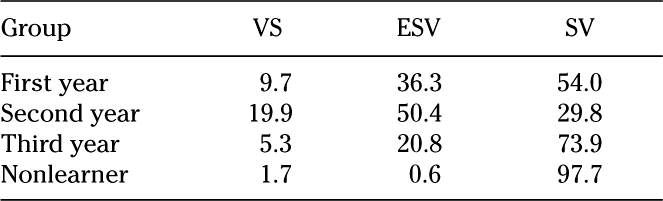
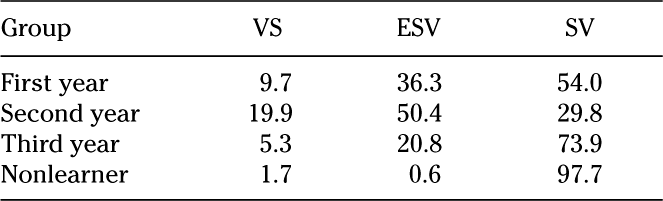
Our first level of analysis of YNQs aims to compare the frequencies with which learner and nonlearner participants used each of the three structures available in French (i.e., VS, ESV, and SV). As in everyday conversational French, nonlearner chat participants strongly favored the SV structure (see Table 1). Indeed, only three tokens of VS and one token of ESV were observed. Further, these four non-SV tokens were produced by the same participant. Two of the VS tokens were used during a rather playful stretch of discourse, as illustrated in (4), as was the single token of ESV, provided in (5).
Relative frequencies of YNQ structures by group
(4) Sera tu mepardonner un jour ma traîtrise envers toi? Footnote 2
Will you me forgive one day my treachery against you
“Will you one day be able to forgive my treachery against you?”
(5) Est ce ke mon corp est si bo ke cela???
Is it that my body is so handsome as that
“Is my body as good-looking as that???”
In (4), this participant adopts a formal style of discourse in jest, as illustrated by the use of the formal VS interrogative variant and of the formal term traîtrise “treachery,” which could have been substituted in this context with any number of less formal synonyms (e.g., coup “blow,” tromperie “fraud”). Similarly, this participant’s single token of ESV, as illustrated in (5), occurred when she joked about the appearance of her body, and it co-occurred with the use of the (rather formal) form cela “that,” which is normally replaced by the form ça “that” in everyday French. All other participants used the SV structure categorically.
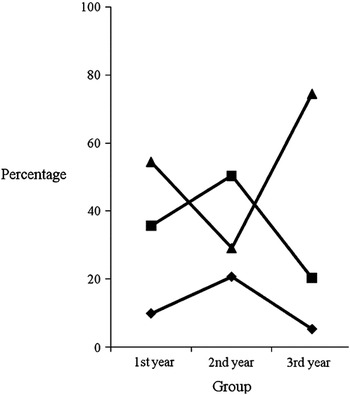
In the L2 learner data, however, there is a great degree of variation. The first-year students used SV and ESV at relatively high frequencies, whereas they avoided the VS structure most of the time. The second-year students used VS more frequently compared to the first-year students; they also appeared to prefer the ESV structure. The third-year students approximated the nonlearner norm, although ESV was used at a relatively high rate. Figure 1 compares the relative frequencies of each of the three variants across student levels.
Relative frequencies of YNQ structures. The symbol ◆ corresponds to VS word order, ■ corresponds to ESV word order, and ▲ corresponds to SV word order.

The VS structure, the formal variant in European French, was the structure used least often in all three student datasets. However, a slight increase in VS use is apparent between the first and second year, followed by a decrease to its lowest rate of use in the third-year student data. Similarly, the rate of use for the ESV structure, which is neither formal nor informal in European French, increased approximately 14% between the first and second year, whereas it dropped to only 20.8% in the third-year student data. The SV structure, which is the preferred structure in everyday European French as well as in IRC, shows the opposite trend: SV was the preferred structure among first- and third-year students, whereas second-year students used it only 29.8% of the time. In the second-year students’ data, the increased rate of VS and ESV use may account for the decrease in the use of SV.
These results are somewhat counterintuitive. Indeed, we hypothesized that the use of the informal variant (i.e., SV) would steadily increase as students progressed from first-, to second-, to third-year courses. Although third-year students approximated the nonlearner norm, which was expected, first-year students used the informal variant at significantly higher rates than did second-year students, χ2(1, N = 253) = 16.72, p < .05. A close review of the first-year student tokens of SV revealed, however, that their high rate of SV use was probably due to an incomplete grasp of French grammar rather than some knowledge of sociolinguistic variation. Indeed, most examples of SV in the first-year student data occurred in contexts in which English already provides a SV model, as illustrated in (6).
(6) Tu aimes chocolate?
“You like chocolate?”
Because it is likely that first-year learners were modeling the English word order, it is necessary to reinterpret the data presented in Figure 1. It appears that an incomplete understanding of the French grammatical system in the first-year students led to a high rate of SV use, whereas the second-year students, who were more advanced, moved in the direction of the written language as presented in their textbooks, which favor VS and ESV. This finding accounts for the increased use of the formal variant (i.e., VS) as well as the relatively unmarked ESV structure. As expected, however, third-year students approximated the nonlearner norm, possibly because of increased exposure to authentic discourse both in and outside of formal learning environments (e.g., radio, films, or study abroad) between the second and third year of study. However, intraindividual variation in the use of the three interrogative structures was considerable at all three levels, which led us to explore what internal linguistic factors, if any, may have influenced the choice of one variant or another.
A review of the data suggests that verb type (i.e., lexical verb, copula, auxiliary verb, or modal verb) and grammatical subject (i.e., tu “you-informal,” vous “you-formal/plural,” nous “we,” third person or noun phrase [NP] subject) may have influenced the choice of interrogative structure. In particular, the sequence êtes-vous ...? “are you ...?” (VS) occurred much more frequently than did est-ce que vous êtes ...? “are you ...?” (ESV) or vous êtes ...? “are you ...?” (SV), although the SV structure was used most often with the subject pronoun tu “you-informal” and a lexical verb. To test our hypothesis that verb type and grammatical subject were contributing factors in the variation, we performed a series of VARBRUL analyses with Goldvarb X (Sankoff, Tagliamonte, & Smith, Reference Sankoff, Tagliamonte and Smith2005). Goldvarb X is a program used in variationist sociolinguistics to determine the influence of any number of independent variables on the application of the rule (i.e., the presence or absence of the variant under investigation; for detailed treatments of VARBRUL in analyses of linguistic variation, see Paolillo, Reference Paolillo2002, and Tagliamonte, Reference Tagliamonte2006).
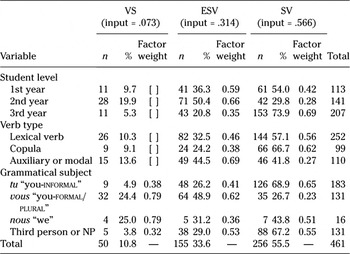
Each YNQ token was coded for (a) structure (i.e., VS, ESV, or SV; the dependent variable), (b) level of student (first, second, or third year), (c) verb type (i.e., lexical verb, copula, or auxiliaries including modals), and (d) grammatical subject (i.e., tu “you-informal,” vous “you-formal/plural,” nous “we,” third person or NP subject). Because Goldvarb X can only perform binomial analyses (i.e., the application vs. the nonapplication of a selected variant), three separate analyses were performed in which one of the three variants was considered to be the application of the rule and the other two variants were counted as nonapplications. For example, when SV was under consideration, it was labeled as the application of the rule, whereas instances of VS and ESV were considered nonapplications (i.e., the two remaining variants were collapsed into one nonapplication variant). This practice has been described elsewhere in the literature on YNQ structures as a means of conducting VARBRUL analyses when more than two variants are available (Elsig & Poplack, Reference Elsig and Poplack2006). The results of our analysis are provided in Table 2.
VARBRUL analysis of YNQ structures

Note
Empty brackets indicate statistical nonsignificance.
Goldvarb X reports two principal types of information. First, the program determines the probability of the application of the rule irrespective of conditioning factors (i.e., the corrected mean), which is labeled as the input. For example, the input for VS was .073, which indicates that VS would be expected in approximately 7.3% of all YNQ tokens, regardless of the student’s level, the type of verb used, or the grammatical subject present. Second, Goldvarb X calculates the factor weight of each factor for a given independent variable. This number is derived from the difference between the input and the observed frequencies of the application of the rule. If the rule applies more frequently in a given context relative to the input, Goldvarb X will report a factor weight greater than or equal to .50, which indicates that the rule is favored to occur in that environment. Conversely, a factor weight less than or equal to .49 means that the rule is disfavored to occur in that environment. Additionally, Goldvarb X reports statistical significance (at the p = .05 level).
Level. Goldvarb X selected level as a statistically significant factor in the use of ESV and SV but not for VS. First- and second-year students favored ESV, whereas third-year students were more likely to use the informal SV structure. This finding corroborates the relative frequencies of YNQ structure use in the participant data. Although the ESV structure is considered unmarked (i.e., it is neither formal nor informal) by most reference grammars (e.g., Grevisse & Goosse, Reference Grevisse and Goosse1993) and learner textbooks, it is rarely found in everyday speech or in IRC. However, a review of the first- and second-year textbooks used in the French courses in which this research was conducted revealed that ESV accounted for a large percentage of the questions presented to students. Indeed, although VS (the formal variant) was generally the preferred structure for instructions throughout the textbook, ESV was used nearly categorically in model sentences for activities. One such example from the chapter in the first-year textbook in which question structures are introduced is provided in (7).
(7) Préférences. Interviewez votre partenaire sur ses préférences
[“Preferences. Interview your partner about his or her preferences”]
Exemple le français/les mathématiques
[“Example French/math”]
— Est-ce que tu préfères le français ou les mathématiques?
[“Do you prefer French or math?”]
— Je préfère le français.
[“I prefer French.”]
(Manley, Smith, McMinn, & Prévost, Reference Manley, Smith, McMinn and Prévost2006, p. 51)
In a subsequent chapter, students are reminded of the three different YNQ structures available in French; however, no discussion of their sociostylistic values is provided. Indeed, VS, ESV, and SV are presented as three equal variants, as illustrated in the explanation of questions provided in (8).
(8) You can ask a question using rising intonation or est-ce que [“is it that”]. You can also use inversion; that is, you can invert the subject pronoun and the verb. Add a hyphen when the subject and the verb are inverted.
Est-ce que tu travailles lundi? = Travailles-tu lundi?
[“Do you work Monday?” = “Do you work Monday?”]
• Inversion is the equivalent of est-ce que [“is it that”]. Never use both inversion and est-ce que [“is it that”] in the same question.
Est-ce que tu joues de la guitare? OR Joues-tu de la guitare?
[“Do you play guitar?” OR “Do you play guitar?”]
(Manley et al., p. 86)
Because many low-level language learners rely solely on their pedagogical materials for grammatical guidance (Regan, Reference Regan2004), it is not surprising that these first- and second-year learners of French modeled their question-asking behavior after the examples provided in their textbooks. Thus, the high rate of ESV use in first- and second-year students may be attributed to the preponderance of ESV in textbook activities and dialogues. Additionally, given that little explanation of the stylistic status of the three YNQ variants is provided in most pedagogical materials, ESV may have been preferred to SV, for example, simply because it is a clearly marked interrogative (i.e., the presence of periphrastic est-ce que “is it that” signals that a question will follow). Even the brief discussion of formality and question formation provided in the second-year text (Bragger & Rice, Reference Bragger and Rice2005) understates the distribution of the three structures across levels of formality. In fact, all three are given equal importance and distinguished according to (rather artificial) impressionistic claims.
By contrast with the first- and second-year students, the third-year students favored the informal SV structure, perhaps because they had been exposed to a wider range of texts and discourses as well as to NSs of French in everyday contexts. Indeed, several of the third-year students had spent time in a francophone country, either through a study-abroad program or, in the case of one young man, while traveling with French-speaking friends. Although it is unclear exactly what happens between the second and third year of study—and this most certainly differs from one individual to another—there is a clear link between exposure to a wider variety of discourses over time—in particular, quality contact with native or near-native speakers of French—and the use of the informal variant (SV).
Verb Type. Another significant factor in the use of ESV and SV to emerge was verb type, although Goldvarb X reported nonsignificance for this factor in the analysis of VS. The results indicate that ESV is preferred with auxiliary verbs (including modals), whereas SV is favored when a lexical verb or a copula—which is almost categorically être “to be”—is used. The relatively high rate of ESV with auxiliary verbs may be explained by students’ introduction to the passé composé, or compound past, in the textbooks. Indeed, approximately one half of the tokens of ESV plus auxiliary verb occurred with the auxiliary verb avoir “to have” followed by a past participle (e.g., Est-ce que tu as mangé? “Have you eaten” or “Did you eat?”). A cross-tab analysis revealed that the first- and second-year students produced nearly two thirds of the ESV plus auxiliary verb tokens (63.3%), and both levels strongly favored this structure, although ESV was disfavored in the third-year students (first year = 75%; second year = 61.3%; third year = 28.6%). An examination of the textbook revealed that when the passé composé is first introduced, most of the model questions are given in the ESV form, as illustrated in (9): This exercise immediately follows the explanation for using the passé composé with the auxiliary verb avoir “to have.”
(9) Entre amis. Demandez à votre partenaire s’il/si elle a fait ces choses avec son meilleur ami (sa meilleure amie) cette semaine.
[“With friends. Ask your partner if he or she has done these things with his or her best friend this week.”]
Exemple. Déjeuner ensemble
[“Example. To have lunch together”]
— Est-ce vous avez déjeuné ensemble?
[“Did you have lunch together?”]
— Oui, nous avons déjeuné ensemble lundi.
[“Yes, we had lunch together on Monday.”]
Non, nous n’avons pas déjeuné ensemble.
[“No, we haven’t had lunch together.”]
(Manley et al., Reference Manley, Smith, McMinn and Prévost2006, p. 194)
Because ESV is the YNQ structure that predominates in the part of the textbook in which the passé composé is explained, it is not surprising that first- and second-year students used ESV with the passé composé at relatively high rates, whereas its use drops significantly in the third-year students who have been exposed to YNQ structures in authentic contexts. The preference for SV in the presence of a lexical verb or a copula is also attributed to student level, at least to some extent. Indeed, 63.6% of the SV plus copula tokens and 50.7% of the SV plus lexical verb tokens were produced by third-year students, who favored SV overall. Additionally, the first-year students produced a relatively high number of SV tokens with copular and lexical verbs (63.6% and 60.0%, respectively), whereas SV was used only 12.5% of the time with an auxiliary verb. Although the third-year students appear to have approximated the nonlearner norm, this is not the case for the first-year students.
Many of the first-year students simply used SV as a direct translation of an English SV question (e.g., Tu aimes le cours de français? “You like the French course?” or Vous pensez que ...? “You think that ...?”). This type of question most notably occurred with lexical verbs—in particular, with the verbs aimer “to like” and penser “to think.” In the case of copular verbs, we suspect that, once again, an incomplete grasp of French grammar led to the higher rate of SV in the first-year students. A close analysis of the first-year student SV tokens revealed—in at least some varieties of American English—a large number of contexts in which the copula could be either deleted or retained (e.g., Tu es là? “Are you there?” or “Ø you there?”). Although a direct translation would actually involve the VS structure (e.g., Es-tu là? “Are you there?”), it is possible that students equate copula deletion in English with the absence of a phrase-initial marker of interrogation—in this case, est-ce que “is it that.” Finally, the results suggest that verb type does not influence second-year students’ choice of interrogative structure because ESV was preferred in each category.
Grammatical Subject. Goldvarb X selected grammatical subject as an influential factor for all three YNQ structures. Students were more likely to use SV than ESV or VS with the subject pronoun tu “you-informal.” The subject pronoun vous “you-formal/plural,” on the other hand, was used more often with VS and ESV. Nous “we” appeared to favor VS and SV word order but to disfavor ESV; however, this finding is tentative because of the low number of nous “we” tokens (n = 14). Third-person pronouns and NP subjects favored ESV and SV although they disfavored VS. A more detailed analysis of grammatical subject and verb type revealed a more complex set of factors.
The subject pronoun tu “you-informal,” although found to favor SV in all contexts, was used with the ESV structure at a relatively high frequency when an auxiliary verb was present (SV = 55.9%; ESV = 35.6%). When a copular verb (SV = 73.9%; ESV = 21.7%) or a lexical verb (SV = 75.2%; ESV = 21.8%) was used with tu “you-informal,” the preference for SV was much more pronounced. Similarly, third-person pronouns and NPs, which favored SV word order overall, were found to co-occur with ESV at the highest frequency when an auxiliary verb was used (ESV = 60.0%). These results corroborate our finding that ESV was the preferred structure when an auxiliary verb was used, especially in the case of the passé composé. Additionally, SV appears to be strongly favored with a third-person pronoun or a NP subject plus copula structure. One explanation for the high rate of SV use with third-person pronouns or NP subjects is that the majority of these tokens were questions of the type c’est “is it...” plus an adjective or adverb (e.g., C’est bon? “Is it good?”), which almost invariably take the SV structure in Modern French. This occurs despite the fact that textbooks present the other two variants, VS (e.g., Est-ce bon? “Is it good?”) and ESV (e.g., Est-ce que c’est bon? “Is it good?”), as viable options. Nevertheless, the results clearly indicate that both grammatical subject and verb type influenced the choice of one form or another.
Nous “We” Versus On “One” or “We” Variation
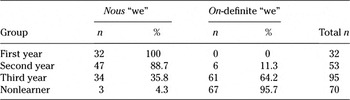
The use of the pronoun on “one” or “we” for first-person plural reference has long been characteristic of informal spoken French, so much so that the use of nous “we” is now considered a vestigial variant (i.e., a variant that has all but left the speech community; Trudgill, Reference Trudgill1999) in Modern French (see Blondeau, Reference Blondeau2003; Coveney, Reference Coveney2000). Indeed, the use of nous “we” is now reserved for formal, public speech and (formal or literary) written language, although it is by no means used categorically in these contexts. Our analysis of IRC discourse revealed that the replacement of nous “we” by on “one” or “we” is nearly categorical in this communicative context as well, although a few tenacious examples of nous “we” persist. However, these examples are limited to playful utterances, such as imitations of (real or fictional) television advertisements or public speech, and nonspontaneous utterances, such as proverbs (see van Compernolle, Reference van Compernolle2008b, for a full analysis). Students, however, overuse nous “we” in the learner data when compared to the nonlearner dataset, as shown in Table 3.
Nous“we” versus on-definite “we” pronoun use by group

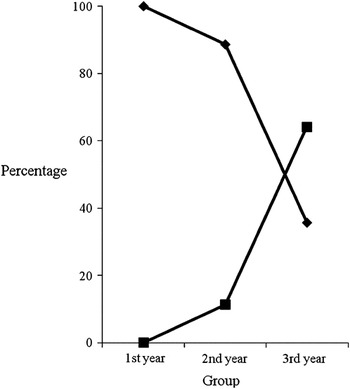
The first-year students categorically used nous “we” for first-person plural reference, and the second-year students used nous “we” nearly categorically. The third-year students approached the nonlearner norm, but they did not, as a group, exhibit a nativelike pattern (i.e., their use of nous “we” was not used in jest or in nonspontaneous utterances). Figure 2 shows a clear progression in the use of on “one” or “we” from the first to the second year and then from the second to the third year, in which on “one” or “we” becomes the most commonly used first-person plural pronoun.
Use of nous “we” versus on-definite “we.” The symbol ◆ corresponds to the use of nous “we,” and ■ corresponds to the use of on-definite “we.”

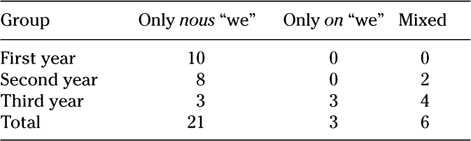
Group Versus Individual Patterns of Variation. In her longitudinal study of the variable omission of the negative particle ne in a group of Irish learners of French, Regan (Reference Regan2004) argued that, although the analysis of a group’s rate of use (or nonuse) of a particular variant can provide much insight into general developmental patterns in the acquisition of sociolinguistic features of discourse, interindividual and intraindividual patterns of variation must also be explored. This type of analysis can be useful when accounting for a particular student’s contribution of tokens as well as for evaluating each individual’s pattern of variation (or lack thereof) in relation to the group as a whole. In an attempt to determine to what extent an individual’s patterns of variation were representative of the group, students were divided into three categories: (a) those who used nous “we” categorically, (b) those who used on “one” or “we” categorically, and (c) those who alternated between nous “we” and on “one” or “we.” Table 4 provides the number of students in each level that corresponded to each of these three categories.
L2 learner patterns of nous “we” versus on-definite “we” use
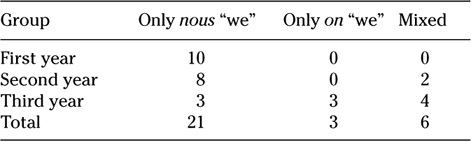
In total, 21 students categorically used nous “we.” Of these, 10 were in their first year, 8 in their second year, and the remaining 3 in their third year of study. Six students (two in their second year and four in their third year) alternated between nous “we” and on “one” or “we.” Only three students (all third-year students) exhibited a nativelike pattern through their categorical use of on “one” or “we.” These results suggest that although there is a general trend whereby on “one” or “we” use increases with time, not all students develop sociolinguistic competence at the same rate. Furthermore, the fact that only 3 of the 10 third-year students used on “one” or “we” categorically indicates that even advanced students (based on years of study rather than a placement or proficiency evaluation) have an incomplete understanding of this sociolinguistic variable. Indeed, several factors seem to be at work. One of the second-year students who alternated between nous “we” and on “one” or “we,” for example, had had previous exposure to everyday French. His family had lived in francophone Switzerland for several years when he was very young, following his father’s transfer to Geneva. Although this student reported not to have studied or practiced his French in over 10 years (i.e., prior to enrolling in the second-year course), a review of his contributions to chat discussions suggested that his proficiency in French was higher than several of the third-year students with regard to lexical knowledge, grammatical competence, and sociolinguistic awareness.
Seven of the 10 third-year students used on “one” or “we” at least occasionally in variation with nous “we,” which indicates that as students progress even within a formal, structured educational setting, they are not only exposed to but also begin to use informal variants. This is corroborated by the fact that three of the students who used on “one” or “we” in variation with nous “we” had never spent more than a few days in a French-speaking country. As such, there does not seem to be a clear one-to-one relationship between time spent abroad and increased use of informal variants among third-year students; rather, it is reasonable to presume that other psychological, social, and motivational factors not captured in the present study are at play.
The Presentation of On “One” or “We” in the Textbooks. Our review of the textbooks (Bragger & Rice, Reference Bragger and Rice2005; Manley et al., Reference Manley, Smith, McMinn and Prévost2006) suggested that on “one” or “we,” although used as both an indefinite pronoun (its traditional role) and as a substitute for nous “we” throughout the textbooks, is not actually presented and explained until very late into the first semester of study (i.e., in the first-year text; Manley et al.)—even though students often see the pronoun on “one” or “we” used as an indefinite pronoun in many exercises and activities. On “one” or “we” is indeed absent from every verb conjugation activity and grammar note until the fourth chapter of the first-year textbook, which is generally covered near the end of the first semester. The excerpt in (10), entitled Suggesting activities, provides the first explanation of on “one” or “we” and mentions three uses for this pronoun.
(10) Use on as the subject of a sentence when you are referring to people in general (one, people, they). Consider the difference between these two sentences.
Tes parents? Ils parlent français? Your parents? Do they speak French? (specific people)
À Paris, on parle français. In Paris, they speak French. (general group)
The pronoun on is also often used instead of nous to say we. On takes the same form of the verb as il [“he”] and elle [“she”], regardless of its translation in English.
Claude et moi, on aime sortir le samedi. Claude and I, we like to go out on Saturdays.
You can propose doing something with someone (How about...? Shall we...?) by asking a question with on.
On va au cinéma? How about going to the movies?
Qu’est-ce qu’on fait ce soir? What shall we do this evening?
(Manley et al., Reference Manley, Smith, McMinn and Prévost2006, p. 152)
The pronoun on “one” or “we” is first presented as a generic-indefinite pronoun, the equivalent of English one or indefinite they. The following examples inform students that on “one” can also be a viable substitute for nous “we”; however, there are two principle shortcomings of these explanations. First, the observation that “The pronoun on is also often used instead of nous to say we” (Manley et al., Reference Manley, Smith, McMinn and Prévost2006, p. 152) rather understates the extent of the replacement of nous “we” by on “one” or “we” in most varieties of French. Indeed, most studies of spoken French (e.g., Blondeau, Reference Blondeau2003; Coveney, Reference Coveney2000) indicate that nous “we” is used in less than 5% of all first-person plural references, which is corroborated by the results for the nonlearner data (e.g., nous “we” use at 4.3%). Second, there is no mention of the social significance of the two variants. Instead, they are treated as free variants, or, rather, nous “we” emerges as the default first-person plural pronoun and on “one” or “we” is an option if students should decide to use it from time to time.
As shown in (10), a related problem is that on “one” or “we” is then immediately presented with its possible use to suggest an activity, in which “On va au cinéma?” is translated as “How about going to the movies?” (Manley et al., Reference Manley, Smith, McMinn and Prévost2006, p. 152). Although this is an appropriate translation of this utterance, the definite nature of the pronoun on “one” or “we” is lost, which may lead students to wonder whether this is a special context in which on “one” or “we” is used instead of nous “we.” In the rest of the textbook, on “one” or “we” used in variation with nous “we” is not mentioned or explained although on “one” or “we” is used in many example dialogues. However, in several of these dialogues, on “one” or “we” and nous “we” are used interchangeably by the same speakers in contexts in which nous “we” would most likely be seen as an inappropriate choice (e.g., young people speaking with friends). This apparent free variation in the textbook may have contributed to first- and second-year students’ incomplete understanding of this sociolinguistic variable.
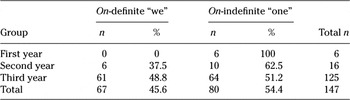
Other Uses of On “One” or “We” by Students. Although on “one” or “we” has nearly categorically replaced nous “we” as the first-person plural pronoun in everyday French, on “one” or “we” also has other discursive functions—most notably, its traditional use as a third-person pronoun with indefinite reference. Because on “one” or “we” is introduced first as an indefinite pronoun in learner textbooks, it is possible that students’ lack of on “one” or “we” use as a definite pronoun (i.e., in variation with nous “we”) is due to its association with indefinite reference. To better understand how students used on “one” or “we,” we compared occurrences of its definite and indefinite use (see Table 5).
L2 learner patterns of on-definite “we” and on-indefinite “one” use

Contrary to what we might have expected, the lack of on “one” or “we” used as a definite pronoun among first- and second-year students is not due to their frequent use of on “one” or “we” as an indefinite pronoun. Indeed, first-year students use on “one” (indefinite) a mere six times: All instances were observed in the sequence Comment dit-on… en français? “How does one say… in French?” used for lexical retrieval. Second-year students used on “one” as an indefinite pronoun only 10 times, also for lexical retrieval or, as in only three examples, when telling general truths. Despite these few examples of indefinite on “one” use, it is clear that the first- and second-year students rarely use on “one” or “we” at all, even as an indefinite pronoun as presented by their textbook. We believe that this low rate of on “one” or “we” use for definite or indefinite reference is due—at least in part—to students’ incomplete understanding of French grammar, specifically because of the less-than-clear explanations of on “one” or “we” use in their textbooks. The third-year students, on the other hand, appear to understand on “one” or “we” used as either a definite and indefinite pronoun, as shown by their higher rates of both definite and indefinite on “one” or “we” use compared to the rates of first- and second-year students.
Covariation of On “One” or “We” and YNQ Structure
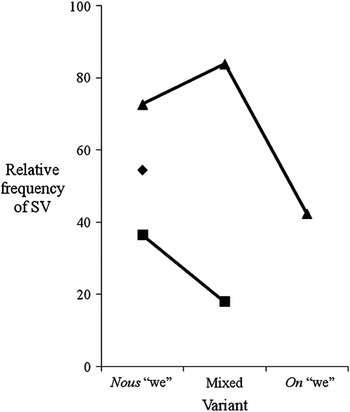
Although we have presented formal, independent analyses of variation in the use of YNQ structures and nous “we” versus on “one” or “we,” we have not yet discussed the issue of covariation. Through our categorization of students by their use of on “one” or “we,” nous “we,” or mixed use of the two variants (see Table 4), we tallied the number of tokens of SV (the informal YNQ structure) produced by each group. We hypothesized that students who used nous “we” categorically would have the lowest rates of SV and that those who used on “one” or “we” categorically would have the highest rates of SV (i.e., formal variants should co-occur with other formal variants, and informal variants should co-occur with other informal variants). Those who alternated between nous “we” and on “one” or “we” would thus be somewhere in between. However, there appears to be no such correlation, as illustrated in Figure 3.
Correlation between first-person plural pronoun use and SV use. The symbol ◆ corresponds to the first-year students, ■ corresponds to the second-year students, and ▲ corresponds to the third-year students.

The data from the third-year students indicate that SV use increases as students begin to use on “one” or “we”—that is, as learners stop using only nous “we” and begin to use both of the variants. Somewhat counterintuitively, however, SV use dropped sharply among those who categorically used on “one” or “we.” Similarly, SV use decreased among those second-year students who alternated between nous “we” and on “one” or “we.” In other words, in the second- and third-year data, it almost seems as if students are increasing their use of one informal variant (i.e., on “one” or “we”) while increasing their use of a formal variant (i.e., ESV or VS); that is, no positive correlation was found between an increase in on “one” or “we” use and an increase in SV use. Thus, it would seem that, although certain students may have a least some grasp of how variation functions in one feature of discourse, it is limited to only one variable.
CONCLUSION
The results of this study have provided insight into the development of sociolinguistic competence—as shown through performance data—among instructed learners of French engaged in synchronous electronic communication. It is not surprising to observe that the third-year students used informal variants more often than the first- and second-year students. However, the third-year students rates of SV and on “we” used as a definite pronoun did not match those of the nonlearner chat participants. This corroborates previous studies on the acquisition of sociolinguistic variation, in that (advanced) L2 learners often approximate NS norms without actually reaching them (see Dewaele, Reference Dewaele2004a, for an overview). We have also suggested that less-than-clear (or absent) explanations of the sociostylistic values of linguistic variants in learner textbooks may be the source of students’ lack of sociolinguistic competence. We have shown that third-year students who have continued beyond the four-semester language sequence exhibit patterns of variation that align more closely with NS norms. This is likely due to their exposure to more authentic discourse in advanced-level content courses, as opposed to basic (i.e., first- and second-year) language courses. Nonetheless, we did not find a positive correlation between the use of one informal variant and another, which suggests that learners may learn to use each variant independently. This lack of covariation represents a major gap in these learners’ sociolinguistic competence. As such, we argue that, in order for language learners to become competent L2 users, the most salient sociolinguistic and stylistic features of discourse should be addressed early on in L2 education.
A more unexpected finding of this study was the significant rise in the use of the more formal YNQ structures VS and ESV in the second-year students. We have shown that this may be due to an increase in grammatical competence after the first year of study (i.e., learning to use clitic inversion and periphrastic est-ce que “is it that”) without a concomitant increase in knowledge of the sociostylistic values attached to these structures. We have also shown that, as suggested by Dewaele (Reference Dewaele1999), the use of YNQ structures is significantly influenced by at least two internal linguistic factors in all learners—verb type and grammatical subject—and argued that this is due—at least in part—to the preponderance of more formal sample sentence structures presented in learner textbooks.
Our analysis of on “one” or “we” use revealed that first- and second-year students avoided the use of this pronoun for both indefinite and definite reference. We believe that this is due to insufficient explanations of the functions of on “one” or “we” in learner textbooks and to the fact that most students associate this pronoun with formulaic utterances, such as Comment dit-on… en français? “How do you say… in French?” However, our results clearly show a dramatic rise in the use of on “one” or “we” as both an indefinite and definite pronoun in the third-year students. Thus, we argue that this is due—at least in part—to these learners’ exposure to a wider range of discourses in both pedagogical and nonpedagogical settings. Although not all third-year learners exhibited nativelike patterns of variation in the use of nous “we” versus on “one” or “we,” it is clear that these L2 learners, at least as a group, have learned to use on “one” or “we” appropriately for both indefinite and definite reference.
As advocates of the teaching and learning of sociolinguistic variation in L2 education, we believe that more research is needed on students’ acquisition, development, and use of sociolinguistic and sociopragmatic features of discourse. A number of recent studies (e.g., Bayley & Regan, Reference Bayley and Regan2004; Dewaele, Reference Dewaele2004a; Rehner et al., Reference Rehner, Mougeon and Nadasdi2003) of students’ performance (i.e., learner-produced discourse) have provided insight into students’ use of variable features of discourse; however, relatively little is known about when and how learners begin to recognize patterns of sociostylistic variation found in NS communities. This pattern recognition may or may not occur at the same time as learners’ increased use of variable features of discourse. We believe that using complementary analyses of performance (i.e., production) and competence (i.e., understanding or awareness) in sociolinguistic variation would contribute to our understanding of the development of sociolinguistic awareness in L2 users because “performance data alone are not sufficient to assess learners’ knowledge in this domain” (Kinginger & Farrell, Reference Kinginger and Farrell2004, p. 20).
Perhaps the next wave of research on the acquisition of sociolinguistic competence will include in-depth case studies of collaborative learning and pragmatic development within L2 communities of practice (Lave & Wenger, Reference Lave and Wenger1991), whereby expert language users (i.e., more advanced students or NSs) provide peer assistance (Tharp & Gallimore, Reference Tharp and Gallimore1988) to others. Such research appears to be on the rise, as demonstrated by a number of recent studies on the development of sociopragmatic competence within the paradigm of second-person address pronouns in French and German (e.g., Belz & Kinginger, Reference Belz and Kinginger2002; Kinginger & Belz, Reference Kinginger and Belz2005; see also Dewaele, Reference Dewaele2005). Additionally, more research is needed that addresses effective approaches to raising learners’ awareness of sociolinguistic variation (van Compernolle, Reference van Compernolle2008c): Despite the growing body of literature on L2 sociolinguistic variation, the majority of these studies (e.g., Mougeon, Rehner, & Nadasdi, Reference Mougeon, Rehner and Nadasdi2004; Regan, Reference Regan2004; Sax, Reference Sax2003)—including the present one—are post hoc or summative evaluations of what learners were able to do at the time of data collection. Although these studies have provided insight into when learners develop observable sociolinguistic competence, this research is stalled on the idea that learners are “bunches of variables” (Dewaele, p. 369); that is, still little is known about specific experiences learners may have—which most likely differ from one individual to the next—that might contribute to their development of sociolinguistic competence, both in and outside of the classroom. Smaller scale case studies, which include complementary analyses of performance, competence, individual learner histories, and classroom discourse and which combine both quantitative and qualitative approaches to data analysis, may provide insight into the development of sociolinguistic competence that has thus far remained unexplored in the literature.